

2024-2025 EMT FISDAP Readiness Practice Exam with Answers (161 Solved Questions)
- National Registry of Emergency Medical Technicians
- 49 pages
- Shared February 2025
- 141 downloads
2024-2025 EMT FISDAP Readiness Practice Exam with Answers helps you build confidence by practicing with past papers.
Preview 15 of 49 pages
See the first 15 pages exactly as they appear in the document.
Page 1 Read page 1 as text
EMT FISDAP Readiness Exam 2 100% VERIFIED ANSWERS 2024/2025 The collective set of regulations and ethical considerations governing the EMT is called: a. duty to act b. scope of practice c. a dvanced directives d. good samaritan laws b. scope of practice Legislation that governs the skills and medical interventions that may be performed by the EMT is: a. standardized (uniform) throughout the country b. different from state to state c. standard ized for regions within a state d. governed by the US Department of Transportation b. different from state to state When the EMT makes the physical/emotional needs of the patient a priority, this is considered a(n)_______ of the EMT. a. advanced directive b. protocol
Page 2 Page 3 Read page 3 as text
c. ethical responsibility d. legal responsibility c. ethical responsibility Which one of the following is NOT a type of consent required for any treatment or action by an EMT? a. child and mentally incompetent adult b. implied c. applied d. e xpressed c. applied When you informed the adult patient of the procedures were about to perform and its associated risks, you are asking for his or her: a. expressed consent b. negligence c. implied d. applied a. expressed consent You are treating a patient that was found unconscious at the bottom of the stairwell. Consent that is based on the assumption that an unconscious patient would approve the EMT's life - saving interventions is called: a. expressed b. negligence c. implied d. applied c. implied
Page 4 Read page 4 as text
Your record of a patient's refusal of medical care (aid) or transport should include all of the following EXCEPT: a. informing the patient of the risks and consequences of refusal b. documenting the steps you took c. signing of the for m by the medical director d. obtaining a release form with the patient's witnessed signature c. signing of the form by the medical director Forcing a competent adult patient to go to the hospital agains his or her will may result in _______ charges against the EMT. a. abandonment b. assault and battery c. implied consent d. negligence b. assault and battery Which of the following is an action you should not take if a patient refuses care? a. leave phone stickers with emergency numbers b. recommend that a relative call the family physician to report the incident c. tell the patient to call his or her family physician if the problem reoccurs d. call a relative or neighbor who can stay with the patient b. recommend that a relative call the family physician to report the incident Another name for a DNR order is: a. deviated nervous response b. duty not to react
Page 5 Read page 5 as text
c. refusal of treatment d. advanced directive d. advanced directive There are varying degrees of DNR orders, expressed through a variety of detailed instructions that may be part of the order such as: a. allowing CPR only if cardiac or respiratory arrest was observed b. allowing comfort - care measures such as intravenous f eeding c. disallowing the use of long - term life - support measures d. specify that only five minutes of artificial respiration will be attempted a. allowing CPR only if cardiac or respiratory arrest was observed In a hospital, long - term life support and comf ort care measures would consist of intravenous feeding and: a. routine inoculations b. the use of a respirator c. infection control by the healthcare providers d. hourly patient documentation b. the use of a respirator If an EMT with a duty to act fails t o provide the standard of care, and if this failure causes harm or injury to the patient, the EMT may be accused of: a. res ipsa loquitur b. negligence c. abandonment d. assault b. negligence
Page 6 Read page 6 as text
Leaving a patient on the hallway stretcher in a busy ED and lea ving without giving report with a healthcare professional is an example of: a. liability infraction b. battery c. abandonment d. breach of duty c. abandonment The EMT should not discuss information about the patient except to relate pertinent information t o the physician at the ED. Information considered confidential includes: a. patient history gained through the interview b. assessment findings c. treatment rendered d. all of the above d. all of the above The EMT can release confidential patient informati on in all of the following circumstances EXCEPT to: a. inform other health care professionals who need to know information to continue care b. report incidents required by state law, such as rape or abuse c. comply with the legal subpoena d. protect the o ther victims of a motor vehicle collision d. protect the other victims of a motor vehicle collision A medical identification device that indicates serious patient medical conditions, allergies, and/or medications they are currently prescribed comes in the form of each of the following except:
Page 7 Read page 7 as text
a. bracelets b. necklaces c. cards d. patches d. patches You responded to a high - speed collision involving a motorcycle and automobile. The 22 - year - old male cyclist has a severe head injury and is not likely to live t hrough the evening. When treating this critical patient, who happens to have an organ donor card, the EMT should: a. transport without delay and document a DNR b. treat the patient with the same care as any other patient and inform the ED physician c. wit hhold oxygen therapy from the patient to keep the organ hypoxic d. all of the above b. treat the patient with the same care as any other patient and inform the ED physician You are at the scene of a home invasion where the homeowner was shot to death by th e perpetrators. At this crime scene, you should: a. avoid disturbing any evidence at the scene unless emergency care requires it b. immediately remove the patient from the scene c. move all obstacles from around the patient to make more room to work d. se arch the house for clues to find the cause of the crime a. avoid disturbing any evidence at the scene unless emergency care requires it Commonly required reporting situations include all the following EXCEPT: a. child and elder abuse b. crimes in public places
Page 8 Read page 8 as text
c. sexual assault d. domestic abuse b. crimes in public places The extent of limits of the EMT's job is called the: a. ethical dilemma b. national curriculum c. scope of practice d. regional protocol c. scope of practice The fed eral law designed to protect the patient's private medical information is the: a. NHTSA b. ANSI c. HIPPA d. OSHA c. HIPPA You were called to the scene of an incident where a 21 - year - old male was knocked unconscious in a bar fight. Upon arrival, the patien t is awake and has a broken nose but no life threats. He admits to drinking six beers in the last hour. He wants to refuse medical attention. Why should you discourage a refusal? a. he is not legally old enough to consent b. he may not be mentally compete nt at this time c. he is unable to actually sign the release d. the patient may die from a broken nose
Page 9 Read page 9 as text
b. he may not be mentally competent at this time You are on the scene of a call where a patient barricaded himself and his wife in their home and is thre atening to do harm. The police have been at the scene for hours and, after the wife escaped, they rushed in. It is now your responsibility to transport this now - restrained patient to the local ED. What should be your highest priority? a. monitoring the pa tient's mental status and vital signs b. making sure your documentation shows you did not apply the handcuffs c. restraining the patient so he is not able to move d. explaining to the patient that he no longer has any rights to refuse care a. monitoring th e patient's mental status and vital signs The scene size up is the first part of the patient assessment process. it begins as you approach the scene, firstly surveying it to determine: a. if there are any threats to your safety b. the number of injured c. personal safety of all those involved in the call d. the mechanism of injury a. if there are any threats to your safety Which of the following is the most accurate statement about scene size up? a. it takes place as you are approaching the scene b. it is replaced by patient care once you arrive at the scene c. it occurs during the first part of the assessment process d. it continues throughout the call d. it continues throughout the call
Page 10 Read page 10 as text
If you arrive at a collision scene where there are police, fire vehi cles, and other ambulances already present, you should: a. immediately begin patient care b. conduct your own scene size up c. ensure that no bystanders are injured d. all of the above b. conduct your own scene size up Which of the following is not an app ropriate action when you near the scene of a traffic collision? a. look and listen for other EMS units as you near intersections b. look for signs of collision - related power outages c. observe traffic flow to anticipate blockage of the scene d. attempt to park your vehicle downhill from the scene d. attempt to park your vehicle downhill from the scene When you are in sight of the collision scene, you should watch for the signals of police officers and other emergency service personnel because: a. they may have information about hazards or the location of injured persons b. the first ones on the scene are considered to be in charge c. federal law requires you to follow the command of other responders d. they are considered the medical care experts on the sc ene a. they may have information about hazards or the location of injured persons When there are no apparent hazards, consider the danger zone to extend at least ______ feet in all directions from the wreckage. a. 25
Page 11 Read page 11 as text
b. 50 c. 100 d D. 200 b. 50 When a col lision vehicle is on fire, consider the danger zone to extend at least______ feet in all directions. a. 25 b. 50 c. 100 d. 200 c. 100 It is essential that the EMT do a good scene size up. Your scene size up should identify: a. the potential for a violent situation b. the name and amount of toxic substances c. the number of patients and their diagnoses d. all of the above a. the potential for a violent situation The EMT's Standard Precautions equipment during the scene size up may include all the following except: a. eye protection b. disposable gloves c. face mask or eye shield d. nonrebreather mask
Page 12 Read page 12 as text
d. nonrebreather mask Standard Precautions should be taken with all patients. The key element of the Standard Precautions is to: a. always wear all protective clothing b. always have personal protective equipment readily available c. place equipment on the patient as well as the rescuer d. determine which body fluids are a danger to the EMT b. always have personal protective equipme nt readily available Certain injuries are common to particular situations. Injuries to bones and joints are usually associated with: a. fights and drug usage b. falls and vehicle collisions c. fires and explosions d. bullet wounds b. falls and vehicle col lisions Knowing the mechanism of injury assists the EMT in: a. immobilizing the patient's spine b. determining which Standard Precautions to use c. Predicting various injury patterns d. All of the above c. Predicting various injury patterns The physical fo rces and energy that impinge on the patient are influenced by the laws of physics. One of those laws, the law of inertia, states that: a. the faster you enter a turn, the more your vehicle will be pulled straight b. the slower the speed, the greater the e nergy loss
Page 13 Read page 13 as text
c. a body in motion will remain in motion unless acted upon by an outside force d. the mass or weight of an object is the most important contributor to an injury c. a body in motion will remain in motion unless acted upon by an outside force You are treating a patient who was involved in a head on collision. She was the unrestrained driver who took the "up and over" pathway. To which part of her body would she have most likely sustained injuries? a. skull b. fibula c. knees d. femur a. skull Whi ch of the following is LEAST likely to be considered a MOI for a patient who was involved in a head - on collision in which they were unrestrained and took the "up and over" pathway? a. steering wheel b. windshield c. Brake pedal d. dashboard c. Brake pedal Which type of collision is most serious when the occupant is not restrained because it has the potential for multiple impacts? a. side impact b. rear end impact c. head - on, up and over d. roll - over
Page 14 Read page 14 as text
d. roll - over You are on the scene of a car crash. Your p atient has stable vital signs and is complaint of knee, leg, and hip pain. He also states that he was in the front seat of the car and did not have his seatbelt on. What type of collision did he most likely experience? a. head - on, up and over b. rear end c. head - on, down and under d. rotational impact c. head - on, down and under You are walking around a vehicle that was involved in a collision. All of the following are examples of MOI except a: a. patient who fell 3 times her height b. spiderweb crack in the windshield c. broken steering column in a collision d. flat rear tire d. flat rear tire A severe fall for an adult is: a. over 20 feet b. over 15 feet c. less than 10 feet d. always fatal a. over 20 feet
Page 15 Read page 15 as text
You are evaluating a patient who sustained a pe netrating injury. The injury is usually limited to the penetrated area in a _______ injury. a. low velocity b. medium velocity c. high velocity d. super velocity a. low velocity The pressure wave around the bullet's track through the body is called: a. e xsanguination b. gas penetration c. cavitation d. pressure damage c. cavitation You are evaluating a patient who sustained an injury cased by a blow that hit the body but did not penetrate the skin. This type of injury is called a(n): a. inertia trauma b. cavitation c. blunt force trauma d. rotational impact c. blunt force trauma In which of the following situations would it be necessary for you and your partner to call for additional assistance? a. You are treating a patient with flulike symptoms and the toddler also has similar symptoms
34 more pages in the full document
Unlock it once and it stays in your library, ready to chat with or turn into flashcards.
Unlock the full documentMore National Registry of Emergency Medical Technicians study materials
See all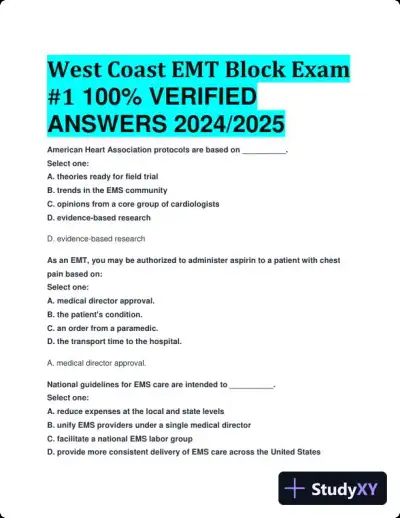 Past Exams
2024-2025 West Coast EMT Block Exam #1 with Answers (222 Solved Questions)
National Registry of Emergency Medical Technicians
68 pages158downloadsFeb 2025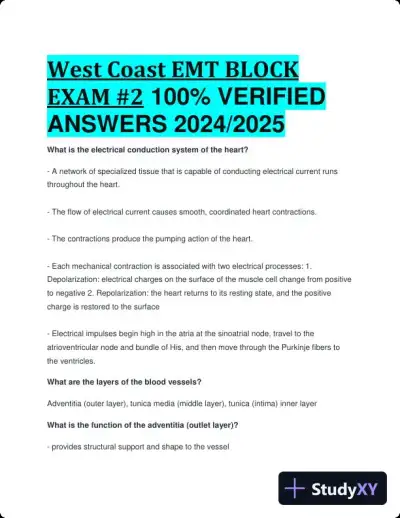 Past Exams
2024-2025 West Coast EMT Block Exam #2 with Answers (180 Solved Questions)
National Registry of Emergency Medical Technicians
29 pages103downloadsFeb 2025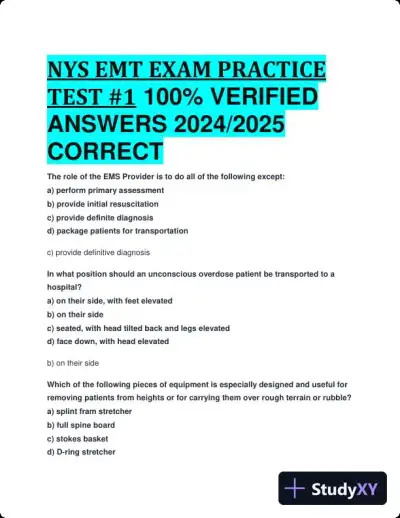 Past Exams
2024-2025 NYS EMT Practice Exam with Answers (98 Solved Questions)
National Registry of Emergency Medical Technicians
27 pages96downloadsFeb 2025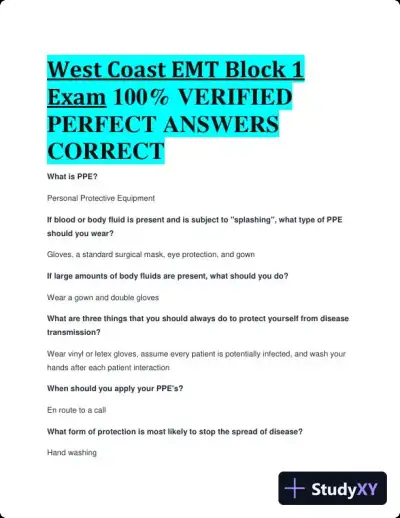 Past Exams
West Coast EMT Block 1 Practice Exam with Answers (190 Solved Questions)
National Registry of Emergency Medical Technicians
23 pages80downloadsFeb 2025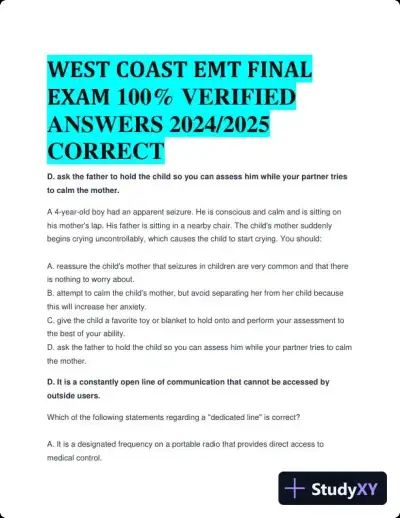 Past Exams
2024-2025 West Coast EMT Final Exam with Answers (258 Solved Questions)
National Registry of Emergency Medical Technicians
84 pages63downloadsFeb 2025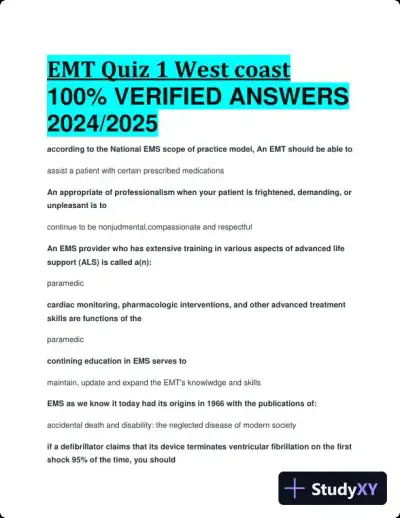 Past Exams
2024-2025 West Coast EMT Quiz 1 Practice Exam with Answers (210 Solved Questions)
National Registry of Emergency Medical Technicians
22 pages50downloadsFeb 2025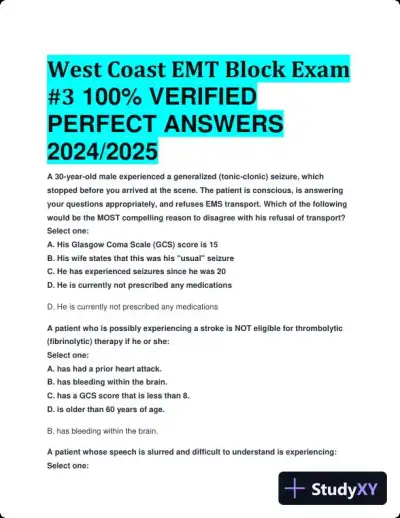 Past Exams
2024-2025 West Coast EMT Block Exam #3 with Answers (183 Solved Questions)
National Registry of Emergency Medical Technicians
57 pages42downloadsFeb 2025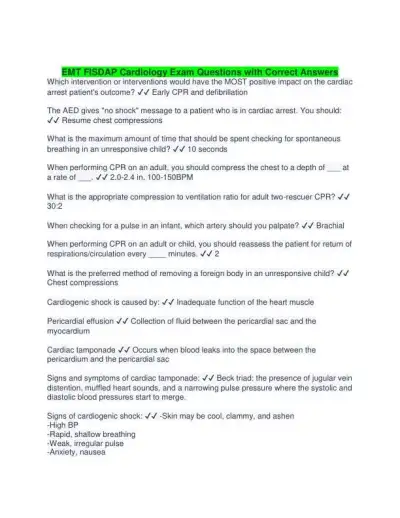 Past Exams
EMT FISDAP Cardiology Practice Exam With Answers (78 Solved Questions)
National Registry of Emergency Medical Technicians
6 pagesMay 2025
Study this document with CramX
Once it is in your library, every tool can work from it.