

2024-2025 West Coast EMT Block Exam #1 with Answers (222 Solved Questions)
- National Registry of Emergency Medical Technicians
- 68 pages
- Shared February 2025
- 158 downloads
Prepare like a pro with 2024-2025 West Coast EMT Block Exam #1 with Answers, featuring authentic past exams.
Preview 21 of 68 pages
See the first 21 pages exactly as they appear in the document.
Page 1 Read page 1 as text
West Coast EMT Block Exam #1 100% VERIFIED ANSWERS 2024/2025 American Heart Association protocols are based on __________. Select one: A. theories ready for field trial B. trends in the EMS community C. opinions from a core group of cardiologists D. evidence - based research D. evidence - based research As an EMT, you may be authorized to administer aspirin to a patient with chest pain based on: Select one: A. medical director approval. B. the patient's condition. C. an order from a paramedic. D. the t ransport time to the hospital. A. medical director approval. National guidelines for EMS care are intended to __________. Select one: A. reduce expenses at the local and state levels B. unify EMS providers under a single medical director C. facilitate a na tional EMS labor group D. provide more consistent delivery of EMS care across the United States
Page 2 Page 3 Read page 3 as text
D. provide more consistent delivery of EMS care across the United States Online medical control requires __________. Select one: A. the presence of an advanced - level provider B. written protocols approved by medical control C. a physician's presence on the scene of the call D. phone or radio contact with the medical director D. phone or radio contact with the medical director Prehospital patient care decisions sh ould be based on __________. Select one: A. the experiences of EMTs B. the opinions of physicians C. an EMS agency's fiscal resources D. EMS research D. EMS research The ability to handle multiple tasks based on their priority is called __________. Select one: A. patient empathy B. patient advocacy C. integrity D. time management D. time management The ability to take appropriate action with little direction is known as __________. Select one: A. self - motivation B. diplomacy
Page 4 Read page 4 as text
C. time management D. self - confi dence A. self - motivation The ability to understand others and have them understand you is known as __________. Select one: A. self - confidence B. teamwork and diplomacy C. communication D. scene leadership C. communication The determination that prompt surg ical care in the hospital is more important than performing time - consuming procedures in the field on a major trauma patient is based MOSTLY on: Select one: A. the lead EMT's decision. B. regional trauma guidelines. C. EMS research. D. local protocols. C. EMS research. The EMT is legally obligated to protect a patient's privacy according to _____________. Select one: A. APGAR B. CQI C. HIPAA D. DCAP
Page 5 Read page 5 as text
C. HIPAA What is an EMT's primary service area? Select one: A. The only area the EMT is certified to provide patient care B. The main area in which the EMS agency operates C. The area serviced by the EMT's medical director D. The location where the EMT provides essential care during a 9 - 1 - 1 call B. The main area in which the EMS agency operates What should an EMT do to limit errors in the field? Select one: A. Contact medical direction before initiating any treatments. B. Carry an EMT text for reference at all times. C. Follow the agency's written protocols. D. Devi ate from established standards when necessary. C. Follow the agency's written protocols. Which of the following courses requires about 150 hours of training? Select one: A. EMT B. EMR C. AEMT D. Paramedic A. EMT Which of the following descriptions MOST acc urately portrays emergency medical services (EMS)? Select one: A. A team of paramedics and emergency physicians who are responsible for providing emergency care to critically injured patients
Page 6 Read page 6 as text
B. A team of health care professionals who are responsible for p roviding emergency care and transportation to the sick and injured C. A vast network of advanced life support (ALS) providers who provide definitive emergency care in the prehospital setting D. A system composed exclusively of emergency medical responders (EMRs) and emergency medical technicians (EMTs) who are responsible for providing care to sick and injured patients B. A team of health care professionals who are responsible for providing emergency care and transportation to the sick and injured Which of the following interventions is used by all levels of EMS providers? Select one: A. Automatic transport ventilators B. Automated external defibrillator C. Needle decompression D. Multilumen airways B. Automated external defibrillator Which of the following is a specific example of the Mobile Integrated Healthcare (MIH) model? Select one: A. EMTs respond to a woman who complains of high fever B. Paramedics pick up a patient from an acute care clinic C. EMTs assess a patient whose lung disease is "acting up" D . The paramedic administers a patient's flu vaccination D. The paramedic administers a patient's flu vaccination Which of the following statements regarding the Americans With Disabilities Act (ADA) of 1990 is correct? Select one: A. The minimum number of hours required to successfully complete an EMT
Page 7 Read page 7 as text
course is less for candidates who are disabled. B. According to the ADA, EMT candidates with a documented disability are exempt from taking the NREMT exam. C. The ADA applies only to individuals with a diagnos ed and well - documented physical disability. D. The ADA prohibits employers from failing to provide full and equal employment to those who are disabled. D. The ADA prohibits employers from failing to provide full and equal employment to those who are disabl ed. Which of the following statements regarding the NREMT is correct? Select one: A. The NREMT is a governmental agency that certifies EMTs. B. EMS training standards are regulated by the NREMT. C. The NREMT is the exclusive certifying body for EMTs. D. Th e NREMT provides a national standard for EMS testing. D. The NREMT provides a national standard for EMS testing You are caring for a driver who struck a light pole. She admits to drinking alcohol but orders you not to tell anyone. You should report the inf ormation to __________. Select one: a. the state motor vehicle department b. your medical director c. the receiving nurse or doctor d. law enforcement personnel c. the receiving nurse or doctor You are encouraging a patient to go to the hospital by ambulan ce. You know that a transport will keep you on duty several hours after your regular quitting time. This is an example of __________.
Page 8 Read page 8 as text
Select one: A. abuse of authority B. scope of practice C. undue hardship D. patient advocacy D. patient advocacy After ass essing a patient's blood glucose level, you accidentally stick yourself with the contaminated lancet. You should: Select one: A. get immunized against hepatitis as soon as possible. B. report the incident to your supervisor after the call. C. discontinue p atient care and seek medical attention. D. immerse your wound in an alcohol - based solution. B. report the incident to your supervisor after the call. At the scene of an automobile crash, a utility pole has been broken and power lines are lying across the c ar. The patients inside the car are conscious. You should: Select one: A. mark off a danger zone around the downed lines. B. proceed with normal extrication procedures. C. advise the patients to carefully get out of the car. D. remove the lines with a nonc onductive object. A. mark off a danger zone around the downed lines. Common factors that influence how a patient reacts to the stress of an illness or injury include all of the following, EXCEPT: Select one: A. mental disorders. B. fear of medical personne l.
Page 9 Read page 9 as text
C. history of chronic disease. D. assessment by the EMT. D. assessment by the EMT. General adaptation syndrome is characterized by which of the following phases? Select one: A. Delayed reaction, alarm response, and physical recovery B. Immediate reaction, psychological exhaustion, and recovery C. Alarm response, reaction and resistance, and recovery D. Reaction and resistance, euphoria, and physical exhaustion C. Alarm response, reaction and resistance, and recovery Gloves, a mask, ey e protection, and a face shield should be used: Select one: A. whenever you touch nonintact skin. B. during routine cleaning of the ambulance. C. while handling needles or other sharps. D. when performing endotracheal intubation. D. when performing endotra cheal intubation. Quid pro quo, a type of sexual harassment, occurs when the harasser: Select one: A. touches another person without his or her consent. B. stares at certain parts of another person's anatomy. C. requests sexual favors in exchange for somet hing else. D. makes rude remarks about a person's body parts. C. requests sexual favors in exchange for something else. The EMT's first priority is __________. Select one: A. personal safety
Page 10 Read page 10 as text
B. rapid response C. treatment and transport D. empathy for all p atients A. personal safety The MOST serious consequence of drug or alcohol abuse among EMS personnel is: Select one: A. punitive action and the loss of a job. B. low morale and frequently missed shifts. C. substandard or inappropriate patient care. D. tens ion among coworkers and supervisors. C. substandard or inappropriate patient care. The simplest, yet most effective method of preventing the spread of an infectious disease is to: Select one: A. wash your hands in between patient contacts. B. undergo an an nual physical examination. C. ensure that your immunizations are up - to - date. D. undergo annual testing for tuberculosis and hepatitis. A. wash your hands in between patient contacts. Upon arriving at the scene of a motor vehicle crash, you note that two sm all cars collided head - on; the occupants are still in their vehicles. The fire department is in the process of stabilizing the vehicles and law enforcement personnel are directing traffic. After parking the ambulance at a safe distance, you and your partne r should: Select one: A. put on high - visibility safety vests. B. assist with vehicle stabilization.
Page 11 Read page 11 as text
C. quickly begin the triage process. D. report to the incident commander. A. put on high - visibility safety vests. Vaccination against the hepatitis A virus is unnecessary if you: Select one: A. have been infected with hepatitis in the past. B. have a weak immune system. C. received a hepatitis B vaccination. D. are older than 35 years of age. A. have been infected with hepatitis in the past. Vector - borne tran smission of an infectious organism occurs via: Select one: A. animals or insects. B. direct contact. C. smoke or dust. D. inanimate objects. A. animals or insects. When decontaminating the back of your ambulance after a call, you should: Select one: A. spr ay the contaminated areas and then immediately wipe them dry with a towel. B. use a bleach and water solution at a 1:2 dilution ratio to thoroughly wipe all surfaces. C. clean all surfaces and patient contact areas with a mixture of alcohol and water. D. a llow surfaces to air dry unless otherwise indicated in the product directions. D. allow surfaces to air dry unless otherwise indicated in the product directions.
Page 12 Read page 12 as text
Which of the following is an effective stress management strategy? Select one: A. Requesting o vertime to occupy your mind B. Developing a social network outside of EMS C. Frequently reflecting on troublesome calls D. Modestly increasing caffeine consumption B. Developing a social network outside of EMS Which of the following scenarios MOST accurate ly depicts a posttraumatic stress disorder (PTSD) reaction? Select one: A. An EMT is emotionally exhausted and depressed after a school bus crash involving critical injuries and the death of several children. B. A newly certified EMT becomes extremely naus eated and diaphoretic at the scene of an incident involving grotesque injuries. C. An EMT with many years of field experience becomes irritable with her coworkers and experiences headaches and insomnia. D. An EMT becomes distracted at the scene of a motor vehicle crash involving the same type of car in which a child was previously killed. D. An EMT becomes distracted at the scene of a motor vehicle crash involving the same type of car in which a child was previously killed. Which of the following statements regarding HIV is correct? Select one: A. HIV is easily transmittable in the EMS field. B. HIV is transmitted exclusively via blood. C. HIV is far more contagious than hepatitis B. D. There is no vaccine against HIV infection. D. There is no vaccine agains t HIV infection.
Page 13 Read page 13 as text
Which of the following statements regarding the different stages of the grieving process is correct? Select one: A. The stages of the grieving process may occur simultaneously. B. It is rare that people will jump back and forth between sta ges. C. Bargaining is the most unpleasant stage of the grieving process. D. The grieving process typically begins with severe depression. A. The stages of the grieving process may occur simultaneously. Which of the following would provide the EMT with the BEST cover in a situation involving active gunfire? Select one: A. A concrete barricade B. Behind a car door C. A large cluster of shrubs D. Stacked empty barrels A. A concrete barricade While providing care to a patient, blood got onto the ambulance stretcher. Because the stretcher was not properly cleaned afterward, a virus was transmitted to another emergency medical technician (EMT) several days later. Which route of transmission does this scenario d escribe? Select one: A. Direct contact B. Airborne transmission C. Indirect contact D. Vector - borne transmission C. Indirect contact You are transporting an elderly woman who has possibly experienced a stroke. She is obviously scared but is unable to talk and cannot move the entire right
Page 14 Read page 14 as text
side of her body. In addition to providing the medical care that she needs, you should: Select one: A. reassure her that after proper treatment in the hospital, she will regain her speech in time. B. maintain eye contact at all times and tell her that there is no need for her to be scared. C. acknowledge that she is scared and tell her that you will take good care of her. D. tell her that you understand why she is scared and that everything will likely be okay. C. acknowledg e that she is scared and tell her that you will take good care of her. As an EMT, the standards of emergency care are often partially based on: Select one: A. locally accepted protocols. B. the wishes of the general public. C. a consensus among paramedic s upervisors. D. the priorities of the medical director. A. locally accepted protocols. During your monthly internal quality improvement (QI) meeting, you review several patient care reports (PCRs) with the staff of your EMS system. You identify the patient's name, age, and sex, and then discuss the treatment that was provided by the EMTs in the field. By taking this approach to the QI process, you: Select one: A. are in violation of HIPAA because you did not remove the PHI from the PCR beforehand. B. violated the patient's privacy because you should have discussed the information only with th e EMTs involved. C. acted appropriately but must have each EMT sign a waiver stating that he or she will not discuss the cases with others.
Page 15 Read page 15 as text
D. adequately safeguarded the patient's PHI because the cases were discussed internally. A. are in violation of HIPA A because you did not remove the PHI from the PCR beforehand. In which of the following circumstances can the EMT legally release confidential patient information? Select one: A. A police officer requests a copy to place on file B. The family requests a co py for insurance purposes C. A media representative inquires about the patient D. The patient is competent and signs a release form D. The patient is competent and signs a release form In which of the following situations does a legal duty to act clearly e xist? Select one: A. The EMT hears of a cardiac arrest after his or her shift ends. B. The EMT witnesses a vehicle crash while off duty. C. A bystander encounters a victim who is not breathing. D. A call is received 15 minutes prior to shift change. D. A c all is received 15 minutes prior to shift change. Maintaining the chain of evidence at the scene of a crime should include: Select one: A. quickly moving any weapons out of the patient's sight. B. placing the patient in a private area until the police arri ve. C. making brief notes at the scene and then completing them later. D. not cutting through holes in clothing that were caused by weapons. D. not cutting through holes in clothing that were caused by weapons.
Page 16 Read page 16 as text
Putrefaction is defined as: Select one: A. pr ofound cyanosis to the trunk and face. B. blood settling to the lowest point of the body. C. separation of the torso from the rest of the body. D. decomposition of the body's tissues. D. decomposition of the body's tissues. The EMT's scope of practice with in his or her local response area is defined by the: Select one: A. medical director. B. EMS supervisor. C. state EMS office. D. local health district. A. medical director. To help protect patients, EMS agencies are required to have __________. Select one: A. online access to patient records B. public forums with their medical director C. an anonymous reporting system D. a privacy officer to answer questions D. a privacy officer to answer questions When is forcible restraint permitted? Select one: A. When t he patient poses a significant threat to self or others B. Only if law enforcement personnel have witnessed threatening behavior C. Anytime that the EMT feels threatened D. Only if consent to restrain is given by a family member
Page 17 Read page 17 as text
A. When the patient poses a significant threat to self or others When performing his or her duties, the EMT is generally expected to: Select one: A. exercise reasonable care and act prudently. B. function above his or her scope of practice. C. contact medical control on every EMS ca ll. D. consistently exceed the standard of care. A. exercise reasonable care and act prudently. Where would you MOST likely find information regarding a patient's wishes to be an organ donor? Select one: A. Insurance card B. Social Security card C. Voter r egistration card D. Driver's license D. Driver's license Which aspect of the Health Insurance Portability and Accountability Act (HIPAA) MOST affects EMS personnel? Select one: A. Preventing insurance fraud B. Controlling insurance costs C. Protecting patient privacy D. Ensuring access to insurance C. Protecting patient privacy Which of the following components are needed to prove negligence? Select one: A. Duty to act, breach of duty, injury/damages, and causation
Page 18 Read page 18 as text
B. Abandonment, breach o f duty, damages, and causation C. Duty to act, abandonment, breach of duty, and causation D. Breach of duty, injury/damages, abandonment, and causation A. Duty to act, breach of duty, injury/damages, and causation Which of the following general statements regarding consent is correct? Select one: A. A patient can consent to transport but can legally refuse to be treated. B. Patients who are intoxicated are generally allowed to refuse treatment. C. All patients older than 18 years can legally refuse treatmen t or transport. D. Expressed consent is valid only if given in writing by a family member. A. A patient can consent to transport but can legally refuse to be treated. Which of the following statements about the patient care report is correct? Select one: a . It is difficult to prove actions were performed if they are not included on the report. b. EMTs are not liable for any actions that are accurately documented. c. Patient care cannot be discredited based on poor documentation. d. Incomplete reports are co mmon and accepted in EMS. a. It is difficult to prove actions were performed if they are not included on the report. Which type of consent is involved when a 39 - year - old mentally competent female with a severe headache asks you to take her to the hospital? Select one: A. Formal B. Implied C. Expressed D. Informed C. Expressed
Page 19 Read page 19 as text
You and your partner arrive at the scene of a major motor vehicle crash. The driver, a young male, is severely entrapped in his car. He has an open head injury and massive facial traum a. He is unresponsive, is not breathing, and does not have a palpable carotid pulse. You should: Select one: A. ventilate the patient for 5 minutes and then stop if there is no response. B. stop any active bleeding and advise dispatch to send a paramedic c rew. C. have your partner check for a pulse to confirm that the patient is deceased. D. request the fire department to extricate the patient so you can begin CPR. C. have your partner check for a pulse to confirm that the patient is deceased. You are calle d to attend to an elderly patient with an extensive medical history who is now in cardiac arrest. The patient's family tells you that the patient has a DNR order. There is no paperwork available but the patient does have a MedicAlert bracelet indicating Do Not Resuscitate. You should: Select one: A. initiate resuscitation in the absence of paperwork. B. transport with minimal care. C. confirm the patient identity and then confirm the DNR by calling the MedicAlert Foundation number on the bracelet. D. confir m the patient's identity and honor the DNR order. C. confirm the patient identity and then confirm the DNR by calling the MedicAlert Foundation number on the bracelet. You arrive at the scene of a motor vehicle - versus - pedestrian accident. The patient, a 13 - year - old male, is unconscious and has multiple injuries. As you are treating the child, a law enforcement officer advises you that the child's parents will be at the scene in approximately 15 minutes. What should you do? Select one: A. Withhold treatment until the parents arrive and give you consent for treatment. B. Transport the child immediately and have the parents meet you at the hospital.
Page 20 Read page 20 as text
C. Begin transport at once and have the parents meet you en route to the hospital. D. Treat the child at the scen e and wait for the parents to arrive and give consent. B. Transport the child immediately and have the parents meet you at the hospital. You respond to the home of a 59 - year - old man who is unconscious; has slow, shallow breathing; and has a weak pulse. The family states that the patient has terminal brain cancer and does not wish to be resuscitated. They further state that there is a DNR order for this patient, but they are unable to locate it. You should: Select one: A. decide on further action once the DN R order is produced. B. honor the patient's wishes and withhold all treatment. C. transport the patient without providing any treatment. D. begin treatment and contact medical control as needed. D. begin treatment and contact medical control as needed. A 4 - year - old boy had an apparent seizure. He is conscious and calm and is sitting on his mother's lap. His father is sitting in a nearby chair. The child's mother suddenly begins crying uncontrollably, which causes the child to start crying. You should: Selec t one: A. attempt to calm the child's mother, but avoid separating her from her child because this will increase her anxiety. B. ask the father to hold the child so you can assess him while your partner tries to calm the mother. C. reassure the child's mot her that seizures in children are very common and that there is nothing to worry about. D. give the child a favorite toy or blanket to hold onto and perform your assessment to the best of your ability.
Page 21 Read page 21 as text
B. ask the father to hold the child so you can assess him while your partner tries to calm the mother. As you are wheeling your patient through the emergency department doors, you receive another call for a major motor vehicle crash. You should: Select one: A. place the patient in a high - visibility area and t hen respond to the call. B. leave a copy of the run form with a nurse and then respond to the call. C. inform the admissions clerk of the situation and then respond at once. D. respond only after giving a verbal patient report to a nurse or physician. D. r espond only after giving a verbal patient report to a nurse or physician. Communicating with patients who are deaf or hard - of - hearing can be facilitated by doing all of the following, EXCEPT: Select one: A. shining a light on your face when you are in a da rkened environment. B. placing yourself in a position to ensure that the patient can see your lips. C. providing pen and paper if the patient prefers to write his or her response. D. elevating the tone of your voice and exaggerating word pronunciation. D. elevating the tone of your voice and exaggerating word pronunciation. During your assessment of a 20 - year - old man with a severe headache and nausea, you ask him when his headache began, but he does not answer your question immediately. You should: Select o ne: A. allow him time to think about the question and respond to it. B. tell him that you cannot help him unless he answers your questions. C. repeat your question because he probably did not hear you. D. ask him if he frequently experiences severe headach es and nausea. A. allow him time to think about the question and respond to it.
47 more pages in the full document
Unlock it once and it stays in your library, ready to chat with or turn into flashcards.
Unlock the full documentMore National Registry of Emergency Medical Technicians study materials
See all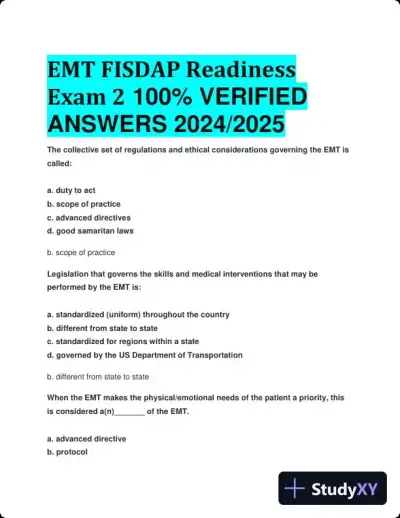 Past Exams
2024-2025 EMT FISDAP Readiness Practice Exam with Answers (161 Solved Questions)
National Registry of Emergency Medical Technicians
49 pages141downloadsFeb 2025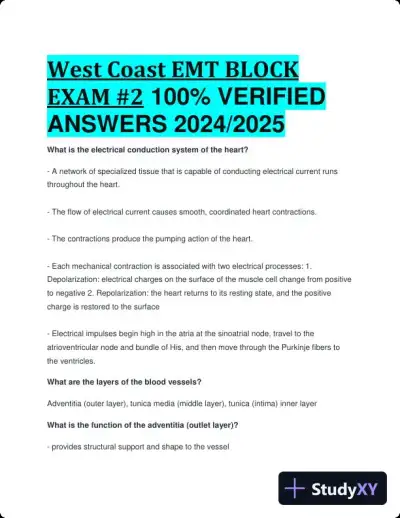 Past Exams
2024-2025 West Coast EMT Block Exam #2 with Answers (180 Solved Questions)
National Registry of Emergency Medical Technicians
29 pages103downloadsFeb 2025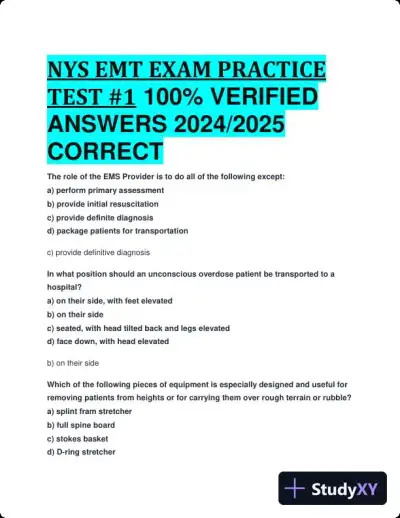 Past Exams
2024-2025 NYS EMT Practice Exam with Answers (98 Solved Questions)
National Registry of Emergency Medical Technicians
27 pages96downloadsFeb 2025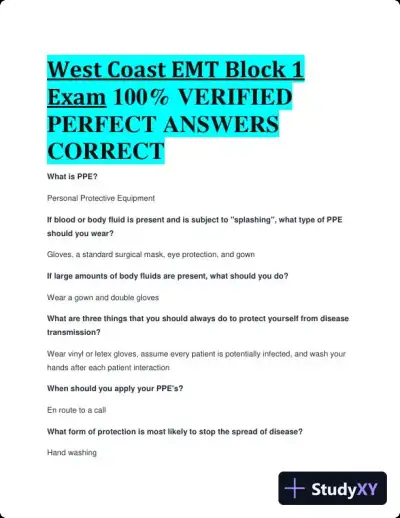 Past Exams
West Coast EMT Block 1 Practice Exam with Answers (190 Solved Questions)
National Registry of Emergency Medical Technicians
23 pages80downloadsFeb 2025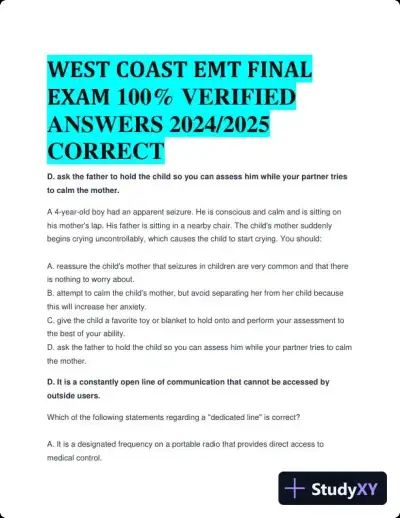 Past Exams
2024-2025 West Coast EMT Final Exam with Answers (258 Solved Questions)
National Registry of Emergency Medical Technicians
84 pages63downloadsFeb 2025 Past Exams
2024-2025 West Coast EMT Quiz 1 Practice Exam with Answers (210 Solved Questions)
National Registry of Emergency Medical Technicians
22 pages50downloadsFeb 2025 Past Exams
2024-2025 West Coast EMT Block Exam #3 with Answers (183 Solved Questions)
National Registry of Emergency Medical Technicians
57 pages42downloadsFeb 2025 Past Exams
EMT FISDAP Cardiology Practice Exam With Answers (78 Solved Questions)
National Registry of Emergency Medical Technicians
6 pagesMay 2025
Study this document with CramX
Once it is in your library, every tool can work from it.