

2024-2025 West Coast EMT Block Exam #3 with Answers (183 Solved Questions)
- National Registry of Emergency Medical Technicians
- 57 pages
- Shared February 2025
- 42 downloads
2024-2025 West Coast EMT Block Exam #3 with Answers is the perfect way to get a feel for your upcoming test.
Preview 18 of 57 pages
See the first 18 pages exactly as they appear in the document.
Page 1 Read page 1 as text
West Coast EMT Block Exam #3 100% VERIFIED PERFECT ANSWERS 2024/2025 A 30 - year - old male experienced a generalized (tonic - clonic) seizure, which stopped before you arrived at the scene. The patient is conscious, is answering your questions appropriately, and refuses EMS transport. Which of the following would be the MOST compelling reason to disagree with his refusal of transport? Select one: A. His Glasgow Coma Scale (GCS) score is 15 B. His wife states that this was his "usual" seizure C. He has experienced seizures since he was 20 D. He is currently not prescribed any medications D. He is currently not prescribed any medications A patient who is possibly experiencing a stroke is NOT eligible for thrombolytic (fibrinolytic) therapy if he or she: Select one: A. has had a prior heart attack. B. has bleeding within the brain. C. has a GCS score that is less than 8. D. is older than 60 years of age. B. has bleeding within the brain. A patient whose speech is slurred and difficult to understand is experiencing: Select one:
Page 2 Page 3 Read page 3 as text
A. paraplegia. B. dysph agia. C. dysarthria. D. aphasia. C. dysarthria. A patient with an altered mental status is: Select one: A. typically alert but is confused as to preceding events. B. not thinking clearly or is incapable of being aroused. C. usually able to be aroused with a painful stimulus. D. completely unresponsive to all forms of stimuli. B. not thinking clearly or is incapable of being aroused. During the primary assessment of a semiconscious 70 - year - old female, you should: Select one: A. insert a nasopharyngeal airway and assist ventilations. B. ask family members if the patient has a history of stroke. C. immediately determine the patient's blood glucose level. D. ensure a patent airway and support ventilation as needed. D. ensure a patent airway and support ventilati on as needed. Interruption of cerebral blood flow may result from all of the following, EXCEPT: Select one: A. an embolism. B. cerebral vasodilation. C. a thrombus. D. an acute arterial rupture. B. cerebral vasodilation.
Page 4 Read page 4 as text
The left cerebral hemisphere contro ls: Select one: A. heart rate and pupil reaction. B. the right side of the face. C. breathing and blood pressure. D. the right side of the body. D. the right side of the body. The MOST significant risk factor for a hemorrhagic stroke is: Select one: A. dia betes mellitus. B. hypertension. C. heavy exertion. D. severe stress. B. hypertension. The three major parts of the brain are the: Select one: A. midbrain, cerebellum, and spinal cord. B. brain stem, midbrain, and spinal cord. C. cerebellum, medulla, and o cciput. D. cerebrum, cerebellum, and brain stem. D. cerebrum, cerebellum, and brain stem. When assessing for arm drift of a patient with a suspected stroke, you should: Select one: A. ask the patient to close his or her eyes during the assessment. B. expect to see one arm slowly drift down to the patient's side. C. observe movement of the arms for approximately 2 minutes. D. ask the patient to hold his or her arms up with the palms down.
Page 5 Read page 5 as text
A. ask the patient to close his or her eyes during the assessm ent. When caring for a patient with documented hypoglycemia, you should be MOST alert for: Select one: A. a seizure. B. respiratory distress. C. an acute stroke. D. a febrile convulsion. A. a seizure. When you are obtaining medical history from the family of a suspected stroke patient, it is MOST important to determine: Select one: A. if the patient has been hospitalized before. B. if there is a family history of a stroke. C. when the patient last appeared normal. D. the patient's overall medication complia nce. C. when the patient last appeared normal. Which of the following conditions would be the LEAST likely to mimic the signs and symptoms of a stroke? Select one: A. Intracranial bleeding B. A postictal state C. Hypoglycemia D. Hypovolemia D. Hypovolemia Which of the following conditions would MOST likely affect the entire brain? Select one:
Page 6 Read page 6 as text
A. Respiratory failure or cardiopulmonary arrest B. Ruptured cerebral artery in the occipital lobe C. Blocked cerebral artery in the frontal lobe D. Reduced blood supp ly to the left hemisphere A. Respiratory failure or cardiopulmonary arrest Which of the following MOST accurately describes a simple partial seizure? Select one: A. A generalized seizure without incontinence B. A seizure that causes the patient to stare bl ankly C. A seizure that begins in one extremity D. A seizure that is not preceded by an aura C. A seizure that begins in one extremity Which of the following MOST accurately describes what the patient will experience during the postictal state that follows a seizure? Select one: A. A gradually decreasing level of consciousness B. A rapidly improving level of consciousness C. Hyperventilation and hypersalivation D. Confusion and fatigue D. Confusion and fatigue Which of the following symptoms would lead the EMT to believe that a patient's headache is caused by sinus congestion? Select one: A. The headache began suddenly B. There is associated neck stiffness C. There is numbness in the extremities D. The pain is worse when bending over
Page 7 Read page 7 as text
D. The pain is worse whe n bending over You are caring for a 68 - year - old man with sudden onset of left - sided paralysis and slurred speech. His airway is patent, his respirations are 14 breaths/min with adequate depth, and his oxygen saturation is 98%. Treatment for this patient sh ould include: Select one: A. recovery position and transport. B. oral glucose gel and transport. C. high - flow oxygen and transport. D. ventilatory assistance and transport. A. recovery position and transport. You respond to a residence for a child who is h aving a seizure. Upon arrival at the scene, you enter the residence and find the mother holding her child, a 2 - year - old male. The child is conscious and crying. According to the mother, the child had been running a high fever and then experienced a seizure that lasted approximately 3 minutes. You should: Select one: A. call medical control and request permission to give the child aspirin. B. transport the child to the hospital and reassure the mother en route. C. advise the mother to take her child to the d octor the following day. D. cover the child with wet towels and give oxygen via nasal cannula. B. transport the child to the hospital and reassure the mother en route. Your patient opens his eyes, moans, and pulls away from you when you pinch his trapezius muscle. You should assign a Glasgow Coma Scale (GCS) score of: Select one: A. 7. B. 9.
Page 8 Read page 8 as text
C. 8. D. 6. C. 8. A 29 - year - old pregnant woman has had severe vomiting for the last 2 days. Today, she is vomiting large amounts of blood. Her skin is cool and pale and she is tachycardic. The EMT should suspect: Select one: A. Mallory - Weiss tear. B. esophagitis. C. esophageal varices. D. acute pancreatitis. A. Mallory - Weiss tear. A 30 - year - old woman with a history of alcoholism presents with severe upper abdominal pain and is vomiting large amounts of bright red blood. Her skin is cool, pale, and clammy; her heart rate is 120 beats/min and weak; and her blood pressure is 70/50 mm Hg. Your MOST immediate action should be to: Select one: A. rapidly transport her to the hos pital. B. give her high - flow supplemental oxygen. C. protect her airway from aspiration. D. keep her supine and keep her warm. C. protect her airway from aspiration. A 47 - year - old male presents with severe abdominal pain of 3 hours' duration. His abdomen i s distended and guarded. Your MOST important consideration for this patient should be to: Select one: A. be alert for signs and symptoms of shock. B. assess his blood pressure to determine perfusion adequacy.
Page 9 Read page 9 as text
C. transport him in a supine position. D. deter mine the exact location and cause of his pain. A. be alert for signs and symptoms of shock. A 59 - year - old male presents with sudden - onset severe lower back pain. He is conscious and alert, but very restless and diaphoretic. Your assessment reveals a pulsating mass to the left of his umbilicus. You should: Select one: A. request a paramedic unit t o give the patient pain medication. B. vigorously palpate the abdomen to establish pain severity. C. administer oxygen and prepare for immediate transport. D. place the patient in a sitting position and transport at once. C. administer oxygen and prepare f or immediate transport. A young female presents with costovertebral angle tenderness. She is conscious and alert with stable vital signs. Which of the following organs is MOST likely causing her pain? Select one: A. Pancreas B. Liver C. Kidney D. Gallbladd er C. Kidney An important aspect in the treatment of a patient with severe abdominal pain is to: Select one: A. provide emotional support en route to the hospital. B. give 100% oxygen only if signs of shock are present. C. encourage the patient to remain i n a supine position. D. administer analgesic medications to alleviate pain.
Page 10 Read page 10 as text
A. provide emotional support en route to the hospital. For a patient with a gastrointestinal complaint, it is MOST important for the EMT to _________. Select one: A. avoid transpor ting the patient if the condition is minor B. perform all interventions prior to transport C. determine the cause of the patient's complaint D. identify whether the patient requires rapid transport D. identify whether the patient requires rapid transport M ost patients with abdominal pain prefer to: Select one: A. lie on their side with their knees drawn into the abdomen. B. sit fully upright because it helps relax the abdominal muscles. C. sit in a semi - Fowler position with their knees slightly bent. D. lie in a supine position with their knees in a flexed position. A. lie on their side with their knees drawn into the abdomen. Pain that may be perceived at a distant point on the surface of the body, such as the back or shoulder, is called: Select one: A. vis ceral pain. B. radiating pain. C. referred pain. D. remote pain. C. referred pain. Peritonitis may result in shock because: Select one: A. abdominal distention impairs cardiac contractions.
Page 11 Read page 11 as text
B. severe pain causes systemic dilation of the vasculature. C. int ra - abdominal hemorrhage is typically present. D. fluid shifts from the bloodstream into body tissues. D. fluid shifts from the bloodstream into body tissues. Urinary tract infections are more common in ____________. Select one: A. men B. active adults C. w omen D. sedentary adults C. women When assessing a patient with abdominal pain, you should: Select one: A. visually assess the painful area of the abdomen, but avoid palpation because this could worsen his or her condition. B. palpate the abdomen in a cloc kwise direction, beginning with the quadrant after the one the patient indicates is painful. C. ask the patient to point to the area of pain or tenderness and assess for rebound tenderness over that specific area. D. observe for abdominal guarding, which i s characterized by sudden relaxation of the abdominal muscles when palpated. B. palpate the abdomen in a clockwise direction, beginning with the quadrant after the one the patient indicates is painful. Which of the following helps filter the blood and has no digestive function? Select one: A. Large intestine B. Spleen
Page 12 Read page 12 as text
C. Stomach D. Small intestine B. Spleen Which of the following is correct about the secondary assessment for a high - priority patient? Select one: A. The secondary assessment must be performed prior to transport. B. Never contact medical direction before completing the secondary assessment. C. You may not have time to complete a secondary assessment. D. Never perform a secondary assessment on a high - priority patient. C. You may not have time to complete a secondary assessment. Which of the following may help reduce your patient's nausea? Select one: A. Low - flow oxygen B. Positive - pressure ventilation C. Cricoid pressure D. Oral glucose A. Low - flow oxygen Which of the following organs lies in the retroperitoneal space? Select one: A. Pancreas B. Gallbladder C. Spleen D. Liver A. Pancreas Which of the following statements regarding dialysis is correct? Select one:
Page 13 Read page 13 as text
A. Acute hypertension is a common adverse effect of dialysis. B. The purpose of dialys is is to help the kidneys retain salt and water. C. Hemodialysis is effective but carries a high risk of peritonitis. D. Patients who miss a dialysis treatment often present with weakness. D. Patients who miss a dialysis treatment often present with weakne ss. Which of the following statements regarding the acute abdomen is correct? Select one: A. The initial pain associated with an acute abdomen tends to be vague and poorly localized. B. The parietal peritoneum is typically the first abdominal layer that becomes inflamed or irritated. C. The most common cause of an acute abdomen is inflammation of the gallbladder and liver. D. An acute abdomen almost always occurs as the result of blunt trauma to solid abdominal organs. A. The initial pain associated with an acute abdomen tends to be vague and poorly localized. Your patient complains of abdominal pain that occurs mostly at night or after eating fatty foods. You should suspect ___________ _. Select one: A. cholecystitis B. a hernia C. appendicitis D. kidney stones A. cholecystitis Your patient complains of chronic "burning" stomach pain that improves after eating. You should suspect: Select one:
Page 14 Read page 14 as text
A. pneumonia. B. peptic ulcer disease. C. aor tic aneurysm. D. kidney stones. B. peptic ulcer disease. A 37 - year - old female with a history of diabetes presents with excessive urination and weakness of 2 days' duration. Her blood glucose level reads 320 mg/dL. If this patient's condition is not promptl y treated, she will MOST likely develop: Select one: A. irreversible renal failure. B. severe insulin shock. C. hypoxia and overhydration. D. acidosis and dehydration. A. irreversible renal failure. A 66 - year - old woman experienced a sudden onset of difficu lty breathing. She has a history of type 2 diabetes and deep vein thrombosis (DVT). On the basis of her medical history, which of the following should the EMT suspect? Select one: A. Pulmonary embolism B. Severe hypoglycemia C. Diabetic ketoacidosis D. Con gestive heart failure A. Pulmonary embolism A 75 - year - old male with type 1 diabetes presents with chest pain and a general feeling of weakness. He tells you that he took his insulin today and ate a regular meal approximately 2 hours ago. You should treat t his patient as though he is experiencing: Select one:
Page 15 Read page 15 as text
A. hyperglycemia. B. hypoglycemia. C. a heart attack. D. an acute stroke. C. a heart attack. A man finds his 59 - year - old wife unconscious on the couch. He states that she takes medications for type 2 di abetes. He further tells you that his wife has been ill recently and has not eaten for the past 24 hours. Your assessment reveals that the patient is unresponsive. You should: Select one: A. open and maintain her airway and assess breathing. B. administer 100% oxygen via a nonrebreathing mask. C. assess for the presence of a medical identification tag. D. administer oral glucose between her cheek and gum. A. open and maintain her airway and assess breathing. A patient with an altered mental status; high blo od glucose levels; and deep, rapid breathing may have a condition known as __________. Select one: A. hyperosmolar hyperglycemic nonketotic coma B. hypoglycemic crisis C. hyperglycemic crisis D. diabetic ketoacidosis D. diabetic ketoacidosis A patient with hypoglycemia will often present with which of the following signs/symptoms? Select one: A. Warm, red, and dry skin B. Deep, rapid respirations
Page 16 Read page 16 as text
C. Pale, cool, and clammy skin D. Hypertension C. Pale, cool, and clammy skin Classic signs and symptoms of hypoglycemia include: Select one: A. cool, clammy skin; weakness; tachycardia; and rapid respirations. B. warm, dry skin; hunger; abdominal pain; and deep, slow respirations. C. warm, dry skin; irritability; bradycardia; and r apid respirations. D. cold, clammy skin; bradycardia; hunger; and deep, rapid respirations. A. cool, clammy skin; weakness; tachycardia; and rapid respirations. During your assessment of a 19 - year - old male, you are told that he is being treated with factor VIII. This indicates that: Select one: A. his blood clots too quickly. B. he has thrombophilia. C. he has hemophilia A. D. he has a thrombosis. C. he has hemophilia A. Excessive eating caused by cellular "hunger" is called: Select one: A. dyspepsia. B. po lyphagia. C. dysphasia. D. polydipsia. B. polyphagia. In contrast to type 1 diabetes, type 2 diabetes: Select one:
Page 17 Read page 17 as text
A. occurs when antibodies attack insulin - producing cells. B. is caused by a complete lack of insulin in the body. C. is caused by resistance to insulin at the cellular level. D. is commonly diagnosed in children and young adults. C. is caused by resistance to insulin at the cellular level. Proper procedure for administering oral glucose to a patient includes all of the following, EXCEPT: Select one: A. ensuring the absence of a gag reflex. B. requesting permission from medical control. C. checking the medication's expiration date. D. assessing the patient's mental status. A. ensuring the absence of a gag reflex. Symptomatic hypoglycemia will MOST likely develop if a patient: Select one: A. markedly overeats and misses an insulin dose. B. takes too much of his or her prescribed insulin. C. misses one or two prescribed insulin injections. D. eats a regular meal foll owed by mild exertion. B. takes too much of his or her prescribed insulin. The EMT should assess for hypoglycemia in small children with a severe illness or injury because: Select one: A. children overproduce insulin during severe illness or injury. B. chi ldren cannot store excess glucose as effectively as adults. C. a child's cells do not uptake glucose as rapidly as adults' do. D. illness or injury causes the pancreas to produce less insulin.
Page 18 Read page 18 as text
B. children cannot store excess glucose as effectively as adult s. The main function of the endocrine system is to _________. Select one: A. regulate blood flow B. regulate glucose and calcium C. produce glandular secretions D. maintain homeostasis D. maintain homeostasis The normal blood glucose level is between: Sele ct one: A. 30 and 150 mg/dL. B. 60 and 80 mg/dL. C. 160 and 200 mg/dL. D. 80 and 120 mg/dL. D. 80 and 120 mg/dL. The two main types of cells contained in blood are called _________. Select one: A. erythrocytes and leukocytes B. transport and clotting C. pl atelets and plasma D. hemoglobin A and S A. erythrocytes and leukocytes Which of the following conditions is the diabetic patient at an increased risk of developing? Select one: A. Alcoholism B. Hepatitis B
39 more pages in the full document
Unlock it once and it stays in your library, ready to chat with or turn into flashcards.
Unlock the full documentMore National Registry of Emergency Medical Technicians study materials
See all Past Exams
2024-2025 West Coast EMT Block Exam #1 with Answers (222 Solved Questions)
National Registry of Emergency Medical Technicians
68 pages158downloadsFeb 2025 Past Exams
2024-2025 EMT FISDAP Readiness Practice Exam with Answers (161 Solved Questions)
National Registry of Emergency Medical Technicians
49 pages141downloadsFeb 2025 Past Exams
2024-2025 West Coast EMT Block Exam #2 with Answers (180 Solved Questions)
National Registry of Emergency Medical Technicians
29 pages103downloadsFeb 2025 Past Exams
2024-2025 NYS EMT Practice Exam with Answers (98 Solved Questions)
National Registry of Emergency Medical Technicians
27 pages96downloadsFeb 2025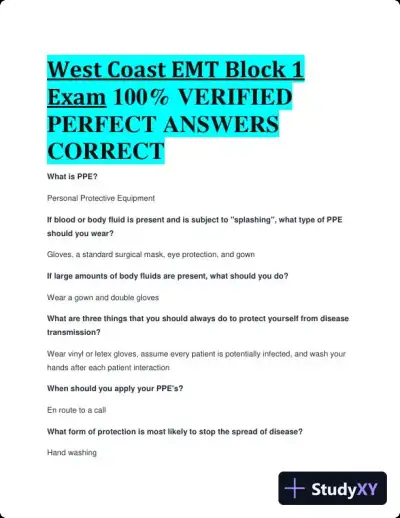 Past Exams
West Coast EMT Block 1 Practice Exam with Answers (190 Solved Questions)
National Registry of Emergency Medical Technicians
23 pages80downloadsFeb 2025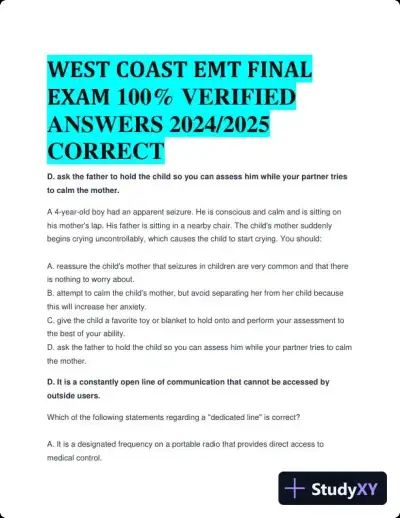 Past Exams
2024-2025 West Coast EMT Final Exam with Answers (258 Solved Questions)
National Registry of Emergency Medical Technicians
84 pages63downloadsFeb 2025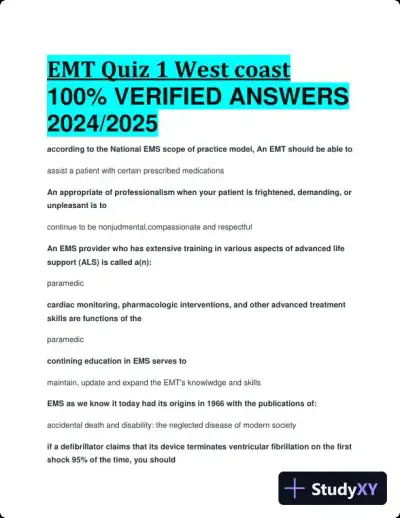 Past Exams
2024-2025 West Coast EMT Quiz 1 Practice Exam with Answers (210 Solved Questions)
National Registry of Emergency Medical Technicians
22 pages50downloadsFeb 2025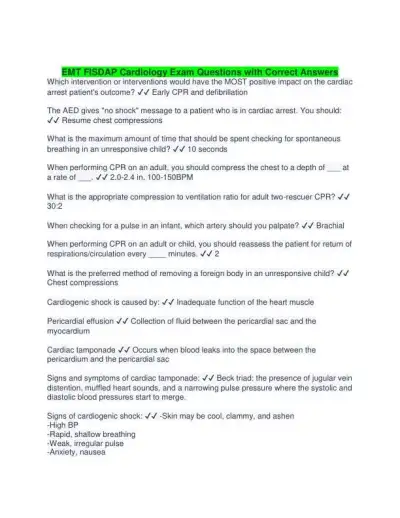 Past Exams
EMT FISDAP Cardiology Practice Exam With Answers (78 Solved Questions)
National Registry of Emergency Medical Technicians
6 pagesMay 2025
Study this document with CramX
Once it is in your library, every tool can work from it.