
CramX Logo
2023 ARRT Radiology VI Practice Exam with Answers (353 Solved Questions) - Document preview page 1

2023 ARRT Radiology VI Practice Exam with Answers (353 Solved Questions) - Page 1

Document preview content for 2023 ARRT Radiology VI Practice Exam with Answers (353 Solved Questions)

2023 ARRT Radiology VI Practice Exam with Answers (353 Solved Questions)

2023 ARRT Radiology VI Practice Exam with Answers is the perfect way to get a feel for your upcoming test.

Sophia Lee
Contributor
4.6
114
over 1 year ago
Preview (27 of 88 Pages)
100%
Log in to unlock
Page 1 of 27
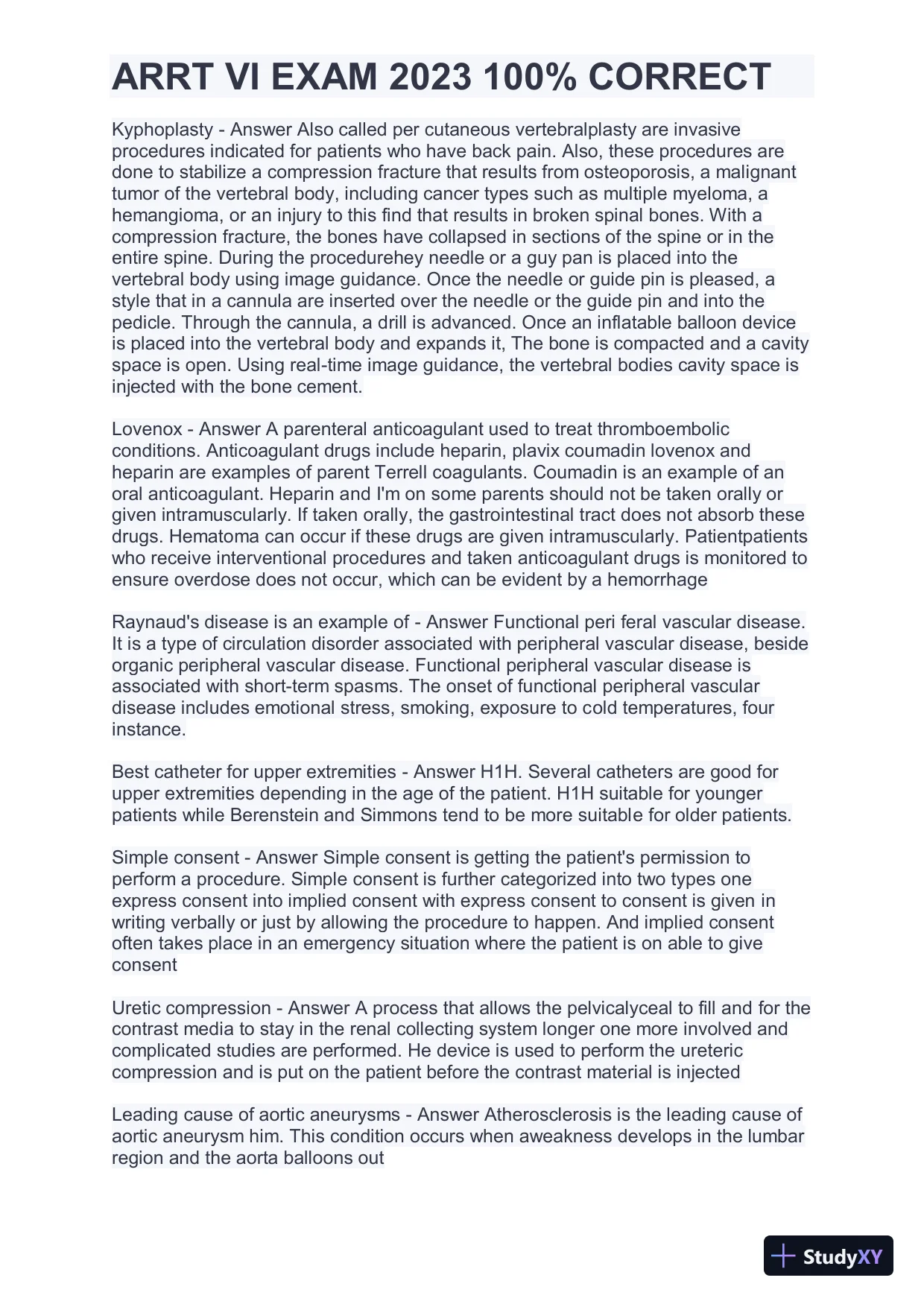
2023 ARRT Radiology VI Practice Exam with Answers (353 Solved Questions) - Page 1 preview imageARRT VI EXAM2023 100% CORRECTKyphoplasty-Answer Also called per cutaneous vertebralplasty are invasiveprocedures indicated for patients who have back pain. Also, these procedures aredone to stabilize a compression fracture that results from osteoporosis, a malignanttumorof the vertebral body, including cancer types such as multiple myeloma, ahemangioma, or an injury to this find that results in broken spinal bones. With acompression fracture, the bones have collapsed in sections of the spine or in theentire spine. During the procedurehey needle or a guy pan is placed into thevertebral body using image guidance. Once the needle or guide pin is pleased, astyle that in a cannula are inserted over the needle or the guide pin and into thepedicle. Through the cannula, a drill is advanced. Once an inflatable balloon deviceis placed into the vertebral body and expands it, The bone is compacted and a cavityspace is open. Using real-time image guidance, the vertebral bodies cavity space isinjected with the bone cement.Lovenox-Answer A parenteral anticoagulant used to treat thromboembolicconditions. Anticoagulant drugs include heparin, plavix coumadin lovenox andheparin are examples of parent Terrell coagulants. Coumadin is an example of anoral anticoagulant. Heparin and I'm on some parents should not be taken orally orgiven intramuscularly. If taken orally, the gastrointestinal tract does not absorb thesedrugs. Hematoma can occur if these drugs are given intramuscularly. Patientpatientswho receive interventional procedures and taken anticoagulant drugs is monitored toensure overdose does not occur, which can be evident by a hemorrhageRaynaud's disease is an example of-Answer Functional peri feral vascular disease.It is a type of circulation disorder associatedwith peripheral vascular disease, besideorganic peripheral vascular disease. Functional peripheral vascular disease isassociated with short-term spasms. The onset of functional peripheral vasculardisease includes emotional stress, smoking, exposure to cold temperatures, fourinstance.Best catheter for upper extremities-Answer H1H. Several catheters are good forupper extremities depending in the age of the patient. H1H suitable for youngerpatients while Berenstein and Simmons tend to be more suitable for older patients.Simple consent-Answer Simple consent is getting the patient's permission toperform a procedure. Simple consent is further categorized into two types oneexpress consent into implied consent with express consent to consent is giveninwriting verbally or just by allowing the procedure to happen. And implied consentoften takes place in an emergency situation where the patient is on able to giveconsentUretic compression-Answer A process that allows the pelvicalyceal to fill andfor thecontrast media to stay in the renal collecting system longer one more involved andcomplicated studies are performed. He device is used to perform the uretericcompression and is put on the patient before the contrast material is injectedLeadingcause of aortic aneurysms-Answer Atherosclerosis is the leading cause ofaortic aneurysm him. This condition occurs when aweakness develops in the lumbarregion and the aorta balloons out
Page 2 of 27
2023 ARRT Radiology VI Practice Exam with Answers (353 Solved Questions) - Page 2 preview image
Page 3 of 27
2023 ARRT Radiology VI Practice Exam with Answers (353 Solved Questions) - Page 3 preview imageARRT VI EXAM2023 100% CORRECTQualifications for abdominal aortic aneurysm ultrasound screening-Answer Familyhistory abdominal aortic aneurysm or, a male who is aged 65 to 75 years old, a malewho smokes cigarettes and has smoked a minimum of 100 cigarettes over thecourse of his lifeWilkie's syndrome-Answer Hey vascular compression disorderof the superiormesenteric artery or SMA that can be checked with the vascular interventionalradiologyThe posterior branches of the renal arteries supply blood to which of the part of thekidney?-Answer Upper pole and posterior portionBest common catheter used for visceral angiography are-Answer Cobras andsidewindersVisceral angiography evaluates bloodflow in the liver, spleen, and bowelExternal renal stone removal procedures are generally used for stones larger then-Answer 2 cm or 8 inchesThe folds in the brain matter are known as-Answer Gyrus. The brain matter is madeup of folds and fishers the folds are known as gyrusA digital image acquisition mode where one image is produced a refers to?-AnswerDigital angiography. Image production for vascular image has three types of modesfor digital image acquisition, which are Digital angiography, Digital cineradiographyand digital subtraction angiography. With digital angeography, also called spafilming, a single images produced. For instance,Organic peripheral vascular disease-Answer Hey disease that occurs whenstructural changes service in the blood vessel. Examples of this disorder are tissuedamage and inflammation. Further, a type of organic peripheral vascular disease is aperipheral artery disease. When the blood flow is restricted in the arteries, which arethe blood vessels that transports blood to the organs of the body from the heart, thearteries restricts or Narrows and fattydeposits accumulate and block the arteries alsoarthrosclerosis peripheral arterial disease happens when the blood does not flowthrough the arteries sufficiently to provide adequate blood supply to the muscles inthe body. This condition most often occurs in the legs and arms.signs and symptomsof peripheralartery disease that has progressed into advanced stages are pain,especially in the feet or toes, paleness in the legs one elevated, does colorization,such as blue or red numbness soreness of the foot tiredness of the legs to name afewMoral values-Answer Believes cultivated based on cultural family and suicidalideas.Law-Answer a set of established rulesEthics-Answer The standards that govern the way an individual asked and guidesthe person to decide what is right or wrong
Page 4 of 27
2023 ARRT Radiology VI Practice Exam with Answers (353 Solved Questions) - Page 4 preview imageARRT VI EXAM2023 100% CORRECTVascular insufficiency-Answer When blood valves do not work properly and bloodbegins to flow backwards. A thrombectomy is used to remove a blood clot from avessel. It is a type of surgical procedure. The procedure restores proper circulation.Patients that have severe vascular insufficiency are recommended to have thisprocedureCholecystitis-Answer And acute infection and inflammation of the gallbladderA procedure that images all of the arteries in the skull-Answer CerebralangiographyAtropine-Answer CorrectAnswer:AtropineMedication often used to treat patients who have a reaction to contrast material,whether it is a minor reaction or a major life threatening reaction, are B-agonistsinhalers, epinephrine, atropine, and diphenhydramine to name a few. Atropine is amuscarinic cholinergic blocking agent.Tunneled catheter-Answer Tunneled catheters are passed underneath the skinfrom the insertion site to a separate exit site. Common types of tunneled cathetersused are Hickman, Groshong, Leonard, and Broviac catheters.The common bile duct joins the pancreatic duct before opening up into which of thefollowing structures?-Answer Correct Answer:DuodenumThe common duct combines with the pancreatic duct before opening up into theduodenum. These ducts are part of the biliary system, which carries bile secretionsfrom the liver to the duodenum.The vessel which lies along the ventral surface of the brainstem is known as which ofthe following?-Answer Explanation:Correct Answer:Basilar arteryThebasilar artery lies on the ventral surface of the brainstem. This artery suppliesblood to the brain stem.The use of a MRI during the preprocedure phase for a kyphoplasty helps to:-Answer Explanation:Correct Answer:Identify spine degenerative diseasePreparation for a kyphoplasty may involve imaging studies, such as a computedtomography (CT), plain x-ray films or a magnetic resonance imaging (MRI).A CT scan is used to locate pedicle fractures in order to find a pedicle that is notdamaged for access or entry during the kyphoplasty procedure. Then, plain x-rayfilms determine the extent of the vertebral body compression. A magnetic resonance
Page 5 of 27
2023 ARRT Radiology VI Practice Exam with Answers (353 Solved Questions) - Page 5 preview imageARRT VI EXAM2023 100% CORRECTimaging(MRI) study evaluates the spine for other conditions that may cause backpain, such as spine degenerative disease.Which of the following is not a reason that an intracranial vascular treatment wouldoccur?AVM.Aneurysms.Collapsed lung.Tumors that have excessive blood flow.-Answer Collapsed lungIntracranial vascular treatments are used to gain images of the body's blood vessels.It is focused on the blood flow in the arteries and veins in the brain. It can be used tohelp treat and detect aneurysms, AVM, AVF and tumors.Most wires constructed into guidewires are composed of:KinaseAsystoleStainless steelCardiac index-Answer Stainless steelA contaminated latex glove is best described as:a cysta vectora fomitesterilization-Answer a fomiteFomites are contaminated inanimate objects that have been exposed to infectiousagents. Infectious agents can live on inanimate objects, such as gloves, radiographicequipment, food, water, medical devices, clothes, bedding and towels, for example.A cyst is not the best answer choice as this is where a parasite is enclosed in acovering or protective wall. A vector is a carrier of an infectious disease that spreadsthe disease from one host to another host. Then, sterilization is the elimination of amicroorganism.The right lobe of the liver is composed of which of the following segments?Anterior and posterior.Medial and lateral.Superior and inferior.Medial and inferior.-Answer Anterior and posteriorThe liver is divided into right and left lobes by a line drawn between the gallbladderand the inferior vena cava. The right lobe is composed of anterior and posteriorsegments, each with superior and inferior subsegmentsAbdominal aortography requires how manymilliliters of contrast medium injection?60-70.10-20.1-5.
Page 6 of 27
2023 ARRT Radiology VI Practice Exam with Answers (353 Solved Questions) - Page 6 preview imageARRT VI EXAM2023 100% CORRECT40-50.-Answer Abdominal aortography requires 40 to 50 milliliters of contrastmedia injection. Knowledge of the appropriate amount of contrast medium requiredfor procedures is essential to radiographic professionalismThe small saphenous vein usually drains into which vessel?Fibular vein.Femoral vein.Popliteal vein.Anterior tibial.-Answer Popliteal veinThe small saphenous vein is a rather large superficial vein in theposterior leg. Itusually drains into the popliteal vein, but it sometimes joins with the Giacomini veinand that merged vein drains into the great saphenous vein. Knowledge of anatomy isan essential part of professionalism for radiographersOf which ofthe following is the deltoid artery a branch?Subclavian artery.Thoracoacromial trunk.Thyrocervical trunk.Descending aorta-Answer Thoracoacromial trunkThe deltoid artery is a branch of the thoracoacromial trunk. It supplies blood to thedeltoid muscleWhich of the following best identifies a functionality of a guide wire?It prevents a catheter from being inserted into an organIt allows access to the blood vesselA guide wire is made of thick coils of gold ropeA guide wire is attached to the tip of a balloon catheter tip-Answer It allows accessto the blood vesselFor vascular access procedures or minimally invasive procedures, several types ofequipment is used to access the blood vessels, the bile duct, and other organs in thebody. The equipment may include imaging equipment, a needle, guide wire or acatheter. A guide wire is defined as a thin piece of wire. The wire helps to guide theinsertion and placement of a catheter, stent or material into the body.At what level does the celiac artery arise from the abdominal aorta?L3-L5.T10-T12.T9-T11.T12-L1.-Answer T12-L1The celiac artery arises from the abdominal aorta at the T12 to L1 level. Knowledgeof anatomy and the position of organs and blood vessels is essentialto radiographicprofessionalism.What should a radiologic technologist remember when using moral rules to make anethical decision?Moral rules require a health care professional to make alternate choices
Page 7 of 27
2023 ARRT Radiology VI Practice Exam with Answers (353 Solved Questions) - Page 7 preview imageARRT VI EXAM2023 100% CORRECTMoral rules are grounded in conflict resolutionMoral rules are incompleteMoral rules are applicable to a subset of professional groups-Answer Moral rulesare incompleteMoral rules deal with statements governing right and wrong conduct or behavior.Moral rules typically apply to individual behavior. Moral rules have limitations such asthey are not complete and do not address all ethical situations that may arise.Therefore, moral rules often rely on an individual's personal judgment when dealingwith an ethical situation and making a decision.The thoracic aorta ends at which level?T9.L1.T12.T4.-Answer T12The thoracic aorta is contained in the posterior mediastinal cavity. It ends at theaortic hiatus of the diaphragm in the T12level.Which of the following documents is referred to a "declaration" in some states?Health care power of attorneyA living willA physician's orderA requisition request-Answer A living willHealth care advanced directives are legal documents that express the wishes of thepatient if the individual is incompetent or unable to make medical decisions. A livingwill outlines an individual's choices for medical care.In some states, a living willmay be called a declaration. A living takes effect whenthe patient is incapacitated and is not able to make decisions about his or hermedical care or in situations where the patient has a terminal medical illness or isunconscious.The living will canhave directions for medical care, such as if the patient want ordoes not want cardiopulmonary resuscitation, mechanical ventilation or nutritionalfeedings through a tube, for example.The left and right hepatic ducts combine to form which of the following?Common hepatic duct.Common bile duct.Biliary tract.Celiac artery.-Answer Common hepatic ductThe left and right hepatic ducts combine to form the common hepatic duct. Thecommon hepatic duct is part of the biliary tract, which transports bile from the liver tothe small intestine.
Page 8 of 27
2023 ARRT Radiology VI Practice Exam with Answers (353 Solved Questions) - Page 8 preview imageARRT VI EXAM2023 100% CORRECTUnlike an angiogram, a thrombolysis procedure is performed by inserting thecatheter how?Using a percutaneous needle.Through a small incision.Directly into the thrombus site.None of the above-Answer Through a small incisionAn angiogram typically uses a needle to create a percutaneous puncture for thecatheter. However, a thrombolysis may use a larger catheter or need a larger entryport to target a thrombus, so the technician will create a small incision in the skin inorder to gain better access. The incision is typically very small and may or may notneed a stitch/suture to closeWhich of the following is NOT one of the majorbranches of the celiac trunk?Left gastric artery.Splenic artery.Superior mesenteric artery.Common hepatic artery.-Answer Superior mesenteric arteryThe celiac trunk has three major branches: the splenic artery, common hepaticartery, and left gastric artery. The superior mesenteric artery is a branch of thethoracic artery.A patient is scheduled to undergo an angiography of the adrenal glands. Monitoringthe patient's blood pressure is important to evaluate the patient for symptoms of:Electrolyte imbalancesActivated clotting timeHypertensive crisisHypertrophy-Answer Hypertensive crisisThe blood pressure is monitored constantly during an angiography procedure of theadrenal glands. The monitoring helps to identify emergency conditions, such asmalignant hypertensive crisis.Hypertensive crisis often develops from kidney failure, individuals who have vasculardisorders, such as collagen vascular disorder, renal artery stenosis that leads torenal hypertension, to name a few.Symptoms of hypertensive crisis may include: confusion, fatigue, chest pain,headache, blurred vision, seizure, weakness or numbness in the extremities, forinstance.When performing lower limb venography, an injection is made into which of thefollowing vessels?
Page 9 of 27
2023 ARRT Radiology VI Practice Exam with Answers (353 Solved Questions) - Page 9 preview imageARRT VI EXAM2023 100% CORRECTDeep vein of the foot.Superficial vein of the foot.Superficial vein of the leg.Deep vein of the leg-Answer Superficial vein of the footLower limb venography is used to exclude thrombosis of the deep veins. Whenperforming alower limb venography, an injection is made into a superficial vein ofthe foot, such as the dorsal venous arch.Positioning of the patient for renal venography is done in the:Supine positionSim'sFowlersTrendelenburg-Answer Supine positionA renal venograph is an x-ray that is used to evaluate the kidneys. The test can alsodetermine the amount of hormone levels the kidney is producing. Further, renalvenography is indicated for evaluation of the kidneys for tumors or renal cellcarcinoma,blood clots (renal thrombus), for instance. Access for catheter insertion isdone through the femoral or jugular vein.Positioning of the patient involves placing the patient in the supine position on the x-ray table. The patient's abdomen is centered sothat it is over the film. The skinlocated over the femoral vein, if used for access, is prepped by cleaning the skinusing antiseptic liquid and then draped. An anesthetic agent is then injected,followed by cannulation of the femoral vein. Fluoroscopic guidance is used where aguide wire is threaded into the vein and a catheter is inserted over the wire andpassed into the inferior vena cava.Which of the following is a section of the American Registry of RadiologicTechnologist's Standards of Ethics, which has enforceable standards?Code of EthicsPreambleRules of EthicsDoctrine-Answer Rules of EthicsThe Standard of Ethics has two parts, which are the (1) Code of Ethics and the (2)Rules of Ethics. The first section of the American Registry of Radiologic Technologist-Standards of Ethics is the Code of Ethics, which outlines standards thetechnologists should follow and use to measure professional and ethical conduct.The Code of Ethics has an aspirational section, which comprises 10 statements.The second section of the Standards of Ethics is the Rules of Ethics, which outlinesacceptable practices for a registered technologist and are mandatory standards thetechnologist must follow. The Rules of Ethics provides patients, the community andother health care professional assurance that the technologist has the qualification topractice in the field. As with the Code of Ethics, the Rules of Ethics are designed tofoster patient safety, patient protection and guidelines for patient comfort.
Page 10 of 27
2023 ARRT Radiology VI Practice Exam with Answers (353 Solved Questions) - Page 10 preview imageARRT VI EXAM2023 100% CORRECTThe transverse cervical artery supplies blood to which of the following?Upper chest.Anterior chest wall.Intercostal spaces.Upper back muscles-Answer Upper back musclesThe transverse cervical artery supplies blood to the upper back muscles. It is abranch of the thryocervical trunkDuring an abdominal aortography, the exposure is made during the:Beginning of suspended expirationEnd of suspended expirationMiddle of suspended expirationOnset of suspended expiration-Answer End of suspended expirationAn abdominal aortography has several requirements, such as ensuring the exposureis made toward the end of suspended expiration. Further, the central ray ispositioned at the level of theL2. This allows the aorta extending to the diaphragmand the aortic bifurcation to appear in the image. The abdominal aortography isperformed on patients who are suspected to have bruits in the mid-section of theabdomen, has vascular disease in the abdominal aorta, the arteries such as the iliac,visceral and renal.The structure at the base of the brain which is formed by the joining of the basilarand carotid arteries is known as which of the following?Interior carotid artery.Inferior vena cava.Circle of Willis.Circle of Pons.-Answer Circle of WillisThe Circle of Willis is a structure at the base of the brain. It is formed by the junctureof the carotid and basilar arteries. It is sometimes also called the cerebral arterialcircle.What type of atherectomy is considered the first type?Rotational.Staged.Directional.Transluminal extraction-Answer DirectionalAn atherectomy is considered a non-surgical procedure. It is used to open bothblocked vein grafts or coronary arteries. It restores proper blood flow to the heart.There are three types. They are rotational, directional, and transluminal extraction.Rotational uses a fast rotating shaver to remove plaque. Directional was the original
Page 11 of 27
2023 ARRT Radiology VI Practice Exam with Answers (353 Solved Questions) - Page 11 preview imageARRT VI EXAM2023 100% CORRECTtype of atherectomy. Transluminal extraction cuts plaque off of blood vessels, andthen sucks it up into a bottle.Which of the following supplies blood to the brain and eyes?Basilar artery.Internal carotid artery.Vertebral artery.External carotid artery..-Answer Internal carotid arteryThe internal carotid artery supplies blood to the brain, eyes, and some internal partsof the head. Knowledge of thevessels of the body part being imaged or treated iskey for radiographic professionalsWhich vessel begins at the junction of the brachial and basilic veins and travels tothe first rib where it becomes the subclavian vein?Cephalic.Digital metacarpal.Axillary.Iliac.-Answer AxillaryThe axillary vein begins at the junction of the brachial and basilic veins and travels tothe first rib where it becomes the subclavian vein. Knowledge of anatomy is anessential part of professionalism as a radiographerA type of catheter used during thrombolysis where the dissolving solution is injectedwith the use of a syringe refers to:Systemic approachPulse spray methodSuper selective approachVasoconstrictor method-Answer Pulse spray methodFor a thrombolytic procedure there are several kinds of catheters that can beinserted into the blood clot. Common types of catheters are pulse spray and infusiontype. With the pulse spray approach, an individual uses a syringe to inject thethrombolyticagent.With the infusion approach, a pump infuses the thrombolytic agent over a course oftime, such as hours or days. There is not a vasoconstrictor method. However, avasoconstrictor drug exists that is used for infusion therapy.Then, systemicapproach and the super selective approach is a method for infusingtherapeutic drugs.
Page 12 of 27
2023 ARRT Radiology VI Practice Exam with Answers (353 Solved Questions) - Page 12 preview imageARRT VI EXAM2023 100% CORRECTWhen evaluating the kidneys for tumors, which of the following is injected prior to thecontrast medium?Epinephrine.Saline.Adrenaline.Hydrocortisone-Answer EpinephrineWhen evaluating the kidneys for tumors, epinephrine is injected prior to the contrastmedia. The epinephrine helps produces better images for evaluation by constrictingthe blood vessels.All but which of the following are the superficial veins in the upper arm?Brachial.Median cubital.Cephalic.Digital metacarpal-Answer BrachialThe superficial veins of the upper arm are the basilic, cephalic, digital metacarpal,and median cubital. Knowledge of anatomy is an essential part ofprofessionalism asa radiographerWhat is the ratio of flow rate to the catheter width when using an automatic pressureinjector?As flow rate decreases, catheter length increases.As flow rate decreases, catheter length decreases.As flow rate increases, catheter length decreases.The flow rate stays the same as catheter length increases or decreases-Answer Asflow rate decreases, catheter length increasesThe length of the catheter determines the appropriate flow rate that should be used.Asthe catheter length increases, flow rate decreases because the resistance isapplied over a longer length of catheter tubing.Which of the following settings on an automatic pressure injector controls when thefilming and the injection will start?Volume.Linear rise.Flow rate.Injection delay.-Answer Injection delayAutomatic pressure injectors are used to inject contrast media. The injection delaycontrols when the filming begins and then when the injection will startWhich of the following is the normal range for total protein on a liver panel?6.3-7.9 g/dL.
Page 13 of 27
2023 ARRT Radiology VI Practice Exam with Answers (353 Solved Questions) - Page 13 preview imageARRT VI EXAM2023 100% CORRECT3.5-5.0 g/dL.1.3-5.9 g/dL.12.3-15.7 g/dL.-Answer 6.3-7.9 g/dLA liver panel measures enzymes, proteins, and substances produced or excreted bythe liver that are affectedby liver injury or disease. The normal range for total proteinon a liver panel is 6.3-7.9 g/dL.Which of the following is a normal range for hemoglobin in an adult male?12-16 g/dL.8-13 g/dL.20-28 g/dL.13-18 g/dL.-Answer 13-18 g/dLA hemoglobin or Hgb test measures the amount of hemoglobin in the blood. Normalranges vary by age and sex. A normal range of hemoglobin in adult males is 13-18g/dL.Which of the following is the normal range for a potassium test in adults?3.5-5.2 mEq/L.5.2-8.3 mEq/L.1.2-3.6 mEq/L.6.5-9.2 mEq/L.-Answer 3.5-5.2 mEq/LA potassium test is performed to determine whether a patient's potassium level iswithin normal limits and to help evaluate an electrolyte imbalance as well monitor forseveral conditions. Normal potassium levels vary by age. The normal range forpotassium in adults is 3.5-5.2 mEq/L.How is nitroprusside administered?Intramuscularly.Via infusion pump.Via enema.Intrathecally.-Answer Via infusion pumpNitroprusside is avasodillator, which widens blood vessels and results in loweredblood pressure, increased heart rate, and increased cardiac output. Nitroprusside isadministers by an infusion pump.Determine which is considered a mild reaction to iodine contrast media?Difficulty breathing.Swelling of the throat.Swelling of the face.Headache.-Answer Swelling of the face
Page 14 of 27
2023 ARRT Radiology VI Practice Exam with Answers (353 Solved Questions) - Page 14 preview imageARRT VI EXAM2023 100% CORRECTMost patients tolerate contrast media well. However, it is important to educatepatients about potential reactions. Mild reactions to iodine contrast include swellingof the face and eyes, hives, pallor, chills, and shaking.A private or civil injustice that may involve an injury refers to:Reasonable causeDue careCriminal lawTort-Answer ...A contraindication for atransjugular intrahepatic portosystemic shunt (TIPS)procedure is:Severe encephalopathySevere endocarditisSevere endoblastSevere hemothorax-Answer Severe encephalopathyTransjugular intrahepatic portosystemic shunt (TIPS) is a percutaneousprocedure.With this technique, a stent is placed inside the portal veins to reduce the amount ofpressure between the portal vein and the adjacent veins, such as the hepatic vein.The blood flow pressure (a) is reduced as the blood goes to the liver whenit isdiseased, (b) prevents bleeding and (c) stops fluid accumulation.The best answer choice for this question is encephalopathy, which is a condition ordisease affecting the brain. Additional contraindications associated with atransjugular intrahepatic portosystemic shunt (TIPS) procedure are heart failure andliver failure.The remaining answer choices, severe hemothorax, severe endoblast and severeendocarditis, are incorrect. Endocarditis describes inflammation affecting the heart'smembrane lining. Then, endoblast is an immature cell that develops into theendodermal cell. Hemothorax occurs when the blood vessels break and blood andfluid builds up in the pleural cavity.Which of the following is used to screen patients for an abdominal aortic aneurysm?A routine onetime ultrasoundA CT angiographyA routine physical transducer examination by a physicianA magnetic resonance imaging-Answer A routine onetime ultrasound is ascreening tool used to not only screen a patient for an abdominalaortic aneurysm,but also confirm the size of an abdominal aortic aneurysmAlso, the ultrasound is used to watch the growth of the abdominal aortic aneurysm.Suspected aortic aneurysms are often discovered during a routine physicalexamination and from there the physician may order an abdominal ultrasound, acomputed tomography scan or a magnetic resonance imaging.
Page 15 of 27
2023 ARRT Radiology VI Practice Exam with Answers (353 Solved Questions) - Page 15 preview imageARRT VI EXAM2023 100% CORRECTA computed tomography (CT) angiography is the first line imaging test when apatient has an abdominal aortic aneurysm but it is used for the measurement of theaneurysm and not for screening purposes. Also, the CT angiography helps withplanning an endovascular aortic aneurysm repair and is used as a follow up medicaltest after an endovascular aortic aneurysm repair.`Which of the following would you use when it is necessary to diminish flow?Straight catheter.Balloon occlusion catheter.Pig tailcatheter.Umbrella catheter.-Answer Umbrella catheterUmbrella catheters are used to diminish flow. Awareness of the different types ofcatheters and the circumstances in which they are used is key for radiologyprofessionals.Which type of injectorhas an electromechanical flow rate that is relative tovariables?Air-compressed.Linear rise.Pressure dependent.Fixed flow rate.-Answer Pressure dependentAutomatic pressure injectors are used to inject contrast media into a patient. Apressure dependent injector has an electromechanical flow rate that is relative tovariablesWhen exchanging catheters, the guidewire should be at least how much longer thanthe catheter?10 cm.Three times as long.Twice as long.20 cm.-AnswerTwice as longCatheters are long hollow tubes that provide pathways for contrast media to get to acertain area of the body, and guidewires thread the catheters through the vessels.When exchanging catheters, the guidewire should be at least twice as long as thecatheter.Which type of injector has an electromechanical flow rate that is not dependent uponvariables?Pressure dependent.Linear rise.Air-compressed.Fixed flow rate-Answer Fixed flow rate
Page 16 of 27
2023 ARRT Radiology VI Practice Exam with Answers (353 Solved Questions) - Page 16 preview imageARRT VI EXAM2023 100% CORRECTAutomatic pressure injectors are used toinject contrast media into a patient. Fixedflow rate injectors have an electromechanical flow that is not dependent uponvariablesWhich branch of the abdominal aorta arises around the L3 level anterolaterally andto the left?Inferior mesenteric artery.Celiac trunk.Superior mesenteric artery.Renal arteries-Answer Inferior mesenteric arteryThe inferior mesenteric artery arises around the L3 level anterolaterally and to theleft of the abdominal aorta. It supplies blood to the descending and sigmoid colonand rectumThe hepatic veins releases blood into the:LiverInferior vena cavaMitral valvePancreatic duct-Answer Inferior vena cavaThe hepatic veins are three vessels which carries out two main functions. One, thehepatic veins carries blood from the liver. Secondly, the hepatic veins releases bloodinto the inferior vena cavaWhich of the following supplies blood to the inner part and lateral surfaces of bothcerebral hemispheres of the brain?Basilar artery.Posterior cerebral artery.Anterior cerebral artery.Middle cerebral artery-Answer Middle cerebral arteryThe middle cerebral artery provides blood to the inner part and lateral surfaces ofboth cerebral hemispheres. The ability to locate and identify key blood vessels is avital skill for radiographic professionals.Which of the following is the FINAL segement of the small intestine?Ileum.Duodenum.Jejunum.Descending colon.-Answer IleumThe ileum is the final segment of the smallintestine. It is also the longest segment.The small intestine has three segments: the duodenum, jejunum, and ileum.A technologist should perform what action FIRST when talking with the patient?
Page 17 of 27
2023 ARRT Radiology VI Practice Exam with Answers (353 Solved Questions) - Page 17 preview imageARRT VI EXAM2023 100% CORRECTProvide an introduction to the patientProperly identify the patientStart the imaging procedureChart notes in the patient's medical record-Answer Provide an introduction to thepatientBefore an imaging procedure, the technologist should first start with an introduction.By introducing himself or herself to the patient, the technologist establishes trust andrapport and oftentimes places the patient at ease.After this, the technologist will need to verify the identity of the patient. Thetechnologist in an outpatient setting can use specific piecesof information, such asthe patient's name or date of birth to verify the identity of the patient. In a hospitalsetting, the technologist can check the patient's identification wristband to identify thepatient.What is the maximum infusion rate for a PICC line?5 ml/sec.10 ml/sec.3 ml/sec.7 ml/sec-Answer 5 ml/secPICC lines are used to deliver medications or fluids and can be used for a prolongedperiod of time. The maximum rate of infusion for a PICC line is 5 ml/sec.An angioplasty can be an effective treatment for atherosclerosis, which is damage tothe arteries caused by what?Defective blood cells.Tissue scarring.Plaque.Recent injury.-Answer PlaqueAtherosclerosis is a disordercharacterized by damage to the artery or vein from abuild-up of plaque long the vessel walls. An angioplasty is designed to help correctthis problem by pressing this build up against the vessel wall and implanting a stent ifnecessary.The anterior andposterior tibial arteries are located at which of the following?Trochanteric fossa.Fovea.Linea aspera.Intercondyloid fossa-Answer Intercondyloid fossaThe anterior and posterior tibial arteries arise from the bifurcation of the politealartery. They are located at the anterior and posterior intercondyloid fossa.Knowledge of anatomy is an essential part of professionalism as a radiographer
Page 18 of 27
2023 ARRT Radiology VI Practice Exam with Answers (353 Solved Questions) - Page 18 preview imageARRT VI EXAM2023 100% CORRECTA major complication of a catheter placed to drain an abdominal abscess is:HemorrhagePainInfectionPericatheter leak-Answer HemorrhageComplications associated with a catheter inserted for the drainage of an abdominalabscess is divided into two categories: major and minor. Major complications arehemopneumothorax, septic shock, hemorrhage, an enteric fistula, for instance.Minor complications may involve a pericatheter leak or the patient experiencing painor acquiring an infection.After a percutaneous stone removal procedure, how long does a patient generallystay in the hospital?1 hour.12 hours.1 day.2-7 days.-Answer 2-7 daysA percutaneous stone removal is a type of procedure that is used to remove stonematerial directly from a kidney. During the procedure, a small incision will be madeinto the patient's back. Ascore is inserted into the incision which goes directly to thekidney, and from there the stones can be removed. Since the procedure is invasive,it requires of a hospital stay of 2-7 days.The popliteal artery supplies blood to all but which of the following?Knee.Calf.Plantar region of the foot.Thigh.-Answer Plantar region of the footThe popliteal artery supplies the knee, calf, and thigh. Knowledge of the location andfunction of the various arteries and veins is key to professionals whoperformvascular interventions.of the following is a major branch of the posterior tibial artery?Popliteal artery.Dorsalis pedis.External circumflex arteries.Peroneal artery.-Answer Peroneal arteryThe peroneal artery is a major branchof the posterior tibial artery and supplies bloodto the lateral and posterior compartments of the leg. Knowledge of anatomy is anessential part of professionalism for radiographers.
Page 19 of 27
2023 ARRT Radiology VI Practice Exam with Answers (353 Solved Questions) - Page 19 preview imageARRT VI EXAM2023 100% CORRECTWhen performing a retrograde femoral artery catheterization, the femoral artery isfound:In the middle of the femoral cavity space instead of the pubic symphysisPosterior to the iliac spineAnterior to the superior iliac spine and the pubic tubercleAbove the inguinal nodes in the ligaments-Answer Anterior to the superior iliacspine and the pubic tubercleThe femoral vessel is often selected for vascular procedures because the vesselsare large, which helps with the insertion of large diameter catheters. Also, this vesselcarries the least risk for thrombosis developing in the vessel.The puncture site to administer anesthesia for a retrograde femoral arterycatheterization is located by palpating the femoral artery and the inguinal ligamentdirectly underneath the inguinal ligament where a mark is made which designates0.5 cm medially to the strongest pulsation of the femoral vein. The femoral artery islocated between the middle of the pubic symphysis. It is also anterior to superior tothe iliac spine.An esophageal stricture is further classified as:Benign or malignantExtraluminal or intraluminalLow output or high outputTherapeutic or nontherapeutic-Answer Benign or malignantA stricture of the esophagus is defined as the narrowing of the esophagus. Anesophagealstricture can be benign (no cancer) or malignant (cancer). Patients withesophageal stricture has problems swallowing, may experience pain duringswallowing or have regurgitation of food, to name a few symptoms.How many types of atherectomy are there?3.5.7.9.-Answer 3An atherectomy is considered a non-surgical procedure. It is used to open bothblocked vein grafts or coronary arteries. It restores proper blood flow to the heart.There are three types. They are rotational, directional, and transluminal extractionA procedure in which an artificial opening is created in the stomach, such as forproviding nutritional support, is known as which of the following?Nephrotomy.
Page 20 of 27
2023 ARRT Radiology VI Practice Exam with Answers (353 Solved Questions) - Page 20 preview imageARRT VI EXAM2023 100% CORRECTColostomy.Gastrostomy.Lithotomy.-Answer GastrostomyIn gastrostomy, an artificial opening is created in the stomach. This may be used forproviding nutritional support, by inserting a feeding tube.Contrast passes through all but which of the following structures of the kidneysduring the nephrogram phaseof an arteriogram?Papillary ducts.Glomeruli.Tubules.Capillaries.-Answer Papillary ductsAn arteriogram is an imaging test that uses x-rays and contrast to demonstratearteries. During the nephrogramphase of an arteriogram, contrast passes throughthe glomeruli, tubules, and capillaries of the kidneys.Which of the following is NOT one of the sections of the large intestine?Cecum.Ileum.Colon.Rectum.-Answer IleumThe large intestine has four sections. They are the cecum, colon, rectum, and analcanal.The brain structure that marks the boundary between the frontal and parietal lobes isknown as which of the following?Central sulcus.Longitudinal fissure.Temporal fissure.Transverse fissure.-Answer Central sulcusThe central sulcus marks the boundary between the frontal lobe and the parietallobes of the brain. The ability to identify key structures is vital when imaging ortreating a patient.If a stent is implanted intoa vessel during an angioplasty, what part of the vessel is itattached to?The lumen.The mucosa.The villi.The tunica media-Answer The lumen
Page 21 of 27
2023 ARRT Radiology VI Practice Exam with Answers (353 Solved Questions) - Page 21 preview imageARRT VI EXAM2023 100% CORRECTIn some angioplasty procedures, a stent is implanted into the vessel to keep it open.When the stentis implanted, it is set into the lumen of the vessel so that it can sitfirmly in place while still allowing blood to flow freely.The abdominal aorta bifurcates at which level?L3.T12.L5.T10.-Answer L3The abdominal aorta transcends fromthe diaphragm, anterior to the vertebralcolumn, by passing through the aortic hiatus on the left side of the body. It bifurcatesat the L3 level.The suprascapular artery supplies blood to all but which of the following?Upper chest.Shoulder joint.1st and 2nd intercostal spaces.Upper back muscles-Answer 1st and 2nd intercostal spacesThe suprascapular artery supplies blood to the upper chest, upper back muscles,and shoulder joint. It is a branch of the thyrocervical trunk.Catheters best used for Brachial Vessels-Answer HIH, Berenstein, and Simmons 1& 2An example of an injection parameter is:Control panelTotal volumePulsationSynchronization-Answer The contrast medium injection device has different typesof parameters. These parameters are the flow rate, total volume, rise, pressure anddelay. The flow rate defines the speed or degree that the contrast agent is injected,which is measured by cubic centimeters per second. The control panel is where theparameters can be changed by the interventional technologistWhich of the following is a disadvantage of side holes on a catheter?Increases resistance.Must be flushed frequently.Increases recoil.Cannot be used in large vessels.-Answer Must be flushed frequentlyCatheters are long hollow tubes that provide pathways for contrast media to get to acertain area of the body. Side holes in catheters reduce catheter's resistance andrecoil, but theymust be flushed frequently to avoid clotting.All but which of the following is a basic shape of a catheter?
Page 22 of 27
2023 ARRT Radiology VI Practice Exam with Answers (353 Solved Questions) - Page 22 preview imageARRT VI EXAM2023 100% CORRECTSingle curve.Pigtail.Double curve.Straight.-Answer Double curveCatheters are long hollow tubes that provide pathways for contrastmedia to get to acertain area of the body. There are four basic shapes of catheters: single curve,multiple curve, pigtail, and straight.What is the increment of French sizes?.33 mm..33 cm.3.3 mm.33 mm.-Answer .33 mmCatheters are long hollow tubes that provide pathways for contrast media to get to acertain area of the body. Catheters are measured by French sizes, which refers tothe outer diameter of the catheter tube. The increment of French sizes is .33 mm or1/3 mm.What is the length of the flexible portion of a fixed core guidewire?10-15 mm.10-20 mm.3-10 mm.3-10 cm.-Answer 3-10 cmGuidewires are used to direct the catheter through vessels. With fixed coreguidewires, the core is attached close to the tip. Theflexible portion of a moveablecore guidewire is 10-15 cm in length.A patient who has undergone angioplasty should be advised to contact his physicianimmediately if he experiences all but which of these?Increased leg pain.Shortness of breath.Drainage at the catheter site.Nausea.-Answer NauseaA patient who experiences chest pain, persistent or worsening leg pain, shortness ofbreath, bleeding or drainage at the catheter site, and fever should contact his or herphysician immediately. These are potential signs of a serious complication.What is DSI used for in a renal angiogram?To view only bones and tissues, and blood vessels.To view only blood vessels, and not bones and tissues.To view only bones, and not blood vessels and tissues.
Page 23 of 27
2023 ARRT Radiology VI Practice Exam with Answers (353 Solved Questions) - Page 23 preview imageARRT VI EXAM2023 100% CORRECTTo view only tissues, and not bones and blood vessels-Answer To view only bloodvessels, and not bones and tissuesDSI stands for Digital Subtraction Angiography. It is used in procedures like renalangiograms. On a computer, tissues and bonesare subtracted out of the picture.This is done to view only the blood vessels during an angiogram.The anterior tibial artery branches off into which vessel?Dorsalis pedis.Peroneal artery.Popliteal artery.Deep femoral artery.-Answer Dorsalis pedisThe anterior tibial artery branches into the dorsalis pedis, which supplies blood to thefoot. Knowledge of anatomy is an essential part of professionalism as aradiographer.Which of the following is the preferred insertion site for a PICC line?Brachial vein.Basilic vein.Cephalic vein.Superior vena cava-Answer Basilic veinA PICC line is a form of intravenous access that can be used for a prolonged periodof time to administer medications or fluids and to withdraw blood samples. The line isinserted into a peripheral vein in the patient's arm and then advanced to the superiorvena cava. The preferred insertion site for a PICC line is the basilic vein, but thecephalic and brachial veins may also be used for an insertion site if the basilic veincannot be used for some reasonHow long can a PICC line stay in position?72 hours.30 days.1 year.6 months.-Answer 1 yearA PICC line can remain in place for one year. This is an advantageover a regularline, which can only remain in place for 72 hours.Treatment of a serious allergic condition, anaphylaxis, may involve:Giving the patient oxygenPerforming surgeryInjecting the patient with an allergenInducing vomiting-Answer Giving the patient oxygen
Page 24 of 27
2023 ARRT Radiology VI Practice Exam with Answers (353 Solved Questions) - Page 24 preview imageARRT VI EXAM2023 100% CORRECTAnaphylaxis, also known as allergic shock, is an allergic reaction that is lifethreatening. Symptoms of anaphylaxis are wheezing, closure of the airwaystriggered by laryngeal edema, difficulty swallowing (dysphagia), dyspnea andhypotension, to name a few. Many types of allergens can cause anaphylaxis, suchas medication, latex, foods, insect venom and anesthesia. Injecting, absorption andingestion of an allergen can produce anaphylaxis.A patient who is having anaphylaxis while undergoing a procedure, the procedureshould be stopped immediately. Treatment of anaphylaxis which is a medicalemergency can include assessing the patent's flow of oxygen. If oxygen is low,especially due to airway obstruction, the patient is given oxygen. Oxygen isdecreased (hypoxia) when the airways are constricted or the patient is suffering fromaspiration. The technologist can call a code or start the Heimlich maneuver on thepatient. Also, documentation of the allergic reaction should be notated including thetime the reaction occurred and the symptoms.Epinephrine is indicated for:Preventing vasospasmControlling bleedingA renal arteriographyAngina pectoris-Answer A renal arteriographyEpinephrine is avasoconstrictor. Vasoconstrictors narrows the blood vessels, whichincreases the heart rate, blood pressure, ventricular contractility, to name a few.Indications for epinephrine include renal arteriography, visceral arteriography, forinstance. Epinephrine is contraindicated in patients who have organic brain damageand narrow angle glaucoma. This drug should be used with caution in hypertensiveand diabetic patients.Vasopressin (Pitressin) is a vasoconstrictor that is indicated for controllinggastrointestinal bleeding. A vasodilator, such as nifedipine (Procardia), preventsvasospasm during an angioplasty. Further, nitroglycerin is indicated for anginapectorisThe acromial artery is a branch of which of the following?Subclavian artery.Ascending aorta.Brachocephalic artery.Thoracocromial trunk.-Answer Thoracocromial trunkThe acromial artery is a branch of the thoracocromial trunk. It supplies blood to theshoulder joint and deltoidAll but which of the following indicates that a patient may have gallstones?Pain in the upper right quadrant of the abdomen.Pain that radiates between the shoulder blades.Vomiting.
Page 25 of 27
2023 ARRT Radiology VI Practice Exam with Answers (353 Solved Questions) - Page 25 preview imageARRT VI EXAM2023 100% CORRECTCentral chest pain.-Answer Central chest painCommon signs and symptoms of gallstones include pain in the right upper quadrantof the abdomen, pain that radiates between the shoulder blades, and nausea andvomiting. The pain is typically severe, and may be confused with cardiac pain.When assessing a patient witha stricture, the use of atropine before the procedurehelps control:Vocal cord palsyDysphagiaVagal toneBleeding diathesis that is not controlled-Answer Vagal toneBefore performing a procedure, such as an esophageal stent placement, a catheteris placed to measure the size of a stricture. To stop the patient from gagging whenthe catheter is inserted through the mouth, the patient is given an anesthetic.Atropine or suctioning is used to decrease the amount of salivary secretions as wellascontrol vagal tone.Further, dysphagia is relieved when an esophageal stent is placed using anendoscopic or fluoroscopic approach. Then, bleeding diathesis that is not controlledand vocal cord palsy are contraindications for esophageal stent placement.Theseconditions are not managed with the use of Atropine.A PICC line is inserted into a vein in the patient's arm and then advanced proximallyuntil the tip rests in which of the following vessels?Inferior vena cava.Thoracic aorta.Superior vena cava.Femoral vein-Answer Superior vena cavaA PICC line is inserted into a peripheral vein in the patient's arm, such as thecephalic, basilic, or brachial vein. It is just advanced proximally toward the heart untilthe tip rests in the distal superior vena cava or cavoatrial junctionOf all disruptions diagnosed, the majority are found to be at which location?Aortic root.Aortic arch.Isthmus.Mediastinal branches-Answer IsthmusOf all the aortic disruptions diagnosed, 80-86% are found at the isthmus of the aorta.With an incidence ofabout 9%, the next most likely site for disruption is at the aorticroot.The LPO position of the lower leg demonstrates which of the following?
Page 26 of 27
2023 ARRT Radiology VI Practice Exam with Answers (353 Solved Questions) - Page 26 preview imageARRT VI EXAM2023 100% CORRECTRight internal iliac artery and left femoral bifurcation.Left internal iliac artery and right femoral bifurcation.Left internal iliac artery and left femoral bifurcation.Right internal iliac artery and right femoral bifurcation-Answer Left internal iliacartery and right femoral bifurcationThe LPO position of the lower leg will demonstrate the left internal iliac artery andright femoral bifurcation. Knowledge of anatomy and positioning is an essential partof professionalism for radiographers.How often should a technologist evaluate a patient who is in a cast for impairedcirculation?Every 30 minutesEvery 15 minutesEvery hourEvaluation is not necessary-Answer Every 15 minutesIndividuals in a cast due to a fracture are at risk for developing a decubitus ulcer. Acast on a person's extremities can impair circulation and reduce blood flow to theskin which may lead to skin breakdown. The technologist should assess the patientforpotential impaired circulation or even compression of the nerve. This assessmentshould be done every 15 minute.Examples of symptoms the technologist should watch for associated with impairedcirculation and compression of the nerves are: (1) pain-rapid onset of pain when aperson is not moving is a sign of damage to the nerves (2) Cold-an individual mayfeel coldness in the extremities instead of warmth (3) numbness-numbness isattributed to nerve damage or the cast is applied to tightly on the patient (4) Burning-tingling sensation or burning in the fingers or the patient's toes is indicative ofimpaired circulation (5) Swelling-represents edema.About how long is the recovery period for a patient who has had an abdominalangiogram?30 minutes-4 hours.12-24 hours.48-120 hours.3-4 weeks.-Answer 12-24 hoursAn abdominal angiogram is commonly referred to as an abdominal arteriogram. It isa type of imaging test. It uses X-rays to evaluate blood vessels. The recovery timefor this procedure is about 12-24 hours.Which of the following is the widest, shortest part of the small intestine?
Page 27 of 27
2023 ARRT Radiology VI Practice Exam with Answers (353 Solved Questions) - Page 27 preview imageARRT VI EXAM2023 100% CORRECTDescending colon.Duodenum.Jejunum.Cecum.-Answer DuodenumThe duodenum is the shortest, widest section of the small intestine. Itis mostlyretroperitoneal--behind the peritoneum, which protects the abdominal and pelvicorgans.The posterior tibial artery divides into which vessels?Dorsalis pedis.Peroneal artery.Medial and lateral plantar arteries.Popliteal artery.-Answer Medial and lateral plantar arteriesThe posterior tibial artery branches into the medial and lateral plantar arteries.Knowledge of anatomy is an essential part of professionalism for radiographers.After a pulmonary angiogramis completed, how long should pressure be applied tothe puncture site?30 seconds.5-10 minutes.20-45 minutes.There is no puncture site.-Answer 20-45 minutesA pulmonary angiogram is used to check to see how well blood flows through thelungs. It is a type of imaging test. The catheter is placed through the skin into a vein.At this puncture site, it is crucial to place pressure for 20-45 minutes to avoidbleeding.The ileocolic artery is a branch of which of the following?Inferior mesenteric artery.Superior mesenteric artery.Common hepatic artery.Splenic artery.-Answer Superior mesenteric arteryThe ileocolic artery is a branch of the superior mesenteric artery. The ileocolic arterysupplies blood the appendix, cecum, and ileum.During a percutaneous biliary drainage procedure an antibiotic is given:After the procedureOne hour before the procedure7-10 days once the patient is discharged
Preview Mode

This document has 88 pages. Sign in to access the full document!