

2023 Wall Street Accounts Course Exam With Answers (222 Solved Questions)
- Other Exams & Certifications
- 57 pages
- Shared May 2025
Increase your confidence with 2023 Wall Street Accounts Course Exam With Answers, covering past exams with in-depth explanations.
Preview 16 of 57 pages
See the first 16 pages exactly as they appear in the document.
Page 1 Read page 1 as text
1 / 29 Wall Street Prep Accounting Crash Course Exam 1. What is Accounting?: Accounting is the language of business; it is a standard set of rules for measuring a company's financial performance. Assessing a company's financial performance is important for: The firm's officers (managers and employees) Investors Lenders General public Standard financial statements serve as a "yardstick" of communicating financial performance to the general public. 2. Why is Accounting Important?: Enables managers to make corporate deci- sions Enables the general public to make investment decisions 3. Who Uses Accounting?: Used by a variety of organizations - fro government to non-profit organizations to small businesses to corpor We will discuss accounting rules as they pertain to publicly- traded c 4. Accounting Regulations: Accounting attempts to standardize financial informa- tion and follows rules and regulations These rules are called Generally Accepted Accounting Principles (GAAP) In the US, the Securities and Exchange Commision (SEC) authorizes the Financial Accounting Standards Board (FASB) to determine accounting rules m the federal ations ompanies
Page 2 Page 3 Read page 3 as text
2 / 29 GAAP comes from the Statements of Financial Accounting Standards (SFAS) issued by the FASB 5. An Overview of the SEC: A US federal agency established by the US Congress in 1934 Primary mission is "to protect investors and maintain the integrity of t markets" Division of Corporate Finance oversees FASB 6. An Overview of FASB: Established in 1973 as an independent body to carry out the function of codifying accounting standards on the behalf of the S Composed of seven full-time members appointed for five years by the Account Foundation (FAF) Decisions are influenced by: 7. International Financial Reporting Standards (IFRS): Over 100 countries, in- cluding the EU, UK, Canada, Australia, and Russia, have adopted a unified set of international accounting standards (IFRS) Although we have seen unprecedented convergence over the last few years be- tween US GAAP and IFRS, some differences remain he EC
Page 4 Read page 4 as text
8. Assumption 1: Accounting Entity: A company is considered a separate "living" enterprise, apart from its owners In other words, a corporation is a "fictional" being 9. Assumption 2: Going Concern: A company is considered a "going concern" for the foreseeable future; it is assumed to remain in existence indefinitely 10. Assumption 3: Measurement: Financial statements can only show measurable activities of a corporation such as its quantifiable resources, its liability, amount of taxes it is facing, etc. 11. Assumption 4: Periodicity: Companies are required to file annual and interim reports In the US, quarterly and annual financial reports are required An accounting year (fiscal year) is frequently aligned with the calendar year 12. Four Underlying Assumptions of Accounting: (1) Accounting Entity (2) Going Concern (3) Measurement (4) Periodicity 13. Principle 1: Historical Cost: Financial statements report companies' resources at an initial historical cost Why? Represents the easiest measurement method without a need for appraisal and revaluation Marking resources up to fair value allows for management discretion and subjectivity, which US GAAP attempts to minimize by using historical cost Note: IFRS allows you to write up the asset to fair value, but most companies use historical value anyways
Page 5 Read page 5 as text
14. Principles 2 and 3: Accrual Accounting (Revenue Recognition and Match- ing Principle): Governs the company's timing in recording its revenues (i.e. sales) and associated expenses 2) Revenue Recognition: Accrual basis of accounting dictates that revenues must be recorded when earned and measurable 3) Matching Principle: Under the matching principle, costs associated a product must be recorded during the same period as revenue generated from that product Exercise Answer: 1) 1/4/15; 2) 1/4/15 15. Why can't companies immediately record these revenues and expenses?- : According to the revenue recognition principle, a company cannot record revenue until that order is shipped to a customer (only then, is the revenue actually earned) and collection from that customer is reasonably assured with making
Page 6 Read page 6 as text
16. Why shouldn't a company record an expense when it actually buys the item?: According to the matching principle, costs associated with the production of the product should be recorded in the same period as the revenue from the product's sale 17. US GAAP vs. IFRS Accrual Accounting: 18. Principle 4: Full Disclosure: Companies must reveal all relevant economic information that they determine to make a difference to its users Such disclosure should be accomplished in the following sections of companies' reports: (1) Financial statements (2) Notes to financial statements (3) Supplementary information 19. Four Underlying Principles in Accounting: (1) Historical Cost (2) Accrual Accounting: Revenue Recognition (3) Accrual Accounting: Matching Principle (4) Full Disclosure 20. Constraint 1: Estimates & Judgments: Certain measurements cannot be performed completely accurately, and must therefore utilize conservative estimates and judgments 21. Constraint 2: Materiality: Inclusion and disclosure of financial transactions in financial statements hinge on their size and effect on the company performing them Note: Materiality varies across different entities 22. Constraint 3: Consistency: Each company has to prepare financial statements using measurement techniques and assumptions which are consistent from one period to another
Page 7 Read page 7 as text
23. Constraint 4: Conservatism: Financial statements should be prepared with a downward measurement bias Assets and revenues should not be overstated, while liabilities and expenses should not be understated 24. Four Underlying Constraints in Accounting: (1) Estimates & judgments (2) Materiality (3) Consistency (4) Conservatism 25. Summary of Accounting Assumptions, Principles, Constrain portant are the historical cost, revenue recognition, and matching pri ts: Most im- nciples
Page 8 Read page 8 as text
26. Financial Reporting Overview: Presented in the companies' financial reports and standardized by accounting Companies must file periodic financial reports with the SEC 27. Finding Financial Reports: On the sec.gov website UK: companieshoues.gov.uk Canada: sedar.com Also, company websites and financial websites and services 28. Form 10-K (Annual Filing): Publicly traded companies must file the 10-K at the end of each fiscal year Includes a thorough overview of their businesses and finances, as well as their financial statements Must be filed within 60-90 days within year end, depending on filer's status (large accelerated (60)/accelerated/non-accelerated filer (90)) 29. Why is the 10-K important?: Required annual filing that provides the most detailed overview of companies' financial operations and regulations governing them 30. Annual Report vs. 10-K: 31. Form 10-Q (Quarterly): At the end of each quarter of their fiscal year (for the first three quarters), publicly-traded companies file a report with the SEC which includes financial statements and non-financial data
Page 9 Read page 9 as text
Must be filed within 40-45 days of quarter end 32. 10-K vs. 10-Q: 33. Form 8-K: A required filing any time a company undergoes or announces a materially significant event such as an earnings press release Usually filed within 4 days of the event 34. Form 14A (Proxy Statement): A required filing prior to a company's annual shareholder meeting Contains detailed information about top officers and their compensations Often solicits shareholder votes (proxies) for Board nominees and other important matters 35. Other Financial Reports: S-1, S-4, and 20-F
Page 10 Read page 10 as text
36. Part 1 of the 10-K: 37. Part 2 of the 10-K: The red meat of the 10-K 38. Parts 3 and 4 of the 10-K: 39. Where can you find the latest share count on a 10-K?: At the bottom of the cover page 40. Business Section of the 10-K: Allows you to get to know a company Generally Includes: Company background, business strategy, product descriptions, markets and distribution, competition, distribution networks 41. MD&A Section of the 10-K (Item 7): Reviews what happened during the year, what their expectations are, etc. 42. Selected Financial Data of the 10-K (Item 6): Includes the most important financial highlights 43. Financial Statements Section of the 10-K (Item 8): Includes: B/S, CFS, I/S, etc. 44. T/F: GAAP requires that firms show recorded values for acquired intangi- ble assets such as patents and trademarks on their financial statements:
Page 11 Read page 11 as text
True! GAAP requires that firms only show measurable activities, such as the value of acquired intangible assets Assets such as employee, customer loyalty, and internally-developed trademarks are not shown on financial statements 45. The Income Statement is designed to measure...: The profits of a firm over a period of time 46. What is the Income Statement?: A financial report that depicts the operating performance of a company (i.e. revenues less expenses generated or profitability) over a specific period of time (quarter or year) AKA The Consolidated Statement of Earnings, Profit and Loss Statement (P&L), Statement of Revenues and Expenses
Page 12 Read page 12 as text
47. Why is the Income Statement Important?: Facilitates the analysis of a com- pany's growth prospects, cost structure, and profitability Analysts use it to identify the components and sources ("drivers") of net earnings 48. Major Income Statement Line Items (Pt. I): 49. Major Income Statement Line Items (Pt. II): 50. Ways to Measure Profitability: EBITDA & Operating Profit (EBIT) 51. Bottom Line: Net income on the Income Statement 52. Revenue: Represents proceeds from the sale of goods and services produced or offered by a company Not all income is revenue Interest income earned from investments and income received from a legal settle- ment are not considered revenue AKA Sales, turnover, net sales, net revenues, top line 53. Top Line: Revenues on the Income Statement 54. CVS Revenue Exercise: Note: How much you collect in cash is i revenue; it is how much you EARNED during the period 55. Revenue Recognition: Accrual accounting dictates that revenue must be recorded only when it is earned and measurable rrelevant in
Page 13 Read page 13 as text
In other words, until an order is shipped to a customer and collection from that customer is reasonably assured 56. Revenue Recognition: Multiple Deliverables: For sales of bundled products, companies should assign individual values to each of the bundled co This is especially relevant in the software industry (see picture) 57. Revenue Recognition: Long-Term Projects: Companies have some flexibility with long-term project revenue recognition (1) Percentage of Completion Method: Revenues are recognized on t percentage of total work completed during the accounting period (2) Completed Contract Method: Rarely used in the US; allows revenue recognition only once the entire project has been completed 58. Matching Principle: Expenses should be "matched" to revenues The costs of manufacturing a product are matched to the revenue generated from that product during the same period mponents he basis of
Page 14 Read page 14 as text
59. Accrual Accounting: Revenues are recognized and recorded when an eco- nomic exchange occurs, while expenses are recognized when the associated rev- enues are recognized, not necessarily when cash is exchanged 60. What would happen if we recognized expenses when they are incurred like revenue?: Shows an inaccurate depiction of a company's profitability 61. Accrual vs. Cash Accounting: Although the benefits of the accrual method are apparent, it has the limitation that analysts cannot track objectively t of cash The cash flow statement allows analysts to reconcile these differenc Cash accounting is more objective; accrual accounting is more subjective 62. Cash Accounting: Not allowed under GAAP but used for tax reporting for certain businesses Objectively recognizes revenues when cash is received and records costs when cash is paid out 63. Revenue Manipulation: Because of accrual accounting, revenue r can be subjective This "wiggle room" creates potential for manipulation in the form of shift from one period to another While revenue recognition methods are almost always explained in co footnotes, when there is suspicion of "shenanigans," these should be r 64. Cost of Goods Sold / Cost of Sales: A company's direct cost of manufacture (for manufacturers) or procurement (for merchandisers) of a good or service that the company sells to generate revenue he movement es ecognition ing revenues mpanies' marketing under s),
Page 15 Read page 15 as text
COGS do not include administrative costs such as corporate overhead, and administrative expenses, R&D, and salaries of employees (included Selling, General, & Administrative Expenses or other line items) For a Manufacturer Inventory, direct labor, factory overhead (indirect cost & delivery costs For a Merchandiser Inventory, shipping & delivery costs For a Service Provider Direct service costs 65. COGS Exercise: Cashiers and management offices are a part of S es R&D is its own line item 66. Gross Profit: Represents profit after only direct expenses (COGS) have been accounted for: Gross Profit = Net Revenues - COGS In Exercise: $100M in revenues - $40M in inventories used up - $2M i $58M (Remember the matching principle!) G&A expens- n shipping =
Page 16 Read page 16 as text
67. Selling, General, & Administrative Expenses: Operating expenses that are not included in cost of goods sold are allocated to categories titled 'Selling, general & administrative expenses' (SG&A) but may also include terms like m operating expenses in the title Represents the operating expenses not directly associated with the production or procurement of the product or service that the company sells to generate revenue 68. SG&A Exercise: 69. Research & Development (R&D): R&D expenses stem from a company's activities that are directed at developing new products or procedures Research-intensive industries like healthcare, energy, and technology often identify R&D expenses separately because they are so large; other companies aggregate R&D expenses within Other Operating Expenses or SG&A Includes: Compensation for employees, equipment, and facilities engaged in the R&D process 70. Depreciation Expense: Accrual accounting dictates that we spread the cost of an asset evenly over the useful life of the asset so that costs are mat period when revenue is earned as a result of using the asset The resulting annual expense is called depreciation Quantifies the wear and tear from the use and passage of time of the p through a systematic decrease of the assets' book (historical) value 71. Depreciation Exercise: arketing and ched to the hysical asset
41 more pages in the full document
Unlock it once and it stays in your library, ready to chat with or turn into flashcards.
Unlock the full documentMore Other Exams & Certifications study materials
See all Certification Guides
ACFT For Dummies (2020)
Other Exams & Certifications
467 pages156downloadsFeb 2025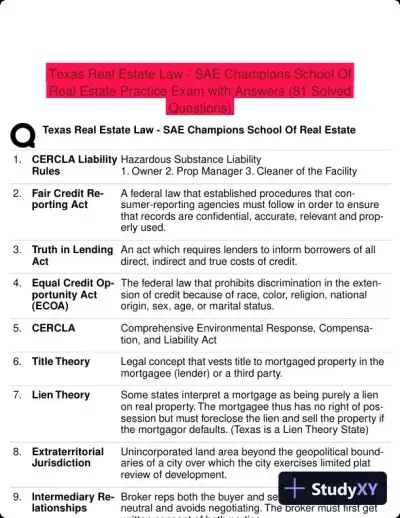 Past Exams
Texas Real Estate Law - SAE Champions School Of Real Estate Practice Exam with Answers (81 Solved Questions)
Other Exams & Certifications
9 pages153downloadsFeb 2025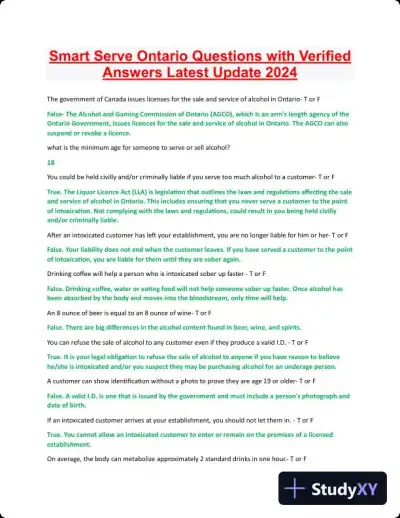 Past Exams
2024 Smart Serve Ontario Practice Exam with Answers (53 Solved Questions)
Other Exams & Certifications
6 pages153downloadsFeb 2025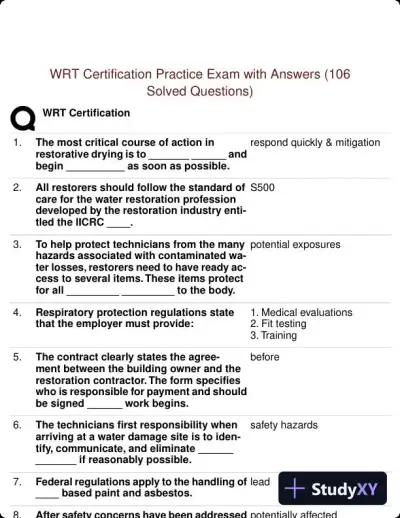 Past Exams
WRT Certification Practice Exam with Answers (106 Solved Questions)
Other Exams & Certifications
16 pages151downloadsFeb 2025 Past Exams
2024 Vivint SHP Practice Exam with Answers (35 Solved Questions)
Other Exams & Certifications
4 pages144downloadsFeb 2025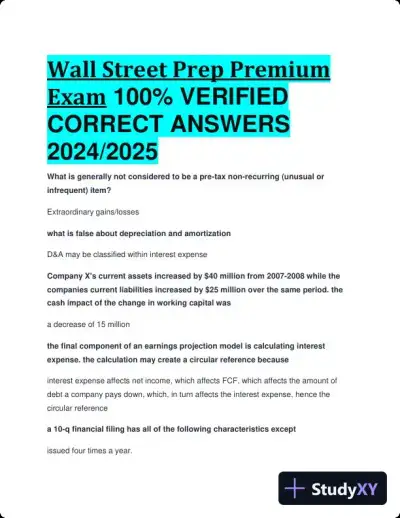 Past Exams
2024-2025 Wall Street Prep Premium Exam with Answers (50 Solved Questions)
Other Exams & Certifications
13 pages138downloadsFeb 2025 Past Exams
2024-2025 Lifeguard Final Exam with Answers (69 Solved Questions)
Other Exams & Certifications
11 pages137downloadsFeb 2025 Past Exams
2023-2024 ISSA Certification Final Exam with Answers (200 Solved Questions)
Other Exams & Certifications
49 pages136downloadsFeb 2025
Study this document with CramX
Once it is in your library, every tool can work from it.