
American Red Cross Lifeguarding Practice Exam with Answers (238 Solved Questions)

Master exam questions with American Red Cross Lifeguarding Practice Exam with Answers, offering solved exams and practice questions to improve your test-taking skills.

Anna Wilson
Contributor
4.0
47
10 months ago
Preview (8 of 26 Pages)
100%
Log in to unlock

Page 1

American Red Cross Lifeguarding Practice Exam with Answers (238 Solved Questions) - Page 1 preview image

Loading page ...

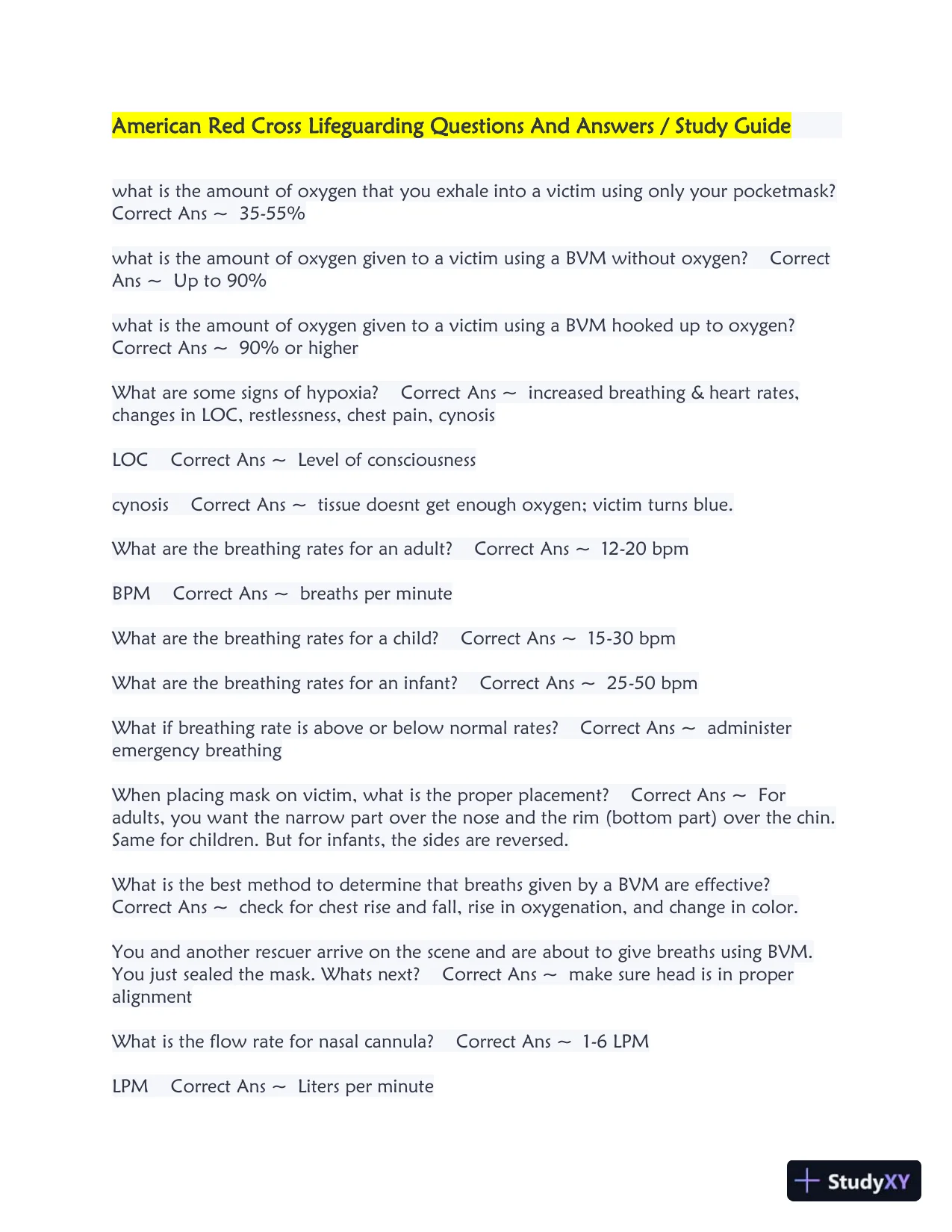
American Red Cross Lifeguarding Questions And Answers / Study Guidewhat is the amount of oxygen that you exhale into a victim using only your pocketmask?Correct Ans ~ 35-55%whatis the amount of oxygen given to a victim using a BVM without oxygen?CorrectAns ~Up to 90%what is the amount of oxygen given to a victim using a BVM hooked up to oxygen?Correct Ans ~ 90% or higherWhat are some signs of hypoxia?CorrectAns ~ increased breathing & heart rates,changes in LOC, restlessness, chest pain, cynosisLOCCorrect Ans ~ Level of consciousnesscynosisCorrect Ans ~ tissue doesnt get enough oxygen; victim turns blue.What are the breathing rates for an adult?Correct Ans ~ 12-20 bpmBPMCorrect Ans ~ breaths per minuteWhat are the breathing rates for a child?Correct Ans ~ 15-30 bpmWhat are the breathing rates for an infant?Correct Ans ~ 25-50 bpmWhat if breathing rate is above or below normal rates?Correct Ans ~ administeremergency breathingWhen placing mask on victim, what is the proper placement?Correct Ans ~ Foradults, you want the narrow part over the nose and the rim (bottom part) over the chin.Same for children.But for infants, the sides are reversed.What is the best method to determine that breaths given by a BVM are effective?Correct Ans ~ check for chest rise and fall, rise in oxygenation, and change in color.You and another rescuer arrive on the scene and are about to give breaths using BVM.You just sealed the mask. Whats next?Correct Ans ~ make sure head is in properalignmentWhat is the flow rate for nasal cannula?Correct Ans ~ 1-6 LPMLPMCorrect Ans ~ Liters per minute

Page 2

American Red Cross Lifeguarding Practice Exam with Answers (238 Solved Questions) - Page 2 preview image

Loading page ...

Page 3

American Red Cross Lifeguarding Practice Exam with Answers (238 Solved Questions) - Page 3 preview image

Loading page ...

What is the flow rate for resuscitation mask?Correct Ans ~ 6-15 LPMWhat is the flow rate for a non-rebreather mask?Correct Ans ~10-15 LPMBVMCorrect Ans ~Bag-Valve MaskWhat is the flow rate for a BVM?Correct Ans ~15LPM or higherWhat do you use to set LPM?Correct Ans ~ with a variable-flow-rate oxygen system,turn the FLOWMETER to suggested L.P.Mhow do you determine oxygen is flowing?Correct Ans ~ Listen for a hissing soundand feel for oxygen flow through the delivery device.What will interfere with the accuracy of a pulse oximeter reading?Correct Ans~shock, cardiac arrest, excessive motion of patient during reading, carbon monoxidepoisoning, fingernail polish, hypothermia or other other cold related emergency, sicklecell anemia, cigarette smokers, swelling, time lag detection of repiratory insufficiencyPulse oximeter (the finger box thing)Correct Ans ~used to measure percentage ofoxygen saturation in the blood.What should you do when the oxygen cylinder reaads 200 lbs per sq. inch?CorrectAns ~do not use. you want the pressure gauge to read more than 200 psiWhat should you do when the oxygen cylinder reaads 800 lbs per sq. inch?CorrectAns ~its ok to useWhat pulse oximeter reading indicates possible hypoxia?Correct Ans ~ 94% andbelow. 91-94 is mild, 86-90 is moderate, less than 85 is severeHow many seconds should ventilation last?Correct Ans ~ 1 second and make thechest clearly riseActive Drowning VictimCorrect Ans ~ A person exhibiting universal behavior thatincludes struggling at the surface in a vertical position and being unable to move forwardor tread water. Cant call for helpPassive Drowning VictimCorrect Ans ~An unconscious victim face-down, submergedor near the surface.What are signs of spinal victim?Correct Ans ~unusual bumps or bruises, pain,bleeding, loss of balance, etc. If the incident happened and you did not witness it, youcan assume it was a spinal. Reassess what they were doing before the incident

Page 4

American Red Cross Lifeguarding Practice Exam with Answers (238 Solved Questions) - Page 4 preview image

Loading page ...

Your primary responsibility as a lifeguard is?Correct Ans ~ Preventing injuries,enforcing rules, recognizing and responding quickly to emergencies, administering firstaid and CPR, and informing others when help is needed. Watching the waterHow do you treat a victim with ahead, back, or neck injury?Correct Ans ~ minimizemovement of area, if victim is in the water, immobilize them using a backboard. If thevictim is not breathing remove them first. call EMS first!What do you do if you cant see a part of the pool because of glare?Correct Ans ~move to a different position, ask to move the stand, get a closer lookA patron is running on deck. What should you do?Correct Ans ~ Ask them politely tostop running. If they choose to ignore you advice them of certain consequencesWhen you have a victim with a head neck or back injury. What is the technique you usein the water called?Correct Ans ~ Head-Splint technique. Keeping both hands onmuscles pressing against the headA head, back, or neck injury rarely happens where?Correct Ans ~ supervised diving inthe deep endWhat is an AFR?Correct Ans ~ Accidental Fecal ReleaseHow do you handle an AFR?Correct Ans ~ direct all patrons to exit the pool thatuses the same filtration system, remove as much of the material as possible with a scoopnet trying not to break it apart. Dispose of.AFR: stoolCorrect Ans ~ Filtration system, pH below 7.5, raise free chlorine to atleaast 2 ppm, maintain levels for 25 minAFR: diarrheal dischargeCorrect Ans ~continue operating circulation system, adjustpH to below 7.5, raise free chlorine to 20 ppm, maintain those levels for 13 hours,backwash filter, return chlorine level to normal before reopening the pool.What should you do if you see a patron trying to swim underneath the water for longdistances over long periods of time?Correct Ans ~Stop him and tell him of thedangersWhat do you do with a victim that has suffered a head, neck or spine injury and isconscious?Correct Ans ~ dont move the victim unless the scene becomes unsafeWhat is effective scanning?Correct Ans ~ keeps an eye on the patrons of the pool,checking the bottom, middle and surface of the water.

Page 5

American Red Cross Lifeguarding Practice Exam with Answers (238 Solved Questions) - Page 5 preview image

Loading page ...

What type of coverage is it if your supervisor sets up multiple stands for watching thepool?Correct Ans ~zone coverageWhen do you need to move the victim?Correct Ans ~ when the scene becomesunsafe, and when more people are injuredWhat do you do in case of power failure?Correct Ans ~ clear everyone from the poolYou must leave the victim in order to get help. What must you do with the victim?Correct Ans ~ Put them in the correct HAINES positionHAINESCorrect Ans ~ High Arm IN Endangered SpineWhat pieces of equip. needs to be accessible for an emergency?Correct Ans ~Backboards, AED's, BVM, PPE, Reaching poles, Shepherds CrooksWhat equip. should be carried with you at all time?Correct Ans ~ Pocket mask,Gloves, First AID materials, Rescue tubeIn what order do you strap the victim on the backboard in?Correct Ans ~ Chest,Waist, ThighsThe facility management should provide you with what things?Correct Ans ~ pre-service evaluation, annual or preseason orientation and training, a policies andprocedures manual and reg. in service trainingWhat is an MSDS sheet and what info is on it?Correct Ans ~ Material Safety DataSheet; info about chemical, how to clean it up and how to safely dispose,What is good indication someone has suffered a headback or spine injury?Correct Ans~If the accident was not seenWhat is the good samaritan law? Are you protected?Correct Ans ~protect peopleagainst claims of negligence after providing care in good faith without having acceptedanything in returnWhat is negligenceCorrect Ans ~ The failure to follow the standard of care or to act,thereby causing injury or further harm to another.What should you do if you hear/ see lighting and thunder?Correct Ans ~clear thepool, get everyone inside, no phones, no showers, watch for storm on weather report,PPECorrect Ans ~ personal protective equipment, use whenever you come in contactwith open wounds, another person, emergency breaths

Page 6

American Red Cross Lifeguarding Practice Exam with Answers (238 Solved Questions) - Page 6 preview image

Loading page ...

Signs of Asthma. How to handle.Correct Ans ~Hoarse inhaling (wheezing),coughing, inability to talk. Caring: Sit in comfortable position, help with medication, useinhaler, count to 10 holding breath (victim)Conscious choking: Adult, ChildCorrect Ans ~5 hits on upper back between shoulderblades, 5 abdominal thrusts.Differences in providing careCorrect Ans ~ breathing/has pulse; nobreathing/pulse;not breathing/no pulse*Unconscious choking; Adult. Child. InfantCorrect Ans ~ Retilt head and attemptventilation, give 30 chest compressions, look inside mouth, attempt ventilationsInfant. Conscious chokingCorrect Ans ~ 5 back blows, 5 chest thrusts (with twofingers)Continue providing care for choking untilCorrect Ans ~ object is forced out, victimbegins to cough or forcefully breathe, victim becomes unconsciousAdult CPR compression depthCorrect Ans ~ 2 in or moreChild CPR compression depthCorrect Ans ~ 2 inInfant CPR compression depthCorrect Ans ~1.5 inAdult, Child, Infant CPR co0mpression cycles one rescuerCorrect Ans ~ 30 chestcompressions and 2 vent.Adult Child Infant CPR Compression cycles 2 rescuersCorrect Ans ~Adultstays thesame. Infant and Child change to 15 chest compressions 2 breathsRate of CPR compressionsCorrect Ans ~ 100 p.m.Cardiac Chain of Survival (4 earlies)Correct Ans ~early recognition and early accessto 911, early CPR, early defibrillation, early EMS careV-fibCorrect Ans ~ heart quivers, pumps but shallow. venticular fibrillationV-techCorrect Ans ~ abnormal electrical impulse of heart; ventricular tachycardiaHow to use AEDCorrect Ans ~AED present, powered on, victims chest/suit isprepped (shave, cut, dry, patch), pads placed on victims upper right & lower left, padsare then plugged in, place analyze button or shock button if machine indicatesAgonal GaspsCorrect Ans ~Isolated or infrequent gasping in the

Page 7

American Red Cross Lifeguarding Practice Exam with Answers (238 Solved Questions) - Page 7 preview image

Loading page ...

absence of other breathing in an unconscious person. care for victim as if not breathingby giving ventilations or providing CPRLife threatening conditionsCorrect Ans ~ drowning, severe bleeding, unconsciousness,cardiac problems, breathing problemsNon life threatening conditionsCorrect Ans ~head neck back injury, cramps,overexertion, dislocations, sunburns, fractures, sprains, dehydrationRWICorrect Ans ~ Recreational Water IllnessesOSHACorrect Ans ~ Occupational and Safety Health Administrationtotal coverageCorrect Ans ~one personFIND-FCorrect Ans ~ Figure out the problemFIND-ICorrect Ans ~ Identify possible solutionsFIND-NCorrect Ans ~ Name the pros and cons for each solutionFIND-DCorrect Ans ~Decide which solution is bestOne long whistleCorrect Ans ~ leaving stand2 whistlesCorrect Ans ~someone come and help me with...3 whistlesCorrect Ans ~calls head lifeguard4 whistlesCorrect Ans ~ firstaid, where person cant get to office. Bleeding, fall,someone needs help, Not life threateningPDSDCorrect Ans ~Post dramatic stress disorderWhistle activates...Correct Ans ~ EAPFASTCorrect Ans ~ Face, Arm, Speech, TimeSAMPLECorrect Ans ~ Signs and symptoms, Allergies, Medications, Pertinent pastmedical history, Last oral intake, Events leading to incidentSecondary assesment isCorrect Ans ~ non life threateningDuty to actCorrect Ans ~ Your legal responsibility todo something in the case of anemergency

Page 8

American Red Cross Lifeguarding Practice Exam with Answers (238 Solved Questions) - Page 8 preview image

Loading page ...

Anaphylactic ShockCorrect Ans ~ A severe allergic reaction inwhich air passages may swell and restrict breathing; aform of shock. See also anaphylaxis.AEDCorrect Ans ~ automatedexternal defibrillatorDistressed SwimmerCorrect Ans ~A person capable of staying afloat, but likely toneed assistance to get to safety.EAPCorrect Ans ~ emergency action planin line stabilizationCorrect Ans ~ A technique used to minimize movement of avictim's head and neck while providing care.RICECorrect Ans ~ rest, immobilize, cold, elevateCPR child ageCorrect Ans ~ 12AED child ageCorrect Ans ~ 1 yr-8yr 50 lbs
Preview Mode

This document has 26 pages. Sign in to access the full document!