

CNML Test Practice Exam with Answers (175 Solved Questions)
- Other Exams & Certifications
- 18 pages
- Shared February 2025
- 135 downloads
Prepare like a pro with CNML Test Practice Exam with Answers, featuring authentic past exams.
Preview 6 of 18 pages
See the first 6 pages exactly as they appear in the document.
Page 1 Read page 1 as text
CNML Test 1. DRGs Diagnostic-Related Groups: payment rate based on spe- cific diagnoses 2. Prospective Pay- ment System Used by Medicare-participating hospitals: pretreatment diagnosis billings based on DRGs; rate decided ahead of time between insurance companies and hospitals 3. Exclusive Provider Used by HMO's: insurance coverage for contracted providers or institutions 4. HMOs Health maintenance organizations: comprehensive healthcare to people who pay a fee for a fixed period of time 5. Capitation Fixed rate paid to provider per member per month for healthcare services; set fee paid by insurance company per month for all the patient needs 6. PPOs Preferred provider organizations: special reduced rate for services when customers use certain providers approved by the insurance company; usually fee-for-service 7. IPAs Individual provider arrangements: provide care in their offices for prepaid plans; coalition of physicians who serve HMO patients and third-party patients 8. Fulltime FTE Hours 2080 hours (1.0 @ 40 hours per week) 9. Capital Expens- es Long-term equipment or physical purchases: usually over $500-$1000 that will last years and depreciate over time and be used multiple times 10. Zero-Based Bud- get With each new budget (i.e. fiscal year), it is determined which programs/areas get money; no historical context is used; may rank packages and then only fund top-ranked ones; can be time-consuming way to create a budget 11. 1 / 18
Page 2 Page 3 Read page 3 as text
CNML Test Variance Calcu- lation & Re- minders Variance $ /Budgeted $ X 100 = % difference; contract staff on separate line of budget; many staff sick costs more than a few staff on LOA 12. Cost of Nursing Services Calcu- lation Nurse Time X (Avg. RN Hourly Rate + Benefits + Indi- rects) = Total Nursing Cost per DRG 13. General Nurse Staffing Calcula- tion # of RNs needed X days open / # days worked per RN 14. FTE Definition & Calculation Full-time equivalent = full-time employee paid for 1 year FTE = (Hours per shift X # of days worked) / 40 hours 15. Fixed Costs Stay the same no matter the census: manager salaries, keeping phones on, rent, etc. 16. Variable Costs Change with census and how much staffing is used 17. Net Revenue Cal- culation Gross Revenue - Deductions from Revenue (DRGs and the Contractual allowances paid by insurance compa- nies) 18. UAP Unlicensed assistive personnel (CNA's) 19. ADC Average daily census (patients in a bed at midnight) 20. Total Patient Days Calculation ADC X Days open per year (for SCH - ADC X 365) 21. Nurse Hours Per Patient Day (HPPD) Calcula- tion Total Direct Care Hours / Total Patient Days = # of RN hours needed to provide care for a pt. for 24 hours. For example - for 12 hour staff and 12 workers each shift you multiply 12 staff X 2 shifts = 24 staff X 12 hours each = 288 divided by midnight census of 31 = NHPPD 22. VBP 2 / 18
Page 4 Read page 4 as text
CNML Test Value-based purchasing: how CMS determines how much to reimburse a hospital for care (benchmarked stan- dards and how they are meeting it); quality of care & following best practice & patient experience 23. Per Diem Rate Negotiated pay for services by insurance companies re- gardless of what services were actually completed; per day admitted 24. UOS Unit of service: patient days for inpatient nursing but could be visits or # of procedures or whatever that healthcare organization counts 25. RVU Relative value unit: what ancillary services might use to add up their UOS; # of hi-flows hooked up or vents started for RT., for example 26. ALOS Calcula- tion Average length of stay = # of pt. days / # of discharges (in same time period) 27. CPUOS Cost per unit of service = salaries / UOS 28. Productivity # of staff hours or $'s / # of UOS RN hours / patients in beds @ midnight (HOC) RN salaries / UOS Output / input Amount of work performed by a set # of staff 29. Minimum Staffing Minimum staff needed to operate unit usually determined by law, hospital policy, and pt safety 30. Breakeven Needed in order not to lose money; minimum patients needed to meet budget using minimum staffing; can't control admissions but some would work with staffing office to ensure minimum occupancy occurred 3 / 18
Page 5 Read page 5 as text
CNML Test 31. Medicare Federal program that helps those over 65, those on dialysis/ESRD, and combines with state run Medicaid, younger people who are permanently disabled, and physician residency training 32. EMTALA Emergency Medical Treatment and Active Labor Act: must treat people in ED regardless of ability to pay, cit- izenship, and legal status 33. Case Mix Index A system that classifies patients by age, diagnosis, treat- ment, clinical, and financial categories to develop the reimbursement rate 34. Productive Time 2080 hours - Benefit hours 35. Revenue Gross = $ charged Net = $ collected 36. OE for Budgets Operating Expenses: salaries, supplies, rent, non-pro- ductive time, etc. 37. Margin Difference between expenses and how much money is collected Margins down = less gross or net income Margins up = more gross or net income 38. Workload Per Day Total workload hours / 365 days / 24 hours 39. Costs in a Bud- get Fixed, variable & non-recurring (like installing new piece of equipment or 100th anniversary party for the hospital) 40. Replacement Factor Adding up the benefit time because nurses don't actually work 2080 hours per year; add this to the total FTE's 41. HCAHPS Hospital Consumer Assessment of Healthcare Providers and Systems: national survey asking patients how their stay was 4 / 18
Page 6 Read page 6 as text
CNML Test 42. National Labor Relations Act (NLRA) (AKA: Wagner Act) Passed to end the depression; pre- vented employers from cutting wages; lots of power to unions/employees; 1974 amendments created union needs to give notice before striking, no strikes during no- tice time, written notice to employers about new contract need, mediation needs, board of inquiry to settle disputes, and allowed employees to bow out of joining; created unfair labor practices against employers from stopping unions or discriminating against union employees Rights of unions/workers 43. Labor Manage- ment Relations Act (AKA: Taft-Hartley Act) Listed union restrictions to even out rights between employees and employers from the NLRA/Wagner Act; placed restrictions on labor organiza- tions like forcing employees to join or refusing to bargain; created code of contact for unions Rights of management 44. Civil Rights Act of 1964 Prohibits discrimination against race, religion, sex, creed, color, gender, national origin 45. Recognition Phase of Negotiations Need 30% of nurses to sign individualized authorization cards before labor union can rep them 46. Decertification Employees elect to stop using the union; also need 30% of the vote before even going to the NLRB to start the process 47. Hill-Burton Act Funding given to healthcare facilities so these facilities must treat any patient through ED, participate in CMS, post things in language of 10% of population, etc. 48. Fair Labor Act Federal law that establishes minimum wage, overtime pay eligibility, and child labor standards 49. Shared Gover- nance 5 / 18
12 more pages in the full document
Unlock it once and it stays in your library, ready to chat with or turn into flashcards.
Unlock the full documentMore Other Exams & Certifications study materials
See all Certification Guides
ACFT For Dummies (2020)
Other Exams & Certifications
467 pages156downloadsFeb 2025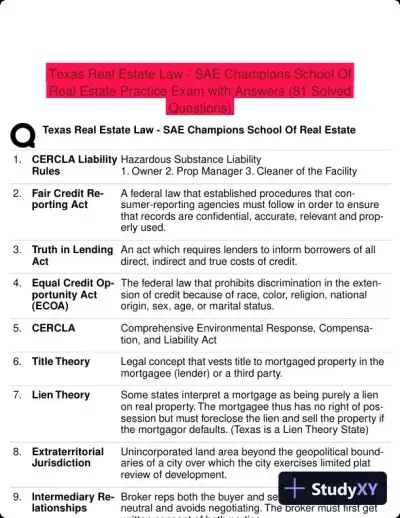 Past Exams
Texas Real Estate Law - SAE Champions School Of Real Estate Practice Exam with Answers (81 Solved Questions)
Other Exams & Certifications
9 pages153downloadsFeb 2025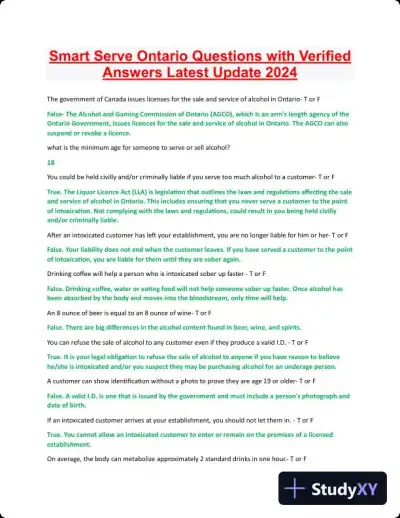 Past Exams
2024 Smart Serve Ontario Practice Exam with Answers (53 Solved Questions)
Other Exams & Certifications
6 pages153downloadsFeb 2025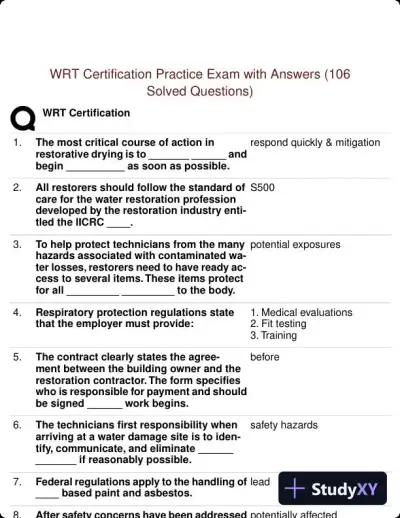 Past Exams
WRT Certification Practice Exam with Answers (106 Solved Questions)
Other Exams & Certifications
16 pages151downloadsFeb 2025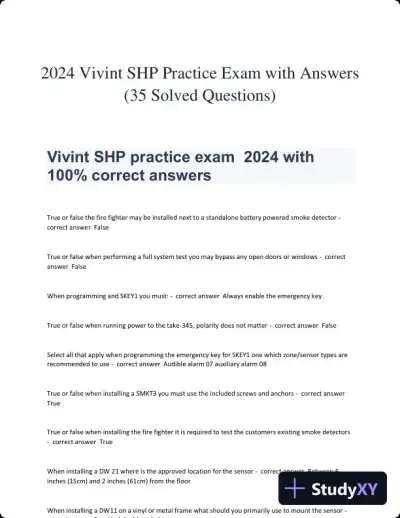 Past Exams
2024 Vivint SHP Practice Exam with Answers (35 Solved Questions)
Other Exams & Certifications
4 pages144downloadsFeb 2025 Past Exams
2024-2025 Wall Street Prep Premium Exam with Answers (50 Solved Questions)
Other Exams & Certifications
13 pages138downloadsFeb 2025 Past Exams
2024-2025 Lifeguard Final Exam with Answers (69 Solved Questions)
Other Exams & Certifications
11 pages137downloadsFeb 2025 Past Exams
2023-2024 ISSA Certification Final Exam with Answers (200 Solved Questions)
Other Exams & Certifications
49 pages136downloadsFeb 2025
Study this document with CramX
Once it is in your library, every tool can work from it.