
New RPSGT Exam - Study Guide and Practice test with Answers (999 Solved Questions)

New RPSGT Exam - Study Guide and Practice test with Answers is your go-to resource for practicing past exams, featuring real exam questions and answers.

Lily Green
Contributor
4.2
32
10 months ago
Preview (16 of 68 Pages)
100%
Log in to unlock

Page 1

New RPSGT Exam - Study Guide and Practice test with Answers (999 Solved Questions) - Page 1 preview image

Loading page ...

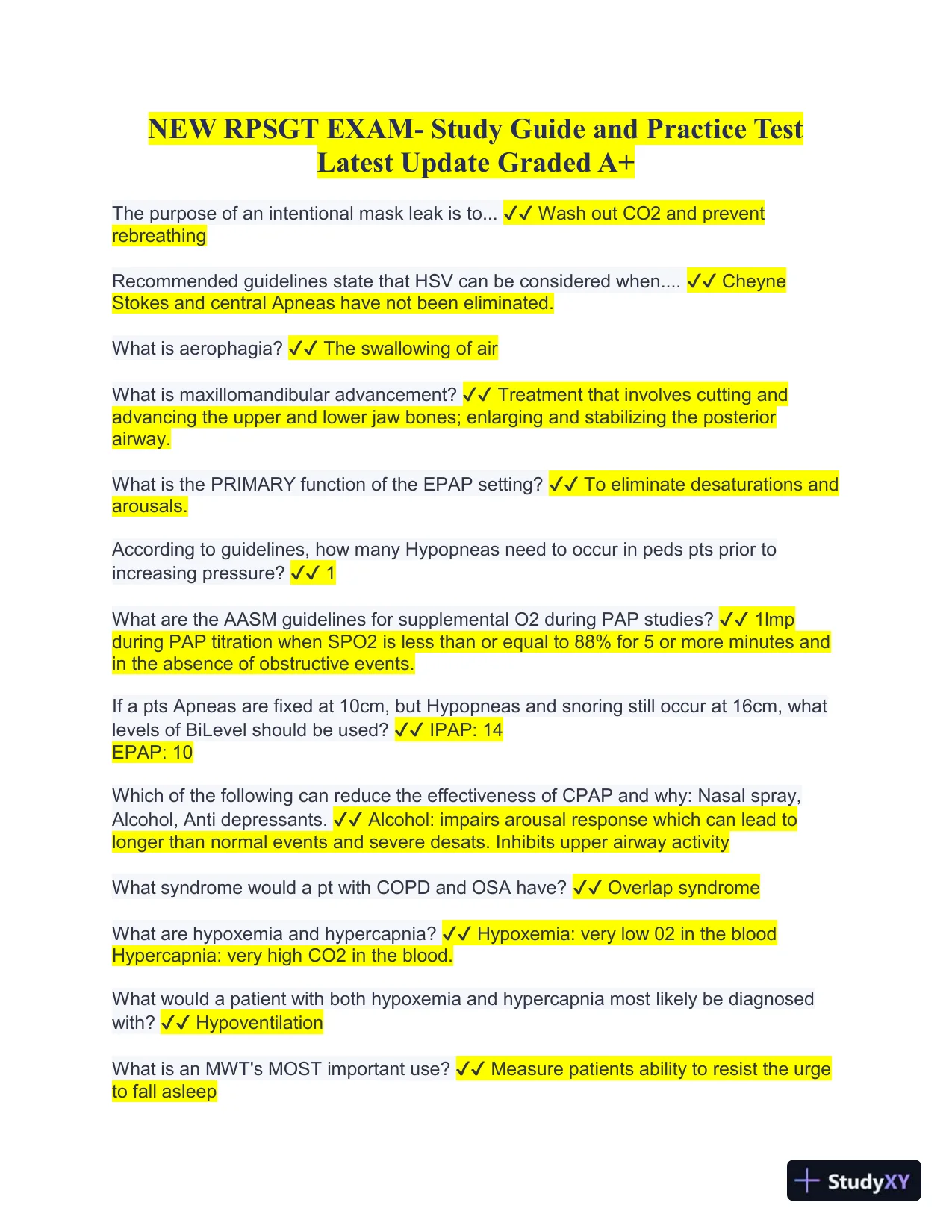
NEW RPSGT EXAM-Study Guide and Practice TestLatest UpdateGraded A+The purpose of an intentional mask leak is to...✔✔Wash out CO2 and preventrebreathingRecommended guidelines state that HSV can be considered when....✔✔CheyneStokes and central Apneas have not been eliminated.What is aerophagia?✔✔The swallowing of airWhat is maxillomandibular advancement?✔✔Treatment that involves cutting andadvancing the upper and lower jaw bones; enlarging and stabilizing the posteriorairway.What is thePRIMARY function of the EPAP setting?✔✔To eliminate desaturations andarousals.According to guidelines, how many Hypopneas need to occur in peds pts prior toincreasing pressure?✔✔1What are the AASM guidelines for supplemental O2 during PAP studies?✔✔1lmpduring PAP titration when SPO2 is less than or equal to 88% for 5 or more minutes andin the absence of obstructive events.If a pts Apneas are fixed at 10cm, but Hypopneas and snoring still occur at 16cm, whatlevels of BiLevel should be used?✔✔IPAP: 14EPAP: 10Which of the following can reduce the effectiveness of CPAP and why: Nasal spray,Alcohol, Anti depressants.✔✔Alcohol: impairs arousal response which can lead tolonger than normal events and severe desats. Inhibits upper airway activityWhat syndrome would a pt with COPD and OSA have?✔✔Overlap syndromeWhat are hypoxemia and hypercapnia?✔✔Hypoxemia: very low 02 in the bloodHypercapnia: very high CO2 in the blood.What would a patient with both hypoxemia and hypercapnia mostlikely be diagnosedwith?✔✔HypoventilationWhat is an MWT's MOST important use?✔✔Measure patients ability to resist the urgeto fall asleep

Page 2

New RPSGT Exam - Study Guide and Practice test with Answers (999 Solved Questions) - Page 2 preview image

Loading page ...

Page 3

New RPSGT Exam - Study Guide and Practice test with Answers (999 Solved Questions) - Page 3 preview image

Loading page ...

Tricyclic antidepressants, large amounts of caffeine and large amounts of chocolatehave been known to trigger what?✔✔REM sleep behavior disorderRecommended impedance for eeg and eog✔✔5k ohmsThe amount of space needed to archive digitized data is MOST impacted by?✔✔Sampling rateCortical activity is best described as✔✔Spontaneous arousalCalculate the AHI based on the following data25 obstructive apneas5 central apneas23 mixed apneas15 hypopneas48 RERAS65 arousals360 min of sleep✔✔11According to RECOMMENDED guidelines, the minimum duration of a significant legmovement is✔✔.5Accordingto RECOMMENDED guidelines, an optional parameter to include in thereport for an adult polysomnogram is✔✔Occurrence of hypoventilation during thediagnostic study in adultThe respiratory event that requires oxygen desaturation and/ or an arousal as part ofthe scoring criteria is✔✔Obstructive hypopneaAn ECG arrhythmia commonly seen when recording PSG's, particularly in patients thathave obstructive sleep apnea and cardiac disease. It can be identified by themorphology of an irregularly irregular ventricular rhythm associated with replacement ofconsistent P waves by rapid oscillations that vary in size, shape, and timing✔✔AtrialfibrillationThe stage that is the greatest portion of the epoch✔✔The stage that is the greatestportion of the epochWhat is the best response when a patient asks the technologist if they have sleepapnea and will need to wear a CPAP mask?✔✔Provide the patient with educationalmaterial about sleep apneaWhich of the following is the MOST LIKELY cause of a 35 minuteREM latency✔✔Untreated depression

Page 4

New RPSGT Exam - Study Guide and Practice test with Answers (999 Solved Questions) - Page 4 preview image

Loading page ...

A breathing pattern characterized by at least three cycles of crescendo breathing withduration of at least 10 minutes is✔✔Cheyne Stokes respirationAn important responsibility of the scoring tech is to✔✔Confirm accuracy of reportcomponentsWhich type of calibration is based on a series of patient instructions intended to verifythe signal response and quality✔✔PhysiologicalThe most important reason for performing a MWT is to✔✔Measure the patient's abilityto resist the urge to fall asleepThe importance of selecting sampling rates according to RECOMMENDED guidelines isto✔✔Minimize aliasing effectThe syndrome characterized by prolonged episodes of severe hypoxemia andassociated PaCO2 elevation that worsens during sleep is✔✔Obesity hypoventilationThe patient's medical history indicates the patient has been taking tricyclicantidepressants for the past 5 years. The technologist should anticipate that the patientmay have an increased likelihood of✔✔REM Sleep Behavior DisorderAccording to RECOMMENDED guidelines, the sampling rate to provide the optimalresolution for recording EEG in a patient with suspected nocturnal seizure is✔✔500HzThe electrode located 30% above the left pre-a creaseis✔✔C3According to RECOMMENDED guidelines, four nap opportunities on a MSLT would beacceptable when the patient✔✔Had REM on at least two nap opportunitiesA patient's history indicates a diagnosis of overlap syndrome. The tech can anticipatethat the patient has✔✔COPD AND OSAaccording to recommended guidelines, which of the following should be included whenrecording pediatric patients✔✔end-tidal co2the ability to remontage while recording on digital equipment is the result of✔✔systemreferencingwhen reviewing a patient's history in preparation for a polysomnogram, physiologicfindings suggestive of hypoventilation include✔✔hypoxemia and hypercapnia

Page 5

New RPSGT Exam - Study Guide and Practice test with Answers (999 Solved Questions) - Page 5 preview image

Loading page ...

when the amplitude of a signal exceeds the physical limitations of a channel the mostimportant adjustment the tech can make to optimize waveform display is to✔✔decrease sensitivitywhen intermittent 60 hz activity occurs in the f4-m1 electrodes during rem sleep the bestimmediate action would be to✔✔rely on f3-m2a patient with mild dementia becomes more confused and/or agitated in the earlyevening. the patient is most likely experiencing✔✔sundowningthe most common method to monitor blood oxygen saturation during polysomnographyis✔✔pulse oximetrythe most appropriate action a technologist would take when there is confirmedventricular tachycardia greater than 30 seconds is✔✔initiate emergency responsesystema patient's chart indicates that they use 30 l/min of oxygen at home. the tech notes thatthe physician's orders for the psgspecifies the study without supplemental oxygen andto add 1.0 l/min oxygen if the saturation is less than 89%. the best action for the tech isto✔✔call the physician for confirmationwhich of the following is the most likely effect of zolpidem and zaleplon on sleeparchitecture✔✔increased sleep latencywhich of the following best describes a referential montage✔✔there is potential forelectrode contaminationaccording to recommended guidelines, the device that should be used to monitor airflowand detect apnea during a diagnostic study is✔✔oronasal thermal sensorwhich process would be an adequate routine for disinfecting cup electrodes afterremoving adhesive residue, gel and organic material, and washing in warm water andmild detergent✔✔soaking in 1: 10 bleach and water for 10 min.which of the following would be most important to document during a polysomnogram✔✔position changesthe electrode array used for recording physiologic activity is referred to as✔✔montageaccording to recommended guidelines, the maximum electrode impedance for eeg andeog recording is✔✔5000 ohms

Page 6

New RPSGT Exam - Study Guide and Practice test with Answers (999 Solved Questions) - Page 6 preview image

Loading page ...

according to recommended guidelines, unattended portable monitoring can be used asan alternative to in lab testing when✔✔there is a high probability of moderate to severeosa without comorbid conditionsa self reporting tool used to evaluate subjective sleep quality and disturbance over theprevious month is✔✔pittsburgh sleep quality indexthe most appropriate setting a technologist would use to control thefrequency band ofwaveforms on a recording is the✔✔(low filter (high pass filter)which of the following can negatively impact all bioelectric channels✔✔contaminatedm1which of the following substances can reduce the effectiveness of pap therapy✔✔alcoholic beveragesa patient that intentionally engages in behavioral patterns that are inconsistent withsleeping well is demonstrating✔✔inadequate sleep hygienewhat is the best tool that a physician could use to more clearly explain the results ofthesleep study and the importance of therapy to a patient✔✔histogramreal time access to pap compliance data is an example of✔✔efficacy monitoringa process to decrease fear of artificial circumstances by repeated and controlledexposure to a fearedsituation is✔✔desensitizationwhat has the largest impact on adherence to pap therapy✔✔patient educationwhich statement is true regarding cpap✔✔there is one level of pressure for inspirationand expirationsleep debt can best be described as the✔✔cumulative effect of insufficient sleepaccording to recommended guidelines for pediatric cpap titration, how many hypopneasmust occur prior to increasing pressure✔✔oneexcessive warming and humidification will cause✔✔water to pool in the cpap tubingmaxillomandibular advancement treats osa by✔✔enlarging and stabilizing the upperairwayin patients with severe sleep-disordered breathing the most commonly seen responseresulting from successful pap titration is✔✔rem and slow wave rebound

Page 7

New RPSGT Exam - Study Guide and Practice test with Answers (999 Solved Questions) - Page 7 preview image

Loading page ...

which of the following is most likely to occur due to an improperly fitting pap interface?✔✔conjunctivitiswhen a patient complains of claustrophobia, is unable to tolerate pap and requests toend the psg, the next best step is to✔✔schedule desensitizationa patient reports a complete nasal obstruction prior to pap titration. the tech should✔✔use a oro-nasal interfacethe best candidate for oral appliance would have✔✔mild osaduring stage n2 sleep, the patient changes position and the tech notes increasedsnoring and an increasing leak. the tech should✔✔reposition and adjust pap interfaceaccording to recommended guidelines, cpap should be increased at an interval no lessthan✔✔5 minutesthe primary function of epap is to✔✔maintain upper airway patency through inspirationbased on the psg results below, what would be the best recommendation for a patientthat is non-compliant and refuses to continue with cpap therapyoverall ahi 8overall rem ahi 38supine rem ahi 28supine nrem ahi 21lateral nrem ahi 1lateral rem 3✔✔position therapythe best method for detecting apneas and hypopneas during pap titration is to use a/an✔✔airflow signal generated by the pap delivery devicethe primary benefit of heated humidification is to✔✔help reduce nasal congestiona side effect of cpap is✔✔aerophagiathe most common reason for changing the pap interface during a titration is✔✔unacceptable leak valuewhat is the recommended starting pressure for pediatric and adult cpap titration✔✔4cmh2othe purpose of intentionalleak is to✔✔wash out co2 and prevent rebreathing

Page 8

New RPSGT Exam - Study Guide and Practice test with Answers (999 Solved Questions) - Page 8 preview image

Loading page ...

during cpap titration at 10 cm h2o, spo2, values range between 80 and 85% for 10 mindespite absence of respiratory events. what is the best action for the tech to take✔✔follow protocol for supplementaloxygenaccording to recommended guidelines, adaptive servo ventilation can be consideredduring a titration study when a down titration✔✔has not eliminated cheyne stokesrespiration or central emergent apneasduring a titration study the patients apneas are eliminated at 10 cm h2o but hypopneasand snoring continue at 16 cm h20. according to recommended guidelines, theappropriate pressures to begin a bilevel titration are✔✔ipap 10epap 14during a cpap titration at 15 cm h20, the patient is restless and continues to havefrequent obstructive respiratory events. the best action is to✔✔change to bi leveldc channel✔✔psg channel derived from an external piece of equipment such as a papdevice or oximeter.stray capacitance✔✔when electrical signals from external sources interfere w/ signalsderived from the pt.amperes are measured in what units?✔✔coulombs/secondtime axis✔✔horizontal positioning of the pen.common mode rejection✔✔the process by which a differential amplifier rejectsidentical inputs (unwanted signals).mechanical baseline✔✔pen's vertical position when the power to the psg is turned off.electrical baseline✔✔the vertical positioning of the pen w/ power of psg turned on.capnometer✔✔a device used to measure the level of co2 in a sample of air.frequency✔✔measured in hertz(hz) or cycles/second.paper speed for psg✔✔10 mm/secwhen a pt. looks towards an eog electrode it causes what?✔✔a positive charge, ordownward deflection.rise time✔✔amount of time ittakes for a wave to reach 63% of its peak.

Page 9

New RPSGT Exam - Study Guide and Practice test with Answers (999 Solved Questions) - Page 9 preview image

Loading page ...

sensitivity setting for eeg channel✔✔7uv/mm or 70uv/cm*in pt.'s w/ low amplitude eegs, the sensitivity can be adjusted to 5uv/mm or 50uv/cmfilter settings for respiratory effort & airflow✔✔lff= 0.1hz hff=15hzfilter settings for eog✔✔lff= 0.3hz hff= 35hzhigh level disinfection✔✔used for items that come into contact w/ non-intact skin,blood, and mucous membranes.do the naps occur every 2 hours from the time the previous nap ended or every 2 hourson the hou r or half-hour?✔✔every 2 hours on the hour or half hour.how long before a nap begins should the subject cease smoking?✔✔30 minuteswhat epoch size is best for recording the "mslt"?✔✔30 seconds.a mean sleep latency of indicates what?Pathological sleepiness.A normal mean sleep latency is how many minutes?✔✔10-20 minutesHow many naps must have unequivocal periods of REM to arrive at a Diagnosis ofNarcolepsy?✔✔2 naps.What is the Narcoleptic Tetrad?✔✔Excessive daytime sleepiness, hypnagogichallucinations, sleep paralysis, cataplexy.How is the mean sleep latency calculated?✔✔Sum of all latencies, divided by total# ofnaps.During REM, inhibition of thermoregulatory mechanisms lead to what state?✔✔Poikilothermia.What equation best expresses time constant?✔✔TC= C x RTC=Time ConstantC= CapacitanceR= ResistanceWhat sleep stage requires at least 20% but no more than 50% of the epoch to consist ofwave of 2 cps or slower w/amplitudes greater than 75 uV.✔✔Stage3.an epoch that does not meet the criteria for active sleep or quite sleep is called what?✔✔intermediate sleep

Page 10

New RPSGT Exam - Study Guide and Practice test with Answers (999 Solved Questions) - Page 10 preview image

Loading page ...

trace alternant pattern is associated with what stage of sleep in the infant?✔✔quietsleep (nrem sleep)infant breathing patterns that alternates regular breathing with 5-10 seconds of apnea?✔✔periodic breathing.rem occupies what percentage of sleep in the neonate at term?✔✔50%.a function that expresses the frequency of eye movements per unit time during sleepstage rem?✔✔rem density.know as the pacemaker for mammalian circadian rhythms?✔✔suprachiasmaticnucleus (scn).a complaint of morning headaches associated with severe sleep apnea is a result ofwhat?✔✔Severe oxygen desaturation and hypercapnia (Elevated levels of carbondioxide in the blood).Pre-Sleep Interviews✔✔conducted by sleep technicians who ask questions to clarifyinformation and make careful observations of the patient such as, willingness to learn,mental age, physical limitations, etc.Sleep Diary✔✔Patient keeps a record of sleep habits for 2 weeks preceding the test.The sleep diary generally has two components: Before Sleep and After Sleep.Pre-sleep Questionnaire✔✔standardized form that reviews issues related to sleep, buttech asks additional questions for clarification, as needed. The questionnairedetermines if the patient's preceding 24 hrs was normal for that individual.Bed-Partner Questionnaires✔✔Filled out by the patient's bed partner (or roommate orparent in some cases) with the patient's permission. The partner typically is aware ofsnoring or periods of apnea even though the patient may not be aware.Morning Questionnaire✔✔Takes place in the morning after PSG; May come in theform of a checklist, or the tech may ask specific questions regarding sleep quality,onsetto sleep time,number of arousals,TST,Differences between sleeping at home and in lab,and Sleepiness upon awakening.-If pt reports sleep was very different from home,repeat PSG may be warranted.Morning/Evening Questionnaires✔✔asks 19 questionnaires about time preferences todetermine if patient is a morning,evening, or neutral person.

Page 11

New RPSGT Exam - Study Guide and Practice test with Answers (999 Solved Questions) - Page 11 preview image

Loading page ...

Excessive Daytime Sleepiness✔✔increasing societal problem related to lack ofadequate sleep, causing the patient to feel sleepy during thewaking hours to the pointthat the patient may fall asleep or feel the need to nap.Fatigue✔✔General feeling of tiredness, weakness, or lack of energy and may berelated to physical or emotional problems."Do you feel the need to sleep during the daytime?" "Do you feel drowsy?"---arequestions a tech should ask to determine if they are experiencing EDS or Fatigue?✔✔EDS"Do you feel as though you have no energy?" "Do you feel weary or weak?"---arequestions a tech should ask to determine if they are experiencing EDS or Fatigue?✔✔FatigueStanford Sleepiness Scale✔✔brief assessment used a number of different times a dayto determine if people have excessive daytime sleepiness (EDS).Epworth Sleepiness Scale✔✔evaluates how likely a person is to fall asleep during anumber of different activities. The person rates each situation on a scale of 0-3corresponding to the chance of falling asleep (none, slight, moderate, or high).Sleep-Wake Activity Inventory (SWAI)✔✔Measures a number of different aspects ofsleep disorders:excessive daytime sleepiness, nocturnal sleep,relaxing ability,energy,etc.-asks patient to score 9 different statements about sleepiness on a 1-9 scale. (Ascore of 50 or more is normal, 40-50 suggests EDS, 40 or less indicated EDS.Fatigue Severity Scale✔✔list of nine descriptions related to fatigue; patient scoreseach statement on a 1-7 scale (strongly disagree to strongly agree). Scores of 9-35=normal; scores above 35 suggest high degree of fatigue.Multiple Sleep Latency Tests (MSLT's)✔✔measure sleepiness during waking hoursand the tendency of a person to fall asleep.-may diagnose narcolepsy and idiopathichypersomnia.MSLT includes how many nap periods with first within 3 hours of nocturnal PSG, andthen spaced at 2 hours after preceding nap.✔✔5No smoking is allowed within _____ minutes of starting MSLT nap and no strenuousactivity within ____ minutes of a nap.✔✔30;15Maintenance of Wakefulness Test✔✔determines patient's ability to stay awake in thedaytime.

Page 12

New RPSGT Exam - Study Guide and Practice test with Answers (999 Solved Questions) - Page 12 preview image

Loading page ...

During MWT, patient is placed at rest, sitting in bed with low lights for ___ 40 minuteperiods spaced at 2 hours.✔✔4Tracheostomy✔✔An opening directly into the trachea bypasses the obstruction andopens the airway, but it is invasive and can result in many complications, so itis rarelydone.-can be blocked during waking hours and opened during sleep.-usued as lastresort usually in elderly or morbidly obese, facial abnormalities etcHigher Sampling Rates are needed to detect seizure activity in infant and child PSG'S.What sampling Rates for EOG AND EMG recordings during psg for seizure acivity?✔✔greater than or equal to 500 Hz for EOG and greater than or equal to 200 Hz for EMGrecording.Initiate Low-Flow Supplemental Oxygen at how many liters per minute when SpO2 fallsbelow 85% on ambient room air.✔✔1 liter per minuteMonitor SpO2 carefully to ensure it increases to at least __%✔✔90%Titrate oxygen by slowly increasing the flow rate by _._ liters per minute at a time untilthe SpO2 is 90% or more, but do not exceed 4 liters/min. without a physicians order.✔✔0.5 l/min.Obesity Hypoventilation Syndrome occurs when the body mass index is __kg/m2 ormore, resulting in impaired respirations,hypoxia, and hypercapnia during sleep. Theobesity results in impairment of muscles of muscles of inspiration, restricting the thoraxand causing hypoventilation, leading to hypercapnia.✔✔30You should begin CPAP when the patient is ready for sleep and start it at the lowestsetting, usually _ cm H20 and maintain the low pressure until the patient falls asleep.✔✔5Increase Positive Airway Pressure during CPAP titration by _ cm h20 ata time, usuallyat 15 minute intervals, and observe effects, including changes in oxygen saturation,EEG,EMG, and ECG.✔✔1Ensure that the patient is in what body position during titration for part of the titrationperiod?✔✔supineRespiratory EffortRelated Arousal (RERA)✔✔Occurs when the airway narrows duringsleep, usually indicated by snoring. Although the constricted airway does not result inapnea or hypopnea, it does cause a brief arousal.For scoring of a RERA, there should be a sequence ofrespirations indicating increasedrespiratory effort or flattening of nasal pressure waveforms with a duration of ___seconds or more.✔✔10

Page 13

New RPSGT Exam - Study Guide and Practice test with Answers (999 Solved Questions) - Page 13 preview image

Loading page ...

Hypoventilation✔✔based on PaCO2 scores on awakening and not on persistentdesaturation.-the use of other sensorsis not considered adequate to determine this.To score Hypoventilation, the PaCO2 level (immediately upon awakening) increases__mm Hg or more as compared to the baseline awake/supine value.✔✔10Bruxism✔✔teeth grindingStages of sleep should be reported in minutes, minutes of latencies, and percentage of✔✔TST________ should be reported as a total number, index number, numbers occurring inREM sleep and in non-REM sleep for all different types and associations.✔✔ArousalsSinus Bradycardia✔✔is caused by a decreased rate of impulses from the sinus node.The pulse and ECG usually appear normal except for at a slower rate. (Less than 50-60beats per minute).Sinus Bradycardia is scored during sleep with a sustained heart rate of less than __beats/min for patients 6 years of age or more.✔✔40Alternating Leg Muscle Activation (ALMA)✔✔Occurs with a rapid alternating activationof EMG's in the lower extremities.-may be associated with PLM'S. Usually consideredbenign, do not require treatment, and are unrelated to sleep disorders.AnALMA Series requires at least _ Alma's at a minimum frequency of 0.5 Hz and amaximum frequency of 3.0 Hz.✔✔4Hypnagogic Foot Tremors✔✔tremors that occur during sleep onset in one or both feetthat are most common in stage wake but may continue into stages 1 and 2.Hypnagogic Foot Tremors are scored with a minimum of _ EMG bursts in the frequencyrange of 0.3-4.0 Hz.✔✔4Hypnagogic Foot Tremors have a frequency of _._-_._ Hz.✔✔0.3-4.0Cheyne-Stokes Respirations✔✔periodic breathing characterizedby periods of apnea,alternating with rapid respirations that increase in intensity and then decrease in acrescendo-decrescendo pattern.What respirations are common before death or can occur with central nervous systemdamage (ex: brain tumor), hyperventilation, and heart failure.✔✔Cheyne-Stokes

Page 14

New RPSGT Exam - Study Guide and Practice test with Answers (999 Solved Questions) - Page 14 preview image

Loading page ...

Criteria for scoring Cheyne-Stokes respirations includes _ or more consecutive cycles ofcrescendo-decrescendo pattern and one of the following:1. Cycles that persist for 10 or more consecutive minutes2. Five central apneas or centralhypopneas PER HOUR of sleep.✔✔3Rhythmic Movement Disorder✔✔very common in infants; beginning at about 6 monthsof age continuing until 2-3 years of age.-incidence after age 5 is rare unless pt hasinjury to the central nervous system.often includes:1. Rocking2.Head Banging3.Head Rolling4.Leg Banging5.Body Rolling-These Movements may be accompanied by humming.Rhythmic Movement Disorder-scoring✔✔-often occurs in stage wake when the pt isvery drowsy or during stage 1.-clusters of 4 or morerhythmic movements.-amplitude of each burst is double background EMG activity.-minimum frequency of 0.5 Hz and maximum frequency of 2.0 Hz.(Video Synchronized with PSG required for diagnosis).Stage 3 non-REM Sleep✔✔-also referred to as Slow Wave Sleep (SWS) or DeltaSleep.-Adolescents have higher percentage of this stage as it is the stage the growth hormoneis produced.-pt is easily aroused by external stimuliStage 3✔✔20% of TST; Delta activity of 0.5-2 Hz; stage where parasomnias such as,sleep walking, enuresis, and night terrors occur.This is an example of Cheyne-Stokes Respiration✔✔Example of Central Apnea✔✔Example of Hypopnea✔✔Example of Obstructive Apnea✔✔Pediatric RERAs must be scored with adequate ______ or nasal pressure signals.✔✔esophageal

Page 15

New RPSGT Exam - Study Guide and Practice test with Answers (999 Solved Questions) - Page 15 preview image

Loading page ...

REM Sleep Behavior Disorder (RBD)✔✔Requires a PSG and a video, audio, or clinicalhistory of REM occuring without atonia or with excessive muscle activity.-chin and legEMG may have slightly higher frequency than usual forREM.Score RBD if REM Epoch has __% or more increased cEMG activity and __% or moreof excessive transient movement for 10 mini-epochs.-bursts of activity are usually 0.1-5.0 seconds in duration✔✔50To score an apnea, it must last __ seconds or moreand the thermal sensor must dropat least 90% or more below baseline.✔✔10Obstructive✔✔Inspiratory effort continues or increases throughout the apneic period.Central✔✔Inspiratory effort is absent during apneic period.Mixed✔✔Inspiratory effortis absent for the initial apneic period but resumes during thesecond half of the apneic period.Example of Mixed Apnea✔✔How many stages does the normal conduction of the heart have?✔✔4SA Node✔✔primary pacemakerPurkinje Fibers✔✔stimulate themyocardial cells to contract the ventriclesPediatric Sleep scoring rules apply to children _ months post term or older.✔✔2Sleep Spindles occur at _-_ months or older✔✔2-3K complexes and slow-wave activity occur at _-_ months or older✔✔4-6Stages 1, 2, and 3 can be scored in most infants at _-_ months or older.✔✔5-6REM Sleep✔✔occupies about 25% of TST for adults.Dreaming as well as sexual arousal (penile/clitoral erection) most often occurs in whatstage of sleep?✔✔REMNon-REM and REM cycles occur about every _._-_hours.✔✔1.5-2What sleep stage are sawtooth theta waves most likely to be present?✔✔REM

Page 16

New RPSGT Exam - Study Guide and Practice test with Answers (999 Solved Questions) - Page 16 preview image

Loading page ...

How many seconds of chin activity in REM for it to be scored as an arousal?✔✔1Excessive Fragmentary Myoclonus (EFM)✔✔Twitching movements of the fingers,toes, and mouth that may occur in any stage, including wake.To score EFM, activity needs to continue for at least __ minutes of Non-REM sleep withat least 5 EMG potentials per minute.✔✔20Pediatric Scoring of Wake uses the __________ _________ _________ rather than theterm 'alpha rhythm.'✔✔Dominant Posterior Rhythm (DPR)If there is no reactive alpha waves or age-appropriate DPR, score wake with ______________________.✔✔Eye MovementsWhat is the recommended squarefeet for patient rooms?✔✔140Electroencephalogram (EEG)✔✔Measure the electrical activity within the brainthrough the scalp electrodes to rule out seizure disorders and to determinecharacteristics of the sleep-wake state.Alpha wave frequency✔✔8-13 HzBeta wave frequency✔✔13-30 HzDelta wave frequency✔✔< 0.5-4HzTheta wave frequency✔✔> 4-7 HzHow many leads are typically used for the EEG channels during a nocturnal PSG?-although more may be applied to diagnose seizure disorders✔✔6Electrocardiogram (ECG)✔✔Record and display electrical activity of the heart througha number of different wave-forms, complexes, and intervals.P wave✔✔wave in ECG that represents the beginning of electrical impulses in theSinus Node, which spread through the atria (muscle depolarization).QRS Complex✔✔wave in ECG that represents ventricular muscle depolarization andatrial repolarization.T wave✔✔wave in ECG that represents ventricular muscle repolarization (restingstate) as cells regain negativecharge.U wave✔✔wave that represents repolarization of the Purkinje Fibers
Preview Mode

This document has 68 pages. Sign in to access the full document!