
CramX Logo
Unit Exam 3 Capstone Study Guide with Answers (98 Solved Questions) - Document preview page 1

Unit Exam 3 Capstone Study Guide with Answers (98 Solved Questions) - Page 1

Document preview content for Unit Exam 3 Capstone Study Guide with Answers (98 Solved Questions)

Unit Exam 3 Capstone Study Guide with Answers (98 Solved Questions)

Unit Exam 3 Capstone Study Guide with Answers gives you insight into exam patterns with actual previous tests.

Joseph Martinez
Contributor
4.4
102
about 1 year ago
Preview (7 of 20 Pages)
100%
Log in to unlock
Page 1 of 7
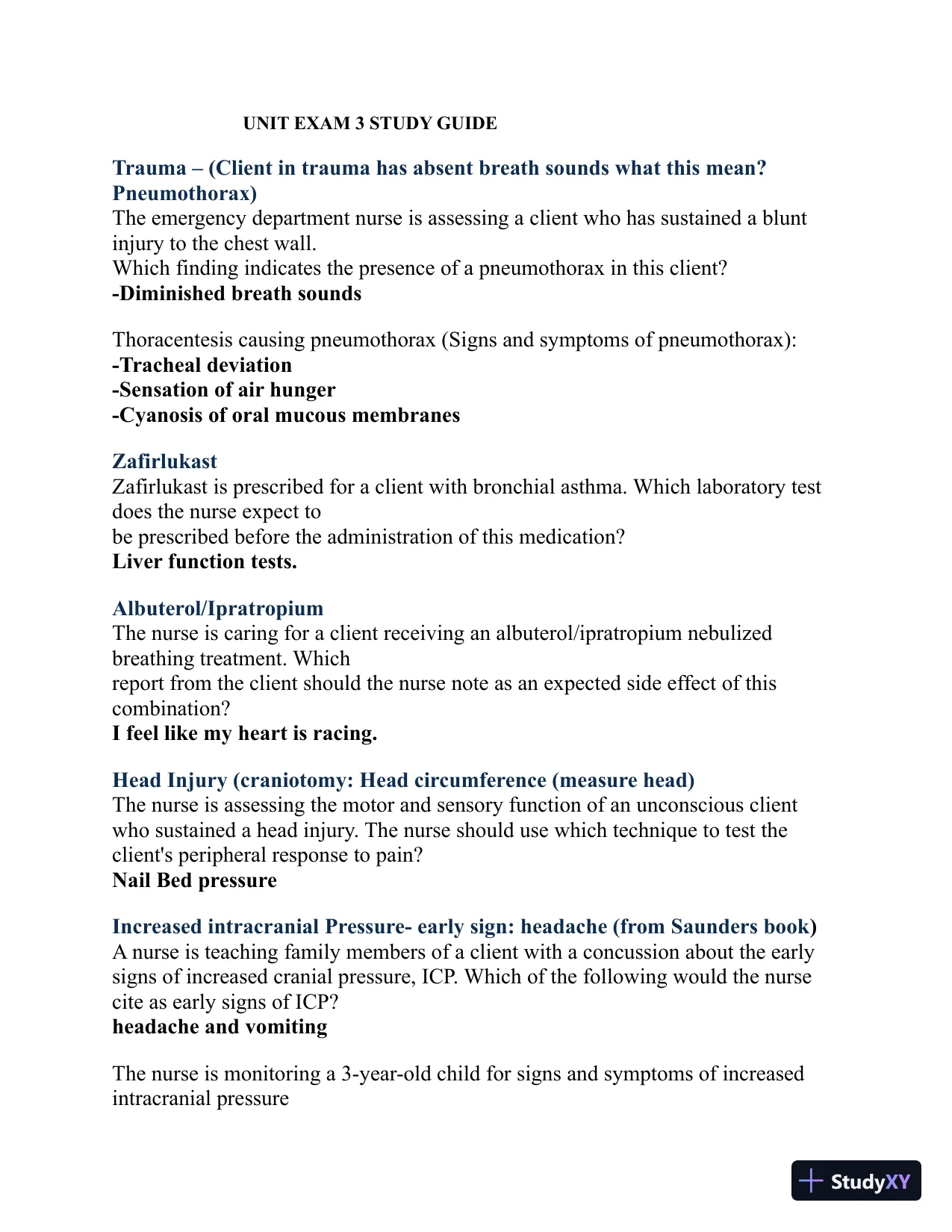
Unit Exam 3 Capstone Study Guide with Answers (98 Solved Questions) - Page 1 preview imageUNIT EXAM 3 STUDY GUIDETrauma – (Client in trauma has absent breath sounds what this mean?Pneumothorax)The emergency department nurse is assessing a client who has sustained a bluntinjury to the chest wall.Which finding indicates the presence of a pneumothorax in this client?-Diminished breath soundsThoracentesis causing pneumothorax (Signs and symptoms of pneumothorax):-Tracheal deviation-Sensation of air hunger-Cyanosis of oral mucous membranesZafirlukastZafirlukast is prescribed for a client with bronchial asthma. Which laboratory testdoes the nurse expect tobe prescribed before the administration of this medication?Liver function tests.Albuterol/IpratropiumThe nurse is caring for a client receiving an albuterol/ipratropium nebulizedbreathing treatment. Whichreport from the client should the nurse note as an expected side effect of thiscombination?I feel like my heart is racing.Head Injury (craniotomy: Head circumference (measure head)The nurse is assessing the motor and sensory function of an unconscious clientwho sustained a head injury. The nurse should use which technique to test theclient's peripheral response to pain?Nail Bed pressureIncreased intracranial Pressure- early sign: headache (from Saunders book)A nurse is teaching family members of a client with a concussion about the earlysigns of increased cranial pressure, ICP. Which of the following would the nursecite as early signs of ICP?headache and vomitingThe nurse is monitoring a 3-year-old child for signs and symptoms of increasedintracranial pressurelOMoARcPSD|12950611
Page 2 of 7
Unit Exam 3 Capstone Study Guide with Answers (98 Solved Questions) - Page 2 preview image
Page 3 of 7
Unit Exam 3 Capstone Study Guide with Answers (98 Solved Questions) - Page 3 preview image(ICP) after a craniotomy. The nurse plans to monitor for which early sign orsymptom of increased ICP?VomitingWhat is one of the earliest signs of increased intracranial pressure ICP?decreased level of consciousness (LOC)A mother arrives at the emergency department with her 5-year-old chills and statesthat the child fell off abunk bed. A head injury is suspected. The nurse checks the child's airway statusand assesses the child forearlyand late signsof ICP.Which is the late sign?BradycardiaThe nurse is reviewing the record of a child with ICP and notes that thechild has exhibited signsof decerebrate posturing. On assessment of the child,the nurse expects to note which characteristic of this type posturing?Rigid extension and pronation of the arms and legsA client recovering from a head injury is participating in care. The nursedetermines that the client understands measures to prevent elevations in ICP ifthe nurse observes the client doing which activity?Exhaling during repositioning1The nurse is caring for the client with ICP as a result of a head injury/ thenurse would note which trend inVS if the intracranial pressure is rising?Increasing temp, decreasing pulse, decreasing respirations, increasing bloodpressureSeizure (Continue Monitoring when pt is experiencing a seizure turnscyanotic)A child becomes cyanotic during a generalized tonic-clonic seizure. What is themost appropriate actionby the nurse?Continuing to observe the seizureThe nurse is creating a plan of care for a child who is at risk for seizures. Which
Page 4 of 7
Unit Exam 3 Capstone Study Guide with Answers (98 Solved Questions) - Page 4 preview imageinterventions apply if thechild has a seizure?-Time the seizure-Stay with the child-Move the furniture away from the childThe nurse is caring for a client who begins to experience seizure activity while inbed. Which actionsshould the nurse take? (SATA)-Loosening restrictive clothing-Removing the pillow and raising padded side rails-Positioning the client to the side, if possible with the head flexed forwardThe nurse is instituting seizure precautions for a client who is being admitted fromthe emergencydepartment. Which measures should the nurse include in planning for the client’ssafety? (SATA)-Padding the side rails of the bed-Placing an airway at the bedside-Placing oxygen and suction equipment at the bedside-Flushing the intravenous catheter to ensure that the site is patentThe nurse creates a plan of care for a child at risk for tonic-clonic seizures. In theplan of care, the nurseidentifies seizure precautions and documents which items need to be placed at thechild's bedside?Suctioning equipment and oxygenVP Shunt- (What to watch for: Infection)A nurse is providing discharge teaching to parents whose infant had aventriculoperitoneal shuntplacement for the treatment of hydrocephalus. Which of the following statementsby the parents indicatesan understanding of the teaching?"We will notify the doctor right away if he has a fever."Important to communicate to the surgeon after ventriculoperitoneal shunt isplaced?3-year-old returned ped unit= The right pupil is 1mm larger than the left pupilGuillain Barre Syndrome (Monitor Respiratory)
Page 5 of 7
Unit Exam 3 Capstone Study Guide with Answers (98 Solved Questions) - Page 5 preview imageA 27-year-old patient is hospitalized with new onset of Guillain-Barre syndrome.The most essentialassessment for the nurse to carry out isobserving respiratory rate and effort.The nurse is admitting a client with Guillain-Barre syndrome to the nursingunit. The client hascomplaints of inability to move both legs and reports a tingling sensationabove the waistline. Knowingthe complications of the disorder, the nurse should bring which most essentialitems into the client’sroom?Electrocardiographic monitoring electrodes and intubation tray2A client with Guillain-Barre syndrome has ascending paralysis and is intubatedand recovering mechanical ventilation. Which strategy should the nurseincorporate in the plan of care to help the client cope with this illness?Providing information, giving positive feedback, and encouraging relaxationThe client is admitted to the hospital with a diagnosis of Guillain-Barre syndrome.Which past medical history finding makes the client most at risk for this disease?Respiratory or gastrointestinal infection during the previous monthMeningitis (Brudzinski sign: Neck flexion pick the one with neck)The nurse is assessing a client for meningeal irritation and elicits a positiveBrudzinski's sign. Whichfinding did the nurse observe?The client passively flexes the hip and knee in response to neck flexion andreports pain in the vertebral column.The nurse is evaluating the status of a client who had a craniotomy 3 days ago.Which assessment findingwould indicate that the client is developing meningitis as a complication ofsurgery?
Page 6 of 7
Unit Exam 3 Capstone Study Guide with Answers (98 Solved Questions) - Page 6 preview imageA positive Brudzinski’s signThe nurse notes documentation that a child is exhibiting an inability to flex legwhen the thigh is flexedanteriorly at the hip. Which condition does the nurse suspect?MeningitisA lumbar puncture is performed on a child suspected to have bacterial meningitis,and cerebrospinal fluidis obtained for analysis. The nurse reviews the results of the CSF analysis anddetermines which resultswould verify the diagnosis?Cloudy CSF, elevated protein, and decrease glucose levelsThe nurse is planning care for a child with acute bacterial meningitis. Based on themode of transmissionof this infection, which precautionary intervention should be included in the planof care?Maintain respiratory isolation precautions for at least 24hrs after theinitiation of antibioticsStroke (on the right side of the brain what would you see? Answers with theleft side of the body)Left sided neglect, paralyzed left side, hemiplegiaThe nurse is assigned to care for a client with complete right-sided hemiparesisfrom stroke (brain attack).Which characteristics are associated with this condition? (SATA)-The client is aphasic-The client has weakness on the right side of the body-The client has weakness on the right side of the face and tongueWhen caring for a patient with a new right-sided homonymous hemianopsiaresulting from a stroke,which intervention should the nurse include in the plan of care?Place objects needed on the patients left side.A 73-year-old patient with a stroke experiences facial drooping on the right sidelOMoARcPSD|12950611
Page 7 of 7
Unit Exam 3 Capstone Study Guide with Answers (98 Solved Questions) - Page 7 preview imageand right-sided arm andleg paralysis. When admitting the patient, which clinical manifestation will thenurse expect to find?Difficulty comprehending instructionsRisk factors for stroke (SATA): -High blood pressure-TIA (transientischaemic attack)-Smoking-Use of oral contraceptives3The nurse is assessing the adaptation of a client to changes in functionalstatus after a stroke. Whichobservation indicates to the nurse that the client is adapting mostsuccessfully?Consistently uses adaptive equipment in dressing selfMyasthenia gravis (spread chores throughout day/ take breaks)The nurse is teaching a client with Myasthenia Gravis about the prevention ofMyasthenic and cholinergiccrisis. Which client activity suggests that teaching is most effective?Taking medications as scheduledA client with Myasthenia Gravis has become increasingly weaker. Theprimary health care provider prepares to identify whether the client is reacting toan overdose of the medication (cholinergic crisis) or an increasing severity of thedisease (myasthenic crisis). An injection of edrophonium is administered. Whichfinding would indicate that the client is in a cholinergic crisis?A temporary worsening of the conditionMultiple Sclerosis (Oxybutynin “I still get up at night to pee”The home health nurse is visiting a client with a diagnosis of multiple sclerosis.The client has beentaking oxybutynin (Ditropan XL). The nurse evaluates the effectiveness of themedication by asking theclient which assessment question?"Are you getting up at night to urinate?"When obtaining a health history and physical assessment for a 36-year-oldfemale patient with possiblemultiple sclerosis (MS), the nurse should
Preview Mode

This document has 20 pages. Sign in to access the full document!