

2024-2025 Cognitive Psychology Exam 2 with Answers (72 Solved Questions)
- Physician Assistant National Certifying Exam
- 15 pages
- Shared February 2025
- 92 downloads
Get familiar with your upcoming exam with 2024-2025 Cognitive Psychology Exam 2 with Answers, a reliable past exam resource.
Preview 5 of 15 pages
See the first 5 pages exactly as they appear in the document.
Page 1 Read page 1 as text
Cognitive Psychology Exam 2 100% VERIFIED SOLUTIONS 2024/2025 CORRECT The two divisions of Long Term Memory implicit and explicit OR non - declarative and declarative memories Part of the brain where binding of related pieces of information for long - term memory takes place hippocampus Reduced response after repeated exposure t o a stimulus Habituation e idea that you should take the test in the same room that you learned the material, so that you may recall better. Context - dependent effect Processing at encoding is most effective to the extent that processing overlaps with the processing to be performed at retrieval Transfer - Appropriate Learning What is chunking?
Page 2 Page 3 Read page 3 as text
You have to remember of new phone number. Instead of remembering each of the se ven digits individually (5 - 5 - 5 - 1 - 2 - 1 - 2), you remember two numbers (555 - 1212). What is Episodic Buffer? A supplementary information store when the visuospatial sketchpad and the phonological loop are overloaded or disrupted What is the Phonological Similari ty Effect? the effect that occurs when similar sound - based codes are activated in the phonologocial loop What is the "What"/Ventral stream? the stream accessed by object working memory. What is the Prefrontal Cortex? Area of the brain implicated for the ex ecutive functions of working memory An individual is brought to you who has deficits in self - monitoring, attention - switching, and sequencing behaviors to achieve a goal. You suspect that he has damage in this area of the brain. What is the Frontal Lobe? Wh at is Monitoring? the executive process you are engaging in when thinking about how well you are doing in answering the questions right now What is a Go/No go task? The task used to study inhibition of a response What is a script?
Page 4 Read page 4 as text
examples: starting a car, washing clothes, baking a cake... What is the Parietal cortex? In addition to the prefrontal cortex, imaging studies have shown that the this cortex is involved with switching of attention One of the main areas of the brain involved with emotional process ing is... the Amygdala? What is Autonomic Conditioning? The specific type of conditioning associated with taste aversions. E.g. You became sick one night after eating sushi. Now, you will not eat sushi. What are Flashbulb Memories? Clear and vivid memories of surprising and/or consequential events What is a Secondary Reinforcer? Stimuli with a learned motivational property What is the Approach - Withdrawal model? Model that classifies emotions based on motivation Impairment to this brain region results in impairment in goal - planning the Frontal Lobe Brain region that facilitates Inhibition of Response Anterior Cingulate Who are Baddeley and Hitch? They proposed a model of WM encompassing 3 buffers adn the Central E xecutive.
Page 5 Read page 5 as text
Who are Brown and Peterson? Demonstrated the short duration of WM through the following task: Subjects are given a three letter string they will have to remember and are asked to count backwards (e.g. by 3s) Who is Ebbinghaus? Developed a graphic al function depicting the nature of forgetting What are the two kinds of Declarative - (Explicit) Memory? Episodic and Semantic uses: medial temporal lobes What are the four kinds of Non Declarative (Implicit) Memory? Priming, Procedural, Associative, nonas sociative Priming central to Non declarative system. - example, using an expression more than you used to because you heard a friend say it. Brain Structure: left inferior frontal & lateral temporal lobes Procedural (Skills + Habits) learning to snowboard, you become better with more practice three stages: 1. cognitive 2. associative 3. autonomous (use the basal ganglia especially the striatum, putamen & caudate nucleus)
10 more pages in the full document
Unlock it once and it stays in your library, ready to chat with or turn into flashcards.
Unlock the full documentMore Physician Assistant National Certifying Exam study materials
See all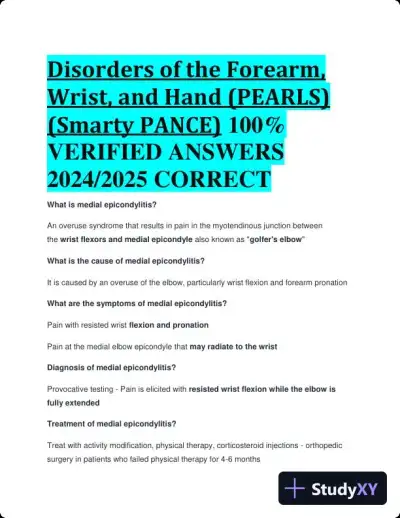 Past Exams
2024-2025 Disorders of the Forearm, Wrist, and Hand (PEARLS) (Smarty PANCE) with Answers (77 Solved Questions)
Physician Assistant National Certifying Exam
15 pages149downloadsFeb 2025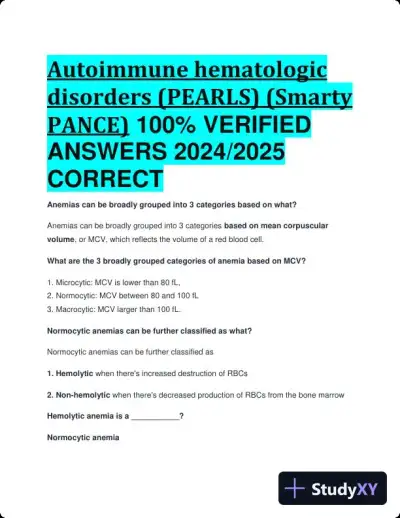 Past Exams
2024-2025 Autoimmune hematologic Disorders (PEARLS) (Smarty PANCE) with Answers (45 Solved Questions)
Physician Assistant National Certifying Exam
8 pages141downloadsFeb 2025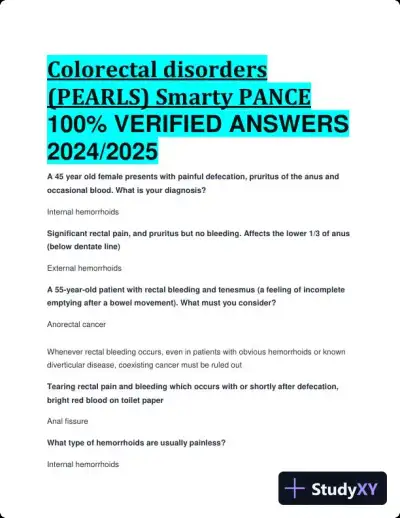 Past Exams
2024-2025 Colorectal Disorders (PEARLS) (Smarty PANCE) with Answers (127 Solved Questions)
Physician Assistant National Certifying Exam
19 pages135downloadsFeb 2025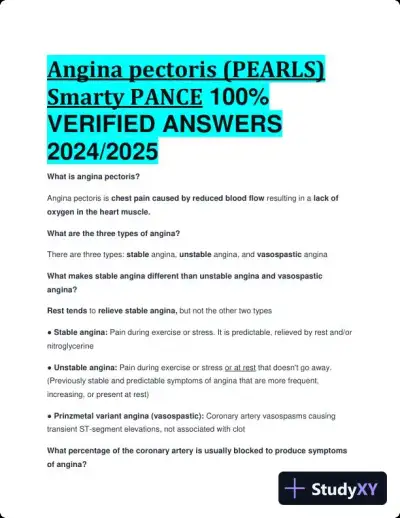 Past Exams
2024-2025 Angina pectoris Disorders (PEARLS) (Smarty PANCE) with Answers (25 Solved Questions)
Physician Assistant National Certifying Exam
5 pages129downloadsFeb 2025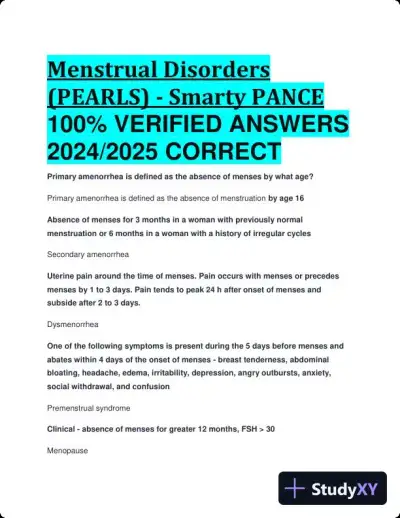 Past Exams
2024-2025 Menstrual Disorders (PEARLS) (Smarty PANCE) with Answers (23 Solved Questions)
Physician Assistant National Certifying Exam
4 pages117downloadsFeb 2025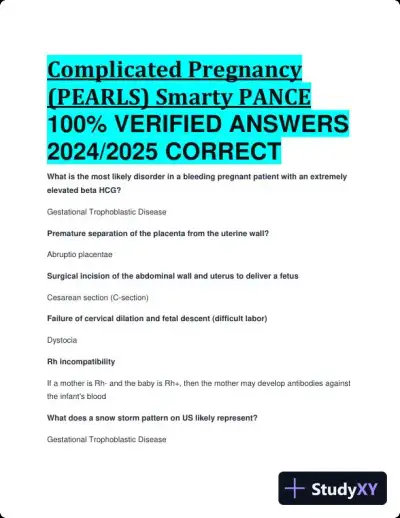 Past Exams
2024-2025 Complicated Pregnancy Disorders (PEARLS) (Smarty PANCE) with Answers (64 Solved Questions)
Physician Assistant National Certifying Exam
8 pages111downloadsFeb 2025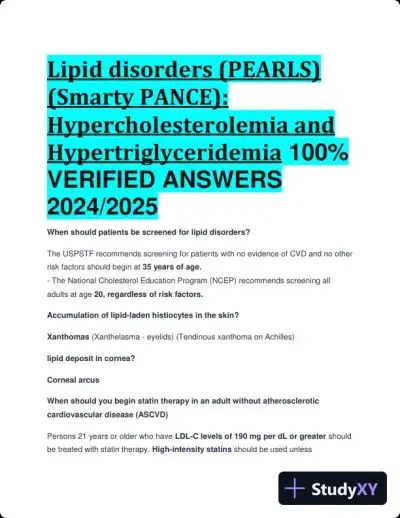 Past Exams
2024-2025 Lipid Disorders (PEARLS) (Smarty PANCE): Hypercholesterolemia and Hypertriglyceridemia with Answers (29 Solved Questions)
Physician Assistant National Certifying Exam
7 pages108downloadsFeb 2025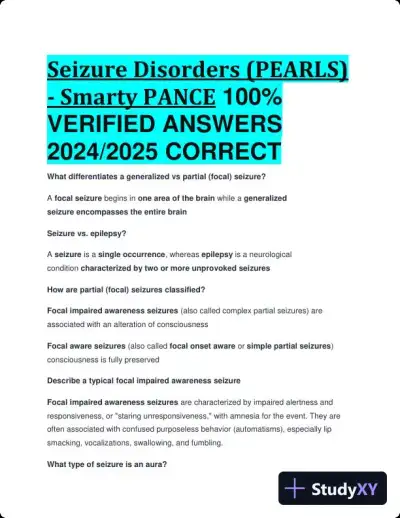 Past Exams
2024-2025 Seizure Disorders (PEARLS) (Smarty PANCE) with Answers (36 Solved Questions)
Physician Assistant National Certifying Exam
6 pages105downloadsFeb 2025
Study this document with CramX
Once it is in your library, every tool can work from it.