

Test Bank For A Guide to Crisis Intervention, 6th Edition
- Psychology
- 146 pages
- Shared February 2025
- 88 downloads
Test Bank For A Guide to Crisis Intervention, 6th Edition is your key to effective test preparation. Access it now and start practicing!
Preview 31 of 146 pages
See the first 31 pages exactly as they appear in the document.
Page 1 Read page 1 as text
1. Ego strength refers to a. how proud and self-centered the person is. b. the energy required to overcome post-traumatic stress disorder. c. the ability to understand the world realistically and act upon it to get one’s needs met. d. All of the above. ANSWER: c POINTS: 1 DIFFICULTY: Easy REFERENCES: Other Factors Determining Danger or Opportunity QUESTION TYPE: Multiple Choice HAS VARIABLES: False LEARNING OBJECTIVES: KAN_CI_07_01_08 - Discern characteristics of effective coping people NATIONAL STANDARDS: United States - CACREP 3 c. - Theories of normal and abnormal personality development DATE CREATED: 10/28/2017 10:32 AM DATE MODIFIED: 10/28/2017 10:46 AM 2. The focus on client responsibility and choice best represents which theoretical approach? a. Existential b. Humanistic c. Behavioral d. Cognitive ANSWER: a POINTS: 1 DIFFICULTY: Medium REFERENCES: Existential Theory QUESTION TYPE: Multiple Choice HAS VARIABLES: False LEARNING OBJECTIVES: KAN_CI_07_01_02 - Increase functioning in a person going through a crisis NATIONAL STANDARDS: United States - CACREP 5 a. - Theories and models of counseling DATE CREATED: 10/28/2017 10:32 AM DATE MODIFIED: 10/28/2017 10:46 AM Page 1
Page 2 Page 3 Read page 3 as text
3. The concept of limited psychic energy comes from which theory? a. Existential b. Humanistic c. Cognitive d. Psychoanalytic e. Behavioral ANSWER: d POINTS: 1 DIFFICULTY: Medium REFERENCES: Psychoanalytic Theory QUESTION TYPE: Multiple Choice HAS VARIABLES: False LEARNING OBJECTIVES: KAN_CI_07_01_02 - Increase functioning in a person going through a crisis NATIONAL STANDARDS: United States - CACREP 5 a. - Theories and models of counseling DATE CREATED: 10/28/2017 10:32 AM DATE MODIFIED: 10/28/2017 10:46 AM 4. A person who has experienced a crisis event can benefit from it through a. personal growth, as a result of successfully dealing with the crisis. b. financial opportunity, as a result of a lawsuit or worker’s compensation claim. c. learning to use their ego defense mechanism. d. Both A and B. ANSWER: a POINTS: 1 DIFFICULTY: Medium REFERENCES: Crisis as Both Danger and Opportunity QUESTION TYPE: Multiple Choice HAS VARIABLES: False LEARNING OBJECTIVES: KAN_CI_07_01_02 - Increase functioning in a person going through a crisis NATIONAL STANDARDS: United States - CACREP 3 g. - Effects of crisis, disasters, and trauma on diverse individuals across the lifespan DATE CREATED: 10/28/2017 10:32 AM DATE MODIFIED: 10/30/2017 8:05 AM Page 2
Page 4 Read page 4 as text
5. Trauma-Informed Care is used in many state and federal agencies. It focuses on three key elements, not including a. realizing the high incidence of trauma. b. recognizing the effects of trauma on the individual. c. reorganizing resources to minimize risk of crisis incidents. d. responding by acting on the knowledge gained. ANSWER: c POINTS: 1 DIFFICULTY: Medium REFERENCES: Trauma-Informed Care QUESTION TYPE: Multiple Choice HAS VARIABLES: False LEARNING OBJECTIVES: KAN_CI_07_01_06 - Be aware of trauma-informed care NATIONAL STANDARDS: United States - CACREP 5 m. - Crisis intervention, trauma-informed, and community-based strategies, such as Psychological First Aid DATE CREATED: 10/28/2017 10:32 AM DATE MODIFIED: 10/28/2017 10:46 AM 6. Managed Care replaced the use of indemnity insurance companies for payment of mental health services in the a. 1960s. b. 1970s. c. 1980s. d. 1990s. e. 2000s. ANSWER: c POINTS: 1 DIFFICULTY: Easy REFERENCES: The Rise of Managed Care QUESTION TYPE: Multiple Choice HAS VARIABLES: False LEARNING OBJECTIVES: KAN_CI_07_01_03 - Understand the beginning of the history of crisis intervention NATIONAL STANDARDS: United States - CACREP 1 a. - History and philosophy of the counseling profession and its specialty areas DATE CREATED: 10/28/2017 10:32 AM DATE MODIFIED: 10/28/2017 10:46 AM Page 3
Page 5 Read page 5 as text
7. Factors influencing a person’s response to crisis include their a. social resources. b. material resources. c. personal (internal) resources. d. Both A and C. ANSWER: d POINTS: 1 DIFFICULTY: Medium REFERENCES: Other Factors Determining Danger or Opportunity QUESTION TYPE: Multiple Choice HAS VARIABLES: False LEARNING OBJECTIVES: KAN_CI_07_01_08 - Discern characteristics of effective coping people NATIONAL STANDARDS: United States - CACREP 3 c. - Theories of normal and abnormal personality development DATE CREATED: 10/28/2017 10:32 AM DATE MODIFIED: 10/28/2017 10:46 AM 8. Growth and optimism are ideas central to what theory? a. Cognitive b. Existential c. Psychoanalytic d. Humanistic ANSWER: d POINTS: 1 DIFFICULTY: Medium REFERENCES: Humanistic Approach QUESTION TYPE: Multiple Choice HAS VARIABLES: False LEARNING OBJECTIVES: KAN_CI_07_01_02 - Increase functioning in a person going through a crisis NATIONAL STANDARDS: United States - CACREP 5 a. - Theories and models of counseling DATE CREATED: 10/28/2017 10:32 AM DATE MODIFIED: 10/28/2017 10:46 AM Page 4
Page 6 Read page 6 as text
9. The crisis-prone person usually does not a. continue to function well when under stress. b. access their ego to help deal with stress. c. find solutions to their problems when under stress. d. turn to a support network for help. e. All of the above. ANSWER: e POINTS: 1 DIFFICULTY: Easy REFERENCES: Crisis as Danger: Becoming a Crisis-Prone Person QUESTION TYPE: Multiple Choice HAS VARIABLES: False LEARNING OBJECTIVES: KAN_CI_07_01_05 - Recognize the crisis prone person NATIONAL STANDARDS: United States - CACREP 3 g. - Effects of crisis, disasters, and trauma on diverse individuals across the lifespan DATE CREATED: 10/28/2017 10:32 AM DATE MODIFIED: 10/28/2017 10:46 AM 10. The cognitive key refers to a. the precipitating event. b. the coping strategies of the person. c. the person’s perception of the event. d. Both B and C. ANSWER: c POINTS: 1 DIFFICULTY: Medium REFERENCES: Other Factors Determining Danger or Opportunity QUESTION TYPE: Multiple Choice HAS VARIABLES: False LEARNING OBJECTIVES: KAN_CI_07_01_05 - Recognize the crisis prone person NATIONAL STANDARDS: United States - CACREP 3 g. - Effects of crisis, disasters, and trauma on diverse individuals across the lifespan DATE CREATED: 10/28/2017 10:32 AM DATE MODIFIED: 10/28/2017 10:46 AM Page 5
Page 7 Read page 7 as text
11. For the crisis worker, what is the most important part of a crisis event? ANSWER: Answers will vary POINTS: 1 DIFFICULTY: Medium REFERENCES: Crisis Defined QUESTION TYPE: Essay HAS VARIABLES: False LEARNING OBJECTIVES: KAN_CI_07_01_01 - Understand how a crisis state is formed and the factors that make up a crisis state NATIONAL STANDARDS: United States - CACREP 5. c. - theories, models, and strategies for understanding and practicing consultation DATE CREATED: 10/28/2017 10:32 AM DATE MODIFIED: 10/28/2017 10:46 AM 12. What are Caplan’s seven characteristics of effective coping behavior? ANSWER: Answers will vary POINTS: 1 DIFFICULTY: Difficult REFERENCES: The Wellesley Project: The Development of Crisis Intervention QUESTION TYPE: Essay HAS VARIABLES: False LEARNING OBJECTIVES: KAN_CI_07_01_08 - Discern characteristics of effective coping people NATIONAL STANDARDS: United States - CACREP 3 c. - Theories of normal and abnormal personality development DATE CREATED: 10/28/2017 10:32 AM DATE MODIFIED: 10/28/2017 10:46 AM 13. When might medication be useful for someone in crisis? ANSWER: Answers will vary POINTS: 1 DIFFICULTY: Medium REFERENCES: Emotional Distress QUESTION TYPE: Essay HAS VARIABLES: False LEARNING OBJECTIVES: KAN_CI_07_01_02 - Increase functioning in a person going through a crisis NATIONAL STANDARDS: United States - CACREP 3 h. - a general framework for understanding differing abilities and strategies for differentiated interventions DATE CREATED: 10/28/2017 10:32 AM DATE MODIFIED: 10/28/2017 10:46 AM Page 6
Page 8 Read page 8 as text
14. How is stress different from a crisis? ANSWER: Answers will vary POINTS: 1 DIFFICULTY: Difficult REFERENCES: Crisis as Danger: Becoming a Crisis-Prone Person QUESTION TYPE: Essay HAS VARIABLES: False LEARNING OBJECTIVES: KAN_CI_07_01_07 - Decipher the difference between stress and crisis NATIONAL STANDARDS: United States - CACREP 3 f. - Systemic and environmental factors that affect human development, functioning, and behavior DATE CREATED: 10/28/2017 10:32 AM DATE MODIFIED: 10/28/2017 10:46 AM 15. Why is the Community Mental Health Act of 1963 still relevant today? ANSWER: Answers will vary POINTS: 1 DIFFICULTY: Medium REFERENCES: Community Mental Health Act of 1963 QUESTION TYPE: Essay HAS VARIABLES: False LEARNING OBJECTIVES: KAN_CI_07_01_03 - Understand the beginning of the history of crisis intervention NATIONAL STANDARDS: United States - CACREP 1 a. - History and philosophy of the counseling profession and its specialty areas DATE CREATED: 10/28/2017 10:32 AM DATE MODIFIED: 10/28/2017 10:46 AM 16. The focus of crisis intervention is on helping the client to win a favorable outcome to a lawsuit. a. True b. False ANSWER: False POINTS: 1 DIFFICULTY: Easy REFERENCES: Crisis Defined QUESTION TYPE: True / False HAS VARIABLES: False LEARNING OBJECTIVES: KAN_CI_07_01_02 - Increase functioning in a person going through a crisis NATIONAL STANDARDS: United States - CACREP 3 g. - Effects of crisis, disasters, and trauma on diverse individuals across the lifespan DATE CREATED: 10/28/2017 10:32 AM DATE MODIFIED: 10/28/2017 10:46 AM Page 7
Page 9 Read page 9 as text
17. How quickly a person receives intervention after a crisis event does not matter to their long-term ability to function. a. True b. False ANSWER: False POINTS: 1 DIFFICULTY: Medium REFERENCES: Crisis as Danger: Becoming a Crisis-Prone Person QUESTION TYPE: True / False HAS VARIABLES: False LEARNING OBJECTIVES: KAN_CI_07_01_04 - Identify how a crisis can be both a danger and an opportunity NATIONAL STANDARDS: United States - CACREP 3 g. - Effects of crisis, disasters, and trauma on diverse individuals across the lifespan DATE CREATED: 10/28/2017 10:32 AM DATE MODIFIED: 10/28/2017 10:46 AM 18. It might be appropriate for a crisis worker to serve temporarily as their client’s ego strength. a. True b. False ANSWER: True POINTS: 1 DIFFICULTY: Medium REFERENCES: Other Factors Determining Danger or Opportunity QUESTION TYPE: True / False HAS VARIABLES: False LEARNING OBJECTIVES: KAN_CI_07_01_02 - Increase functioning in a person going through a crisis NATIONAL STANDARDS: United States - CACREP 3 i. - Ethical and culturally relevant strategies for promoting resilience and optimum development and wellness across the lifespan DATE CREATED: 10/28/2017 10:32 AM DATE MODIFIED: 10/28/2017 10:46 AM Page 8
Page 10 Read page 10 as text
19. Crisis intervention as a response to trauma first emerged when World War II soldiers began to return home. a. True b. False ANSWER: False POINTS: 1 DIFFICULTY: Easy REFERENCES: The Wellesley Project: The Development of Crisis Intervention QUESTION TYPE: True / False HAS VARIABLES: False LEARNING OBJECTIVES: KAN_CI_07_01_03 - Understand the beginning of the history of crisis intervention NATIONAL STANDARDS: United States - CACREP 1 a. - History and philosophy of the counseling profession and its specialty areas DATE CREATED: 10/28/2017 10:32 AM DATE MODIFIED: 10/28/2017 10:46 AM 20. Everyone who becomes stressed will experience a crisis state at one time or another. a. True b. False ANSWER: False POINTS: 1 DIFFICULTY: Easy REFERENCES: Crisis as Danger: Becoming a Crisis-Prone Person QUESTION TYPE: True / False HAS VARIABLES: False LEARNING OBJECTIVES: KAN_CI_07_01_05 - Recognize the crisis prone person NATIONAL STANDARDS: United States - CACREP 3 g. - Effects of crisis, disasters, and trauma on diverse individuals across the lifespan DATE CREATED: 10/28/2017 10:32 AM DATE MODIFIED: 10/28/2017 10:46 AM Page 9
Page 11 Read page 11 as text
21. Suicide prevention first became widespread during the time of Freud. a. True b. False ANSWER: False POINTS: 1 DIFFICULTY: Easy REFERENCES: Crisis Intervention and Suicide Prevention Strengthen Nationwide QUESTION TYPE: True / False HAS VARIABLES: False LEARNING OBJECTIVES: KAN_CI_07_01_03 - Understand the beginning of the history of crisis intervention NATIONAL STANDARDS: United States - CACREP 1 a. - History and philosophy of the counseling profession and its specialty areas DATE CREATED: 10/28/2017 10:32 AM DATE MODIFIED: 10/28/2017 10:46 AM 22. A person can effectively come out of a crisis state through use of ego defense mechanisms such as repression and denial. a. True b. False ANSWER: False POINTS: 1 DIFFICULTY: Easy REFERENCES: Crisis as Danger: Becoming a Crisis-Prone Person QUESTION TYPE: True / False HAS VARIABLES: False LEARNING OBJECTIVES: KAN_CI_07_01_05 - Recognize the crisis prone person NATIONAL STANDARDS: United States - CACREP 3 g. - Effects of crisis, disasters, and trauma on diverse individuals across the lifespan DATE CREATED: 10/28/2017 10:32 AM DATE MODIFIED: 10/28/2017 10:46 AM Page 10
Page 12 Read page 12 as text
23. The major goal of crisis intervention is to increase the client’s functioning. a. True b. False ANSWER: True POINTS: 1 DIFFICULTY: Medium REFERENCES: Crisis Defined QUESTION TYPE: True / False HAS VARIABLES: False LEARNING OBJECTIVES: KAN_CI_07_01_02 - Increase functioning in a person going through a crisis NATIONAL STANDARDS: United States - CACREP 3 i. - Ethical and culturally relevant strategies for promoting resilience and optimum development and wellness across the lifespan DATE CREATED: 10/28/2017 10:32 AM DATE MODIFIED: 10/28/2017 10:46 AM 24. A typical reaction to a crisis event is an increase in anxiety. a. True b. False ANSWER: True POINTS: 1 DIFFICULTY: Easy REFERENCES: Emotional Distress QUESTION TYPE: True / False HAS VARIABLES: False LEARNING OBJECTIVES: KAN_CI_07_01_01 - Understand how a crisis state is formed and the factors that make up a crisis state NATIONAL STANDARDS: United States - CACREP 3 g. - Effects of crisis, disasters, and trauma on diverse individuals across the lifespan DATE CREATED: 10/28/2017 10:32 AM DATE MODIFIED: 10/28/2017 10:46 AM Page 11
Page 13 Read page 13 as text
25. Crisis intervention and brief therapy both use the same approach to client care. a. True b. False ANSWER: False POINTS: 1 DIFFICULTY: Medium REFERENCES: Brief Therapy QUESTION TYPE: True / False HAS VARIABLES: False LEARNING OBJECTIVES: KAN_CI_07_01_07 - Decipher the difference between stress and crisis NATIONAL STANDARDS: United States - CACREP 5. c. - theories, models, and strategies for understanding and practicing consultation DATE CREATED: 10/28/2017 10:32 AM DATE MODIFIED: 10/28/2017 10:46 AM Page 12
Page 14 Read page 14 as text
1. In what year did the social work profession first adopt a code of ethics? a. 1969 b. 1947 c. 1930 d. 1990 e. None of the above. ANSWER: b POINTS: 1 DIFFICULTY: Easy REFERENCES: What Are Ethics? QUESTION TYPE: Multiple Choice HAS VARIABLES: False LEARNING OBJECTIVES: KAN_CI_07_02_01 - Comprehend the major ethical standards in most mental health professions NATIONAL STANDARDS: United States - CACREP 1 a. - History and philosophy of the counseling profession and its specialty areas DATE CREATED: 10/28/2017 10:57 AM DATE MODIFIED: 10/28/2017 11:04 AM 2. The only situation in which a dual relationship between a counselor and client would not be prohibited is when a. they are married. b. they are related. c. they are friends. d. they work together. e. A dual relationship is always prohibited. ANSWER: e POINTS: 1 DIFFICULTY: Easy REFERENCES: Dual Relationships QUESTION TYPE: Multiple Choice HAS VARIABLES: False LEARNING OBJECTIVES: KAN_CI_07_02_01 - Comprehend the major ethical standards in most mental health professions NATIONAL STANDARDS: United States - CACREP 5 d. - Ethical and culturally relevant strategies for establishing and maintaining in-person and technology-assisted relationships DATE CREATED: 10/28/2017 10:57 AM DATE MODIFIED: 10/30/2017 8:09 AM Page 1
Page 15 Read page 15 as text
3. Client confidentiality must be broken in the case of a. suspected elder abuse. b. suspected child abuse. c. the client’s inability to look after their own basic needs (e.g., food and shelter). d. All of the above. e. Both A and B. ANSWER: d POINTS: 1 DIFFICULTY: Easy REFERENCES: Confidentiality QUESTION TYPE: Multiple Choice HAS VARIABLES: False LEARNING OBJECTIVES: KAN_CI_07_02_01 - Comprehend the major ethical standards in most mental health professions NATIONAL STANDARDS: United States - CACREP 5 d. - Ethical and culturally relevant strategies for establishing and maintaining in-person and technology-assisted relationships DATE CREATED: 10/28/2017 10:57 AM DATE MODIFIED: 10/30/2017 8:10 AM 4. “Duty to Warn” came from a. the National Child Abuse Prevention and Treatment Act. b. the Community Mental Health Act. c. the Tarasoff Case. d. the Americans with Disabilities Act. e. None of the above. ANSWER: c POINTS: 1 DIFFICULTY: Medium REFERENCES: The Tarasoff Case QUESTION TYPE: Multiple Choice HAS VARIABLES: False LEARNING OBJECTIVES: KAN_CI_07_02_02 - Recognize the need for ethics in crisis intervention NATIONAL STANDARDS: United States - CACREP 5 a. - Theories and models of counseling DATE CREATED: 10/28/2017 10:57 AM DATE MODIFIED: 10/28/2017 11:04 AM Page 2
Page 16 Read page 16 as text
5. A crisis worker who resents their parents because he was sent to boarding school, and now gives advice to clients based on their unresolved feelings, is suffering from a. countertransference. b. self-awareness. c. dual relationship. d. All of the above. e. None of the above. ANSWER: a POINTS: 1 DIFFICULTY: Medium REFERENCES: Self-Awareness and Self-Monitoring QUESTION TYPE: Multiple Choice HAS VARIABLES: False LEARNING OBJECTIVES: KAN_CI_07_02_02 - Recognize the need for ethics in crisis intervention NATIONAL STANDARDS: United States - CACREP 1 k. - Strategies for personal and professional self- evaluation and implications for practice DATE CREATED: 10/28/2017 10:57 AM DATE MODIFIED: 10/28/2017 11:04 AM 6. Elder abuse can include a. physical abuse. b. neglect. c. misuse of the person’s money. d. Both A and B. e. All of the above. ANSWER: e POINTS: 1 DIFFICULTY: Medium REFERENCES: Elder Abuse Reporting Act QUESTION TYPE: Multiple Choice HAS VARIABLES: False LEARNING OBJECTIVES: KAN_CI_07_02_01 - Comprehend the major ethical standards in most mental health professions NATIONAL STANDARDS: United States - CACREP 3 i. - Ethical and culturally relevant strategies for promoting resilience and optimum development and wellness across the lifespan DATE CREATED: 10/28/2017 10:57 AM DATE MODIFIED: 10/30/2017 8:23 AM Page 3
Page 17 Read page 17 as text
7. Which moral principle is not a guide to ethical decision-making? a. Non-malfeasance b. Autonomy c. Justice d. Fidelity e. The U.S. Constitution ANSWER: e POINTS: 1 DIFFICULTY: Easy REFERENCES: Ethical Issues QUESTION TYPE: Multiple Choice HAS VARIABLES: False LEARNING OBJECTIVES: KAN_CI_07_02_01 - Comprehend the major ethical standards in most mental health professions NATIONAL STANDARDS: United States - CACREP 5 d. - Ethical and culturally relevant strategies for establishing and maintaining in-person and technology-assisted relationships DATE CREATED: 10/28/2017 10:57 AM DATE MODIFIED: 10/30/2017 8:23 AM 8. The use of virtual therapy might encounter ethical issues because of a. risks to security. b. inappropriate counseling due to the inability to study body language. c. lack of legal recourse for malpractice. d. Both A and C. e. All of the above. ANSWER: e POINTS: 1 DIFFICULTY: Medium REFERENCES: Virtual or e-Therapy QUESTION TYPE: Multiple Choice HAS VARIABLES: False LEARNING OBJECTIVES: KAN_CI_07_02_03 - Grasp the various controversies related to ethics NATIONAL STANDARDS: United States - CACREP 5 d. - Ethical and culturally relevant strategies for establishing and maintaining in-person and technology-assisted relationships DATE CREATED: 10/28/2017 10:57 AM DATE MODIFIED: 10/30/2017 8:24 AM Page 4
Page 18 Read page 18 as text
9. According to Arredondo et al., there are five major cultural groups in the United States. These do not include a. African Americans b. Caucasians c. Native Americans d. Asian Americans e. Middle Eastern Americans ANSWER: e POINTS: 1 DIFFICULTY: Easy REFERENCES: Multicultural Competence QUESTION TYPE: Multiple Choice HAS VARIABLES: False LEARNING OBJECTIVES: KAN_CI_07_02_01 - Comprehend the major ethical standards in most mental health professions NATIONAL STANDARDS: United States - CACREP 2 a. - Multicultural and pluralistic characteristics within and among diverse groups nationally and internationally DATE CREATED: 10/28/2017 10:57 AM DATE MODIFIED: 10/30/2017 8:24 AM 10. A gravely disabled client is one who has a mental disorder and thus cannot take care of their daily needs for a. food and shelter. b. medical care. c. clothing. d. personal safety. e. All of the above. ANSWER: e POINTS: 1 DIFFICULTY: Easy REFERENCES: Confidentiality QUESTION TYPE: Multiple Choice HAS VARIABLES: False LEARNING OBJECTIVES: KAN_CI_07_02_02 - Recognize the need for ethics in crisis intervention NATIONAL STANDARDS: United States - CACREP 1 c. - Counselors’ roles and responsibilities as members of interdisciplinary community outreach and emergency management response teams DATE CREATED: 10/28/2017 10:57 AM DATE MODIFIED: 10/30/2017 8:24 AM Page 5
Page 19 Read page 19 as text
11. Why is strong ethical practice particularly important in crisis intervention? ANSWER: Answers will vary POINTS: 1 DIFFICULTY: Easy REFERENCES: The Need for Ethics QUESTION TYPE: Essay HAS VARIABLES: False LEARNING OBJECTIVES: KAN_CI_07_02_02 - Recognize the need for ethics in crisis intervention NATIONAL STANDARDS: United States - CACREP 1 c. - Counselors’ roles and responsibilities as members of interdisciplinary community outreach and emergency management response teams DATE CREATED: 10/28/2017 10:57 AM DATE MODIFIED: 10/28/2017 11:04 AM 12. List Kitchener’s five guiding principles that inform ethical decision-making. ANSWER: Answers will vary POINTS: 1 DIFFICULTY: Medium REFERENCES: Ethical Issues QUESTION TYPE: Essay HAS VARIABLES: False LEARNING OBJECTIVES: KAN_CI_07_02_01 - Comprehend the major ethical standards in most mental health professions NATIONAL STANDARDS: United States - CACREP 1 k. - Strategies for personal and professional self- evaluation and implications for practice DATE CREATED: 10/28/2017 10:57 AM DATE MODIFIED: 10/28/2017 11:04 AM Page 6
Page 20 Read page 20 as text
13. When MUST a counselor breach confidentiality? ANSWER: Answers will vary POINTS: 1 DIFFICULTY: Easy REFERENCES: Confidentiality QUESTION TYPE: Essay HAS VARIABLES: False LEARNING OBJECTIVES: KAN_CI_07_02_01 - Comprehend the major ethical standards in most mental health professions NATIONAL STANDARDS: United States - CACREP 1 i. - Ethical standards of professional counseling organizations and credentialing bodies, and applications of ethical and legal considerations in professional counseling DATE CREATED: 10/28/2017 10:57 AM DATE MODIFIED: 10/28/2017 11:04 AM 14. Why is therapeutic self-awareness important to the mental health professional? ANSWER: Answers will vary POINTS: 1 DIFFICULTY: Medium REFERENCES: Self-Awareness and Self-Monitoring QUESTION TYPE: Essay HAS VARIABLES: False LEARNING OBJECTIVES: KAN_CI_07_02_02 - Recognize the need for ethics in crisis intervention NATIONAL STANDARDS: United States - CACREP 1 k. - Strategies for personal and professional self- evaluation and implications for practice DATE CREATED: 10/28/2017 10:57 AM DATE MODIFIED: 10/28/2017 11:04 AM Page 7
Page 21 Read page 21 as text
15. How does privileged communication differ from confidentiality? ANSWER: Answers will vary POINTS: 1 DIFFICULTY: Medium REFERENCES: Confidentiality QUESTION TYPE: Essay HAS VARIABLES: False LEARNING OBJECTIVES: KAN_CI_07_02_01 - Comprehend the major ethical standards in most mental health professions NATIONAL STANDARDS: United States - CACREP 1 i. - Ethical standards of professional counseling organizations and credentialing bodies, and applications of ethical and legal considerations in professional counseling DATE CREATED: 10/28/2017 10:57 AM DATE MODIFIED: 10/28/2017 11:04 AM 16. Community volunteers or undergraduate students can effectively practice crisis intervention independently, so long as they have received appropriate training. a. True b. False ANSWER: False POINTS: 1 DIFFICULTY: Easy REFERENCES: Use of Paraprofessionals QUESTION TYPE: True / False HAS VARIABLES: False LEARNING OBJECTIVES: KAN_CI_07_02_02 - Recognize the need for ethics in crisis intervention NATIONAL STANDARDS: United States - CACREP 1 m. - The role of counseling supervision in the profession DATE CREATED: 10/28/2017 10:57 AM DATE MODIFIED: 10/28/2017 11:04 AM Page 8
Page 22 Read page 22 as text
17. The concept of “first, do no harm” was first expressly stated in the Code of Hammurabi (ca. 2000 BCE). a. True b. False ANSWER: False POINTS: 1 DIFFICULTY: Medium REFERENCES: Introduction QUESTION TYPE: True / False HAS VARIABLES: False LEARNING OBJECTIVES: KAN_CI_07_02_01 - Comprehend the major ethical standards in most mental health professions NATIONAL STANDARDS: United States - CACREP 5 i. - Development of measurable outcomes for clients DATE CREATED: 10/28/2017 10:57 AM DATE MODIFIED: 10/28/2017 11:04 AM 18. Cultural sensitivity is important, but it is not an ethical mandate. a. True b. False ANSWER: False POINTS: 1 DIFFICULTY: Easy REFERENCES: Multicultural Competence QUESTION TYPE: True / False HAS VARIABLES: False LEARNING OBJECTIVES: KAN_CI_07_02_01 - Comprehend the major ethical standards in most mental health professions NATIONAL STANDARDS: United States - CACREP 2 c. - Multicultural counseling competencies DATE CREATED: 10/28/2017 10:57 AM DATE MODIFIED: 10/28/2017 11:04 AM Page 9
Page 23 Read page 23 as text
19. The federal law that established standards for the protection of select health information was the Health Insurance Portability and Accountability Act (HIPAA). a. True b. False ANSWER: True POINTS: 1 DIFFICULTY: Easy REFERENCES: Defining Law QUESTION TYPE: True / False HAS VARIABLES: False LEARNING OBJECTIVES: KAN_CI_07_02_01 - Comprehend the major ethical standards in most mental health professions NATIONAL STANDARDS: United States - CACREP 1 i. - Ethical standards of professional counseling organizations and credentialing bodies, and applications of ethical and legal considerations in professional counseling DATE CREATED: 10/28/2017 10:57 AM DATE MODIFIED: 10/28/2017 11:04 AM 20. If a crisis worker strongly believes in a particular moral code, it is appropriate for them to encourage their clients to adopt, or at least consider, that code. a. True b. False ANSWER: False POINTS: 1 DIFFICULTY: Easy REFERENCES: Multicultural Competence QUESTION TYPE: True / False HAS VARIABLES: False LEARNING OBJECTIVES: KAN_CI_07_02_01 - Comprehend the major ethical standards in most mental health professions NATIONAL STANDARDS: United States - CACREP 2 d. - The impact of heritage, attitudes, beliefs, understandings, and acculturative experiences on an individual’s views of others DATE CREATED: 10/28/2017 10:57 AM DATE MODIFIED: 10/28/2017 11:04 AM Page 10
Page 24 Read page 24 as text
21. If a mental health professional has undergone sufficient training, there is no risk that he will experience countertransference. a. True b. False ANSWER: False POINTS: 1 DIFFICULTY: Medium REFERENCES: Self-Awareness and Self-Monitoring QUESTION TYPE: True / False HAS VARIABLES: False LEARNING OBJECTIVES: KAN_CI_07_02_02 - Recognize the need for ethics in crisis intervention NATIONAL STANDARDS: United States - CACREP 1 k. - Strategies for personal and professional self- evaluation and implications for practice DATE CREATED: 10/28/2017 10:57 AM DATE MODIFIED: 10/28/2017 11:04 AM 22. “Duty to Warn” refers to reporting to their family or caregiver that a client intends to harm themselves. a. True b. False ANSWER: False POINTS: 1 DIFFICULTY: Medium REFERENCES: The Tarasoff Case QUESTION TYPE: True / False HAS VARIABLES: False LEARNING OBJECTIVES: KAN_CI_07_02_01 - Comprehend the major ethical standards in most mental health professions NATIONAL STANDARDS: United States - CACREP 1 i. - Ethical standards of professional counseling organizations and credentialing bodies, and applications of ethical and legal considerations in professional counseling DATE CREATED: 10/28/2017 10:57 AM DATE MODIFIED: 10/28/2017 11:04 AM Page 11
Page 25 Read page 25 as text
23. One argument in support of virtual or e-therapy is that it allows people to be served who otherwise would not seek counseling because of fears of being stigmatized. a. True b. False ANSWER: True POINTS: 1 DIFFICULTY: Easy REFERENCES: Virtual or e-Therapy QUESTION TYPE: True / False HAS VARIABLES: False LEARNING OBJECTIVES: KAN_CI_07_02_03 - Grasp the various controversies related to ethics NATIONAL STANDARDS: United States - CACREP 1 j. - Technology’s impact on the counseling profession DATE CREATED: 10/28/2017 10:57 AM DATE MODIFIED: 10/28/2017 11:04 AM 24. Because a crisis worker is not a psychiatrist, it is not important for them to be familiar with the conditions listed in the American Psychiatric Association’s Diagnostic and Statistical Manual of Mental Disorders . a. True b. False ANSWER: False POINTS: 1 DIFFICULTY: Easy REFERENCES: Competence QUESTION TYPE: True / False HAS VARIABLES: False LEARNING OBJECTIVES: KAN_CI_07_02_02 - Recognize the need for ethics in crisis intervention NATIONAL STANDARDS: United States - CACREP 5 c. - Theories, models, and strategies for understanding and practicing consultation DATE CREATED: 10/28/2017 10:57 AM DATE MODIFIED: 10/28/2017 11:04 AM Page 12
Page 26 Read page 26 as text
25. Medication can sometimes be given without client consent. a. True b. False ANSWER: True POINTS: 1 DIFFICULTY: Medium REFERENCES: Informed Consent QUESTION TYPE: True / False HAS VARIABLES: False LEARNING OBJECTIVES: KAN_CI_07_02_03 - Grasp the various controversies related to ethics NATIONAL STANDARDS: United States - CACREP 1 i. - Ethical standards of professional counseling organizations and credentialing bodies, and applications of ethical and legal considerations in professional counseling DATE CREATED: 10/28/2017 10:57 AM DATE MODIFIED: 10/28/2017 11:04 AM Page 13
Page 27 Read page 27 as text
1. What is the purpose of basic attending skills? a. To find the precipitating event b. To develop rapport c. To provide coping skills d. To develop self-confidence ANSWER: b POINTS: 1 DIFFICULTY: Easy REFERENCES: A: Developing and Maintaining Rapport: Follow the Client QUESTION TYPE: Multiple Choice HAS VARIABLES: False LEARNING OBJECTIVES: KAN_CI_07_03_02 - Understand the purpose of basic attending skills and how to apply them to real life cases. NATIONAL STANDARDS: United States - CACREP 5 f. - counselor characteristics and behaviors that influence the counseling process DATE CREATED: 10/28/2017 11:21 AM DATE MODIFIED: 10/28/2017 11:29 AM 2. Which is considered the most effective way to allow clients to express their real selves without categories imposed on them by the interviewer? a. Close-ended questions b. Interpretations c. Open-ended questions d. None of the above ANSWER: c POINTS: 1 DIFFICULTY: Easy REFERENCES: Questioning QUESTION TYPE: Multiple Choice HAS VARIABLES: False LEARNING OBJECTIVES: KAN_CI_07_03_02 - Understand the purpose of basic attending skills and how to apply them to real life cases. NATIONAL STANDARDS: United States - CACREP 5 c. - Theories, models, and strategies for understanding and practicing consultation DATE CREATED: 10/28/2017 11:21 AM DATE MODIFIED: 10/28/2017 11:29 AM Page 1
Page 28 Read page 28 as text
3. Restating in your own words what you thought you heard client say is called a. interweaving. b. clarifying or paraphrasing. c. attending behavior. d. summarization. ANSWER: b POINTS: 1 DIFFICULTY: Easy REFERENCES: Paraphrasing QUESTION TYPE: Multiple Choice HAS VARIABLES: False LEARNING OBJECTIVES: KAN_CI_07_03_02 - Understand the purpose of basic attending skills and how to apply them to real life cases. NATIONAL STANDARDS: United States - CACREP 5 c. - Theories, models, and strategies for understanding and practicing consultation DATE CREATED: 10/28/2017 11:21 AM DATE MODIFIED: 10/28/2017 11:29 AM 4. The ABC method of crisis management is a three-stage process involving a. A, achieving rapport; B, boiling the problem down to basics; C, coping. b. A, achieving rapport; B, basic attending skills; C, coping skills. c. A, attending behavior; B, boiling the problem down to basics; C, clarifying. d. A, alternative strategies; B, basic attending skills; C, caring skills. ANSWER: a POINTS: 1 DIFFICULTY: Easy REFERENCES: Introduction QUESTION TYPE: Multiple Choice HAS VARIABLES: False LEARNING OBJECTIVES: KAN_CI_07_03_01 - Practice the ABC Model of Crisis Intervention. NATIONAL STANDARDS: United States - CACREP 5 a. - Theories and models of counseling DATE CREATED: 10/28/2017 11:21 AM DATE MODIFIED: 10/28/2017 11:29 AM Page 2
Page 29 Read page 29 as text
5. When a counselor tells a client that his or her feelings are normal and suggests that others would feel the same way under the same conditions, he is giving a/an a. educational statement. b. empowerment statement. c. support/validation statement. d. reframing statement. ANSWER: c POINTS: 1 DIFFICULTY: Easy REFERENCES: Therapeutic Interaction QUESTION TYPE: Multiple Choice HAS VARIABLES: False LEARNING OBJECTIVES: KAN_CI_07_03_02 - Understand the purpose of basic attending skills and how to apply them to real life cases. NATIONAL STANDARDS: United States - CACREP 5 c. - Theories, models, and strategies for understanding and practicing consultation DATE CREATED: 10/28/2017 11:21 AM DATE MODIFIED: 10/28/2017 11:29 AM 6. An advanced technique that provides new perspective and possibilities for client change is called a/an a. educational statement. b. empowerment statement. c. support statement. d. reframing statement. ANSWER: d POINTS: 1 DIFFICULTY: Moderate REFERENCES: Therapeutic Interaction QUESTION TYPE: Multiple Choice HAS VARIABLES: False LEARNING OBJECTIVES: KAN_CI_07_03_03 - Offer coping strategies and provide referrals to clients. NATIONAL STANDARDS: United States - CACREP 5 c. - Theories, models, and strategies for understanding and practicing consultation DATE CREATED: 10/28/2017 11:21 AM DATE MODIFIED: 10/28/2017 11:29 AM Page 3
Page 30 Read page 30 as text
7. When a client is presented with choices and is encouraged to master their feelings, the counselor is providing a/an a. educational statement. b. empowerment statement. c. support statement. d. reframing statement. ANSWER: b POINTS: 1 DIFFICULTY: Easy REFERENCES: Therapeutic Interaction QUESTION TYPE: Multiple Choice HAS VARIABLES: False LEARNING OBJECTIVES: KAN_CI_07_03_03 - Offer coping strategies and provide referrals to clients. NATIONAL STANDARDS: United States - CACREP 5 c. - Theories, models, and strategies for understanding and practicing consultation DATE CREATED: 10/28/2017 11:21 AM DATE MODIFIED: 10/28/2017 11:29 AM 8. The most important way to begin the coping phase of crisis intervention is a. to give the client reading assignments. b. encouraging the client to develop new coping ideas. c. refer them to support groups or twelve-step groups. d. ask, “Would you be open to a suggestion?” ANSWER: b POINTS: 1 DIFFICULTY: Easy REFERENCES: Encouraging the Development of New Coping Behaviors QUESTION TYPE: Multiple Choice HAS VARIABLES: False LEARNING OBJECTIVES: KAN_CI_07_03_03 - Offer coping strategies and provide referrals to clients. NATIONAL STANDARDS: United States - CACREP 5 c. - Theories, models, and strategies for understanding and practicing consultation DATE CREATED: 10/28/2017 11:21 AM DATE MODIFIED: 10/28/2017 11:29 AM Page 4
Page 31 Read page 31 as text
9. Which of the following is an example of a 12-step group? a. Al-Anon b. Adult Children of Alcoholics c. Kleptomaniacs and Shoplifters Anonymous d. All of the above ANSWER: d POINTS: 1 DIFFICULTY: Medium REFERENCES: Presenting Alternative Coping Behaviors QUESTION TYPE: Multiple Choice HAS VARIABLES: False LEARNING OBJECTIVES: KAN_CI_07_03_03 - Offer coping strategies and provide referrals to clients. NATIONAL STANDARDS: United States - CACREP 5 k. - Strategies to promote client understanding of and access to a variety of community-based resources DATE CREATED: 10/28/2017 11:21 AM DATE MODIFIED: 10/28/2017 11:29 AM 10. At the end of a crisis intervention interview, the counselor should a. develop a follow-up plan with the client. b. ensure commitment from the client. c. have the client sign a “no suicide” contract. d. schedule the next appointment e. A, B, C ANSWER: e POINTS: 1 DIFFICULTY: Medium REFERENCES: Commitment and Follow-Up QUESTION TYPE: Multiple Choice HAS VARIABLES: False LEARNING OBJECTIVES: KAN_CI_07_03_04 - Explore cognitions with clients and offer new ways of thinking about events. NATIONAL STANDARDS: United States - CACREP 5 j. - Evidence-based counseling strategies and techniques for prevention and intervention DATE CREATED: 10/28/2017 11:21 AM DATE MODIFIED: 10/30/2017 8:33 AM Page 5
115 more pages in the full document
Unlock it once and it stays in your library, ready to chat with or turn into flashcards.
Unlock the full documentMore Psychology study materials
See all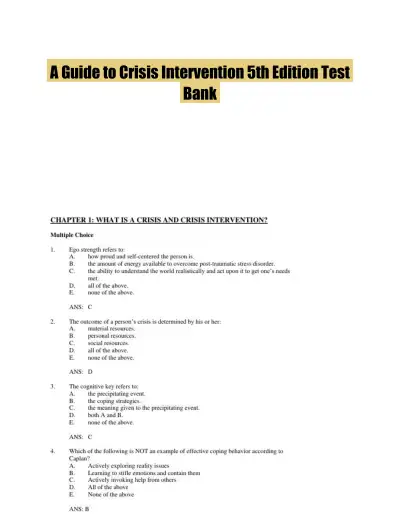 Exam Guides
A Guide to Crisis Intervention 5th Edition Test Bank
Psychology
82 pagesMay 2025 Exam Guides
Test Bank for Fundamentals of Corporate Finance, 4th Edition
Psychology
917 pages173downloadsFeb 2025 Textbook Guides
Solution Manual for International Economics, 13th Edition
Psychology
242 pages156downloadsFeb 2025 Exam Guides
Test Bank For Fundamentals of Abnormal Psychology, 7th Edition
Psychology
665 pages149downloadsFeb 2025 Class Notes
Lecture Notes for Abnormal Child and Adolescent Psychology, 8th Edition
Psychology
124 pages146downloadsFeb 2025 Class Notes
Lecture Notes For Abnormal Psychology, 18th Edition
Psychology
413 pages146downloadsFeb 2025 Exam Guides
Test Bank For Understanding Dying, Death, and Bereavement, 7th Edition
Psychology
140 pages141downloadsFeb 2025 Exam Guides
Test Bank For Psychology in Modules, 10th Edition
Psychology
1393 pages139downloadsFeb 2025
Study this document with CramX
Once it is in your library, every tool can work from it.