

Princeton Review SSAT and ISEE Prep, 2023: 6 Practice Tests + Review and Techniques (2023)
- Scholastic Assessment Test
- 1194 pages
- Shared February 2025
- 89 downloads
Get certified faster with Princeton Review SSAT and ISEE Prep, 2023: 6 Practice Tests + Review and Techniques (2023), a top-rated exam prep guide.
Preview 31 of 1194 pages
See the first 31 pages exactly as they appear in the document.
Page 1 Page 2 Read page 2 as text
Downloaded from StudyXY.com [= Ww + StudyXY oi as . Za \ Rr ' BE \ Stu dy Anything This ContentHas been Posted On StudyXY.com as supplementary learning material. StudyXY does not endrose any university, college or publisher. Allmaterials posted are under the liability of the contributors. | 8) www.studyxy.com
Page 3 Page 4 Read page 4 as text
The Princeton Review Publishing Team Rob Franek, Editor-in-Chief David Soto, Senior Director, Data Operations Stephen Koch, Senior Manager, Data Operations Deborah Weber, Director of Production Jason Ullmeyer, Production Design Manager Jennifer Chapman, Senior Production Artist Selena Coppock, Director of Editorial Aaron Riccio, Senior Editor Meave Shelton, Senior Editor Chris Chimera, Editor Orion McBean, Editor Patricia Murphy, Editor Laura Rose, Editor Alexa Schmitt Bugler, Editorial Assistant Penguin Random House Publishing Team Tom Russell, VP, Publisher Alison Stoltzfus, Senior Director, Publishing Brett Wright, Senior Editor Emily Hoffman, Assistant Managing Editor Ellen Reed, Production Manager Suzanne Lee, Designer Eugenia Lo, Publishing Assistant The Princeton Review 110 East 42nd St., 7th Floor New York, NY 10017 Copyright © 2022 by TPR Education IP Holdings, LLC. All rights reserved. Published in the United States by Penguin Random House LLC, New York, and in Canada by Random House of Canada, a division of Penguin Random House Ltd., Toronto. Terms of Service: The Princeton Review Online Companion Tools (“Student Tools”) for the retail books are available for only the two most recent editions of that book. Student Tools may be activated only twice per eligible book purchased for two consecutive 12-month periods, for a total of 24 months of access. Activation of Student Tools more than twice per book is in direct violation of these Terms of Service and may result in discontinuation of access to Student Tools Services.
Page 5 Read page 5 as text
ISBN 9780593450642 Ebook ISBN 9780593451045 All tests are registered trademarks of their respective owners. None of the trademark holders are affiliated with The Princeton Review. The Princeton Review is not affiliated with Princeton University. The material in this book is up-to-date at the time of publication. However, changes may have been instituted by the testing body in the test after this book was published. If there are any important late-breaking developments, changes, or corrections to the materials in this book, we will post that information online in the Student Tools. Register your book and check your Student Tools to see if there are any updates posted there. Editor: Orion McBean Production Editors: Nina Mozes and Wendy Rosen Production Artists: Shavon I. Serrano and Deborah Weber Cover art by Maren Winter / Alamy Stock Photo Cover design by Suzanne Lee For customer service, please contact editorialsupport@review.com, and be sure to include: o full title of the book * ISBN e page number a_prh_6.0_140784831_c0_r0 f Studyxy
Page 6 Read page 6 as text
Acknowledgments The Princeton Review would like to thank Shaina Walter Bowie for her hard work revising and developing test material for this book.
Page 7 Read page 7 as text
Contents Get More (Free) Content A Caregiver’s Introduction A Student's Introduction Part I: The Basics of Both Tests 1 Learning Vocabulary 2 Fundamental Math Skills for the SSAT & ISEE 3 Answer Key to Fundamental Math Drills 4 Writing the Essay Part ll: The SSAT 5 Everything You Always Wanted to Know About the SSAT 6 SSAT Math 7 SSAT Verbal 8 SSAT Reading 9 Answers and Explanations for SSAT Practice Drills Part lll: SSAT Practice Tests 10 Upper Level SSAT Practice Test 11 Middle Level SSAT Practice Test 12 Answer Key to SSAT Practice Tests Part IV: The ISEE 13 Everything You Always Wanted to Know About the ISEE
Page 8 Read page 8 as text
14 |ISEE Math 15 ISEE Verbal 16 ISEE Reading 17 Answers and Explanations for ISEE Practice Drills Part V: ISEE Practice Tests 18 Upper Level ISEE Practice Test 19 Middle Level ISEE Practice Test 20 Lower Level ISEE Practice Test 21 Answer Key to ISEE Practice Tests
Page 9 Read page 9 as text
1 Go to PrincetonReview.com/prep and enter the following ISBN for your book: 9780593451045 2 Answer a few simple questions to set up an exclusive Princeton Review account. (If you already have one, you can just log in.)
Page 10 Read page 10 as text
3 Enjoy access to FREE content! Need to report a potential content issue? Contact EditorialSupport@review.com and include:
Page 11 Read page 11 as text
full title of the book * ISBN * page number Need to report a technical issue? Contact TPRStudentTech@review.com and provide: « your full name « email address used to register the book « full book title and ISBN * Operating system (Mac/PC) and browser (Chrome, Firefox, Safari, etc.) Once you've registered, you can... « Get our take on any recent or pending updates to the SSAT or ISEE « Download a full-length SSAT Elementary Level test and take online versions of the SSAT and ISEE tests found in this book. * Access a student study guide that will help you outline a plan to get through each chapter in this book. * Get complete explanations for the in-book SSAT and ISEE Practice Tests
Page 12 Read page 12 as text
* Check to see if there have been any corrections or updates to this edition Look For These Icons Throughout The PROVEN TECHNIQUES APPLIED STRATEGIES ANOTHER APPROACH DON'T FORGET! WATCH OUT TIME-SAVING TIP TIME YOURSELF ONLINE PRACTICE TESTS
Page 13 Read page 13 as text
ONLINE ARTICLES
Page 14 Read page 14 as text
A Caregiver’s Introduction
Page 15 Read page 15 as text
HOW CAN | HELP? Congratulations! Your child is considering attending a private school, and by virtue of the fact that you hold this book in your hands, you have recognized that either the SSAT or the ISEE is an important part of the admissions process. Providing your child with the information contained in this book is an excellent first step toward a strong performance on the SSAT or the ISEE. As a caregiver, however, you know well the fine line between support and intrusion. To guide you in your efforts to help your child, we’d like to offer a few suggestions. Have a Healthy Perspective Both the SSAT and the ISEE are standardized tests designed to say something about an individual student’s chances for success in a private school. Neither is an intelligence test; neither claims to be. Set realistic expectations for your child. The skills necessary for a strong performance on these tests are often very different from those a student uses in school. The additional stress that comes from being expected to do well generally serves only to distract a student from taking a test efficiently. At the same time, beware of dismissing disappointing results with a simple, “My child doesn’t test well.” While it is undoubtedly true that some students test better than others, this explanation does little to encourage a student to invest time and effort into overcoming obstacles and improving performance. Be Informed The SSAT and the ISEE are neither achievement tests nor intelligence tests. To score well, your child needs to understand what is tested and how it is tested Know How to Interpret Performance + Studyxy
Page 16 Read page 16 as text
Each level of the SSAT and ISEE covers a range of grade levels. It is impossible to interpret scores without considering the grade level of the student. Percentile rankings have much more value than do either raw or scaled scores, and percentiles are the numbers schools use to compare students. Remember That This Is Not an English or a Math Test There are both verbal and math questions on the SSAT and on the ISEE. However, these questions are often based on skills and concepts that are different from those used on a day-to-day basis in school. For instance, very few English teachers—at any level—spend a lot of time teaching students how to approach analogy or sentence completion questions. This may be frustrating for caregivers, students, and teachers. But in the final judgment, our educational system would take a turn for the worse if it attempted to teach students to do well on the SSAT, the ISEE, or even the SAT. The fact that the valuable skills students learn in school don’t directly improve test scores is evidence of a flaw in the testing system, not an indictment of our schools or those who have devoted their professional careers to education. Realize That All Tests Are Different Many of the general rules that students are accustomed to applying to tests in school do not apply to either the SSAT or the ISEE. Many students, for instance, actually hurt their scores by trying to work on every question. Although these tests are timed, accuracy is much more important than speed. Once your child learns the format and structure of these tests, it will be easier for your child to apply underlying knowledge to the test and answer more questions correctly. Provide All the Resources You Can This book has been written to provide your child with a very thorough review of all the math, vocabulary, reading, and writing skills that are necessary for
Page 17 Read page 17 as text
success on the SSAT and ISEE. We have also included practice drills for each chapter and practice tests that simulate actual SSAT or ISEE examinations. For a more realistic testing experience, register this book to access the tests in an online format. The very best practice test questions, however, are naturally the ones written by the organizations who write the real test questions—the Enrollment Management Association (EMA) for the SSAT and the Educational Resources Bureau (ERB) for the ISEE. We encourage you to contact both organizations (websites, email addresses and phone numbers can be found on this page) to obtain any resources containing test questions that you can use for additional practice. In addition, both the SSAT and the ISEE change with time in very subtle ways. Thus, we suggest supplementing the information in this book with ERB’s What to Expect on the ISEE, which you can find at isee.erblearn.org, and EMA’s The Official Study Guide for the SSAT, which you can order at ssat.org/prepare/practice. Make sure the materials you choose are, to the greatest extent possible, reflective of the test your child will take and not a test that was given years earlier. Also, try to avoid the inevitable confusion that comes from asking a student to follow two different sets of advice. Presumably, you have decided (or are about to decide) to trust The Princeton Review to prepare your child for this test. In doing so, you have made a wise decision. As we have said, we encourage you to provide any and all sources of additional practice material (as long as it is accurate and reflective of the current test), but providing other test preparation advice tends to muddy the waters and confuse students. Be Patient and Be Involved Preparing for the SSAT or the ISEE is like learning how to ride a bicycle. You will watch your child struggle, at first, to develop a level of familiarity and comfort with the test’s format and content.
Page 18 Read page 18 as text
Developing the math, vocabulary, reading, and writing skills that your child will use on the SSAT or the ISEE is a long-term process. In addition to making certain that your child is committed to spending the time necessary to work through the chapters of this book, you should also be on the lookout for other opportunities to be supportive. One way to do this is to make vocabulary development into a group activity. In the vocabulary chapter, we provide an extensive list of vocabulary words; you can work on them together by creating flashcards at the breakfast table or during car trips. You may even pick up a new word or two yourself! Important: If your child is in a lower grade, you may want to offer extra guidance as your child works through this book and prepares for the test. Because this book covers preparation for the full range of grade levels taking the tests (first through eleventh grades), some of the content review will be beyond the areas that your child is expected to know. It is an excellent idea to work through the book along with younger children, so that they don’t become intimidated by these higher-level questions that should be skipped. Check out your Student Tools to see the suggested study schedule. A SHORT WORD ON ADMISSIONS The most important insight into private school admissions that we can offer is that a student’s score on the SSAT or the ISEE is only one of many components involved in admission decisions. While many schools will request SSAT or ISEE scores, all will look seriously at your child’s academic record. Think about it: which says more about a student—a single test or years of solid academic performance? In terms of testing, which is the focus of this book, some schools will specify which test they want applicants to take—the SSAT or the ISEE. Others will allow you to use scores from either test. If you are faced with a decision of whether to focus on the SSAT, the ISEE, or both, we encourage you to be an informed consumer. This book contains practice tests for the ISEE and the SSAT, and your child should attempt both. Then, based on the requirements
Page 19 Read page 19 as text
of your desired school and the results of the practice tests, you can decide which test best suits your child. Students may register to take the ISEE up to three times in a 12-month admission cycle, once in any or all of three testing seasons. The seasons are Fall (August-November), Winter (December— March), and Spring/Summer (April-July). ISEE does not encourage multiple testing, but does offer students and families that option. The Middle and Upper Level SSAT may be taken up to eleven times during the testing year (which EMA defines as August 1st— July 31st)—three computer based administrations (either online at-home or at a Prometric Test Center), six paper-based Standard administrations, and one paper-based Flex administration in each of the two Flex periods (the first period is typically from August to mid-November and the second is typically from late- November to the end of July). The Elementary Level SSAT is only offered as a paper-based test and may be taken up to two times—two Standard administrations or one Standard administration and one Flex test. For the most accurate information about their admissions policies, don't hesitate to call the schools to which your child may apply. There are some differences in question types between the two tests. While both the SSAT and the ISEE test vocabulary, they do so in different ways. The SSAT, for example, contains a section on analogies, which many students may not be familiar with, while the ISEE includes a section of sentence completions. On the other hand, Middle and Upper Level ISEE test- takers will be faced with a number of quantitative comparison questions in the Math section, and these can be tricky at first, especially for younger students. Take these differences into consideration if you have the option to choose between the two tests.
Page 20 Read page 20 as text
A Flex test is a paper-based SSAT given on a flexible schedule other than the six typical testing Saturdays. Learn more at ssat.org/pages/what-is-a- flex-test Resources The Enrollment Management Association (EMA) SSAT 609-683-4440 www.ssat.org info@ssat.org Educational Records Bureau (ERB) 800-989-3721 ISEE ~~ www.erblearn.org info@erblearn.org www.iseetest.org REGISTERING FOR THE SSAT Before you go any further in preparing for the SSAT, you must complete one essen-tial step: sign up for the SSAT. The online at-home Middle and Upper Level tests are offered at least one weekend each month (usually on both Saturday and Sunday). Additional weekday test dates are also available during peak testing times. Students also have the option to take the online test at Prometric Test Centers on a wide variety of dates. Paper-based Standard administrations are offered six times per testing year, typically in October, November, December, January, February, and April. In addition, Middle and Upper Level students can take one paper-based Flex test in each of the two Flex periods. The Elementary Level is only offered as a paper-based test.
Page 21 Read page 21 as text
Check www.ssat.org to determine whether there is a Standard Elementary administration available in your area on your preferred date or call the school your child is applying to and ask whether the school is offering a Flex administration. Additional information on the various testing options can be found at www.ssat.org/testing/about-the-test#testing-options. Testing dates and times can fill up; by registering early, your child will avoid the possibility of having to take the test on an inconvenient date or at an inconvenient time. You can register online at www.ssat.org. Not only will early registration give you one less thing to worry about as the test approaches, but it will also make it easier to get your first-choice test date and time Registration for online testing is available until twenty-four hours prior to the test (though dates typically fill up far in advance of that deadline so we strongly recommend that you select a date and time well in advance). The regular registration deadline for the paper-based Standard test (at domestic test centers) is the Sunday three weeks before the test date; from that point until the next Sunday, there is a $50 Late Fee. The deadline for students with accommodations is the Sunday two weeks before the test date. Students without accommodations may continue to register after that point for an additional $90 Rush Fee. Registration for paper-based Standard test dates closes at 11:59 p.m. the Wednesday before the test date. The cost to test in the United States and Canada starts at $95 for the Elementary Level Standard or school-based Flex test and $155 for the Middle and Upper Level paper-based Standard or school Flex tests, and are higher for testing with an educational consultant, online at a Prometric center, or online at home. For a full list of current fees, see www.ssat.org/testing/about-the-test#pricing. Internationally, the cost is $210 for the Elementary Level test and $299 for the Middle and Upper Level tests. There are additional fees for optional add-ons such as score availability alerts or mailed paper score reports (online score report
Page 22 Read page 22 as text
access is free). Fees are paid online by Visa, MasterCard, or American Express. In some cases, you may be able to obtain an SSAT fee waiver. Fees for the most popular SSAT testing options: + $95 for Elementary Level Standard or school- based Flex test * $135 for a Flex test « $155 for Middle Level/Upper Level Standard or school flex * $235 for SSAT at Home If you have already registered and want to change your Prometric Test Center date or location at least 29 days in advance of your original appointment, there is no fee. If you want to change within 3-28 days of your Prometric appointment, there’s a change fee of $35. There is no charge to reschedule an at-home appointment, but it must be done at least three days in advance of your original appointment. Students who need special testing accommodations must apply and be approved for accommodations before registering for a test date. Make sure to apply for accommodations early; it typically takes at least 3-4 weeks for applications to be reviewed. Once approved, accommodations will apply to all of a student’s tests within a testing year (August 1st to July 31st). Find more information at ssat.org/testing/accommodations/overview. REGISTERING FOR THE ISEE Before you go any further in preparing for the ISEE, you must do one essential thing: sign up for the ISEE. Go to https:/iseeonline.erblearn.org/, and create an online account or call 1 (800) 446-0320 or (919) 956-8524 to register. The ISEE is offered in an online format at home, Prometric Test Centers, schools, and testing offices. The ISEE is also offered in a paper format at schools and testing offices. Phone registration is not available for at-home or Prometric center testing.
Page 23 Read page 23 as text
Students may register to take the ISEE one time in any or all of three testing seasons. As previously mentioned, ISEE testing seasons are defined as Fall (August-November), Winter (December—March), and Spring/Summer (April-July). Students do not have to select schools to receive ISEE scores at the time of registration; they may add them at no extra charge after a test is scored. The regular registration deadline for on-site testing at a school or satellite site is three weeks before the test date. The registration fee varies by location and modality, and you can pay by Visa, MasterCard, American Express, or check. There are additional fees for rescheduling and late registration. Registration closes two weeks before each test date, but some sites may offer Walk-In Registration. For more details on fees and the different testing options, visit www.erblearn.org/families/isee-pricing. Fees for the most popular ISEE testing options: * $140 for online at-home, online at school, or paper-based at school testing administered by a school + $200 for online at-home testing administered by ERB + $200 for online testing at a Prometric Testing Center Walk-In Registration Walk-in registration is available at a limited number of ISEE test site schools. It is available on a first-come, first-served basis and cannot be assured due to limitations on testing materials and staff. The Walk-In Registration fee is $180 and must be processed online by Visa or MasterCard only. If you are a candidate for walk-in registration, you must call the test site school directly to see if you may be accommodated and receive a Walk-In Registration Code.
Page 24 Read page 24 as text
A Student’s Introduction
Page 25 Read page 25 as text
HOW TO USE THIS BOOK You've got a hefty amount of paper and information in your hands. How can you work through it thoroughly, without spending eight hours on it the Saturday before the test? Plan ahead. Before you start, go to your Student Tools and download the study guide. We’ve broken down the contents of this book into 12 study sessions and suggested a timeline for you to follow. Some of these sessions will take longer than others, depending on your strengths and weaknesses. If any of them takes more than two hours, take a break and try to finish the session the following day. You may want to do one, two, or three sessions a week, but we suggest you give yourself at least a day or two in between to absorb the information you’ve just learned. The one thing you should be doing every day is quizzing yourself on vocabulary and making new flashcards. We also caution against thinking that you can work through this book during summer vacation, put it aside in September, and be ready to take the test in December. If you want to start that early, work primarily on vocabulary until about 10 weeks before the test. Then you can start on techniques, and they’ll be fresh in your mind on the day of the test. If you’ve finished your preparation too soon and have nothing to practice on in the weeks before the test, you're going to get rusty. If you know you are significantly weaker in one of the subjects covered by the test, you should begin with that subject so you can practice it throughout your preparation. If you have more than ten weeks to prepare, start with vocabulary building and essay writing. These skills only improve with time
Page 26 Read page 26 as text
At Each Session At each practice session, make sure you have sharpened pencils, blank index cards, and a dictionary. If you’ll be testing online, you should also have a notebook or stack of scratch paper. Each chapter is interactive; to fully understand the techniques we present, you need to be ready to try them out. As you read each chapter, practice the techniques and do all the exercises. Check your answers in the Answer Key as you finish each set of problems, and try to figure out what types of errors you made so you can correct them. Review all of the techniques that give you trouble. Get Your Pencil Moving You'll get the most out of this book by trying out techniques as you read about them. As you begin each session, review the chapter you completed during the previous session before moving on to a new chapter. When You Take a Practice Test We recommend some specific times to take practice tests in the following session outlines. Here are some guidelines for taking these tests. * Know whether you will be testing on paper or online, and practice accordingly. If you're taking an online SSAT, you’ll be permitted two pieces of scratch paper and one pencil. If you're taking an online ISEE, you’ll be permitted up to four pieces of scratch paper and two pens and/or two pencils. e Time yourself strictly. Use a timer, watch, or stopwatch that will ring, and do not allow yourself to go over the allotted time for any section. If you try to do so on the real test, your scores will probably be canceled. o Take a practice test in one sitting, allowing yourself only the breaks that you’ll have on test day (see this page for SSAT and this page for ISEE) T= StudyXY
Page 27 Read page 27 as text
and no more than two minutes between other sections. You need to build up your endurance for the real test, and you also need an accurate picture of how you will do. o If you're taking an online test, register this book to take the included tests online. o If your online test will be at home, set up your work area the same way you will on test day. Make sure that you have a quiet, private space and that the computer you’re using meets your test’s technical requirements. The only things on your work space other than your computer, mouse, and keyboard should be a writing instrument and your allotted pieces of scratch paper (2 for SSAT or 4 for ISEE). o If you're taking a paper-based test, always practice with an answer sheet with bubbles to fill in, just as you will do for the real test. For the practice tests in this book, use the attached answer sheets. You need to be comfortable transferring answers to the separate sheet because you might end up skipping around a bit. Thoroughly fill in each bubble you choose, and make no other marks in the answer area. As you fill in the bubble for a question, check to be sure you are on the correct number on the answer sheet. If you fill in the wrong bubble on the answer sheet, it won’t matter if you’ve worked out the problem correctly in your test booklet. All that matters to the machine scoring your test is the No. 2 pencil mark. The EMA and the ERB consider their Score Reports proprietary information, so we can't reproduce them for our practice tests. You can get an idea of how you did by marking off how many you got right in the answer key after each test. Keep the learning going! The Day of the Exam * Wake up refreshed from at least eight hours of sleep the night before. * Eat a good breakfast. StudyXY
Page 28 Read page 28 as text
* Plan to arrive at the test center or check in to the online proctoring site about a half hour before your test is scheduled to begin. o If you're testing at a school or test center, bring your SSAT admission ticket or ISEE Verification Letter, four No. 2 pencils with erasers, and, for the paper ISEE only, two working blue or black pens (erasable pens are acceptable). Prometric Test Centers will provide a pencil and scratch paper. The test center may not allow you to take food or beverages into the room, but you can leave them in the hall, in case you have a chance to get them during a short break. Do not take a cell phone or any books, papers, or calculators. * Remind yourself that you do not have to work out every question on the test to get a good score. Don’t let yourself become rushed. Pace yourself. If you're not testing at home, take a sweater! You never know how cold the room might be GENERAL TEST-TAKING TECHNIQUES FOR THE SSAT & ISEE Pacing Most people believe that to do well on a test, it is important to answer every question. While this is true of most of the tests you take in school, it is not true of many standardized tests, including the SSAT and ISEE. On these tests, it is very possible to score well without attempting all of the questions; in fact, many students can improve their scores by answering fewer questions. “Wait a second. I can get a better score by attempting fewer questions?” Yes. On the Middle and Upper Level SSAT, you are penalized only for the questions you answer incorrectly, not for the questions you skip. Because all of the questions are worth the same number of points, it’s better to answer an + Studyxy
Page 29 Read page 29 as text
easier question you understand and are likely to get right than waste time with one you don’t. So for the most part, you’ll give your attention to problems you think you can answer, and decide which questions are too thorny to waste time on. This test-taking approach is just as important to score improvement as your knowledge of vocabulary and math rules! because there is no guessing penalty. In general, all math and verbal questions on the SSAT and ISEE gradually increase in difficulty from first to last. (The one exception is the Reading section, where question difficulty is mixed.) This means that for most students, the longest and most complicated problems are at the end of each section. For this reason, all students should focus the majority of their attention on the questions they know they can answer. Why rush through these and make careless errors, when you could spend time and get all of them right? Attempt the ones you find more challenging last—if you have time. The reason that this approach to pacing can actually increase scores on the Middle and Upper Level SSAT is that skipped questions gain you zero points, whereas each incorrect answer reduces your raw score by a quarter- point. Because your raw score will decrease only if you answer a question incorrectly, skipping is the best strategy for a problem that has you completely stumped. Ideally, you will either get a question right or skip it (with some exceptions when you can guess intelligently and aggressively). Skipping will be a major tool for the questions you find most troublesome. Guessing will be part of the whole test, so let’s look at how guessing and
Page 30 Read page 30 as text
skipping work together. Again, ISEE and Elementary SSAT students should select an answer for every question since wrong answers and blanks are treated the same on those tests. Points are not deducted for wrong answers on the SSAT Elementary Level test. Thus, do not leave any answers blank. Even so, pace yourself wisely to increase your accuracy on questions you know or think you know the answers to. This is also true for all levels of the ISEE Guessing on the Middle and Upper Level SSAT When should you guess? Whenever you can eliminate even one wrong answer with certainty. Yes, really. We’ll get to why in a minute. Eliminate the wrong answers and you’ll have the right answer by Process of Elimination (we’ll explain more about this later). So eliminate the answers that are clearly wrong and guess! Be aggressive. Over the course of the whole test, this strategy will increase your score. How? Well, let’s look again at how SSAT questions are scored: right answers are rewarded and wrong answers are penalized. Correct answers: +1 point Wrong answers: — point Blank answers: 0 points Suppose we asked you to place a bet on five attempts to draw a yellow marble from a bag. The bag contains four black marbles and one yellow StudyXY
Page 31 Read page 31 as text
marble, and you have to put the drawn marble back after each attempt. There’s only one chance in five that you’ll draw the yellow marble, but if you do, you get a dollar. There’s a four in five chance of a black marble; when you draw black, you pay us 25¢. Would you do it? Maybe yes, maybe no. If you drew yellow once and black four times, you’d get a dollar and then pay 25¢ four times, ending up with nothing. You wouldn’t lose money, but you wouldn’t win any, either. Similarly, there are five choices on every SSAT question, but only one right answer. So if you just guess randomly without eliminating anything first, you will be right about one time and wrong about four times for every five questions you do. That means that the one time you were right, you would get one full raw point (yay!), but you would lose a quarter-point four times (boo!). All of this would bring you right back to where you started. 1-4( )=0 So random guessing will pretty much keep your score flat. Here is where our guessing strategy comes in. What if, instead of a one-in-five chance of drawing yellow, the odds were one in four? This time, if four attempts usually resulted in drawing one yellow ($1 for you) and three blacks (pay out 75¢), you’d make a little money and come out on top. On an SSAT question, if you can eliminate one choice out of the five, you're in the same situation. You now have only four possible answers, and you will be right about once for every three times you are wrong. Now the penalty for wrong answers will have less impact. If you narrow it down to three choices, you’ll get about one right for every two times you’re wrong. Good odds? You bet. That’s like making a dollar and losing 50¢. If you can do this throughout the test, you will gradually increase your score. That's why it pays to spend time eliminating the wrong answers and then guessing aggressively. 1-3()=
1163 more pages in the full document
Unlock it once and it stays in your library, ready to chat with or turn into flashcards.
Unlock the full documentMore Scholastic Assessment Test study materials
See all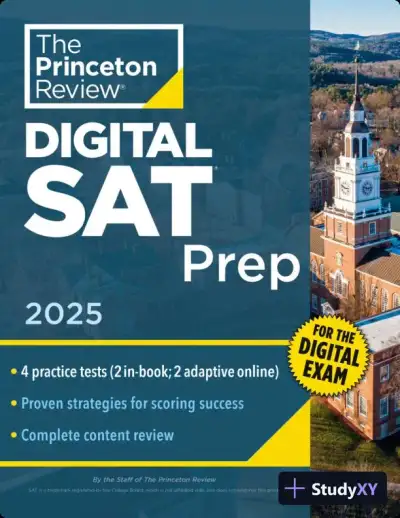 Certification Guides
Princeton Review Digital SAT Prep, 2025: 4 Full-Length Practice Tests (2024)
Scholastic Assessment Test
1073 pages167downloadsFeb 2025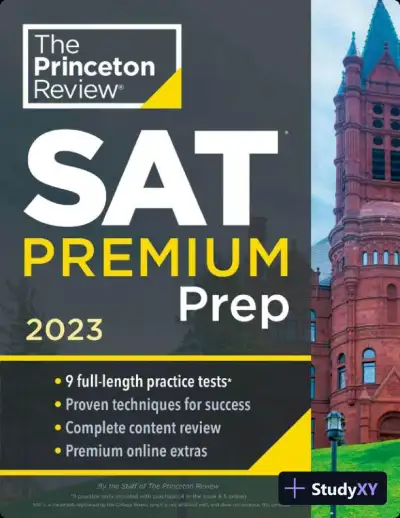 Certification Guides
Princeton Review SAT Premium Prep, 2023: 9 Practice Tests + Review and Techniques (2022)
Scholastic Assessment Test
1391 pages155downloadsFeb 2025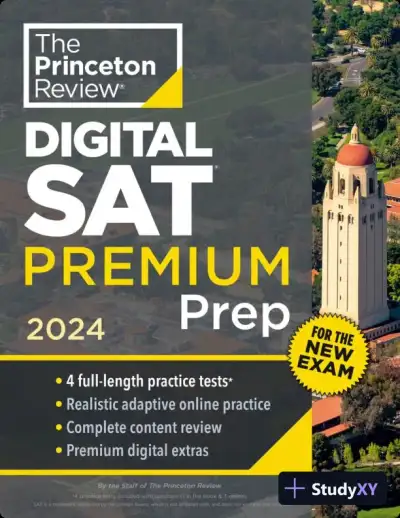 Certification Guides
Princeton Review Digital SAT Premium Prep, 2024 : 4 Practice Tests + Online Flashcards + Review and Tools (2023)
Scholastic Assessment Test
873 pages153downloadsFeb 2025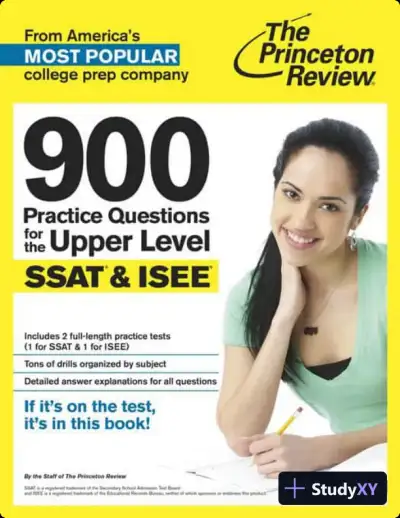 Certification Guides
900 Practice Questions for the Upper Level SSAT and ISEE (2014)
Scholastic Assessment Test
870 pages137downloadsFeb 2025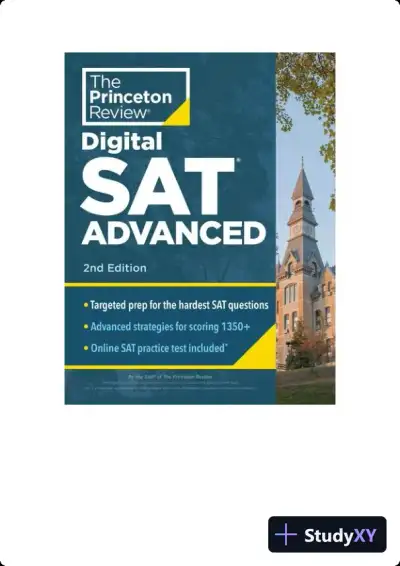 Certification Guides
Princeton Review Digital SAT Advanced (College Test Preparation), 2nd Edition (2024)
Scholastic Assessment Test
415 pages128downloadsFeb 2025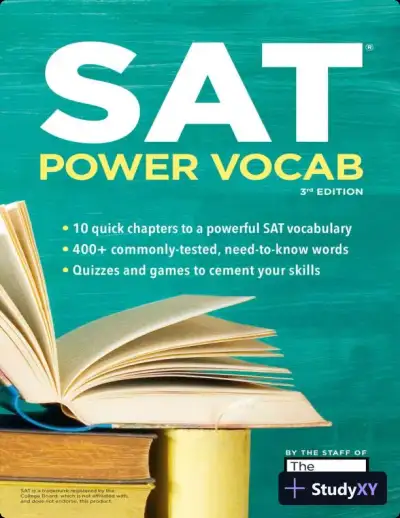 Certification Guides
SAT Power Vocab : A Complete Guide to Vocabulary Skills and Strategies for the SAT (2024)
Scholastic Assessment Test
355 pages94downloadsFeb 2025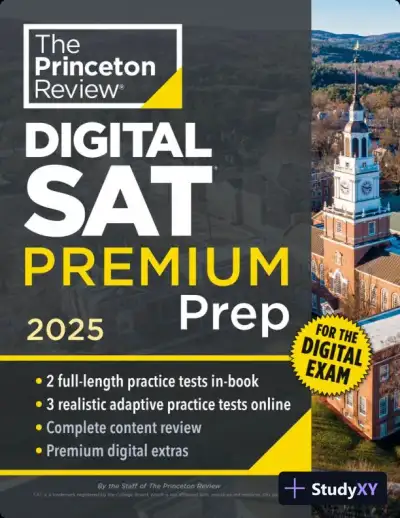 Certification Guides
The Princeton Review 2025 PREMIUM @DSATuz1 (2024)
Scholastic Assessment Test
1094 pages89downloadsFeb 2025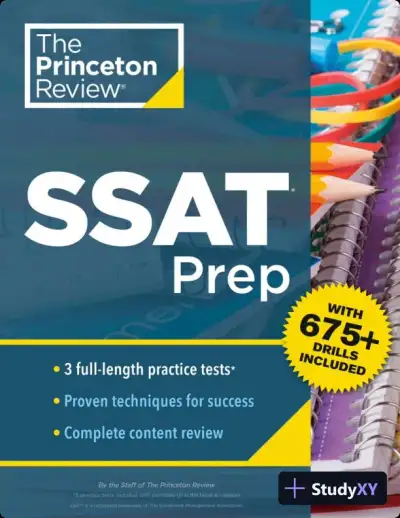 Certification Guides
Princeton Review SSAT Prep: 3 Practice Tests + Review and Techniques + Drills (2023)
Scholastic Assessment Test
688 pages65downloadsFeb 2025
Study this document with CramX
Once it is in your library, every tool can work from it.