

SAT Power Vocab : A Complete Guide to Vocabulary Skills and Strategies for the SAT (2024)
- Scholastic Assessment Test
- 355 pages
- Shared February 2025
- 94 downloads
SAT Power Vocab : A Complete Guide to Vocabulary Skills and Strategies for the SAT (2024) provides detailed explanations to help you understand key concepts.
Preview 31 of 355 pages
See the first 31 pages exactly as they appear in the document.
Page 1 Page 2 Read page 2 as text
Downloaded from StudyXY.com [= Ww + StudyXY oi as . Za \ Rr ' BE \ Stu dy Anything This ContentHas been Posted On StudyXY.com as supplementary learning material. StudyXY does not endrose any university, college or publisher. Allmaterials posted are under the liability of the contributors. | 8) www.studyxy.com
Page 3 Page 4 Read page 4 as text
The Princeton Review Publishing Team Rob Franek, Editor-in-Chief David Soto, Senior Director, Data Operations Stephen Koch, Senior Manager, Data Operations Deborah Weber, Director of Production Jason Ullmeyer, Production Design Manager Jennifer Chapman, Senior Production Artist Selena Coppock, Director of Editorial Orion McBean, Senior Editor Aaron Riccio, Senior Editor Meave Shelton, Senior Editor Chris Chimera, Editor Patricia Murphy, Editor Laura Rose, Editor Isabelle Appleton, Editorial Assistant Penguin Random House Publishing Team Tom Russell, VP, Publisher Alison Stoltzfus, Senior Director, Publishing Brett Wright, Senior Editor Emily Hoffman, Assistant Managing Editor Ellen Reed, Production Manager Suzanne Lee, Designer Eugenia Lo, Publishing Assistant The Princeton Review 110 East 42nd St, 7th Floor New York, NY 10017 Copyright © 2023 by TPR Education IP Holdings, LLC. All rights reserved. Published in the United States by Penguin Random House LLC, New York. Terms of Service: The Princeton Review Online Companion Tools (“Student Tools”) for retail books are available for only the two most recent editions of that book. Student Tools may be activated only once per eligible book purchased for a total of 24 months of access. Activation of Student Tools more than once per book is in direct violation of these Terms of Service and may result in discontinuation of access to Student Tools Services. ISBN 9780593516706
Page 5 Read page 5 as text
Ebook ISBN 9780593516713 The Princeton Review is not affiliated with Princeton University. Editor: Patricia Murphy Production Editors: Heidi Torres and Lyssa Mandel Production Artist: Deborah A. Weber © 2023 Penguin Random House LLC Cover art by Thomas Bethge / Alamy Stock Photo Cover design by Suzanne Lee For customer service, please contact editorialsupport@review.com, and be sure to include: o full title of the book e ISBN e page number a_prh_6.3_146139109_c0_r0 StudyXY
Page 6 Read page 6 as text
Acknowledgments The Princeton Review would like to thank Sara Kuperstein and Kenneth Brenner for their fantastic work on this edition. Thanks also to everyone who contributed to the creation of this book: Amy Minster, Debbie Weber, Lyssa Mandel, and Heidi Torres. Special thanks to Adam Robinson, who conceived of and perfected the Joe Bloggs approach to standardized tests and many of the other successful techniques used by The Princeton Review.
Page 7 Read page 7 as text
Contents Get More (Free) Content Introduction Part I: Etymology 1 Basic Word Roots 2 Latin Roots and Feeling Words 3 Greek Roots 4 More Latin Roots Part ll: Mnemonic Devices 5 Mnemonics 6 Create Your Own Mnemonics 7 Word Associations Part lll: Practice, Practice, Practice 8 New Words 9 Cumulative Drills Part IV: Math Vocabulary 10 Math Terms for the SAT Part V: Conclusion Building Your Vocabulary: Strategies and Study Tips Online Glossary
Page 8 Read page 8 as text
_146139109_
Page 9 Read page 9 as text
Online Glossary Click here to go to the online supplement for this book. * Online Glossary
Page 10 Read page 10 as text
1 Go to PrincetonReview.com/prep and enter the following ISBN for your book: 9780593516713 2 Answer a few simple questions to set up an exclusive Princeton Review account. (If you already have one, you can just log in.)
Page 11 Read page 11 as text
3 Enjoy access to your FREE content! LET’S GO MOBILE! Access all of these free, additional resources by downloading the new Princeton Review app at www.princetonreview.com/mobile/apps/highschool. Need to report a potential content issue? Contact EditorialSupport@review.com and include: full title of the book « ISBN * page number Need to report a technical issue?
Page 12 Read page 12 as text
Contact TPRStudentTech@review.com and provide: e your full name + email address used to register the book « full book title and ISBN e Operating system (Mac/PC) and browser (Chrome, Firefox, Safari, etc.) Once you've registered, you can... « Access four more full-length practice tests « Find any late-breaking information released about the ACT + Read our special “College Admissions Insider” and get valuable advice about the college application process, including tips for writing a great essay and where to apply for financial aid + Check to see if there have been any corrections or updates to this edition « Sort colleges by whatever you're looking for (such as Best Theater or Dorm), learn more about your top choices, and see how they all rank according to The Best 389 Colleges * Check out bonus features in your Student Tools, including comprehensive study guides and short videos to help enhance your test prep
Page 13 Read page 13 as text
Introduction
Page 14 Read page 14 as text
Why You Need This Book If you're reading this book, chances are you are preparing to take a major standardized test such as the SAT. Or perhaps you have already taken the SAT and will be taking it again in hopes of achieving a higher score. You may have heard that the SAT no longer tests vocabulary, but this is not entirely accurate. It is true that the SAT does not test as much vocabulary as it once did, but here at The Princeton Review, we know that students with a strong vocabulary tend to get better scores. Why? The College Board's SAT underwent a major change in March 2016. Prior to 2016, there were many questions (called Sentence Completions) that explicitly tested difficult vocabulary words. And if you go back further in time to when your parents took the test, for example, there were even more vocabulary-based questions, such as word analogies. In March 2016, Sentence Completions were removed from the SAT, and the entire Verbal portion of the exam was said to test only reading and grammar skills. The dirty little secret about the SAT, however, is that you still need a strong knowledge of vocabulary in order to score well. Difficult words still appear in many Reading passages, questions, and answer choices, and if you don’t know these words, you will probably struggle. The SAT contains at least 10-15 words that the average student may not know—which could be the difference between answering these questions correctly and getting stuck. At The Princeton Review, we know the SAT like the backs of our hands. We know which words you are likely to see on the SAT and which words you will not. More importantly, we know some effective
Page 15 Read page 15 as text
strategies for learning unfamiliar vocabulary that do not require long hours spent memorizing endless lists of difficult words. The SAT Goes Digital As of 2023 for international test-takers and 2024 for U.S. test-takers, students will be taking the Digital SAT. While there are significant changes in the format and delivery of the test, most of the Reading topics are the same as they have been for many years. However, the Digital SAT actually has a greater emphasis on vocabulary. Based on what College Board has released about the Digital SAT as of this writing, we expect that you will see a good number of questions that test your vocabulary knowledge. Therefore, this book will be even more helpful if you are preparing for the Digital SAT. A Strong Vocabulary Is “Good for Your Brain” You may be thinking, “There is more to life than a score on a standardized test.” Of course, we agree. Although we eat, sleep, and breathe test prep, we do occasionally venture into the “real world.” And, yes, you guessed it: vocabulary is useful there, too. The English language is impressive in its variety. Unabridged dictionaries can contain as many as 600,000 words, but if you count the myriad of technical words found in disciplines such as science, medicine, engineering, and law, there are likely about one million English words. None of us can learn all of these—nor do we need to— but the more words you know, the more you will understand the world around you. When a news anchor says that a bill has “bipartisan support” in Congress, you will be a more engaged citizen if you know what bipartisan means. (It means that both political parties support the legislation.)
Page 16 Read page 16 as text
In addition to being able to understand more, having a larger vocabulary will also help you to express yourself more concisely and precisely. Try this out: how could you describe the story of Cinderella using as few words as possible? A person with a limited vocabulary might say something like this: “A poor girl whose father has died gets help from a fairy godmother to go to a ball dressed as a beautiful, wealthy lady. She meets a prince, and after she runs away, he finds her shoe. He uses her shoe to find her, and then they get married.” If you have a more robust vocabulary, however, you can get your point across much more concisely: “After a fairy godmother temporarily transforms an abused orphan into a noblewoman, her dance partner, a prince, uses her abandoned shoe to reunite with her.” How many times have you tried to explain something, and it came out as “It's like, you know, when these things...”? It can be quite frustrating to not possess the words you need to convey your intended meaning. The more words you know, the easier you'll find it to express yourself. Plus, you'll be able to do so using fewer words. Instead of saying, “I can see both sides,” you can simply say, “I'm ambivalent.” Instead of saying, “I'm not 100% set on these plans,” you can say, “These plans are tentative.” And instead of saying, “My friend told me this, but | really don’t know if it's true,” you can say, “My friend told me this, but I'm dubious.” You might be thinking, “Sure, | get the point, but | really can’t see myself using these weird words.” Well, you may be surprised to find that the words in this book aren't all that weird. In fact, we think you'll find that when you come across a word you think you've never seen before and start studying it, you'll start to see it everywhere, and before you know it the once weird word will become part of your vocabulary. No matter what you study in college, you can expect to do a lot of reading. The better a reader you become, and the better your vocabulary is, the easier it will be to understand all of that reading. As
Page 17 Read page 17 as text
you get older and read more, you'll realize that words that might have previously seemed obscure are actually common in academic writing, and it'll be a huge help if you already know what they mean. Who Needs This Book? Some might tell you that the best and easiest way to learn vocabulary is to learn it naturally throughout your lifetime: from your friends, parents, teachers, the media, books, and so on. After all, that's how you first learned many of the words you use every day. While there is no substitute for the natural, organic way of learning vocabulary from reading and real-life interactions, if you feel that your vocabulary is weaker than it should be, you need a fast way to bring yourself up to speed. Reading the world’s great classic works of literature and listening to hours of NPR on the car radio takes years of dedication. There is a faster way. This book is written for people at all levels of English knowledge and expertise. Maybe you are relatively new to the English language, know the basics, and now want to learn more challenging words. This book is for you. Maybe you are a native speaker and want to expand upon what you already know. This book is for you. Most of you probably have an average vocabulary. This book is for everyone. We guarantee that you will learn a lot of new words, and that you will see many of these words when you take the SAT. How to Use This Book SAT Power Vocab is designed to let you learn vocabulary in a logical manner, gradually, and with strategies and practice to ensure that you will remember new words for more than just a few minutes. For the best results, we recommend you read the chapters in this book
Page 18 Read page 18 as text
thoroughly and in order, as each chapter builds on the one before it. The chapters are fairly short, so you can read them anytime, anywhere: during study hall, on a bus trip, or before bed. You can use this book over a long period of time, or you can read it all in the week or two before your exam. Cramming is not the ideal way to learn anything, but it's better than not studying at all. Tricks of the Trade The most common question we get from students is this: How do | learn vocabulary? Well, different approaches work for different people, but we at The Princeton Review believe in a multilayered approach that incorporates etymology (word roots), mnemonics, and more—plus practice exercises and activities to hone your word skills. Word Roots In Chapters 1 through 4, we will explore the fundamental building blocks of words. English is, in fact, cobbled together from other languages, including Latin and Greek. Many English words contain roots with meanings derived from those languages. When you learn some common roots, you will find that you can decipher the meaning of a word on sight, even if you've never seen or heard it before. For example, let's look at the Greek root chron-, which relates to time. The words below contain the root chron- and all have to do with time in some way. chronological: in order according to time synchronize: to put on the same timetable
Page 19 Read page 19 as text
anachronism: something out of place in time or history chronic: continuing over a long time chronicle: record of events in time order chronometer: device to measure time The Advantages of Learning Etymology Learning word roots is a key part of etymology, which is the study of the origin of words and how their meanings have changed over time. The principal advantages of using etymology to remember a definition are: (1) a word's etymology tells you something about the meaning of the word, and (2) the same etymology may be shared by lots of words, which, in turn, can help you remember the meanings of clusters of related words. Moreover, learning etymology can get you interested in the origin of words and language in general; etymology tells you a story of a word through the centuries. The Pitfalls of Learning Etymology Most of the time, etymology helps you to decipher the meanings of words. In rare cases, however, it can lead you astray. The etymology of a word will usually tell you something about the meaning, but it will rarely give you the full definition. Students often confuse a word's etymology with its meaning, which can lead to errors on the SAT. For example, on a certain SAT, many students got a question wrong because they thought that the word verdant was etymologically related to words like verify, verdict, verisimilitude, and veritable. Verdant must have something to do with the concept of truth or reality, they reasoned.
Page 20 Read page 20 as text
This is clever thinking, but it's wrong. Verdant comes from a different family of words with the same root as the French word vert, which means “green.” If those same students had recognized that connection, they might have realized that verdant means “green with vegetation,” as in a verdant forest. Similarly, a lot of words that begin with ped- have something to do with feet: pedestrian, pedal, pedestal, pedometer, impede, expedite. A pediatrician, however, is not a foot doctor. A pediatrician is a doctor for children. A podiatrist is a foot doctor. (The word pediatrician is, however, related to the word meaning a strict teacher of children: pedagogue.) Despite these sorts of exceptions, etymology is a powerful tool to remember words that you already know and to successfully determine the meanings of words you don’t know. Mnemonics A mnemonic (pronounced “ni-MON-ick”) is a device or trick that helps you remember something specific. Grade-schoolers are sometimes taught to remember the spelling of arithmetic by using the following mnemonic: A Rat In The House Might Eat Tom's Ice Cream. The first letter in each word in this silly sentence stands for the letters in arithmetic. Remember the sentence, and you remember how to spell the word. Mnemonics can appeal to our ears, too. Take this popular history mnemonic: In fourteen hundred ninety-two, Columbus sailed the ocean blue. Or this spelling mnemonic: “i” before “e” except after “c,” and in words that say “a,” as in “neighbor” and “weigh.” Some vocabulary words do not have obvious roots, or their meanings are still fuzzy even when you notice the roots. Fortunately, we can use mnemonics to remember even the strangest members of the English
Page 21 Read page 21 as text
language. In Chapter 5, we provide a bunch of suggested mnemonics, but you may have fun creating your own as well in Chapter 6. Word associations are also types of mnemonics. For example, the word alleviate might remind you of the name of a popular over-the- counter pain reliever. That's right: to alleviate is to relieve something, such as pain. Associating a word with an idea, phrase, or object that is related in meaning can help you remember the actual definition of the word. We take a closer look at this strategy (and provide lots of practice) in Chapter 7. Practice and Puzzles Even with roots and mnemonics at your disposal, practice is undoubtedly the key to learning—and remembering—challenging words. Flashcards and similar study tactics are definitely useful (we discuss flashcards later in this book). Still, practice is often more effective (and interesting) when there is a task to complete. In this book, you'll find exercises that test your knowledge of word relationships, synonyms, and roots, as well as how to determine the meaning of words in context. Starting in Chapter 6, there are also a bunch of SAT “quick quizzes,” which give you first-hand experience with the kind of vocabulary-in-context questions you will see on the SAT. For the best results, do all of the practice exercises at the end of a chapter before you move on to the next one. Math Vocabulary The bulk of this book is dedicated to helping you succeed on the verbal portion of the SAT, especially the first half of each module, where you'll encounter the most vocabulary words. However, discussions about vocabulary often leave out math terms, which can be just as essential to your success on the SAT. In order to do well on the Math Test, you need to know what the questions are asking you—
Page 22 Read page 22 as text
and that all begins with understanding key math terms. Chapter 10 serves as a glossary of the most important math vocabulary you should know for the exam. If you need to brush up on the definitions of integer or coefficient, for instance, this chapter will guide the way. Strategies, Word Lists, and More Last but not least, the Conclusion provides tips for taking your vocab prep beyond this book. Our step-by-step approach for learning and remembering key vocabulary will help you on the SAT, in the classroom or workplace, and in your daily life. You can start with the words in this book, which are compiled in end- of-chapter word lists throughout the book as well as a comprehensive Glossary. (The Glossary also provides a “Cram List” of the 50 most important words to know for the SAT.) Both the end-of-chapter word lists and the Glossary can also be found online in your Student Tools. (See Get More (Free) Content on this page to access these resources.) Feel free to print these out so that they can serve as study guides on the go, or use them to make flashcards. How you study is up to you. Two Final Words of Advice: Be Suspicious You already know some of the words in the book. You may know quite a few of them. Naturally, you don’t need to drill yourself on words you already know and use. But be careful. Before skipping a word, be sure that you really do know what it means. Some of the most embarrassing vocabulary mistakes occur when a person confidently misuses familiar words.
Page 23 Read page 23 as text
Now it's time to start learning some vocabulary! But before you dive into Chapter 1, take a little time to study our pronunciation key on the following page. Pronunciation Key The pronunciations in this book differ slightly from the pronunciation keys found in most dictionaries. Our key is based on consistent phonetic sounds, so you don’t have to memorize it. All consonants not found in this table are pronounced as you would expect. Capitalized letters are accented. Letter(s) Letter(s) Word(s) a a bat, can ao loenbo | a aerme | ee lsemnem | ee ea [steam,dem | limon ig ng [sngrmg | CE CI [A 0 oo room boom | ooo | lamoume |
Page 24 Read page 24 as text
f f, ph film, phony CR Y= i onde | ss fowwe | a lapoogee |
Page 25 Read page 25 as text
PARTI Etymology
Page 26 Read page 26 as text
CHAPTER 1 Basic Word Roots
Page 27 Read page 27 as text
Get Back to Your Roots The traditional and perhaps tedious way to learn vocabulary is memorizing hundreds of words, drilling them into your brain over and over again until your head spins. However, this is not the approach we take in this book. (Remember, studying vocabulary for the SAT no longer requires rote memorization.) A far more productive way to prepare for the exam, and one of the strategies we will focus on in this book, is to learn the building blocks of many English words and use those building blocks to figure out the meanings of words that challenge you. Not all English words contain common word roots, but many of the most challenging ones do, including many found on the SAT. For example, one of the longest, most notorious words in the English language is antidisestablishmentarianism This word may look ridiculous, and we promise you will never see it on a standardized test. But it's a good example of how roots can help you. Break the word up like this: anti + dis + establishment + arian + ism Now try to figure out the meaning. Anti- and dis- are both negative roots, and two negatives can cancel each other out and become a positive. We all know what establishment is: an organized, preset way of doing something. An -arian is a person (think vegetarian). An -ism is a belief. So this word must refer to people who share a belief in keeping the established order, or an idea shared by people opposed to change.
Page 28 Read page 28 as text
Actually, antidisestablishmentarianism is a litle more specific than that. It pertains to the movement to keep the government's “established” support of the church intact in 19th-century England. Still, as shown in this example, knowledge of word roots can get you very close to this meaning—without having to open a dictionary! We promise you won't see any words in this book nearly as long as the one above. But many words involve similar building blocks, so in this chapter we'll look at some of the most common ones. Some of them may be new to you, and some may be familiar. Let's get started! To keep you organized, we will present them in alphabetical order. English is a complex language with many different derivations. Some roots can have multiple meanings. The goal of this book, though, is to expose you to the most important meanings—the ones that are relevant to the SAT. Other books and websites may load you up with hundreds of roots, but we'll stick to the ones you need to know. a- without; not Put a- in front of a common word, and it usually indicates that something is not true. « If you are apolitical, then you are not a political person. « If you are amoral, then you are not concerned with the morality of a situation. Don’t get too carried away with a-, though. This prefix works only if it is placed in front of another root. (An apple is not a fruit that is without
Page 29 Read page 29 as text
pple, for example.) an-, ana- against Just like a-, the prefixes an- and ana- usually indicate a negative relationship within the word. + Anaerobic digestion means “without air.” + An anagram is a word whose letters have been scrambled, i.e., against the usual order. anti- against; opposite This is yet another negative prefix. The possibilities are endless: « If you are anti-authority, you are opposed to authority figures. * An anticancer drug fights cancer, while an antidepressant helps to combat (oppose) depression. * In late 18th-century America, an Anti-Federalist was opposed to excessive federal power. You get the idea. (Please note that anti- is different from ante-, which means “before.”) auto- self Why is it called an automatic dishwasher? Because it washes dishes by itself (after you load the machine, of course). + How did the automobile get its name? A hundred years ago, it was remarkable to see a vehicle that moved by itself (as opposed to a horse-drawn cart). * Your autograph is your own self's unique handwriting. « An autobiography is a biography that you write about yourself. co-, con- with; together Co- at the beginning of a word means “with” or “together.” « Coauthors collaborate on a book together. « Coworkers work together. * Species coexist when they can persist together
Page 30 Read page 30 as text
contra- against + When you contradict yourself, you say something against what you have previously said. « A contrary opinion is one not in agreement with (or that goes against) the majority. « Controversy occurs when two or more people disagree. de- reduce; remove « When you deduct money from your bank account, you remove it. « Deceleration is the opposite of acceleration. You are reducing your speed. « To dethrone a king is to remove him from the throne. * When you debug your computer, you remove the “bugs,” i.e., viruses or glitches. ex- out « The exterior of your house is the outer portion. * To exhale is to breathe out. * Archaeologists excavate a site by digging out the dirt that surrounds an artifact. + The ex-Congressmember left, or came out, of Congress. They are no longer in office. im-, in- not; without Lots of words start with im- and in-, and they are almost all negative in meaning. « Impossible means “not possible.” « Inappropriate means “not appropriate.” magna- great; large « To call something magnificent suggests that it is a great achievement. + To magnify is to make something larger. « A magnate is a great or powerful person, especially in business.
Page 31 Read page 31 as text
mis- bad; wrong; hate Mis- is another negative prefix. + When your little brother misbehaves, he behaves badly. « If a book contains a misprint, the words were printed in the wrong way. morph- shape When things morph, they change shape. Morph- can also be combined with other roots to form new words. « Metamorphosis occurs when a caterpillar turns into a butterfly. It changes shape. Q: Go back to the prefix a-. What does amorphous mean? (Turn to this page for the answer.) non- not; without English is full of negative roots. Non- is yet another of these pessimistic characters. * Nonsense is an idea that does not make any sense. + Nonfiction is a type of writing that does not contain any fictional elements; it is real. « Something that is nondescript has no real description; it is difficult to describe. omni- all + Omnivorous animals are not simply carnivorous (eating meat) or herbivorous (eating animals); they eat all foods. * Omniscience is the ability to “know all.” (Science is the pursuit of knowledge.) « Omnipotence is the quality of being all-powerful. (Potency is power.)
324 more pages in the full document
Unlock it once and it stays in your library, ready to chat with or turn into flashcards.
Unlock the full documentMore Scholastic Assessment Test study materials
See all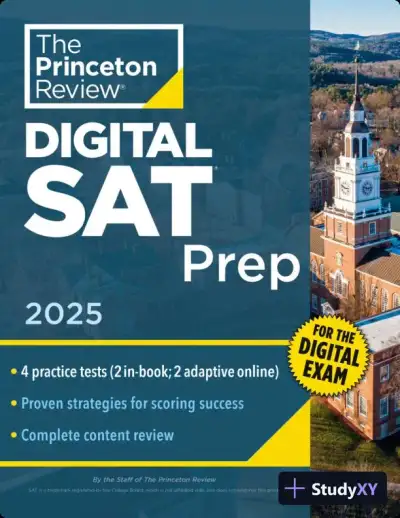 Certification Guides
Princeton Review Digital SAT Prep, 2025: 4 Full-Length Practice Tests (2024)
Scholastic Assessment Test
1073 pages167downloadsFeb 2025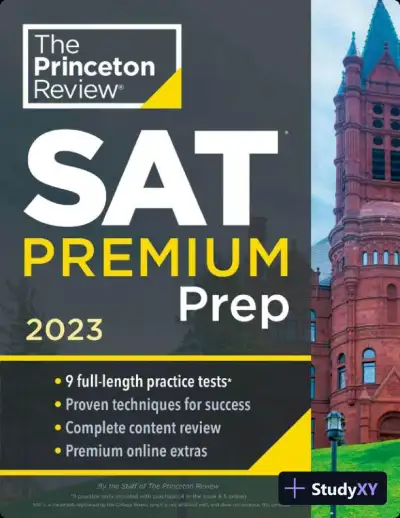 Certification Guides
Princeton Review SAT Premium Prep, 2023: 9 Practice Tests + Review and Techniques (2022)
Scholastic Assessment Test
1391 pages155downloadsFeb 2025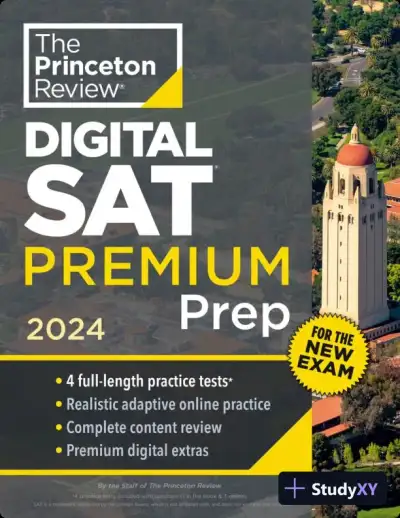 Certification Guides
Princeton Review Digital SAT Premium Prep, 2024 : 4 Practice Tests + Online Flashcards + Review and Tools (2023)
Scholastic Assessment Test
873 pages153downloadsFeb 2025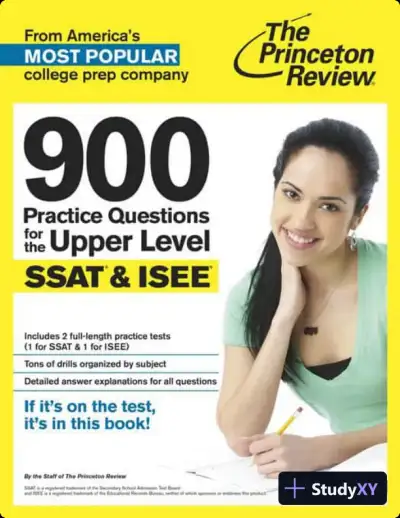 Certification Guides
900 Practice Questions for the Upper Level SSAT and ISEE (2014)
Scholastic Assessment Test
870 pages137downloadsFeb 2025 Certification Guides
Princeton Review Digital SAT Advanced (College Test Preparation), 2nd Edition (2024)
Scholastic Assessment Test
415 pages128downloadsFeb 2025 Certification Guides
Princeton Review SSAT and ISEE Prep, 2023: 6 Practice Tests + Review and Techniques (2023)
Scholastic Assessment Test
1194 pages89downloadsFeb 2025 Certification Guides
The Princeton Review 2025 PREMIUM @DSATuz1 (2024)
Scholastic Assessment Test
1094 pages89downloadsFeb 2025 Certification Guides
Princeton Review SSAT Prep: 3 Practice Tests + Review and Techniques + Drills (2023)
Scholastic Assessment Test
688 pages65downloadsFeb 2025
Study this document with CramX
Once it is in your library, every tool can work from it.