

Social Problems In A Diverse Society, Third Canadian Edition Lecture Notes
- Sociology
- 188 pages
- Shared February 2025
- 71 downloads
Social Problems In A Diverse Society, Third Canadian Edition Lecture Notes is your go-to reference for efficient studying.
Preview 31 of 188 pages
See the first 31 pages exactly as they appear in the document.
Page 1 Read page 1 as text
Social Problems in a Diverse Society , 3Ce Kendall/Nygaard/Thompson EPILOGUE How Can Social Problems Be Solved? CHAPTER SUMMARY Attempting to reduce or solve a social problem is a complex undertaking, which typically involves many obstacles, delays, and sometimes, high costs. If the functionalist approach is applied to reducing social problems, then maintaining the status quo, preventing rapid social changes, and restoring order are central factors. By contrast, the conflict perspective states that the root causes of social problems - such as patriarchy, capitalism, and sp ending priorities that place corporate tax breaks and military spending ahead of social services - would have to be radically altered or eliminated altogether. Feminist approaches suggest that in order to eliminate social problems, we need to look at the way s that oppressions are interconnected, simultaneously dealing with our own prejudices while working with others to eliminate social injustice. Some analysts believe we need to develop a “human agenda” that focuses on the needs of people over profit. To cre ate a human agenda, critical social analysis is a key foundation for effective social action. A shared vision, shared values and free and full participation in social life are also necessary components for creating critical mass. LEARNING OBJECTIVES A fter reading the Epilogue, students should be able to: 1. Explain how adherents of each of four theoretical perspectives would describe social problems and suggest eliminating them. 2. Evaluate their personal tendency toward critical social analysis and understa nd what this means. 3. Begin thinking about the kind of world they hope to take part in creating. CHAPTER OUTLINE I. A REVIEW OF MAJOR SOCIAL THEORIES ON SOCIAL PROBLEMS A. Functionalist Perspectives 1) According to the functionalist perspective, society i s a stable, orderly system composed of interrelated parts, each of which performs a function that contributes to the overall stability of society. From the functionalist perspective, social problems arise when social institutions do not fulfill the functio ns they are supposed to perform or when dysfunctions (undesirable consequences of an activity or social process that inhibit a society’s ability to adapt or adjust) occur. Dysfunctions create social disorganization, causing a breakdown in traditional value s and norms that serve as social control mechanisms.
Page 2 Page 3 Read page 3 as text
Social Problems in a Diverse Society , 3Ce Kendall/Nygaard/Thompson 2) If the functionalist approach is applied to reducing social problems, then preventing rapid social changes, maintaining the status quo, and restoring order are central factors. B. Conflict Perspectives 1) The conflict perspective is based on the assumption that conflict is natural and inevitable in society. From this approach, root causes of social problems would have to be radically altered or eliminated altogether. 2) To reduce social problems, conflict theoris ts suggest proposals that are not always viewed positively in societies where economic prosperity based on individual attributes, rather than collective activities, is highly valued as a mark of personal and social achievement. The interlocking nature of r acialized, class, and gender as systems of domination and subordination are also central concerns to some conflict theorists. To reduce or eliminate social problems that are embedded in racialized and ethnic relations, class relationships and gender inequa lities would also require dramatic changes in society. C. Interactionist Perspectives 1) The interactionist perspective focuses on how people act toward one another and make sense of their daily lives. From this approach, society is viewed as the sum of the inte ractions of individuals and groups. Interactionists often study social problems by analyzing the process whereby certain behaviour is defined as a social problem and how individuals and groups come to engage in activities that a significant number of peopl e view as a major social concern. 2) Theories of deviance emphasize that inadequate socialization or interacting with the “wrong” people may contribute to deviant behaviour and crime. Similarly, interactionists who use the labeling framework for their analys is study how people label behaviour, how they respond to people engaged in such behaviour, and what the consequences are of their responses. D. Feminist Perspectives 1) Feminist theorists concentrate on both macro and micro levels of interaction. Society is see n as a matrix of oppression, organized according to specific relations of domination and subordination. 2) Analysts study how forms of oppression work to reinforce a paradigm of oppression, competition, and hierarchy. Radical changes in these relations, str uctures, and ideologies of domination and subordination are sought through paradigm shifts. II. HOW CAN SOCIAL PROBLEMS BE SOLVED? A. According to some analysts we need to develop a human agenda that puts people’s needs and priorities before those of c orporations, business and profits. In order to create a human agenda and solve social problems, we need to develop good social analyses, shared visions, shared values and ways for people to participate fully and freely in social life.
Page 4 Read page 4 as text
CONTENTS Preface Chapter 1: Taking a New Look at Social Problems Chapter 2: Poverty in the Canadian Context Chapter 3: Racism and Ethnic Inequality Chapter 4: Gender Inequality Chapter 5: Inequality Based on Age Chapter 6: Inequality Based on Sexual Orientation Chapter 7: The Sex Trade in Canada Chapter 8: Addictions Chapter 9: Crime and Criminal Justice Chapter 10: Health, Illness, and Health Care as Social Problems Chapter 11: The Changing Family Chapter 12: Problems in Education Chapter 13: Problems in the Globalized Economy Chapter 14: Problems Related to Media Chapter 15: Population, Urbanization, and the Environmental Crisis Chapter 16: Global Social Problems Epilogue How Can Social Problems Be Solved?
Page 5 Read page 5 as text
Social Problems in a Diverse Society , 3Ce Kendall/Nygaard/Thompso PREFACE This Instructor’s Manual has been designed to make teaching using Social Problems in a Diverse Society, Third Canadian Edition, by Diana Kendall, Vicki L. Nygaard, and Edward G. Thompson more interesting and enjoyable for you and your students. For your convenience, this Instructor’s Manual provides you with tools for classroom discussion, assignments, and recommendations for related films and reading. A test bank, consisting of multiple-choice, true/false, and essay questions is also available. The Instructor’s Manual contains the following sections for each chapter: • The CHAPTER SUMMARY briefly explains the purpose of the chapter and identifies the main themes. • The LEARNING OBJECTIVES point out the key concepts and topics that students should be able to master after learning the material in the chapter. • The KEY TERMS section lists important concepts introduced in the chapter. • ACCESSING THE REAL WORLD: ACTIVE ENGAGEMENT activities are provided to assist you in preparing a variety of student learning activities that promote engagement with (1) community action, (2) theoretical analysis, and (3) media. • APPLYING CRITICAL THINKING THROUGH DISCUSSION questions are designed mainly for classroom or homework use but could also be used for testing purposes. The questions are designed to foster critical thinking and to assist in the development of new insights pertaining to the causes, effects, and possible solutions for the range of social problems discussed in the text. • AUDIO-VISUAL MEDIA FOR FURTHER EXPLORATION suggestions provide information on some, mainly current, audio-visual media that may be helpful for furthering exploration, discussion and/or understanding of issues. • CRITICAL READINGS include just a few of the many outstanding and helpful references on some of the issues covered in each chapter. NOTE FROM THE AUTHORS As the authors of the Third Canadian edition of Social Problems in a Diverse Society and the accompanying Instructor’s Manual, Test Bank, PowerPoint Presentations, and MySocKit Site, it is our hope that we have provided a text and ancillary materials that will make teaching social problems a rewarding experience for you and a positive learning experience for your students. Although we live in challenging times, the social problems course may appear irrelevant to students if it focuses on issues that students believe are unrelated to their daily lives. Consequently, we wrote the text for the students, focusing on topics that our own students have found interesting and relevant and using the personal narratives of real people to illustrate how these concerns impact individuals, how they affect entire societies, and the importance of applying the sociological imagination when examining the causes, effects, and possible solutions to the most pressing problems of the twenty-first century. Although many of the issues raised are daunting, as people’s awareness grows, so too does our collective ability to address the issues in a humane and sustainable way. Vive!
Page 6 Read page 6 as text
Social Problems in a Diverse Society , 3Ce Kendall/Nygaard/Thomp son CHAPTER 1 Taking a New Look at Social Problems CHAPTER SUMMARY Social problems are social conditions or patterns of behaviour that people believe warrant public concern and collective action to bring about change. An example of a social problem is viol ence — the use of physical force to cause pain, injury, or death, or damage to property and is relational. Social problems such as violence often involve significant discrepancies between the ideals of a society and their actual achievement. Sociologists stu dy many types of social problems to determine their causes, effects, and possible solutions. Sociology is the academic and scholarly discipline that engages in systematic study of human society and social interactions. Using the sociological imagination , w e can place seemingly personal problems into a larger context. Sociologists make connections between personal and public issues through microlevel (focused on small - group relations and social interaction among individuals) and macrolevel (focused on social processes occurring at the societal level) analysis . Sociologists use four primary theoretical perspectives to examine social life and social problems: (1) the functionalist perspective ; (2) the conflict perspective ; (3) the interactionist perspective ; an d, (4) feminist perspectives . Microlevel, mid - range and macrolevel attempts to solve social problems differ considerably. At the microlevel, the interactionist perspective focuses on how individuals operate within primary groups to try to remedy a problem that affects them, their family, or friends. Mid - range attempts focus on secondary groups and formal organizations, looking at how they can assist individuals in overcoming problems such as drug addiction or domestic violence. Macrolevel analysis of soluti ons to social problems focuses on how large - scale social institutions such as the government and the media may become involved in remedying social problems. Collective behaviour, social movements, and special interest groups are among the methods people us e in their attempts to reduce social problems. LEARNING OBJECTIVES After reading Chapter 1, students should be able to: 1. State the sociological definition of a social problem and distinguish between subjective awareness and objective reality of social pr oblems. 2. Distinguish between microlevel, mid - range and macrolevel analyses of social life. 3. Explain the functionalist perspective on society and state how functionalist theorists believe that social problems arise. 4. Explain the conflict perspective on society and state how conflict theorists (using different approaches under this perspective) believe that social problems arise. 5. Explain the interactionist perspective on society and state how interactionists believe that social problems arise. 6. Explain feminist p erspectives on society and state how feminist theorists believe that social problems arise.
Page 7 Read page 7 as text
Social Problems in a Diverse Society , 3Ce Kendall/Nygaard/Thomp son 7. Discuss, and distinguish between, microlevel, mid - range and macrolevel attempts to reduce or solve social problems. 8. Describe how sociological theories can be used t o analyse social problems such as violence. 9. Describe the part that primary groups and secondary groups play in reducing social problems. 10. Compare and contrast grassroots groups and special interest groups, and discuss how each seeks to bring about positive social change. 11. Describe ways in which collective behaviour may be used to address a perceived social problem. 12. Identify the five major categories of social movements and note the types of social problems that each is most likely to address. KEY TERMS ca pitalism primary groups civil disobedience self - fulfilling prophecy collective behaviour situational approach conflict perspective social change discrimination social disorganization dominant group social movement functionalist perspective social pro blem grassroots groups society hate crime sociological imagination industrialization sociology interactionist perspective subordinate group lifestyle - routine activity approach theory macrolevel analysis urbanization microlevel analysis values norms violence perspective CHAPTER OUTLINE I. WHAT IS A SOCIAL PROBLEM? A. A social problem is a social condition or a pattern of behaviour that people believe warrants public concern and collective action to bring about change. B. Social conditions or patte rns of behaviour such as violence become defined as social problems when they systematically disadvantage or harm a significant number of people or when they are seen as harmful by a number of “significant people” who wield power, wealth, and influence in a group or society.
Page 8 Read page 8 as text
Social Problems in a Diverse Society , 3Ce Kendall/Nygaard/Thomp son C. In sociology , examination of social problems primarily focuses on society . 1) Some social problems (e.g., violence and crime) are commonly viewed as conditions that affect all members of a population. 2) Other social problems (e.g., racializ ed discrimination and sexual harassment) may be viewed (correctly or incorrectly) as conditions that affect some members of a population more than others. D. Social problems often involve significant discrepancies between the ideals of society and their actua l achievement. One example is discrimination (actions or practice of dominant group members that have harmful effects on subordinate group members ), which heightens existing inequalities along class, racialization, gender, and age lines. It may be directe d against subordinate group members whose sexual orientation, religion, nationality, or other characteristics are devalued by those who discriminate against them. This type of discrimination, when acted out in the form of violence, is known as a hate crime . E. Why Study Social Problems? 1) Studying social problems helps us understand the social forces that shape our lives on both the personal and societal levels. 2) We learn to take a sociological approach as opposed to a commonsense (“what everybody knows”) appro ach. Many commonsense notions are “myths” and may be widely and publicly accepted, even when erroneous. 3) A sociological examination of social problems also enables us to gain new insights into ourselves and to develop an awareness of the connection between our own “world” and those of other people. 4) A global perspective reveals that the lives of all people are closely intertwined, that and any one nation’s problems are part of a larger global problem. II. THE SOCIOLOGICAL IMAGINATION AND SOCIAL PROBLEMS A. Sociologists use systematic research techniques and report their findings to other social scientists for consideration. Sociologists strive to be objective , although complete objectivity may not be attainable or desirable. B. According to sociologist C. Wrigh t Mills, the sociological imagination is the ability to see the relationship between individual experiences and the larger society. 1) The sociological imagination enables us to connect personal troubles to public issues. 2) Personal troubles are private problem s of individuals and the networks of people with whom they associate regularly. For example, one person’s unemployment is a personal trouble facing the individual, other family members, and friends. 3) Public issues are matters beyond a person’s control that originate at the regional or national level and can be resolved only by collective action. 4) The sociological imagination helps us place seemingly personal troubles, such as being a victim of violence, into a larger social context and see how personal troubl es may be related to public issues. 5) A clearer understanding of our situations may allow us to develop more effective and better preventions and interventions.
Page 9 Read page 9 as text
Social Problems in a Diverse Society , 3Ce Kendall/Nygaard/Thomp son C. Sociologists make connections between personal and public issues in society through microlevel and macrolevel analysis . Using microlevel analysis, a sociologist might investigate how fear of unemployment affects workers and their immediate families. A macrolevel analysis might examine how globalization, and the attendant labour market restructuring , has impacted Canadian workers and their families. III. SOCIOLOGICAL PERSPECTIVES ON SOCIAL PROBLEMS A. How Sociologists View Society 1) Sociologists develop theories and conduct research to determine how social life is organized. Theories help us interpret social reality in a distinct way by giving us a framework for organizing our observations and may allow us to describe, explain or possibly even predict social events. 2) Sociologists refer to a theoretical framework as a perspective , an overall approach or viewpoint toward some subject. B. The Functionalist Perspective 1) According to the functionalist perspective , society is a stable, orderly system composed of a number of interrelated parts, each of which performs a function that contributes to the overall stabi lity of society. 2) These interrelated parts are social institutions (such as families, the economy, education, and the government) that a society develops to organize its main concerns and activities so that social needs are met. Each institution performs a unique function, the contribution that each part makes to the overall stability of society and the well - being of individuals. 3) Manifest and Latent Functions: Social institutions perform two different types of societal functions: manifest functions (the intended and recognized consequences of an activity or social process) and latent functions (the unintended consequences of an activity or social process that are hidden and remain unacknowledged by participants). 4) Dysfunctions and Social Disorganization: From the functionalist perspective, social problems arise when social institutions do not fulfill the functions they are supposed to perform or when dysfunctions (undesirable consequences of an activity or social process that inhibit a society’s ability to adapt or adjust) occur. a. According to functionalists, dysfunctions in social institutions create social disorganization , causing a breakdown in traditional values and norms that serve as the social control mechanisms that, under normal circumstances, keep people from engaging in nonconforming behaviour. Although values provide ideas about behaviour, they do not state explicitly how we should behave; norms do state explicit rules of behaviour or standards of conduct. b. Social disorganization is intensified by rapid social change that disrupts the stability of society. Early sociologists examined the relationship between social problems and industrialization and urbanization in Britain, Western Europe, and the United States in the late nineteenth and early twent ieth centuries.
Page 10 Read page 10 as text
Social Problems in a Diverse Society , 3Ce Kendall/Nygaard/Thomp son 5) Applying the Functionalist Perspective to Problems of Violence: Functionalists provide several explanations for violence in societies. One approach believes that violence arises from a condition of anomie, in which many individuals have a feeling of helplessness, normlessness, or alienation. Another functionalist explanation of violence is the lifestyle - routine activity approach , in which the patterns and timing of people’s daily movements and activities are the keys to understanding viol ent personal crimes as well as other types of crime. C. The Conflict Perspective 1) The conflict perspective is based on the assumption that groups in society are engaged in a continuous power struggle for control of scarce resources. 2) According to conflict theo rists, certain groups of people are privileged while others are disadvantaged through the unjust use of political, economic, or social power. This perspective consists of a variety of related approaches that hold differing views regarding the most importan t form of conflict. 3) The Value Conflict Perspective: According to value conflict theorists, social problems are conditions incompatible with group values. a. Value clashes are ordinary occurrences in families, communities, and the larger society, where people commonly hold many divergent values. Although individuals may share certain core values, they do not share all values or a common culture (the knowledge, language, values, customs, and material objects that are passed from person to person and from one gen eration to the next in a human group or society). b. Discrepancies between ideal (the values and beliefs people claim they hold) and real culture (the values and beliefs they actually follow) are a source of social problems in all societies. 4) Critical - Conflict Perspective: According to critical - conflict theorists, social problems arise out of major contradictions inherent in the way societies are organized. a. Some of these approaches focus on class inequalities resulting from capitalism , while others focus on in equalities based on racialization/ethnicity or gender. b. According to early German economist Karl Marx, members of the capitalist class (the bourgeoisie ) control the means of production (e.g., the land, tools, factories, and money for investment) and are at the top of a system of social stratification that affords them different lifestyles and life chances from the members of the working class (the proletariat ), who must sell their labour power (ability to work) to capitalists. In the process, the capitalist s derive excessive profit from the workers’ labour. c. Marx believed that capitalism led workers to experience increased levels of poverty and alienation , feelings of powerlessness and estrangement from other people and from oneself. He predicted the workers would eventually overthrow the capitalist economic system. 5) Some critical - conflict approaches focus on racialized and gendered subordination instead of on class - based inequalities. Theorists who emphasize discrimination and inequality based on racialization or ethnicity note that many social problems
Page 11 Read page 11 as text
Social Problems in a Diverse Society , 3Ce Kendall/Nygaard/Thomp son are rooted in the continuing exploitation and subordination of people of colour and Indigenous people by White people and White - dominant systems. 6) Applying the Conflict Perspective to Problems of Violence: Critic al conflict theorists believe that in capitalist societies the wealthy may engage in some forms of violence to further their economic interests (e.g., the abuse of police or military power to protect property) whereas people living in poverty may engage in other forms of violence as a reaction against the unjust social and economic conditions they experience daily. D. The Interactionist Perspective 1) The interactionist perspective focuses on a microlevel analysis of how people act toward one another and make sen se of their daily lives, viewing society as the sum of the interactions of individuals and groups. 2) Most interactionists study social problems by analyzing the process whereby certain behaviour is defined as a social problem and how individuals and groups c ome to engage in activities that a significant number of people view as a major social concern. 3) A founder of the interactionist approach, German sociologist Georg Simmel, investigated the impact of industrialization and urbanization on people’s values and behaviour within small social units. He noted that rapid changes in technology and dramatic growth of cities produced new social problems by breaking up the “geometry of social life.” 4) According to Simmel, alienation is brought about by a decline in persona l and emotional contacts. How people interpret subjective messages they receive from others, as well as the situations they encounter in their daily life, strongly influences their behaviour and their perceptions of what constitutes a social problem. 5) Label ling Theory and the Social Construction of Reality: Other interactionists examine how people impose meanings on others. According to sociologist Howard Becker, moral entrepreneurs are persons who use their own views of right and wrong to establish rules a nd label others as deviant. a. Labelling theory suggests that deviants are people who have been successfully labelled as such by others. b. It raises questions about why some individuals and types of behaviour are labelled deviant but others are not. c. According to some interaction theorists, many social problems can be linked to the social construction of reality , or the process by which people’s perception of reality and their subsequent reaction, if any, is shaped largely by the subjective meaning that they gi ve to an experience. d. A related approach that some interactionists favour is the definition of the situation approach, often called the Thomas Theorum after sociologists Dorothy S. Thomas and William I. Thomas. The Thomas Theroum suggests that how people d efine a situation determines their reaction to it. If a situation is perceived as real, it is real in its consequences. e. Sociologist Robert Merton has suggested that when people view a situation in a certain way and act according to their perceptions, the end result may be a self - fulfilling prophecy .
Page 12 Read page 12 as text
Social Problems in a Diverse Society , 3Ce Kendall/Nygaard/Thomp son 6) Applying Interactionist Perspectives to Problems of Violence: a. To analyze the problem of violence, interactionists focus on social interaction, and note that human behaviour is learned through interaction. For i nteractionists, violence is a learned response, not an inherent characteristic. b. Interactionists also look at the types of social interactions that commonly lead to violence. The situational approach suggests that violence results from a specific interacti on process, termed a “situational transaction.” c. According to interactionists, reducing violence requires changing those societal values that encourage excessive competition and violence. E. Feminist Perspectives 1) Feminist theorists begin their analysis by poin ting out that mainstream sociological thought and theory is both androcentric and Eurocentric , in that most sociological theory is based on the experiences, ideas, and issues of concern for males, particularly those males of European/Western extraction. 2) Th ere are no “feminist issues” per se since every issue is a feminist issue. When feminist theorists engage in analysis, they “gender” the issues under study by looking at the differential impacts of social phenomena for men and women, and more recently for transgendered and/or non - gendered people as well. 3) Feminist theories typically examine dynamics of power in relationships between individuals, roles, and structures. This focus on power differentials is shared with conflict and Marxist theories, but femini st theories add a focus on gendered power and patriarchy. These theories generally begin an analysis from a particular “standpoint” by examining social life from the situated vantage points of the individuals and/or groups involved. 4) A classification system that categorizes various feminist theories includes: a. theories of difference (men and women experience different realities); b. theories of inequality (women’s experiences are less privileged or are disadvantaged relative to men’s); and c. or, theories of oppres sion (women are actively subordinated and kept disadvantaged, both by patriarchal structures and individuals reinforcing sexist socialization and ideologies). 5) Modern - day feminist theories, if they are reflexive, turn the lenses back upon themselves. Ma ny contemporary feminists spend a good deal of time deconstructing the theories they favour, the underlying assumptions, the exclusions, the inclusiveness, the intersections and the impacts of the analysis. 6) Applying Feminist Perspectives to Problems of Violence: a. Feminist perspectives of violence highlight issues of dominance and power, and suggest that inequalities between groups result in violence. They conclude that people who enjoy power and privilege likely commit as many acts of violence as those w ho are disenfranchised, and that main difference between groups is that those without power are disproportionately targeted as the perpetrators or viewed as bringing it on themselves. b. One feminist perspective suggests that violence against women is a means of reinforcing patriarchy. Gender stratification is reinforced by powerful
Page 13 Read page 13 as text
Social Problems in a Diverse Society , 3Ce Kendall/Nygaard/Thomp son physical, psychological, and social mechanisms of control, including force or the threat of force. Fear of violence forces women to adapt their ways of being in and navigating the social world in order to ensure they are not in a position to be victimized by men. IV. SOCIAL CHANGE AND REDUCING SOCIAL PROBLEMS A. The concept of social change is important to our discussion of reducing social problems. Social change often occurs ov er time. Some efforts to deal with social problems are short - term strategies, whereas others are middle - term remedies, and still others constitute long - term efforts to alleviate the root causes of a social problem. For example, efforts to alleviate individ ual unemployment or reduce unemployment rates in a community have a different temporal dimension than long - term efforts to change the political economy in such a manner that high levels of employment and greater wage equity are brought about throughout a n ation or nations. Some discussions of social change sound idealistic or utopian; however, for most social problems, a combination of strategies will be required to reduce them (for example, unemployment would need multi - level strategies to effectively prev ent it). V. MICROLEVEL ATTEMPTS TO SOLVE SOCIAL PROBLEMS A. Seeking Individual Solutions to Personal Problems 1) Microlevel analysis of solutions to social problems focuses on how individuals operate within small groups to try to remedy a problem that affect s them, their family, or friends. In this case, most people turn to their primary groups . Primary groups include one’s family, close friends, and other peers with whom one routinely shares the more personal experiences in life (such as school - or work - rela ted peer groups). 2) According to sociologists, members of our primary groups are usually there to support us even when others are not. Consequently, many people turn first to family members and friends. For example, some analysts believe that we have many m ore people who are without a domicile (who are technically “homeless”) than current statistics indicate: whenever possible, homeless individuals may live with relatives or friends, many of whom may already live in overcrowded and sometimes substandard hous ing. When people seek such short - term solutions to personal troubles, most believe the situation will be temporary. However, problems that are widespread or embedded in the larger society may stretch into months or years without resolution. At best, indivi dualized efforts to reduce a problem are short - term measures, which some critics refer as the “band - aid approach” because such efforts most often do not eliminate the causes of the problem.
Page 14 Read page 14 as text
Social Problems in a Diverse Society , 3Ce Kendall/Nygaard/Thomp son 3) Some microlevel approaches to reducing social problems focus on h ow individuals can do something about the problems they face. For example, a person who is unemployed or among the “working poor” because of low wages, seasonal employment, or other factors may be urged to get more education or training and work experience in order to find a “better” job and have the opportunity for upward mobility. VI. MID - RANGE ATTEMPTS TO SOLVE SOCIAL PROBLEMS A. Groups That Help People Cope With Their Problems 1) Groups that attempt to reduce a social problem by helping individuals cope with it, or to eliminate it from their own lives, are commonplace in our society (e.g. Alcoholics Anonymous or “AA”). The basic assumption of most mid - range approaches to reducing social problems is that prevention and intervention are most effective at th e personal and community levels. 2) Typically, self - help groups bring together individuals who have experienced the same problem and have the same goals - quitting the problematic behaviour. An underlying assumption of this approach is that some social problem s can best be reduced by reaching one person at a time. Volunteers who have had similar problems (and believe they are on the road to overcoming them) often act as role models for newer members. 3) Mid - range approaches may bring changes in the individual’s li fe; however, such groups typically do not systematically address the larger structural factors (such as unemployment, work - related stress, and aggressive advertising campaigns) that may contribute to the problems. As a result, larger, societal intervention is necessary to reduce the underlying problems that contribute to individual behaviour. For example, AA typically does not lobby for more stringent laws pertaining to drunk driving or the sale and consumption of alcoholic beverages. B. Grassroots Groups Tha t Work for Community - Based Change 1) Some grassroots groups focus on bringing about a change that may reduce or eliminate a social problem in a specific community or region. From this approach, people learn how to empower themselves against local, provincial, territorial, and national government officials; corporate executives; and media figures who determine what constitutes the “news” in their area. 2) Social analysts suggest that more community dialogue is needed on social issues, and more people need to becom e involved in grassroots social movements. Because social movements have not become institutionalized and are outside the political mainstream, they empower outsiders by offering them an opportunity to have their voices heard. 3) Grassroots organizations and other local structures are crucial to national social movements because these movements must recruit members and gain the economic resources necessary for nationwide or global social activism. Numerous studies have shown that the local level constitutes a necessary micro - foundation for larger - scale social movement activism.
Page 15 Read page 15 as text
Social Problems in a Diverse Society , 3Ce Kendall/Nygaard/Thomp son 4) Some social movements participate in what has been defined as counter - hegemonic practice by Canadian sociologist William K. Carroll. Counter - hegemonic practice refers to creating true alternatives to hegemony, although counter - hegemonic social movements need to be aware of the movement’s potential to create new injustices by defining its own issues as “the” issues. VII. MACROLEVEL ATTEMPTS TO SOLVE SOCIAL PROBLEMS A. Working Through Special Interest Groups for Political Change 1) Examples of special interest groups include the Canadian Labour Congress, the Reform Party, and REAL Women. They are often referred to as pressure groups or lobbies , and may be categorized on the basis of four factors: 2) Issues. Some groups focus on single issues (such as abortion, gun control, or teaching acceptance for family diversity in Canadian schools); others focus on multiple issues (such as equal access to education, employment, and health care). 3) View of the present system of wealth and power . Some groups make radical demands that would involve the end of patriarchy, capitalism, governmental bureaucracy, or other existing power structures; others do not attack the legitimacy of the present system of wealt h and power but insist on specific social reforms. 4) Beliefs about elites . Some groups want to influence elites (or incorporate movement leaders into the elite); others want to replace the existing elites with persons whom they believe share their own intere sts and concerns. 5) Type of Political Action . There are often many different groups, all of whom do not entirely agree on the nature or extent of the problems of proposed solutions, who may try to gain recognition from elected officials or bureaucrats for t heir agendas. B. Working through National Social Movements to Reduce Problems 1) Collective behavior and national social movements are significant ways in which people seek to resolve social problems. Examples of collective behavior include public demonstration s and riots. 2) Beginning with the 1919 Egyptian revolution against British occupation, an increasingly popular form of public demonstration is civil disobedience . People often seek to bring about change through actions such as sit - ins, marches, boycotts, an d strikes. When people refuse to abide by a policy or law and challenge authorities to do something about it, they are demanding social change with some sense of urgency. Sometimes referred to as protest crowds , these groups engage in activities that the y hope will achieve specific political goals. 3) National social movements are divided into five major categories: a. Reform movements seek to improve society by changing some specific aspect of the social structure. Environmental groups and disability rights gr oups are examples of groups of people who seek to bring about a change that they perceive will benefit themselves and others. Activists in reform movements typically seek to bring about change by working within the existing organizational structures of s ociety.
Page 16 Read page 16 as text
Social Problems in a Diverse Society , 3Ce Kendall/Nygaard/Thomp son b. Revolutionary movements seek to bring about a total change in society. Examples include utopian groups and radical terrorists who use fear tactics to intimidate and — at least briefly — gain concessions from those with whom they disagree ideologically. Some radical terrorists may kill people in their pursuit of a society that more closely conforms to their own worldview. c. Religious movements (also referred to as expressive movements ) seek to renovate or renew people through inner change. For this reaso n, religious movements are often linked to local and regional organizations that seek to bring about changes in the individual’s life. National religious movements often seek to persuade political officials to enact laws that will replace or eliminate wha t they perceive to be social problems. d. Alternative movements seek limited change in some aspects of people’s behaviour and currently include a variety of “New Age” movements which emphasize such things as the development of a new national spiritual consci ousness. e. Resistance movements seek to prevent change or undo change that has already occurred. In public debates over social policies, most social movements advocating change will face resistance from the members of reactive movements that hold opposing vi ewpoints and want social policy to reflect their own beliefs and values. Examples of resistance movements include those which oppose same sex marriage, anti - abortion groups, such as “Operation Rescue,” which seek to close clinics which provide abortions an d to recriminalize abortion; and anti - immigrant groups seeking to close Canadian borders to outsiders or to place harsher demands on immigrant workers. TEACHING SUGGESTIONS FOR ACTIVE LEARNING Professor Kathleen McKinney, one of the recipients of the Ha ns O. Mauksch Award for distinguished contributions to undergraduate sociology, is an advocate of active learning and has provided outstanding suggestions for classroom techniques to encourage students to do more than simply listen to a lecture. According to McKinney, active learning techniques are most likely to succeed when instructors prepare students in advance by providing specific objectives for the activities and explaining how using active learning techniques will benefit them. It is important to so licit student feedback afterwards in order to improve the activity in the future. Four of McKinney’s suggestions are summarized here because they are incorporated into teaching suggestions throughout this manual: 1. Think - Pair - Share: After giving students a question or problem to solve, give them a few minutes to think about the problem alone. Then have them discuss their ideas with the person sitting next to them. Finally, have student pairs share their ideas with the whole class or a larger group. This can be done in any size class, including those meeting in lecture halls with permanently fixed seating.
Page 17 Read page 17 as text
Social Problems in a Diverse Society , 3Ce Kendall/Nygaard/Thomp son 2. Collaborative Learning Groups : Students work in groups to fulfill a task. Each group chooses a leader and someone to take notes, and the group presents a response or a paper to the entire class. This requires flexibility in classroom space or having some other location or time when students can confer with each other. 3. Analysis or reaction to videos: Before showing a video, prepare students with questi ons or ideas on which to focus. After the video, ask them to answer the questions or write a review or reaction, applying sociological concepts and perspectives. Have the students present their ideas to the class. 4. Student debates: Having students prepa re for and present debates on the social issues discussed in the text and in class provides an outstanding opportunity to expose them to more than one viewpoint. Students should be given advance assignments, suggested resources, and a game plan for how to approach the debates so they can take a position, gather data, and support their viewpoints. Kathleen McKinney, Sociology, Illinois State University, Normal, Il , kmckinne@ilstu.edu ACCESSING THE REAL WORLD: ACTIVE ENGAGEMENT WITH PROBLEMS RELATED TO VI OLENCE Focus on Community Action Have a class discussion about prevention and intervention strategies for reducing youth violence and gang participation in your community. Although people have initially laughed at ideas such as midnight basketball, bowl ing , or dances, some social analysts believe that activities such as this keep so me young people out of trouble. What other types of activities and training might be useful in reducing youth - related violence in the community? Separate students in to small groups and h ave students investigate the current programs in place to deter youth from engaging in violence. Have these programs or initiatives been effective in their communities? Why or why not? Next, have them develop a set of suggestions for progra ms that might provide other opportunities for young people or activities that might help youth make better life choices. What resources would be necessary to bring such programs into being? How would the costs of these programs compare with the cost of pro cessing people through the justice system and following up with young offenders? Each group should prepare a small report on their findings and share it with the rest of the class. Focus on Theoretical Analysis Based on Chapter One or other information y ou might wish to provide to students, have the class decide on a social problem (such as youth violence) they would like to analyze during the next class meeting. Set up four collaborative learning groups and determine which group will be the “experts” on each of the major theoretical perspectives. Students should bring notes to turn in to their note - taker on the following: (1) key factors involved in the theoretical perspective, (2) how that approach might explain the social problem under consideration, (3 ) how that approach might
Page 18 Read page 18 as text
Social Problems in a Diverse Society , 3Ce Kendall/Nygaard/Thomp son suggest resolving the problem, and (4) major strengths and weaknesses of the theoretical perspective as applied to that problem. Have students meet in their collaborative learning groups for about 20 - 30 minutes (depending on th e length of your class) to compile their notes and prepare a presentation for the entire class. Then, ask group leaders to appoint other people in their group to do various aspects of the presentation, so that other members do not become dependent on the l eader doing most of the group’s work and talking. Focus on Media Engagement Ask students to do a content analysis of television programs such as Saturday morning cartoons, prime - time police and hospital shows, college and professional sporting events, a nd Internet websites which are likely to depict violent acts . Also have students go to web sites such as Media Watch ( http://www.mediawatch.com ) and Media Awareness Network ( www.media - awareness.ca ) to get the latest “Television and I nternet Statistics” on how many h ours children spend watching television and surfing the Internet and what perceptions they have about violence in media . For example, a 2005 Canadian study foun d this in regard to children and Internet usage : • Almost one - third of the 50 favourite Web sites listed by kids incorporate ma terial that is violent (28 perc ent) or highly sexualized (32 per cent). Kids in Grades 8 and 9 include these sites in their list of favourites most frequently visited . • Two sites that appear in the top four most popular sites with students in Grades 8 to 11 – Newgrounds and eBaumsworld – contain mature content. These sites also appear on the list of favourites for Grade 6 and 7 stude nts. Students should take note of the frequency of violent acts on television programs and the Internet. As well, they should write about the gendered, racialized and class dimensions of each violent act depicted. Were they surprised with their findings ? Why or why not? Have students bring their notes on what they observed on the television and Internet so they can share information with the rest of the class . APPLYING CRITICAL THINKING THROUGH DISCUSSION 1. How can the sociological imagination he lp us as we deal with social problems that affect us personally? What kinds of insights might advanced sociological training provide for a person who wants to engage in problem solving in politics, government, education, the military, or other social organ izations and institutions? 2. Has Canada’s adoption of harsher penalties for people convicted of hate crimes had any impact for victims or perpetrators? What, if any, impacts might these penalties have had so far?
Page 19 Read page 19 as text
Social Problems in a Diverse Society , 3Ce Kendall/Nygaard/Thomp son 3. Some critical - conflict theorists b elieve that social problems arise from the major contradictions inherent in capitalist economies. What roles does violence play in a capitalist economy? 4. How might labelling theory work with the concept of the self - fulfilling prophecy to increase or dec rease the life chances of a youth who is suspected of committing a deviant act? 5. Some feminist theorists suggest that the use of violence against women is one way that men use to maintain and reinforce patriarchal oppression throughout society. Constr uct arguments that support and/or refute this position. 6. Suppose that you were given the economic resources and political clout to reduce a major social problem. Which problem would you choose? What steps would you take to alleviate the problem? How w ould you measure your success or failure in reducing or eliminating the problem? 7. Do governments at all levels in Canada listen to their constituents about social issues? What evidence can you find to support that they do or do not? Why is the situation the way it is? AUDIO - VISUAL MEDIA FOR FURTHER EXPLORATION African Canadian Issues Collection — This 5 - part collection of NFB titles illustrates that there is a life beyond the streets for inner city youth. A gritty focus on the serious problems of povert y, drug abuse, violence and street gangs. 2006. Varying clip lengths. National Film Board of Canada, www.nfb.ca . Charting New Waters: Responding to Violence against Women with Disabilities — This is a video and a study guide about violence against women with disabilities. 1996. 38 mins. National Film Board of Canada, www.nfb.ca . Cheating Death — This documentary tells the story of a young Toronto man and the little understood world of guns, gangs and drugs. 2004. 24 mins. National Film Board of Canada, w ww.nfb.ca . Cultivating Peace in the 21st Century — The four films in Cultivating Peace in the 21st Century provide teachers with tools to engage students to search for a “culture of peace” in our homes, schools, neighbourhoods and global communities. 2002. 100 mins. National Film Board of Canada, www.nfb.ca . Exiles in Lotusland — This video is gritty look a the life of Canadian youth living on the edge, suicide and “street kid” culture. 2005. 71 mins. National Film Board of Canada, www.nfb.ca . It’s a Girl’ s World — This film looks at bullying and social power in a clique of 10 year old girls. 2004. 54 mins. National Film Board of Canada , www.nfb.ca.
Page 20 Read page 20 as text
Social Problems in a Diverse Society , 3Ce Kendall/Nygaard/Thomp son Kids in Jail — This partially animated documentary shares the experiences of several incarcerated youths as they reflect upon their lives, on what led to incarceration and on their futures. 2008. 57 mins. National Film Board of Canada, www.nfb.ca . Still Longshots — This documentary follows four “at - risk” young people through a weekend long video making workshop. 20 07. 52 mins. National Film Board of Canada, www.nfb.ca . The Line — A young woman is raped when a one - night stand far from home goes terribly wrong. In the aftermath, as she struggles to make sense of what happened, she decides to make a film about the rel ationship between her own experience and the tangle of political, legal, and cultural questions that surround issues of sex and consent. 2010. 24 mins. Media Education Foundation, www.mediaed.org . Tough Guise: Violence, Media, & the Crisis in Masculi n i t y — While the social construction of femininity has been widely examined, the dominant role of masculinity has until recently remained largely invisible. Tough Guise is the first educational video geared toward systematically examin ing the relationship betwee n pop - cultural imagery and the social construction of masculine identities in the U.S. at the dawn of the 21st century. 1999. 82 mins. Media Education Foundation. www.mediaed.org . CRITICAL READINGS Agnew, Vijay (Ed.). 2009. Racialized Migrant Women in Canada: Essays on Health, Violence, and Equity. Toronto, ON: University of Toronto Press. Blyth, Maggie and Enver Solomon (Eds.). 2009. Prevention and Youth Crime: Is Early Intervention Working? Bristol, UK: Policy Press. Carroll, William K. (Ed.). 19 97. Organizing Dissent: Contemporary Social Movements in Theory and Practice. Toronto, ON: Garamond Press. Jiwani, Yasmin. 2006. Discourses of Denial: Mediations of Race, Gender and Violence. Vancouver, BC: UBC Press. Johnson, Allan G. 1991. The Forest f or the Trees : An Introduction to Sociological Thinking. Toronto, ON: Harcourt Brace Jovanovich College Publishers. Kutner, Lawrence. 2008. Grand Theft Childhood: The Surprising Truth about Video Games and What Parents Can Do. Toronto, ON: Simon and Schust er. Mills, C. Wright. 1959. The Sociological Imagination. New York, NY: Oxford University Press. Minaker, Joanne C. and Bryn Hogeveen. 2009. Youth, Crime and Society: Issues of power and Justice. Toronto, ON: Pearson Prentice Hall. Schneider, Steven. 2 009. Iced: The Story of Organized Crime in Canada. Mississauga, ON: J. Wiley and Sons Canada. Totten, Mark D. 2001. Guys, Gangs, and Girlfriend Abuse. Peterborough, ON: Broadview Press Ltd.
Page 21 Read page 21 as text
Social Problems in a Diverse Society , 3Ce Kendall/Nygaard/Thompson CHAPTER 2 Poverty in the Canadian Context CHAPTER SUMMARY Canadians believe they live in a meritocracy , where success is possible for anyone who works hard enough. Many Canadians, along with more than 1.3 billion people worldwide live in absolute povert y today, a life threatening condition. In fact, more than 600 million people globally suffer from chronic malnutrition, an estimated 40 million of which die each year from hunger - related conditions. Social stratification refers to the hierarchical arrange ment of large social groups based on their control over basic resources. Stratification in Canada — which is based on the class system — is linked with global systems of stratification that affect people’s life chances . A person’s position in a class system is determined by the wealth, power, and prestige that the person has. Stratification also exists on a global basis. Among the aspects of the Canadian class system that sociologists study are the classes themselves and the unequal distribution of people — by ag e, racialization/ethnicity, gender, and household composition — across those class divisions. Sociologists also study the consequences of living in poverty, including poor health and nutrition, housing, and education. Explanations for poverty include indivi dualistic, cultural, and structural. LEARNING OBJECTIVES After reading Chapter 2, students should be able to: 1. Analyse poverty in Canada within a global context. 2. Understand wealth and income inequalities, with particular emphasis on understanding the situations of the lower classes in Canada. 3. Describe the situation of poverty in Canada, and be able to differentiate between relative and absolute poverty. 4. Discuss the consequences of poverty for people in Canada with regard to health, nutriti on and housing. 5. Critically analyse how Canada deals with poverty. 6. Explain the system of social welfare in Canada and demonstrate how neoliberal policies have impacted the Canadian welfare state since the 1970s. 7. State the individual, cultural, and structural explanations of poverty, and explain why sociologists prefer structural explanations. 8. Discuss various ways that poverty can be reduced in Canada including being able to critically examine proposed poverty reduction strategies.
Page 22 Read page 22 as text
Social Problems in a Diverse Society , 3Ce Kendall/Nygaard/Thompson KEY TERMS absolute poverty life chances relative poverty blaming the victim meritocracy social stratification cultural capital poverty rate wealth feminization of poverty power welfare state income prestige CHAPTER OUTLINE I. POVERTY IN GLOBAL PERSPECTIVE A. Canadians view themselves as living in a meritocracy . But do all people in this nations and other part of the world really have an equal opportunity for success? What kinds of inequalities exist in the Canadian and worldw ide class system today? Sociologists study inequality and poverty in a class system. A primary characteristic of the class system is social mobility , the upward or downward movement in the class structure that occurs during a person’s lifetime and from on e generation to another. B. Comparisons between nations reflect the growing gap between the rich and the poor, both within and among nations. C. Disparity in life chances between high - income and low - income nations also is apparent. 1) Today, more than 1.3 billion people live in absolute poverty , which is often life threatening, as when people suffer from chronic malnutrition or die from hunger - related diseases. 2) Over 600 million people suffer from chronic malnutrition; 40 million annually die from hunger - related di seases. II. ANALYZING INEQUALITY IN CANADA A. One of this country’s most persistent social problems is that Canada has a high degree of s ocial stratification . Today, the gap between the rich and the poor in this nation is wider than it has been for decad es. Throughout the world, the wealthiest and poorest people are living in increasingly separate worlds. The widening gap between rich and poor has a dramatic impact on everyone’s life chances. As one might predict, affluent people typically have better lif e chances than the less affluent. B. Most contemporary research on class is influenced by the theories of Karl Marx and Max Weber, and more recently by modifications to these theories by sociologists like Erik Olin Wright. 1) Marx’s means of production model: capitalist societies are divided into two classes — the capitalist class (bourgeoisie) that owns the means of production and the working - class (proletariat) that sells its labour power to the capitalists. According to Marx, inequality and poverty inevitably result from the exploitation of the workers. 2) Weber’s multidimensional model: economic factors are important in determining class location and studying social inequality, but other factors also are important.
Page 23 Read page 23 as text
Social Problems in a Diverse Society , 3Ce Kendall/Nygaard/Thompson The model focuses on the interplay of wealth , p ower , and prestige as determinants of people’s class position. 3) Wright modified Marx’s and Weber’s models so that placement in the class structure is based on four criteria (1) ownership of the means of production (capitalist class); (2) employing others (m anagerial class); (3) supervising others on the job (small business class); and (4) being employed by someone else (working class). C. Wealth and Income Inequality 1) The richest Canadian in 2009, Kenneth J. Thomson, has a net worth of $13 billion (USD) or appr oximately $15 billion dollars, Canadian. The vast majority of Canadians will never amass even a fraction of this type of wealth, however even billionaires lose money – in 2009 the average net worth of billionaires worldwide was down 23%. 2) The face of pover ty is increasingly diverse with regard to family type, as more Canadians experience layoffs, lack of real wage gains, and reduced work hours. 3) Wealth is a particularly important indicator of individual and family access to life chances. 4) Income is extremely unevenly divided in Canada. The gap between the richest and poorest Canadian households continues to widen. In 2003, the highest quintile had 46.5% of all the income while the lowest quintile had 4.3%. D. The Canadian Lower Classes 1) The lower class in Canada makes up about 20% of the population. It is comprised of the working poor and the chronically poor. 2) The working poor comprise those who work full - time in positions such as unskilled labour, seasonal or migrant agricultural jobs, or the lowest - paid servic e sector jobs, but still remain at the edge of poverty. 3) Although the poor constitute between 11 and 16 percent of the Canadian population, depending on the measures used, they receive only about 5 percent of the overall Canadian income. 4) Minimum wages in Ca nada do not function to keep Canadians out of poverty any more, even if people work full time, full year. 5) Overrepresented in these lower classes are people who are unable to work because of age or disability and lone - parent female head of households, alon g with their dependent children. III. POVERTY IN CANADA A. The fact that Canada is such a wealthy nation, but one in which such a high proportion of the population lives in low income and poverty situations, has made Canada the target of international cr iticism, particularly by the United Nations. B. There are between 150,000 and 300,000 homeless people living in Canada, including the new poor, families, women, new Canadians, children and students. C. People living in poverty face two critical issues – housing insecurity and food insecurity. There is a dearth of affordable housing in Canada. People must often chose between a roof over their heads or food in their bellies. Further, being employed does not prevent people from needing to access food banks: in 2008, 14.5% of people who accessed
Page 24 Read page 24 as text
Social Problems in a Diverse Society , 3Ce Kendall/Nygaard/Thompson increasing numbers of Canadian food banks were employed. Food banks feed an average of 700,000 Canadians, approximately 40% of whom are children, each month. D. While the past decade demonstrated strong economic growth (prior t o the recent recession), governments continued to make severe cuts to social programs. E. Sociologists distinguish between absolute poverty and relative poverty . Canada has a high poverty rate compared with other advanced industrial nations. The number of f amilies who live below the unofficial poverty (LICO) line in Canada increased throughout the 1980s and 1990s, although since 1996, the numbers have dropped marginally each year, signifying better overall economic conditions in the late 1990s and into the 2 000s for some groups of people (prior to the most recent recession). F. The Canadian Poverty Line: LICOs 1) Though there is no established formal “poverty line,” the Canadian government, through Statistics Canada, has established a low - income cut - off line that i s commonly used to measure poverty in Canada. 2) A Low Income Cut - Off (LICO) line allows us to see how many people in Canada spend significantly more than the average on the necessities of life, as well as seeing how low below the cut - off some people live. 3) LI COs are not measures of poverty, although they are typically used as such, as they do indicate relative circumstances for citizens. 4) The lack of a formal governmental measure of poverty suggests that the Canadian government does not wish to officially reco gnize that poverty is a significant and ongoing issue in Canada. G. Consequences of Poverty 1) Health and Nutrition a. Good nutrition, which is essential to good health, depends on the food purchased, and when people are poor, they are more likely to purchase chea p but filling foods that may not meet all daily nutritional requirements. Poor children are especially at risk. b. Increasing numbers of people annually are relying on food banks to meet their needs. Approximately 40 percent of food bank users are children. c. Rural food banks serve more children and seniors than urban food banks do and rural food banks make up nearly one half of the nation’s food banks. d. The nutritional content of food bank hampers is dubious and at best, provides only five days food. Most food banks only allow once per month access to a hamper. e. Nutritional analysis of the food bank hamper contents demonstrates that donated goods do not meet basic nutritional requirements. Unsurprisingly, 40% of children living in poverty consume significantly less than the recommended guidelines for caloric and nutritional intake. 2) Housing a. Many regions of Canada lack affordable housing and has reached crisis proportions. The problem is even greater for individuals and families living in poverty because t he number of low - cost housing units is decreasing and being replaced by expensive condominiums through a process of “gentrification.”
Page 25 Read page 25 as text
Social Problems in a Diverse Society , 3Ce Kendall/Nygaard/Thompson b. When low - income housing is available, it may be located in high - density, often over - crowded areas. The housing often has inadequate heating/plumbing facilities, insect and rodent infestation, and dangerous structural problems due to faulty construction or lack of adequate maintenance. c. 24% of Canadians in 2001 and 30% of food bank users in 2001 spent more than 30% of their gross income on shelter, a situation that puts them at risk for homelessness. d. In recent years, increasing rates of homelessness reflect one of the most devastating effects of poverty. The composition of the homeless population has shifted t o include many more families, young children, youth, and elderly. At least one - third of de - housed people in Canada today are families and one - third are youth, aged 16 - 24. One of every seven shelter users in Canada is a child. H. How Canada Deals with Pov erty 1) In Canada, as part of an overall retrenchment of government programs and services, structural poverty is dealt with as though it is an individual problem. Rather than examine ways of eliminating poverty or dealing with poverty at a societal level, we offer temporary assistance, not through our governments, but through charity -- both through individual charity and through charitable organizations. 2) Canada had zero food banks in 1980 and today has thousands – a clear measure of welfare state retrenchment. 3) Despite overall economic growth in the 1990s, poverty did not decrease on par. Further, the current recession has significantly and negatively impacted those most vulnerable. We continue to temporarily fund shelters and food banks as though the problems associated with poverty in our nation were fleeting. State welfare programs, such as Employment Insurance (EI) and Social Assistance, continue to be retrenched, resulting in heightened risks of poverty for income - insecure individuals. IV. SOCIAL WELFAR E IN CANADA A. Canada, like many other advanced capitalist nations, is a welfare state . Most benefits of the Canadian welfare state are taken for granted by most Canadians. Under the mantle of the welfare state come all our social programs, such as universa l health care, education, pension plans, worker’s compensation, minimum wage, employment standards, environmental regulations, health and safety standards, social or income assistance, and child tax benefits, to name a few. B. The modern welfare state, or Key nesian welfare state, came into existence in Canada following World War II. One of the unintended, but useful, consequences of the welfare state has been to ameliorate the worst contradictions created by capitalism’s normal “ebb and flow” cycle. C. In the ear ly 1970s, capitalism shifted from a national to an international economic system; in short, capitalism became global. Capitalist enterprises were no longer reliant on the purchasing power of any particular nation - state when a whole world was now the
Page 26 Read page 26 as text
Social Problems in a Diverse Society , 3Ce Kendall/Nygaard/Thompson market . Under various trade agreements, capitalists sought to level or “harmonize” social and economic policies between nations so as to facilitate easier, and more profitable, trade. V. PERSPECTIVES ON POVERTY AND CLASS INEQUALITY A. The Symbolic Interactionis t Perspective 1) Symbolic interactionists examine poverty from the perspective of meanings, definitions, and labels. Workfare programs for social assistance recipients are based on individualistic explanations for poverty. Most sociologists, however, feel tha t individual explanations of poverty amount to blaming the victim . 2) Symbolic interactionists are also interested in what it means to people to be poor and the impact of stigma on people’s self - concepts. Some researchers have focused on how cultural backgrou nd affects people’s values and behaviour. a. According to the much criticized “culture of poverty” thesis, some, but not all, poor people develop a self - perpetuating system of beliefs and values (e.g., inability to defer gratification or plan for the future, feelings of apathy, hostility, and suspicion, and deficient speech/ communication patterns) that keeps them poor. This thesis has been critiqued as paternalistic, based on stereotypes, and simply incorrect. b. More recent cultural explanations of poverty hav e focused on the lack of cultural capital : low - income people do not have adequate cultural capital to function in a competitive global economy. This approach has been critiqued as victim blaming. B. The Structural Functionalist Perspective: Structural explana tions for poverty focus on the macrolevel organization of society that an individual alone cannot change. 1) According to functionalists, social inequality serves an important function in society because it motivates people to work hard to acquire scarce reso urces, but changes in the economy have dramatically altered employment opportunities. 2) Functionalists also assert that it is functional to maintain a pool of more desperate workers in order to fill the occupations that no one wants to do. Though this may b e “functional” for some perhaps, it is likely problematic for those who are forced to work in unfavourable conditions for low wages. 3) Poverty as an industry may be seen as functional for those who work within it (e.g. financial assistance workers). C. The Con flict Perspective 1) Conflict theorists suggest that poverty is a side effect of capitalism. Corporate downsizing and new technologies have enhanced capitalists’ profits and contributed to the impoverishment of middle - and low - income workers by creating a res erve army of unemployed people whom the capitalists use as a source of cheap labour and a means to keep other workers’ wages low. 2) Corporations’ (shareholders) intense quest for profit results in low wages for workers, a wide disparity in the life chances o f affluent people and poor people, and the unemployment and impoverishment of many people. Conflict between the capitalists and the workers has, in part, been ameliorated in past decades by welfare state programs like EI or social assistance.
Page 27 Read page 27 as text
Social Problems in a Diverse Society , 3Ce Kendall/Nygaard/Thompson D. Feminist Pers pectives 1) Many feminist perspectives on poverty or class inequality focus on the gendered character of stratification and poverty. Most of the people living in poverty are women and children. This is known as the “feminization of poverty.” 2) In the foundation al work for socialist feminism, Engels theorized that the fact of private property was at the heart of patriarchy. Where private property is important (in capitalism), ensuring “legitimate” offspring to inherit this property is vital. In order to ensure a man’s children were his own, monogamy and the subjugation of women became necessary. For Engels, this was “the world - historical defeat of women.” Some critique this analysis for being too deterministic. 3) More recently, instead of seeing women and men as op positional classes, scholars have analyzed the variety of ways that gender, racialization, and class intersect within a capitalist economic system, recognizing the complexities in an analysis of who is poor and who is wealthy, who is an oppressor and who i s oppressed. VI. HOW CAN POVERTY BE REDUCED? 1) Analysts who focus on individual causes for poverty typically suggest that low - income and poverty - level people should change their attitudes, beliefs, and work habits if they want to get out of poverty. 2) Pe ople who believe poverty is culturally based suggest that poverty can be reduced by enhancing people’s cultural capital (e.g., we should develop more job training and school enrichment programs to enhance people’s cultural capital and counteract negative f amilial and neighbourhood influences). 3) Although some structural solutions suggest that poverty can be eliminated only if capitalism is abolished and a new means of distributing valued goods and services is established, others state that poverty can be redu ced by the creation of a society where wealth is distributed more equitably. 4) In a recent (2008) poll, 90% of Canadians felt that Canada needs strong political leadership to reduce poverty and that Canada needs a proper poverty reduction plan now. 5) Poverty reduction plans that have been successful in jurisdictions outside Canada have included the following characteristics: targets and timelimes; accountability; comprehensiveness; a focus on marginalized groups; and community involvement. ACCESSING THE R EAL WORLD: ACTIVE ENGAGEMENT WITH PROBLEMS RELATED TO POVERTY Focus on Community Action Have a class discussion on the geography of public and private space in the student’s community. How are homeless people and people living in poverty affected by the division of private and public space?
Page 28 Read page 28 as text
Social Problems in a Diverse Society , 3Ce Kendall/Nygaard/Thompson Next, h ave the students design a short questionnaire pertaining to attitudes and beliefs about poverty and public versus private space . Suggest that they investigate popular stereotypes about poverty, welfare, and w elfare recipients. Students should administer the survey to other students, co - workers, or acquaintances and compile their results. After that have students go out and speak with someone who is actually homeless or living in absolute poverty. Have the st udents find out the person’s life story and how the division of public and private space affects her or his life. Ask students to prepare a report and discuss their findings with the rest of the class. H ow closely do the answers given by their non - represe ntative sample in the survey they administered correspond to the facts presented in the text ? Were they surprised with the information they found from talking to de - housed people? Did any of their attitudes or beliefs change as a result of interviewing p eople in poverty? Focus on Theoretical Analysis Divide the class into four collaborative learning groups (or 8 if the class is very large) and have members of each group serve as experts on how functionalists, conflict theorists, feminists, or interaction ists explain poverty and how they would go about reducing or eliminating the growing gap between the rich and the poor in this country. Each group should choose political leaders (e.g. Stephen Harper, Gordon Campbell) or community organizations (e.g. Women ’s Resource Centres, Churches) that represent the sociological theory they have been assigned. One person from each group will be elected to participate in a political forum on poverty, role playing the political leader or community organization that is most closely aligned with their assigned sociological theory. The rest of the students will be tasked with asking challenging questions for each political and community leader about how they explain inequality and how it could be eliminated, making sure to include relevant information from each sociological theory. Was it possible to get consensus on how the issues of poverty, homelessness and inequality should be dealt with? Why or why not? Focus on Media Engagement Have the class watch at least thre e different “reality television” shows that depict how wealth, power, prestige , and poverty influence people’s lives (Some good examples: Laguna Beach, Jon and Kate Plus 8, COPS, To Serve and Protect, What Not To Wear, Clean Sweep, Pimp My Ride, The Swan, Survival of the Richest, Brat Camp, The Simple Life, The Hills, The Rich Girls) . If students do not have access to cable television, they can use a website such as www.tvshack.net or www.episodecentral.com to watch streaming video of reality tv. Students should then prepare a brief report on what they have found, focusing on the visual images, language used, subliminal messages, intended audience of each program. How do these supposed “reality television” shows influence our perceptions about poverty? Do they accurately reflect the reality of how wealth, power, prestige, and poverty influence people’s lives? Have each student provide a synopsis for their own real “reali ty television” show that would more accurately reflect the daily lives of both people living in poverty and with wealth. They should share their “reality television” show ideas with the rest of the class.
Page 29 Read page 29 as text
Social Problems in a Diverse Society , 3Ce Kendall/Nygaard/Thompson APPLYING CRITICAL THINKING THROUGH DISCUSSION 1. W hy do Canadians persist in their belief in Canada as a meritocracy? What evidence exists to support that view and what evidence exists to the contrary? 2. Why are racialization/ethnicity, class, age, and gender important concerns for sociologists who study social stratification and poverty in Canada and other nations? 3. What suggestions can you make for alleviating the problems associated with the feminization of poverty in this country? 4. What will happen in Canada if the rich continue to get richer and the p oor continue t o become increasingly impoverished? 5. Why does Canada not have a formal measure of poverty? Would having an official measure change our approach to poverty in Canada? If yes, how? 6. How do individual, cultural, and structural explanations fo r poverty differ? Which explanation best fits poverty in Canada? Why? 7. If Canada implemented a poverty reduction strategy such as the one outlined in the chapter, what impact would that have on poverty? Why do you think Canada has not adopted this or any o ther similar strategy? AUDIO - VISUAL MEDIA FOR FURTHER EXPLORATION A Call to Action — This film follows one activist through one of Toronto’s poorest neighbourhoods, funding cuts, housing shortages and political activism through OCAP. 2004. 12 mins. Nat ional Film Board of Canada, www.nfb.ca. A Far Cry from the Beach — A Swiss priest brings hope to the inhabitants of a squatter settlement living in poverty in Sao Paulo. 18 min. 1993. National Film Board of Canada, www.nfb.ca. Capitalism: A Love Story — Ex amines the impact of corporate dominance on the everyday lives of Americans (and by default, the rest of the world). 120 mins. 2009. Overture Films and Paramount Vantage. Come on Down: Searching for the American Dream — A Canadian man’s road trip into the heart of the American Dream. 2004. 45 mins. National Film Board of Canada, www.nfb.ca. Neighbourhood Deliveries — A look at poverty in one of Montreal’s most impoverished areas, Hochelaga - Maisonneuve. 2006. 52 mins. National Film Board of Canada, www.nfb.c a.
Page 30 Read page 30 as text
Social Problems in a Diverse Society , 3Ce Kendall/Nygaard/Thompson Salvation — This documentary portrays the front - line street workers who serve the needy under the umbrella of the Salvation Army. 2001. 51 mins. National Film Board of Canada, www.nfb.ca. Them That’s Not — This video puts a human face on the statistics r elating to women and poverty. 54 min. 1993. National Film Board of Canada, www.nfb.ca. Turbulences — This film highlights the unprecedented power of the financial markets and the threat they pose to democracy. 52 min. 1998. National Film Board of Canada, ww w.nfb.ca. Voices from the Shadows — This film examines Canada’s inequitable, often punitive, welfare system. 1992. 77 mins. National Film Board of Canada, www.nfb.ca. Winning — This film tracks six Canadian lottery winners to see how their lives have changed , for better or for worse. 2004. 56 mins. National Film Board of Canada, www.nfb.ca. CRITICAL READINGS Beckett,Katherine and Steve Herbert. 2010. Banished: The New Social Control in Urban America. New York: NY: Oxford University Press. Crowe, Cathy. 2007. Dying for a Home: Homeless Activists Speak Out. Toronto, ON: Between the Lines. Hermer, Joe and Janet Mosher (Eds.). 2002. Disorderly People: Law and the Politics of Exclusion in Ontario. Halifax, NS: Fernwood Publishing. Kazemipur, Abdolmohammad a nd Shiva S. Halli. 2000. The New Poverty in Canada: Ethnic Groups and Ghetto Neighbourhoods. Toronto, ON: Thompson Publishing Inc. Mirchandani, Kiran and Wendy Chan. 2007. Criminalizing Race, Criminalizing Poverty: Welfare Fraud Enforcement in Canada. H alifax, NS: Fernwood Publishing. Naiman, Joanne. 2008. How Societies Work: Class, Power and Change in a Canadian Context (Fourth Edition). Halifax, NS; Fernwood Publishing. Olsen, Gregg M. 2002. The Politics of the Welfare State: Canada, Sweden, and the U nited States. Don Mills, ON: Oxford University Press. Seccombe, Karen. 2007. Families in Poverty. New York, NY: Pearson Education Inc. Shragge, Eric. 1997. “Workfare: An Overview” in Workfare: Ideology for a New Under - Class. Eric Shragge (Ed.). Toronto, ON: Garamond Press. Pgs. 17 - 34. Swanson, Jean. 2001. Poor - Bashing: The Politics of Exclusion. Toronto, ON: Between the Lines.
Page 31 Read page 31 as text
Social Problems in a Diverse Society , 3Ce Kendall/Nygaard/Thompson CHAPTER 3 Racism and Ethnic Inequality CHAPTER SUMMARY Racialized and ethnic discrimination are among the most divisive social problems facing Canada. A racialized group is a category of people who have been characterized as a group on the basis of arbi trarily chosen physical characteristics such as skin colour, hair texture, or eye shape. By contrast, an ethnic group is a category of people distinguished, by others or themselves, on the basis of cultural or nationality characteristics. Racialization and ethnicity often form the basis of ranking between majority (or dominant ) group members , who are advantaged and have superior resources and rights, and minority (or subordinate ) group members , who are subjected to unequal treatment by the dominant group. P rejudice is a set of negative attitudes toward members of another group simply because they are members of that group; it is rooted in ethnocentrism , the assumption that one’s own group and way of life are superior to all others. Negative ethnocentrism is manifested in stereotypes and adversely affects many people. S ome symbolic interactionists emphasize racialized socialization , a process of social interaction that contains specific messages and practices concerning one’s racialized or ethnic status. Two functionalist perspectives, assimilation and ethnic pluralism , focus on how members of subordinate groups become a part of the mainstream. Conflict theorists, on the other hand, analyze racialized and ethnic inequality from class perspectives in terms of internal colonialism or racial formation theory . Anti - racist feminists analyze gendered racism , the interactive and interlocking effect of racism and sexism. Their theorizing differs from many mainstream feminist theorists, challenging the notion of a comm on experience that all women share under capitalism, and it focuses on the specific ways that class, gender, racialization and ethnicity play out as interconnections. LEARNING OBJECTIVES After reading Chapter 3, students should be able to: 1. Define “r ace,” racialization and ethnicity and explain their social significance, currently and historically. 2. Explain the sociological use of the terms majority group and minority group and note how these terms can be misleading. 3. Discuss the concept of intern alized dominance and list the many privileges that Whiteness confers on people in Canada. 4. Explain why stereotyping and generalizing are not the same thing and discuss which one is more harmful and why. 5. Discuss the differences between prejudice and discrimination and be able to distinguish between individual and institutional discrimination. 6. Discuss the many forms of racism in Canadian society, including democratic racism. 7. Discuss the differences between racism and anti - Semitism.
157 more pages in the full document
Unlock it once and it stays in your library, ready to chat with or turn into flashcards.
Unlock the full documentMore Sociology study materials
See all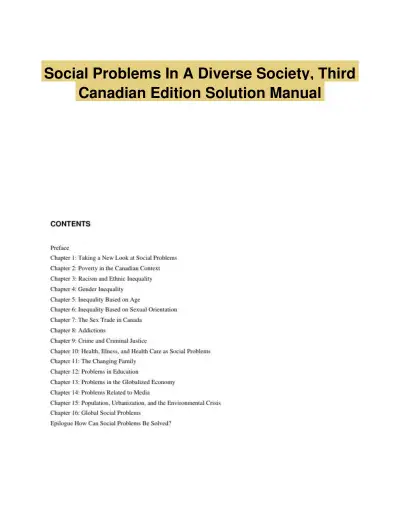 Textbook Guides
Social Problems In A Diverse Society, Third Canadian Edition Solution Manual
Sociology
187 pagesMay 2025 Exam Guides
Test Bank For Sociology in Our Times, 11th Edition
Sociology
1058 pages139downloadsFeb 2025 Class Notes
Class Notes for Exploring Marriages and Families, 3rd Edition
Sociology
167 pages126downloadsFeb 2025 Class Notes
Changing Families : Relationships In Context, Third Canadian Edition Lecture Notes
Sociology
60 pages111downloadsFeb 2025 Exam Guides
Test Bank for Cities and Urban Life, 7th Edition
Sociology
156 pages99downloadsFeb 2025 Exam Guides
Test Bank For Essentials of Sociology 12th Edition Test Bank
Sociology
306 pages94downloadsFeb 2025 Class Notes
Class Notes for Qualitative Research Methods for the Social Sciences, 9th Edition
Sociology
43 pages91downloadsFeb 2025 Exam Guides
Basics Of Social Research, Fourth Canadian Edition Test Bank
Sociology
498 pages86downloadsFeb 2025
Study this document with CramX
Once it is in your library, every tool can work from it.