

Sociology - Economics and Politics
- Sociology
- Texas A&M University
- 23 pages
- Shared March 2026
Preview 7 of 23 pages
See the first 7 pages exactly as they appear in the document.
Page 1 Read page 1 as text
Study Guide Sociology – Economics and Politics 1. Modern Corporations and Multinationals 1.1 What Is a Corporation? A corporation is a business that is legally separate from the people who own it. This means the company can: • Borrow and repay money • Sign contracts • Sue others or be sued Because the corporation is its own legal entity, the owners are not personally responsible for the company’s debts. Corporations come in many sizes. Some are small, like a local retail store. Others are massive, such as Ford Motor Company or General Electric , two of the largest corporations in the United States. 1.2 Ownership vs. Management Large corporations raise money by selling stocks . People who buy these stocks are called shareholders , and they legally own part of the company. However, shareholders usually do not run the business day to day. Instead: • Shareholders elect a board of directors • The board meets regularly • The board sets major policies and long - term goals While many Americans own stock, most do not attend board meetings or have much direct influence over company decisions. Management runs the company but must answer to the board and shareholders.
Page 2 Read page 2 as text
Study Guide 1.3 Interlocking Directorates Sometimes, corporations with closely connected businesses share board members. This is known as an interlocking directorate . For example: • A manufacturing company • A financial services company • An insurance company If these companies work closely together, they may share the same board members. As a result, a small group of individuals can influence decisions across several related companies at once. 1.4 What Is a Conglomerate? A conglomerate is a large corporation made up of many smaller companies, called subsidiaries . These companies may or may not be in related industries. Conglomerates often grow by buying and selling companies for profit , rather than focusing on the goods or services those companies provide. 1.5 Mergers and Job Losses When companies merge, large layoffs often happen. This is because many jobs overlap. For example: • A conglomerate buys a smaller company • Both companies have marketing departments • Only one department is needed As a result, many — or even all — employees from the smaller company’s marketing department may lose their jobs. Similar layoffs often occur when two companies of similar size merge.
Page 3 Read page 3 as text
Study Guide 1.6 Monopolies, Oligopolies, and Multinationals Corporations can also be grouped by how much control they have over a market. 1.7 Monopolies A monopoly exists when one company controls all or nearly all of the sales of a product or service. In the United States: • Most monopolies are illegal • They eliminate competition • They allow companies to set unfair prices • Consumers are harmed Monopolies interfere with capitalism, which depends on competition. 1.8 Legal Monopolies Some monopolies are allowed, especially in industries where competition would be difficult. Utilities — such as electricity or water — are common examples. Even these industries have changed: • Telephone service became more competitive after the breakup of AT&T in the 1980s • Some regions now allow competition among electric power companies through deregulation 1.9 Oligopolies An oligopoly exists when a small number of companies dominate a market. A classic example:
Page 4 Read page 4 as text
Study Guide • U.S. auto manufacturers before the 1980s • Ford, Chrysler, and General Motors produced nearly all American - made cars As globalization increased, foreign competition entered the market. Today, true oligopolies are much less common. 1.10 Multinational Corporations Multinationals are corporations that operate in many different countries. These companies: • Produce enormous amounts of goods • Generate more wealth than many small countries Because of their size and influence, multinationals are often controversial. 1.11 Supporters’ View Business supporters argue that multinationals: • Bring jobs and industry to less - developed countries • Raise standards of living • Strengthen local economies 1.12 Critics’ View Critics argue that multinationals: • Exploit low - paid workers • Use up natural resources • Cause serious environmental damage
Page 5 Read page 5 as text
Study Guide 1.13 Why This Matters Understanding corporations helps explain how the global economy works. From job creation to environmental impact, modern corporations — and especially multinationals — play a powerful role in shaping societies around the world. By learning how they operate, students can better understand business, government policy, and global economic issues. 2. Labor Unions 2.1 Why Workers Formed Labor Unions As large corporations grew, many workers began to feel isolated and powerless . One worker alone had very little influence over company decisions. Employers often did not listen to individual complaints or concerns. Workers soon realized something important: A single voice could be ignored, but a united voice could not. This understanding led to the creation of labor unions . 2.2 What Is a Labor Union? A labor union is an organized group of workers who join together to improve their working conditions and benefits. Unions speak on behalf of workers to demand things such as: • Better wages • Safer working conditions • Reasonable working hours • Job security and benefits By working together, employees gain more bargaining power than they would have on their own.
Page 6 Read page 6 as text
Study Guide 2.3 The Rise of Labor Unions Labor unions were especially strong during the early and mid - twentieth century . During this time, unions played a major role in improving workplace standards and protecting workers’ rights across many industries. 2.4 Decline in Recent Years In more recent decades, labor unions in the United States have lost members and influence . Several factors have contributed to this decline, including: • Globalization , which has moved many jobs overseas • Corporate mergers , which often reduce the workforce • Downsizing , where companies cut jobs to lower costs These changes have made it harder for unions to maintain their strength. 2.5 What the Future May Hold Even though unions are weaker today, many experts believe they may become more important again. As globalization continues and companies grow larger, workers may once again look to unions for: • Greater job stability • Fair treatment • A larger share of the benefits created by the global economy 2.6 Why Labor Unions Still Matter Labor unions remind us that workers are strongest when they work together. By uniting, employees can protect their interests and ensure their voices are heard — even in an economy dominated by large corporations.
Page 7 Read page 7 as text
Study Guide 3. Politics and Major Political Structures Politics is all about how societies organize and run their governments. Just as there are many different economic systems, there are also many different political systems . Each nation uses a system that fits its history, culture, and values. 3.1 What Do “Nation,” “State,” and “Nation - State” Mean? These words are often used interchangeably, but they actually have different meanings. • A nation is a group of people who share common customs, history, language, or origin. • A state is a political organization that has the legal authority to use force when necessary. This includes control over the police, military, and laws. • A nation - state combines both ideas. It is a political system that governs a group of people who share common cultural traits and claims legal authority over them. Sociologists and political scientists prefer the term nation - state instead of “country” because it is more precise and clearly defined. 3.2 Major Political Systems in the Modern World Throughout history, many types of political systems have existed. Today, most modern nation - states fall into one of three main categories: 1. Totalitarianism 2. Authoritarianism 3. Democracy 3.3 Totalitarianism Totalitarianism is a political system in which the government has almost complete control over every aspect of citizens’ lives.
16 more pages in the full document
Unlock it once and it stays in your library, ready to chat with or turn into flashcards.
Unlock the full documentMore Sociology study materials
See all Quick Guides
Sociology - Socialization
Sociology
30 pagesMar 2026 Quick Guides
Sociology - Social Groups and Organizations
Sociology
11 pagesMar 2026 Quick Guides
Sociology - Education
Sociology
16 pagesMar 2026 Quick Guides
Sociology - Deviance, Crime, and Social Control
Sociology
19 pagesMar 2026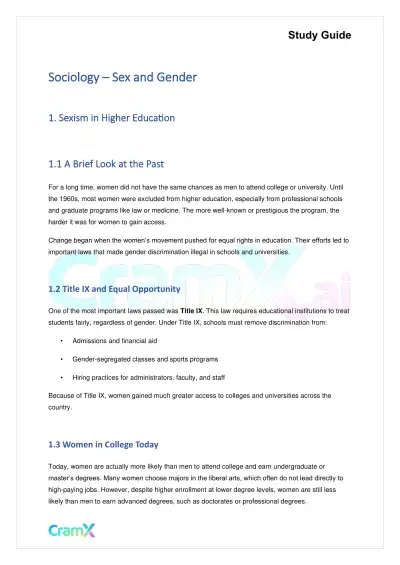 Quick Guides
Sociology - Sex and Gender
Sociology
19 pagesMar 2026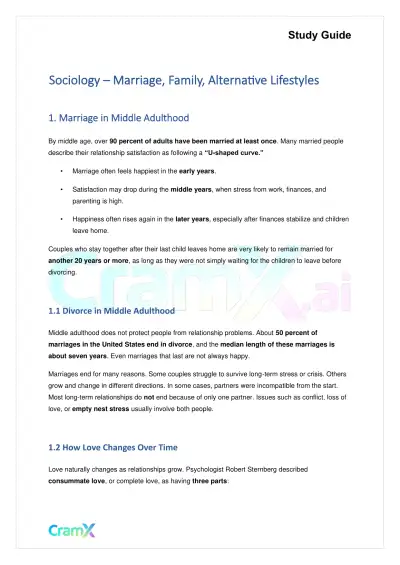 Quick Guides
Sociology - Marriage, Family, Alternative Lifestyl
Sociology
16 pagesMar 2026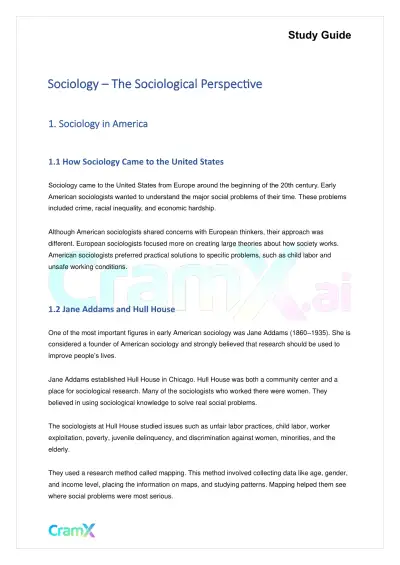 Quick Guides
Sociology - The Sociological Perspective
Sociology
14 pagesMar 2026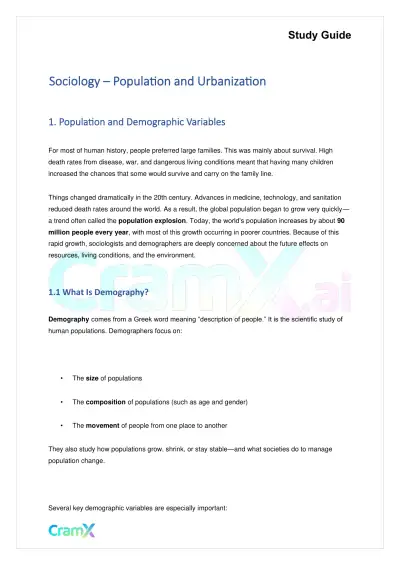 Quick Guides
Sociology - Population and Urbanization
Sociology
15 pagesMar 2026
Study this document with CramX
Once it is in your library, every tool can work from it.