

Fundamental Accounting Principles, Volume 1, 14th Canadian Edition Solution Manual
- Accounting
- 883 pages
- Shared February 2025
- 71 downloads
Strengthen your problem-solving skills with Fundamental Accounting Principles, Volume 1, 14th Canadian Edition Solution Manual, your essential study tool.
Preview 31 of 883 pages
See the first 31 pages exactly as they appear in the document.
Page 1 Read page 1 as text
Last revised : October 26 , 2012 1 - 1 SOLUTIONS MANUAL to accompany Fundamental Accounting Principles 14 th Canadian Edition by Larson/Jensen Prepared by: Tilly Jensen, Athabasca University Wendy Popowich, Northern Alberta Institute of Technology Susan Hurley, Northern Alberta Institute of Technology Ruby So Koumarelas, Northern Alberta Institute of Technology Technical checks by: Ross Meacher Betty Young, Red River College, ANSR Source
Page 2 Page 3 Read page 3 as text
Last revised : October 26 , 2012 1 - 2 Chapter 1 Accounting in Business Chapter Opening Vignette Critical Thinking Challenge Questions * 1. What questions might Jake need the answers to in order to get a loan from a bank? How many employees does he need to hire to provide services to clients? Does Jake pay his employees a salary or a wage ? How much does he pay them? Does he have the cash in the bank to pay his employees? Does he have rental equipment? Does he have a vehicle? Does he have insurance? Is the building rented or purchased? If he rents a building, did he make rental payments in advance or does he pay monthly? If the building was purchased, did he pay cash or does he owe money on it? If he owes money, does he pay interest ? If he owns a building, how much does he pay on property taxes and utilities? If he owns a building, how much does he pay for repairs and maintenance? What about buying and paying for supplies? Does he advertise? If so, how much does he pay? How much is the business actually earning? Do customers pay in advance or do they pay per session? Do customers pay cash or on account? What is the amount of income tax he has to pay? Are there any outstanding loans? If so, what is the balance outstanding, the term, the payments, and the interest rate? There are many other questions that could be asked. 2. Who else might require accounting information from Jake’s business? Other stakeholders that might require accounting information from Jake’s business include Canada Revenue Agency (CRA), employees, and potential investors. *The Chapter 1 Critical Thinking Challenge questions are asked at the beginning of this chapter . Students are reminded at the conclusion of the chapter to refer to the Critical Thinking Challenge questions at the beginning of the chapter. The solutions to the Critical Thinking Challenge questions are available here in the Solutions Manual and accessible to students at Connect .
Page 4 Read page 4 as text
Last revised : October 26 , 2012 1 - 3 Concept Review Questions 1. Jake identifies accounting knowledge as the key to success in business. 2. Businesses offering products include Danier Leather, Bauer, NIKE, and Reebok which produce apparel; Dell, Hewlett - Packard, and Apple which produce computer equipment; and Tilley, Levis, and GAP which produce clothing . Service business examples include: WestJet Airlines which provides airline services; Sympatico, AOL Canada, and CompuServe provide information communication services; and Tilden, Hertz, and Budget which provide vehicle rental services . 3. Business organizations can be organized in one of three forms: sole proprietorship, partnership, or corporation. These forms have implications for legal liability, taxation, continuity, number of owners, and legal status as follows: Sole Proprietorship Partnership Corporation Legal entity no no yes Limited liability no no yes Unlimited life no no yes Business income taxed no no yes One owner allowed yes no yes 4. The equity section of the balance sheet reports a Virgil Klimb, Capital account. The presence of the owner’s capital account indicates that Vertically Inclined has been organized as a sole proprietorship. 5. The two organizations for which accounting information is available in Appendix 1 at the end of the book are WestJet Airlines and Danier Leather. 6 . Hospitals, colleges, prisons, and bus lines are examples of organizations that can be formed as profit - oriented businesses, government units, or nonprofit establishments. 7 . Individuals responsible for marketing activities are likely interested in information such as sales volume, advertising costs, promotion costs, salaries of sales personnel, and sales commissions. 8 . External users and their uses of accounting information include: (a) lenders for measuring the return of loans; (b) shareholders for assessing the acquisition of shares; (c) members of the board of directors for overseeing management; and (d) potential employees for judging employment opportunities. Other users are auditors, consultants, regulators, unions, suppliers, and appraisers. Internal users and their uses of accounting information include: (a) management for overseeing performance, financial position, and cash flow ; and (b) current employees for generating special purpose reports to assist management. 9 . The internal role of accounting is to serve the organization’s internal operating functions by providing useful information in completing their tasks more effectively and efficiently. By providing this information, accounting helps the organization reach its overall goals. 10. Managerial accounting tasks performed by both private and government accountants include general accounting, cost accounting, budgeting, auditing, and management consulting. 11. Management consulting services offered by public accounting professionals include designing and installing accounting systems, establishing internal controls, advice
Page 5 Read page 5 as text
Last revised : October 26 , 2012 1 - 4 on budgeting, guidance in information technology, and constructing employee benefit plans. 12. In addition to preparing tax returns, tax accountants help companies plan future transactions to minimize the amount of tax to be paid. 13. The independent auditor for Danier Leather is PricewaterhouseCoopers LLP. 14. The purpose of accounting is to provide decision makers with information helping them make better decisions. Examples include information for people making investments, loans and similar decisions. 15. Accounting professionals deal with a variety of information about their employers and clients that is not generally available to the public. Ethical issues arise concerning the possibility that accounting professionals might personally benefit by using confidential information. There is also the possibility that their employers and clients might be harmed if certain information is not kept confidential. 16. An income statement user must know what time period is covered to judge whether the company’s performance is satisfactory. For example, a statement user would not be able to assess whether the amounts of revenue and net income are satisfactory without knowing whether they were earned over a week, a month, or a year. 17. The revenue recognition principle provides guidance that managers and auditors need for knowing when to recognize revenue. For example, if revenue is recognized too early, the income statement reports income earlier than it should and the business looks more profitable than it really is. On the other hand, if the revenue is not recognized on time, the income statement shows lower amounts of revenue and net income than it should and the business looks less profitable than it really is. Basically, this principle requires revenue to be recognized when it is earned and can be measured reliably. The amount of revenue should equal the value of the assets received from the customers. 18. The four financial statements are: the income statement, the balance sheet, the statement of changes in equity, and the statement of cash flows. 19. An income statement reports on the business’s performance during the period. It shows whether the business earned a net income (or net loss). The statement does not simply report the amount of net income or loss but lists the types and amounts of the revenues and expenses. 20. A revenue is an inflow of assets received in exchange for goods or services provided to customers as part of the major or central operations of the business. A revenue also may occur as a decrease in liabilities as when a service or product is delivered having been paid for in advance. 21. A business’s equity is increased by investments into the business made by the owner and by net income. It is decreased by withdrawals made by the owner and by a net loss, which is the excess of expenses over revenues. 22. The balance sheet reports on the financial position of a business at a specific point in time. It is often called the statement of financial position. It provides information that helps users understand a company’s financial status. The balance sheet lists the types and dollar amounts of assets, liabilities, and equity of the business.
Page 6 Read page 6 as text
Last revised : October 26 , 2012 1 - 5 23. (a) Assets are probable future economic benefits obtained or controlled by a particular entity as a result of past transactions or events. (b) Liabilities are probable future sacrifices of economic benefits arising from present obligations of a particular entity to transfer assets or provide services to other entities in the future as a result of past transactions or events. (c) Equity is the residual interest in the assets of an entity that remains after deducting its liabilities. (d) The term “net assets” means the same thing as equity, which is also determined as assets less liabilities. QUICK STUDY Quick Study 1 - 1 There are a variety of questions and this list is certainly not exhaustive: 1. How much was spent on advertising last year? And/or how much is projected to be spent this year? 2. What is the effect of advertising on sales? And/or what is the project ed effect of advertising on this year’s sales? 3. How much was spent on delivering flowers last year? And/or how much is projected to be spent this year? 4. How much will it cost to create a webpage and sell flowers online? 5. Can sales be increased by selling online? And/or what is the experience of our competitors in this regard? 6. When pricing flowers, how much is being charged for delivery? 7. Are there enough sales staff to answer phones/emails and/or are sales being lost because of insufficient staffing and/or staffing issues? Quick Study 1 - 2 a. Accounting Meeting with the mechanical staff to determine new machine requirements for next year. b. Recordkeeping Data entry of sales orders received via the telephone. c. Accounting Analyzing a sales report to determine if the discount policy is effective in getting customers to buy in multiple quantities. d. Recordkeeping Listing cheques received in the mail. Quick Study 1 - 3 a. Highlands United Church Non - business d. CDI College Business b. Royal Alexandra Hospital Non - business e. Loblaw Business c. RBC Business f. World Vision Non - business
Page 7 Read page 7 as text
Last revised : October 26 , 2012 1 - 6 Quick Study 1 - 4 Accounting professionals practice in four broad fields including: Accounting - related opportunities within each field are numerous and include: Financial accounting - Statement preparation - Statement analysis - Auditing - Regulatory - Consulting - Planning - Criminal investigation Managerial accounting - General accounting - Cost accounting - Budgeting - Internal auditing - Management advisory services Taxation - Preparation - Planning - Regulatory - Investigations - Consulting Accounting - related - Lenders - Consultants - Analysts - Traders - Managers - Directors - Underwriters - Planners - Appraisers Quick Study 1 - 5 Accounting information could be used to determine if a product should be sold or if an investment should be made.
Page 8 Read page 8 as text
Last revised : October 26 , 2012 1 - 7 Quick Study 1 - 6 The four elements need to be addressed as follows: 1. Is it the Truth? No, personal dinners with a spouse are not business expenses so you are not being truthful in submitting these as part of the expense report. 2. Is it Fair to all concerned? No, it is not fair to the owner(s) of the business, to the other employees, or to your spouse (since they are likely not aware of the deceit). 3. Will it build goodwill and better friendships? It may build a good relationship with the restaurant owners where you take your spouse but it will damage goodwill between the employer and you as well as strain friendships with other employees. 4. Will it be beneficial to all concerned? It will benefit you, your spouse, and the restaurant owner but it will not benefit the business owner(s) and the other employees. Conclusion: The behaviour in the situation described appears to be unethical based on the application of the Rotary 4 - Way Test. Quick Study 1 - 7 a. Business entity principle b. Revenue recognition principle c. Cost principle Quick Study 1 - 8 1. Revenue Recognition 2. Cost 3. Business Entity 4. Going Concern 5. Monetary Unit Quick Study 1 - 9 Monetary Unit a. Delco performed work for a client located in China and collected 8,450,000 RMB (Chinese currency), the equivalent of about $1,320,000 Canadian. Delco recorded it as 8,450,000. Revenue Recognition b. Delco collected $180,000 from a customer on December 20, 2014 for w ork to be done in February 2015 . The $180,000 was record ed as revenue during 2014 . Delco’s year end is December 31. Going Concern c. Delco’s December 31, 2014 balance sheet showed total assets of $840,000 and liabilities of $1,120,000. The income statement for the past 6 years has shown a trend of increasing losses. Cost d. Included in Delco’s assets was land and building purchased for $310,000 and reported on the balance sheet at $470,000. Business Entity e. Delco’s owner, Tom Del, consistently buys personal supplies and charges them to the company.
Page 9 Read page 9 as text
Last revised : October 26 , 2012 1 - 8 Quick Study 1 - 10 1. SP 2. C 3. P 4. SP 5. C 6. C 7. P Qu ick Study 1 - 11 a. Equity = $ 75,000 – $ 40,500 = $ 34,500 b. Liabilities = $300,000 – $ 85,500 = $214,500 c. Assets = $187,500 + $ 95,400 = $282,900 Quick Study 1 - 12 a. Equity = $374,700 – $252,450 = $122,250 b. Liabilities = $150,900 – $126,000 = $ 24,900 c. Assets = $ 37,650 + $112,500 = $150,150
Page 10 Read page 10 as text
Last revised : October 26 , 2012 1 - 9 Quick Study 1 - 13 a. Allin Servicing Income Statement For Month Ended April 30, 201 4 Revenues $300 Expenses 125 Net income (loss) 175 Allin Servicing Statement of Changes in Equity For Month E nded April 30, 2014 Tim Allin, capital, April 1 $ 50 Add: Investments by owner $ 30 Net income 175 205 Total $255 Less: Withdrawals by owner 15 Tim Allin, capital, April 30 $240 Allin Servicing Balance Sheet April 30, 201 4 Assets Liabilities Cash $ 60 Accounts payable $ 25 Equipment 205 Equity Tim Allin, capital 240 Total liabilities and Total assets $265 equity $265 b. Allin Servicing Income Statement For Month Ended May 31, 2014 Revenues $135 Expenses 85 Net income (loss) $ 50 Allin Servicing Statement of Changes in Equity For Month Ended May 31, 2014 Tim Allin, capital, May 1 $240 Add: Investments by owner $ 60 Net income 50 $110 Total 350 Less: Withdrawals by owner 75 Tim Allin, capital, May 3 1 $ 275 Allin Servicing Balance Sheet May 31, 2014 Assets Liabilities Cash $120 Accounts payable $ 45 Equipment 200 Equity Tim Allin, capital 275 Total liabilities and Total assets $320 equity $ 320
Page 11 Read page 11 as text
Last revised : October 26 , 2012 1 - 10 Quick Study 1 - 14 1. $20,000 - $15,000 = $5,000 beginning capital on Jan uary 1, 2014 2. $5,000 + $3,000 + $8,000 - $4,000 = $12,000 end ing capital on December 31, 2014 Quick Study 1 - 15 The source documents include: c. Telephone bill d. Invoice from supplier g. Bank statement h. Sales invoice Quick Study 1 - 16 Assets = Liabilities + Equity a. Increase/Decrease b. Increase Increase c. Decrease Decrease d. Increase Decrease e. Decrease Decrease Quick Study 1 - 17 c 1. Supplies ................................ ................... $10 a 2. Supplies expense ................................ .... 22 c 3. Accounts receivable ................................ 25 c 4. Accounts payable ................................ .... 12 c 5. Equipment ................................ ................ 40 b 6. Tim Roadster’s withdrawals in April ...... 35 c 7. Notes payable ................................ .......... 30 a 8. Utilities expense ................................ ....... 10 c 9. Furniture ................................ ................... 20 a 10. Fees earned ................................ .............. 70 a 11. Rent revenue ................................ ............. 35 a 12. Salaries expense ................................ ...... 45 b 13. Tim Roadster’s investments in April ....... 60 a+b 14. Net income* ................................ ............... 28 * Calculated as : 70 + 35 – 22 – 10 – 45 = 28
Page 12 Read page 12 as text
Last revised : October 26 , 2012 1 - 11 Quick Study 1 - 18 1. Total revenues ................................ ............. 70 + 35 = 105 2. Total operating expenses ............................ 22 + 10 + 45 = 77 3. Net income ................................ ................... 105 – 77 = 28 4. Total assets ................................ .................. 10 + 25 + 40 + 20 = 95 5. Total liabilities ................................ .............. 12 + 30 = 42 6. Tim R oadster, capital (April 30, 2014 ) ........ 60 – 35 + 28 = 53 7. Total liabilities and equity ........................... 42 + 53 = 95 Q uick Study 1 - 19 d 1. Net loss ................................ ................... 2 Income statement & Statement of changes in equity d 2. Rent expense ................................ .......... 22 Income statement b 3. Rent payable ................................ ........... 6 a 4. Accounts receivable .............................. 14 d 5. Joan Bennish’s investments in May ..... 30 Statement of changes in equity d 6. Interest revenue ................................ ..... 2 Income statement d 7. Jo an Bennish, capital, May 1, 2014 ....... 0 Statement of changes in equity a 8. Repair supplies ................................ ....... 5 b 9. Notes payable ................................ .......... 25 d 10. Joan Bennish’s withdrawals in May ...... 5 Statement of changes in equity a 11. Truck ................................ ........................ 15 d 12. Consulting fees earned .......................... 18 Income statement c 13. Joa n Bennish, capital, May 31, 2014 ...... 23 * a 14. Cash ................................ ......................... 20 * See QS1 - 20 for details on how this amount was calculated ; this calculation was not a requirement of QS1 - 19 .
Page 13 Read page 13 as text
Last revised : October 26 , 2012 1 - 12 Quick Study 1 - 20 BENNISH CONSULTING Income Statem ent For Month Ended May 31, 2014 Revenues: Consulting fees earned ................................ ..... $18 Interest revenue ................................ ................. 2 Total revenues ................................ ........................... $20 Operating expenses: Rent expense ................................ ..................... 22 Net loss ................................ ................................ .... $ 2 BENNISH CONSULTING Statement of Changes in Equ ity For Month Ended May 31, 2014 Joan Bennish, capital, May 1 .............................. $ 0 Add: Investments by owner ............................ 30 Total ................................ ............................... $30 Less: Withdrawals by owner .............................. $ 5 Net loss ................................ ...................... 2 7 Joan Bennish, capital, May 31 ............................ $23 BENNISH CONSU LTING Balance Sheet May 31, 2014 Assets Liabilities Cash ................................ ................ $20 Rent payable ............................. $ 6 Accounts receivable ...................... 14 Notes payable ........................... 25 Repair supplies .............................. 5 Total liabilities .......................... $31 Truck ................................ ............... 15 Equity Joan Bennish, capital ............... 23 Total liabilities and Total assets ................................ .... $54 equity ................................ ..... $54
Page 14 Read page 14 as text
Last revised : October 26 , 2012 1 - 13 EXERCISES Exercise 1 - 1 (10 minutes) a. Corporation b. Sole proprietorship c. Corporation d. Partnership e. Sole proprietorship f. Sole proprietorship g. Corporation Exercise 1 - 2 (5 minutes) I or E I or E Bank manager E Parent E Owner I Canada Revenue Agency E Toy Supplier E Cleaner contracted by TLC E Exercise 1 - 3 (10 minutes) 1. A 2. C 3. B 4. A 5. A 6. B 7. B 8. C Exercise 1 - 4 (20 minutes) (Answers will vary.) a. 1. Is it the Truth? No, making personal long distance calls on the company phone without paying for the charges is deceitful. 2. Is it Fair to all concerned? No, it is not fair to the owner(s) of the business or to the other employees. 3. Will it build goodwill and better friendships? It will damage goodwill and friendships between the caller and their employer and colleagues as well as with the people they are calling (since they are likely not aware of the deceit). 4. Will it be beneficial to all concerned? It will benefit the caller in the short run in terms of cost savings but these costs will reduce the profits of the business owner(s). Conclusion: The behaviour in the situation described appears to be unethical based on the application of the Rotary 4 - Way Test.
Page 15 Read page 15 as text
Last revised : October 26 , 2012 1 - 14 Exercise 1 - 4 (concluded) b. 1. Is it the Truth? It appears that the three people ahead of you entered without tickets which is deceitful. They may have fabricated a story to enter and/or the ticket - taker is part of the deceit. 2. Is it Fair to all concerned? It is unfair to the paying patrons of the theatre and unfair to the owner of the theatre. 3. Will it build goodwill and better friendships? In the long run, these types of relationships (between the ticket - taker and the three individuals admitted without tickets) are not what goodwill and true friendships are based upon. Having observed the event, your respect for the ticket - taker and the three individuals admitted without tickets will be negatively affected. 4. Will it be beneficial to all concerned? In the short run, it will benefit the three people who were admitted without paying and the ticket - taker, if an acquaintance, may have accrued future benefits from the three people admitted. If this transgression is discovered by the ticket - taker’s supervisor, the ticket - taker will likely lose their job which is certainly not beneficial. The owner(s) of the theatre do not benefit from this event, nor do other patrons because if it is known that such things occur, ticket prices will be priced to include the cost of this kind of lost sale. Conclusion: The behaviour in the situation described appears to be unethical based on the application of the Rotary 4 - Way Test. c. 1. Is it the Truth? The cashier is not being truthful by providing receipts only upon request because the cash register would be showing fewer drop - in customers than actually occur. 2. Is it Fair to all concerned? No, it is not fair to the paying customers (prices may go up if drop - in revenues are not what is expected) or the owner of the facility. 3. Will it build goodwill and better friendships? No, deceitful acts never build goodwill and do not build good friendships. Eventually, the supervisor and/or owner of the facility will recognize that drop - in revenues are lower than the actual number of drop - in customers attending the facility and the cashier will lose his/her job and perhaps face criminal charges. 4. Will it be beneficial to all concerned? No, it is not beneficial to the cashier (as they may lose his/her job), to the owner, or to the paying patrons. Conclusion: The behaviour in the situation described appears to be unethical based on the application of the Rotary 4 - Way Test.
Page 16 Read page 16 as text
Last revised : October 26 , 2012 1 - 15 Exercise 1 - 5 (10 minutes) Description B 1. Requires every business to be accounted for separately from its owner or owners. A 2. Requires financial statement information to be based on costs incurred in transactions. D 3. Requires financial statements to reflect the assumption that the business will continue operating instead of being closed or sold. C 4. Requires revenue to be recorded only when t he earnings process is complete Exercise 1 - 6 (10 minutes) a) $516,000 – $492 ,000 = $24 ,000 net income b) $165,000 – $240 ,000 = $75 ,000 net loss c) $32 ,000 + 0 – 0 + x = $86,000 x = $86,000 – $32 ,000 x = $54 ,000 net income d) $48 ,000 + $40,000 – 0 + x = $52,000 x = $ 52,000 – $ 48 ,000 – $ 40,000 x = – $36 ,000 or a $36 ,000 n et loss Exercise 1 - 7 (15 minutes) (a) (b) (c) (d) (e) Answers $ (19 ,750 ) $ 4 6,000 $7 ,000 $10 , 25 0 $10 2,000 Proofs: Equity, January 1 ................................ $ 0 $ 0 $ 0 $ 0 $10 2,000 Owner’s investments during the year ................................ 60,000 4 6,000 31,500 37,500 14 0,000 Net income (loss) for the year ............... 15,750 3 0,500 (4,500 ) 10 , 25 0 (8,000 ) Owner’s withdrawals during the year ................................ (19 ,750 ) (27,000 ) (20 ,000 ) (15,750 ) (63,000 ) Equity, December 31 .............................. $56 ,000 $49,500 $7 ,000 $32,00 0 $171,000
Page 17 Read page 17 as text
Last revised : October 26 , 2012 1 - 16 Exercise 1 - 8 (15 minutes) THE HIGGINS GROUP Income Statement F or Month Ended November 30, 2014 Revenues: Consulting fees earned ................................ ..... $22 ,000 Operating expenses: Salaries expense ................................ ............... $6,000 Rent expense ................................ ..................... 2,550 Telephone expense ................................ ........... 1,680 Utilities expenses ................................ .............. 660 Total operating expenses .............................. 10,890 Net income ................................ ................................ . $ 11 ,110 Exercise 1 - 9 (15 minutes) THE HIGGINS GROUP Statement of Changes in Equity F or Month Ended November 30, 2014 Jean Higgins , capital, November 1 ..................... $ 0 Add: Investments by owner ............................ 84,000 Net income ................................ ............... 11 ,110 95 ,110 Total ................................ ............................... $95 ,110 Less: Withdrawals by owner .............................. 3,360 Jean Higgins , capital, November 30 ................... $91 ,750 Analysis component: The owner, Jean Higgins , invested $84,000 of assets during the month, which caused equity to increase. Also, net incom e earned during the month was $11 ,110 also causing equity to increase during November. The total increases in equity during the month were a total of $95 ,110 ($84,000 + $11 ,110). NOTE: Students might point out that equity decreased by a total of $3,360 in withdrawals which in combinatio n with the total increase of $95 ,110 caused a net increase in equity of $91 ,750.
Page 18 Read page 18 as text
Last revised : October 26 , 2012 1 - 17 Exercise 1 - 10 (15 minutes) THE HIGGINS GROUP Balance Sheet November 30, 2014 Assets Liabilities Cash ................................ ................ $16 ,000 Accounts payable ..................... $ 7,500 Accounts receivable ...................... 17,000 Office supplies ............................... 5,00 0 Equity Automobiles ................................ ... 36,000 Jean Higgins , capital ................ 91 ,750 Office equipment ............................ 25,25 0 Total liabilities and Total assets ................................ .... $99 ,250 equity ................................ ..... $99 ,250 Analysis component: $91,750 (or 92.44 % calculated as $91,750/$99 ,250 × 100 ) of the total $99,250 assets are financ ed by Jean Higgins , the owner of The Higgins Group. Exercise 1 - 11 (15 minutes) WINDSOR LEARNING SERVICES Income Stateme nt For Month Ended July 31, 2014 Revenues: Tutoring fees earned ................................ ......... $4,200 Textbook rental revenue ................................ ... 300 Total revenues ................................ ................ $ 4,500 Operating expenses: Office rent expense ................................ ........... $2,500 Tutors wages expense ................................ ...... 1,540 Utilities expense ................................ ................ 6 80 Total operating expenses .............................. 4,7 20 Net loss ................................ ................................ .... $ 2 20
Page 19 Read page 19 as text
Last revised : October 26 , 2012 1 - 18 Exercise 1 - 12 (15 minutes) WINDSOR LEARNING SERVIC ES Statement of Changes in Equi ty For Month Ended July 31, 2014 Milton Windsor , capital, July 1 ........................... $ 7,400 Add: Investments by owner ............................ 1,200 Total ................................ ............................... $ 8,600 Less: Withdrawals by owner .............................. $ 1,000 Net loss ................................ ...................... 2 20 1, 2 20 Milton Windsor , capital, July 31 ......................... $ 7,3 80 Analysis component: Withdrawals of $1,000 by the owner, Milton Windsor , caused equi ty to decrease during July, 2014 . Also, the net loss of $2 20 caused equity to decrease in July. The total decrease in equity during the month of Ju ly was $1,220 (calculated as $1,000 + $2 20). NOTE: Students might point out that equity increased by $1,200 of owner investments which, in combination with the total decrease of $1,220, caused a net decrease in equity of $2 0. Exercise 1 - 13 (15 minutes) WINDSOR LEARNING SERV ICES Balance Sheet July 31, 2014 Assets Liabilities Cash ................................ ................ $ 1,600 Accounts payable ..................... $ 1,5 00 Accounts receivable ...................... 2,00 0 Supplies ................................ .......... 1,28 0 Equity Furniture ................................ ......... 1,800 Milton Windsor , capital ............ 7,3 80 Computer equipment ..................... 2,200 Total liabilities and Total assets ................................ .... $8,880 equity ................................ ..... $8,880 Analysis component: $1,500 or 16.89 % (calculated as $1,5 00/$8,880 × 100) of the total $8,880 assets held by Windsor Learning Services are financed by debt.
Page 20 Read page 20 as text
Last revised : October 26 , 2012 1 - 19 Exercise 1 - 14 (20 minutes) Assets – Liabilities = Equity Beginning of the year ......................... $ 75,000 – $30,000 = $ 45 ,000 End of the year ................................ ... $120,000 – $46,000 = 74 ,000 (a) (b) (c) (d) Answers $ 29 ,000 $ 86 ,000 $( 51 , 0 00 ) $ ( 4 ,000 ) Proofs: Equity, January 1 ................................ $ 45 ,000 $ 45 ,000 $ 45 ,000 $ 45 ,000 Owner’s investments during the year ................................ 0 0 80 , 0 00 7 5 ,000 Net income (loss) for the year ............... 29 ,000 86 ,000 ( 51 , 0 00 ) (4 ,000 ) Owner’s withdrawals during the year ................................ (0 ) ( 57 ,000 ) (0 ) ( 42 ,000 ) Equity, December 31 .............................. $74 ,000 $74 ,000 $74 ,000 $74 ,000 a. An alternative calculation: $45,000 + 0 + x – 0 = $74,000; x = $29,000 b . An alternative calculation: $45,000 + 0 + x - $ 57 ,000 = $ 74 ,000; x = $ 86 ,000 c . An alternative calculation: $45,000 + $ 80 , 0 00 + x - 0 = $74,000; x = ($ 51 , 0 00) where the negative represents a loss. d . An alternative calculation: $45 ,00 0 + $ 7 5,000 + x - $ 42 ,000 = $ 74 ,000; x = ( $ 4 ,000 ) where the negative represents a loss. Exercise 1 - 15 (10 minutes) a. If assets decreased by $ 1 5,000 during August, then $25 ,000 + $ 1 5,000 = $40 ,000 Assets at August 1, 2014 . The refore, Equity at August 1, 2014 = $40 ,000 - $1 0 ,000 = $30 ,000 b. If liabilities increased by $9 ,000 during August, then $1 0,000 + $9 ,000 = $19 ,000 Liabilities at August 31, 2014 . Therefore, Equity at August 31, 2014 = $25,000 - $19 ,000 = $ 6,000
Page 21 Read page 21 as text
Last revised : October 26 , 2012 1 - 20 Exercise 1 - 16 (15 minutes) Assets Liabilities + Equity Cash + Accounts Receivable + Office Supplies = Accounts Payable + Marnie Wesson , Capital a) + $25 ,0 00 + $25 ,0 00 b) + $ 6 00 + $6 00 c) + 7,0 00 + 7,0 00 d)* e) – 4 ,500 – 4 ,500 f) + $1,250 + 1,250 Totals $27,5 00 + $1,250 + $6 00 = $6 00 + $2 8,75 0 $29,3 50 = $29,3 50 *Note: For (d), since no exchange has occurred, no entry is required. Exercise 1 - 17 (20 minutes) Assets Liabilities + Equity Cash + Accounts Receivable + Parts Supplies + Equipment = Accounts Payable + Stacey Crowe, Capital a) + $14 ,000 + $ 14 ,000 b) - 2,500 - 2,500 c) + $8 00 + $8 00 d) + $3,400 + $ 3,400 e) – $ 1, 950 + $ 1, 950 f)* g) – $8 00 – $8 00 h) + $3 ,400 + $ 3 ,400 i) – $2,700 – $ 2,700 Totals $9,4 50 + $3,400 + $8 00 + $ 1, 950 = $ 0 + $15 ,600 $15 ,600 = $15 ,600 *Note: For (f), since no exchange has occurred, no entry is required.
Page 22 Read page 22 as text
Last revised : October 26 , 2012 1 - 21 Exercise 1 - 18 : (15 minutes) b. Office Supplies were purchased paying cash of $500. c. Office Furniture was purchased paying cash of $8,000. d. Completed work for a client on credit; $1,000. e. Purchased office supplies on credit; $400. f. Paid $250 to a creditor. g. Collected $750 cash from a credit customer. Exercise 1 - 19 (20 minutes) Assets = Liabilities + Equity Explanation of Equity Transaction Cash + Accounts Receivable + Supplie s + Equipment = Accounts Payable + Mailin Moon , Capital a) + $3,000 + $2,500 +$5 ,500 Owner Investment b) + $6,5 00 +$6,5 00 Revenue c) + $60 0 + $60 0 d) – $ 1, 450 – $ 1, 450 Sal. Expense e)* f) – $ 1,400 – $ 1,400 Rent Expense g) + $4,5 00 +$4,5 00 Revenue Totals $6,6 50 + $4,5 00 + $60 0 + $2,500 = $60 0 + $13 ,650 $14,25 0 = $14,25 0 *Note: For (e), since no exchange has occurred, no entry is required.
Page 23 Read page 23 as text
Last revised : October 26 , 2012 1 - 22 Exercise 1 - 20 (25 minutes) Mailin Moon – Freelance Writing Income Statement For Month Ended March 31, 2014 Revenues: Freelance writing revenue $11 ,000 Operating expenses: Salaries expense $ 1, 450 Rent expense 1,400 Total operating expenses 2 ,850 Net income $8 ,150 Mailin Moon – Freelance Writing Statement of Changes in Equity For Month Ended March 31, 2014 Mailin Moon , capital, March 1 $ 0 Add: Investment by owner $5 ,500 Net income 8 ,150 13 ,650 Mailin Moon , capital, March 31 $ 13 ,650 Mailin Moon – Freelance Writing Balance Sheet March 31, 2014 Assets Liabilities Cash $6,6 50 Accounts payable $ 60 0 Accounts receivable 4,5 00 Supplies 60 0 Equipment 2,500 Equity Mailin Moon , capital 13 ,650 Total assets $14,25 0 Total liabilities and equity $14 , 25 0 Analysis component: a. Supplies of $600 were financed by accounts payable, a liability. b. Equipment of $2,500 was financed by owner investment, an equity transaction. c. Cash of $6,650 and Accounts receivable of $4,5 00 w ere financed by an investment by owner of $3,000 and net income of $8 ,150. Net income includes the equity transactions of revenues and expenses (revenues of $11,000 less expenses of $2 ,850).
Page 24 Read page 24 as text
Last revised : October 26 , 2012 1 - 23 Exercise 1 - 21 (20 minutes) Assets = Liabilities + Equity Explanation of Equity Transaction Cash + Accounts Receivable + Supplie s + Equipment = Accounts Payable + Pete Kequahtooway, Capital a) + $4,3 00 +$15,000 +$19,3 00 Owner Investment b) +$1,6 00 +$1,6 00 c) +$95 0 +$95 0 d)* e) +$550 +$550 Revenue f) +$600 +$600 Revenue g) - $200 - $200 h) - $250 - $250 Adv. Expense i) +$600 - $600 Totals $ 4,4 50 + $5 50 + $ 2,55 0 + $15,000 = $2,35 0 + $20,2 00 $22,55 0 = $22,55 0 *Note: For (d), since no exchange has occurred, no entry is required.
Page 25 Read page 25 as text
Last revised : October 26 , 2012 1 - 24 Exercise 1 - 22 (25 minutes) Pete’s Yard Care Income Statement For Month Ended March 31, 2014 Revenues: Yard care revenue $1,150 Operating expenses: Advertising expense 250 Net income $ 900 Pete’s Yard Care Statement of Changes in Equity For Month Ended March 31, 2014 Pete Kequahtooway, capital, March 1 $ 0 Add: Investment by owner $19,3 00 Net income 900 20,2 00 Pete Kequahtooway , capital, March 31 $20,2 00 Pete’s Yard Care Balance Sheet March 31, 2014 Assets Liabilities Cash $ 4,4 50 Accounts payable $ 2,35 0 Accounts receivable 5 50 Supplies 2,55 0 Equipment 15,000 Equity Pete Kequahtooway, capital 20,2 00 Total assets $22,55 0 Total liabilities and equity $22,55 0 Analysis component: The $900 of net income does not represent cash because all of the revenues ($550 + $600 = $1,150) were on account. The $250 of advertising expense was paid in cash. The net income (loss) on an income statement represents the net income (loss) that was actually earned which is not necessarily going to agree to the net income (loss) actually received in cash. This is in accordance with the revenue recognition principle which says that revenue s (and also expenses) are recorded at the time earned (or expensed in the case of expenses) regardless of whether cash has been exchanged .
Page 26 Read page 26 as text
Last revised : October 26 , 2012 1 - 25 Exercise 1 - 23 (20 minutes) Assets = Liabilities + Equity Explanation of Equity Transaction Cash + Accounts Receivable + Supplie s + Equipment = Accounts Payable + Otto Ingles, Capital Bal. $6 ,000 $1,200 $ 1, 900 $6 ,500 $4,000 $11 ,600 a) +$8 00 - $8 00 b) - $2,5 00 - $2,5 00 c) +$1,1 00 +$1,1 00 Revenue d) - $95 0 - $95 0 Wage Exp. e) - $1,200 - $1,200 Rent Exp. f) - $600 - $600 Utilities Exp. g) +$1, 6 00 +$1, 6 00 Revenue h)* Totals $2,65 0 + $ 2,0 00 + $ 1, 900 + $6 ,500 = $1,5 00 + $11,55 0 $ 13,050 = $ 13,050 *Note: For (h), since no exchange has occurred, no entry is required.
Page 27 Read page 27 as text
Last revised : October 26 , 2012 1 - 26 Exercise 1 - 24 (25 minutes) Otto’s Wrecking Service Income Statement For Month Ended July 31, 2014 Revenues: Wrecking revenue $2, 7 00 Operating expenses: Rent expense $ 1,200 Utilities expense 6 00 Wage expense 95 0 Total operating expenses 2,75 0 Net loss $ 5 0 Otto’s Wrecking Service Statement of Changes in Equity For Month Ended July 31, 2014 Otto Ingles, capital, July 1 $ 11 ,600 Less: Net loss 5 0 Otto Ingles , capital, July 31 $ 11, 55 0 Otto’s Wrecking Service Balance Sheet July 31, 2014 Assets Liabilities Cash $2,65 0 Accounts payable $ 1,5 00 Accounts receivable 2,000 Supplies 1, 900 Equipment 6 ,500 Equity Otto Ingles, capital 11, 55 0 Total assets $ 13,050 Total liabilities and equity $ 13,050 Analysis component: $11, 550 or 88. 54 % (calculated as $11, 550 /$ 13,050 × 100) of the assets are finance d by Otto Ingles, the owner. $1,500 or 11. 49 % (calculated as $ 1,500/$ 13,050 × 100) of the assets are financed by debt.
Page 28 Read page 28 as text
Last revised : October 26 , 2012 1 - 27 PROBLEM SET “A” Problem 1 - 1A (10 minutes) Characteristic Type of Business Organization Sole Proprietorship Partnership Corporation Limited liability Unlimited liability Owners are shareholders Owners are partners Taxed as a separate legal entity Problem 1 - 2 A (20 minutes) Year 201 5 2014 20 13 Beginning capital 125,000 1 28,000 3 0 + Owner investment 0 0 10,000 + Net income (loss) (5,000) 175,000 60,000 5 – Owner withdrawals 0 78,000 42,000 = Ending capital 120,000 125,000 2 28,000 4 Note: The superscripts show the order in which the answers were calculated. Calculations: 1. $120,000 + 5,000 = $125,000 2. $125,000 (The beginning capital balance for one period is the ending capital balance of the previous period) 3. $125,000 + $78,000 - $175,000 = $28,000 4. $28,000 (The beginning capital balance for one period is the ending capital balance of the previous period) 5. $28,000 + $42,000 - $10,000 = $60,000
Page 29 Read page 29 as text
Last revised : October 26 , 2012 1 - 28 Problem 1 - 3 A (30 minutes) BEE - CLEAN Income Statem ent For Year Ended July 31, 2014 Revenues: Service revenue ................................ ................. $131 ,000 Repair revenue ................................ ................... 2,5 00 Total revenues ................................ ................ $133,5 00 Operating expenses: Wages expense ................................ .................. $68 ,000 Rent expe nse ................................ ..................... 14 ,000 Supplies expense ................................ .............. 15,9 00 Utilities expense ................................ ................ 9,800 Interest expense ................................ ................ 2,1 00 Total operating expenses .............................. 109,8 00 Net income ................................ ................................ . $ 23,7 00 BEE - CLEAN Statement of Changes in Equ ity For Year Ended July 31, 2014 Bee Cummins, cap ital, August 1, 2013 .............. $ 79,300 Add: Investments by owner ............................ $ - 0 - Net income ................................ ............... 23,7 00 23,7 00 Total ................................ ............................... $ 103,0 00 Less: Withdrawals by owner .............................. 46 ,000 Bee Cummins, capital, July 31, 2014 ................. $ 57,0 00 BEE - C LEAN Balance Sheet July 31, 2014 Assets Liabilities Cash ................................ ............ $ 5,6 00 Accounts payable ................... $ 9,4 00 Accounts receivable .................. 42 ,000 Notes payable ......................... 20,000 Supplies ................................ ...... 2,400 Total liabilities ................. $ 29,4 00 Prepaid rent ................................ 4 ,000 Office equipment ........................ 19 ,200 Equity Furniture ................................ ..... 13,2 00 Bee Cummins, capital ............ 57,0 00 Total assets ................................ $86 ,400 Total liabilities and equity ...... $ 86 ,400
Page 30 Read page 30 as text
Last revised : October 26 , 2012 1 - 29 Problem 1 - 3A ( concluded ) Analysis comp onent: $29,400 or 34.03 % (calculated as $ 29,400/$86,40 0 × 100) of the assets are financed by de bt. $57,000 or 65.97% (calculated as $57,000/$86,40 0 × 100) of the assets are finance d by Bee Cummins , the owner. Problem 1 - 4 A (60 minutes) Part 1 LeCLAIRE DELIVERY SERVICES Balance Sheet December 31, 2013 Assets Liabilities Cash ................................ ..... $ 26,250 Accounts payable ....................... $ 3,750 Accounts receivable ........... 14,250 Office supplies .................... 2,250 Trucks ................................ .. 27,000 Equity Office equipment ................. 69,000 Jess LeClaire, capital ................. 135,000 1 Total assets $138,750 Total liabilities and equity .......... $138,750 ______________________ Calculations: 1. $138,750 – $3,750 = $135,000 (calculation of unknown amount)
Page 31 Read page 31 as text
Last revised : October 26 , 2012 1 - 30 Problem 1 - 4 A (concluded) Part 1 LeCLAIRE DELIVERY SERVICES Balance Sheet December 31, 2014 Assets Liabilities Cash ................................ ..... $ 9,375 Accounts payable ....................... $ 18,750 Accounts receivable ........... 11,175 Notes payable ............................. 52,500 Office supplies .................... 1,650 Total liabilities ...................... $ 71,250 Trucks ................................ .. 27,000 Office equipment ................. 73,500 Land ................................ ..... 22,500 Equity Building ............................... 90,000 Jess LeClaire, capital ................. 163,950 2 Total assets ......................... $235,200 Total liabilities and equity .......... $235,200 Calculations: 2. $235,200 – $71,250 = $163,950 Part 2 Ca lculation of net income for 2014 : Jess LeC laire, Capital December 31, 2013 $135,000 + Owner investment 17,500 + Net income (loss) ? – Owner withdrawals 18,000 = Jess LeC laire, capital December 31, 2014 $163,950 OR $135,000 + $17,500 + ? - $18,000 = $163,950; ? = $29,450 Analysis component: Assets increased by $96,450 ($235,200 - $138,750). $67,500 of the increase in assets were financed by an increase in debt (total liabilities went from $3,750 at December 31, 2013 to $71,250 at December 31, 2014 ). The remaining $28,950 increase in assets ($96,450 - $67,500) resulted from equity financing (equity increased to $163,950 a t December 31, 2014 fr om $135,000 at December 31, 2013 because of $17,500 owner investment plus $29,450 net income less $1 8,000 of withdrawals during 2014 ).
852 more pages in the full document
Unlock it once and it stays in your library, ready to chat with or turn into flashcards.
Unlock the full documentMore Accounting study materials
See all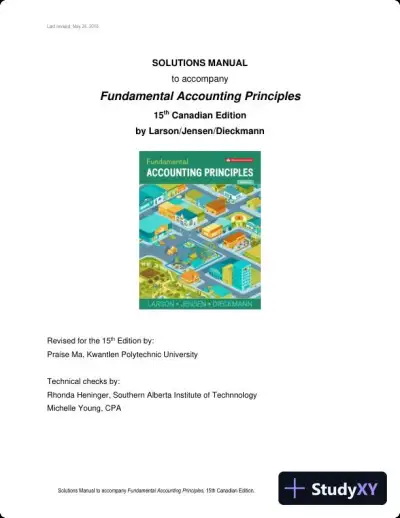 Textbook Guides
Fundamental Accounting Principles, Volume 1 15th Canadian Edition Solution Manual
Accounting
970 pages108downloadsFeb 2025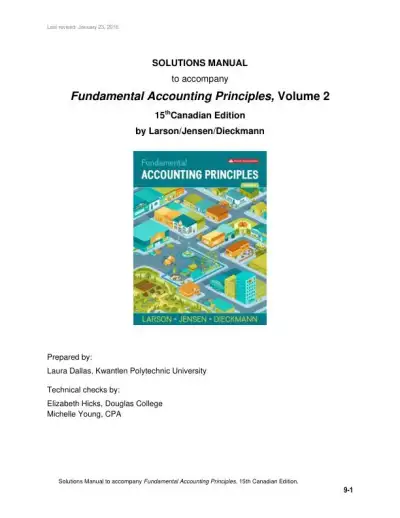 Textbook Guides
Solution Manual for Fundamental Accounting Principles, 15th Edition
Accounting
590 pagesMay 2025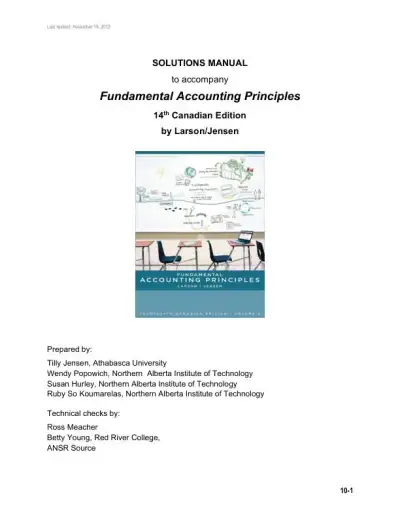 Textbook Guides
Fundamental Accounting Principles, Volume 2, 14th Canadian Edition Solution Manual
Accounting
551 pagesMay 2025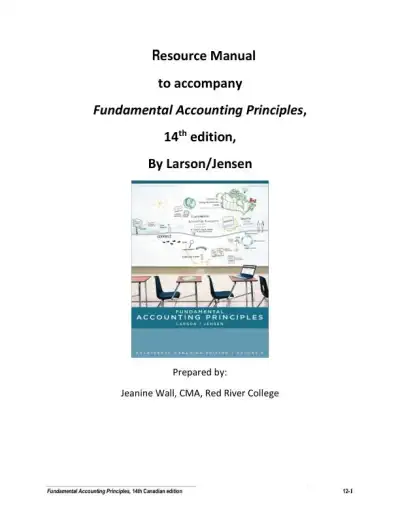 Class Notes
Fundamental Accounting Principles, Volume 2, 14th Canadian Edition Lecture Notes
Accounting
74 pagesMay 2025 Textbook Guides
Solution Manual for Fundamental Accounting Principles, Fifteenth Canadian Edition
Accounting
964 pagesMay 2025 Class Notes
Revision Notes for Fundamental Accounting Principles, 15th Edition
Accounting
75 pagesMay 2025 Exam Guides
Fundamental Accounting Principles, Vol 1, 15th Edition Test Bank
Accounting
633 pagesMay 2025 Exam Guides
Fundamental Accounting Principles, Vol 2, 15th Edition Test Bank
Accounting
535 pagesMay 2025
Study this document with CramX
Once it is in your library, every tool can work from it.