

Revision Notes for Fundamental Accounting Principles, 15th Edition
- Accounting
- 75 pages
- Shared May 2025
Stay on top of your studies with Revision Notes for Fundamental Accounting Principles, 15th Edition, providing well-organized notes that summarize the essential topics.
Preview 16 of 75 pages
See the first 16 pages exactly as they appear in the document.
Page 1 Read page 1 as text
Fundamental Accounting Principles, 1 5 th Canadian edition 9 - 1 Fundamental Accounting Principles , Chapter 9, 1 5 th edition, By Larson/Jensen /Dieckmann Prepared by: Joe Pidutti CPA , CGA , Durham College LECTURE NOTES
Page 2 Page 3 Read page 3 as text
Copyright Education Limited. All rights reserved. 9 - 2 Fundamental Accounting Principles , 1 5 th Canadian edition CHAPTER 9 PROPERTY , PLANT AND EQUIPMENT AND INTANGI B LES Related Assignment Materials Student Learning Objectives Quick Studies Exercises Problems 1. Describe property, plant and equipment (PPE) an d c alculate their cost. 9 - 1, 9 - 2, 9 - 3 9 - 1, 9 - 2, 9 - 3, 9 - 4, 9 - 5 , 9 - 9 9 - 1A, 9 - 7A, 9 - 10A , 9 - 13A, 9 - 15A. 9 - 1B , 9 - 7B, 9 - 10B, 9 - 13B, 9 - 15B. 2. Explain, record and calculate depreciation using the methods of straight - line, units - of - production and double - declining - balance. 9 - 4, 9 - 5, 9 - 6, 9 - 7, 9 - 8, 9 - 9, 9 - 10 , 9 - 11 9 - 5, 9 - 6 , 9 - 7, 9 - 8, 9 - 9, 9 - 10, 9 - 11, 9 - 12 , 9 - 18, 9 - 19, 9 - 21, 9 - 26, 9 - 27, 9 - 28, 9 - 29 , 9 - 30 9 - 2A, 9 - 3A, 9 - 4 A , 9 - 5A, 9 - 6A, 9 - 7A, 9 - 8A, 9 - 9A, 9 - 10A, 9 - 12 A, 9 - 13 A, 9 - 14A, 9 - 15A , 9 - 16A, 9 - 17A, 9 - 19A, 9 - 20A. 9 - 2B, 9 - 3B , 9 - 4B, 9 - 5B, 9 - 6B, 9 - 7B, 9 - 8B, 9 - 9B, 9 - 10B, 9 - 12B, 9 - 13B, 9 - 14B, 9 - 15B, 9 - 16B, 9 - 17B, 9 - 19B, 9 - 20B . 3. Explain and calculate depreciation for partial years. 9 - 9, 9 - 10 , 9 - 11 9 - 13, 9 - 14, 9 - 15, 9 - 21, 9 - 26, 9 - 28, 9 - 29 , 9 - 30 9 - 3A, 9 - 4A, 9 - 5A, 9 - 7A, 9 - 8A, 9 - 9A, 9 - 12A 9 - 13A, 9 - 14A, 9 - 15A, 9 - 16A, 9 - 17A, 9 - 19A, 9 - 20A. 9 - 3B , 9 - 4B, 9 - 5B, 9 - 7B, 9 - 8B, 9 - 9B, 9 - 12B, 9 - 13B, 9 - 14B, 9 - 15B, 9 - 16B, 9 - 17B, 9 - 19B, 9 - 20B . 4. Explain and calculate revised depreciation . 9 - 12 , 9 - 13 9 - 16, 9 - 17, 9 - 18 9 - 10A, 9 - 11A, 9 - 12 A, 9 - 20A . 9 - 10B, 9 - 11B, 9 - 12B, 9 - 16B, 9 - 20B . 5. Explain and record impairment losses. 9 - 14 9 - 19 9 - 13 A . 9 - 13B , 9 - 15B. 6. Account for asset disposal through discarding, selling or exchanging an asset . 9 - 15, 9 - 16 , 9 - 17 9 - 20, 9 - 21, 9 - 22, 9 - 23, 9 - 24 , 9 - 29 9 - 14A, 9 - 15A, 9 - 16A, 9 - 17A, 9 - 19A. 9 - 14B, 9 - 16B, 9 - 17B, 9 - 19B . 7. Account for intangible assets and their amortization . 9 - 1 8, 9 - 19 9 - 25, 9 - 2 6, 9 - 27, 9 - 28 9 - 18 A , 9 - 19A . 9 - 18B, 9 - 19B . 8. * Appendix 9 A - Explain and calculate revised deprec i ation when there is a subsequent capital expenditure that creates a partial period depreciation. 9 - 20 9 - 29 , 9 - 30 9 - 20A . 9 - 20B .
Page 4 Read page 4 as text
Fundamental Accounting Principles, 1 5 th Canadian edition 9 - 3 Chapter Outline Property, plant and equipment (LO1) Property, plant and equipment may be tangible or intangible. A ssets used in the operations to help generate revenue and have a useful life of more than one accounting period are property, plant and equipment. Cost of Property, plant and equipment A. Consistent with cost principle, property, plant and equipment are recorded at cost. Cost includes all normal and reasonable expenditures necessary to get the asset in place and ready for its intended use. B. Subsequent expenditures may be incurred after an asset is placed in service. Capital expenditures are costs of PPE that provide material benefits extending beyond the current period. They are debited to PPE accounts and appear on the balance sheet. Revenue expenditures are normal costs incurred to keep an asset in its normal running condition. They are expense s and would appear on the income statement. C. Subsidiary ledgers may be kept for maintaining control of large numbers of assets. Low cost asset purchases are usually expensed under the materiality principle. D. Low cost assets may be expensed (treated as revenue expenditures) under the materiality principle . E. Land purchased as a building site — cost includes purchase price, commissions, title insurance, legal fees, accrued property taxes, surveying, clearing, landscaping, and local government assessments (current or future) for streets, sewers, etc. Also includes cost of removal of any existing structures (less proceeds from sale of residual material F. Land Improvements — Costs that increase the usefulness of the land. 1. Examples: parking lot surfaces, driveways, fences, and lighting systems have limited useful lives. 2. Costs are charged to a separate Land Improvement account. 3. Costs are allocated to the periods they benefit through depreciation. G. Buildings 1. If purchased — Cost usually include its purchase price, brokerage fees, taxes, title fees, attorney costs, and all expenditures to make it ready for its intended use. ( any necessary repairs or renovations such as wiring, lighting, flooring and wall coverings). 2. If constructed for own use — Costs includes materials and labour plus a reasonable amount of indirect overhead cost (heat, lighting, power, and depreciation on machinery used to construct the asset). Cost also includes design fees, building permits, and insurance during construction. H. Leasehold improvements are alterations or improvements made to leased property. Leasehold improvements become part of the property and revert to the lessor at the end of the lease. These amounts are depreciate d over the life of the lease or life of the improvements, whichever is less. I. Machinery and Equipment — costs include all normal and necessary expenditures to purchase them and prepare them for their intended use (purchase price, taxes, transportation charges, insurance while in transit, and the installing, assembling and testing of machinery and equipment).
Page 5 Read page 5 as text
Copyright Education Limited. All rights reserved. 9 - 4 Fundamental Accounting Principles , 1 5 th Canadian edition J. Lump - Sum Purchase — a group of property, plant and equipment purchased with a single transaction for a lump - sum price. Individual asset cost determined by allocating the cost of the purchase among the different types of assets acquired based on their relative values . Depreciation (LO2) The process of allocating to expense the cost of a capital asset to the accounting periods benefiting from its use. Recorded as a debit to Depreciation Expense and a credit to Accumulated Depreciation. A. Factors in Computing Depreciation 1. Cost — described above. 2. Residual value — ( residual value ) an estimate of the asset ’ s value at the end of its benefit period. 3. Useful life — ( service life ) length of time the asset is expected to be productively used in a company ’ s operations. Factors affecting useful life include: a) Inadequacy — a condition in which the capacity of property, plant and equipment becomes too small for the productive demands of the business. b) Obsolescence — a condition in which, because of new inventions and improvements, a capital asset can no longer be used to produce goods or services with a competitive advantage. B. Depreciation Methods 1. Straight - line Method — charges the same amount to expense for each period of the asset’s useful life. Calculation: • Cost minus residual value (equals the cost to be depreciate d) divided by the asset's useful life . (usually in years ) 2. Units - of - Production Method — charges a varying amount to expense for each period of an asset’s useful life depending on its usage. Charges are based on the consumed capacity of the asset. Examples of capacity measurements: miles driven, product outputs, hours used. Calculation: • Cost minus residual value divided by the number of units to be produced equals the depreciation per unit. • Depreciation per unit X number of units consumed in period equals the period’s depreciation. 3. Declining - Balance Method — an accelerated depreciation method. Charges larger depreciation during the early years of an asset's life and smaller expenses in the later years. Double - declining balance method (DDB) is also referred to as being twice the straight line rate. 4. Calculation: Calculate the rate. 2/useful life= % (or 100%/useful life X 2) Calculate annual depreciation as : Net Book Value X Rate Note: Depreciation is a method of allocation, not of valuation. The cost of a capital
Page 6 Read page 6 as text
Fundamental Accounting Principles, 1 5 th Canadian edition 9 - 5 asset, less estimated residual, is allocated over the estimated useful life in a systematic and rational manner. The amount of depreciation charged per year may vary with the different methods. However, the total depreciation over an asset’s life will be the same regardless of which method is used. Depreciation for Tax Reporting — differences between financial and tax accounting systems are normal and expected. 1. Many companies use accelerated depreciation in computing taxable income because it postpone its tax payments by charging higher depreciation expense in the early years and lower amounts in the later years. 4. Federal income tax regulations require a company to depreciate assets according to the Capital Cost Allowance system (CCA) 5. The income tax regulations specify maximum CCA rates that businesses may claim but a business may decide to claim less than the maximum or claim none at all. Partial Year Depreciation (LO3) When an asset is purchased (or disposed of) at a time other than the beginning or end of an accounting period, depreciation is recorded for the part of the year the asset was in use. The two methods we will examine are: 1. Nearest whole month, depreciation is calculated if the asset was in use for more than half of the month of acquisition. 2. Half - Year Convention, six months depreciation is recorded for the partial year, regardless of when the asset was acquired. Revising Depreciation Rates (LO4) A. If estimated residual value and/or useful life is revised: Depreciation expense calculations are revised by spreading the remaining cost to be depreciate d over the revised useful life remaining. Calculation : Remaining Book value - Revised residual value Revised remaining useful life The revision is referred to as a change in an accounting estimate and is reflected in future financial statements. Past statements are not changed. B. Subsequent Capital Expenditures: Subsequent capital expenditures will change the book value of the asset. A revision to depreciation is required to reflect the change. The first step is to bring depreciation up to date at the time of the subsequent capital expenditure. (using the original rate) The capital expenditure may involve replacing a portion of an asset or adding to the asset without removing any portion. A journal entry is done to record the addition or the addition and removal of an old part. If an old part is removed there may be a loss recorded. Depreciation is then calculated at the revised rate.
Page 7 Read page 7 as text
Copyright Education Limited. All rights reserved. 9 - 6 Fundamental Accounting Principles , 1 5 th Canadian edition Impairment of PPE Assets (LO5) An impairment loss happens when a PPE item’s book value is greater than the amount to be recovered through the asset’s use or sale. Assets should be assessed for impairment annually. Technological, economic or legal factors can all cause impairments to occur. The journal entry to record impairment: Date Impairment loss XX Asset account XX The asset’s book value will be reduced. Depreciation would be revised to reflect this change. Disposals of property, plant and equipment (LO6) A ssets may be discarded, sold, or exchanged due to wear and tear, obsolescence, inadequacy, or damage by fire or other accident. A. In general, accounting for disposals requires the following steps: 1. Record depreciation expense up to the date of disposal. This updates the accumulated depreciation account. 2. Remove the balances of the disposed asset and related accumulated depreciation accounts. 3. Record any cash (and other assets) received or paid in the disposal. 4. Record any gain or loss resulting from comparing the asset's book value with the value received in the disposal. B. Discarding Property, plant and equipment — follow general accounting procedure above. 1. If fully depreciate d — no loss (can never have a gain if discarding) 2. If not fully depreciate d — Record a loss (debit) equal to the book value. C. Selling Property, plant and equipment — follow general accounting procedure above. Compare value received to book value to determine gain (receive value greater than book value) or loss (receive value less than book value). 1. Sale is at a gain if value received exceeds book value. 2. Sale is at a loss if value received is less than book value. Students frequently have difficulty in deriving the journal entry involving a gain or loss. It is very helpful to have them journalize the parts of the entry that they already know such as cash received, debit to accumulated depreciation and credit to the asset account. I usually leave a space between the debits and credits and show the calculation as being the difference between the two sides. A debit or credit can then be recorded with the entry still in the correct order. They just have to fill in th e space! D. Exchanging assets Assets are often exchanged (traded - in) for new assets. The exchange is treated as a sale of the old asset and the purchase of a new asset. The cost and accumulated depreciation of the old asset is removed from the books. The cost of the new asset will be recorded at the fair value of the asset(s) received. If the fair value cannot be reliably determined, the new asset will be recorded at the carrying value of the assets given up. Any gains or losses realized on the exchange are recorded at the time of dispo sal.
Page 8 Read page 8 as text
Fundamental Accounting Principles, 1 5 th Canadian edition 9 - 7 Intangible Assets (LO7) In tangible assets have no physical substance but provide future economic benefits. This is a difficult topic for students to grasp. Examples include patents, copyrights, leaseholds, drilling rights and trademarks. Accounting for intangibles is similar to accounting for PPE. Intangibles are recorded at cost when purchased. Cost is allocated to the asset over its useful life through amortization. The asset account itself is reduced. There is no accumulated account used. In this way intangibles will al ways be shown at net book value. Intangible assets are shown on the balance sheet separately from goodwill and property, plant and equipment. APPENDIX 9A (LO8) Revised Depreciation When There Is a Subsequent Capital Expenditure That Creates Partial Period Depreciation In this case depreciation is calculated and recorded using the following steps: 1. Depreciation on the asset is updated to the date of the subsequent capital expenditure. 2. The subsequent capital expenditure is recorded. 3. If the subsequent capital expenditure is a replacement, the component being replaced is removed from the books and any resulting gain or loss is recorded. 4. Revised depreciation is calculated.
Page 9 Read page 9 as text
Copyright Education Limited. All rights reserved. 9 - 8 Fundamental Accounting Principles , 1 5 th Canadian edition VISUAL # 9 - 1 FORMULAE FOR DEPRECIATION METHODS 1. STRAIGHT LINE Cost - Estimated Residual Value Annual Estimated Useful Life (in years) Depreciation 2. UNITS OF PRODUCTION Depreciation a) Cost - Estimated Residual Value per Predicted units of production Unit b) Depreciation per unit x units produced = Depreciation for PERIOD Depreciation should stop when book value is equal to residual value. 3. DOUBLE DECLINING BALANCE Step 1: Calculate rate to be used ---- 2/Estimated useful life Step 2. Multiply Net Book Value by Rate Net Book Value =Cost – Accumulated Depreciation to Date Depreciation should stop when book value is equal to residual value. = =
Page 10 Read page 10 as text
Fundamental Accounting Principles, 1 5 th Canadian edition 9 - 9 Alternate Demo Problem Chapter 9 A new machine cost $ 10 0,000, has an estimated useful life of five years and an estimated residual value of $15,000 at the end of that time. It is expected that the machine can produce 17 0,000 widgets during its useful life. The New Times Company purchases this machine on January 1, 2017 , and uses it for exactly three years. During these years the annual production of widgets has been 80,000, 50,000, and 30,000 units, r espectively. On January 1, 201 7 , the machine is sold for $45,000. Required: 1. Calculate the depreciation expense for each of the first three years using a. straight - line b. units - of - production c. double - declining - balance 2. Prepare the proper journal entry for the sale of the machine under the three different depreciation methods.
Page 11 Read page 11 as text
Copyright Education Limited. All rights reserved. 9 - 10 Fundamental Accounting Principles , 1 5 th Canadian edition Solution to Alternate Demo Problem Chapter 9 1a . Straight - line The depreciation expense each year is equal to (cost - residual ) / useful life. In this example the cost is $ 10 0,000, the residual is $15,000, and the useful life is 5 years. Therefore, Annual depreciation = ( 10 0,000 - 15,000)/ 5 = 17,000 each year 1b. Units - of - production T he depreciation expense each year is equal to a rate [(cost - residual ) / total production] multiplied by the actual number of units produced that year. In this example the rate would be $0.50 per widget, ( 10 0,000 - 15,000)/ 170 ,000, and the depreciation expense for each of the first three years would be : 2017 = .50 x 80,000 = 40,000 2018 = .50 x 50,000 = 25,000 2019 = .50 x 30,000 = 15,000 1c. Double - declining - balance The depreciation expense each year is equal to a rate (twice the straight - line rate, or 2 / useful life) multiplied by the asset’s net book value (cost less accumulated depreciation ) at the beginning of the year. In this example the rate would be 2/5, or 40%, and the depreciation expense for each of the first three years would be 2017 = .40 x 10 0,000 = 4 0,000 2018 = .40 x 60,000 = 24,000 2019 = .40 x 36,000 = 14,400
Page 12 Read page 12 as text
Fundamental Accounting Principles, 1 5 th Canadian edition 9 - 11 2. The journal entry for the sale of the asset will have the same general form regardless of the method of depreciation adopted, except that whether there is a gain or a loss on the sale may change according to the depreciation method used. The gain or loss on disposal of the asset is determined by comparing the sale price, in this case $45,000, with the net book value of the asset at the time of the sale. Straight - line Cash ................................ ......................... 45,000 Accumulated depreciation ....................... 51,000 Loss on sale of machine ........................... 4,000 Machine ................................ ........... 10 0,000 Units - of - production Cash ................................ ......................... 45,000 Accumulated depreciation ....................... 80,000 Machine ................................ ........... 10 0,000 Gain on sale of machine ................... 2 5,000 Double - declining - balance Cash ................................ ......................... 45,000 Accumulated depreciation ....................... 78,400 Machine ................................ ........... 10 0,000 Gain on sale of machine ................... 23,400
Page 13 Read page 13 as text
Copyright ©201 6 McGraw - Hill Ryerson Limited. All rights reserved. 1 0 - 2 Fundamental Accounting Principles, 1 5 th Canadian edition CHAPTER 1 0 CURRENT LIABILITIES Related Assignment Materials Student Learning Objectives Quick Studies Exercises Problems 1. Describe the characteristics of liabilities and explain the diff erence between current and non - current liabilities. 10 - 1, 10 - 2 10 - 1, 10 - 2, 10 - 3, 10 - 4 , 10 - 1 9 10 - 1A, 10 - 4A, 10 - 6A , 10 - 7A 10 - 1B, 10 - 6B , 10 - 7B 2. Identify and describe known current liabilities. 10 - 3, 10 - 4, 10 - 5, 10 - 6, 10 - 7 10 - 5, 10 - 6, 10 - 7, 10 - 8, 10 - 9, 10 - 10, 10 - 11, 10 - 1 7 , 10 - 1 8, 10 - 19 10 - 5A, 10 - 6A , 10 - 7A 10 - 5B, 10 - 6B , 10 - 7B 3. Prepare entries to account for short - term notes payable. 10 - 8, 10 - 9 10 - 11 , 10 - 1 2, 10 - 13, 10 - 19 10 - 2A, 10 - 6A , 10 - 7A 10 - 2B, 10 - 6B , 10 - 7B 4. Account for estimated liabilities including warranties and corporate income taxes. 10 - 10, 10 - 11, 10 - 12, 10 - 13 , 10 - 14 10 - 14, 10 - 15 , 10 - 16 , 10 - 17 , 10 - 18, 10 - 19 10 - 3A, 10 - 4A, 10 - 6A , 10 - 7A 10 - 3B, 10 - 4B, 10 - 6B , 10 - 7B Note: Analytical & Review Problems may be assigned to student for additional enrichment. Chapter Outline Characteristics of Liabilities (LO1) A. Defining liabilities — a future payment of assets or services that a company is presently obligated to make as a result of past transactions or events. Note three crucial factors: 1. Due to past transaction or event. 2. Present obligation. 3. Future payment of assets or services. B. Classifying liabilities as current or non - current 1. Current liabilities - expected to be settled within one year of the balance sheet date or within the operating cycle of the business, whichever is longer, using current assets or by creating other current liabilities . 2. Non - current liabilities — do not require settlement within one year or the current operating cycle, whichever is longer 3. Current portion of long - term debt refers to the part of a long term liability that is due within one year of the balance sheet date or one operating, cycle, whichever is longer. . 4. Balance sheet presentation of current liabilities - listed by maturity or due dates
Page 14 Read page 14 as text
Fundamental Accounting Principles, 1 5 th Canadian edition 1 0 - 3 Known (Determinable) Liabilities (LO2) S et by agreements, contracts or laws and are measurable. Examples of these current liabilities include: A. Trade accounts payable (or accounts payable) — amounts owed to suppliers for products or services purchased with credit. B. Customer loyalty programs - Some businesses offer customers points and other rewards to encourage long - term relationships and loyalty. Since these create future obligations for the company it must create a current liability for the estimated amount of the redemptions. The liability is reduced when the customers redeem their points. C. Gift cards - These represent a liability to the company since it receives cash in advance of providing goods or services. The liability is reduced when the customers redeem their cards. D. Payroll Liabilities - employee compensation amounts owed to employees. Amounts withheld could include CPP, EI and taxes owing to the Receiver General on behalf of employees. Other possibilities include amounts owing for union dues or medical insurance. E. PST and GST Payable — Provincial sales taxes collected are recorded in an account called PST Payable. PST must be remitted periodically to the appropriate government agency. As these taxes are paid the following journal entry is made: PST Payable XXX Cash XXX GST charged is 5% of sales price. GST is both paid by a business and collected from customers from sales. The net amount of these two amounts is either payable or receivable, depending upon the balance. Assuming GST is payable, the following entry would be made quarterly. (Some large businesses may need to remit monthly, while certain others elect to pay annually.) GST Payable(net of receivable) XXX Cash XXX GST Payable(net of receivable) XXX Cash XXX Some provinces combine the PST and GST into one tax called HST (Harmonized sales tax). The accounting for HST is similar to accounting for GST. F. Unearned revenues — (deferred revenues) amounts received in advance from customers for future products or services. Reported as current liabilities.
Page 15 Read page 15 as text
Copyright ©201 6 McGraw - Hill Ryerson Limited. All rights reserved. 1 0 - 4 Fundamental Accounting Principles, 1 5 th Canadian edition Short - term note payable (LO3) A written promise to pay a specified amount on a specified future date within one year or the company’s operating cycle, whichever is longer. Notes payable are usually interest - bearing. They may be used to purchase merchandise inventory or to replace an account payable. Short term payables may also result from borrowings from a bank. S hort - term note s payable and any accrued interest are reported as a current liabilit ies. Estimated Liabilities(Provisions) (LO4) Obligations that exist but have an uncertain amount that can be reasonably estimated. Examples are: A. Warranty liabilities — The s eller reports the expected warranty expense and related liability in the period when revenue from the sales of the product is reported. This satisfies the matching principle. Estimated warranty liability is increased with an estimate of warranty expense each year. As warranty costs are incurred, the liability account is debited or decreased. B. Income tax liabilities for corporations — Creates a liability until paid to government. Payments are usually paid monthly. The amount to be paid each month is equal to one twelfth of the corporation’s estimated income tax liability for the year. The a ctual amount of total income tax for the period is not known until after the end of the accounting period. The adjustment to bring the estimated taxes and actual income taxes is made in the last period of the year. Income taxes are not applicable to sole pr oprietorships or partnerships since income is taxed at the owner/partner level. C. A contingent liability exists when the liability is not probable or it cannot be estimated. Contingent liabilities are not recorded as a liability on the balance sheet because they do not meet the recognition criteria . Contingent liabilities are disclosed in the notes to the statements unless it is very unlikely that there will be an outflow of assets.
Page 16 Read page 16 as text
Copyright Ryerson. All rights reserved. 1 1 - 2 Fundamental Accounting Principles, 1 5 th Canadian edition CHAPTER 1 1 PARTNERSHIPS Related Assignment Materials Student Learning Objectives Quick Studies Exercises Problems 1. Identify characteristics of partnerships . 11 - 1, 11 - 2 11 - 1 2. Prepare entries when forming a partnership. 11 - 3 11 - 2 11 - 3A, 11 - 5A. 11 - 3B , 11 - 5B 3. Allocate and record income and loss among partners. 11 - 4, 11 - 5, 11 - 6 11 - 2, 11 - 3, 11 - 4, 11 - 5, 11 - 6, 11 - 7 11 - 1A, 11 - 2A, 11 - 3A, 11 - 5A. 11 - 1B, 11 - 2B, 11 - 3B , 11 - 5B. 4. Account for the admission and w ithdrawal of a partner. 11 - 7, 11 - 8, 11 - 9, 11 - 10, 11 - 11, 11 - 12 , 11 - 13 11 - 8, 11 - 9, 11 - 10, 11 - 11, 11 - 12 11 - 4A, 11 - 5A, 11 - 6A. 11 - 4B, 11 - 5B, 11 - 6B. 5. Prepare entries for partnership liquidation. 11 - 14, 11 - 15 11 - 13, 11 - 14, 11 - 15, 11 - 16 11 - 7A, 11 - 8A. 11 - 7B, 11 - 8B. Note: Analytical & Review Problems may be assigned to students for additional enrichment.
59 more pages in the full document
Unlock it once and it stays in your library, ready to chat with or turn into flashcards.
Unlock the full documentMore Accounting study materials
See all Textbook Guides
Fundamental Accounting Principles, Volume 1 15th Canadian Edition Solution Manual
Accounting
970 pages108downloadsFeb 2025 Textbook Guides
Fundamental Accounting Principles, Volume 1, 14th Canadian Edition Solution Manual
Accounting
883 pages71downloadsFeb 2025 Textbook Guides
Fundamental Accounting Principles, Volume 2, 14th Canadian Edition Solution Manual
Accounting
551 pagesMay 2025 Class Notes
Fundamental Accounting Principles, Volume 2, 14th Canadian Edition Lecture Notes
Accounting
74 pagesMay 2025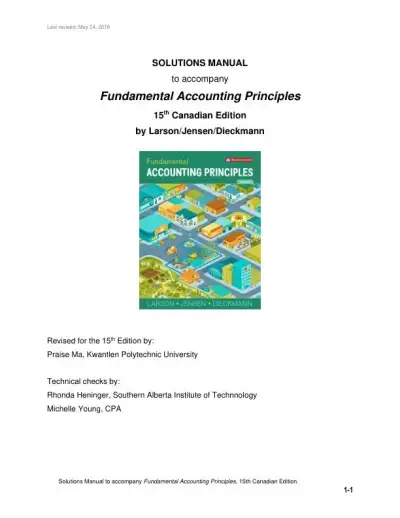 Textbook Guides
Solution Manual for Fundamental Accounting Principles, Fifteenth Canadian Edition
Accounting
964 pagesMay 2025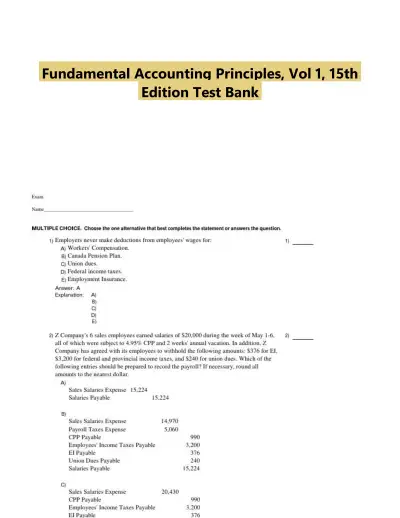 Exam Guides
Fundamental Accounting Principles, Vol 1, 15th Edition Test Bank
Accounting
633 pagesMay 2025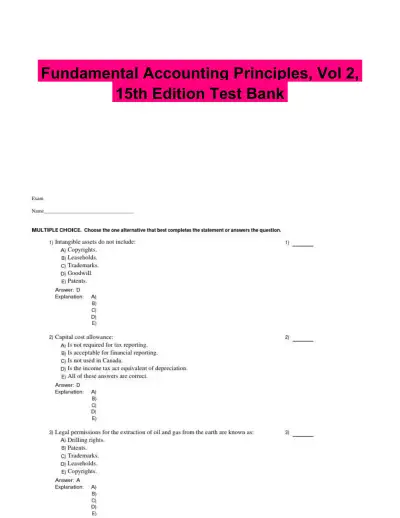 Exam Guides
Fundamental Accounting Principles, Vol 2, 15th Edition Test Bank
Accounting
535 pagesMay 2025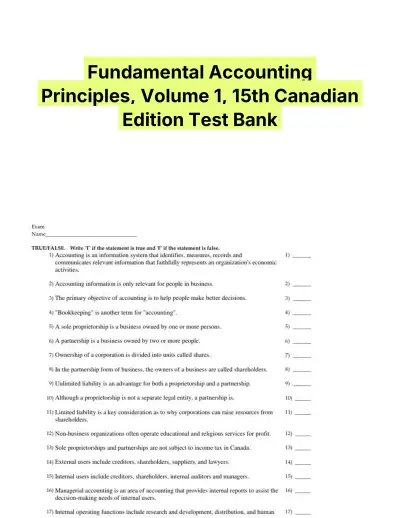 Exam Guides
Fundamental Accounting Principles, Volume 1, 15th Canadian Edition Test Bank
Accounting
320 pagesMay 2025
Study this document with CramX
Once it is in your library, every tool can work from it.