

Solution Manual for Fundamental Accounting Principles, 15th Edition
- Accounting
- 590 pages
- Shared May 2025
Solve textbook problems faster with Solution Manual for Fundamental Accounting Principles, 15th Edition, a solutions guide designed to make your studies easier.
Preview 16 of 590 pages
See the first 16 pages exactly as they appear in the document.
Page 1 Read page 1 as text
Last revised: January 23, 2016 Solutions Manual to accompany Fundamental Accounting Principles, 1 5 th Canadian Edition. 9 - 1 SOLUTIONS MANUAL to accompany Fundamental Accounting Principles , Volume 2 15 th Canadian Edition b y Larson/Jensen /Dieckmann Prepared by: Laura Dallas, Kwantlen Polytechnic University Technical checks by: Elizabeth Hicks, Douglas College Michelle Young, CPA
Page 2 Page 3 Read page 3 as text
Last revised: January 23, 2016 Solutions Manual to accompany Fundamental Accounting Principles, 1 5 th Canadian Edition. 9 - 2 Chapter 9 Property, Plant and Equipment and Intangibles Chapter Opening Critical Thinking Challenge Questions* You are asked by the CFO of YVR to evaluate the newest capital asset, the Airside Operations Building at YVR, and to break it into major components for depreciation purposes. Identify at least five major components and determine an expected life for each of those components. Components of the Airside Operations Building could include: 1. Building exterior walls 40 years 2. Roofing 25 years 3. Pavement 15 years 4. Landscaping 10 years 5. Electrical Components 15 years 6. Flooring 15 years 7. Plumbing 15 years 8. Furniture and Fixtures 15 years 9. Fire Equipment 20 years 10. Snow Removal Equipment 20 years *The Chapter 9 Critical Thinking Challenge questions are asked at the beginning of this chapter . Students are reminded at the conclusion of the chapter to refer to the Critical Thinking Challenge questions at the beginning of the chapter . The solutions to the Critical Thinking Challenge questions are available here in the Solutions Manual and accessible to students at Connect.
Page 4 Read page 4 as text
Last revised: January 23, 2016 Solutions Manual to accompany Fundamental Accounting Principles, 1 5 th Canadian Edition. 9 - 3 Concept Review Questions 1. A property, plant and equipment asset is long - lived in that it has a service life of longer than one accounting period; it is used in the production or sale of products or services. It is different from other assets such as receivables or inventory in that the property, plant and equipment is used within the operations of business to generate profit, whereas inventory is purchased or manufactured for resale. Receivables represent the amounts due from customers based on past transactions. 2. Land held for future expansion is classified as a long - term investment. It is not a property, plant and equipment asset because it is not being used in the production or sale of other assets or services. 3. The cost of a property, plant and equipment asset includes all normal, reasonable, and necessary costs of getting the asset in place and ready to use. For example, c ost includes such items as the invoice price paid, freight costs, non refundable sales taxes (PST, HST) and all costs incurred related to installing and testing an asset before it is put into use. 4. Land is an asset with an unlimited life and, therefore, is not subject to depreciation . Land improvements refer to items such as fencing, parking lots surfac es, landscape lighting and have limited lives and are depreciat ed over their useful lives . 5. No. The Accumulated Depreciation , Machinery account is a contra asset account with a credit balance that does not represent cash or any other funds . Funds available for buying machinery would be shown on the balance sheet as liquid assets with debit balances , such as the account Cash and Cash Equivalents . The balance of the Accumulated Depreciation , Machinery account shows the portion of the machinery's original cost that has been charged to depreciation expense, and gives some indication of how soon the asset will need to be replaced. 6. Revenue expenditures, such as r epairs , are made to keep a plant and equipment asset in normal, good operating condition, and should be charged to expense of the current period. Capital expenditures are made to extend the service potential or the life of a plant and equipment asset beyond the original estimated life and are charged to the plant and equipment asset account. After incurring a capital expenditure, a depreciation policy also needs to be established. 7. Because the $75 cost of the plant and equipment asset is not likely to be material to the users of the financial statements, the materiality principle justifies charging it to expense. 8. Danier Leather did not report any gains or losses on disposal of assets for its year ended June 28 , 2014 . However , the corporation did have an Impairment loss on property and equipment of $ 663 ,000. 9. A company might sell or exchange an asset when it reaches the end of its useful life, or if it becomes inadequate or obsolete, or because the company has changed its business plans. An asset may also be damaged or destroyed by fire or some other accident. 1 0 . An intangible asset has no physical existence. Its value comes from the unique legal and contractual rights held by its owner.
Page 5 Read page 5 as text
Last revised: January 23, 2016 Solutions Manual to accompany Fundamental Accounting Principles, 1 5 th Canadian Edition. 9 - 4 1 1 . T ypes of intangible assets are patents, copyrights, leaseholds, drilling rights, and trademarks. 12. WestJet reported $60,623,000 as Intangible assets at December 31, 2014 . 13. A business can only record goodwill when the price paid for a company being purchased exceeds the fair market value of this company’s net assets (assets minus liabilities) if purchased separately. 14. Westjet did not report any Goodwill at December 31, 2014 . 15. When an asset is constructed, such as the development of a new runway, all costs for construction - related materials and labour costs can be capitalized. Also any electricity and utilities consumed relating to the project, plus a reasonable amount for depreciation on any equipment used during construction. Other permitted costs include design fees, building materials and any interest charges on debt outstanding during the period of construction incurred to finance the project.
Page 6 Read page 6 as text
Last revised: January 23, 2016 Solutions Manual to accompany Fundamental Accounting Principles, 1 5 th Canadian Edition. 9 - 5 QUICK STUDY Quick Study 9 - 1 (5 minutes) $18,000 + $180,000 + $3,000 + $600 = $201,600 Quick Study 9 - 2 (10 minutes) 1. (a) R (b) C (c) R (d) C 2. (a) Mar. 15 Repairs Expense ................................ . 120 Accounts Payable .......................... 120 To record repairs. (b) Mar. 15 Refrigeration Equipment .................... 40,000 Accounts Payable .......................... 40,000 To record capital expenditure. (c) Mar. 15 Repairs Expense ................................ . 200 Accounts Payable .......................... 200 To record repairs. (d) Mar. 15 Office Building ................................ .... 175,000 Accounts Payable .......................... 175,000 To record capital expenditure.
Page 7 Read page 7 as text
Last revised: January 23, 2016 Solutions Manual to accompany Fundamental Accounting Principles, 1 5 th Canadian Edition. 9 - 6 Quick Study 9 - 3 (10 minutes) (a) (b) (c) PPE Item Appraised Values Ratio of Individual Appraised Value to Total Appraised Value (a) Total Appraised Value Cost Allocation (b) x Total Actual Cost Land .............. $ 320,000 320,000 500,000 = .64 or 64% $ 345,600 1 Building ........ 180,000 180,000 500,000 = .36 or 36% 194,400 2 Totals ............ $ 500,000 $ 540,000 1. 64% x 540,000 = 345,600 2. 36% x 540,000 = 194,400 201 7 Apr. 14 Land ................................ ........................... 345,600 Building ................................ ..................... 194,400 Cash ................................ ...................... 85,000 Notes Payable ................................ ....... 455,000 To record purchase of land and building. Quick Study 9 - 4 (10 minutes) TechCom Partial Balance Sheet October 31, 201 7 Assets Current assets: Cash ................................ ................................ ....... $ 9,000 Accounts receivable ................................ .............. $16,400 Less: Allowance for doubtful accounts ............ 800 15,600 Total current assets ................................ ............... $ 24,600 Property, plant and equipment: Land ................................ ................................ ........ $48,000 Vehicles ................................ ................................ .. $62,000 Less: Accumulated depreciation ....................... 13,800 48,200 Equipment ................................ .............................. $25,000 Less: Accumulated depreciation ....................... 3,800 21,200 Total property, plant and equipment .................... 117,400 Intangible assets: Patent ................................ ................................ ..... $20,100 Less: Accumulated amortization, patent 3,100 17,000 Total assets ................................ ................................ ..... $159,000
Page 8 Read page 8 as text
Last revised: January 23, 2016 Solutions Manual to accompany Fundamental Accounting Principles, 1 5 th Canadian Edition. 9 - 7 Quick Study 9 - 5 (10 minutes) ($55,900 – $1,900)/4 = $13,500/year Quick Study 9 - 6 (10 minutes) Rate per copy = ($45,000 – $5,000)/4,000,000 copies = $0.01/copy Year Calculation Annual Depreciation 2017 $.01 × 650,000 = $6,500 2018 $.01 × 798,000 = 7,980 2019 $.01 × 424,000 = 4,240 2020 $.01 × 935,000 = 9,350 2021 $.01 × 1,193,000 = 11,930 $40,000 Quick Study 9 - 7 (10 minutes) Annual rate of depreciation = 2/5 = .40 or 40% per year Year Calculation Annual Depreciation 2017 40% × $86,000 = $34,400 2018 40% × ($86,000 – $34,400) = 20,640 2019 40% × ($86,000 – $34,400 – $20,640) = 12,384 2020 40% × ($86,000 – $34,400 – $20,640 – $12,384) = 2,576 * 2021 0 $70,000 * The calculation shows $7,430 of depreciation but that amount would cause accumulated depreciation to exceed the maximum allowed of cost less resi d ual ($86,000 – $16,000 = $70,000). Therefore, the depreciation for 2020 must be adjusted to $2,576.
Page 9 Read page 9 as text
Last revised: January 23, 2016 Solutions Manual to accompany Fundamental Accounting Principles, 1 5 th Canadian Edition. 9 - 8 Quick Study 9 - 8 (10 minutes) Computer panel: $4,000/8 years = $500 depreciation Dry - cleaning drum: $70,000 - $5,000 = $65,000/400,000 garments = $0.1625/garment; $0.1625/garment × 62,000 garments = $10,075 depreciation Stainless steel housing: $85,000 - $10,000 = $75,000/20 years = $3,750 depreciation Miscellaneous parts: $26,000/2 years = $13,000 depreciation Total depreciation on the dry cleaning equipment for 2017 = $500 + $10,075 + $3,750 + $13,000 = $27,325 Quick Study 9 - 9 (10 minutes) 2017 2018 a. $5,000 $6,000 b. $3,000 $6,000 Calculations: a. 60,000 - 0 = 6,000/year x 10/12 = 5,000 10 years b. 6,000/year x 6/12 = 3,000 Quick Study 9 - 10 (10 minutes) 2017 2018 a. $10,000 $10,000 b. $6,000 $10,800 Calculations: a. 2/10 = .2 or 20%; 20% x 60,000 = 12,000 x 10/12 = 10,000 for 2017 20% x (60,000 – 10,000) = 10,000 for 2018 b. 20% x 60,000 = 12,000 x 6/12 = 6,000 for 2017 20% x (60,000 – 6,000) = 10,800 for 2018
Page 10 Read page 10 as text
Last revised: January 23, 2016 Solutions Manual to accompany Fundamental Accounting Principles, 1 5 th Canadian Edition. 9 - 9 Quick Study 9 - 11 (10 minutes) 2017 2018 a. 10,000 14,000 b. 10,000 14,000 Calculations: 75,000 – 15,000 = 60,000/120,000 = $0.50 depreciation expense per unit produced $0.50 x 20,000 = $10,000 for 2017 ; $0.50 x 28,000 = $14,000 for 2018 NOTE: The units - of - production method is a usage - based method as opposed to a time - based method (such as straight - line and double - declining - balance) and therefore partial periods do not affect the calculations. Quick Study 9 - 12 (10 minutes) [($35,720 – $11,820 1 ) – $1,570]/ 7 2 years remaining = $3,190 1. ($35,720 – $4,200)/8 = $3,940/year × 3 years = $11,820 2.10 – 3 = 7 Quick Study 9 - 13 (10 minutes) 2017 Jan. 3 Barbe c ue – Rotisserie …………………………………… 1,000 Cash ………………………………………………….. 1,000 To record the purchase of electronic rotisserie. Dec. 31 Depreciation Expense, Barbe c ue ……………………… 1,560 Accumulated Depreciation, Barbe c ue ………… 1,560 To record revised depreciation on the barbe c ue caused by the addition of a rotisserie; $7,000 - $200 = $6,800 ÷ 5 years = $1,360 PLUS $1,000 ÷5 years = $200; Total depreciation = $1,360 + $200 = $1,560.
Page 11 Read page 11 as text
Last revised: January 23, 2016 Solutions Manual to accompany Fundamental Accounting Principles, 1 5 th Canadian Edition. 9 - 10 Quick Study 9 - 1 4 (10 minutes) Impairment losses occurred on the computer and the furniture in the amounts of $1,500 and $21,000, respectively. Calculations: Asset Cost Accumulated Depreciation Book Value Recoverable Amount Impairment Loss Building $1,200,000 $465,000 $735,000 $735,000 N/A Computer 3,500 1,800 1,700 200 $ 1,500 Furniture 79,000 53,000 26,000 5,000 21,000 Land 630,000 0 630,000 790,000 N/A Machine 284,000 117,000 167,000 172,000 N/A Quick Study 9 - 1 5 (10 minutes) a. 2017 Oct. 1 Accumulated Depreciation , Equipment ................ 39,000 Cash ................................ ................................ ........ 17,000 Equipment ................................ ......................... 56,000 To record sale of equipment. b. Oct. 1 Accumulated Depreciation , Machinery ................ 96,000 Cash ................................ ................................ ........ 27,000 Machinery ................................ .......................... 109,000 Gain on Disposal ................................ ............... 14,000 To record sale of equipment. c. Oct. 1 Accumulated Depreciation , Truck ........................ 33,000 Cash ................................ ................................ ........ 11,000 Loss on disposal ................................ ................... 4,000 Delivery truck ................................ .................... 48,000 To record sale of equipment. d. Oct. 1 Accumulated Depreciation , Furniture .................. 21 ,000 Loss on disposal ................................ ................... 5 ,000 Furniture ................................ ................................ . 26 ,000 To record disposal of equipment.
Page 12 Read page 12 as text
Last revised: January 23, 2016 Solutions Manual to accompany Fundamental Accounting Principles, 1 5 th Canadian Edition. 9 - 11 Quick Study 9 - 1 6 (10 minutes) 2017 Dec 31 Accumulated Depreciation , Automobile .............. 13,500 Computer * ................................ .............................. 5, 80 0 Automobile ................................ ........................ 15,000 Cash ................................ ................................ ... 2,750 Gain on Disposal ................................ ............... 1,5 5 0 To record exchange. *Computer = FV of assets received= $5, 80 0 as given Quick Study 9 - 1 7 (15 minutes) 2017 Mar. 1 Accumulated Depreciation , Machine (old) .......... 36,000 Machine (new) 2 ................................ ...................... 117 ,000 Cash 1 ................................ ................................ ...... 63,000 Machine (old) ................................ ............... 90,000 To record exchange of machines. 1. Cash paid = $123,000 - $60,000 = $63,000 2. Machine (new) = $63,000 cash paid + $54,000 book value of old = $117,000 Quick Study 9 - 1 8 (10 minutes) 2017 Jan. 4 Franchise ................................ ............................... 95,000 Cash 95,000 To record purchase of franchise. Dec. 31 Amortization Expense, Franchise ........................ 9,500 Accumulated Amortization, Franchise ......... 9,500 To record amortization of franchise; $95,000/10 years = $9,500 per year
Page 13 Read page 13 as text
Last revised: January 23, 2016 Solutions Manual to accompany Fundamental Accounting Principles, 1 5 th Canadian Edition. 9 - 12 Quick Study 9 - 1 9 (10 minutes) 2017 Oct. 1 Mineral Rights 35,000,000 Water Rights 4,000,000 Cash 9,000,000 Long - Term Note Payable 30,000,000 To record the purchase of intangibles. Dec. 31 Amortization Expense, Mineral Rights 875,000 Accumulated Amortization, Mineral Rights 875,000 To record amortization of mineral rights; $35,000,000 ÷ 10 years = $3,500,000/year; $3,500,000/year × 3/12 = $875,000. 31 Amortization Expense, Water Rights 100,000 Accumulated Amortization, Water Rights 100,000 To record amortization of water rights; $4,000,000 ÷ 10 years = $400,000/year; $400,000/year × 3/12 = $100,000. * Quick Study 9 - 20 (20 minutes) Motor (old) $45,000 - $5,000 = $40,000 ÷ 10 yrs × 8/12 = $ 2,667 Motor (new) $60,000 - $10,000 = $50,000 ÷ 8 yrs × 4/12 = 2,083 Metal housing $68,000 - $15,000 = $53,000 ÷ 25 yrs = 2,120 Misc. parts $15,000 ÷ 5 yrs = 3,000 Total depreciation expense to be recorded on the machine for 2017 = $ 9,870
Page 14 Read page 14 as text
Last revised: January 23, 2016 Solutions Manual to accompany Fundamental Accounting Principles, 1 5 th Canadian Edition. 9 - 13 EXERCISES Exercise 9 - 1 (10 minutes) Invoice cost ................................ ........................... $1 5 , 0 00 Freight costs ................................ ......................... 260 Steel mounting ................................ ...................... 795 Assembly ................................ ............................... 375 Raw materials for testing ................................ ...... 12 0 Less: discount ($1 5 , 0 00 × 2%) ............................ 300 Total acquisition costs ................................ ..... $1 6 , 25 0 Note: The $190 repairs are an expense and therefore not capitalized. Exercise 9 - 2 (15 minutes) Cost of land: Purchase price for land ................................ ................................ $ 1, 2 00 ,000 Purchase price for old building ................................ 48 0,000 Demolition costs for old building ................................ 75 ,0 00 L evelling the lot ................................ ................................ 105 ,000 Total cost of land ................................ ................................ $ 1,8 60 ,0 00 Cost of new building: Construction costs ................................ ................ $ 2,880,0 00 Less: Cost of land improvements* ...................... 215 ,0 00 Cost of new building ................................ ............. $ 2 , 665 ,0 00 *The land improvements are a distinct PPE asset that depreciates at a different rate than the building. Therefore it should be debited to an account separate from the building. Journal entry: 2017 Mar. 10 Land ................................ ................................ ....... 1,8 60 ,0 00 Land Improvements ................................ .............. 215 ,0 00 Building ................................ ................................ . 2, 665 ,0 00 Cash ................................ ................................ . 4,7 40 ,000 To record costs of plant assets.
Page 15 Read page 15 as text
Last revised: January 23, 2016 Solutions Manual to accompany Fundamental Accounting Principles, 1 5 th Canadian Edition. 9 - 14 Exercise 9 - 3 (15 minutes) Allocation of total cost: (a) (b) (c) PPE Asset Appraised Values Ratio of Individual Appraised Value to Total Appraised Value (a) Total Appraised Value Cost Allocation (b) x Total Actual Cost Land $ 249 , 480 249 , 48 0 594 ,000 = .42 or 42% $ 244 , 346 2 Land Imprv. 83 , 16 0 83 , 16 0 594 ,000 = .14 or 14% 81,448 3 Building 261 , 36 0 261 , 36 0 594 ,000 = .44 or 44% 255 , 981 4 Totals $ 594 ,000 $ 581 , 775 1 1. 552 , 375 + 2 9, 4 00 = 5 8 1 , 775 2. 42% x 5 8 1 , 775 = 244 , 346 3. 14% x 5 8 1 , 775 = 81,448 4. 44% x 5 8 1 , 775 = 255 , 981 Journal entry: 2017 Apr. 12 Land ................................ ................................ .................... 244,346 Land Improvements ................................ ........................... 81,448 Building ................................ ................................ .............. 255,981 Cash ................................ ................................ ............. 581,775 To record costs of lump - sum purchase.
Page 16 Read page 16 as text
Last revised: January 23, 2016 Solutions Manual to accompany Fundamental Accounting Principles, 1 5 th Canadian Edition. 9 - 15 Exercise 9 - 4 (20 minutes) 2017 Jan. 1 Land ................................ ................................ ................ 1, 296 ,000 Building ................................ ................................ .......... 1, 512 ,000 Equipment ................................ ................................ ...... 1,123,2 00 Tools ................................ ................................ ............... 3 88 , 8 00 Cash ................................ ................................ .......... 1,104 ,000 Notes Payable ................................ ........................... 3 , 216 ,000 To record lump - sum purchase. Calculations: (a) (b) (c) PPE Asset Appraised Values Ratio of Individual Appraised Value to Total Appraised Value (a) Total Appraised Value Cost Allocation (b) x Total Actual Cost Land $ 1,152 ,000 1,152 ,000 3, 840 ,000 = .30 or 30% $ 1, 296 ,000 1 Building 1, 344 ,000 1, 344 ,000 3, 840 ,000 = .35 or 35% 1, 512 ,000 2 Equipment 998 , 4 00 998 , 4 00 3, 840 ,000 = .26 or 26% 1,123 , 2 00 3 Tools 345 , 6 00 345 , 6 00 3, 840 ,000 = .09 or 9% 3 88 , 8 00 4 Totals $ 3, 840 ,000 $ 4 , 32 0,000 1. 30% x 4,320 ,000 = 1, 296 ,000 2. 35% x 4,320 ,000 = 1, 512 ,000 3. 26% x 4,320 ,000 = 1,123 , 2 00 4. 9% x 4,320 ,000 = 3 88 , 8 00
574 more pages in the full document
Unlock it once and it stays in your library, ready to chat with or turn into flashcards.
Unlock the full documentMore Accounting study materials
See all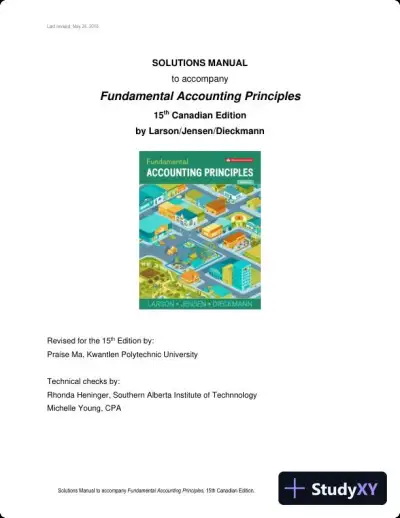 Textbook Guides
Fundamental Accounting Principles, Volume 1 15th Canadian Edition Solution Manual
Accounting
970 pages108downloadsFeb 2025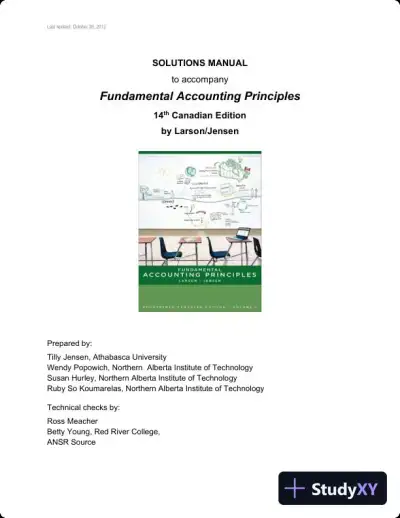 Textbook Guides
Fundamental Accounting Principles, Volume 1, 14th Canadian Edition Solution Manual
Accounting
883 pages71downloadsFeb 2025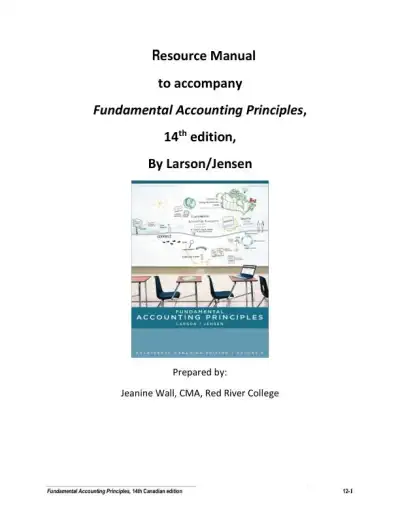 Class Notes
Fundamental Accounting Principles, Volume 2, 14th Canadian Edition Lecture Notes
Accounting
74 pagesMay 2025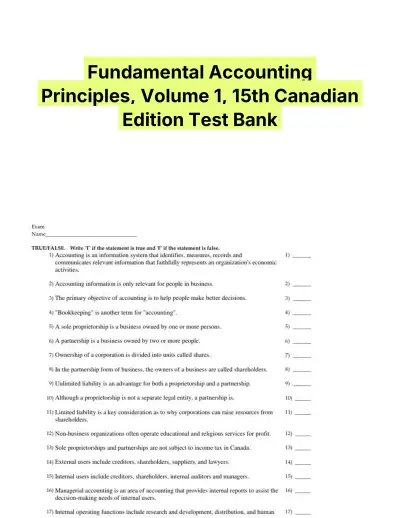 Exam Guides
Fundamental Accounting Principles, Volume 1, 15th Canadian Edition Test Bank
Accounting
320 pagesMay 2025 Textbook Guides
Solution Manual for Fundamental Accounting Principles, Fifteenth Canadian Edition
Accounting
964 pagesMay 2025 Exam Guides
Fundamental Accounting Principles, Vol 1, 15th Edition Test Bank
Accounting
633 pagesMay 2025 Exam Guides
Fundamental Accounting Principles, Vol 2, 15th Edition Test Bank
Accounting
535 pagesMay 2025 Class Notes
Revision Notes for Fundamental Accounting Principles, 15th Edition
Accounting
75 pagesMay 2025
Study this document with CramX
Once it is in your library, every tool can work from it.