

Test Bank For Human Anatomy and Physiology, 11th Edition
- Anatomy and Physiology
- 448 pages
- Shared May 2025
Don't leave anything to chance�use Test Bank For Human Anatomy and Physiology, 11th Edition to prepare for your exam with confidence.
Preview 16 of 448 pages
See the first 16 pages exactly as they appear in the document.
Page 1 Read page 1 as text
Exam Name___________________________________ SHORT ANSWER. Write the word or phrase that best completes each statement or answers the question. Figure 1.1 Using Figure 1.1, match the following cavities: 1) Thoracic cavity. Answer: C 2) Cranial cavity. Answer: A 3) Abdominal cavity. Answer: D 4) Vertebral cavity. Answer: B 1
Page 2 Page 3 Read page 3 as text
Figure 1.2 Using Figure 1.2, match the following descriptions to the most appropriate letter on the diagram: 5) Information about body temperature is sent through afferent pathways to the brain. Answer: C 6) Free nerve endings in the skin detect changes in skin temperature (getting warmer). Answer: B 7) Appropriate response information is sent through efferent pathways. Answer: D 8) A change in the temperature of the external environment (getting warmer). Answer: A 9) Sweat glands are stimulated as well as blood being distributed to the skin to allow cooling of the body to return the body's temperature to a physiological level. Answer: E MATCHING. Choose the item in column 2 that best matches each item in column 1. Match the following systems to their functions: 10) Provides the force to move bones about their joints. Answer: A A) Muscular 2
Page 4 Read page 4 as text
11) Responds to environmental changes by transmitting appropriate electrical impulses. Answer: C 12) Provides a ridged framework to support the body and stores minerals. Answer: B 13) Prevents water loss, entry of germs into the body and synthesizes vitamin D. Answer: A A) Integumentary B) Skeletal C) Nervous Match the following systems to their functions: 14) Controls the body with chemical molecules called hormones. Answer: C 15) Delivers oxygen and nutrients to the tissues. Answer: D 16) A functional organ system which provides a means of protecting us from foreign invaders. Answer: B 17) Picks up and cleans excess fluid from tissues. Answer: A A) Lymphatic B) Immune C) Endocrine D) Cardiovascular Match the following examples of feedback mechanisms: 18) Used for changes in blood glucose levels. Answer: B 19) Used for changes in blood pressure. Answer: B 20) Used for blood clotting. Answer: A 21) Used for childbirth. Answer: A A) Positive feedback B) Negative feedback 3
Page 5 Read page 5 as text
Match the following systems and organs: 22) Arteries, veins, heart. Answer: E 23) Trachea, bronchi, alveoli. Answer: C 24) Adrenal glands, pancreas, pituitary. Answer: A 25) Esophagus, large intestine, rectum. Answer: B 26) Kidneys, bladder, ureters. Answer: D A) Endocrine B) Digestive C) Respiratory D) Urinary E) Cardiovascular Match the following cavities and organs: 27) Stomach. Answer: C 28) Heart. Answer: A 29) Uterus. Answer: B 30) Brain. Answer: D 31) Lungs. Answer: A A) Thoracic B) Pelvic C) Abdominal D) Cranial Match the following regional terms and common terms: 32) Arm. Answer: A 33) Buttock. Answer: B A) Brachial B) Gluteal 4
Page 6 Read page 6 as text
34) Head. Answer: C 35) Knee (anterior aspect). Answer: B 36) Chest. Answer: A A) Thoracic B) Patellar C) Cephalic Match the regional/directional terms and examples: 37) The bridge of the nose is ________ to the left eye. Answer: E 38) The upper arm is ________ to the forearm. Answer: D 39) The lungs are ________ to the heart. Answer: A 40) The fingers are ________ to the wrist. Answer: C 41) The stomach is ________ to the spine. Answer: B A) Lateral B) Anterior C) Distal D) Proximal E) Medial TRUE/FALSE. Write 'T' if the statement is true and 'F' if the statement is false. 42) Positive feedback mechanisms tend to enhance the original stimulus so that the response is accelerated. Answer: True False 43) Digital Subtraction Angiography (DSA) imaging is most useful in discovering obstructed blood supplies in organs and tissues. Answer: True False 44) The elbow is proximal to the shoulder. Answer: True False 45) The part of the serous membrane that lines the peritoneal cavity wall is called visceral peritoneum. Answer: True False 46) A major function of serous membranes is to decrease friction. Answer: True False 47) The right hypochondriac region contains the majority of the stomach. Answer: True False 5
Page 7 Read page 7 as text
48) Lungs carry out an excretory function. Answer: True False 49) Embryology concerns the structural changes that occur in an individual from conception through old age. Answer: True False 50) A tissue consists of groups of similar cells that have a common function. Answer: True False 51) It is important for any organism to maintain its boundaries, so that its internal environment remains distinct from the external environment surrounding it. Answer: True False 52) Without some sort of negative feedback mechanism, it would be impossible to keep our body chemistry in balance. Answer: True False 53) Responsiveness or irritability is the ability to sense changes in the environment and then respond to them. Answer: True False 54) The epigastric region is superior to the umbilical region. Answer: True False MULTIPLE CHOICE. Choose the one alternative that best completes the statement or answers the question. 55) Histology would be best defined as a study of ________. A) cells B) cell chemistry C) the gross structures of the body D) tissues Answer: D 56) The study of large body structures, visible to the naked eye, such as the heart is called ________ anatomy. A) systemic B) microscopic C) developmental D) gross Answer: D 57) Expiration (breathing out) is how the body removes excessive carbon dioxide from the blood. This is an example of ________. A) maintaining boundaries B) metabolism C) responsiveness D) excretion of metabolic waste Answer: D 58) Generally, what is the result of the negative feedback process? A) to maintain homeostasis B) to keep the body's blood sugar level high C) to regulate excretion via the kidneys D) to control body movement Answer: A 59) The coxal joint is most likely found in the ________ region of the body. A) groin B) hand C) foot D) hip Answer: D 6
Page 8 Read page 8 as text
60) A structure that is composed of two or more tissue types that work together to perform specific functions for the body is a(n) ________. A) complex cell B) organ system C) complex tissue D) organ Answer: D 61) The anatomical position is characterized by all of the following EXCEPT ________. A) arms at sides B) thumbs pointed laterally C) body erect D) palms turned posteriorly Answer: D 62) A good example of a positive feedback mechanism would be ________. A) regulating glucose levels in the blood B) body temperature regulation C) blood calcium level regulation D) enhancement of labor contractions Answer: D 63) Which of the following describes a parasagittal plane? A) any sagittal plane except in the midline B) any cut dividing the body into anterior and posterior portions C) two cuts dividing the body into left and right halves D) a transverse cut just above the knees Answer: A 64) Which of the following organs or structures would be found in the left iliac region? A) stomach B) intestines C) appendix D) liver Answer: B 65) The parietal pleura would represent a serous membrane ________. A) lining the thoracic cavity B) covering individual lungs C) covering the heart D) lining the abdominal cavity Answer: A 66) Which one of the following systems responds fastest to environmental stimuli? A) lymphatic B) immune C) nervous D) muscular Answer: C 67) Choose the anatomical topic and definition that is NOT correctly matched. A) Gross anatomy: study of structures visible to the eye. B) Cytology: study of the structures in a particular region. C) Microscopic anatomy: study of structures too small to be seen by the naked eye. D) Embryology: study of the changes in an individual from conception to birth. Answer: B 68) Homeostasis is the condition in which the body maintains ________. A) a relatively stable internal environment, within limits B) a static state with no deviation from preset points C) the lowest possible energy usage D) a dynamic state within an unlimited range, depending on circumstances Answer: A 7
Page 9 Read page 9 as text
69) In which body cavities are the lungs located? A) pleural, dorsal, and abdominal B) pericardial, ventral, and thoracic C) mediastinal, thoracic, and ventral D) pleural, ventral, and thoracic Answer: D 70) Choose the following statement that is NOT completely correct regarding serous membranes. A) Serous membranes are divided into parietal and visceral membranes with a virtual space between the two. B) Visceral pericardium covers the outer surface of the heart, and parietal pericardium lines the internal walls of the heart. C) Serosa are very thin, double - layered structures. D) Serous membranes secrete a watery lubricating fluid. Answer: B 71) Place the following in correct sequence from simplest to most complex: 1. molecules 2. atoms 3. tissues 4. cells 5. organs A) 2 - 1 - 3 - 4 - 5 B) 1 - 2 - 4 - 3 - 5 C) 1 - 2 - 3 - 4 - 5 D) 2 - 1 - 4 - 3 - 5 Answer: D 72) Which of the following imaging devices would best localize a tumor in a person's brain? A) DSA B) MRI C) PET D) X - ray Answer: B 73) Which of these is NOT part of the dorsal cavity? A) vertebral cavity B) cranial cavity C) thoracic cavity D) spinal cord Answer: C 74) In which quadrant of the abdominopelvic cavity is the stomach located? A) left upper quadrant B) right lower quadrant C) left lower quadrant D) right upper quadrant Answer: A 75) Which of the following statements is the most correct regarding homeostatic imbalance? A) It is considered the cause of most diseases. B) Positive feedback mechanisms are overwhelmed. C) Negative feedback mechanisms are functioning normally. D) The internal environment is becoming more stable. Answer: A 76) The term pollex refers to the ________. A) calf B) thumb C) great toe D) fingers Answer: B 8
Page 10 Read page 10 as text
77) The dorsal body cavity is the site of which of the following? A) lungs B) intestines C) liver D) brain Answer: D 78) Select the most correct statement. A) The endocrine system is not a true structural organ system. B) The immune system is closely associated with the lymphatic system. C) Organ systems can be composed of cells or tissues, but not both. D) Organ systems operate independently of each other to maintain life. Answer: B 79) One of the functional characteristics of life is excitability or responsiveness. This refers to ________. A) sensing changes in the environment and then reacting or responding to them B) indigestible food residues stimulating the excretory system C) the nervous system causing all living things to sometimes experience anger D) the necessity for all organisms to reproduce Answer: A 80) Which of the following are survival needs of the body? A) nutrients, water, movement, and reproduction B) water, atmospheric pressure, growth, and movement C) nutrients, water, growth, and reproduction D) nutrients, water, atmospheric pressure, and oxygen Answer: D 81) What is a vertical section through the body, dividing it into left and right, called? A) transverse B) sagittal C) regional D) frontal Answer: B 82) What is a vertical section through the body, dividing it into anterior and posterior regions called? A) median B) sagittal C) transverse D) frontal Answer: D 83) The body cavities that protect the nervous system are located in the ________ cavity. A) ventral B) cranial C) vertebral D) dorsal E) thoracic Answer: D 84) Which of the following describes the operation of the heart and blood vessels? A) cardiovascular anatomy B) systemic anatomy C) systemic physiology D) cardiovascular physiology Answer: D 85) It is wise to study anatomy alongside with physiology because ________. A) to understand anatomy requires complete understanding of physiology B) it makes for more efficient use of students' and teachers' time C) anatomy and physiology are practically the same thing D) physiology is only explainable in terms of the underlying anatomy Answer: D 9
Page 11 Read page 11 as text
86) The study of anatomy and physiology assumes and describes a healthy body. Select the description below that does NOT explain why this approach is useful. A) A healthy body establishes what "normal" is. B) Study of a healthy body provides a foundation for a more complete understanding of all human bodies. C) Study of a healthy body is less intimidating and more familiar to new students. D) A healthy body provides a common standard to compare to. Answer: C 87) One of the descriptions below is from the perspective of anatomical study, the rest are from a physiological perspective. Select the description below that comes from an anatomical perspective. A) The extremely thin tissue (simple squamous epithelium) of the lungs allows for the quick diffusion of respiratory gases into and out of the body. B) The direction of blood flow through the heart is directed by one way valves. C) The cell - to - cell connections between heart (cardiac) muscle cells are strong. They hold the tissue together for a life time of forceful contractions. D) The innermost lining of the lungs is composed primarily of a thin tissue called simple squamous epithelium. Answer: D 88) One of the descriptions below is from the perspective of physiological study, the rest are from an anatomical perspective. Select the description below that comes from physiological perspective. A) The pancreas lies deep to the stomach within the abdominal cavity. B) The skull is formed by 22 facial and cranial bones. C) The contraction of smooth muscle in blood vessels (vasoconstriction) can reduce the flow of blood through the vessel. D) The chambers of the heart and blood vessels leading to and from the heart are separated by valves composed of fibrous connective tissue. Answer: C 89) Which of the following is the best explanation for why cells are considered the smallest units of living things. A) Cells are highly ordered and complex. B) Cells are the simplest structure to fit all of the characteristics necessary to be considered alive. C) Cells have the ability to reproduce identical copies of themselves in a process called mitosis. D) Cells cannot be seen with the naked eye and are considered microscopic. Answer: B 90) Prevention of water loss is a necessary function for life that would best fit in the category of ________. A) metabolism B) excretion C) maintaining boundaries D) responsiveness Answer: C 91) Anabolic reactions are chemical reactions of the body that build things, make them bigger or more complex. Catabolic reactions break things down making them smaller or less complex. If the rate of anabolic reaction in the body is much faster than the rate of catabolic reactions, which of the following necessary life function will be accomplished? A) digestion B) growth C) responsiveness D) movement Answer: B 10
Page 12 Read page 12 as text
92) Anatomical position is important because ________. A) it allows diagrams within textbooks to display a greater surface area of the body with one simple diagram B) it provides the greatest circulation to the extremities C) it is the position most comfortable to hospital patients D) it allows a common point of reference for body position to help communicate anatomical relationships Answer: D 93) Positive feedback differs from negative feedback because ________. A) positive feedback provides moment - to - moment wellbeing while negative feedback causes a cascade effect B) positive feedback tends to enhance the triggering stimulus while negative feedback tends to return the body to a homeostatic balance or "ideal" level C) positive feedback is critical to health while negative feedback serves only to alert us to potential health threats D) positive feedback is generally beneficial while negative feedback is typically harmful Answer: B 94) When a baby suckles at its mother's breast the stimulus at the breast is sent to the mother's brain (a region called the hypothalamus). The brain responds by releasing hormones to stimulate the production and the ejection of milk from the breast. This helps the newborn to receive nourishment and encourages more suckling. This example is best described as a ________. A) necessary life function B) negative feedback C) loss of homeostasis D) positive feedback Answer: D 95) Some of the nerve endings in the skin are sensitive to changes in temperature. They are part of a negative feedback mechanism regulating body temperature. These nerve endings represent a(n) ________ in the negative feedback mechanism. A) control center B) homeostatic balance or "ideal" value C) receptor D) effector Answer: C 96) You are asked to take a person's heart rate at the popliteal pulse point. You will look for this pulse ________. A) on the palmar side of the hand B) in the distal end of the lower leg C) on the posterior side of the knee D) at the posterior side of the wrist Answer: C 97) You are told to take an axillary temperature on a small child. You will place the thermometer ________. A) under the tongue B) in the rectum C) on the forehead D) in the armpit Answer: D 98) You are asked to draw blood from the median cubital vein. You will search for this vein in the ________. A) hand B) proximal arm C) lateral side of the foot D) anterior side of the elbow Answer: D 99) The thoracic cavity contains the ________. It is found ________ to the vertebral cavity. A) heart and lungs; anterior B) kidneys and spleen; deep C) digestive viscera; inferior D) stomach and liver; superficial Answer: A 11
Page 13 Read page 13 as text
SHORT ANSWER. Write the word or phrase that best completes each statement or answers the question. 100) Similar cells that have a common function are called ________. Answer: tissues 101) What does the "principle of complementarity of structures and function" mean? Answer: Structure is specific to meet the needs of it's function. 102) The term that describes the back of the elbow is ________. Answer: olecranal 103) The term that describes the neck region is ________. Answer: cervical 104) The heart is ________ to the lungs. Answer: medial 105) ________ is explained by chemical and physical principles and is concerned with the function of specific organs or organic systems. Answer: Physiology 106) What is a dynamic equilibrium of your internal environment termed? Answer: homeostasis 107) Which cavity contains the bladder, some reproductive organs, and the rectum? Answer: pelvic 108) What is the serous membrane that covers the intestines called? Answer: visceral peritoneum 109) What broad term covers all chemical reactions that occur within the body cells? Answer: metabolism 110) What is the function of the serous membranes? Answer: They act to reduce friction and allow the organs to slide across cavity walls. 111) Can lungs carry out excretory functions? Explain your answer. Answer: Yes, carbon dioxide is a metabolic waste the lungs excrete. 112) Why is anatomical terminology necessary? Answer: Anatomical terms are precise words that have limited usage, which prevents confusion when describing the location of body parts. 113) The ability to sense changes in the environment and respond to them is called ________. Answer: responsiveness or excitability 114) What is the single most abundant chemical substance in the body? Answer: water 12
Page 14 Read page 14 as text
115) Why must a normal body temperature be maintained in order for chemical reactions to be continued at life - sustaining rates? Answer: If body temperature is too low, chemical reactions slow and eventually stop. If body temperature is too high, chemical reactions speed up and body proteins lose their normal shape, resulting in loss of function. 116) What is the pathway between the receptor and the control center in the reflex pathway called? Answer: afferent pathway 117) What type of homeostatic feedback reflex is the withdrawal reflex? Answer: negative 118) Why are the abdominopelvic cavity organs the most vulnerable to blunt deceleration in an automobile accident with seat belts? Answer: The walls of the abdominal cavity are formed only by trunk muscles and are not reinforced by bone. The pelvic organs receive a somewhat greater degree of protection from the bony pelvis. 119) What is the action of all of the negative feedback mechanisms of the body? Answer: They provide a mechanism to maintain levels of substances within physiological limits. 120) Which feedback mechanism causes the variable to deviate further and further from its original value or range? Answer: positive feedback 121) What can happen when the usual negative feedback mechanisms are overwhelmed and destructive positive feedback mechanisms take over? Answer: Homeostatic imbalances increase our risk for disease processes and produce the changes we associate with aging. 122) Which body system would be most affected by a lower than normal atmospheric pressure? Answer: respiratory system 123) Describe the overlap in function between the cardiovascular system and respiratory system. In other words, describe how they work together. Answer: The blood is provided a consistent supply of oxygen from the lungs while the circulatory system delivers carbon dioxide which will be removed from the body by the respiratory system. 124) Describe the overlap in function between the muscular system and skeletal system. In other words, describe how they work together. Answer: The skeleton provides the ridged frame work (levers) for muscles to attach to. Muscles provide the force to move the bones about the joints. 125) The integumentary system helps to maintain a boundary between the internal and external environment. Give an example of something that is prevented entry to the body and an example of something prevented from escaping the body by the integumentary system. Answer: The integument prevents entry of pathogens (germs, viruses, bacteria) OR harmful chemicals. The integumentary system prevents water (body fluid) loss. 126) Describe the opposing ways that the muscular system and integumentary system act as effectors in the regulation of body temperature. Answer: The integument cools the body through sweat while the muscular system warms the body by shivering. 13
Page 15 Read page 15 as text
ESSAY. Write your answer in the space provided or on a separate sheet of paper. 127) A small family was traveling in its van and had a minor accident. The children in the back seats were wearing lap belts, but still sustained numerous bruises about the abdomen, and had some internal organ injuries. Why is this area more vulnerable to damage than others? Answer: The abdominal organs are the least protected in the body because they are not surrounded by a bony covering such as the ribs, pelvis, or cranium. 128) Steve was injured in a football accident. X - ray examination showed a fracture underlying his left brachial deformity. What part of his body was injured? Answer: His left upper arm 129) Judy is 16 years old and collapses on the gym floor with severe pain in her chest wall every time she takes a deep breath. She is rushed by ambulance to the emergency room. Judy is diagnosed with pleurisy and is given an anti - inflammatory drug through the intravenous route. Explain why an anti - inflammatory drug would be prescribed for someone with pleurisy. Answer: The pleural space contains a small amount of fluid that acts as a lubricant, allowing the pleurae to slide smoothly over each other as the lungs expand and contract. Pleurisy is an inflammation of the pleura around the lungs. When inflammation occurs in the pleural space, the pleurae do not slide smoothly and this causes severe pain that is more directly transmitted by the parietal than the visceral pleura. 130) Sara is giving birth to her first child. She is concerned that her labor is taking longer than she thought it would. Why does giving birth usually take time for the contractions to proceed to the point when the child is born? Answer: Childbirth is based on the increasing levels of oxytocin that cause the uterine contractions. Under positive feedback, oxytocin levels increase which results in increasing strong contractions by the upper uterus that will ultimately result in the birth of the child. But this positive feedback needs numerous contraction cycles to overcome the muscular resistance to stretching in the lower uterus in order for the head to pass. 131) The nurse charted: "Patient has an open wound located on lateral aspect of leg." Describe where the wound is located. Answer: The wound is located on the outer side of the leg, the peroneal or fibular area. 14
Page 16 Read page 16 as text
Exam Name___________________________________ SHORT ANSWER. Write the word or phrase that best completes each statement or answers the question. Figure 2.1 Using Figure 2.1, match the following: 1) Lipid. Answer: D 2) Functional protein. Answer: B 3) Nucleotide. Answer: E 4) Polysaccharide. Answer: C 5) Monosaccharide. Answer: A 6) Polymer. Answer: C 1
432 more pages in the full document
Unlock it once and it stays in your library, ready to chat with or turn into flashcards.
Unlock the full documentMore Anatomy and Physiology study materials
See all Exam Guides
Human Anatomy And Physiology, 8th Edition Test Bank
Anatomy and Physiology
874 pagesMay 2025 Exam Guides
Human Anatomy And Physiology, 9th Edition Test Bank
Anatomy and Physiology
883 pagesMay 2025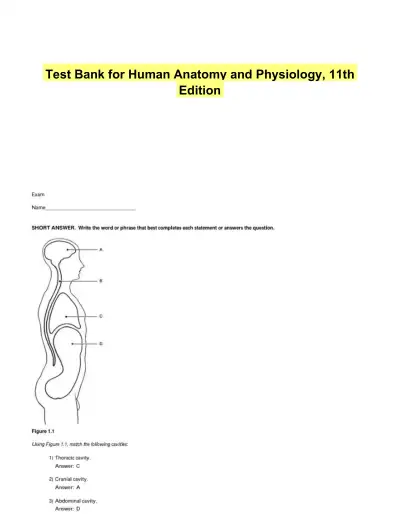 Exam Guides
Test Bank for Human Anatomy and Physiology, 11th Edition
Anatomy and Physiology
448 pagesMay 2025 Exam Guides
Test Bank for Essentials of Anatomy and Physiology , 7th Edition
Anatomy and Physiology
510 pages161downloadsFeb 2025 Exam Guides
Test Bank for Laboratory Manual for Anatomy and Physiology featuring Martini Art, Main Version , 6th Edition
Anatomy and Physiology
454 pages121downloadsFeb 2025 Exam Guides
Test Bank For Visual Anatomy & Physiology, 3rd Edition
Anatomy and Physiology
1145 pages117downloadsFeb 2025 Exam Guides
Seeley's Principles of Anatomy and Physiology 2nd Edition Test Bank
Anatomy and Physiology
721 pages114downloadsFeb 2025 Exam Guides
Test Bank For Seeley's Anatomy And Physiology, 11th Edition
Anatomy and Physiology
2403 pages109downloadsFeb 2025
Study this document with CramX
Once it is in your library, every tool can work from it.