

Astronomy - Observing the Sky
- Astronomy
- Texas A&M University
- 12 pages
- Shared March 2026
Preview 4 of 12 pages
See the first 4 pages exactly as they appear in the document.
Page 1 Read page 1 as text
Study Guide Astronomy – Observing the Sky 1. Naked - Eye Astronomy Human understanding of the universe began when people started observing the sky with their own eyes. Long before telescopes existed, people noticed that objects in the sky changed their positions over days, months, and years. These careful observations lai d the foundation of astronomy. 1.1 The Sky as We See It When we look up from Earth, the sky appears like a huge dome or bowl covering us from all sides. Astronomers call this imaginary dome the celestial sphere . • The horizon is the circle where the sky seems to meet the ground. • The zenith is the point directly overhead. Because stars and other objects are extremely far away, our eyes cannot judge their distances. As a result, all objects appear to lie on the same spherical surface. 1.2 The Horizon (Alt - Azimuth) Coordinate System To locate objects in the sky, astronomers use coordinates, just like latitude and longitude on Earth. • Altitude : how high an object is above the horizon • Azimuth : the direction of the object, measured along the horizon starting from due north and moving eastward This method is called the horizon coordinate system or alt - azimuth system .
Page 2 Read page 2 as text
Study Guide 1.3 Stars and Constella Ɵ ons On a very dark night, about 6,000 stars can be seen with the naked eye. The relative positions of stars remain almost unchanged over human lifetimes. To make sense of the sky, people grouped bright stars into patterns called constellations . These patterns often resemble animals, objects, or mythological figures. • Northern Hemisphere constellations , such as Ursa Major (Big Bear) and Orion , have been known since ancient times. • Southern Hemisphere constellations were added later to cover areas not visible from the north. Today, the sky is officially divided into 88 constellations . Naming Stars Stars are named using: • A Greek letter (to indicate brightness) • The name of the constellation For example: • α Ursae Majoris ( α UMa) is the brightest star in Ursa Major • It is also known by its ancient name, Dubhe
Page 3 Read page 3 as text
Study Guide 1.4 Daily Mo Ɵ on of the Stars As Earth rotates, stars appear to move across the sky from east to west . • Stars seem to move in circular paths around a point called the celestial pole • In the Northern Hemisphere, this point is marked by Polaris (the Pole Star) The altitude of Polaris above the horizon equals the observer’s latitude on Earth. 1.5 Circumpolar and Equatorial Stars • Circumpolar stars never set; they stay above the horizon all night. • Equatorial stars rise in the east, reach their highest point on the meridian , and set in the west. The meridian is an imaginary line that runs: • From north on the horizon • Through the zenith • To south on the horizon 1.6 The Celes Ɵ al Equator and Cardinal Direc Ɵ ons The celestial equator is Earth’s equator projected onto the sky. It crosses the horizon exactly at east and west . This helps define the cardinal directions : • North • South • East • West These directions are essential for orientation on Earth and in the sky.
Page 4 Read page 4 as text
Study Guide 1.7 The Equatorial Coordinate System Because altitude and azimuth change constantly, astronomers use a fixed coordinate system tied to the stars. This is the equatorial coordinate system , which is similar to Earth’s latitude and longitude. • Declination → celestial latitude (north or south of the celestial equator) • Right Ascension (RA) → celestial longitude Declination is measured in degrees, minutes, and seconds. Right ascension is measured in hours , with 24 hours = 360° . 1.8 The Sun’s Mo Ɵ on in the Sky Like stars, the Sun rises in the east and sets in the west. However, its path changes throughout the year. Equinoxes • Vernal (Spring) Equinox – around March 21 • Autumnal Equinox – around September 21 On these days: • The Sun lies on the celestial equator • Day and night are equal in length
8 more pages in the full document
Unlock it once and it stays in your library, ready to chat with or turn into flashcards.
Unlock the full documentMore Astronomy study materials
See all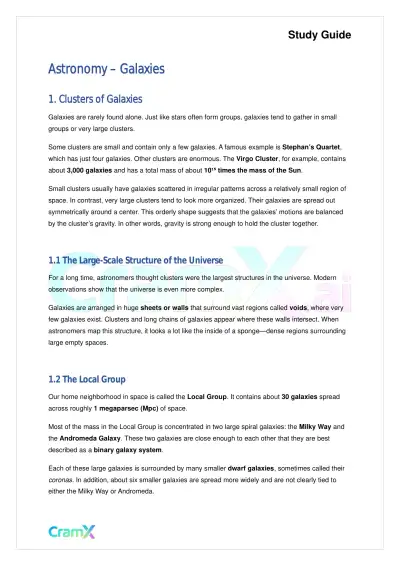 Quick Guides
Astronomy - Galaxies
Astronomy
17 pagesMar 2026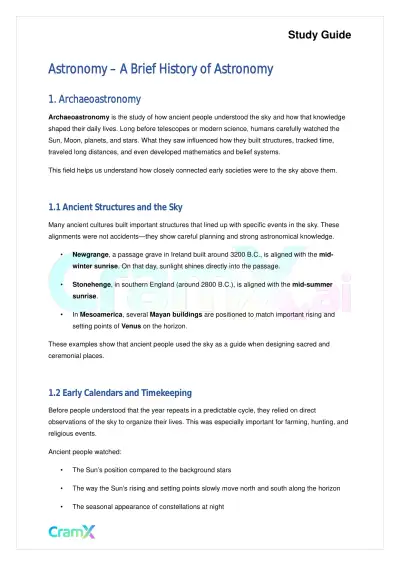 Quick Guides
Astronomy - A Brief History of Astronomy
Astronomy
10 pagesMar 2026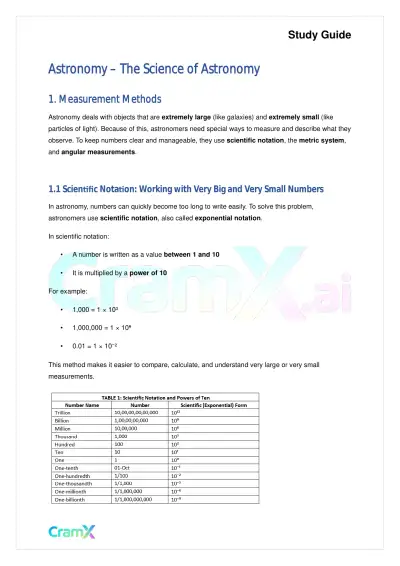 Quick Guides
Astronomy - The Science of Astronomy
Astronomy
19 pagesMar 2026 Quick Guides
Astronomy - Formation and Evolution of Stars
Astronomy
15 pagesMar 2026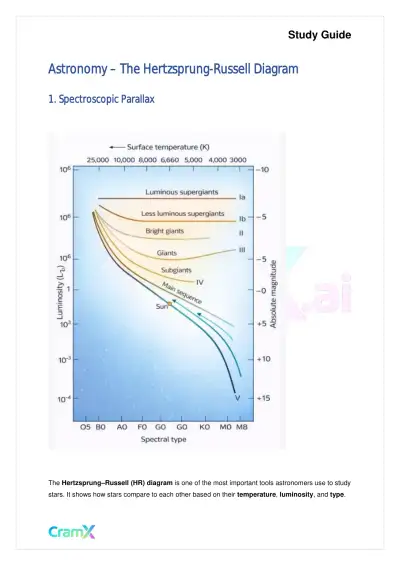 Quick Guides
Astronomy - The Hertzsprung-Russell Diagram
Astronomy
17 pagesMar 2026 Quick Guides
Astronomy - Earth and its Moon
Astronomy
26 pagesMar 2026 Quick Guides
Astronomy - Life in the Universe
Astronomy
9 pagesMar 2026 Quick Guides
Astronomy - The Structure of Stars
Astronomy
19 pagesMar 2026
Study this document with CramX
Once it is in your library, every tool can work from it.