

Astronomy - The Sun a Representative Star
- Astronomy
- Texas A&M University
- 19 pages
- Shared March 2026
Preview 6 of 19 pages
See the first 6 pages exactly as they appear in the document.
Page 1 Read page 1 as text
Study Guide Astronomy – The Sun a Representa Ɵ ve Star 1. The Chromosphere The chromosphere is a layer of the Sun just above the photosphere (the Sun’s visible surface). It’s about 4,000 kilometers thick . Its name comes from the Greek word chroma , meaning color , because it looks pinkish during a solar eclipse. This pink color comes mainly from hydrogen gas glowing in a specific red wavelength called the H - alpha line . 1.1 When Can We See the Chromosphere? Normally, the bright light of the photosphere hides the chromosphere. But during a total solar eclipse , the Moon blocks the photosphere’s light, so we can see the chromosphere shining around the Sun’s edge. Because of this, the chromosphere is sometimes called the reversing layer . That’s because it causes many of the absorption lines we see in the Sun’s light spectrum. This is different from the photosphere below, which mostly emits light . 1.2 Temperature Changes in the Chromosphere At the bottom of the chromosphere, near the photosphere, the temperature is about 4,500 K (very hot, but cooler compared to other parts of the Sun). As you go higher, the temperature rises to about 10,000 K at the top of the chromosphere. This temperature increase is unusual because, from the Sun’s center out to the photosphere, temperatures usually get cooler. The chromosphere reverses this pattern and gets hotter again. 1.3 Why Does the Chromosphere Get Ho Ʃ er? The heating happens because of shock waves moving upwards from the photosphere. These shock waves travel faster than the speed of sound and are created by turbulent convection — which means boiling - like motion — in the photosphere. When these shock waves reach the thinner gas in the chromosphere, they heat it up.
Page 2 Read page 2 as text
Study Guide 1.4 Interes Ɵ ng Features: Spicules One cool feature of the chromosphere is called spicules . These are tiny, narrow jets of gas that shoot upward from the chromosphere, reaching high into the Sun’s atmosphere. Scientists think spicules might be connected to the granules in the photosphere — these granules are patterns created by the boiling motion of hot gases on the Sun’s surface. 2. The Corona 2.1 What is the Corona? The corona is the Sun’s outer atmosphere . It’s very thin and extremely hot, with temperatures soaring up to 1 to 2 million degrees Kelvin (that’s millions of degrees!). Even though it’s so hot, the corona’s light is very faint — only about as bright as the full moon, or just one millionth as bright as the Sun’s main visible surface (called the solar disk). This faintness is why you can only see the corona during a solar eclipse , when the bright disk of the Sun is blocked. 2.2 Why is the Corona So Hot? Scientists believe the Sun’s magnetic activity plays a big role in heating the corona. • The Sun’s surface, called the photosphere , is turbulent and full of energy. • Magnetic forces carry this energy upward into the corona. • Because there are very few atoms in the corona, the energy heats them to incredibly high temperatures.
Page 3 Read page 3 as text
Study Guide 2.3 Bright Features in the Corona Sometimes, parts of the corona look extra bright. Two important features are: • Prominences : Bright loops or arches seen near the Sun’s edge (the “solar limb”). • Plages : Bright patches seen when looking directly at the Sun’s surface. These features often look like streamers or filaments and are shaped by magnetic fields. Although they shine brightly, they don’t always mean that material is flowing or moving in those areas — they’re mostly bright because of the way energy is emitted. 2.4 The Corona in X - rays At the extremely high temperatures of the corona, the Sun also emits X - rays , which are very short wavelength rays. • When viewed in X - rays, the corona’s brightness isn’t the same everywhere. • Some areas called coronal loops shine very brightly. • Other parts, called coronal holes , appear dark. 2.5 The Solar Wind: A Flow from the Corona The corona gradually blends into a stream of charged particles called the solar wind . • The solar wind is a flow of ionized gas (charged particles) that moves away from the Sun fast enough to escape its gravity. • It travels at speeds of around 400 kilometers per second (that’s really fast!). When the solar wind reaches Earth, it interacts with our planet’s magnetic field : • It creates a bow shock — like the wave formed in front of a boat. • Sometimes, when the solar wind is stronger (for example, after a solar flare), it can disturb Earth’s magnetic field. • These disturbances can affect long - distance radio communications on Earth.
Page 4 Read page 4 as text
Study Guide 2.6 E ff ects of the Solar Wind on Earth The solar wind particles trapped by Earth’s magnetic field get funneled toward the polar regions . • When these particles collide with molecules in Earth’s atmosphere, they create beautiful auroras — the Northern and Southern Lights. • They also cause something called airglow , where atmospheric molecules emit light, making the night sky glow faintly. • In fact, the night sky shines with about twice as much light as the stars themselves produce. Summary The Sun’s corona is a fascinating, super - hot outer layer that we can only see during an eclipse. It connects directly to the powerful solar wind, which has important effects here on Earth — especially in creating auroras and sometimes disrupting communicatio ns. The mysterious heating of the corona and its complex magnetic features are still active areas of scientific research. 3. The Sunspot Cycle 3.1 What Are Sunspots? Sunspots are dark spots that appear on the surface of the Sun. They are caused by intense magnetic activity and are cooler than the surrounding areas. 3.2 The Sunspot Cycle The number of sunspots on the Sun’s surface doesn’t stay the same. Instead, it goes up and down in a cycle . This cycle lasts about 11 years . Here’s what happens during the cycle: • At the solar maximum , there are many sunspots . • At the solar minimum , there are very few sunspots . 3.3 Other Solar Ac Ɵ vity Follows This Cycle Not just sunspots, but other kinds of solar activity like solar flares and changes in the solar wind also follow this 11 - year pattern. So the Sun goes through times when it’s very active and times when it’s much quieter.
Page 5 Read page 5 as text
Study Guide 3.4 How Does the Sun’s Magne Ɵ c Field Work? The Sun creates its magnetic field through a process called the solar dynamo . Here’s how it works: 1. Inside the Sun, electric currents are generated. 2. The Sun doesn’t spin evenly — different parts rotate at different speeds, a process called differential rotation . 3. This twisting motion wraps the magnetic field lines around the Sun. 4. At the same time, big currents of hot plasma called convection pull the magnetic field lines up and down through the Sun’s surface layer, called the photosphere . 3.5 How Sunspots Are Made Sunspots form where magnetic field lines are squeezed together and poke through the photosphere. These compressed field lines stop hot plasma from rising, so the spots look darker and cooler than the surrounding areas. 3.6 The Magne Ɵ c Field Reverses After about 11 years, the Sun’s magnetic field becomes so tangled that it disappears. But it doesn’t stay gone — it is rebuilt again with the magnetic poles flipped . This means the magnetic north and south switch places. Because of this flip, two sunspot cycles (each 11 years) actually make up a longer 22 - year magnetic cycle . 3.7 How the Sun’s Atmosphere Changes The Sun’s outer atmosphere, called the corona , also changes during the sunspot cycle: • At solar maximum , the corona looks almost round. • At solar minimum , it becomes very stretched and distorted.
Page 6 Read page 6 as text
Study Guide 4. Internal Structure; Standard Solar Model 4.1 Why Can’t We See Inside the Sun? We cannot directly observe the inside of the Sun because light from its deep interior cannot escape to the surface. So, scientists use theory, mathematics, and computer models to understand what is happening inside. This detailed scientific description of the Sun’s interior is called the Standard Solar Model . 4.2 How Scien Ɵ sts Describe the Sun’s Interior The Sun is studied from its center (r = 0 km) all the way to its visible surface, called the photosphere (r ≈ 700,000 km) . Scientists describe how different physical properties change as we move outward from the center. These properties include: • Mass (M(r)) – how much mass is inside a given radius • Density ( ρ ( r)) – how tightly packed the material is • Pressure (P(r)) – the force exerted by the hot gas • Temperature (T(r)) – how hot each layer is • Luminosity (L(r)) – the amount of energy flowing outward • Energy generation rate – how fast energy is produced • Opacity ( κ ( r)) – how easily light can pass through the material • Chemical composition : o X(r) – fraction of hydrogen o Y(r) – fraction of helium o Z(r) – fraction of all heavier elements • Mean molecular weight ( μ ( r)) – average mass of particles in the gas
13 more pages in the full document
Unlock it once and it stays in your library, ready to chat with or turn into flashcards.
Unlock the full documentMore Astronomy study materials
See all Quick Guides
Astronomy - Galaxies
Astronomy
17 pagesMar 2026 Quick Guides
Astronomy - A Brief History of Astronomy
Astronomy
10 pagesMar 2026 Quick Guides
Astronomy - The Science of Astronomy
Astronomy
19 pagesMar 2026 Quick Guides
Astronomy - Formation and Evolution of Stars
Astronomy
15 pagesMar 2026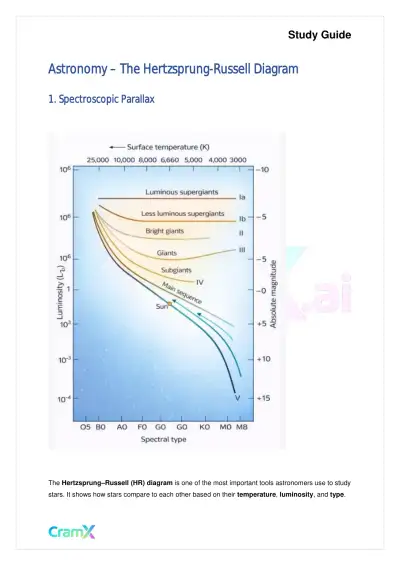 Quick Guides
Astronomy - The Hertzsprung-Russell Diagram
Astronomy
17 pagesMar 2026 Quick Guides
Astronomy - Earth and its Moon
Astronomy
26 pagesMar 2026 Quick Guides
Astronomy - Life in the Universe
Astronomy
9 pagesMar 2026 Quick Guides
Astronomy - The Structure of Stars
Astronomy
19 pagesMar 2026
Study this document with CramX
Once it is in your library, every tool can work from it.