

Astronomy - The Milky Way Galaxy
- Astronomy
- Texas A&M University
- 24 pages
- Shared March 2026
Preview 8 of 24 pages
See the first 8 pages exactly as they appear in the document.
Page 1 Read page 1 as text
Study Guide Astronomy – The Milky Way Galaxy 1. Origin and Evolu Ɵ on of the Galaxy Astronomers study the origin and evolution of the Galaxy by observing where stars are located, how they move, and what they are made of. These observations reveal clues about when and how different stars formed . Early studies showed that stars in the Galaxy could be grouped based on their age, location, motion, and chemical composition. These groups are called stellar populations . 1. 1 Stellar Popula Ɵ ons: An Overview Originally, astronomers identified two main stellar populations because their properties were very different. Later, a third population was discovered. The main populations are: • Population I • Population II • Population III (the earliest stars) Each population helps us understand a different stage in the Galaxy’s history. 1. 2 Popula Ɵ on I Stars – Young and Metal - Rich Population I stars are the youngest stars in the Galaxy . Their key features include: • Found mainly in the galactic disk • Often located in open clusters and stellar associations • Contain bright, blue O and B stars • Closely associated with gas and dust , from which they recently formed • Have chemical compositions similar to the Sun • Heavy element content ranges from one - third to twice the solar abundance • Move with small velocities relative to the Sun These stars are still forming today in the thin disk of the Galaxy.
Page 2 Read page 2 as text
Study Guide 1. 3 Popula Ɵ on II Stars – Old and Metal - Poor Population II stars are much older than Population I stars. Their characteristics include: • Found mainly in globular clusters • Located in a spherical halo around the galactic center • Contain old red giant stars • Lack O and B stars • Have little or no gas and dust • Possess low heavy - element (metal) content , ranging from 0.001 to 0.5 times the solar abundance • Show large velocities relative to the Sun 1. 4 Stellar Popula Ɵ ons Form a Con Ɵ nuum Modern astronomy shows that stellar populations are not completely separate groups . Instead, they represent extremes of a continuous range of star properties. • At one extreme are metal - poor halo stars with random, elongated orbits. • At the other extreme are metal - rich disk stars confined to a thin, rotating plane. Between these extremes are stars with intermediate properties. 1. 5 Popula Ɵ on III Stars – The First Stars Population III stars are the earliest generation of stars in the Galaxy. Their features: • Composed almost entirely of hydrogen and helium • Contained no heavy elements • Formed directly from primordial gas • Were once only theoretical but have now been indirectly identified These stars played a crucial role by producing the first heavy elements through nuclear reactions and supernova explosions.
Page 3 Read page 3 as text
Study Guide 1. 6 Standard Model of Galac Ɵ c Forma Ɵ on According to the standard model, the Galaxy began forming very early in the universe. Key stages include: • About 10¹² solar masses of hydrogen and helium gas began to collapse under gravity • The first stars (Population III) formed from pure gas • Massive stars evolved quickly and exploded as supernovae • These explosions enriched the surrounding gas with heavy elements 1. 7 Forma Ɵ on of the Halo and Disk During the collapse: • Early stars (including globular clusters) formed while the Galaxy was still collapsing • These stars retained nearly radial orbits , forming the halo • Gas continued to collapse and flattened into a rotating disk due to conservation of angular momentum • Collisions between gas particles reduced random motion • Over time, only circular motion remained , forming a thin disk Each new generation of stars formed from increasingly metal - rich gas , creating today’s Population I stars. 1. 8 Ongoing Star Forma Ɵ on Even today: • Interstellar gas remains in a thin disk • This gas is now rich in heavy elements • New Population I stars continue to form Thus, the Galaxy is still evolving.
Page 4 Read page 4 as text
Study Guide 1. 9 Alterna Ɵ ve Model: Galaxy Mergers Some evidence suggests the Galaxy’s formation was more complex than a single collapse. An alternative theory proposes: • Smaller, flat proto - galaxies formed first • These systems gradually merged to form the Milky Way • The Galaxy grew through capture and cannibalism of smaller galaxies This process likely played a major role in shaping the present Galaxy. Key Takeaways • Stellar populations reflect the history of star formation • Heavy elements increase with each generation of stars • The Galaxy formed through collapse, rotation, and enrichment • Mergers with smaller galaxies helped shape today’s Milky Way The stars you see today carry a record of billions of years of galactic evolution. 2. Interstellar Ma Ʃ er 2.1 Our Galaxy: The Milky Way The Milky Way is a typical galaxy. A galaxy is a huge, independent system made up of stars, star clusters, and interstellar material (gas and dust found between stars). By studying the Milky Way, astronomers learn how galaxies work in general. The Milky Way is classified as a spiral galaxy . This is because clouds of gas and dust form a pinwheel - like spiral pattern in the flat plane of the Galaxy. The Galaxy has two main parts : • A flat disk , which contains most of the stars, gas, and dust • A central bulge , which is a slightly flattened, spherical region surrounding the disk
Page 5 Read page 5 as text
Study Guide 2.2 What Is Interstellar Ma Ʃ er? About 3% of the Milky Way’s total mass exists as interstellar matter . This material is spread out between stars and is extremely thin. • Average density: about 1 atom per cubic centimeter • Mostly made of hydrogen atoms To compare, the air we breathe contains about 10²² particles per cubic centimeter , so interstellar matter is almost empty by everyday standards. 2.3 Why Interstellar Ma Ʃ er Is Important Interstellar matter plays three major roles in astronomy: 1. Star formation – It provides the raw material needed to form new stars. 2. Galaxy studies – Observing gas and dust gives information about the Galaxy that stars alone cannot provide. 3. Effect on light – Interstellar material can change how light from distant objects appears to us. 2.4 Components of Interstellar Ma Ʃ er Interstellar matter has two main components : gas and dust . They behave very differently and affect observations in different ways. 2.5 Gas Gas makes up about 98% of interstellar matter . Composition • Mostly hydrogen and helium • In dense regions, molecules can form • Over 100 types of simple molecules have been detected, including water, formaldehyde, and alcohol Effect on Observations Gas has very little effect on the brightness or color of stars seen through it. It mainly:
Page 6 Read page 6 as text
Study Guide • Adds absorption lines to a star’s spectrum • Does not significantly dim or redden starlight The Importance of the 21 - cm Line Neutral hydrogen emits radiation at a wavelength of 21 cm , which is extremely important in astronomy. • This radiation passes through dust easily • It allows astronomers to study parts of the Galaxy that would otherwise be hidden Without this 21 - cm radiation, most of the Milky Way would be invisible to us. Gas only produces visible emission lines in hot, dense regions , usually near very hot stars. 2.6 Dust Dust makes up the remaining 2% of interstellar matter , but it has a much stronger effect on observations . Properties of Dust • Made of tiny solid particles • Typical temperature: about 100 K • Emits thermal radiation due to its temperature Effect on Light Dust: • Absorbs light passing through it • Scatters light in different directions Because of this, dust: • Dims distant stars • Makes objects appear redder In the plane of the Galaxy, dust prevents astronomers from seeing stars farther than about 3 kiloparsecs (10,000 light - years) using visible light.
Page 7 Read page 7 as text
Study Guide 2.7 Why Distant Objects Look Redder 2.8 Explana Ɵ on of the Figure: Interstellar Absorp Ɵ on • Light from a distant object travels toward an observer • Blue light (shorter wavelengths) is scattered more easily by dust grains • Red light (longer wavelengths) passes through more easily As a result: • Less blue light reaches the observer • The object appears redder and dimmer than it really is This effect is called interstellar reddening . Key Takeaway Even though interstellar matter makes up only a small fraction of the Galaxy’s mass, it plays a crucial role in: • Star formation • Understanding galactic structure • Affecting how we observe distant objects Gas helps us map the Galaxy, while dust limits what we can see — but also teaches us how light interacts with matter in space.
Page 8 Read page 8 as text
Study Guide 3. Interstellar Nebulae Interstellar space is not completely empty. It contains gas and dust , called interstellar material . This material is easiest to see where it is densest , forming clouds known as nebulae . Nebulae are grouped into three main types , based on how we observe them: 1. Nebulae that emit their own light 2. Nebulae that block light from stars behind them 3. Nebulae that reflect light from nearby stars 3.1 Emission Nebulae (H II Regions) Emission nebulae are clouds of gas that glow on their own . They are found near hot, young stars , especially very hot O - type and B - type stars . How They Glow • Hot stars emit strong ultraviolet (UV) radiation . • This radiation ionizes hydrogen gas , meaning electrons are stripped from hydrogen atoms. • Ionized hydrogen is called H II (pronounced “H two”), which is why these nebulae are also called H II regions . • When electrons recombine with hydrogen atoms, the gas releases visible light . Color and Temperature • The gas temperature is about 10,000 K . • Most of the light comes from hydrogen emission lines. • The strongest line is the H α line in the Balmer series. • This gives emission nebulae a red or pink color . Size of Ionized Regions • Very hot stars can ionize gas over several parsecs . • An O5 star (about 50,000 K) produces a large ionized region. • A cooler star like the Sun can ionize hydrogen only within the solar system (about 40 AU) .
16 more pages in the full document
Unlock it once and it stays in your library, ready to chat with or turn into flashcards.
Unlock the full documentMore Astronomy study materials
See all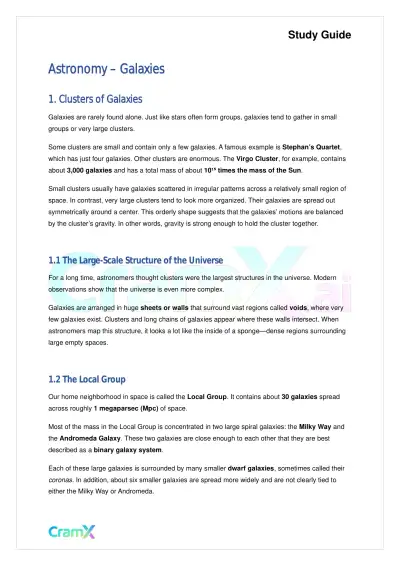 Quick Guides
Astronomy - Galaxies
Astronomy
17 pagesMar 2026 Quick Guides
Astronomy - A Brief History of Astronomy
Astronomy
10 pagesMar 2026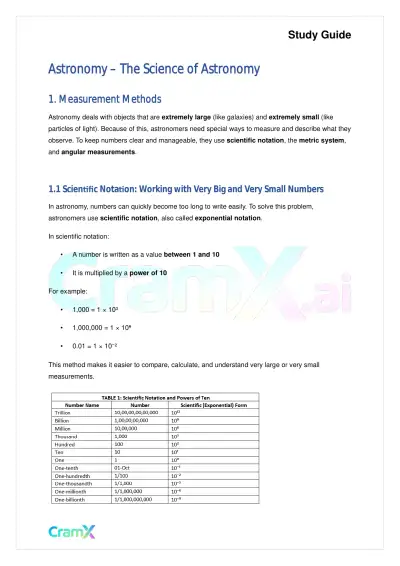 Quick Guides
Astronomy - The Science of Astronomy
Astronomy
19 pagesMar 2026 Quick Guides
Astronomy - Formation and Evolution of Stars
Astronomy
15 pagesMar 2026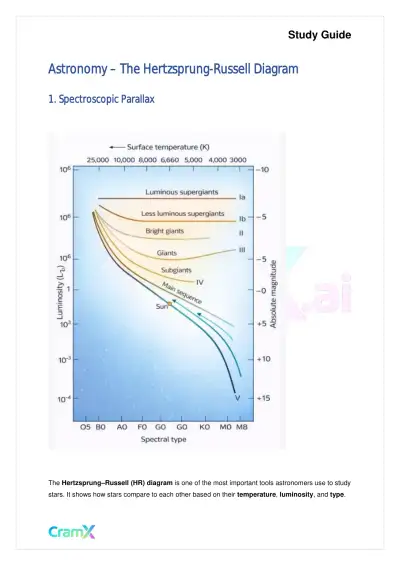 Quick Guides
Astronomy - The Hertzsprung-Russell Diagram
Astronomy
17 pagesMar 2026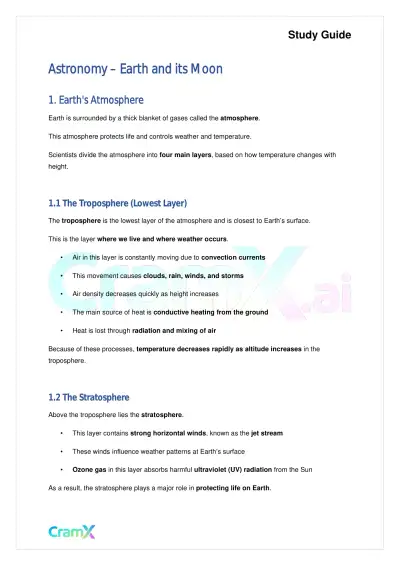 Quick Guides
Astronomy - Earth and its Moon
Astronomy
26 pagesMar 2026 Quick Guides
Astronomy - Life in the Universe
Astronomy
9 pagesMar 2026 Quick Guides
Astronomy - The Structure of Stars
Astronomy
19 pagesMar 2026
Study this document with CramX
Once it is in your library, every tool can work from it.