
Past Exams
AZURE Networking Practice Exam with Answers (37 Solved Questions)
- Azure Networking Practice Exam
- 7 pages
- Shared February 2025
- 118 downloads
Get familiar with your upcoming exam with AZURE Networking Practice Exam with Answers, a reliable past exam resource.
Preview · 3 of 7 pages
100%
Page 1
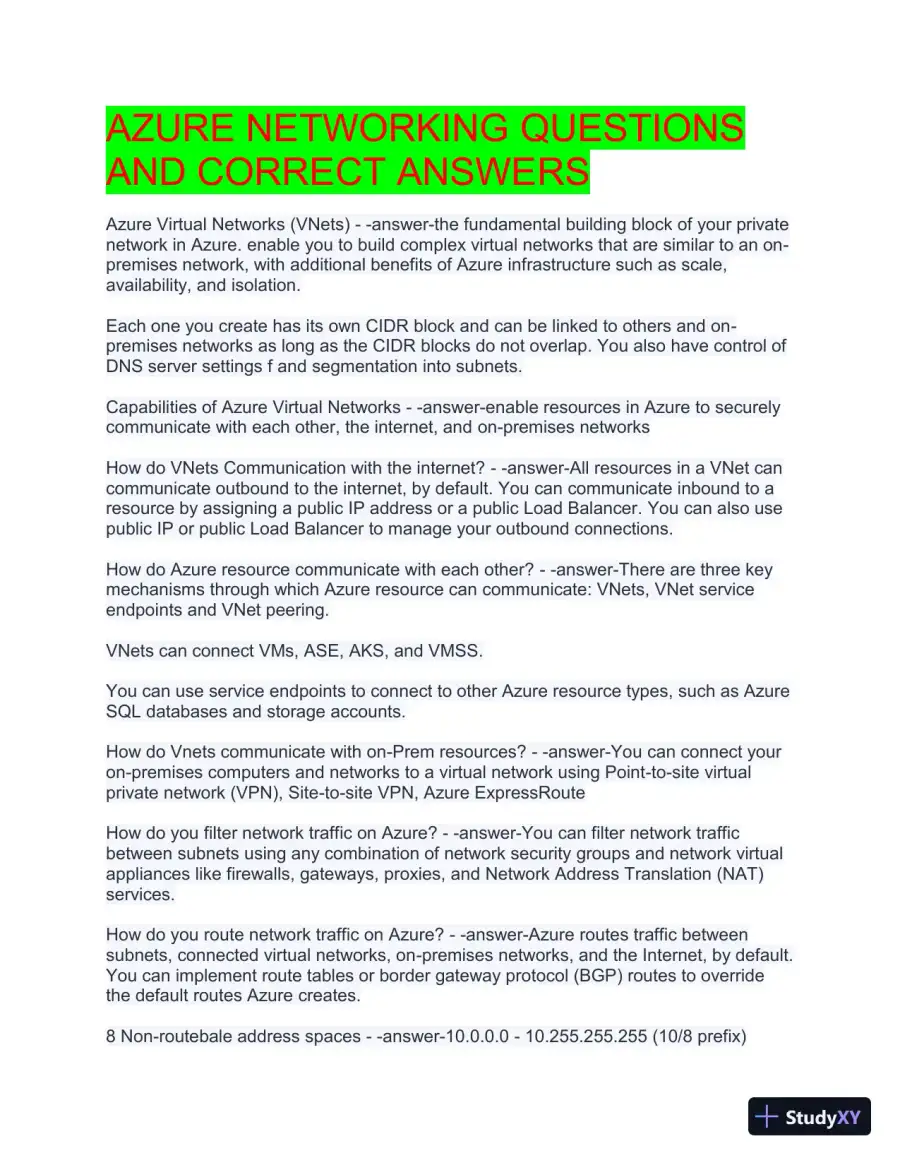 AZURE NETWORKING QUESTIONSAND CORRECT ANSWERSAzure Virtual Networks (VNets)--answer-the fundamental building block of your privatenetwork in Azure. enable you to build complex virtual networks that are similar to an on-premises network, with additional benefits of Azure infrastructure such as scale,availability, and isolation.Each one you create has its own CIDR block and can be linked to others and on-premises networksas long as the CIDR blocks do not overlap. You also have control ofDNS server settings f and segmentation into subnets.Capabilities of Azure Virtual Networks--answer-enable resources in Azure to securelycommunicate with each other, the internet, andon-premises networksHow do VNets Communication with the internet?--answer-All resources in a VNet cancommunicate outbound to the internet, by default. You can communicate inbound to aresource by assigning a public IP address or a public Load Balancer. You can also usepublic IP or public Load Balancer to manage your outbound connections.How do Azure resource communicate with each other?--answer-There are three keymechanisms through which Azure resource can communicate: VNets, VNet serviceendpoints and VNet peering.VNets can connect VMs, ASE, AKS, and VMSS.You can use service endpoints to connect to other Azure resource types, such as AzureSQL databases and storage accounts.How do Vnets communicate with on-Prem resources?--answer-You can connect youron-premises computers and networks to a virtual network using Point-to-site virtualprivate network (VPN), Site-to-site VPN, Azure ExpressRouteHow do you filter network traffic on Azure?--answer-You can filter network trafficbetween subnets using any combination of network security groups and network virtualappliances like firewalls, gateways, proxies, and Network Address Translation (NAT)services.How do you route network traffic on Azure?--answer-Azure routes traffic betweensubnets, connected virtual networks, on-premises networks, and the Internet, by default.You can implement route tables or border gateway protocol (BGP) routes to overridethe default routes Azurecreates.8 Non-routebale address spaces--answer-10.0.0.0-10.255.255.255 (10/8 prefix)
Page 2

Page 3
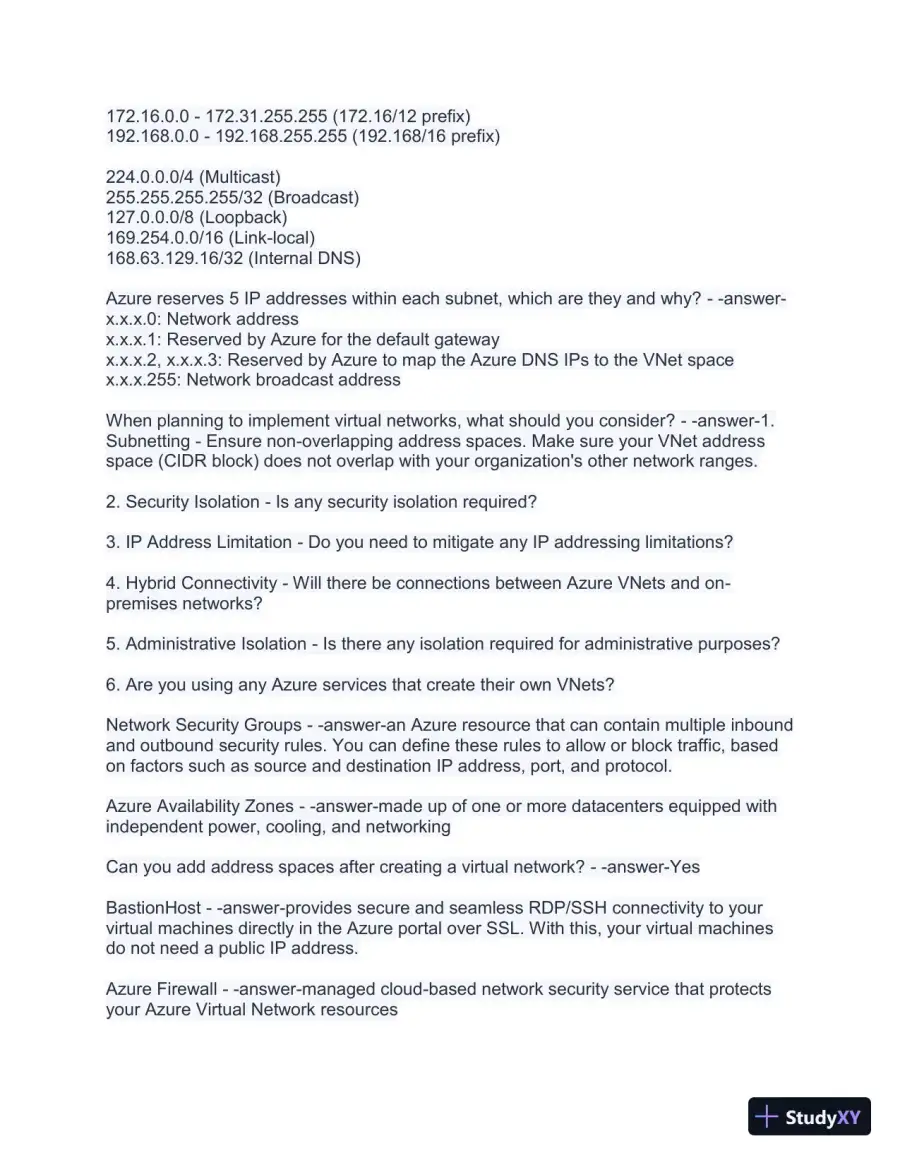 172.16.0.0-172.31.255.255 (172.16/12 prefix)192.168.0.0-192.168.255.255 (192.168/16 prefix)224.0.0.0/4 (Multicast)255.255.255.255/32 (Broadcast)127.0.0.0/8(Loopback)169.254.0.0/16 (Link-local)168.63.129.16/32 (Internal DNS)Azure reserves 5 IP addresses within each subnet, which are they and why?--answer-x.x.x.0: Network addressx.x.x.1: Reserved by Azure for the default gatewayx.x.x.2, x.x.x.3: Reserved by Azure to map the Azure DNS IPs to the VNet spacex.x.x.255: Network broadcast addressWhen planning to implement virtual networks, what should you consider?--answer-1.Subnetting-Ensure non-overlapping address spaces. Make sure your VNet addressspace (CIDR block) does not overlap with your organization's other network ranges.2. Security Isolation-Is any security isolation required?3. IP Address Limitation-Do you need to mitigate any IP addressing limitations?4. Hybrid Connectivity-Will there be connections between Azure VNets and on-premises networks?5. Administrative Isolation-Is there any isolation required for administrative purposes?6. Are you using any Azure services that create their own VNets?Network Security Groups--answer-an Azure resource that can contain multiple inboundand outbound security rules. You can define these rules to allow or block traffic, basedon factors such as source and destination IP address, port, and protocol.AzureAvailability Zones--answer-made up of one or more datacenters equipped withindependent power, cooling, and networkingCan you add address spaces after creating a virtual network?--answer-YesBastionHost--answer-provides secure and seamless RDP/SSHconnectivity to yourvirtual machines directly in the Azure portal over SSL. With this, your virtual machinesdo not need a public IP address.Azure Firewall--answer-managed cloud-based network security service that protectsyour Azure Virtual Networkresources
4 more pages in the full document
Unlock it once and it stays in your library, ready to chat with or turn into flashcards.
Unlock the full documentMore Azure Networking Practice Exam study materials
See all Past Exams
Renewal for Microsoft Certified Azure Administrator Associate Practice Exam with Answers (43 Solved Questions)
Azure Networking Practice Exam
16 pages162downloadsFeb 2025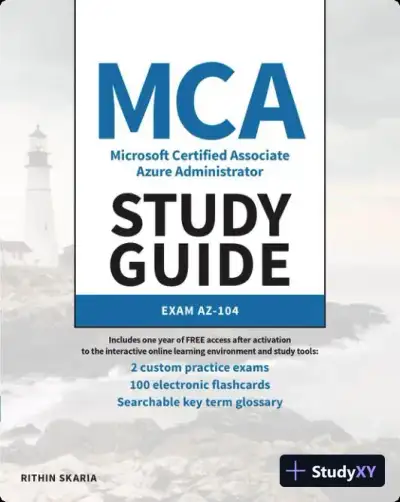 Certification Guides
MCA Microsoft Certified Associate Azure Administrator Study Guide: Exam AZ-104 (2022)
Azure Networking Practice Exam
595 pages93downloadsFeb 2025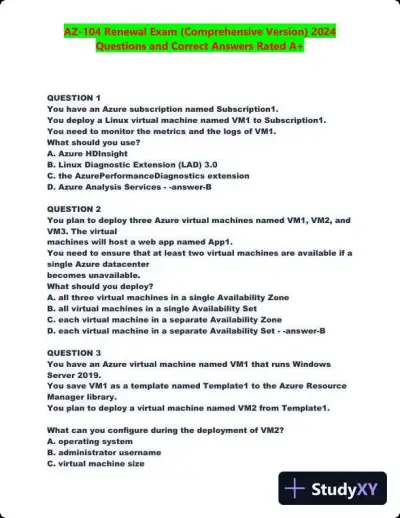 Past Exams
2024 AZ-104 Renewal Comprehensive Exam with Answers (270 Solved Questions)
Azure Networking Practice Exam
115 pages93downloadsFeb 2025 Certification Guides
Study Guide Exam 1Z0-816 and Exam 1Z0-817 (2020)
Azure Networking Practice Exam
996 pages92downloadsFeb 2025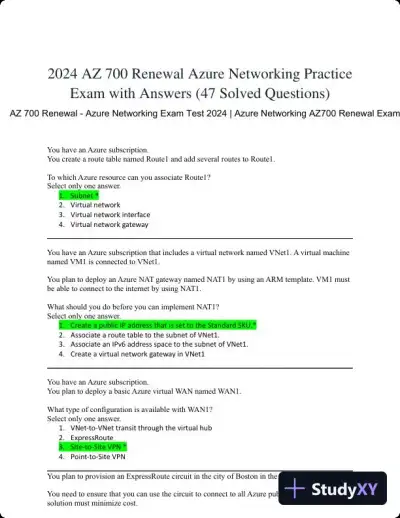 Past Exams
2024 AZ 700 Renewal Azure Networking Practice Exam with Answers (47 Solved Questions)
Azure Networking Practice Exam
13 pages71downloadsFeb 2025 Certification Guides
MCA Microsoft Certified Associate Azure Security Engineer Study Guide: Exam AZ-500 (2022)
Azure Networking Practice Exam
489 pages65downloadsFeb 2025 Certification Guides
Exam Ref AZ-104 Microsoft Azure Administrator (2024)
Azure Networking Practice Exam
604 pages59downloadsFeb 2025 Certification Guides
Designing and Implementing Cloud-native Applications Using Microsoft Azure Cosmos DB: Study Companion for the DP-420 Exam (2023)
Azure Networking Practice Exam
204 pagesMay 2025
Study this document with CramX
Once it is in your library, every tool can work from it.