

MCA Microsoft Certified Associate Azure Administrator Study Guide: Exam AZ-104 (2022)
- Azure Networking Practice Exam
- 595 pages
- Shared February 2025
- 93 downloads
Get step-by-step guidance for your certification with MCA Microsoft Certified Associate Azure Administrator Study Guide: Exam AZ-104 (2022).
Preview 31 of 595 pages
See the first 31 pages exactly as they appear in the document.
Page 1 Read page 1 as text
T= StudyX
Page 2 Read page 2 as text
Downloaded from StudyXY.com & + StudyXY ~~ as . a TB Study [| Anything This ContentHas been Posted On StudyXY.com as supplementary learning material. StudyXY does not endrose any university, college or publisher. Allmaterials posted are under the liability of the contribu:ors. wv 6) www.studyxy.com
Page 3 Read page 3 as text
T= StudyX
Page 4 Read page 4 as text
Microsoft Certified Associate Azure Administrator Exam AZ-104
Page 5 Read page 5 as text
T= StudyX
Page 6 Read page 6 as text
Microsoft Certified Associate Azure Administrator Exam AZ-104 Rithin Skaria
Page 7 Read page 7 as text
Copyright © 2022 by John Wiley & Sons, Inc. All rights reserved. Published by John Wiley & Sons, Inc., Hoboken, New Jersey. Published simultaneously in Canada. ISBN: 978-1-119-70515-4 ISBN: 978-1-119-70520-8 (ebk.) ISBN: 978-1-119-70518-5 (ebk.) No part of this publication may be reproduced, stored in a retrieval system, or transmitted in any form or by any means, electronic, mechanical, photocopying, recording, scanning, or otherwise, except as permitted under Section 107 or 108 of the 1976 United States Copyright Act, without either the prior written permission of the Publisher, or authorization through payment of the appropriate per-copy fee to the Copyright Clearance Center, Inc., 222 Rosewood Drive, Danvers, MA 01923, (978) 750-8400, fax (978) 750-4470, or on the web at www. copyright . com. Requests to the Publisher for permission should be addressed to the Permissions Department, John Wiley & Sons, Inc., 111 River Street, Hoboken, NJ 07030, (201) 748-6011, fax (201) 748-6008, or online at www. wiley. com/go/permission. Limit of Liability/Disclaimer of Warranty: The publisher and the author make no representations or warranties with respect to the accuracy or completeness of the contents of this work and specifically disclaim all warranties, including without limitation warranties of fitness for a particular purpose. No warranty may be created or extended by sales or promotional materials. The advice and strategies contained herein may not be suitable for every situation. This work is sold with the understanding that the publisher is not engaged in rendering legal, accounting, or other professional services. If professional assistance is required, the services of a competent professional person should be sought. Neither the publisher nor the author shall be liable for damages arising herefrom. The fact that an organization or Website is referred to in this work as a citation and/or a potential source of further information does not mean that the author or the publisher endorses the information the organization or Website may provide or recommendations it may make. Further, readers should be aware the Internet Websites listed in this work may have changed or disappeared between when this work was written and when it is read. For general information on our other products and services or for technical support, please contact our Customer Care Department within the United States at (800) 762-2974, outside the United States at (317) 572-3993 or fax (317) 572-4002. Wiley also publishes its books in a variety of electronic formats. Some content that appears in print may not be available in electronic formats. For more information about Wiley products, visit our web site at www. wi Ley . com. Library of Congress Control Number: 2022934721 Trademarks: WILEY, the Wiley logo, Sybex, and the Sybex logo are trademarks or registered trademarks of John Wiley & Sons, Inc. and/or its affiliates, in the United States and other countries, and may not be used without written permission. Microsoft 365 and Azure are trademarks or registered trademarks of Microsoft Corporation. All other trademarks are the property of their respective owners. John Wiley & Sons, Inc. is not associated with any product or vendor mentioned in this book. MCA Microsoft 365 Azure Administrator Study Guide is an independent publication and is neither affiliated with, nor authorized, sponsored, or approved by, Microsoft Corporation. Cover image: © Getty Images Inc./Jeremy Woodhouse Cover design: Wiley Study
Page 8 Read page 8 as text
Acknowledgments Although the book bears my name as the author, many people contributed to its success and creation. I believe without their help and contribution this book wouldn't have been possible. Kenyon Brown was the acquisitions editor; he helped me to get the book started. Melissa Burlock, editorial assistant, was always available to help and answer my questions. Mahalingam M was the technical editor; he was very helpful in giving constructive feedback on the technical content and concepts; nevertheless, any mistakes that remain are my own. Kim was the copy editor, and Janet was the proofreader; they helped me to correct any grammatical mistakes, formatting issues, and typos. I would also like to thank my manager, Monty Pattan, for empowering and motivating me. Last but not least, I would like to extend my gratitude to my family, mentors, friends, colleagues, and everyone who helped directly or indirectly toward the success of this book.
Page 9 Read page 9 as text
T= StudyX
Page 10 Read page 10 as text
About the Author Rithin Skaria is a cloud evangelist with almost a decade of experience in managing and administering Azure, AWS, and OpenStack. He currently works at Microsoft as a Cus- tomer Engineer empowering customers to achieve more. His other works include Linux Administration on Azure, Second Edition; Azure for Architects, Third Edition; and Migrating Linux to Microsoft Azure. He can be reached at rithin@rithin.net. Connect with him on LinkedIn: @ rithin-skaria. Study
Page 11 Read page 11 as text
T= StudyX
Page 12 Read page 12 as text
About the Technical Editor Mahalingam M is an Azure Consultant and works with Enterprises to design and implement their solutions in Azure. He also assesses large-scale applications hosted on Azure and pro- vides recommendations to optimize them. He started his journey on Azure five years back, and he is a certified Azure Solutions Architect Expert, Azure Security Engineer Associate, and Azure Administrator Associate. In addition to this, he is also a Microsoft Certified Trainer and delivers Workshops on Azure Iaa$ and PaaS. Study
Page 13 Read page 13 as text
T= StudyX
Page 14 Read page 14 as text
Contents at a Glance Introduction xxiii Assessment Test xxx Chapter 1 Identity: Azure Active Directory 1 Chapter 2 Compliance and Cloud Governance 49 Chapter 3 Virtual Networking 109 Chapter 4 Intersite Connectivity 153 Chapter 5 Network Traffic Management 203 Chapter 6 Azure Storage 245 Chapter 7 Azure Virtual Machines 307 Chapter 8 Automation, Deployment, and Configuration of Resources 349 Chapter 9 PaaS Compute Options 387 Chapter 10 Data Protection 445 Chapter 11 Monitoring Resources 475 Appendix Answers to the Review Questions 515 Index 533 T= Study)
Page 15 Read page 15 as text
T= StudyX
Page 16 Read page 16 as text
Contents Introduction xxiii Assessment Test xxx Chapter 1 Identity: Azure Active Directory 1 Azure Active Directory 2 Benefits 2 Concepts 4 Azure AD vs. Active Directory Domain Services 4 Azure AD: Licensing 5 Custom Domains in Azure AD 7 Users and Groups 8 User Accounts 8 Group Accounts 26 Azure AD Roles 36 Azure AD Join 37 Benefits 37 Connection Options 38 Self-Service Password Reset 39 Enabling SSPR 39 Authentication Methods 40 Managing Multiple Directories 42 Summary 43 Exam Essentials 44 Review Questions 45 Chapter 2 Compliance and Cloud Governance 49 Azure Regions 50 Facts 51 Regional Pairs 52 Azure Accounts and Subscriptions 53 Azure Accounts 54 Azure Subscriptions 54 Azure Cost Management 57 Plan and Control Expenses 58 Cost Saving Techniques 59 Resource Groups 60 Management Groups 65 Azure Policy 68 Implementing Azure Policy 69 Implementing Initiatives 77
Page 17 Read page 17 as text
xiv Contents Role-Based Access Control 79 Concepts 80 Azure RBAC Roles 82 Custom RBAC Roles 84 Role Assignment 91 Resource Locks 95 Configuring Locks 97 Resource Tags 99 Use Cases 99 Applying Tags 100 Summary 102 Exam Essentials 102 Review Questions 104 Chapter 3 Virtual Networking 109 Virtual Networks 110 VNet Concepts 111 Address Space 111 Subnets 111 Regions 111 Subscription 112 IP Addressing 113 Static and Dynamic Addressing 113 Private IP Addresses 113 Public IP Address 116 Network Routes 118 System Routes 119 User-Defined Routes 119 Service Endpoints 125 Supported Services 127 Private Endpoint 127 Azure DNS 129 Record Management 131 Private DNS Zones 133 Network Security Groups 137 NSG Concepts 137 NSG Effective Rules 141 Azure Firewall 142 Azure Firewall Rules 142 Implementing Azure Firewall 144 Summary 145 Exam Essentials 146 Review Questions 148
Page 18 Read page 18 as text
Contents xv Chapter 4 Intersite Connectivity 153 Azure-to-Azure Connectivity 154 Internet 155 Virtual Network Peering 156 VPN Gateway 165 Virtual Network Peering vs. VPN Gateway 177 Azure to On-Premises Connectivity 178 VPN Gateways 178 ExpressRoute Connections 189 Intersite Connectivity Architecture 193 Virtual WAN 196 Summary 197 Exam Essentials 198 Review Questions 199 Chapter 5 Network Traffic Management 203 Availability Options 204 Availability Sets 205 Availability Zones 207 Service Level Agreement 208 Azure Load Balancer 208 Types of Load Balancers 209 Load Balancer SKUs 212 Configuring Load Balancer 212 Implementing Azure Load Balancer 214 Azure Application Gateway 221 Request Handling Process 222 Routing Methods 223 Configuring Application Gateway 224 Implementing Application Gateway 226 Azure Front Door 235 Azure Traffic Manager 237 Comparing the Load Balancing Solutions 239 Summary 239 Exam Essentials 240 Review Questions 241 Chapter 6 Azure Storage 245 Azure Storage Account 246 Azure Storage Services 247 Azure Blob Storage 247 Azure Files 248 Azure Queues 249
Page 19 Read page 19 as text
xvi Contents Azure Tables 249 Azure Disks 249 Storage Replication 250 Locally Redundant Storage 250 Zone Redundant Storage 251 Georedundant Storage 252 Geo-zone-Redundant Storage 253 Storage Account Types 255 Storage Account Endpoints 256 Accessing Storage 256 Custom Domain Configuration 256 Securing Storage Endpoints 257 Azure Blob Storage 258 Blob Containers 259 Blob Access Tiers 259 Blob Lifecycle Management 260 Uploading Blobs 261 Storage Security 268 Authorization Options 268 Shared Access Signatures 269 Storage Service Encryption 275 Azure Files and File Sync 276 Azure Files vs. Azure Blobs 276 Managing File Shares 277 Mapping File Shares 279 File Share Snapshots 282 Azure File Sync 285 Managing Storage 288 Azure Storage Explorer 289 AzCopy 291 Import/Export Service 297 Summary 299 Exam Essentials 300 Review Questions 302 Chapter 7 Azure Virtual Machines 307 Virtual Machine Planning 309 Virtual Network 309 Name 309 Location and Pricing 310 Size 311 Storage 312 Operating System 315
Page 20 Read page 20 as text
Contents xvii Deploying Virtual Machines 315 Connecting to Virtual Machines 320 ‘Windows Connections 320 Linux Connections 324 Azure Bastion 329 Availability of Virtual Machines 334 Scaling Concepts 335 Vertical Scaling 335 Horizontal Scaling 336 Virtual Machine Scale Sets 336 Implementing a Scale Set 337 Autoscaling 340 Summary 342 Exam Essentials 342 Review Questions 343 Chapter 8 Automation, Deployment, and Configuration of Resources 349 Azure Resource Manager 350 ARM Templates 352 Template Design 352 Template Modes 354 Template Sections 355 Composing Templates 361 Exporting Templates 370 Configuring Virtual Hard Disk Templates 374 Create a VM from a VHD 375 Virtual Machine Extensions 376 Custom Script Extension 378 Desired State Configuration 379 Summary 380 Exam Essentials 381 Review Questions 382 Chapter 9 PaaS Compute Options 387 Azure App Service Plans 388 Pricing Tiers 389 Scaling 391 Azure App Services 396 Continuous Deployment 400 Deployment Slots 402 Securing App Service 405 Custom Domains 408 Backup 409
Page 21 Read page 21 as text
xviii Contents Container Instances 411 Docker 412 Azure Container Instances 415 Container Groups 421 Azure Kubernetes Service 422 Terminology 424 Cluster Components 425 Networking 426 Storage 429 Cluster Upgrade 431 Scaling 432 Summary 438 Exam Essentials 439 Review Questions 440 Chapter 10 Data Protection 445 File and Folder Backups 446 Azure Backup 446 Creating Recovery Services Vault 447 Configuring a Recovery Services Vault 448 Virtual Machine Data Protection 451 Virtual Machine Snapshots 452 Azure Backup 453 Azure Backup Server 463 Azure Site Recovery 466 Summary 469 Exam Essentials 470 Review Questions 471 Chapter 11 Monitoring Resources 475 Azure Monitor 476 Metrics 477 Logs 478 Data Sources 479 Activity Log 480 Azure Alerts 482 Creating Alert Rules 483 Alert States 484 Action Groups 484 Log Analytics 492 Workspace 493 Data Sources 493 Agents Configuration 496 Query Language 497
Page 22 Read page 22 as text
Contents xix Network Watcher 502 IP Flow Verify 503 Next Hop 503 Effective Security Rules 505 ‘VPN Troubleshoot 505 Packet Capture 506 Connection Troubleshoot 506 NSG Flow Logs 507 Topology 509 Summary 509 Exam Essentials 510 Review Questions 511 Appendix Answers to the Review Questions 515 Chapter 1: Identity: Azure Active Directory 516 Chapter 2: Compliance and Cloud Governance 517 Chapter 3: Virtual Networking 519 Chapter 4: Intersite Connectivity 520 Chapter 5: Network Traffic Management 521 Chapter 6: Azure Storage 522 Chapter 7: Azure Virtual Machines 524 Chapter 8: Automation, Deployment, and Configuration of Resources 526 Chapter 9: PaaS Compute Options 528 Chapter 10: Data Protection 529 Chapter 11: Monitoring Resources 530 Index 533
Page 23 Read page 23 as text
Table of Exercises Exercise 1.1 Viewing Users inYour Directory. ................cocoiviinnane.n...9 Exercise 1.2 Creating Users inAzure AD ....................ccieiiiiinnann..... 14 Exercise 1.3 Modifying and Deleting Users ....................................16 Exercise 1.4 Performing Bulk Operations. .......................c0vinenn....20 Exercise 1.5 Viewing Groups inAzure AD ...................iiiiiiiie.. 27 Exercise 1.6 Adding Security Groups to Azure AD. ........................0......29 Exercise 1.7 Adding Microsoft 365 Groups inAzure AD. .........................32 Exercise 2.1 Creating a Resource Group from the Azure Portal ....................61 Exercise 2.2 Listing Resource Groups from the Azure Portal ......................63 Exercise 2.3 Deleting Resource Groups from the Azure Portal.....................64 Exercise 2.3 Implementing a Custom POliCY «.............covueeeeeeiennn.....73 Exercise 2.4 Creating a Custom Role Using PowerShell. .........................87 Exercise 2.5 Assigning Roles from the Azure Portal .............................91 Exercise 3.1 Creating Virtual Networks... .......................cooeeee.... 114 Exercise 3.2 Creating Virtual Networks Using Azure PowerShell .................. 116 Exercise 3.3 Creating Public IPAddresses ...............................0..... M7 Exercise 3.4 CreatingaRouteTable....................... oon. 121 Exercise 3.5 Creatinga CustomRoute .................ooiiiiiinnninnn.....122 Exercise 3.6 Associating a RoutingTabletoa Subnet. ..........................124 Exercise 3.7 Creating an Azure DNS Zone .....................cooveinnn..... 130 Exercise 3.8 Adding Records to an Azure DNS Zone... ..........................132 Exercise 3.9 Creating a Private DNS Zone and Validating Resolution ..............134 Exercise 3.10 Creating NSGandNSGRules ...................................139 Exercise 4.1 Implementing Virtual Network Peering in the Azure Portal ............159 Exercise 4.2 Implementing the Virtual Network to Virtual Network VPN inthe Azure Portal ................. iii... 173 Exercise 4.3 Implementing a P2S VPN in the Azure Portal .......................183 Exercise 5.1 Implementing Load Balancing inAzure............................215 Exercise 5.2 Implementing Azure Application Gateway .........................227 Exercise 6.1 Uploading Blobs .......... cc... 262 Exercise 6.2 Working with SASKeys. ............cooiiiiiiiiieiinninnan.....273 Exercise 6.3 Working with AzCopy ...........ooiiiiiiiiii iii. ...294 Exercise 7.1 Creating a Windows Virtual Machine. .............................316
Page 24 Read page 24 as text
Table of Exercises xxi Exercise 7.2 Connecting to aWindows VM Using RDP. .........................321 Exercise 7.3 Connecting to a Linux VM Using a Password .......................325 Exercise 7.4 Connecting to Linux VM Using SSHKeys ..........................327 Exercise 7.5 Connecting to Linux VM Using SSHKeys ..........................329 Exercise 8.1 Composing an ARMTemplate. ...............coooiviienanan......362 Exercise 9.1 Creating an App Service Plan. ...................................392 Exercise 9.2 Creating an App Service Plan. ...................................397 Exercise 9.3 Building and Running ContainersinAzure.........................416 Exercise 9.4 Running Applications in an AKS Cluster...........................435 Exercise 10.1 Implementing aVM Backup .....................................455 Exercise 11.1 Creating Alerts. ................cooiiiiiiiiananaiiienen.n.....486 Exercise 11.2 Ingesting Logs to the Log Analytics Workspace . . ...................497
Page 25 Read page 25 as text
T= StudyX
Page 26 Read page 26 as text
Introduction Microsoft Azure is the public cloud offering from Microsoft, and it offers more data centers, security, and other services than any other cloud provider. As more organizations are moving their workloads to Azure, there is a high demand for professionals who are trained and cer- tified on Azure. In this book, we will be focusing on Azure administration; the knowledge from this book will help you to manage and administer Azure infrastructure and also help you to pass the AZ-104: Microsoft Azure Administrator exam. The AZ-104: Microsoft Azure Administrator exam is an associate exam targeting profes- sionals interested in certifying their knowledge of implementing, managing, and monitoring the Azure infrastructure. Azure administrators are usually part of a team dedicated to certain tasks and responsibilities. These responsibilities include implementation, management, gov- ernance, and monitoring of an organization’s cloud deployment. This book is aligned to the official curriculum published by Microsoft, and the purpose of this book is to help you pass the AZ-104: Microsoft Azure Administrator exam. We are focusing on this exam because it covers all the tasks that are involved in the day-to-day life of an Azure administrator. You'll learn enough to get started deploying to workloads to Azure, and you'll learn how to administer, monitor, and manage these workloads. Even after you've taken and passed the AZ-104: Microsoft Azure Administrator exam, this book should remain a useful reference. oe Don't just study the questions and answers! The questions on the actual << exam will be different from the practice questions included in this book. The exam is designed to test your knowledge of a concept or objective, so use this book to learn the objectives behind the questions. The AZ-104: Microsoft Azure Administrator Exam Microsoft Azure was formerly known as Windows Azure until 2014. Internally the project was called Project Red Dog and was announced at Microsofts Professional Developers Conference in 2008. Today, Microsoft Azure is one of the leading cloud providers, and many organizations have adopted it as part of the cloud transformation. Though Azure started with just a handful of services, at present Microsoft Azure com- prises numerous services such as compute, storage, network, identity, data management, and 50 on. As the number of services are increasing, customers are relying on the Azure platform. Getting certified on Microsoft Azure will bring more value to your résumé.
Page 27 Read page 27 as text
xxiv Introduction Why Become AZ-104: Microsoft Azure Administrator Certified? There are several good reasons to get your AZ-104: Microsoft Azure Administrator certification. Provides Proof of Professional Achievement Certifications are quickly becoming status symbols in the IT industry. As many organizations are moving to the cloud, the demand for cloud skills is high. Employers are pushing their employees to get certified in Azure to support their cloud workloads. Every day, more people are putting the Azure Admin- istrator Associate badge on their LinkedIn profile and résumé. Increases Your Marketability ~ AZ-104: Microsoft Azure Administrator certification makes individuals more marketable to potential employers. Also, AZ-104: Microsoft Azure Administrator—certified employees might receive a higher salary base because employers won't have to spend as much money on vendor-specific training. Provides an Opportunity for Advancement Most raises and advancements are based on performance. AZ-104: Microsoft Azure Administrator—certified employees work faster and more efficiently. The more productive employees are, the more money they will make for their company; and, of course, the more money they make for the company, the more valuable they will be to the company. So, if employees are AZ- 104: Microsoft Azure Administrator certified, their chances of getting promoted will be greater. Raises Customer Confidence As the IT community, users, small business owners, and the like become more familiar with the AZ-104: Microsoft Azure Administrator—cer- tified professional moniker, more of them will realize that AZ-104: Microsoft Azure Administrator professionals are more qualified to work in their cloud environment than noncertified individuals. How to Become AZ-104: Microsoft Azure Administrator Certified The Microsoft certification is available to anyone who has experience implementing, managing, and monitoring Azure environment. The exam is delivered by Pearson VUE, which is partnering with Microsoft. The exam can be taken at any Pearson VUE testing center or using OnVUE online delivery from your home or office. If you pass, you will get two badges. One is for the AZ:104 exam, and the other one is the Azure Administrator Associate badge. These badges will be emailed to you, and you can use Credly to claim them. Contact (877) 551-PLUS (551-7587) for Pearson VUE information. Registration with Pearson VUE is completed online at https: //docs.microsoft.com/ en-us/learn/certifications/exams/az-104#certification-exams by clicking Study
Page 28 Read page 28 as text
Introduction ov Schedule Exam. You'll be asked for your name, mailing address, phone number, employer, when and where you want to take the test (i.e., which testing center), and your credit card number (arrangement for payment must be made at the time of registration). (SA Exam policies can change from time to time. We highly recommend P that you check the Pearson VUE site for the most up-to-date information when you begin your preparing, when you register, and again a few days before your scheduled exam date. Who Should Buy This Book Anybody who wants to pass the AZ-104: Microsoft Azure Administrator exam may benefit from this book. If you're familiar with Azure fundamentals and would like to expand your knowledge to an administrator level, this book covers the material you will need to learn Azure administration, and it continues to provide the knowledge you need up to a profi- ciency level sufficient to pass the AZ-104: Microsoft Azure Administrator exam. You can pick up this book and learn from it even if you've never used Azure before, although youll find it an easier read if you've at least casually used Azure in the past. If you're already familiar with Azure administration, this book can serve as a review and as a refresher course for information with which you might not be completely familiar. In either case, reading this book will help you to pass the AZ-104: Microsoft Azure Administrator exam. This book was written with the assumption that you know the fundamentals of Azure (what it is, and possibly the role of services that are offered by Azure). I also assume that you know some basics about cloud computing in general, such as Iaa$ versus Paa$ versus SaaS, how the cloud is beneficial, and so on. Chances are, you have used Azure in a substantial way in the past. I do not assume that you have extensive knowledge of Azure administration, but if you've done some Azure administration, you can still use this book to fill in gaps in your knowledge. As a practical matter, you'll need an Azure subscription with which to y—.- practice and learn in a hands-on way. Neither the exam nor this book covers actually how the subscription is created. You may need to sign up for a Free Trial or an Azure for Students offer to create a subscription. Alternatively, if your organization has provided you with a Visual Studio subscription, you can use that to create a subscription. Please visit https://azure.microsoft.com/en—in/support/legal/offer- details to view the list of Azure offers.
Page 29 Read page 29 as text
Xxvi Introduction This study guide uses a number of common elements to help you prepare. These include the following: Summaries The summary section of each chapter briefly explains the chapter, allowing you to easily review what was covered. Exam Essentials The exam essentials focus on major exam topics and critical knowledge that you should take into the test. The exam essentials focus on the exam objectives provided by Microsoft. Chapter Review Questions A set of questions at the end of each chapter will help you assess your knowledge and whether you are ready to take the exam based on your knowledge of that chapter’s topics. The review questions, assessment test, and other testing elements ING included in this book are not derived from the actual exam questions, so don’t memorize the answers to these questions and assume that doing so will enable you to pass the exam. You should learn the underlying topic, as described in the text of the book. This will let you answer the ques- tions provided with this book and pass the exam. Learning the underlying topic is also the approach that will serve you best in the workplace—the ultimate goal of a certification. Additional Study Tools This book comes with additional study tools to help you prepare for the exam. They include the following. om Go to www.wiley.com/go/sybextestprep, register your book to &- receive your unique PIN, and then once you have the PIN, return to www .wiley.com/go/sybextestprep and register a new account or add this book to an existing account. Interactive Online Learning Environment and Test Bank ‘We've put together some really great online tools to help you pass the Microsoft Azure Administrator exam. The interactive online learning environment that accompanies the MCA Azure Administrator Study Guide provides a test bank and study tools to help you prepare for the exam. By using these tools you can dramatically increase your chances of passing the exam on your first try. Study
Page 30 Read page 30 as text
Introduction vii The online section includes the following: Sample Tests Many sample tests are provided throughout this book and online, including the Assessment Test, which you'll find at the end of this introduction, and the Chapter Tests that include the review questions at the end of each chapter. In addition, there are two bonus practice exams. Use these questions to test your knowledge of the study guide material. The online test bank runs on multiple devices. Flashcards The online text bank includes more than 100 flashcards specifically written to hit you hard, so don’t get discouraged if you don’t ace your way through them at first! They’re there to ensure that you're really ready for the exam. And no worries—armed with the review ques- tions, practice exams, and flashcards, you'll be more than prepared when exam day comes! Questions are provided in digital flashcard format (a question followed by a single correct answer). You can use the flashcards to reinforce your learning and provide last-minute test prep before the exam. Glossary A glossary of key terms from this book and their definitions are available as a fully searchable PDE. Like all exams, the AZ-104: Microsoft Azure Administrator certification TE from Microsoft is updated periodically and may eventually be retired or replaced. At some point after Microsoft is no longer offering this exam, the old editions of our books and online tools will be retired. If you have purchased this book after the exam was retired or are attempting to reg- ister in the Sybex online learning environment after the exam was retired, please know that we make no guarantees that this exam’s online Sybex tools will be available once the exam is no longer available. Conventions Used in This Book This book uses certain typographic styles to help you quickly identify important information and to avoid confusion over the meaning of words such as on-screen prompts. In particular, look for the following styles: = lralicized text indicates key terms that are described at length for the first time in a chapter. (Italics are also used for emphasis.) = A monospaced font indicates the contents of configuration files, messages displayed at a command prompt, filenames, text-mode command names, and Internet URLs. Study
Page 31 Read page 31 as text
viii Introduction = Italicized monospaced text indicates a variable—information that differs from one system or command run to another, such as the name of a client computer or a pro- cess ID number. = Bold monospaced text is information that you're to type into the computer, for example at a shell prompt. This text can also be italicized to indicate that you should substitute an appropriate value for your system. In addition to these text conventions, which can apply to individual words or entire para- graphs, a few conventions highlight segments of text. om A note indicates information that's useful or interesting but that's some- &- what peripheral to the main text. A note might be relevant to a small number of networks, for instance, or it may refer to an outdated feature. An exercise is a procedure you should try on your own computer to help you learn about the material in the chapter. Don’t limit yourself to the procedures described in the exercises, though! Try other commands and procedures to really learn about Azure. This book has been written to cover every Microsoft exam objective at a level appropriate to its exam weighting, shown here. Subject Area % of Exam Manage Azure identities and governance 15-20% Implement and manage storage 15-20% Deploy and manage Azure compute resources 20-25% Configure and manage virtual networking 25-30% Monitor and back up Azure resources 10-15% Total 100% 1 StudyX
564 more pages in the full document
Unlock it once and it stays in your library, ready to chat with or turn into flashcards.
Unlock the full documentMore Azure Networking Practice Exam study materials
See all Past Exams
Renewal for Microsoft Certified Azure Administrator Associate Practice Exam with Answers (43 Solved Questions)
Azure Networking Practice Exam
16 pages162downloadsFeb 2025 Past Exams
AZURE Networking Practice Exam with Answers (37 Solved Questions)
Azure Networking Practice Exam
7 pages118downloadsFeb 2025 Past Exams
2024 AZ-104 Renewal Comprehensive Exam with Answers (270 Solved Questions)
Azure Networking Practice Exam
115 pages93downloadsFeb 2025 Certification Guides
Study Guide Exam 1Z0-816 and Exam 1Z0-817 (2020)
Azure Networking Practice Exam
996 pages92downloadsFeb 2025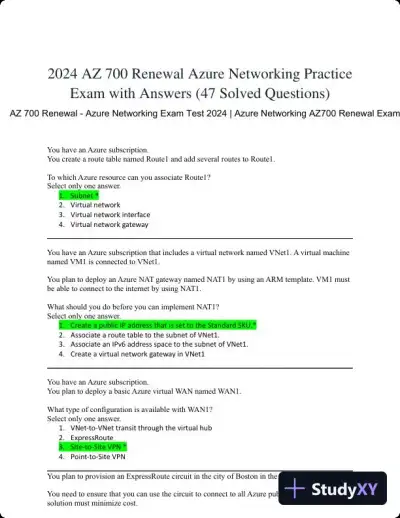 Past Exams
2024 AZ 700 Renewal Azure Networking Practice Exam with Answers (47 Solved Questions)
Azure Networking Practice Exam
13 pages71downloadsFeb 2025 Certification Guides
MCA Microsoft Certified Associate Azure Security Engineer Study Guide: Exam AZ-500 (2022)
Azure Networking Practice Exam
489 pages65downloadsFeb 2025 Certification Guides
Exam Ref AZ-104 Microsoft Azure Administrator (2024)
Azure Networking Practice Exam
604 pages59downloadsFeb 2025 Certification Guides
Microsoft Azure Architect Technologies Study Companion: Exam AZ-300 and AZ-303 (2020)
Azure Networking Practice Exam
879 pagesMay 2025
Study this document with CramX
Once it is in your library, every tool can work from it.