

Study Guide Exam 1Z0-816 and Exam 1Z0-817 (2020)
- Azure Networking Practice Exam
- 996 pages
- Shared February 2025
- 92 downloads
Learn faster with Study Guide Exam 1Z0-816 and Exam 1Z0-817 (2020), featuring key study points for certification.
Preview 31 of 996 pages
See the first 31 pages exactly as they appear in the document.
Page 1 Page 2 Page 3 Read page 3 as text
Table of Contents Cover Acknowledgments About the Authors Introduction Understanding the Exam Reading This Book Preparing for the Exam Taking the Exam Objective Map Taking the Assessment Test Chapter 1: Java Fundamentals Applying the final Modifier Working with Enums Creating Nested Classes Understanding Interface Members Introducing Functional Programming Summary Exam Essentials Review Questions Chapter 2: Annotations Introducing Annotations Creating Custom Annotations Applying Annotations Declaring Annotation-Specific Annotations Using Common Annotations Summary Exam Essentials
Page 4 Read page 4 as text
Review Questions Chapter 3: Generics and Collections Using Method References Using Wrapper Classes Using the Diamond Operator Using Lists, Sets, Maps, and Queues Sorting Data Working with Generics Summary Exam Essentials Review Questions Chapter 4: Functional Programming Working with Built-in Functional Interfaces Returning an Optional Using Streams Working with Primitive Streams Working with Advanced Stream Pipeline Concepts Summary Exam Essentials Review Questions Chapter 5: Exceptions, Assertions, and Localization Reviewing Exceptions Creating Custom Exceptions Automating Resource Management Declaring Assertions Working with Dates and Times Supporting Internationalization and Localization Loading Properties with Resource Bundles Summary
Page 5 Read page 5 as text
Exam Essentials Review Questions Chapter 6: Modular Applications Reviewing Module Directives Comparing Types of Modules Analyzing JDK Dependencies Migrating an Application Creating a Service Summary Exam Essentials Review Questions Chapter 7: Concurrency Introducing Threads Creating Threads with the Concurrency API Writing Thread-Safe Code Using Concurrent Collections Identifying Threading Problems Working with Parallel Streams Summary Exam Essentials Review Questions Chapter 8: I/O Understanding Files and Directories Introducing I/O Streams Common I/O Stream Operations Working with I/O Stream Classes Interacting with Users Summary Exam Essentials
Page 6 Read page 6 as text
Review Questions Chapter 9: NIO.2 Introducing NIO.2 Interacting with Paths Operating on Files and Directories Managing File Attributes Applying Functional Programming Comparing Legacy java.io.File and NIO.2 Methods Summary Exam Essentials Review Questions Chapter 10: JDBC Introducing Relational Databases and SQL Introducing the Interfaces of JDBC Connecting to a Database Working with a PreparedStatement Getting Data from a ResultSet Calling a CallableStatement Closing Database Resources Summary Exam Essentials Review Questions Chapter 11: Security Designing a Secure Object Introducing Injection and Input Validation Working with Confidential Information Serializing and Deserializing Objects Constructing Sensitive Objects Preventing Denial of Service Attacks
Page 7 Read page 7 as text
Summary Exam Essentials Review Questions Appendix A: The Upgrade Exam Working with Local Variable Type Inference Introducing Modules Creating and Running a Modular Program Updating Our Example for Multiple Modules Diving into the module-info File Discovering Modules Reviewing Command-Line Options Summary Exam Essentials Review Questions Appendix B: Answers to Review Questions Chapter 1: Java Fundamentals Chapter 2: Annotations Chapter 3: Generics and Collections Chapter 4: Functional Programming Chapter 5: Exceptions, Assertions, and Localization Chapter 6: Modular Applications Chapter 7: Concurrency Chapter 8: I/O Chapter 9: NIO.2 Chapter 10: JDBC Chapter 11: Security Appendix A: The Upgrade Exam Index Online Test Bank
Page 8 Read page 8 as text
Register and Access the Online Test Bank End User License Agreement List of Tables Chapter 1 TABLE 1.1 Modifiers in nested classes TABLE 1.2 Members in nested classes TABLE 1.3 Nested class access rules TABLE 1.4 Interface member types TABLE 1.5 Interface member access Chapter 2 TABLE 2.1 Values for the @Target annotation TABLE 2.2 Values for the @Retention annotation TABLE 2.3 Annotation-specific annotations TABLE 2.4 Common @ SuppressWarnings values TABLE 2.5 Understanding common annotations TABLE 2.6 Applying common annotations Chapter 3 TABLE 3.1 Functional interfaces used in this chapter TABLE 3.2 Method references TABLE 3.3 Wrapper classes TABLE 3.4 Factory methods to create a List TABLE 3.5 List methods TABLE 3.6 Queue methods TABLE 3.7 Map methods TABLE 3.8 Behavior of the merge() method
Page 9 Read page 9 as text
TABLE 3.9 Java Collections Framework types TABLE 3.10 Collection attributes TABLE 3.11 Comparison of Comparable and Comparator TABLE 3.12 Helper static methods for building a Comparator TABLE 3.13 Helper default methods for building a Comparator TABLE 3.14 Types of bounds TABLE 3.15 Why we need a lower bound Chapter 4 TABLE 4.1 Common functional interfaces TABLE 4.2 Convenience methods TABLE 4.3 Optional instance methods TABLE 4.4 Intermediate vs. terminal operations TABLE 4.5 Creating a source TABLE 4.6 Terminal stream operations TABLE 4.7 Common primitive stream methods TABLE 4.8 Mapping methods between types of streams TABLE 4.9 Function parameters when mapping between types of streams TABLE 4.10 Optional types for primitives TABLE 4.11 Common functional interfaces for primitives TABLE 4.12 Primitive-specific functional interfaces TABLE 4.13 Examples of grouping/partitioning collectors Chapter 5 TABLE 5.1 Unchecked exceptions TABLE 5.2 Checked exceptions TABLE 5.3 Assertion applications
Page 10 Read page 10 as text
TABLE 5.4 Date and time types TABLE 5.5 Common date/time symbols TABLE 5.6 Supported date/time symbols TABLE 5.7 Factory methods to get a NumberFormat TABLE 5.8 DecimalFormat symbols TABLE 5.9 Factory methods to get a DateTimeFormatter TABLE 5.10 Locale.Category values TABLE 5.11 Picking a resource bundle for French/France with default locale En... TABLE 5.12 Selecting resource bundle properties Chapter 6 TABLE 6.1 Common module directives TABLE 6.2 Practicing with automatic module names TABLE 6.3 Properties of modules types TABLE 6.4 Common modules TABLE 6.5 Java modules prefixed with java TABLE 6.6 Java modules prefixed with jdk TABLE 6.7 Comparing migration strategies TABLE 6.8 Reviewing services Chapter 7 TABLE 7.1 ExecutorService methods TABLE 7.2 Future methods TABLE 7.3 TimeUnit values TABLE 7.4 ScheduledExecutorService methods TABLE 7.5 Executors factory methods TABLE 7.6 Atomic classes
Page 11 Read page 11 as text
TABLE 7.7 Common atomic methods TABLE 7.8 Lock methods TABLE 7.9 Concurrent collection classes TABLE 7.10 BlockingQueue waiting methods TABLE 7.11 Synchronized collections methods Chapter 8 TABLE 8.1 Commonly used java.io.File methods TABLE 8.2 The java.io abstract stream base classes TABLE 8.3 The java.io concrete stream classes TABLE 8.4 Common I/O stream methods TABLE 8.5 Common print stream format() symbols Chapter 9 TABLE 9.1 File system symbols TABLE 9.2 Common NIO.2 method arguments TABLE 9.3 Path methods TABLE 9.4 Files methods TABLE 9.5 The attributes and view types TABLE 9.6 Walking a directory with a cycle using breadth- first search TABLE 9.7 Comparison of java.io.File and NIO.2 methods Chapter 10 TABLE 10.1 CRUD operations TABLE 10.2 SQL runnable by the execute method TABLE 10.3 Return types of execute methods TABLE 10.4 PreparedStatement methods TABLE 10.5 ResultSet get methods
Page 12 Read page 12 as text
TABLE 10.6 Sample stored procedures TABLE 10.7 Stored procedure parameter types Chapter 11 TABLE 11.1 Types of confidential data TABLE 11.2 Methods for serialization and deserialization Appendix A TABLE A.1 Options you need to know for using modules with javac TABLE A.2 Options you need to know for using modules with java TABLE A.3 Access control with modules TABLE A.4 Modes using jmod TABLE A.5 Comparing command-line operations TABLE A.6 Options you need to know for the exam: javac TABLE A.7 Options you need to know for the exam: java TABLE A.8 Options you need to know for the exam: jar TABLE A.9 Options you need to know for the exam: jdeps List of Illustrations Introduction FIGURE I.1 Past and current Java certifications FIGURE I.2 Latest Java certification exams FIGURE I.3 Exam prerequisites Chapter 1 FIGURE 1.1 Lambda syntax omitting optional parts FIGURE 1.2 Lambda syntax, including optional parts Chapter 2
Page 13 Read page 13 as text
FIGURE 2.1 Annotation declaration FIGURE 2.2 Using an annotation Chapter 3 FIGURE 3.1 The Collection interface is the root of all collections except ma... FIGURE 3.2 Example of a List FIGURE 3.3 Example of a Set FIGURE 3.4 Examples of a HashSet and TreeSet FIGURE 3.5 Example of a Queue FIGURE 3.6 Working with a queue FIGURE 3.7 Example of a Map Chapter 4 FIGURE 4.1 Optional FIGURE 4.2 Stream pipeline FIGURE 4.3 Steps in running a stream pipeline FIGURE 4.4 A stream pipeline with a limit FIGURE 4.5 Stream pipeline with multiple intermediate operations Chapter 5 FIGURE 5.1 The syntax of a try statement FIGURE 5.2 The syntax of a try with resources statement FIGURE 5.3 Categories of exceptions FIGURE 5.4 The syntax of assert statements FIGURE 5.5 Locale formats Chapter 6 FIGURE 6.1 A named module FIGURE 6.2 An automatic module
Page 14 Read page 14 as text
FIGURE 6.3 An unnamed module FIGURE 6.4 Determining the order FIGURE 6.5 Determining the order when not unique FIGURE 6.6 Bottom-up migration FIGURE 6.7 Top-down migration FIGURE 6.8 First attempt at decomposition FIGURE 6.9 Removing the cyclic dependencies FIGURE 6.10 Modules in the tour application Chapter 7 FIGURE 7.1 Process model FIGURE 7.2 ExecutorService life cycle FIGURE 7.3 Lack of thread synchronization FIGURE 7.4 Thread synchronization using atomic operations FIGURE 7.5 Race condition on user creation Chapter 8 FIGURE 8.1 Directory and file hierarchy FIGURE 8.2 Visual representation of a stream FIGURE 8.3 Serialization process FIGURE 8.4 Diagram of I/O stream classes Chapter 9 FIGURE 9.1 File system with a symbolic link FIGURE 9.2 NIO.2 class and interface relationships FIGURE 9.3 Relative paths using path symbols FIGURE 9.4 Comparing file uniqueness FIGURE 9.5 File and directory as a tree structure FIGURE 9.6 File system with cycle
Page 15 Read page 15 as text
Chapter 10 FIGURE 10.1 Tables in our relational database FIGURE 10.2 Key JDBC interfaces FIGURE 10.3 The JDBC URL format FIGURE 10.4 Types of statements FIGURE 10.5 The ResultSet cursor Chapter 11 FIGURE 11.1 Cloneable logic FIGURE 11.2 Hours table FIGURE 11.3 Directory structure FIGURE 11.4 Writing and reading an employee Appendix A FIGURE A.1 Design of a modular system FIGURE A.2 Looking inside a module FIGURE A.3 Contents of zoo.animal.feeding FIGURE A.4 Module zoo.animal.feeding directory structure FIGURE A.5 Running a module using java FIGURE A.6 Module zoo.animal.feeding directory structure with class and jar ... FIGURE A.7 Modules depending on zoo.animal.feeding FIGURE A.8 Contents of zoo.animal.care FIGURE A.9 Module zoo.animal.care directory structure FIGURE A.10 Dependencies for zoo.animal.talks FIGURE A.11 Contents of zoo.animal.talks FIGURE A.12 Contents of zoo.staff FIGURE A.13 Dependencies for zoo.staff
Page 16 Read page 16 as text
FIGURE A.14 Transitive dependency version of our modules
Page 17 Read page 17 as text
OCP Oracle ® Certified Professional Java ® SE 11 Programmer II Study Guide Exam 1Z0-816 and Exam 1Z0-817 Scott Selikoff Jeanne Boyarsky
Page 18 Page 19 Read page 19 as text
Copyright © 2020 by John Wiley & Sons, Inc., Indianapolis, Indiana Published simultaneously in Canada and the United Kingdom. ISBN: 978-1-119-61762-4 ISBN: 978-1-119-61763-1 (ebk) ISBN: 978-1-119-61758-7 (ebk) No part of this publication may be reproduced, stored in a retrieval system or transmitted in any form or by any means, electronic, mechanical, photocopying, recording, scanning or otherwise, except as permitted under Sections 107 or 108 of the 1976 United States Copyright Act, without either the prior written permission of the Publisher, or authorization through payment of the appropriate per-copy fee to the Copyright Clearance Center, 222 Rosewood Drive, Danvers, MA 01923, (978) 750-8400, fax (978) 646-8600. Requests to the Publisher for permission should be addressed to the Permissions Department, John Wiley & Sons, Inc., 111 River Street, Hoboken, NJ 07030, (201) 748-6011, fax (201) 748-6008, or online at www.wiley.com/go/permissions . Limit of Liability/Disclaimer of Warranty: The publisher and the author make no representations or warranties with respect to the accuracy or completeness of the contents of this work and specifically disclaim all warranties, including without limitation warranties of fitness for a particular purpose. No warranty may be created or extended by sales or promotional materials. The advice and strategies contained herein may not be suitable for every situation. This work is sold with the understanding that the publisher is not engaged in rendering legal, accounting, or other professional services. If professional assistance is required, the services of a competent professional person should be sought. Neither the publisher nor the author shall be liable for damages arising herefrom. The fact that an organization or Web site is referred to in this work as a citation and/or a potential source of further information does not mean that the author or the publisher endorses the information the organization or Web site may provide or recommendations it may make. Further, readers should be aware that Internet Web sites listed in this work may have changed or disappeared between when this work was written and when it is read. For general information on our other products and services or to obtain technical support, please contact our Customer Care Department within the U.S. at (877) 762-2974, outside the U.S. at (317) 572-3993 or fax (317) 572-4002. Wiley publishes in a variety of print and electronic formats and by print-on-demand. Some material included with standard print versions of this book may not be included in e-books or in print-on-demand. If this book refers to media such as a CD or DVD that is not included in the version you purchased, you may download this material at booksupport.wiley.com . For more information about Wiley products, visit www.wiley.com . Library of Congress Control Number: 2020938185 TRADEMARKS: Wiley, the Wiley logo, and the Sybex logo are trademarks or registered trademarks of John Wiley & Sons, Inc. and/or its affiliates, in the United States and other countries, and may not be used without written permission. Oracle and Java are registered trademarks of Oracle America, Inc. All other trademarks are the property of their respective owners. John Wiley & Sons, Inc. is not associated with any product or vendor mentioned in this book.
Page 20 Read page 20 as text
For my daughter, Sophia, you're the best combination of super silly and super serious. You always know exactly what you want. May you never lose that trait as you grow into a strong woman. —Scott Happy 20th anniversary to NYC FIRST and StuyPulse FRC Team 694. —Jeanne
Page 21 Read page 21 as text
Acknowledgments Scott and Jeanne would like to thank numerous individuals for their contribution to this book. Thank you to Kathryn Duggan for guiding us through the process and making the book better in so many ways. Thank you to Janeice DelVecchio for being our technical editor as we wrote this book. Janeice pointed out many subtle errors in addition to the big ones. And thank you to Elena Felder for being our technical proofreader and finding the errors that we managed to sneak by Janeice. This book also wouldn't be possible without many people at Wiley, including Kenyon Brown, Pete Gaughan, Christine O'Connor, Kim Wimpsett, Johnna VanHoose Dinse and so many others. Scott could not have reached this point without his wife, Patti, and family, whose love and support makes this book possible. He would like to thank his twin daughters, Olivia and Sophia, and youngest daughter, Elysia, for their patience and understanding especially when it was “time for Daddy to work in his office!” Scott would like to extend his gratitude to his wonderfully patient co-author, Jeanne, on this, their fifth book. He doesn't know how she puts up with him, but he's glad she does and thrilled at the quality of books we produce. A big thanks to Matt Dalen, who has been a great friend, sounding board, and caring father to Olivia, Adeline, and newborn Henry. Finally, Scott would like to thank his mother and retired teacher, Barbara Selikoff, for teaching him the value of education, and his father, Mark Selikoff, for instilling in him the benefits of working hard. Jeanne would personally like to thank Chris Kreussling for knowing more than a decade ago that she would someday write a book. He was a great mentor for many years and definitely shaped her career. Sibon Barman was helpful in getting feedback on the modules chapter, and Susanta Chattopadhyay provided real-life use cases for both service locator and serialization. Stuart Dabbs Halloway's 2001 book provided examples of serialPeristentFields . Scott was a great co-author, improving everything Jeanne wrote while writing his own chapters. A big thank-you to everyone at CodeRanch.com who asked and responded
Page 22 Read page 22 as text
to questions and comments about our books. Finally, Jeanne would like to thank all of the new programmers at CodeRanch.com and FIRST robotics teams FRC 694, FTC 310, and FTC 479 for the constant reminders of how new programmers think. We'd both like to thank Marcus Biel for providing a European's take on our localization content. Last but not least, both Scott and Jeanne would like to give a big thank-you to the readers of all our books. Hearing from all of you who enjoyed the book and passed the exam is a great feeling. We'd also like to thank those who pointed out errors and made suggestions for improvements in the 1Z0-815 Java 11 book. As of April 2020, the top two were Nikolai Vinoku and Edmond Yong. Also, an honorable mention to Jakub Chrobak.
Page 23 Read page 23 as text
About the Authors Scott Selikoff is a professional software consultant, author, and owner of Selikoff Solutions, LLC, which provides software development solutions to businesses in the tri-state New York City area. Skilled in a plethora of software languages and platforms, Scott specializes in full-stack database-driven systems, cloud-based applications, microservice architectures, and service-oriented architectures. A native of Toms River, New Jersey, Scott achieved his Bachelor of Arts degree from Cornell University in Mathematics and Computer Science in 2002, after three years of study. In 2003, he received his Master of Engineering degree in Computer Science, also from Cornell University. As someone with a deep love of education, Scott has always enjoyed teaching others new concepts. He's given lectures at Cornell University and Rutgers University, as well as conferences including Oracle Code One and The Server Side Java Symposium. Scott lives in New Jersey with his loving wife, Patti; three amazing daughters, twins Olivia and Sophia and little Elysia; and two very playful dogs, Webby and Georgette. You can find out more about Scott at www.linkedin.com/in/selikoff or follow him on Twitter @ScottSelikoff . Jeanne Boyarsky was selected as a Java Champion in 2019. She has worked as a Java developer for more than 18 years at a bank in New York City where she develops, mentors, and conducts training. Besides being a senior moderator at CodeRanch.com in her free time, she works on the forum code base. Jeanne also mentors the programming division of a FIRST robotics team where she works with students just getting started with Java. She also speaks at several conferences each year. Jeanne got her Bachelor of Arts degree in 2002 and her Master in Computer Information Technology degree in 2005. She enjoyed
Page 24 Read page 24 as text
getting her Master's degree in an online program while working full- time. This was before online education was cool! Jeanne is also a Distinguished Toastmaster and a Scrum Master. You can find out more about Jeanne at www.jeanneboyarsky.com or follow her on Twitter at @JeanneBoyarsky . Scott and Jeanne are both moderators on the CodeRanch.com forums and can be reached there for question and comments. They also co- author a technical blog called Down Home Country Coding at www.selikoff.net . In addition to this book, Scott and Jeanne are also authors of the following best-selling Java 8 certification books: OCA Oracle Certified Associate Java SE 8 Programmer I Study Guide (Sybex, 2015) and OCP Oracle Certified Professional Java SE 8 Programmer II Study Guide (Sybex, 2016). These two books have been combined into the single release: OCA/OCP Java SE 8 Programmer Certification Kit: Exam 1Z0-808 and Exam 1Z0-809 (Sybex 2016). They have also written a book of practice test questions for the Java 8 certification exams: OCA/OCP Java SE 8 Programmer Practice Tests (Sybex, 2017). Their most recent book is OCP Oracle Certified Professional Java SE 11 Programmer I Study Guide: Exam 1Z0-815 (Sybex, 2019).
Page 25 Read page 25 as text
Introduction Congratulations! If you are reading this, you've likely passed the 1Z0- 815 Programmer I exam, and you are now ready to start your journey through the 1Z0-816 (Java SE Programmer II) exam. Or perhaps you came here from an older version of the certification and are now taking the IZ0-817 (Upgrade OCP Java 6, 7 & 8 to Java SE 11 Developer) exam. In either case, this book will guide you on your path to becoming a Java 11 Oracle Certified Professional. The Programmer II exam builds upon the Programmer I exam. You are expected to know all of Programmer I material when taking the second exam. Some objectives on the 1Z0-816 exam are the same as those on the 1Z0-815 exam, such as the final modifier. Most are implied. For example, the 1Z0-816 exam objectives don't mention if statements, loops, and constructors. Clearly, you still need to know these. We will also point out differences in Java 11 to help those of you new to Java 11. If you didn't score well on the 1Z0-815 exam or if it has been a while since you took it, we recommend reviewing the book you used to study for it. You really need to know the fundamentals well. If you've misplaced your study materials, feel free to check out our 1Z0-815 book, OCP Oracle Certified Professional Java SE 11 Programmer I Study Guide: Exam 1Z0-815 (Sybex, 2019). In the introduction, we will cover important information about the exam before moving on to information about this book. Finally, this introduction ends with an assessment test so you can see how much studying lays ahead of you. Understanding the Exam At the end of the day, the exam is a list of questions. The more you know about the structure of the exam, the better you are likely to do. For example, knowing how many questions the exam contains allows you to manage your progress and time remaining better. In this
Page 26 Read page 26 as text
section, we discuss the details of the exam, along with some history of previous certification exams. Broader Objectives In previous certification exams, the list of exam objectives tended to include specific topics, classes, and APIs that you needed to know for the exam. For example, take a look at an objective for the 1Z0-809 (OCP 8) exam: Use BufferedReader, BufferedWriter, File, FileReader, FileWriter, FileInputStream, FileOutputStream, ObjectOutputStream, ObjectInputStream, and PrintWriter in the java.io package. Now compare it with the equivalent objective for the 1Z0-816 (OCP 11) exam: Use I/O Streams to read and write files Notice the difference? The older version is more detailed and describes specific classes you will need to understand. The newer version is a lot vaguer. It also gives the exam writers a lot more freedom to insert a new feature, for example, without having to update the list of objectives. So how do you know what to study? By reading this study guide of course! We've spent years studying the certification exams, in all of their forms, and have carefully cultivated topics, material, and practice questions that we are confident can lead to successfully passing the exam. Choosing Which Exam to Take Java is now 25 years old, celebrating being “born” in 1995. As with anything 25 years old, there is a good amount of history and variation between different versions of Java. Over the years, the certification exams have changed to cover different topics. The names of the exams
Page 27 Read page 27 as text
have even changed. This book covers the Java 11 exam. Those with more recent certifications might remember that Oracle released two exams each for Java 7 and Java 8. The first exam tended to be easier, and completing it granted you the title of Oracle Certified Associate (OCA). The second exam was a lot more difficult, with much longer questions, and completing it granted you the title of Oracle Certified Professional (OCP). Oracle did not release an exam for Java 9 or Java 10, probably because neither of these is a Long Term Support (LTS) release. With Java 11, Oracle decided to discontinue both the OCA certification and its associated exam. You still have to take two exams to earn an OCP title. The difference is that now you do not obtain a certification title from completing the first exam. Figure I.1 shows these past and current Java certifications. This image is helpful if you run into material online that references older exams. It is also helpful if you have an older certification and are trying to determine where it fits in. FIGURE I.1 Past and current Java certifications Figure I.2 shows the exams you need to take in order to earn the latest Java certification if you don't have any existing Java certifications. If you haven't taken the 1Z0-815 exam yet, see our OCP Oracle Certified Professional Java SE 11 Programmer I Study Guide: Exam 1Z0-815 (Sybex, 2019).
Page 28 Read page 28 as text
FIGURE I.2 Latest Java certification exams If you already hold a Java certification, you need to decide which exam you can take to earn the Java 11 OCP title. Besides the 1Z0-816 Programmer II exam, there is also a 1Z0-817 Upgrade exam. Oracle has defined a number of upgrade paths to achieve the OCP title, shown in Figure I.3. FIGURE I.3 Exam prerequisites In a nutshell, you can take the 1Z0-816 exam if you passed the 1Z0-815
Page 29 Read page 29 as text
exam or hold the OCA 7 or 8 title. Oracle's goal here is to help people get to Java 11 OCP certification if they are halfway through the journey to OCP certification. If you hold a recent OCP 6, 7, or 8 certification title (or even the older Sun Certified Programmer 6 title), then you can take the 1Z0-817 exam to obtain the Java 11 OCP title with just one exam. Those with a Java certification older than this will have to start over and take the 1Z0- 815 exam, followed by the 1Z0-816 exam. What if you hold both OCA and OCP Java 7 or 8 certifications? Well, in that case you have a decision to make. Passing either the 1Z0-816 or 1Z0-817 exam will grant you the Java 11 OCP title. We recommend reviewing the objectives between the two exams and deciding which one you feel more comfortable with. There are also two edge cases. Those who passed the OCA 6 exam must still take the 1Z0-815 exam. The OCA 6 exam covered far less material than the OCA 7 or 8. Additionally, those who passed the OCP 7 or 8 exam but never received the OCP title because they didn't pass the OCA exam, need to take the 1Z0-815 exam. After that, you have a choice of the 1Z0-816 exam or the 1Z0-817 exam. If you're not sure which exam you should take, you can post questions on CodeRanch.com , and the community will be happy to help. You might even get a response from Scott or Jeanne! Taking the Upgrade Exam The chapters of this book are structured for those taking the 1Z0-816 Programmer II exam. As we said earlier, though, you can easily rely on this book to prepare for the 1Z0-817 exam. If, after reading the previous section, you decide to take the 1Z0-817 exam, then you should be aware that the objectives between the two exams are not the
Page 30 Read page 30 as text
same. To help support those taking the 1Z0-817 exam, we include Appendix A, “The Upgrade Exam,” as part of this book. This appendix includes material you would have learned when taking the 1Z0-815 Programmer I exam that you will need to know for the 1Z0-817 exam. Because of this, you should actually read this appendix first. For example, you need to first know how to create a module before you can create a module service in Chapter 6, “Modular Applications.” While we think every chapter is worth reading, here are some chapters you can skip if you are taking the 1Z0-817 exam: Chapter 2, “Annotations” Chapter 8, “I/O” Chapter 10, “JDBC” Chapter 11, “Security” For other chapters, the 1Z0-817 exam may involve understanding the entire chapter or select portions of the chapter. We've included a mapping of all of the upgrade exam objectives and their associated chapters in the “Reviewing Exam Objectives” section of this introduction. Changes to the Exam At the time of this book being published, all OCP 11 certification exams contain 80 questions and have a duration of 3 hours. The 1Z0-816 exam requires a passing score of 63 percent, while the 1Z0-817 exam requires a passing score of 61 percent. Oracle has a tendency to fiddle with the length of the exam and the passing score once it comes out. Oracle also likes to “tweak” the exam topics over time. It wouldn't be a surprise for Oracle to make minor changes to the exam objectives, the number of questions, or the passing score after this book goes to print. If there are any changes to the exam after this book is published, we will note them on the book page of our blog.
Page 31 Read page 31 as text
www.selikoff.net/ocp11-2 Exam Questions The exams consist entirely of multiple-choice questions. There are between four and seven possible answers. If a question has more than one answer, the question specifically states exactly how many correct answers there are. This book does not do that. We say “Choose all that apply” to make the questions harder. This means the questions in this book are generally harder than those on the exam. The idea is to give you more practice so you can spot the correct answer more easily on the real exam. If you read about older versions of the exam online, you might see references to drag-and-drop questions. These questions had you do a puzzle on how to complete a piece of code. Luckily, these are no longer on the exam. Many of the questions on the exam are code snippets rather than full classes. Saving space by not including imports and/or class definitions leaves room for lots of other code. For example, it is common to come across classes on the exam with portions omitted, like so: public class Zoo { String name; // Getters/Setters/Constructors omitted } In this case, you would assume methods like getName() and setName() , as well as related constructors, exist. For example, we would expect this code to compile: var name = new Zoo("Java Zoo").getName(); Out-of-Scope Material When you take the exam, you may see some questions that appear to be out of scope. Don't panic! Often, these questions do not require knowing anything about the topic to answer the question. For example, after reading this book, you should be able to spot that the following does not compile, even if you've never heard of LocalDate
965 more pages in the full document
Unlock it once and it stays in your library, ready to chat with or turn into flashcards.
Unlock the full documentMore Azure Networking Practice Exam study materials
See all Past Exams
Renewal for Microsoft Certified Azure Administrator Associate Practice Exam with Answers (43 Solved Questions)
Azure Networking Practice Exam
16 pages162downloadsFeb 2025 Past Exams
AZURE Networking Practice Exam with Answers (37 Solved Questions)
Azure Networking Practice Exam
7 pages118downloadsFeb 2025 Certification Guides
MCA Microsoft Certified Associate Azure Administrator Study Guide: Exam AZ-104 (2022)
Azure Networking Practice Exam
595 pages93downloadsFeb 2025 Past Exams
2024 AZ-104 Renewal Comprehensive Exam with Answers (270 Solved Questions)
Azure Networking Practice Exam
115 pages93downloadsFeb 2025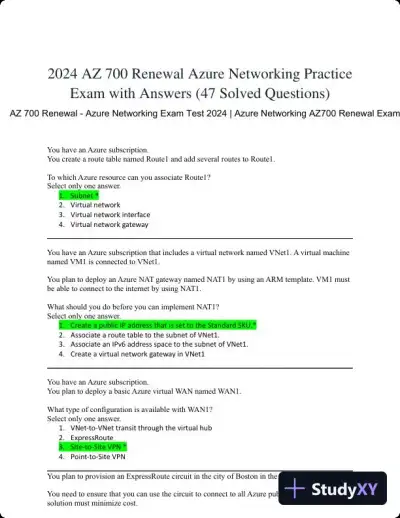 Past Exams
2024 AZ 700 Renewal Azure Networking Practice Exam with Answers (47 Solved Questions)
Azure Networking Practice Exam
13 pages71downloadsFeb 2025 Certification Guides
MCA Microsoft Certified Associate Azure Security Engineer Study Guide: Exam AZ-500 (2022)
Azure Networking Practice Exam
489 pages65downloadsFeb 2025 Certification Guides
Exam Ref AZ-104 Microsoft Azure Administrator (2024)
Azure Networking Practice Exam
604 pages59downloadsFeb 2025 Certification Guides
MCE Microsoft Certified Expert Cybersecurity Architect Study Guide: Exam SC-100 (2023)
Azure Networking Practice Exam
730 pagesMay 2025
Study this document with CramX
Once it is in your library, every tool can work from it.