

Organic Chemistry II - Carboxylic Acids and their Derivatives
- Chemistry
- Texas A&M University
- 38 pages
- Shared March 2026
Preview 10 of 38 pages
See the first 10 pages exactly as they appear in the document.
Page 1 Read page 1 as text
Study Guide Organic Chemistry II – Carboxylic Acids and their Derivatives 1. Introduction to Carboxylic Acids Carboxylic acids are an important class of organic compounds. They all contain a special functional group called the carboxyl group , written as – COOH . This group consists of a carbonyl group (C=O) and a hydroxyl group ( – OH) bonded to the same carbon atom. Carboxylic acids and their related compounds make up a large portion of organic chemistry. Many everyday substances, such as vinegar and fatty acids, belong to this family. 1. Common Derivatives of Carboxylic Acids Carboxylic acids can form several closely related compounds, called derivatives , by replacing the – OH part of the carboxyl group. The most important derivatives are: • Acid halides : – COX (where X is a halogen like Cl or Br) • Acid anhydrides : – CO – O – CO –
Page 2 Read page 2 as text
Study Guide • Esters : – COOR • Amides : – CONH ₂ These derivatives are very common in organic reactions and are widely used in synthesis. 2. Nomenclature of Carboxylic Acids Carboxylic acids are named using two systems : 1. The common naming system 2. The IUPAC naming system
Page 3 Read page 3 as text
Study Guide 3. Common Names Common names often come from Latin or Greek words that describe where the acid occurs naturally. For example: • Formic acid comes from formica (Latin for ant), because it was first isolated from ants. • Acetic acid comes from acetum (Latin for vinegar). • Butyric acid comes from butyrum (Latin for butter). These names are still widely used in chemistry and everyday language. 4. IUPAC Naming of Carboxylic Acids To name a carboxylic acid using the IUPAC system , follow these steps: 1. Find the longest carbon chain that includes the carboxyl group. 2. Take the name of the corresponding alkane with the same number of carbon atoms. 3. Remove the final “ - e” from the alkane name and add “ - oic acid.”
Page 4 Read page 4 as text
Study Guide 4. Number the carbon chain , starting from the carboxyl carbon (this carbon is always carbon number 1). 5. Identify and name any substituents , giving their positions based on the numbering. Using these rules, a compound can be named correctly, such as 2 - ethyl - 4 - methylpentanoic acid . 5. Naming Salts of Carboxylic Acids When a carboxylic acid forms a salt , the name changes slightly: • Replace the “ - ic acid” ending with “ - ate.” • Then add the name of the metal ion. For example: • CH ₃ COO ⁻ K ⁺ is called potassium acetate (common name) or potassium methanoate (IUPAC name). 6. Acidity of Carboxylic Acids Carboxylic acids are weak acids , but they are stronger than alcohols and phenols. Their Ka values are usually between 10 ⁻ ⁴ and 10 ⁻ ⁵ , which means they readily react with common bases like sodium hydroxide and sodium bicarbonate. Why Are Carboxylic Acids Acidic? Their acidity comes from two main reasons: 1. Resonance Effect
Page 5 Read page 5 as text
Study Guide The hydrogen in the – OH group is slightly positive because electrons are shared across the carboxyl group. This makes it easier for the hydrogen ion (H ⁺ ) to leave. 2. Resonance Stabilization of the Conjugate Base When a carboxylic acid loses a hydrogen ion, it forms a carboxylate ion . This ion is very stable because the negative charge is spread evenly over two oxygen atoms through resonance. 7 . Effect of Substituents on Acidity The acidity of a carboxylic acid can be increased by adding electron - withdrawing groups , such as halogens, to the carbon chain. • These groups pull electron density away from the carboxyl group. • This makes it easier for the acid to lose a hydrogen ion. This effect is strongest when the substituent is close to the carboxyl group (especially at the α - carbon) and becomes weaker as the substituent moves farther away. Key Takeaway • Carboxylic acids contain the – COOH functional group . • They have several important derivatives, including esters, amides, and acid halides. • Naming can be done using common names or IUPAC rules . • Carboxylic acids are weak acids , but stronger than many other organic compounds. • Their acidity is explained by resonance stabilization and electron - withdrawing effects .
Page 6 Read page 6 as text
Study Guide 2. Preparation of Carboxylic Acids Carboxylic acids are commonly prepared by oxidation reactions or by transforming other functional groups into the carboxyl group. Let’s go through the most important and commonly used methods step by step. 1. Oxidation of Alkenes Alkenes can be converted into carboxylic acids using strong oxidizing agents such as: • Potassium permanganate (KMnO ₄ ) • Potassium dichromate (K ₂ Cr ₂ O ₇ ) When alkenes are heated with these oxidizing agents, the carbon – carbon double bond breaks , and each carbon is oxidized to form a carboxylic acid (or sometimes a ketone, depending on structure). Example: 2 - Pentene, when oxidized with hot KMnO ₄ , produces: • Ethanoic acid • Propanoic acid 2. Ozonolysis of Alkenes Ozonolysis is another useful method to prepare carboxylic acids indirectly. • First, ozone (O ₃ ) reacts with an alkene to form aldehydes . • These aldehydes can then be further oxidized easily to carboxylic acids using mild oxidizing conditions.
Page 7 Read page 7 as text
Study Guide This method is especially useful when you want to break a double bond at a specific position. 3. Oxidation of Primary Alcohols and Aldehydes Primary alcohols are easily oxidized to aldehydes, and aldehydes are further oxidized to carboxylic acids. Important points to remember: • Strong oxidizing agents such as KMnO ₄ , K ₂ Cr ₂ O ₇ , or chromium trioxide (CrO ₃ ) convert primary alcohols directly into carboxylic acids. • Aldehydes formed during the reaction do not remain stable under strong oxidation and are quickly converted into acids. Note: Mild oxidizing agents such as manganese dioxide (MnO ₂ ) or Tollens’ reagent are only strong enough to oxidize alcohols to aldehydes, not to acids. 4. Oxidation of Alkyl Benzenes Alkyl benzenes that contain benzylic hydrogens (hydrogen atoms on the carbon next to the benzene ring) can be oxidized to carboxylic acids.
Page 8 Read page 8 as text
Study Guide • Strong oxidizing agents like hot KMnO ₄ convert any alkyl side chain (no matter how long) into a – COOH group . • The final product is always benzoic acid . Examples: • Propylbenzene → Benzoic acid • Isopropylbenzene → Benzoic acid • t - Butylbenzene does NOT react because it has no benzylic hydrogen . 5. Hydrolysis of Nitriles Nitriles ( – C≡N) can be converted into carboxylic acids through hydrolysis .
Page 9 Read page 9 as text
Study Guide • This reaction can occur in acidic or basic conditions . • The nitrile is first converted into an amide , which is then further hydrolyzed to form a carboxylic acid. Example: • Propanenitrile → Propanoic acid • Benzonitrile → Benzoic acid Key idea: The reaction proceeds through several steps involving protonation, water attack, amide formation, and finally hydrolysis to the acid. The mechanism for these reactions involves the formation of an amide followed by hydrolysis of the amide to the acid. The mechanism follows these steps: 1. The nitrogen atom of the nitrile group is protonated.
Page 10 Read page 10 as text
Study Guide 2. The carbocation generated in Step 1 attracts a water molecule. 3. The oxonium ion loses a proton to the nitrogen atom, forming an enol. 4. The enol tautomerizes to the more stable keto form. 5. The amide is protonated by the acid, forming a carbocation.
28 more pages in the full document
Unlock it once and it stays in your library, ready to chat with or turn into flashcards.
Unlock the full documentMore Chemistry study materials
See all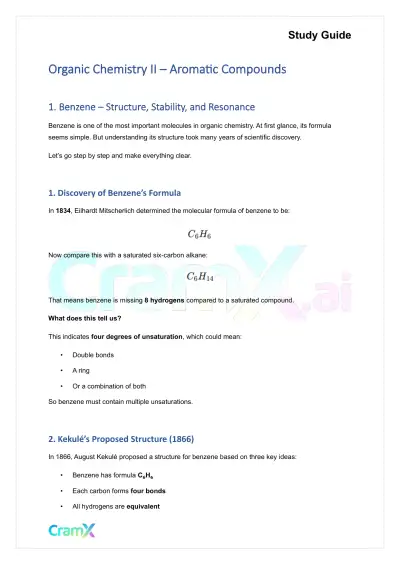 Quick Guides
Organic Chemistry II - Aromatic Compounds
Chemistry
24 pagesMar 2026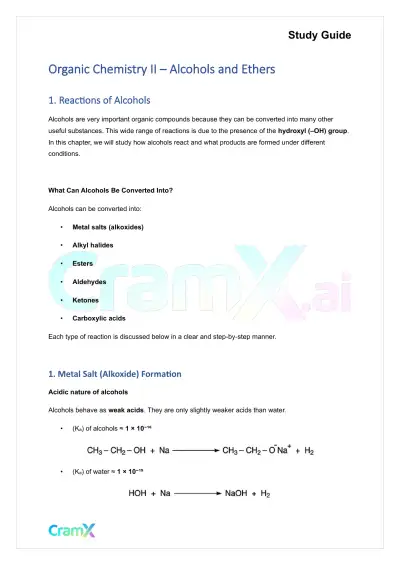 Quick Guides
Organic Chemistry II - Alcohols and Ethers
Chemistry
40 pagesMar 2026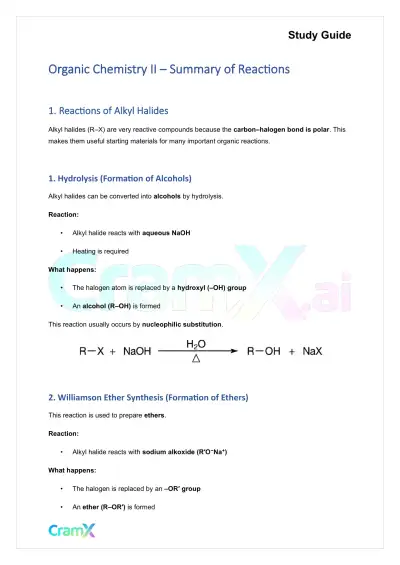 Quick Guides
Organic Chemistry II - Summary of Reactions
Chemistry
52 pagesMar 2026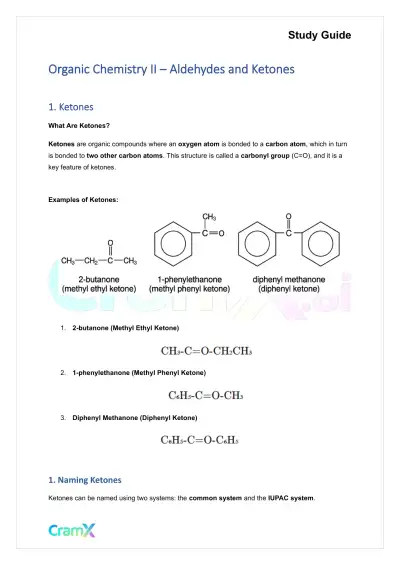 Quick Guides
Organic Chemistry II - Aldehydes and Ketones
Chemistry
35 pagesMar 2026 Quick Guides
Organic Chemistry II - Reactions of Aromatic Compounds
Chemistry
24 pagesMar 2026 Quick Guides
Organic Chemistry II - Phenols and Aryl Halides
Chemistry
35 pagesMar 2026 Quick Guides
Organic Chemistry II - Alkyl Halides
Chemistry
32 pagesMar 2026 Quick Guides
Organic Chemistry II - Spectroscopy and Structure
Chemistry
16 pagesMar 2026
Study this document with CramX
Once it is in your library, every tool can work from it.