
CCNA 1 v7 Modules 4 7 Ethernet Concepts Exam

Respuestas del examen CCNA 1 v7 Módulos 4-7 sobre conceptos Ethernet. Prepárate con preguntas reales, explicaciones claras y tips para aprobar con éxito tu evaluación.

Alice Edwards
Contributor
4.3
48
10 months ago
Preview (9 of 29 Pages)
100%
Log in to unlock

Page 1

CCNA 1 v7 Modules 4 7 Ethernet Concepts Exam - Page 1 preview image

Loading page ...

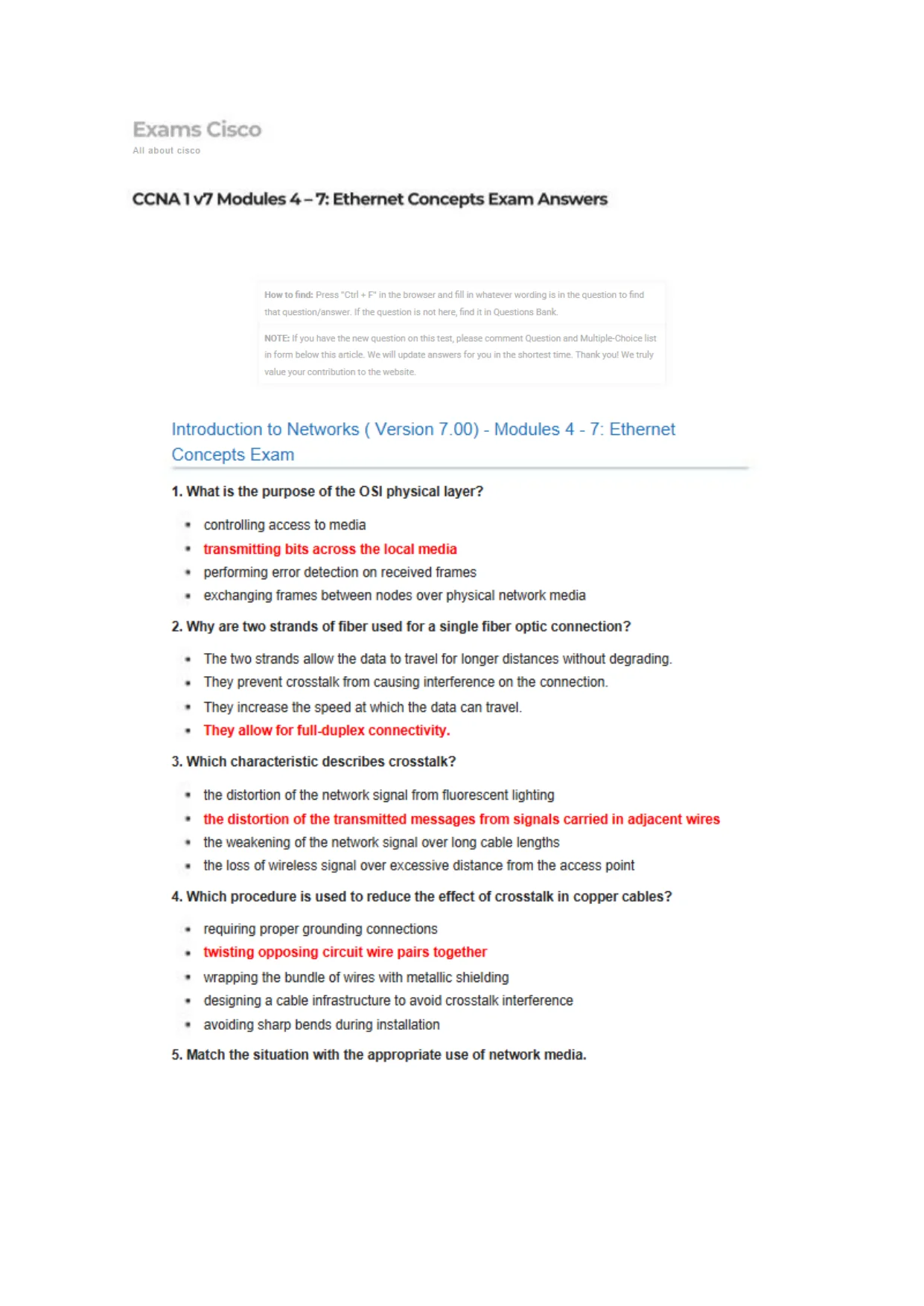
All about ciscoCCNA1v7 Modules 4 - 7 : Ethernet Concepts Exam AnswersHowtofind:Press "Ctrl + F" in the browser and filI in whatever wording is in the question to findthat question/answer. If the question is not here, find it in Questions Bank.NOTEIf you have the new question on this test, please comment Question and Multiple-Choice listin form below this article. We will update answers for you in the shortest time. Thank you! We trulyvalue your contribution to the website.Introduction to Networks (Version 7.00) - Modules 4 - 7: EthernetConcepts Exam1. What is the purpose of the OSI physical layer?controlling access to mediatransmitting bits across the local mediaperforming error detection on received framesexchanging frames between nodes over physical network media2. Why are two strands of fiber used for a single fiber optic connection?The two strands allow the data to travel for longer distances without degrading.They prevent crosstalk from causing interference on the connection.They increase the speed at which the data can travel.They allow for full-duplex connectivity.3. Whichcharacteristic describes crosstalk?the distortion of the network signal from fluorescent lightingthe distortion of the transmitted messages from signals carried in adjacent wiresthe weakening ofthenetwork signal over long cable lengthsthe loss of wireless signal over excessive distance from the access point4. Which procedure is used to reduce the effect of crosstalk in copper cables?requiring proper grounding connectionstwisting opposing circuit wire pairs togetherwrapping the bundle of wires with metallic shieldingdesigning a cable infrastructure to avoid crosstalk interferenceavoiding sharp bends during installation5. Match the situation with the appropriate use of network media.

Page 2

CCNA 1 v7 Modules 4 7 Ethernet Concepts Exam - Page 2 preview image

Loading page ...

CCbiA 1 v7 Modules 4 - 7 : Ethernet Concepts Exam Answers - Exams Cisco6. A network administrator is measuring the transfer of bits across the companybackbone for a mission critical financial application. The administrator notices that thenetwork throughput appears lower than the bandwidth expected. Which three factorscould influence the differences in throughput? (Choose three.).the amount of traffic that is currently crossing the networkthe sophistication of the encapsulation method applied to the datathe type of traffic that is crossing the network*the latency that is created by the number of network devices that the data iscrossing.the bandwidth of the WAN connection to the Inlernetthe reliability of the gigabit Ethernet infrastructure of the backbone

Page 3

CCNA 1 v7 Modules 4 7 Ethernet Concepts Exam - Page 3 preview image

Loading page ...

Explanation:Throughput usually does not match the specified bandwidth of physical linksdue to multiple factors. These factors include, the amount of traffic, type of traffic, andlatency created by the network devicesthedata has to cross.7. What are two characteristics of fiber-optic cable? (Choose two.)It is not affectedbyEMI or RFI.-Each pair of cables is wrapped in metallic foil.It combines the technique of cancelIation, shielding, and twisting to protect data.«It typically contains 4 pairs of fiber-optic wires.It is more expensivethan UTP cablingis.Explanation:Fiber-optic cabling supports higher bandwidth thanUTPfor longer distances.Fiber is immune to EMI and RFI, but costs more, requires more skill to install, and requiresmore safety precautions.8.What is a primary role of the Physical layer in transmitting data on the network?create the signals that represent the bits in each frame on to the mediaprovide physical addressing to the devicesdetermine the path packets take through the networkcontrol data access to the mediaExplanation:The OSI physical layer provides the means to transport the bits that make upa frame across the network media. This layer accepts a complete frame from the data linklayer and encodes it as a series of signals that are transmitted to the local media.9. With the use of unshielded twisted-pair copper wire in a network, what causescrosstalk within the cable pairs?the magnetic field around the adjacent pairs of wirethe use of braided wire to shield the adjacent wire pairs

Page 4

CCNA 1 v7 Modules 4 7 Ethernet Concepts Exam - Page 4 preview image

Loading page ...

-the reflection of the electrical wave backfrontthefar end ofthecable-the collision caused by two nodes trying to use the media simultaneouslyExplanation:Crosstalk is a type of noise, or interference that occurs when signaltransmission on one wire interfereswithanother wire. When current flows through a wire amagnetic field is produced. The produced magnetic field will interface the signal carried inthe adjacent wire10. Refer to the graphic. What type of cabling is shown?STPiUTPcoax.fiberExplanation:Network cabling include different types of cables:»UTPcable consists of four pairs of color-coded wires that have been twisted togetherand then encased in a flexible plastic sheath..STP cable uses four pairs of wires, each wrapped in a foil shield, which are thenwrapped in an overall metallic braid or foil.Coaxial cable uses a copper conductor and a layer of flexible plastic insulationsurrounds the copper conductor..Fiber cable is a flexible, extremely thin, transparent strand of glass surrounded byplastic insulation.

Page 5

CCNA 1 v7 Modules 4 7 Ethernet Concepts Exam - Page 5 preview image

Loading page ...

11. In addition to the cable length, what two factors could interfere with thecommunication carried over UTP cables? (Choose two.)crosstalkbandwidthsize of the networksignalmodulation techniqueelectromagnetic interferenceExplanation:Copper media is widely usedinnetwork communications. However, coppermedia is limited by distance and signal interference. Data is transmitted on copper cablesas electrical pulses. The electrical pulses are susceptible to interference from two sources:Electromagnetic interference (EMI) or radio frequency interference (RFI) - EMIand RFI signals can distort and corrupt the data signals being carried by copper media.Crosstalk -Crosstalk is a disturbance caused by the electric or magnetic fields of asignal on onewireinterferingwittithesignal inan adjacentwire.12. Refer to the graphic. What type of cabling is shown?.STP.UTPcoax.

Page 6

CCNA 1 v7 Modules 4 7 Ethernet Concepts Exam - Page 6 preview image

Loading page ...

13. Which two devices commonly affect wireless networks? {Choose two.)Blu-ray playershome theaterscordless phonesmicrowaves-incandescent light bulbs*external hard drivesExplanation: Radio Frequency Interference (RFI) is the interference that is caused by radiotransmitters and other devices that are transmitting in the same frequency.14. Which two statements describe the services provided by the data link layer? {Choosetwo.)It defines the end-to-end delivery addressing scheme..It maintains the path between the source and destination devices during the datatransmission..It manages the access of frames to the network media.*It provides reliable delivery through link establishment and flow control..It ensures that application data will be transmitted according to the prioritization.-It packages various Layer 3 PDUs into a frame format that is compatible with thenetwork interface.Explanation: The data link layer is divided into two sub layers, namely Logical Link Control(LLC) and Media Access Control (MAC). LLC forms a frame from the network layer PDUinto a format that conforms to the requirements of the network interface and media. Anetwork layer PDU might be for IPv4 or IPv6. The MAC sub layer defines the media accessprocesses performed by the hardware. It manages the frame access to the network mediaaccording to the physical signaling requirements (copper cable;fiber optic wireless, etc.)

Page 7

CCNA 1 v7 Modules 4 7 Ethernet Concepts Exam - Page 7 preview image

Loading page ...

15. What is the function of the CRC value that is found in the FCS field of a frame?to verify the integrity of the received frame<to verify the physical address in the frameto verify the logical address in the frameto compute the checksum header for the data field in the frame16. What is contained in the trailer of a data-link frame?.logical address«physical addressdata«error detection17. Which statement describes a characteristic of the frame header fields of the data linklayer?They all include the flow control and logical connection fields..Ethernet frame header fields contain Layer 3 source and destination addresses.They vary depending on protocols.<They include information on user applications.Explanation:All data link layer protocols encapsulate the Layer 3 PDU within the data fieldof the frame. However,thestructure oftheframe and the fields that are contained in theheader vary according to the protocol. Different data link layer protocols may use differentfields, like priority/quality of service, logical connection control, physical link control, flowcontrol, and congestion control.18. A network team is comparing physical WAN topologies for connecting remote sites toa headquarters building. Which topology provides high availability and connects some,but not all, remote sites?mesh

Page 8

CCNA 1 v7 Modules 4 7 Ethernet Concepts Exam - Page 8 preview image

Loading page ...

partial meshhub and spokepoint-to-pointTranslate »Explanation: Partial mesh topologies provide high availability by interconnecting multipleremote sites, but do not require a connection between all remote sites. A mesh topologyrequires point-to-point links with every system being connected to every other system. Apoint-to-point topology is where each device is connected to one other device. A hub andspoke uses a central device in a star topology that connects to other point-to-point devices.19. Which two fields or features does Ethernet examine to determine if a received frame ispassed to the data link layer or discarded by the NIC? (Choose two.).auto-MDIX.CEFFrame Check Sequenceminimum frame sizesource MAC address20. Which media communication type does not require media arbitration in the data linklayer?deterministic-half-duplexfull-duplex-controlled accessExplanation: Half-duplex communication occurs when both devices can both transmit andreceive on the medium but cannot do so simultaneously. Full-duplex communication occurswhen both devices can transmit and receive on the medium at the same time and thereforedoes not require media arbitration. Half-duplex communication is typically contention-based,whereas controlled (deterministic) access is applied in technologies where devices taketurns to access the medium.

Page 9

CCNA 1 v7 Modules 4 7 Ethernet Concepts Exam - Page 9 preview image

Loading page ...

21. Which statement describes an extended star topology?End devices connect to a central intermediate device, which in turn connects toother central intermediate devices.*End devices are connected together by a bus and each bus connects to a centralintermediate device.Each end system is connected to its respective neighbor via an intermediate device..All end and intermediate devices are connected in a chain to each other.Explanation: In an extended star topology., central intermediate devices interconnect otherstar topologies.22. What is a characteristic of the LLC sublayer?«It provides the logical addressing required that identifies the device.It provides delimitation of data according to the physical signaling requirements of themedium.It places information in the frame allowing multiple Layer 3 protocols to use thesame network interface and media..It defines software processes that provide services to the physical layer23. What are three ways that media access control is used in networking? (Choose three.)*Ethernet utilizes CSMA.'CD.Media access control provides placement of data frames onto the media..Contention-based access is also known as deterministic..802.11 utilizes CSMA/CD.Data link layer protocols define the rules for access to different media.Networks with controlled access have reduced performance due to data collisions.
Preview Mode

This document has 29 pages. Sign in to access the full document!