
CCNA Basic Questions

This CCNA quiz covers key networking topics: MAC address structure, collision and broadcast domains, IOS storage limits, MTU meaning, Ethernet duplex modes, and CSMA/CD. It reinforces foundational concepts essential for Cisco certification success.

Mason Bennett
Contributor
4.3
43
10 months ago
Preview (78 of 259 Pages)
100%
Log in to unlock

Page 1

CCNA Basic Questions - Page 1 preview image

Loading page ...

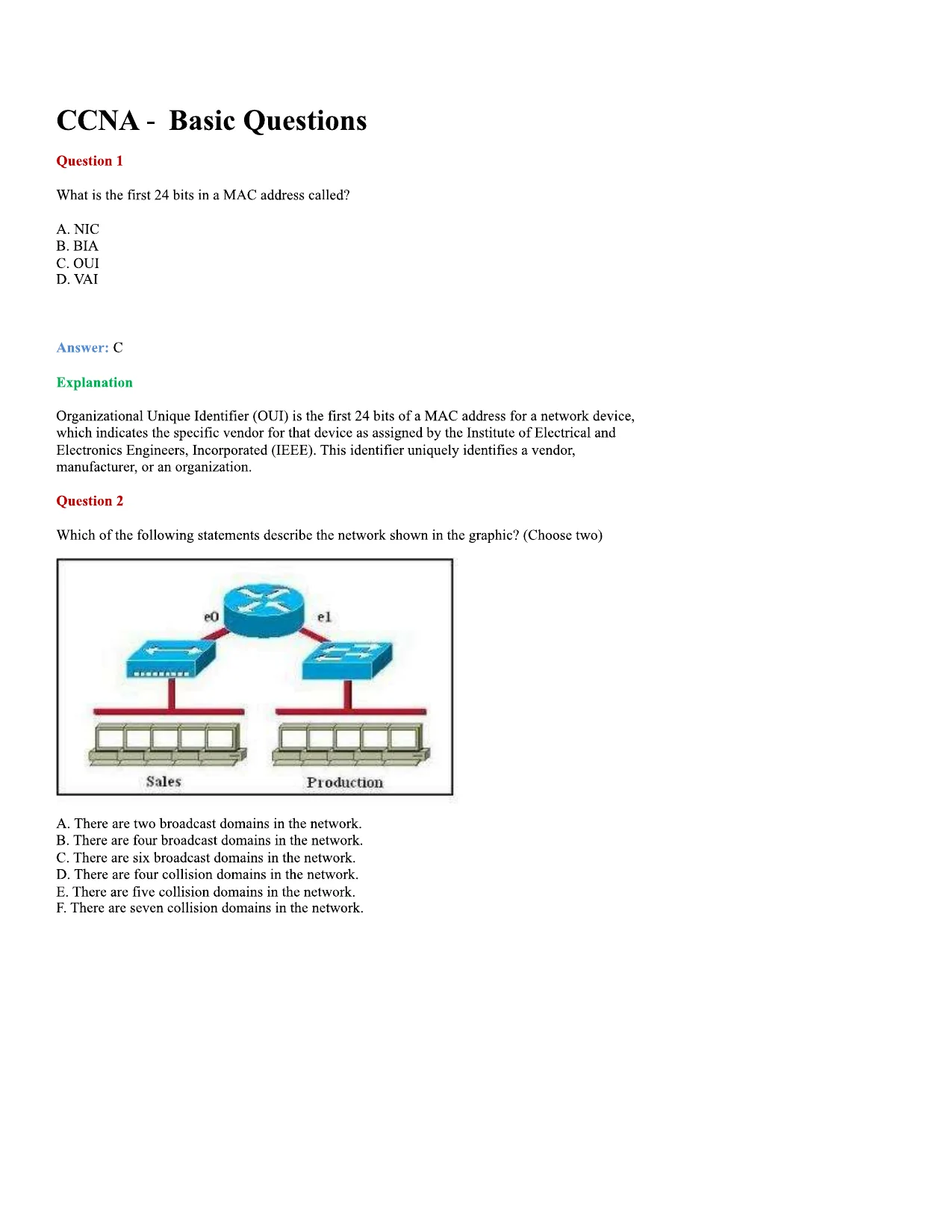
CCNA - Basic QuestionsQuestion 1What is the first 24 bits in a MAC address called?A. NICB. BIAC. GUID. VAIAnswer: CExplanationOrganizational Unique Identifier (GUI) is the first 24 bits of a MAC address for a network device,which indicates the specific vendor for that device as assigned by the Institute of Electrical andElectronics Engineers, Incorporated (IEEE). This identifier uniquely identifies a vendor,manufacturer, or an organization.Question 2Which of the following statements describe the network shown in the graphic? (Choose two)A. There are two broadcast domains in the network.B. There are four broadcast domains in the network.C. There are six broadcast domains in the network.D. There are four collision domains in the network.E. There are five collision domains in the network.F. There are seven collision domains in the network.

Page 2

CCNA Basic Questions - Page 2 preview image

Loading page ...

Answer:A FExplanationOnly router can break up broadcast domains so in the exhibit there are 2 broadcast domains: from eOinterface to the left is a broadcast domain and from el interface to the right is another broadcastdomain -> A is correct.Both router and switch can break up collision domains so there is only 1 collision domain on the leftof the router (because hub doesn't break up collision domain) and there are 6 collision domains onthe right of the router (1 collision domain from el interface to the switch + 5 collision domains for 5PCs in Production) -> F is correct.Question 3Refer to the exhibit:System flash directorFile Length Name/status1 3802992 c827v-y6-mz.121-l.XB[3803056 bytes used,4585552 available, 8388608 total]8192K bytes of processor board System flash(Read/Write)The technician wants to upload a new IOS in the router while keeping the existing IOS. What is themaximum size of an IOS file that could be loaded if the original IOS is also kept in flash?A. 3MBB. 5MBC. 7MBD. 4MBAnswer: DExplanationFrom the exhibit we learn there are 4585552 bytes (over 4MB) available so it is only enough spacefor an IOS file of 4MB. If bigger file is copied then the existing IOS file will be erased (overwritten).Question 4Refer to the exhibit. What is the meaning of the output MTU 1500 bytes?

Page 3

CCNA Basic Questions - Page 3 preview image

Loading page ...

Routersshow interfaces etnemetoEhierneEO is up, line protocol is upHardware is QUICC Ethernet, address is 00c0.ab73 dead (bia 001D.7bcc 7321)MTU1500 bytes, BW 10000 Kbit. DLY 1000 usee,reliability 255/255, txtoad 1/255, rxioad 1/255Encapsulation ARPA. loopbacK not setKeepalive set (10 sec)<oulpul omitted*______________________________________________A. The maximum number of bytes that can traverse this interface per second is 1500.B. The minimum segment size that can traverse this interface is 1500 bytes.C. The minimum segment size that can traverse this interface is 1500 bytes.D. The minimum packet size that can traverse this interface is 1500 bytes.E. The maximum packet size that can traverse this interface is 1500 bytes.F.The maximum frame size that can traverse this interface is 1500 bytes.Answer:EExplanationThe Maximum Transmission Unit (MTU) defines the maximum Layer 3 packet (in bytes) that thelayer can pass onwards.Question 5A network interface port has collision detection and carrier sensing enabled on a shared twisted pairnetwork. From this statement, what is known about the network interface port?A. This is a 10 Mb/s switch port.B. This is a 100 Mb/s switch port.C. This is an Ethernet port operating at half duplex.D. This is an Ethernet port operating at full duplex.E. This is a port on a network interface card in a PC.Answer: CExplanationModem Ethernet networks built with switches and full-duplex connections no longer utilizeCSMA/CD. CSMA/CD is only used in obsolete shared media Ethernet (which uses repeater or hub).Question 6In an Ethernet network, under what two scenarios can devices transmit? (Choose two)

Page 4

CCNA Basic Questions - Page 4 preview image

Loading page ...

A. when they receive a special tokenB. when there is a carrierC. when they detect no other devices are sendingD. when the medium is idleE. when the server grants accessAnswer: C DExplanationEthernet network is a shared environment so all devices have the right to access to the medium. Ifmore than one device transmits simultaneously, the signals collide and can not reach the destination.If a device detects another device is sending, it will wait for a specified amount of time beforeattempting to transmit.When there is no traffic detected, a device will transmit its message. While this transmission isoccurring, the device continues to listen for traffic or collisions on the LAN. After the message issent, the device returns to its default listening mode.So we can see C and D are the correct answers. But in fact —answer C when they detect no otherdevices are sending! and —when the medium is idle! are nearly the same.Question 7For what two purposes does the Ethernet protocol use physical addresses? (Choose two)A. to uniquely identify devices at Layer 2B. to allow communication with devices on a different networkC. to differentiate a Layer 2 frame from a Layer 3 packetD. to establish a priority system to determine which device gets to transmit firstE. to allow communication between different devices on the same networkF. to allow detection of a remote device when its physical address is unknownAnswer:A EExplanationPhysical addresses or MAC addresses are used to identify devices at layer 2 -> A is correct.MAC addresses are only used to communicate on the same network. To communicate on differentnetwork we have to use Layer 3 addresses (IP addresses) -> B is not correct; E is correct.Layer 2 frame and Layer 3 packet can be recognized via headers. Layer 3 packet also containsphysical address -> C is not correct.

Page 5

CCNA Basic Questions - Page 5 preview image

Loading page ...

On Ethernet, each frame has the same priority to transmit by default -> D is not correct.All devices need a physical address to identify itself. If not, they can not communicate -> F is notcorrect.Question 8Which two locations can be configured as a source for the IOS image in the boot system command?(Choose two)A. RAMB. NVRAMC. flash memoryD. HTTP serverE. TFTP serverF. Telnet serverAnswer: CEExplanationThe following locations can be configured as a source for the IOS image:+ Flash (the default location)+ TFTP server+ ROM (used if no other source is found)Question 9What is the difference between a CSU/DSU and a modem?A. A CSU/DSU converts analog signals from a router to a leased line; a modem converts analogsignals from a router to a leased line.B. A CSU/DSU converts analog signals from a router to a phone line; a modem converts digitalsignals from a router to a leased line.C. A CSU/DSU converts digital signals from a router to a phone line; a modem converts analogsignals from a router to a phone line.D. A CSU/DSU converts digital signals from a router to a leased line; a modem converts digitalsignals from a router to a phone line.Answer: DQuestion 10A Cisco router is booting and has just completed the POST process. It is now ready to find and loadan IOS image. What function does the router perform next?

Page 6

CCNA Basic Questions - Page 6 preview image

Loading page ...

A. It checks the configuration registerB. It attempts to boot from a TFTP serverC. It loads the first image file in flash memoryD. It inspects the configuration file in NVRAM for boot instructionsAnswer:AExplanationWhen you turn the router on, it runs through the following boot process.The Power-On Self Test (POST) checks the router's hardware. When the POST completessuccessfully, the System OK LED indicator comes on.The router checks the configuration register to identify where to load the IOS image from. A settingof 0x2102 means that the router will use information in the startup-config file to locate the IOSimage. If the startup-config file is missing or does not specify a location, it will check the followinglocations for the IOS image:1. Flash (the default location)2. TFTP server3. ROM (used if no other source is found)The router loads the configuration file into RAM (which configures the router). The router can load aconfiguration file from:+ NVRAM (startup-configuration file)+ TFTP serverIf a configuration file is not found, the router starts in setup mode.

Page 7

CCNA Basic Questions - Page 7 preview image

Loading page ...

CCNA - OSI & TCP/IP ModelQuestion 1Where does routing occur within the DoD TCP/IP reference model?A. applicationB. internetC. networkD. transportAnswer: BExplanationThe picture below shows the comparison between TCP/IP model & OSI model. Notice that theInternet Layer of TCP/IP is equivalent to the Network Layer which is responsible for routingdecision.Application LayerApplication LayerPresentation LayerSession LayerTransport LayerTransport LayerInternet LayerNetwork LayerNetwork AccessLayerData Link LayerPhysical LayerTCP/IPOSIQuestion 2Refer to exhibit.Router#show running-configBuilding configuration...Current configuration : 659 bytes!version 12.4no service timestamps log datetime msecno service timestamps debug datetime msec

Page 8

CCNA Basic Questions - Page 8 preview image

Loading page ...

service password-encryption!hostname Routerienable secret 5 $l$mERr$hx5rVt7rPNoS4wqbXKX7mO!interface FastEthemetO/Oip address 192.168.1.1 255.255.255.0ip access-group 101 induplex autospeed auto!access-list 101 deny tcp any any eq 22access- list 101 permit ip any anyline con 0password 7 0822455D0A16loginline vty 0 4loginline vty 5 14loginfendA network administrator cannot establish a Telnet session with the indicated router. What is thecause of this failure?A. A Level 5 password is not set.B. An ACL is blocking Telnet access.C. The vty password is missing.D. The console password is missing.Answer: CQuestion 3Before installing a new, upgraded version of the IOS, what should be checked on the router, andwhich command should be used to gather this information? (Choose two)A. the amount of available ROMB. the amount of available flash and RAM memoryC. the version of the bootstrap software present on the routerD. show versionE. show processesF. show running-config

Page 9

CCNA Basic Questions - Page 9 preview image

Loading page ...

Answer: B DExplanationWhen upgrading new version of the IOS we need to copy the IOS to the Flash so first we have tocheck if the Flash has enough memoiy or not. Also running the new IOS may require more RAMthan the older one so we should check the available RAM too. We can check both with the —showversion! command.Question 4Refer to the exhibit. An administrator pings the default gateway at 10.10.10.1 and sees the output asshown. At which OSI layer is the problem?O p i n g10.10.10.1Pinging 10.10.10.1 with 32 bytes of data:Request timed out.Request timed out.Request timed out.Request timed out.Ping statistics for 10.10.10.1:Packets: sent - 4, Received = 0, Lost - 4 (100% loss)A. data link layerB. application layerC.access layerD. session layerE. network layerAnswer:EExplanationThe Network layer is responsible for network addressing and routing through the internetwork. So aping fails, you may have an issue with the Network layer (although lower layers like Data Link &Physical may cause the problem).Question 5At which layer of the OSI model does PPP perform?A. Layer 2B.Layer 3C.Layer 4D. Layer 5

Page 10

CCNA Basic Questions - Page 10 preview image

Loading page ...

Answer: AQuestion 6Which of the following correctly describe steps in the OSI data encapsulation process? (Choose two)A. The transport layer divides a data stream into segments and may add reliability and flow controlinformation.B. The data link layer adds physical source and destination addresses and an FCS to the segment.C. Packets are created when the network layer encapsulates a frame with source and destination hostaddresses and protocol-related control information.D. Packets are created when the network layer adds Layer 3 addresses and control information to asegment.E. The presentation layer translates bits into voltages for transmission across the physical link.Answer: A DExplanationThe transport layer segments data into smaller pieces for transport. Each segment is assigned asequence number, so that the receiving device can reassemble the data on arrival.The transport layer also use flow control to maximize the transfer rate while minimizing therequirements to retransmit. For example, in TCP, basic flow control is implemented byacknowledgment by the receiver of the receipt of data; the sender waits for this acknowledgmentbefore sending the next part.-> A is correct.The data link layer adds physical source and destination addresses and an Frame Check Sequence(FCS) to the packet (on Layer 3), not segment (on Layer 4) -> B is not correct.Packets are created when network layer encapsulates a segment (not frame) with source anddestination host addresses and protocol-related control information. Notice that the network layerencapsulates messages received from higher layers by placing them into datagrams (also calledpackets) with a network layer header -> C is not correct.The Network layer (Layer 3) has two key responsibilities. First, this layer controls the logicaladdressing of devices. Second, the network layer determines the best path to a particular destinationnetwork, and routes the data appropriately.-> D is correct.The Physical layer (presentation layer) translates bits into voltages for transmission across thephysical link -> E is not correct.

Page 11

CCNA Basic Questions - Page 11 preview image

Loading page ...

Question 7A network administrator is verifying the configuration of a newly installed host by establishing anFTP connection to a remote server. What is the highest layer of the protocol stack that the networkadministrator is using for this operation?A. applicationB. presentationC. sessionD. transportE. internetF. data linkAnswer: AExplanationFTP belongs to Application layer and it is also the highest layer of the OSI model.Question 8At which layer of the OSI model is RSTP used to prevent loops?A. data linkB. networkC. physicalD. transportAnswer:AQuestion 9Which layer in the OSI reference model is responsible for determining the availability of thereceiving program and checking to see if enough resources exist for that communication?A. transportB. networkC. presentationD. sessionE. applicationAnswer:EQuestion 10

Page 12

CCNA Basic Questions - Page 12 preview image

Loading page ...

A receiving host computes the checksum on a frame and determines that the frame is damaged. Theframe is then discarded. At which OSI layer did this happen?A. sessionB. networkC. physicalD. data linkE. transportAnswer: DExplanationWhen using the term —frame! we can easily recognize it belongs to the Data Link layerJn this layer,an Frame Check Sequence (FCS) field is added to the frame to verify that the frame data is receivedcorrectly.CCNA - IOS QuestionsQuestion 1Which command encrypts all plaintext passwords?A. Router# service password-encryptionB. Router(config)# password-encryptionC. Router(config)# service password-encryptionD. Router# password-encryptionAnswer: CQuestion 2What can be done to secure the virtual terminal interfaces on a router? (Choose two)A. Administratively shut down the interface.B. Physically secure the interface.C. Create an access list and apply it to the virtual terminal interfaces with the access-groupcommand.D. Configure a virtual terminal password and login process.E. Enter an access list and apply it to the virtual terminal interfaces using the access-class command.

Page 13

CCNA Basic Questions - Page 13 preview image

Loading page ...

Answer: D EExplanationIt is a waste to administratively shut down the interface. Moreover, someone can still access thevirtual terminal interfaces via other interfaces -> A is not correct.We can not physically secure a virtual interface because it is —virtually B is not correct.To apply an access list to a virtual terminal interface we must use the —accessdassll command. The—acces groupll command is only used to apply an access list to a phys ical interface -> C is notcorrect; E is correct.The most simple way to secure the virtual terminal interface is to configure a username & passwordto prevent unauthorized login -> D is correct.Question 3Refer to the exhibit. Why is flash memory erased prior to upgrading the IOS image from the TFTPserver?Router#copy tftp flashAddress or name of remote host []? 192.168.2.167Source filename []? cl600-k8sy-mz.l23-16a.binDestination filename [cl600-k8sy-mz.l23-16a.bin]?Accessing tftp://192.168.2.167/ cl600-k8sy-mz.l23-16a.bin...Erasing flash before copying? [confirm]Erasing the flash filesystem will remove all files! continue? [confinn]Erasing deviceEeeeeeeeeeeeeeeeeeeeeeeeeeeeeeeeeeeeeeeeeeeeeeeeeeeeeeeeeeeeeeeeeeeeeeeeeEeeeeeeeeeeeeeeeeeeeeeeeeeeeeee ...erasedErase of flash: completeLoading cl600-k8sy-mz.l23-16a.bin from 192.168.2.167 (via EthemetO):!!!!!!!!!!!!!!!!!!!!!!!!!!!!!!!!!!!!!!!!!!!!!!!!!!!!!!!!!!!!!!!!!!!!!!!!!!!!!!!!!!!!!!!!!!!!!!!!!!!!!!!!!!!!!!!!!!!!!!!!!!!!!!!!!!!!!!!!!!!!!!!!!!!!!!!!!!!!!!!!!!!!!!!!!!!!!!!!!!!!!!!!!!!!!!!!!!!!!!!!!!!!!!!!!!!!!!!!!!!!!!!!!!!!!!!!!!!!!!!!!!!!!!!!![OK - 6888962/13777920 bytes]verifying checksum... OK (0x7BF3)6888962 bytes copied in 209.920 secs (32961 bytes/sec)Router#A. The router cannot verify that the Cisco IOS image currently in flash is validB. Flash memory on Cisco routers can contain only a single IOS image.C. Erasing current flash content is requested during the copy dialog.D. In order for the router to use the new image as the default, it must be the only IOS image in flash.Answer: C

Page 14

CCNA Basic Questions - Page 14 preview image

Loading page ...

ExplanationDuring the copy process, the router asked —Erasing flash before copying? [confirm]IIand theadministrator confirmed (by pressing Enter) so the flash was deleted.Note: In this case, the flash has enough space to copy a new IOS without deleting the current one.The current IOS is deleted just because the administrator wants to do so. If the flash does not haveenough space you will see an error message like this:%Error copying tftp://192.168.2.167/ cl600-k8sy-mz.l23-16a.bin (Not enough space on device)Question 4How does using theservice password encryptioncommand on a router provide additionalsecurity?A. by encrypting all passwords passing through the routerB. by encrypting passwords in the plain text configuration fileC. by requiring entry of encrypted passwords for access to the deviceD. by configuring an MD5 encrypted key to be used by routing protocols to validate routingexchangesE. by automatically suggesting encrypted passwords for use in configuring the routerAnswer: BExplanationBy using this command, all the (current and future) passwords are encrypted. This command isprimarily useful for keeping unauthorized individuals from viewing your password in yourconfiguration file.Question 5What is a global command?A. a command that is available in every release of IOS, regardless of the version or deploymentstatusB. a command that can be entered in any configuration modeC. a command that is universal in application and supports all protocolsD. a command that is implemented in all foreign and domestic IOS versionsE. a command that is set once and affects the entire routerAnswer:E

Page 15

CCNA Basic Questions - Page 15 preview image

Loading page ...

ExplanationA global command is a command in this form:Device(config)#This mode can affect the entire router/switch.For more information about modes in Cisco devices, please read my Cisco Command Line InterfaceCLI tutorial.Question 6Refer to the exhibit.line vty 0 4password 7 030752180599logintransport input sshWhat is the effect of the configuration that is shown?A. It configures SSH globally for all logins.B. It tells the router or switch to try to establish an SSh connection first and if that foils to use Telnet.C. It configures the virtual terminal lines with the password 030752180500.D. It configures a Cisco network device to use the SSH protocol on incoming communications viathe virtual terminal ports.E. It allows seven failed login attempts before the VTY lines are temporarily shutdown.Answer: DQuestion 7Which router IOS commands can be used to troubleshoot LAN connectivity problems? (Choosethree)A. pingB. tracertC. ipconfigD. show ip routeE. winipcfgF. show interfacesAnswer:A D F

Page 16

CCNA Basic Questions - Page 16 preview image

Loading page ...

ExplanationThe ping command can be used to test if the local device can reach a specific destination -> A iscorrect.—tracertll is not a valid command in Cisco IOS commands, the correct command should be—traceroutell-> B is not correct.The ipconfig command is not a valid command in Cisco IOS too -> C is not correct.The —show ip routell command can be used to view the routing table of the router. It is a very usefulcommand to find out many connectivity problems (like directly connected networks, learned networkvia routing protocols...) -> D is correct.—winipcfgll is an old tool in Windows 95/98 to view IP settings of the installed network interfaces.But it is not a valid command in Cisco IOS commands -> E is not correct.The —show interfacesll command is used to check all the interfaces on the local device only. It hasvery limited information to trouble LAN connectivity problem but it is the most reasonable to choose-> F is acceptable.Question 8Which command shows your active Telnet connections?A. show sessionsB. show cdp neighborsC. show usersD. show queueAnswer: AQuestion 9Which command would you configure globally on a Cisco router that would allow you to view directlyconnected Cisco devices?A. enable cdpB. cdp enableC. cdp runD. run cdpAnswer: CQuestion 10

Page 17

CCNA Basic Questions - Page 17 preview image

Loading page ...

A network administrator needs to allow only one Telnet connection to a router. For anyone viewingthe confguration and issuing the show run command, the password for Telnet access should beencrypted. Which set of commands will accomplish this task?A. service password-encryptionaccess-list 1 permit 192.168.1.0 0.0.0.255line vty 0 4loginpassword ciscoaccess-class 1B. enable password secretline vty 0loginpassword ciscoC.service password-encryptionline vty 1loginpassword ciscoD.service password-encryptionline vty 0 4loginpassword ciscoAnswer: CQuestion 11What is the effect of using the service password-encryption command?A. Only passwords configured after the command has been entered will be encrypted.B. Only the enable password will be encrypted.C.Only the enable secret password will be encryptedD.It will encrypt the secret password and remove the enable secret password from the configuration.E. It will encrypt all current and future passwords.Answer: EExplanationThe secret password (configured by the command —enable secret —) is always encrypted even if the—service passwordbncryptionll command is not used. Moreover, the secret password is not removedfrom the configuration with this command, we still see it in encrypted form in the running-config ->D is not correct.

Page 18

CCNA Basic Questions - Page 18 preview image

Loading page ...

The —enable password IIdoes not encrypt the password and can be viewed in clear text in therunning-config. By using the —servictpassword-encryptionll command, that password is encrypted(both current and future passwords) -> A is not correct, E is correct.Answer B - Only the enable password will be encrypted seems to be correct but it implies the secretpassword will not be encrypted and stay in clear text, which is not correct.For your information, the secret password is encrypted with MD5 one-way hash algorithm which isharder to break than the encryption algorithm used by the —service passwordmcryptionll command.CCNA - WAN QuestionsQuestion 1Which PPP subprotocol negotiates authentication options?A. NCPB. ISDNC. SUPD. LCPE. DLCIAnswer: DQuestion 2A network administrator needs to configure a serial link between the main office and a remotelocation. The router at the remote office is a non-Cisco router. How should the network administratorconfigure the serial interface of the main office router to make the connection?A. Main(config)# interface serial 0/0Main(config-if)# ip address 172.16.1.1 255.255.255.252Main(config-if)# no shutB. Main(config)# interface serial 0/0Main(config-if)# ip address 172.16.1.1 255.255.255.252Main(config-if)# encapsulation pppMain(config-if)# no shutC. Main(config)# interface serial 0/0Main(config-if)# ip address 172.16.1.1 255.255.255.252Main(config-if)# encapsulation frame-relayMain(config-if)# authentication chapMain(config-if)# no shut

Page 19

CCNA Basic Questions - Page 19 preview image

Loading page ...

D. Main(config)# interface serial 0/0Main(config-il)#ip address 172.16.1.1 255.255.255.252Main(config-if)#encapsulation ietfMain(config-if)# no shutAnswer: BQuestion 3Which two options are valid WAN connectivity methods? (Choose two)A. PPPB. WAPC. DSLD. L2TPv3E. EthernetAnswer: A CQuestion 4Which Layer 2 protocol encapsulation type supports synchronous and asynchronous circuits andhas built-in security mechanisms?A. HDLCB. PPPC. X.25D. Frame RelayAnswer: BExplanationPPP supports both synchronous (like analog phone lines) and asynchronous circuits (such as ISDN ordigital links). With synchronous circuits we need to use clock rate.Note: Serial links can be synchronous or asynchronous. Asynchronous connections used to be onlyavailable on low-speed (<2MB) serial interfaces, but now, there are the new HWICs (High-SpeedWAN Interface Cards) which also support asynchronous mode. To learn more about them pleasevisithttp://www.cisco.com/en/US/prod/collateral/modules/ps5949/ps6182/prod_qas0900aecd80274424.html.Question 5

Page 20

CCNA Basic Questions - Page 20 preview image

Loading page ...

Which command is used to enable CHAP authentication with PAP as the fallback method on aserial interface?A. (config-if)# authentication ppp chap fallback pppB. (config-if)# authentication ppp chap papC. (config-if)# ppp authentication chap papD. (config-if)# ppp authentication chap fallback pppAnswer: CExplanationThe command —ppp authentication chap papll command indicates the CHAP authentication is usedfirst. If it fails or is rejected by other side then uses PAP instead. If you want to use PAP first (thenCHAP) you can use the —ppp authentication pap chap IIcommand.Question 6Which of the following describes the roles of devices in a WAN? (Choose three.)A. A CSU/DSU terminates a digital local loopB. A modem terminates a digital local loopC. A CSU/DSU terminates an analog local loopD. A modem terminates an analog local loopE. A router is commonly considered a DTE deviceF. A router is commonly considered a DCE deviceAnswer: A D EExplanationThe idea behind a WAN is to be able to connect two DTE networks together through a DCEnetwork. The network's DCE device (includes CSU/DSU) provides clocking to the DTE -connectedinterface (the router's serial interface).

Page 21

CCNA Basic Questions - Page 21 preview image

Loading page ...

DCE nr Frame Rt-lay SwilrhQuestion 7Which two statements about using the CHAP authentication mechanism in a PPP link are true?(Choose two)A. CHAP uses a two-way handshake.B. CHAP uses a three-way handshake.C. CHAP authentication periodically occurs after link establishment.D. CHAP authentication passwords are sent in plaintext.E. CHAP authentication is performed only upon link establishment.F. CHAP has no protection from playback attacks.Answer: B CCCNA - Switch QuestionsQuestion 1Refer to the exhibit.Switch-1* show mac address-tableDynamic Addresses Count:SeL-ure Addresses (User-delinert) Count;Static Addresses (User-defined) Count:System Self Addresses Count:Total Mac addresses:3004150Destination PortNon-static Address Table:Destination Address Address TypeVLAN0010.0de0.e289Dynamic1FatitF.thenietO/10010.7b00.1540Dynamic2FastEtheriietO/30010.7b00.1545Dynamic2FastEthcmetO/2

Page 22

CCNA Basic Questions - Page 22 preview image

Loading page ...

Switch-1 needs to send data to a host with a MAC address of 00b0.d056.efa4. What will Switch-1 dowith this data?A. Switch-1 will drop the data because it does not have an entry for that MAC address.B. Switch-1 will forward the data to its default gateway.C. Switch-1 will flood the data out all of its ports except the port from which the data originated.D. Switch-1 will send an ARP request out all its ports except the port from which the data originated.Answer: CExplanationThe MAC address of 00b0.d056.efa4 has not been learned in its MAC address table so Switch-1 willbroadcast the frame out all of its ports except the port from which the data originated.Question 2WorkstationA technician has installed SwitchB and needs to configure it for remote access from the managementworkstation connected SwitchA. Which set of commands is required to accomplish this task?A.SwitchB(config)#interface FastEthemet 0/1SwitchB(config)#ip address 192.168.8.252 255.255.255.0SwitchB(config)#no shutdownB.SwitchB(config)#ip default-gateway 192.168.8.254SwitchB(config)#interface vlan 1SwitchB(config)#ip address 192.168.8.252 255.255.255.0SwitchB(config)#no shutdownC.SwitchB(config)#interface vlan 1SwitchB(config)#ip address 192.168.8.252 255.255.255.0

Page 23

CCNA Basic Questions - Page 23 preview image

Loading page ...

SwitchB(config)#ip default-gateway 192.168.8.254 255.255.255.0SwitchB(config)#no shutdownD.SwitchB(config)#ip default-network 192.168.8.254SwitchB(config)#interface vlan 1SwitchB(config)#ip address 192.168.8.252 255.255.255.0SwitchB(config)#no shutdownAnswer: BExplanationTo remote access to SwitchB, it must have a management IP address on a VLAN on that switch.Traditionally, we often use VLAN 1 as the management VLAN (but in fact it is not secure).In the exhibit, we can recognize that the Management Workstation is in a different subnet from theSwitchB. For intersubnetwork communication to occur, you must configure at least one defaultgateway. This default gateway is used to foiward traffic originating from the switch only, not toforward traffic sent by devices connected to the switch.Question 3A switch is configured with all ports assigned to vlan 2 with full duplex FastEthemet to segmentexisting departmental traffic. What is the effect of adding switch ports to a new VLAN on theswitch?A. More collision domains will be created.B. IP address utilization will be more efficient.C. More bandwidth will be required than was needed previously.D. An additional broadcast domain will be created.Answer: DQuestion 4Refer to the exhibit. The two connected ports on the switch are not turning orange or green. Whatwould be the most effective steps to troubleshoot this physical layer problem? (Choose three)

Page 24

CCNA Basic Questions - Page 24 preview image

Loading page ...

RouterA. Ensure that the Ethernet encapsulations match on the interconnected router and switch ports.B. Ensure that cables A and B are straight-through cables.C. Ensure cable A is plugged into a trunk port.D. Ensure the switch has power.E. Reboot all of the devices.F. Reseat all cables.Answer: B D FExplanationThe ports on the switch are not up indicating it is a layer 1 (physical) problem so we should checkcable type, power and how they are plugged in.Question 5Refer to the exhibit.

Page 25

CCNA Basic Questions - Page 25 preview image

Loading page ...

What two results would occur if the hub were to be replaced with a switch that is configured withone Ethernet VLAN? (Choose two)A. The number of collision domains would remain the same.B. The number of collision domains would decrease.C. The number of collision domains would increase.D. The number of broadcast domains would remain the same.E. The number of broadcast domains would decrease.F. The number of broadcast domains would increase.Answer: C DQuestion 6Refer to the exhibit. Give this output for SwitchC, what should the network administrator's nextaction be?SwitchCshow interface faO/1FastEthemetO/1 is up, line protocol is up (connected)Hardware is Fast Ethernet, address is 0010.0000.5e03)MTV 1500 bytes, BW 100000 Kbit, DLY lOOiisecreliabilitv 255/255, txload 14/255, rxload 14/255Encapsulation ARFA, loopback not setKeepalive set (10 sec)Full-duplex, lOOMbA, media type is W/lOOBaseTXinput flow control is off, output flow control is unsupported«Text omitted»5 minute input rate 364000 bsts/sec, 344 packets/sec5 minute output rate, 367000 bits/sec, 0 no butterReceived 1244 broadcasts (0 multicast)0 runts, 3 giants, 0 throttles741 input errors, 738 CKC, 0 frame, 0 overrun, 0 ignored0 watchdog, 1243 multicast, 0 pause input0 input packets with dribble condition detected16420 packets output, 2375034 bytes, 0 underruns«Text omitted»A. Check the trunk encapsulation mode for Switches faO/1 port.B. Check the duplex mode for Switches faO/1 port.C. Check the duplex mode for SwitchA's faO/2 port.D. Check the trunk encapsulation mode for SwitchA's faO/2 port.Answer: C

Page 26

CCNA Basic Questions - Page 26 preview image

Loading page ...

Question 7Which three statements accurately describe layer 2 Ethernet switches? (choose three)A. Microsegmentation decreases the number of collisions on the network.B.If a switch receives a frame for an unknown destination.it uses ARP to resolve the address.C.Spanning Tree Protocol allows switches to automatically share vlan information.D. In a properly functioning network with redundant switched paths, each switched segment willcontain one root bridge with all its ports in the forwarding state. All other switches in that broadcastdomain will have only one root port.E. Establishing vlans increases the number of broadcast domains.F.Switches that are configured with vlans make forwarding decisions based on both layer 2 andlayer 3 address information.Answer: ADEQuestion 8Why will a switch never learn a broadcast address?A. Broadcast frames are never sent to switches.B. Broadcast addresses use an incorrect format for the switching table.C.A broadcast address will never be the source address of a frame.D.Broadcasts only use network layer addressing.E. A broadcast frame is never forwarded by a switch.Answer: CQuestion 9Refer to the exhibit:

Page 27

CCNA Basic Questions - Page 27 preview image

Loading page ...

Switch!#show mac address-tableSystem Self Addresses Count: ' l lTotal MAC addresses: 50Non- static Address Table:Destination AddressAddressTypeVLANDestination PortOOAO.OdeO.e289Dynamic1FastEthemetO/lOOAQ.7bOO.15dODynamic2FastEthemetO/5OOAO.7bOO.1545Dynamic2FastEthemetO/500 A0.5c 74.0076Dynamic1FastEthernetO/lQOAO.5cf4.0O77Dynamic3FastEthernetO/1OOAO.5cf4.1315Dynamic1FastEthernetO/10OA0.7Ocb.f301Dynamic2FastEthernetO/1GOAO.7Ocb.3fOlDynamic5FastEthem.etO/2OOAO.le42.997SDynamic4FastEthernetO/1OOAO.le9f.39QODynamic3FastEthernetO/1OOAD.70cb.33flDynamic6Fasti’ t hernetO/3OOAO.70cb.103fDynamic6Fastf thernetO/4co utput omitted:*Switchl#showcdpneighborsCapability Codes:R - Router, I - I rams Bridge, B- Source Rome BridgeS- Switch, It - Host, I - IGMPrr - RepeaterDevice IDLocal IntrfceHoidtimeCapabilityPlatformPort IDSwitch2Fas 0/115752950-12Fas 0/1Switch3Fas 0/214352950-12Fas 0/5Switchl#Which two statements are tine of the interfaces on Switch1? (Choose two)A. Interface FastEthemetO/2 has been disabled.B. Multiple devices are connected directly to FastEthemetO/1.C. FastEthemetO/1 is configured as a trunk link.D. FastEthemetO/1 is connected to a host with multiple network interface cardsE. FastEthemetO/5 has statically assigned MAC addresses.F. A hub is connected directly to FastEthernetO/5Answer: C FExplanation

Page 28

CCNA Basic Questions - Page 28 preview image

Loading page ...

FastEthemetO/1 can receive traffic from multiple VLANs -> it is configured as a trunk.There are two MAC addresses learned from FastEthemetO/5 -> a hub is used on this port.Question 10The network administrator normally establishes a Telnet session with the switch from host A. Theadministrator's attempt to establish a connect via Telnet to the switch from host B fails, but pingsfrom host B to other two hosts are successful. What is the issue for this problem?FaCVO.l - 172,19,1.254'24 VLAN 1FaO/032- 172.19.32.25'1'24 VLAN 32FatV033- 172.19.33.254'24 VI.AN 33Switchr show ip interlacebrieiInterface[P-AddressOK?MethodStatusprotocolVian 1172.19.1.250 YesmanualUFupFditElhenietD/1urtassigned YesunsetupUPfastEthemetO/2unassigned YesunsetupupFastEthemetO/3unassigned YesunsetUPupOutputA. Host B and the switch need to be in the same subnet.B. The switch needs an appropriate default gateway assigned.C. The switch interface connected to the router is down.D. Host B need to be assigned an IP address in vlan 1.Answer: BExplanationHost A (172.19.1.1) and the management IP address of the Switch (172.19.1.250) are in the samesubnet so telnet from host A to the switch can be successful even if a default gateway is not set onhost A.But host B (172.19.32.2) and the management IP address of the Switch (172.19.1.250) are not in thesame subnet so host B needs a default gateway to telnet to the switch. The default gateway on host Bshould be 172.19.32.254.

Page 29

CCNA Basic Questions - Page 29 preview image

Loading page ...

CCNA - Switch Questions 2Question 1What does a Layer 2 switch use to decide where to forward a received frame?A. source MAC addressB. source IP addressC. source switch portD. destination IP addressE. destination port addressF. destination MAC addressAnswer:FQuestion 2The network administrator cannot connect to Switch1 over a Telnet session, although the hostsattached to Switch1 can ping the interface FaO/O of the router. Given the information in the graphicand assuming that the router and Switch2 are configured properly, which of the following commandsshould be issued on Switchl to correct this problem?A. Switchl (config)# line conOSwitchl (config-line)# password ciscoSwitchl (config-line)#loginB. Switchl (config)# interface faO/1Switch l(config-if)# ip address 192.168.24.3 255.255.255.0C. Switchl (config)# ip default-gateway 192.168.24.1D. Switchl (config)# interface faO/1Switch l(config-if)# duplex fullSwitch 1(config-if)# speed 100E. Switchl (config)# interface faO/1Switch 1(config-if)# switchport mode trunkAnswer: CQuestion 3How many broadcast domains are shown in the graphic assuming only the default vlan is configuredon the switches?

Page 30

CCNA Basic Questions - Page 30 preview image

Loading page ...

HwitchswitchA. oneB. sixC. twelveD. twoAnswer:AExplanationOnly router can break up broadcast domains but in this exhibit no router is used so there is only 1broadcast domain.For your information, there are 7 collision domains in this exhibit (6 collision domains between hubs& switches + 1 collision between the two switches).Question 4Refer to the exhibit. Which of these statements correctly describes the state of the switch once theboot process has been completed?

Page 31

CCNA Basic Questions - Page 31 preview image

Loading page ...

GO 0D:39:NEPRO I O-5-UPDOWN: Line protocol on nterface Vian1 changed state to downGO 00:40: %SPANTREE-5-EXTENDED_SYSID Extended Sys Id enabled for type 4an00 09:42: %SYS-5-C0NFIG_l: Configured from memory by console00' 00:42: %SYS-5-RESTART: System restared --Cisco IOS Software C2960 Software (C296O LANEASEK9-M], Version 12 2(25]SEE 2 RELEASE SOFTWARE if cl)Copyright (c) 1986 2006 by Cisco Systems, IncCompiled Fri 26-Ju 06 11 57 by yenanh00 00:44’ 7-N|< 5 r.i IANGEDfnre4ace Vian1 changed state To aoministrat vely down00 CO'To %; NK 3:JPDOWN: nterfacezasrEthernsrtYl , changed state to up00.00:44 %L NK-3- UPDOWhlnterface -as tEtHernetCh , changed state ic up00 00:44: 5t_ NK-3- LJPDOWN ntertace FastEthernetOf11, changed state to up00 00:45: %i. NEPRO I 0-5-UPD0WN Line protocol on nterface FastEthernettVIchanged state to up00 00:45. %L NEPRO 10-5-UPD0WN. _me protocol on nterface l-s5tEthernetQ/2■■.‘hanged state to up00 00.45. %L NEPRO 10-5-UPD0WN. Line protocol on nterface l-astElhernetCVI 1, changed state to up00 00.48. %L NK-3-UPDOWN.nterfaceastEthemet0fl2, ctm-iged state to up00 00.49: yc_ NEPRO! 0-5-UPD0WN. _me protocol on nterface r aslEif err etD/12, changed state<;upA. As FastEthernetO/12 will be the last to come up, it will not be blocked by STP.B. Remote access management of this switch will not be possible without configuration change.C. More VLANs will need to be created for this switch.D. The switch will need a different IOS code in order to support VLANs and STP.Answer: BExplanationFrom the output we notice that the administrator has just shut down Interface Vlanl, which is thedefault VLAN so no one can access it remotely (like telnet) -> B is correct.Answer A is not correct as STP calculation does not depend on which port comes up first or last.STP recalculates when there is a change in the network.A normal switch can operate without VLAN -> C is not correct.This IOS does support VLAN because it has VLAN 1 on it -> D is not correct.

Page 32

CCNA Basic Questions - Page 32 preview image

Loading page ...

CCNA - VLAN QuestionsQuestion 1What are three benefits of implementing VLANs? (Choose three)A. A more efficient use of bandwidth can be achieved allowing many physical groups to use thesame network infrastructureB. Broadcast storms can be mitigated by decreasing the number of broadcast domains,thus increasingtheir size.C. A higher level of network security can be reached by separating sensitive data traffic from othernetwork traffic.D. Port-based vlans increase switch-port use efficient,thanks to 802. IQ trunksE. A more efficient use of bandwidth can be achieved allowing many logical networks to use thesame network infrastructure.F. Broadcast storms can be mitigated by increasing the number of broadcast domains,thus reducingtheir size.G. VLANs make it easier for IT staff to configure new logical groups,because the vlans all belong tothe same broadcast domain.Answer: CE FQuestion 2VLAN 3 is not yet configured on your switch. What happens if you set theswitchport access vlan 3command interface configuration mode?A. The command is accepted and the respective VLAN is added to vlan.dat.B. The command is rejected.C.The command is accepted and you must configure the VLAN manually.D. The port turns amber.Answer:AExplanationEven VLAN 3 is not yet configured on the switch, we can set the switchport access vlan 3 commandwithout no problem and it also displays when we type the —show runningponfigll command.Question 3What are three advantages of VLANs? (Choose three)A. VLANs establish broadcast domains in switched networks.B. VLANs utilize packet filtering to enhance network security.

Page 33

CCNA Basic Questions - Page 33 preview image

Loading page ...

C. VLANs provide a method of conserving IP addresses in large networks.D. VLANs provide a low-latency internetworking alternative to routed networks.E. VLANs allow access to network services based on department, not physical location.F. VLANs can greatly simplify adding, moving, or changing hosts on the network.Answer:A E FQuestion 4On corporate network, hosts on the same VLAN can communicate with each other, but they areunable to communicate with hosts on different VLANs. What is needed to allow communicationbetween the VLANs?A. a router with subinterfaces configured on the physical interface that is connected to the switchB. a router with an IP address on the physical interface connected to the switchC. a switch with an access link that is configured between the switchesD. a switch with a trunk link that is configured between the switchesAnswer:AQuestion 5Cisco Catalyst switches CAT1 and CAT2 have a connection between them using ports FaO/13. An802.IQ trunk is configured between the two switches. On CAT1, VLAN 10 is chosen as native, buton CAT2 the native VLAN is not specified. What will happen in this scenario?A. 802. IQ giants frames could saturate the link.B. VLAN 10 on CAT1 and VLAN 1 on CAT2 will send untagged frames.C. A native VLAN mismatch error message will appear.D. VLAN 10 on CAT1 and VLAN 1 on CAT2 will send tagged frames.Answer: CExplanation

Page 34

CCNA Basic Questions - Page 34 preview image

Loading page ...

A —native VLAN mismatch! error will appear by CDP if there is a native VLAN mismatch on an802. IQ link. —VLAN mismatch! can cause traffic from one vlan to leak ini another vlan.Question 6Which of the following are benefits of VLANs? (Choose three)A. They increase the size of collision domains.B. They allow logical grouping of users by function.C. They can enhance network security.D. They increase the size of broadcast domains while decreasing the number of collision domains.E. They increase the number of broadcast domains while decreasing the size of the broadcastdomains.F. They simplify switch administration.Answer: BCEExplanationWhen using VLAN the number and size of collision domains remain the same -> A is not correct.VLANs allow to group users by function, not by location or geography -> B is correct.VLANs help minimize the incorrect configuration of VLANs so it enhances the security of thenetwork -> C is correct.VLAN increases the size of broadcast domains but does not decrease the number of collisiondomains -> D is not correct.VLANs increase the number of broadcast domains while decreasing the size of the broadcastdomains which increase the utilization of the links. It is also a big advantage of VLAN -> E iscorrect.VLANs are useful but they are more complex and need more administration -> F is not correct.Question 7

Page 35

CCNA Basic Questions - Page 35 preview image

Loading page ...

Sir show interface trunkPortModeEncapsulationStatusNative vlan.FaO/1on802, IqTrunking1PortVLtns allowed a trunkFaO/11,1005PortVlans allowed and active in management domainFaO/112S2#slupw interface trunkPortModeEncapsulationStatusNative vlanFaO/1on802. IqTrunking2PortVlans allowed a trunkFaO/11.1005PortVlans allowed and active in management domainFaO/112A frame from VLAN1 of switch SI is sent to switch S2 where the frame received on VLAN2. Whatcauses this behavior?A. trunk mode mismatchesB. vlans that do not correspond to a unique IP subnetC. native vlan mismatchesD. allowing only vlan 2 on the destination.Answer: CExplanationFor 802.Iq encapsulation, the native VLAN must matched at both side; otherwise the link will notwork. In this case the native VLAN of SI is 1 while the native VLAN of S2 is 2.Question 8Which statement about vlan operation on Cisco Catalyst switches is true?A. when a packet is received from an 802.IQ trunk, the vlan id can be determined from the sourceMAC address table.B. unknown unicast frames are retransmitted only to the ports that belong to the same vlan.C. ports between switches should be configured in access mode so that vlans can span across theports.D. broadcast and multicast frames are retransmitted to ports that are configured on different vlan.

Page 36

CCNA Basic Questions - Page 36 preview image

Loading page ...

Answer: BExplanationAnswer A is not correct because when a packet is received from an 802.IQ trunk, it always carriesVLAN ID information in the VLAN tag portion so the switch does not need to look up its sourceMAC address table to determine the VLAN ID of that packet.Question 9Which two benefits are provided by creating VLANs? (Choose two)A. added securityB. dedicated bandwidthC. provides segmentationD. allows switches to route traffic between subinterfacesE. contains collisionsAnswer:A CQuestion 10Assuming the default switch configuration which vlan range can be added modified and removed ona Cisco switch?A. 2 through 1001B. 1 through 1001C. 1 through 1002D. 2 through 1005Answer:AExplanationVLAN 1 is the default VLAN on Cisco switch. It always exists and can not be added, modified orremoved.VLANs 1002-1005 are default VLANs for FDDI & Token Ring and they can't be deleted or used forEthernet.

Page 37

CCNA Basic Questions - Page 37 preview image

Loading page ...

CCNA - Trunking QuestionsQuestion 1Refer to the topology and router output shown in the exhibit:S w l l F shew vLui briefVLAN1 NameStatusPorts1defaultactrVrWMarketingactiveFa0/6. FaO/7, FaO/8, FaO/9Fa0/l 0. FaO/U. Fa0/12, Fa 0/13FaOrtl, Fafl/1515AccountingactiveFaO/lto, FaO,13. FaD/19, Fa0J20FaO.'Zf.. FaO/22, FaO/2420AdnuiiactiveFaO.T. FaO/2, FaO/3, FaO/4FaOr'51002fddi defaultactive1003token nng defaultactive1004iddinet defaultactive1005tmet-defauitSwitchactiveA technician is troubleshooting host connectivity issues on the switches. The hosts in VLANs 10 and15 on Swll are unable to communicate with hosts in the same VLANs on Swl2. Hosts in the AdminVLAN are able to communicate. The port-to-VLAN assignments are identical on the two switches.What could be the problem?A. The FaO/1 port is not operational on one of the switches.B. The Link connecting the switches has not been configured as a trunk.C. At lease one port needs to be configured in VLAN 1 for VLANs 10 and 15 to be able tocommunicate.D. Port FastEthemet 0/1 needs to be configured as an access link on both switches.E. A router is required for hosts on Swll in VLANs 10 and 15 to communicate with hosts in thesame VLAN on Swl2.Answer:BExplanation

Page 38

CCNA Basic Questions - Page 38 preview image

Loading page ...

The show vlan command only displays access ports, the trunk ports are not shown in this command(we can use the —show interface trunkll command to see trunked ports). In the output we can see theports FaO/1 connecting between two switches in VLAN 20 -> they are access ports and only VLAN20 can communicate. To make all VLANs can communicate (with the same VLAN at the otherswitch), the link between two switches must be set as trunk -> B is correct.Question 2In a switched environment, what does the IEEE 802. IQ standard describe?A. the operation of VTPB. a method of VLAN trunkingC. an approach to wireless LAN communicationD. the process for root bridge selectionE. VLAN pruningAnswer: BQuestion 3As a network technician, do you know which are valid modes for a switch port used as a VLANtrunk? (Choose three)A. transparentB.autoC. onD. desirableE. blockingF. forwardingAnswer: B C DQuestion 4Refer to the exhibit:

Page 39

CCNA Basic Questions - Page 39 preview image

Loading page ...

SwitchASwitchBSltfitchA£ show niiiiLLrig-cujlfigBuild Lng con hgi ir.it ion ...<3utpx.it omitted--'Current configuration: 100 bytesIinterface FasEthemetO/24switchport mode accessno ip addressloutput omitted---endSwitdlBishownuuliilg-COufigBuilding configuration...Output omitted>Current configuration; IGO bytesIinterface Fa3EthemetO/24switchport mode accessno ip addressIoutputomitted3endAll switch ports are assigned to the correct VLANs, but none of the hosts connected to SwitchA cancommunicate with hosts in the same VLAN connected to SwitchB. Based on the output shown, whatis the most likely problem?A. The access link needs to be configured in multiple VLANs.B. The link between the switches is configured in the wrong VLANC. The link between the switches needs to be configured as a trunk.D. VTP is not configured to carry VLAN information between the switches.E. Switch IP addresses must be configured in order for traffic to be forwarded between the switches.Answer: CQuestion 5Which IEEE standard protocol is initiated as a result of successful DTP completion in a switch overFastEthemet?A. 802.3adB. 802. IwC. 802.1QD. 802.Id

Page 40

CCNA Basic Questions - Page 40 preview image

Loading page ...

Answer: CExplanationDynamic Trunking Protocol (DTP) is a Cisco proprietary protocol for negotiating trunking on a linkbetween two devices and for negotiating the type of trunking encapsulation (802. IQ) to be used.Question 6Which three of these statements regarding 802. IQ trunking are correct? (Choose three)A. 802. IQ native VLAN frames are untagged by default.B. 802. IQ trunking ports can also be secure ports.C. 802. IQ trunks can use 10 Mb/s Ethernet interfaces.D. 802. IQ trunks require full-duplex, point-to-point connectivity.E. 802.1Q trunks should have native VLANs that are the same at both ends.Answer: ACEQuestion 7Refer to the exhibit:Fa0/0,l - 172,19,1,254/24 VLAN 1FaOfo.2- 172.19.2,25L21 VLAN 2Fafl/0.3 - 172.193,15-1/24 VLAN 3C-router is to be used as a —route-ion-a-stickll to route between the VLANs. All the interfaces havebeen properly configured and IP routing is operational. The hosts in the VLANs have beenconfigured with the appropriate default gateway. What can be said about this configuration?A. These commands need to be added to the configuration:C-router(config)# router eigrp 123C-router(config-router)# network 172.19.0.0B. No further routing configuration is required.C. These commands need to be added to the configuration:C-router(config)# router ospf 1C-router(config-router)# network 172.19.0.0 0.0.3.255 area 0

Page 41

CCNA Basic Questions - Page 41 preview image

Loading page ...

D. These commands need to be added to the configuration:C-router(config)# router ripC-router(config-router)# network 172.19.0.0Answer: BQuestion 8Refer to the exhibit:Switch!IP address: 192.168.1.2/24Ports 2-12 VLAN 10Ports 13-24 VLAN 20Hout 1Host 2IP address: 192.168.10.5/24IF address: 192.168.20.5/24Detail It Gateway: 192,168 10.1Detault Gateway; 192.168.20.1What commands must be configured on the 2950 switch and the router to allow communicationbetween host 1 and host 2? (Choose two)A. Router(config)#interface fastethemet 0/0Router(config-if)#ip address 192.168.1.1 255.255.255.0Router(config-if)#no shut downB. Router(config)#interface fastethemet 0/0Router(config-if)#no shutdownRouter(config)#interface fastethemet 0/0.1Router(config-subif)#encapsulation dotlq 10Router(config-subif)#ip address 192.168.10.1 255.255.255.0Router(config-subif)#interface fastethemet 0/0.2Router(config-subif)#encapsulation dotlq 20Router(config-subif)#ip address 192.168.20.1 255.255.255.0C. Router (config)#router eigrp 100Router(config-router)#network 192.168.10.0Router(config-router)#network 192.168.20.0

Page 42

CCNA Basic Questions - Page 42 preview image

Loading page ...

D. Switch1(config)# vlan databaseSwitch1(config-vlan)# vtp domain XYZSwitch1(config-vlan)# vtp serverE. Switch1(config) # interface fastEthemet 0/1Switchl(config-if)# switchport mode trunkF. Switch1(config)# interface vlan 1Switchl(config-if)# ip default-gateway 192.168.1.1Answer: B EQuestion 9Which two of these are characteristics of the 802.IQ protocol? (Choose two)A. It is a layer 2 messaging protocol which maintains vlan configurations across network.B. It includes an 8-bit field which specifies the priority of a frame.C. It is used exclusively for tagging vlan frames and does not address network reconvergencefollowing switched network topology changes.D. It modifies the 802.3 frame header and thus requires that the FCS be recomputed.E. It is a trunking protocol capable of earring untagged frames.Answer:D EExplanationIEEE 802.IQ is the networking standard that supports Virtual LANs (VLANs) on an Ethernetnetwork. It is a protocol that allows VLANs to communicate with one another using a router. 802.1Qtrunks support tagged and untagged frames.If a switch receives untagged frames on a trunk port, it believes that frame is a part of the nativeVLAN. Also, frames from a native VLAN are not tagged when exiting the switch via a trunk port.The 802.Iq frame format is same as 802.3. The only change is the addition of 4 bytes fields. Thatadditional header includes a field with which to identify the VLAN number. Because inserting thisheader changes the frame, 802.IQ encapsulation forces a recalculation of the original FCS field inthe Ethernet trailer.Note: Frame Check Sequence (FCS) is a four-octet field used to verify that the frame was receivedwithout loss or error. FCS is based on the contents of the entire frame.Question 10What are the possible trunking modes for a switch port? (Choose three)

Page 43

CCNA Basic Questions - Page 43 preview image

Loading page ...

A. transparentB. autoC. onD. desirableE. clientF. forwardingAnswer: BCDCCNA - Trunking Questions 2Question 1What is the function of the commandswitchport trunk native vlan 999on a trunk port?A. It designates VLAN 999 for untagged traffic.B. It blocks VLAN 999 traffic from passing on the trunk.C. It creates a VLAN 999 interface.D. It designates VLAN 999 as the default for all unknown tagged traffic.Answer: AQuestion 2Which three elements must be used when you configure a router interface for vlan trunking? (Choosethree)A. one IP network or subnetwork for each subinterfaceB. subinterface numbering that matches vlan tagesC. subinterface encapsulation identifiers that match vlan tagsD. a management domain for each subinterface G E. one physical interface for each subinterfaceF. one subinterface per vlanAnswer:A C FQuestion 3Which two link protocols are used to carry multiple VLANs over a single link? (Choose two)A. VTPB. 802. IqC. IGP

Page 44

CCNA Basic Questions - Page 44 preview image

Loading page ...

D. ISLE. 802.3uAnswer: B DExplanationCisco switches support two trunking protocols 802. Iq & ISL. 802. Iq is an open standard and is thuscompatible between most vendors' equipment while Inter -Switch Link (ISL) is Cisco proprietary.Question 4Which two commands can be used to verify a trunk link configuration status on a Cisco switch?(choose two)A. show interfaces trunkB. show interfaces switchportC. show ip interface briefD.show interfaces vlanAnswer:A BExplanationThe —show interfaces trunkll command and —show interfaces switchportll command can be used toverify the status of an interface (trunking or not). The outputs of these commands are shown below(port Ethernet 1/0 has been configured as trunk):PlUltshoHP o r tLtl/0i n t e r f a c e st r u n kjHnde\onEnc apsu l a t Ion. i dS t a t u st r u n k i n gN a t i v e1<v l a nPortEtl/flUlans14094 a l l o w e dont r u n kPortUIans1a l l o w e danda c t i v einmanagementdomainP o r tFt 1 / 0UIans1ins p a n n i n gtreeforwardings t a t eandnotpruned

Page 45

CCNA Basic Questions - Page 45 preview image

Loading page ...

Ulflttshowinterfacessw it chpo rtName:E t 1 / 0S w i t c h p o r t :E n a b l e dA d m i n i s t r a t i v eHode:trunkOpn ratiu.nalHode:t r u n kA d m i n i s t r a t i v eT r u n k i n gE n c a p s u l a t ion :d o t l qO p e r a t i o n a lT r u n k i n gE n c a p s u l a t i o n :d o t l qOpr I'rt l. i luirtlEl.hk rl.jjjiti ;RxRlflflN e g o t i a t i o nofT r u n k i n g :OnA c c e s sFtodcULAN: 1{ d e f a u l t >T r u n k i n gN a t i v eHindeULAN;f<tl«faLil1:>A d m i n i s t r a t i v eN a t i v eVLAN t a g g i n g :e n a b l e dO p e r a t i o n a lN a t i v eULAN t a g g i n g :d i s a b l e dIhiiizeULAN; noneA d m i n i s t r a t i v ep r i v a t e —u lanho s t - a s s o c i a t ion :noneA d m i n i s t r a t i v ep r i v a t eulann a p p i n g :noneOpe rai. i t m a lp r i o a t e - u T a n ;napeT r u n k i n gVLANs E n a b l e d :ALLP r u n i n gULflNsE n a b l e d :21801CaptureModeDisabledCaptureULANc A l l o w e d :ALLThe —show ip interface brief'll command only gives us information about the IP address, the status(up/down) of an interface:S10#showipi n t e r f a c eb r i e fi n t e r f a c eTP - A d d r e s sOK?MethodS t a t u sP r o t o c o IEthcrnctfl/flu n a s s i g n e dVERHUKAMadmin i s t rat iuc Ly downdownE t h e r n e t 0 / 1u n a s s i g n e dVESNVRANadmin i s t rat ive I.y downdownFt herne i.fl/2u n a s s i g n e dVERNVRAMadi.ri r i . l s t r a l . i u e l ydowndirunEther net 0/3u n a s s i g n e dVESNVRAM admin i s t rat ive l ydowndownE t h e r n e t ! /flu n a s s i g n e dVESu n s e tupupEtheriWfil/iiirias 5 i g n e dVERNVRAM adm in t s t r a t i uel.ydowndnwriE t h e r n e t 1/2u n a s s i g n e dVESNVRAM adninistrative lydowndownE t l i e r n c t l / 3u n a s s i g n e dVESNVRAM admin i s t rat ive 1 ydowndownlild.nlu n a s s ignedVERNVRAM adm i.ni s t ra t iv e l ydowndownThe —show interfaces vlanll command only gives uanformation about that VLAN, not about whichports are the trunk links:SlflWshouinterfacesv lan1J l o n lisa d m i n i s t r a t i v e l ydown,l i n ep r o t o c o li sdownHardwareisE t h e r S U I ,a d d r e s si saabb . ccSfl.Ba00<biaa a b b _ c c 8 0 . 0a0B5fill]IbflBb y t e s ,BW 1B0B0B0K b i t ,PL?10u s e e ,r e l i a b i l i t y2 5 5 / 2 5 5 -t x l o a d1 / 2 5 5 .r x l o a d1 / 2 5 5E n c a p s u l a t i o nARPA,l o o p b a c knots e tK e e p a l i v enots u p p o r t e dARP t y p e sAREA,ARP l i n e o u t0 4 : 0 0 ; 00Lastinputn e u e r ,o u t p u tn e u e r ,o u t p u thangn e u e rLastc l e a r i n gof"showi n t e r f a c e1'c o u n t e r sn e v e rfupu.1.q u e u e :0/75/0/0i e e / n a x / d r o p s / f t u s h e s>T o t a lo u t p u tdrups :ftQueus in gs t rat e gy :f if oOutputq u e u e :(1/40( s i s e / m a x ?5m i n u t ei n p u trate0h i t s / s e r .0i > a r k e t s / N e c5m i n u t eo u t p u tr a t e0b i t s / s o e ,flp a c k e t s / s e cflp a c k e t si n p u t ,(J b y t e s ,0nob u f f e rR e c e i v e d0h m a d u al s<0TP n u l t { . c a s t s >O r u n t s ,0g i a n t s ,Bt h r o t t l e s0i n p u te r r o r s ,0CBC,(J f r a n c ,flo v e r r u n ,fli g n o r e d0p a c k e t so u t p u t .0b y t e s -0under runs(io u t p u te r r o r s ,1i n t e r f a c er e s e t sB o u t p u tb u f f e rf a i l u r e s ,0o u t p u tb u f f e r sswappedoutQuestion 5Refer to the exhibit:

Page 46

CCNA Basic Questions - Page 46 preview image

Loading page ...

Switch?IP address: 192.168.1.3/24Porta 2-12 VLAN 10Ports 13-24 VLAN 20 ____________How should the FastEthernetO/1 port on the 2950 model switches that are shown in the exhibit beconfigured to allow connectivity between all devices?A. The ports only need to be connected by a crossover cable.B.SwitchX (config)#interface FastEthemet 0/1SwitchX(config-if)#switchport mode trunkC. SwitchX (config)#interface FastEthemet 0/1SwitchX(config-if)#switchport mode accessSwitchX(config-if)#switchport access vlan 1D. SwitchX (config)#interface FastEthemet 0/1SwitchX(config-if)#switchport mode trunkSwitchX(config-if)#switchport trunk vlan 1SwitchX(config-if)#switchport trunk vlan 10SwitchX(config-if)#switchport trunk vlan 20Rout&tlfa 0/0.1”192.168,1.1/24 VI AN 1fa 0/0,10 192.168.10.1/24 VLAN 10fa 0/0.20 192.168.20.1/24 VLAN 20Switch1IPaddress; 192.168.1.2/24Ports 3-12 VLAN 10Ports 13-24 VJ AN 20Answer: BCCNA- EtherChannelNotes:The Port Aggregation Protocol (PAgP) and Link Aggregation Control Protocol (LACP) facilitate theautomatic creation of EtherChannels by exchanging packets between Ethernet interfaces. The PortAggregation Protocol (PAgP) is a Cisco-proprietary solution, and the Link Aggregation ControlProtocol (LACP) is standards based.LACP modes:

Page 47

CCNA Basic Questions - Page 47 preview image

Loading page ...

+ on: the link aggregation is forced to be formed without any LACP negotiation. A port-channel isformed only if the peer port is also in —onll mode.+ off: disable LACP and prevent ports to form a port-channel+ passive: the switch does not initiate the channel, but does understand incoming LACP packets+ active: send LACP packets and willing to form a port-channelThe table below lists if an EtherChannel will be formed or not for LACP:LACPActivePassiveActiveYesYesPassiveYesNoPAgP modes:+ on: The link aggregation is forced to be formed without any PAgP negotiation. A port-channel isformed only if the peer port is also in —onlluode.+ off: disable PAgP and prevent ports to form a port-channel+ desirable: send PAgP packets and willing to form a port-channel+ auto: does not start PAgP packet negotiation but responds to PAgP packets it receivesThe table below lists if an EtherChannel will be formed or not for PAgP:PAgPDesirableAutoDesirableYesYesAutoYesNoAn EtherChannel in Cisco can be defined as a Layer 2 EtherChannel or a Layer 3 EtherChannel.+ For Layer 2 EtherChannel, physical ports are placed into an EtherChannel group. A logical port-channel interface will be created automatically. An example of configuring Layer 2 EtherChannelcan be found inQuestion 1in this article.+ For Layer 3 EtherChannel, a Layer 3 Switch Virtual Interface (SVI) is created and then thephysical ports are bound into this Layer 3 SVI.For more information about EtherChannel, please read our EtherChannel tutorial.Question 1Refer to the exhibit.

Page 48

CCNA Basic Questions - Page 48 preview image

Loading page ...

awibau/2SW1interface FastEthemet 0/1channel- group 1 mode autoswitchport trunk encapsulation dotlqswitchport mode trunkinterface FastEttiernel 0/2channel-group 1 mode autoswitchport trunk encapsulation dotlqswitchport mode trunkA network administrator is configuring anEtherChannel between SW1 and SW2. The SW1 configuration is shown. What is the correctconfiguration for SW2?A. interface FastEthemet 0/1channel-group 1 mode activeswitchport trunk encapsulation dotlqswitchport mode trunk!interface FastEthernet 0/2channel-group 1 mode activeswitchport trunk encapsulation dotlqswitchport mode trunkB. interface FastEthemet 0/1channel-group 2 mode autoswitchport trunk encapsulation dotlqswitchport mode trunkinterface FastEthemet 0/2channel-group 2 mode autoswitchport trunk encapsulation dotlqswitchport mode trunkC. interface FastEthemet 0/1channel-group 1 mode desirableswitchport trunk encapsulation dotlqswitchport mode trunk!interface FastEthemet 0/2channel-group 1 mode desirableswitchport trunk encapsulation dotlqswitchport mode trunkD. interface FastEthemet 0/1channel-group 1 mode passiveswitchport trunk encapsulation dotlq

Page 49

CCNA Basic Questions - Page 49 preview image

Loading page ...

switchport mode trunk!interface FastEthernet 0/2channel-group 1 mode passiveswitchport trunk encapsulation dotlqswitchport mode trunkAnswer: CExplanationFrom the configuration of SW1, we see it is using Port Aggregation Protocol (PAgP) with —autollmode so the other end (SW2) must also runs PAgP with —desirablell mode to actively sending requestto form an Etherchannel.Question 2Refer to the exhibit.

Page 50

CCNA Basic Questions - Page 50 preview image

Loading page ...

FaO/1FaO/1FaO/2FaO/2SWlfcshow etherchannel summaryFlagsDdownP - bundled in port-channellsland alone s - suspendedHHol-standby (LACP only)R - LayersS - Layer?U - in usef - failed to allocale aggregatorM - not in use minimum links not metuunsuitable for dunotingwwaiting to be aggregatedd - default portNumber of channel-groups in use: 2Number of aggregators:2SW2#show etherchannel summaryFlagsD - downp - bundled in port-channelistand alone ssuspendedHHot-standby (LACP only)R - Layer3S - Layer?U - in uset - tailed to allocate aggregatorM - not in use. minimum links not metu - unsuitable tor bundlingwK ailing tu be aggregatedddefault portNumber of channel-groups in use. 2Number of aggregators'2GroupPort-channel ProtocolPorts1Pol(SU)LACPFaflr2{P)FaO/1(D)Group Port- channel Protocol:Ports1Po1(SU)LACPFaD/2(P)FaO/1(D)SW1#show mlertace ta(]/1FastFthernotO/1 Is down, line protocol is down (disabled)Hardware is AmdP2raddress is aabb.ccoo 05in(bia aabb.ccOO 0510)MTU 1500 bytes. BW 10000 Kbil/sec, DLY 1000 usee,reliability 255/255, txload 1/255, reload 1/255l.ncapsulation ARFA, loopback not setKeepalive set (10 sec)Full duplex, I0MO/Sinput How control is off. oulpul How control is unsupportedARP type: ARPA, ARP Timeout 04:00:00Last input 00:00:04, output 00:00:00, output hang neverI ast clearing of "show interface" counters neverinput queue: q/2D00W0 {size/max/dmps/nushes);Total output drops, oQueueing strategy, fifoOutput queue. D?0 (size/max)5 minute input rate 0 bits,1sec, 0 packets/sec5 minute output rate D tuts/sec. 0 packets/secSW2#show interface tau/lFastFihernctn/1 is down, line protocol is down (disabled)Hardware Is AmdP2, address is aabb.ccOO.0510(bia aabb.cc00.0510)MTU 1500 bytes. BW WOOD KbiVsec. DLY 1000 usee,reliability 255/255, bdoad 1/255, reload 1/255L.ncapsulation ARFAloopback not setKcepaltve set (10 sec)Full duplex. 100Mb/sinput How control is off. output flow control is unsupportedARP type. ARPA, ARP Timeout 04:00.00Last input 00’00:04, output 00:00:00, output bang neverLast deanng or "show interlace'’ counters neverinput queue n/7oon/D/n ($ize/max/drops/fiusftes);Total output drops: 0Queueing strategy. TifoOutput queue: 0/0 (size/max)5 minute input rate 0 bits/sec, 0 packets/sec5 minute output rale D tnlsteec. 0 packets/secIf the devices produced the given output, what is the cause of the EtherChannel problem?A. SWTs Fa0/l interface is administratively shut down.B. There is an encapsulation mismatch between SWTs Fa0/l and SW2's Fa0/l interfaces.C. There is an MTU mismatch between SWTs Fa0/l and SW2's Fa0/l interfaces.D. There is a speed mismatch between SWl's Fa0/l and SW2's Fa0/l interfa ces.Answer: DExplanationAll interfaces in an EtherChannel must be configured identically to form an EtherChannel. Specificsettings that must be identical include:

Page 51

CCNA Basic Questions - Page 51 preview image

Loading page ...

+ Speed settings+ Duplex settings+ STP settings+ VLAN membership (for access ports)+ Native VLAN (for trunk ports)+ Allowed VLANs (for trunk ports)+ Trunking Encapsulation (ISL or 802. IQ, for trunk ports)In the output of the —show interface faO/1" commands we see the speed of interface FaO/1 of SW1 is—1OOMb/sll while that of SW2 is —lOMb/sll so the speed is mismatched hcr-e> an Etherchannel willnot be formed.Question 3A network administrator creates a layer 3 EtherChannel, bundling four interfaces into channel group1. On what interface is the IP address configured?A. the port-channel 1 interfaceB. the highest number member interfaceC. all member interfacesD. the lowest number member interfaceAnswer: AExplanationWhen an EtherChannel is created, a logical interface will be created on the switches or routersrepresenting for that EtherChannel. You can configure this logical interface in the way you want. Forexample, assign access/trunk mode on switches or assign IP address for the logical interface onrouters... An example of a Layer 3 Etherchannel port is shown below:interface PortChannell2description Link to R2ip address 10.2.4.13 255.255.255.252Question 4What parameter can be different on ports within an EtherChannel?A. speedB. DTP negotiation settingsC. trunk encapsulationD. duplex

Page 52

CCNA Basic Questions - Page 52 preview image

Loading page ...

Answer: BExplanationAll interfaces in an EtherChannel must be configured identically to form an EtherChannel. Specificsettings that must be identical include:+ Speed settings+ Duplex settings+ STP settings+ VLAN membership (for access ports)+ Native VLAN (for trunk ports)+ Allowed VLANs (for trunk ports)+ Trunking Encapsulation (ISL or 802. IQ, for trunk ports)-> DTP negotiation settings can be different on ports within an EtherChannel.Question 5Refer to the exhibit.FastEthemetO/3:Port state- 1Channel group= 2Fort-channel- Po2Port index= 0Mode = PassiveGC- -Load =0x00Gcchange = -Pseudo port-channel - Po2Protocol = LACPWhat set of commands was configured on interface FaO/3 to produce the given output?A. interface FastEthernet 0/3channel-group 1 mode desirableswitchport trunk encapsulation dotlqswitchport mode trunkB. interface FastEthernet 0/3channel-group 2 mode passiveswitchport trunk encapsulation dotlqswitchport mode trunkC. interface FastEthernet 0/3channel-group 2 mode activeswitchport trunk encapsulation dotlqswitchport mode trunkD. interface FastEthernet 0/3channel-group 2 mode onswitchport trunk encapsulation dotlqswitchport mode trunk

Page 53

CCNA Basic Questions - Page 53 preview image

Loading page ...

Answer: BExplanationFrom the output we see these lines:+ Port-channel = Po2 -> must use the command —channelroup 2 ...II+ Mode = Passive -> must set the mode to passive.+ Protocol = LACP -> In fact, from the —passive! mode we have already learned it is running ACP.Therefore the correct command should be —channe roup 2 mode passive!.

Page 54

CCNA Basic Questions - Page 54 preview image

Loading page ...

CCNA - InterVLAN QuestionsQuestion 1Refer to the exhibit:FaO/OTrunkFaO/l192.168.1.2/24VLAN 3VLAN 2VLAN 3Which two statements are true about interVLAN routing in the topology that is shown in the exhibit?(Choose two)A. Host E and host F use the same IP gateway address.B. Routed and Switch2 should be connected via a crossover cable.C. Routerl will not play a role in communications between host A and host D.D. The FastEthemet 0/0 interface on Routerl must be configured with subinterfaces.E. Routerl needs more LAN interfaces to accommodate the VLANs that are shown in the exhibit.F. The FastEthemet 0/0 interface on Routerl and Switch2 trunk ports must be configured using thesame encapsulation type.Answer:D F

Page 55

CCNA Basic Questions - Page 55 preview image

Loading page ...

CCNA- STPQuestion 1Refer to the topology shown in the exhibit. Which ports will be STP designated ports if all the linksare operating at the same bandwidth? (Choose three)MAC: OfOOdtace.OOOCdefault priorityMAC: OfOd i a f et i l ldetanlt priorityMAC: OlOO.fAre.DDOOdefault priorityA. Switch A - FaO/OB. Switch A - FaO/1C. Switch B - FaO/OD. Switch B - FaO/1E. Switch C - FaO/OF. Switch C - FaO/1Answer: BCDExplanationFirst by comparing their MAC addresses we learn that switch B will be root bridge as it has lowestMAC. Therefore all of its ports are designated ports -> C & D are correct.On the link between switch A & switch C there must have one designated port and one non-designated (blocked) port. We can figure out which port is designated port by comparing their MACaddress again. A has lower MAC so FaO/1 of switch A will be designated port while FaO/1 of switchC will be blocked -> B is correct.Question 2What value is primarily used to determine which port becomes the root port on each non-root switchin a spanning-tree topology?

Page 56

CCNA Basic Questions - Page 56 preview image

Loading page ...

A. lowest port MAC addressB. port priority number and MAC address.C. VTP revision numberD. highest port priority number.E. path costAnswer:EExplanationThe path cost to the root bridge is the most important value to determine which port will become theroot port on each non-root switch. In particular, the port with lowest cost to the root bridge willbecome root port (on non-root switch).Question 3What is one benefit of PVST+?A. PVST+ reduces the CPU cycles for all the switches in the network.B. PVST+ automatically selects the root bridge location, to provide optimization.C. PVST+ allows the root switch location to be optimized per vlan.D. PVST+ supports Layer 3 load balancing without loops.Answer: CExplanationPer VLAN Spanning Tree (PVST) maintains a spanning tree instance for each VLAN configured inthe network. It means a switch can be the root bridge of a VLAN while another switch can be theroot bridge of other VLANs in a common topology. For example, Switch 1 can be the root bridge forVoice data while Switch 2 can be the root bridge for Video data. If designed correctly, it canoptimize the network traffic.Question 4Which two protocols are used by bridges and/or switches to prevent loops in a layer 2 network?(Choose two)A. 802.IdB. VTPC. 802. IqD. STPE. SAP

Page 57

CCNA Basic Questions - Page 57 preview image

Loading page ...

Answer: A DQuestion 5In which circumstance are multiple copies of the same unicast frame likely to be transmitted in aswitched LAN?A. after broken links are re-establishedB. in an improperly implemented redundant topologyC. when upper-layer protocols require high reliabilityD. during high traffic periodsE. when a dual ring topology is in useAnswer: BExplanationIf we connect two switches via 2 or more links and do not enable STP on these switches then a loop(which creates multiple copies of the same unicast frame) will occur. It is an example of animproperly implemented redundant topology.Question 6Refer to the exhibit.A problem with network connectivity has been observed. It is suspected that the cable connected toswitch port FaO/9 on Switch1 is disconnected. What would be an effect of this cable beingdisconnected?A. Host B would not be able to access the server in VLAN9 until the cable is reconnected.B. Communication between VLAN3 and the other VLANs would be disabled.C. The transfer of files from Host B to the server in VLAN9 would be significantly slower.

Page 58

CCNA Basic Questions - Page 58 preview image

Loading page ...

D. For less than a minute. Host B would not be able to access the server in VLAN9. Then normalnetwork function would resume.Answer: DQuestion 7Which port state is introduced by Rapid-PVST?A. learningB. listeningC. discardingD. forwardingAnswer: CExplanationPVST+ is based on IEEE802.1D Spanning Tree Protocol (STP). But PVST+ has only 3 port states(discarding, learning and forwarding) while STP has 5 port states (blocking, listening, learning,forwarding and disabled). So discarding is a new port state in PVST+.Question 8Refer to the exhibit. Based on the information given, which switch will be elected root bridge andwhy?A. Switch A, because it has the lowest MAC addressB. Switch A, because it is the most centrally located switchC. Switch B, because it has the highest MAC addressD. Switch C, because it is the most centrally located switchE. Switch C, because it has the lowest priorityF. Switch D, because it has the highest priority

Page 59

CCNA Basic Questions - Page 59 preview image

Loading page ...

Answer: EQuestion 9Which term describes a spanning-tree network that has all switch ports in either the blocking orforwarding state?A. redundantB. spannedC. provisionedD. convergedAnswer: DExplanationSpanning Tree Protocol convergence (Layer 2 convergence) happens when bridges and switcheshave transitioned to either the forwarding or blocking state. When layer 2 is converged, root bridge iselected and all port roles (Root, Designated and Non-Designated) in all switches are selected.Question 10Refer to the exhibit. Given the output shown from this Cisco Catalyst 2950, what is the most likelyreason that interface FastEthernet 0/10 is not the root port for VLAN 2?Switch# show spanning-tree interface fastethernet0/10Vic?'1RoleStsCostPrio.NbrTypeVLANDOC1RootFWD19128.1P2pVLANOO02AitnBLK19128.2P2pVLAN0003RootFWD19128.2P2pA. This switch has more than one interface connected to the root network segment in VLAN 2.B. This switch is running RSTP while the elected designated switch is running 802.Id SpanningTree.C. This switch interface has a higher path cost to the root bridge than another in the topology.D. This switch has a lower bridge ID for VLAN 2 than the elected designated switch.Answer: C

Page 60

CCNA Basic Questions - Page 60 preview image

Loading page ...

CCNA- STP2Question 1Three switches are connected to one another via trunk ports. Assuming the default switchconfiguration, which switch is elected as the root bridge for the spanning-tree instance of VLAN 1?A. the switch with the highest MAC addressB. the switch with the lowest MAC addressC. the switch with the highest IP addressD. the switch with the lowest IP addressAnswer:BQuestion 2Based on the network shown in the graphicWhich option contains both the potential networking problem and the protocol or setting that shouldbe used to prevent the problem?A. routing loops, hold down timersB. Switching loops, split horizonC. routing loops, split horizonD. Switching loops, VTPE. routing loops, STPF. Switching loops, STPAnswer: FQuestion 3

Page 61

CCNA Basic Questions - Page 61 preview image

Loading page ...

Refer to the exhibit. Which switch provides the spanning-tree designated port role for the networksegment that services the printers?A. Switch1B. Switch2C. Switch3D. Switch4Answer: CExplanationFirst, the question asks what switch services the printers, so it can be Switch 3 or Switch 4 which isconnected directly to the Printers.Next, by comparing the MAC address of Switch 3 and Switch 4 we found that the MAC of Switch 3is smaller. Therefore the interface connected to the Printers of Switch 3 will become designatedinterface and the interface of Switch 4 will be blocked. The picture below shows the roles of allports:

Page 62

CCNA Basic Questions - Page 62 preview image

Loading page ...

Sv/iichlDistribution LayerSwitch?DP: Designated PortRP: Root PortBP: Blocked Port(Please notice that Switch 1 will become the root bridge because of its lowest priority, not Switch 3)CCNA- RSTPNote: If you are not sure about Rapid Spanning Tree Protocol, please read our Rapid Spanning TreeProtocol RSTP Tutorial.Question 1Which three statements about RSTP are true? (Choose three)A. RSTP significantly reduces topology reconvening time after a link failure.B. RSTP expands the STP port roles by adding the alternate and backup roles.C. RSTP port states are blocking, discarding, learning, or forwarding.D. RSTP provides a faster transition to the forwarding state on point-to-point links than STP does.E. RSTP also uses the STP proposal-agreement sequence.F. RSTP uses the same timer-based process as STP on point-to-point links.Answer: ABDQuestion 2Refer to the exhibit:

Page 63

CCNA Basic Questions - Page 63 preview image

Loading page ...

Switchshow spanning-tree vlan 1VLAN0001Spanning tree enabled protocolrstpRootIDPriorityAddressCostPortHello Time2 sec Max Age 20 sec Forward Delay 15 sec204810008.217a.5800381(FastEthernetO/1)Priority32769 (priority 32768 sys-id-ext 1)Address0008.205c.6600Hello Time 2 sec Max Age 20 sec Forward Delay 1 5 secAging Time 300BridgeIDInterfaceRoleStsCostPrio.NtnTypeFaO/1Root FWD19128.1P2pFaO/4Desg FDD38128.1P2pFaO/UAltnBLK57128.1P2pFa0/13Desg FWD38128.1P2pWhy has this switch not been elected the root bridge for VLAN1?A. It has more than one internee that is connected to the root network segment.B. It is running RSTP while the elected root bridge is running 802. Id spanning tree.C. It has a higher MAC address than the elected root bridge.D. It has a higher bridge ID than the elected root bridge.Answer: DExplanationAs we can see from the output above, the priority of the root bridge is 20481 while that of the localbridge is 32769.Question 3Which command enables RSTP on a switch?A. spanning-tree mode rapid-pvstB. spanning-tree uplinkfastC. spanning-tree backbonefastD.spanning-tree mode mstAnswer:A

Page 64

CCNA Basic Questions - Page 64 preview image

Loading page ...

Question 4Refer to the exhibit. Which statement is true?S w i t c h A #shows p a n n i n g t r e cvlan20VLAN0020Spanningt r e ee n a b l e dp r o t o c o lr sRoot1 DP r i o r i t y2556A d d r e s s0 0 1 7 . 5 9 6 d . 2 a 0 0Cost35P o r t1 1 ( F a s t E t h e r n e t O / l O )H a l l oTime2secMaxAge2 Js e aForwardD e l a y15seaB r i d g eIDP r i o r i t y2 0 6 5 2[ p r i o r i t y2 6 6 7 2i d - e x t1)A d d r e s s0 0 1 7 . 5 $ 6 d . l 5 B 0H e l l oTine2s e aMaxAge20aecF o r w a r dD e l a y15s e cA g i n gTime300I n t e r f a c eR o l eS t sC o a tP r i o . N b rTypeF a O / 1 1F a O / 1 2RootFWD 191 2 6 . 1 1P2pAl tnBMC 191 2 6 . 1 2P2pA. The FaO/11 role confirms that SwitchA is the root bridge for VLAN 20.B. VLAN 20 is running the Per VLAN Spanning Tree Protocol.C. The MAC address of the root bridge is 0017.596d.1580.D. SwitchA is not the root bridge, because not all of the interface roles are designated.Answer: DExplanationOnly non-root bridge can have root port. Fa0/l 1 is the root port so we can confirm this switch is notthe root bridge -> A is not correct.From the output we learn this switch is running Rapid STP, not PVST -> B is not correct.0017.596d.1580 is the MAC address of this switch, not of the root bridge. The MAC address of theroot bridge is 0017.596d.2a00 -> C is not correct.All of the interface roles of the root bridge are designated. SwitchA has one Root port and 1Alternative port so it is not the root bridge -> D is correct.Question 5Refer to the exhibit. The output that is shown is generated at a switch. Which three of thesestatements are true? (Choose three)

Page 65

CCNA Basic Questions - Page 65 preview image

Loading page ...

S w i t c hshouspanning - ‘ t r e ev i s n30VLAN003Q3 p a n n i n gt r e eenabled:p r o t o c o lr s t pPoocIDPr l o ti c y24 60SAddressOOdO. OATb. 2800T h i sb r i d g ei st h er o o tH e l l oTune2s e cHanAge20s e cF o r w a r dD e l a y15s e cB r i d g eIDP r i o r i t y2 4 6 0 5(pt.r l t y3 4 5 7 6s y s - 1 .:-?* r.50)A d d r e s s-io-’0.047- .2 pooH-L1C Tur-Aging TuneI n t e r f a c e2secHax300Age2ClC o s tsecForward Delay 15 secRoleS t sP t lo . tfbrT y p eFA1 / 1DeagFWD41 2 8 . 1p2pFa 1/2DesgFUD41 2 8 . 2p 2 pF a s / 1DescrFWD41 2 8 , 2 5 7A. All ports will be in a state of discarding, learning or forwarding.B. Thirty VLANs have been configured on this switch.C. The bridge priority is lower than the default value for spanning tree.D. All interfaces that are shown are on shared media.E. All designated ports are in a forwarding state.F. The switch must be the root bridge for all VLANs on this switch.Answer: ACEExplanationFrom the output, we see that all ports are in Designated role (forwarding state) -> A and E arecorrect.The command —show spanningree vlan 30" only shows us information about VLAN 30. We don'tknow how many VLAN exists in this switch -> B is not correct.The bridge priority of this switch is 24606 which is lower than the default value bridge priority32768 -> C is correct.All three interfaces on this switch have the connection type —p2pll, which means Pointto-pointenvironment - not a shared media -> D is not correct.The only thing we can specify is this switch is the root bridge for VLAN 3o but we can not guaranteeit is also the root bridge for other VLANs -> F is not correct.Question 6Which two states are the port states when RSTP has converged? (choose two)

Page 66

CCNA Basic Questions - Page 66 preview image

Loading page ...

A. blockingB. learningC. disabledD. forwardingE. listeningAnswer: A DExplanationRSTP only has 3 port states that are discarding, learning and forwarding. When RSTP has convergedthere are only 2 port states left: discarding and forwarding but the answers don't mention aboutdiscarding state so blocking state (answer A) may be considered the best alternative answer.Question7Which two of these statements regarding RSTP are correct? (Choose two)A. RSTP cannot operate with PVST+.B. RSTP defines new port roles.C. RSTP defines no new port states.D. RSTP is a proprietary implementation of IEEE 802.ID STP.E. RSTP is compatible with the original IEEE 802.ID STP.Answer:B EQuestion 8Refer to the exhibit. Each of these four switches has been configured with a hostname, as well asbeing configured to run RSTP. No other configuration changes have been made. Which three ofthese show the correct RSTP port roles for the indicated switches and interfaces? (Choose three)

Page 67

CCNA Basic Questions - Page 67 preview image

Loading page ...

SwitchASwitchBMAC AddressMAC AddressMAC AddressMAC Address0013.B030.5e800013.80t7.S700A. SwitchA, FaO/2, designatedB. SwitchA, FaO/1, rootC. SwitchB, GiO/2, rootD. SwitchB, GiO/1, designatedE. SwitchC, FaO/2, rootF. SwitchD, GiO/2, rootAnswer:ABFExplanationThe question says —no other configuration changes have been madell so we can understand theseswitches have the same bridge priority. Switch C has lowest MAC address so it will become rootbridge and 2 of its ports (FaO/1 & FaO/2) will be designated ports -> E is incorrect.Because SwitchC is the root bridge so the 2 ports nearest SwitchC on SwitchA (FaO/1) and SwitchD(GiO/2) will be root ports -> B and F are correct.Now we come to the most difficult part of this question: SwitchB must have a root port so which portwill it choose? To answer this question we need to know about STP cost and port cost.In general, —cost! is calculated based on bandwidth of the link. The higher the bandwidth on a link,the lower the value of its cost. Below are the cost values you should memorize:Link speedCost10Mbps100100Mbps19

Page 68

CCNA Basic Questions - Page 68 preview image

Loading page ...

1 Gbps4SwitchB will choose the interface with lower cost to the root bridge as the root port so we mustcalculate the cost on interface GiO/1 & GiO/2 of SwitchB to the root bridge. This can be calculatedfrom the —cost to the root bridgell of each switch becausaswitch always advertises its cost to theroot bridgein its BPDU. The receiving switch willadd its local port cost value to the costin theBPDU.In the exhibit you also we FastEthemet port is connecting to GigabitEthemet port. In this caseGigabitEthemet port will operate as a FastEthemet port so the link can be considered as FastEthemetto FastEthemet connection.One more thing to notice is that a root bridge always advertises the cost to the root bridge (itself)with an initial value of 0.Now let's have a look at the topology againr I can reach Root via+ GiO/1: cost 23+ Gi(N2: costae.SwitchBQiP/1 is better!.MAC Address0013.80d7.d580iMy cost to th#SwitchAI root bridge is 19MAC Addres00 13.8039.9500SwitchCMAC Address. 013.3030.5eB0SwrtchDMAC Address00 13 80c 7 9700SwitchC advertises its cost to the root bridge with a value of 0. Switch D adds 19 (the cost value of100Mbps link although the port on Switch D is GigabitEthemet port) and advertises this value (19)to SwitchB. SwitchB adds 4 (the cost value of IGbps link) and leams that it can reach SwitchC viaGiO/1 port with a total cost of 23. The same process happens for SwitchA and SwitchB leams that itcan reach SwitchC via GiO/2 with a total cost of 38 -> Switch B chooses GiO/1 as its root port -> D isnot correct.Now our last task is to identify the port roles of the ports between SwitchA & SwitchB. It is rathereasy as the MAC address of SwitchA is lower than that of SwitchB so FaO/2 of SwitchA will bedesignated port while GiO/2 of SwitchB will be alternative port -> A is correct but C is not correct.Below summaries all the port roles of these switches:

Page 69

CCNA Basic Questions - Page 69 preview image

Loading page ...

SwItchAMAC A d d r e s s0013 0039 9500SwitchBMAC Address0013 80 d? d580SwitchDMAC Address0 0 1 3 . 8 0 c 7. 9700FaC/1SwItchCMAC A d d r e s s001 3. BO30. 5e BO+ DP: Designated Port (forwarding state)+ RP: Root Port (forwarding state)+ AP: Alternative Port (blocking state)Question 9Refer to the exhibit. At the end of an RSTP election process, which access layer switch port willassume the discarding role?Distribution LayerSwitchlPriority 4096MAC 00l0.7bcc.7320SwitchZPriority 8192.MAC 0010.7bcc.732dCiO/iSwitchPriority 32768MAC 0010.7bcc.733aSwitch*!J .Priority32768MAC O010.7bcc.7347faO/120'11. ---ItaO/1faO/2Access LayerA. Switch3, port fa0/lB. Switch3, port faO/12C. Switch4, port fa0/llD. Switch4, port faO/2E. Switch3, port Gi0/l

Page 70

CCNA Basic Questions - Page 70 preview image

Loading page ...

Answer: CExplanationIn this question, we only care about the Access Layer switches (Switch3 & 4). Switch 3 has a lowerbridge ID than Switch 4 (because the MAC of Switch3 is smaller than that of Switch4) so both portsof Switch3 will be in forwarding state. The alternative port will surely belong to Switch4.Switch4 will need to block one of its ports to avoid a bridging loop between the two switches. Buthow does Switch4 select its blocked port? Well, the answer is based on the BPDUs it receives fromSwitch3. A BPDU is superior than another if it has:1. A lower Root Bridge ID2. A lower path cost to the Root3. A lower Sending Bridge ID4. A lower Sending Port IDThese four parameters are examined in order. In this specific case, all the BPDUs sent by Sswitch3have the same Root Bridge ID, the same path cost to the Root and the same Sending Bridge ID. Theonly parameter left to select the best one is the Sending Port ID (Port ID = port priority + port index).Tn this case the port priorities are equal because they use the default value, so Switch4 will compareport index values, which are unique to each port on the switch, and because FaO/12 is inferior toFaO/1, Switch4 will select the port connected with FaO/1 (of Switch3) as its root port and block theother port -> Port faO/11 of Switch4 will be blocked (discarding role).If you are still not sure about this question, please read my RSTP tutorial.CCNA - Access list QuestionsNote: If you are not sure about Access list, please read our Access List Tutorial.Question 1Which item represents the standard IP ACL?A. access-list 50 deny 192.168.1.1 0.0.0.255B. access-list 110 permit ip any anyC. access-list 2500 deny tcp any host 192.168.1.1 eq 22D. access-list 101 deny tcp any host 192.168.1.1Answer:AExplanationThe standard access lists are ranged from 1 to 99 and from 1300 to 1999 so only access list 50 is astandard access list.

Page 71

CCNA Basic Questions - Page 71 preview image

Loading page ...

Question 2A network administrator is configuring ACLs on a Cisco router, to allow traffic from hosts onnetworks 192.168.146.0, 192.168.147.0, 192.168.148.0, and 192.168.149.0 only. Which two ACLstatements, when combined, would you use to accomplish this task? (Choose two)A. access-list 10 permit ip 192.168.146.0 0.0.1.255B. access-list 10 permit ip 192.168.147.0 0.0.255.255C. access-list 10 permit ip 192.168.148.0 0.0.1.255D. access-list 10 permit ip 192.168.149.0 0.0.255.255E. access-list 10 permit ip 192.168.146.0 0.0.0.255F. access-list 10 permit ip 192.168.146.0 255.255.255.0Answer: A CQuestion 3Refer to the exhibit.ACL 102access-list 102 deny tcp 172.21.1.1 0.0.0.255 any eq 80access-list 102 deny ip any anyRouterA#show ip intFastEthemet0/0 is up, line protocol is upInternet address is 192.168.1.144/20Broadcast address is 255.255.255.255Address determined by DHCPMTU is 1500 bytesHelper address is not setDirected broadcast forwarding is enabledOutgoing access list is 102Inbound access list is not setProxy ARP is enabledAn attempt to deny web access to a subnet blocks all traffic from the subnet. Which interfacecommand immediately removes the effect of ACL 102?A. no ip access-class 102 inB. no ip access-class 102 outC. no ip access-group 102 inD. no ip access-group 102 outE. no ip access-list 102 inAnswer: D

Page 72

CCNA Basic Questions - Page 72 preview image

Loading page ...

Question 4On which options are standard access lists based?A. destination address and wildcard maskB. destination address and subnet maskC. source address and subnet maskD. source address and wildcard maskAnswer: DQuestion 5Refer to the exhibit.ACL 10Statements are written in this order:A. permit anyB. deny 172.21.1.128 0.0.0.15C. permit 172.21.1.129 0.0.0.0D. permit 172.21.1.142 0.0.0.0Statements A, B, C, and D of ACL 10 have been entered in the shown order and applied to interfaceE0 inbound, to prevent all hosts (except those whose addresses are the first and last IP of subnet172.21.1.128/28) from accessing the network. But as is, the ACL does not restrict anyone from thenetwork. How can the ACL statements be re-arranged so that the system works as intended?A. ACDBB. BADCC. DBACD. CDBAAnswer:DQuestion 6Which statement about access lists that are applied to an interface is true?A. you can apply only one access list on any interfaceB. you can configure one access list, per direction, per layer 3 protocolC. you can place as many access lists as you want on any interfaceD. you can configure one access list, per direction, per layer 2 protocol

Page 73

CCNA Basic Questions - Page 73 preview image

Loading page ...

Answer: BExplanationWe can have only 1 access list per protocol, per direction and per interface. It means:+ We can not have 2 inbound access lists on an interface+ We can have 1 inbound and 1 outbound access list on an interfaceQuestion 7A network engineer wants to allow a temporary entry for a remote user with a specific usernameand password so that the user can access the entire network over the internet. Which ACL can beused?A. reflexiveB. extendedC. standardD. dynamicAnswer: DExplanationWe can use a dynamic access list to authenticate a remote user with a specific username andpassword. The authentication process is done by the router or a central access server such as aTACACS+ or RADIUS server. The configuration of dynamic ACL can be read here:http://www.cisco.com/en/US/tech/tk583/tk822/technologies_tech_note09186a0080Q94524.shtml

Page 74

CCNA Basic Questions - Page 74 preview image

Loading page ...

CCNA- SubnettingNote: If you are not sure about Subnetting, please read our Subnetting Tutorial - Subnetting MadeEasy.Question 1Refer to the exhibit. Which subnet mask will place all hosts on Network B in the same subnet withthe least amount of wasted addresses?Network A66 HostsNetwork B310 HostsA. 255.255.255.0B.255.255.254.0C.255.255.252.0D.255.255.248.0Answer: BExplanation310 hosts < 512 = 29-> We need a subnet mask of 9 bits 0 -> 1111 1111.1111 1111.1111 1110.00000000 -> 255.255.254.0Question 2Refer to the exhibit. All of the routers in the network are configured with the ip subnet-zerocommand. Which network addresses should be used for Link A and Network A? (Choose two)

Page 75

CCNA Basic Questions - Page 75 preview image

Loading page ...

Link ANetwork A120 Hosts172,16.3.32127172.16.3.96/27172,16,3.64/27A. Network A - 172.16.3.48/26B. Network A - 172.16.3.128/25C. NetworkA - 172.16.3.192/26D. LinkA - 172.16.3.0/30E. Link A - 172.16.3.40/30F. LinkA - 172.16.3.112/30Answer: B DExplanationNetwork A needs 120 hosts < 128 = 27-> Need a subnet mask of 7 bit 0s -> —125”.Because the ip subnet-zero command is used, network 172.16.3.0/30 can be used.Answer E —Link A -172.16.3.40/30" is not correct because this subnet belongs to MARKETINGsubnet (172.16.3.32/27).Answer F —Link A -172.16.3.112/30" is not correct because this subnet belongs to ADMIN subnet(172.16.3.96/27).Question 3You have been asked to come up with a subnet mask that will allow all three web servers to be onthe same network while providing the maximum number of subnets. Which network address andsubnet mask meet this requirement?A. 192.168.252.0 255.255.255.252B. 192.168.252.8 255.255.255.248C. 192.168.252.8 255.255.255.252D. 192.168.252.16 255.255.255.240E. 192.168.252.16 255.255.255.252

Page 76

CCNA Basic Questions - Page 76 preview image

Loading page ...

Answer: BQuestion 4Which subnet mask would be appropriate for a network address range to be subnetted for up toeight LANs, with each LAN containing 5 to 26 hosts?A. 0.0.0.240B.255.255.255.252C.255.255.255.0D.255.255.255.224E. 255.255.255.240Answer: DExplanationA is not correct because it is a wildcard mask (not subnet mask).This question is a bit unclear but we can suppose we have to begin with default subnet mask and—subnetll it. And the default subnet mask here should be class C: 255.255.255.0For answer B: 252 = 1111 1100 -> with this subnet mask we can subnet up to 26= 64 subnets butonly 22- 2 = 2 hosts per subnet -> B is not correct.C is not correct because it is the default subnet mask of class C and that means we don't —subnetll it.For answer E: 240 = 1111 0000 -> There are 24= 16 subnets but only 24- 2 = 14 hosts per subnet <26 hosts -> E does not satisfy the second requirement (of 26 hosts per subnet).For answer D: 224 = 1110 0000 -> There are 23= 8 subnets and 25- 2 = 30 hosts > 26 hosts -> Thisis the correct answer.Note: The number —511in IIwith each LAN containing 5 to 26 hosts! is just used to trick you and itdoes not have any effect on our answer.Question 5An administrator must assign static IP addresses to the servers in a network. For network192.168.20.24/29, the router is assigned the first usable host address while the sales server is giventhe last usable host address. Which of the following should be entered into the IP properties box forthe sales server?A. IPaddress: 192.168.20.14Subnet Mask: 255.255.255.248Default Gateway: 192.168.20.9

Page 77

CCNA Basic Questions - Page 77 preview image

Loading page ...

B. IPaddress: 192.168.20.254Subnet Mask: 255.255.255.0Default Gateway: 192.168.20.1C. IPaddress: 192.168.20.30Subnet Mask: 255.255.255.248Default Gateway: 192.168.20.25D. IPaddress: 192.168.20.30Subnet Mask: 255.255.255.240Default Gateway: 192.168.20.17E. IPaddress: 192.168.20.30Subnet Mask: 255.255.255.240Default Gateway: 192.168.20.25Answer: CQuestion 6Refer to the exhibit. In this VLSM addressing scheme, what summary address would be sent fromrouter A?A. 172.16.0.0/16B. 172.16.0.0/20C. 172.16.0.0/24D. 172.32.0.0/16E. 172.32.0.0/17F. 172.64.0.0/16

Page 78

CCNA Basic Questions - Page 78 preview image

Loading page ...

Answer: AExplanationRouter A receives 3 subnets: 172.16.64.0/18, 172.16.32.0/24 and 172.16.128.0/18.All these 3 subnets have the same form of 172.16.x.x so our summarized subnet must be also in thatform -> Only A, B or C is correct.The smallest subnet mask of these 3 subnets is /18 so our summarized subnet must also have itssubnet mask equal or smaller than /18.-> Only answer A has these 2 conditions -> A is correct.Question 7You are working in a data center environment and are assigned the address range 10.188.31.0/23.You are asked to develop an IP addressing plan to allow the maximum number of subnets with asmany as 30 hosts each.Which IP address range meets these requirements?A. 10.188.31.0/27B. 10.188.31.0/26C. 10.188.31.0/29D. 10.188.31.0/28E. 10.188.31.0/25Answer:AExplanationEach subnet has 30 hosts < 32 = 25so we need a subnet mask which has at least 5 bit 0s -> /27. Alsothe question requires the maximum number of subnets (which minimum the number of hosts-per-subnet) so /27 is the best choice -> A is correct.Question 8Which two benefits are provided by using a hierarchical addressing network addressing scheme?(Choose two)A. reduces routing table entriesB. auto-negotiation of media ratesC. efficient utilization of MAC addressesD. dedicated communications between devicesE. ease of management and troubleshootingAnswer:A E
Preview Mode

This document has 259 pages. Sign in to access the full document!