
CCNA Practice Exam 5

Topics include NetFlow monitoring commands (ingress/egress), export setup, and switch configurations. Great insight for networking students & IT professionals.

Mason Bennett
Contributor
4.9
42
10 months ago
Preview (12 of 37 Pages)
100%
Log in to unlock

Page 1

CCNA Practice Exam 5 - Page 1 preview image

Loading page ...

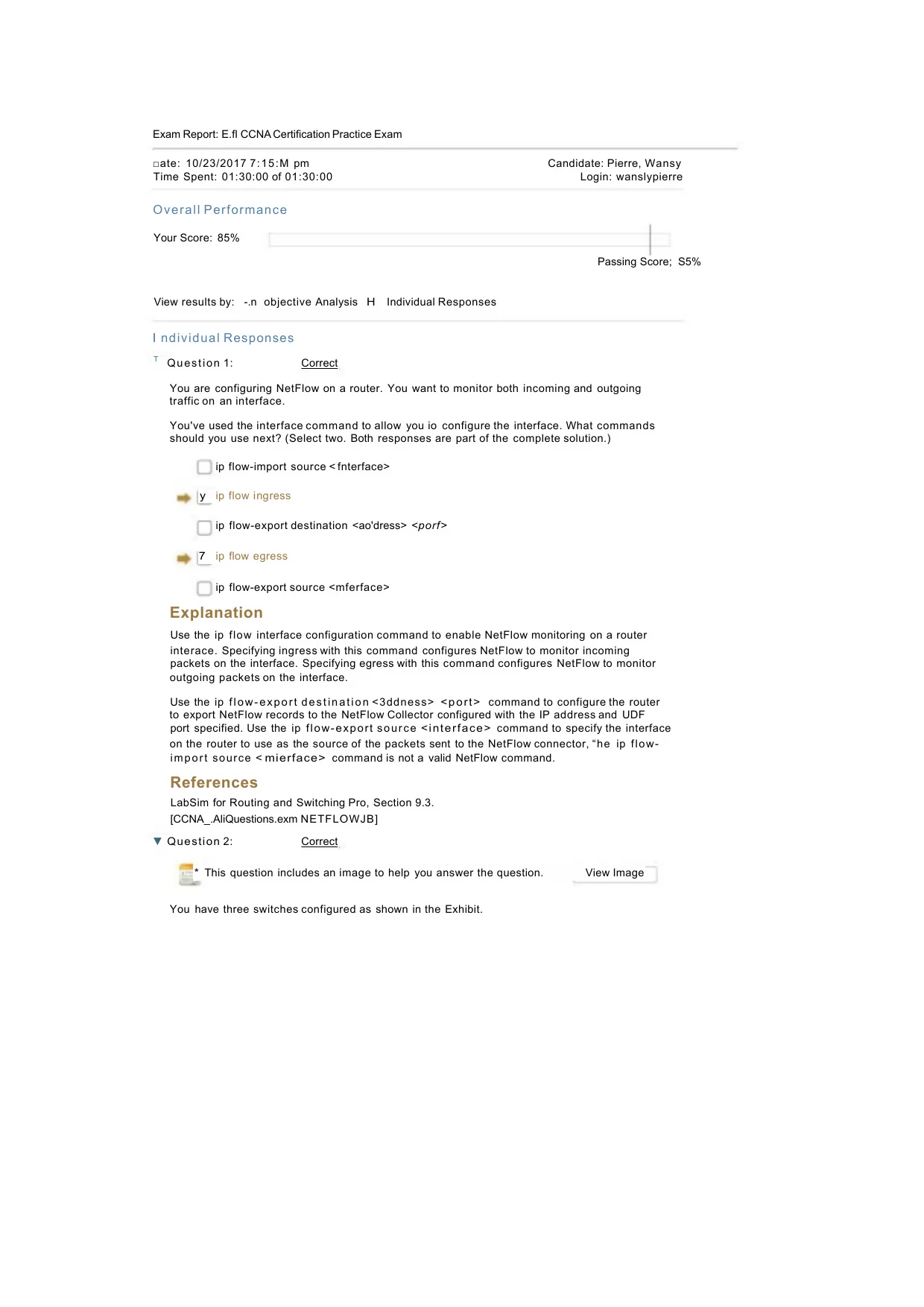
Exam Report: E.fl CCNA Certification Practice Examate: 10/23/2017 7 : 1 5 : M pmTime Spent: 01:30:00 of 01:30:00Candidate: Pierre, WansyLogin: wanslypierreO v e r a l l PerformanceYour Score: 85%Passing Score; S5%View results by:-.nobjective AnalysisHIndividual ResponsesI ndividual ResponsesTQ u e s t i o n 1:CorrectYou are configuring NetFlow on a router. You want to monitor both incoming and outgoingtraffic on an interface.You've used the interface command to allow you io configure the interface. What commandsshould you use next? (Select two. Both responses are part of the complete solution.)ip flow-import source < fnterface>yip flow ingressip flow-export destination <ao'dress><porf>7ip flow egressip flow-export source <mferface>ExplanationUse the ip flow interface configuration command to enable NetFlow monitoring on a routerinterace. Specifying ingress with this command configures NetFlow to monitor incomingpackets on the interface. Specifying egress with this command configures NetFlow to monitoroutgoing packets on the interface.Use the ip f l o w - e x p o r t d e s t i n a t i o n <3ddness>< p o r t >command to configure the routerto export NetFlow records to the NetFlow Collector configured with the IP address and UDFport specified. Use the ip f l o w - e x p o r t s o u r c e < i n t e r f a c e > command to specify the interfaceon the router to use as the source of the packets sent to the NetFlow connector, “he ip f l o w -i m p o r t s o u r c e < mierface>command is not a valid NetFlow command.ReferencesLabSim for Routing and Switching Pro, Section 9.3.[CCNA_.AliQuestions.exm NETFLOWJB]Question 2:Correct* This question includes an image to help you answer the question.View ImageYou have three switches configured as shown in the Exhibit.

Page 2

CCNA Practice Exam 5 - Page 2 preview image

Loading page ...

For each port, identify the port role and status after spanning tree convergence by matchingthe port states on theeft with the ports on the graphic. (Port states on the left can be usednrpore thannot at allBG i D,2cGjQf1Altn BLKRoot FWDDesg F'ADDesg FWDDesg FWDC GiDQRoot FWDExplanationIn this example:Switch B is the root bridge because :ts MAC address is the lowest. This means that GKL'1and GiD/2 are both designated ports (Desg) and are forward ng (FWD).- Pod Gi0i2 on switch A and GiD/2 on switch C are root ports. Root ports are forwarding.- For the segment between switch A anc C, GiE/1 on switch C is the designated port. This isbecause the MAC address for switch C is tower than the MAC add 'ess far switch A.GiO.'T on switch A is an alternate port (Attn) and is blockirg (BLK). There is only onedesignated port per segment, with all other ports being im a blocking slate.Root ports are in the forwarding (FWD) state, not in backing (BLK) state.ReferencesLabSim for Routing anc Switching Pro, Section 11.3.[CCNAAJQuestons.exm STP_COMCEPTS_01]Q u e s t i o n 3:CorrectYou have decided to use ACLs on your router to restrict TFTP traffic between networks.Specifically, you want to allow only the server with an IP address of 172. 17.3.1 to access anTFTP server on a different network with an IP address of 10.0.3.1. The TFTP protocol runs onDP port 60. To accomplish this, you create the following ACL on the router connecting thetwo networks:Routerfccmf gX access-list 100RoutericonfigX access-list 10D permit udp 172. 17.3.1 C.0.0.255 host 10.C.C-.1 eq 65Routericonf gX access-list 103 deny udp any any eq 65Rcuter(configX access-list 100 permit IP any anyAfter applying the ACL to inbound traffic on the interface connected to the 172.1 7.8.0/24network, you find that all hosts on the 172.17.3.0/24 network can still access the TFTP serviceon 1D.D.3.1 over port 65.Which of the following options can be used to fix this issue? (Select two.)Ada ar aaditioral ACL line of access-list100denyI Panyany.Remove the ACL Ifoetbst reads a c c e s s - l i s t 100 deny udpany any eq 69.■■/ .Modify the first ACL line t o a c c e s s - l i s t 100permit udp 1 72.17.8.1 0.0. 0.0 host1 0 . 0 . 0 . 1eq 69.JModify the first ACL ine tc a c c e s s - l i s t100permit udp host 172.17.8.1 host1 0 . 0 . 0 . 1eq 69.Modify the f rst ACL line t o a c c e s s - l i s t 100permitudp 1 72.1 7.8.10.0.255.255

Page 3

CCNA Practice Exam 5 - Page 3 preview image

Loading page ...

host 10.0.0.1 eq 69.ExplanationThis ssue is being caused by the ACL lire that reads access-list 100 p e r m i tudp1 7 2 . 1 7 . 8 . 1 0 . 0 . 0 . 2 5 5 h o s t l O . 0.0.1 eq 69. The 0.0.0.255 mast causes this lire io bematched by any source host whose IP adcress begins with 172.17.8, which would include sllhosts on the 172.17.8.0/24 subnet. Ether of the following resolutions will fix this issue:Mocify the first ACL line tc access-list 100 p e r m i t udp 1 7 2 . 1 7 . 8 . 1 D.0.D.0 h o s t1 0 . 0 . 0 . 1 eq 69. This matches only the source host with an IP address of 172.17.8.1.Modify the f rst ACL line to access-list100p e r m i t udph o s t172.17.8.1h o s t 10.0. 0.1eq 69. This also matches only the source host with an IP address of 172.17.8.1.Modifying the first ACL line toaccess-list 1 00 permit udp 172.17.8.1 0.0.255.255 host10. 0.0.1 eq69 would broacen the number of matches by allowing any source host whose IPacdress begins with 172.17, which violates the conditions of the scenario. Removing the ACLline that reads a c c e s s - l i s t100deny udp anyany eq 69 would allow all TFTP t-afnc throughby any host that doesn't match the f rst line. Adding an additional ACL line ofaccess-list 100deny I P anyanywould duplicate tne effect of the implicit deny and isn't necessary.ReferencesLabSim for Routing and Switcning Pro, Section 8.4.[CCNA_ATQuestions.exm ACL_TRB_03]Question 4:CorrectYour client has acquired several small companies ard would like to connect them together intoone network Not all the routers are Cisco devices and compatibility is a concern. Which WANencapsulation method should you recommend ycur client use?PPPEthernetPAPCisco HDLCExplanationThe Point-to-Point (PPP} protocol is not proprietary. For this reason, it is the best choice forconnecting dissimilar vendor devices.Cisco HDLC is the default serial encapsulation method, but is only supported on Cisco devices.PAP ts a PPP authentication protocol. Ethernet is not a WAN protocol.ReferencesLabSim for Routing and Switcning Pro, Section 13.3.|CCNA_ADQuesbDns.exm PPP_03]Question5:CorrectThis question induces an image to help you answer the question.View ImageYou have a small business network with a single subnet connected to the Internet through aCisco router (RouterA). IP addresses have been assigned as shown in tne ExhibitA browser session on the workstation tries to connect to the www.westsim.com weo server

Page 4

CCNA Practice Exam 5 - Page 4 preview image

Loading page ...

using 16.177.85.116 and port 8D.What IF address and port number will the Web server use as the destinaton address whenresponding to the workstation's request?IF address 190.57.111.89 and port 80IP address 172.17.1.1 and port 89IF add'ess 199.67.111.89 and a dynamic port chosen by the web serverIF address 172. 17. 1.55 and port 80IP address 169.67.111.89 and a dynamic port assigned by RouterAIF add’ess 172.17.1.55 and a port chosen by Wrk1ExplanationWhen the outgoing request passes through RouterA, the router translates the private inside IPaddress into a public address and a port number. The public address it uses in this case is itsown public IP address (169.57.111.89). To identify the private host, it generates a random portnumber and associates that port number with the private IP address. The outgoing packetidentifies 199.67.111.89 with the random port number as the source address, so the webserver uses this address when responding to the request.ReferencesLabSim for Routing anc Switching Pro, Section 8.5.[CCNA_AIIQuestions.exm MAT_09]Ques ti on 6 :CorrectYour router generates a log message with a severity level of 6 .What does this indicate?Immediate action is neecec.The system is unusable.A critical condition exists.The message is only informational in nature.ExplanationSystem lagging message severity levels include the following:E m e r g e n c i e s(0)System urusaoleAlerts (1)Immed ate actor, needecCritical (2)Critical conditionsErrors(3)Error conditionsWarnings (4)Warn ng conditionsNotifications(5)Normal by significant conditionsI n forma t i o n a l (6) Informational messages onlyDebugging (7)Debugging messagesIn this example, a severity level of 6 indicates the message is only informational in nature.References

Page 5

CCNA Practice Exam 5 - Page 5 preview image

Loading page ...

LabSim for Routing and Switching Pro, Section 5.7.[CCNA_AJIQjestions.exm SYSLOG_Q5]VQuestion7:IncorrectWhich can be stored in NVRAM on a Cisco device? (Select two.}] startup-config filelimited IOS versionrunning-config file4full IOS imageExplanationTherouter NVRAM is flashmemorythat saves data when the router is powered off. NVRAMholds the startup-config file and can also hold, depending on the device, the full IOS image.When the router starts, it loads the IOS image into system RAM, then applies the startup-configfile to create the running-config file.System ROM holds a limited IOS version that has minimal functionality to run the system if thefull IOS image cannot be located in NVRAM at startup.ReferencesLabSim for Routing anc Switching Pro, Section5.2.[CCNA_AIIGk.estions.exm SYSTEM_START_Q3]QuestionB:CorrectWhich of the following IPv6 addresses is used by a host to contact a DHCP server?FF02::2FE80::1:2FE30::2>FF02::1:2FE80::1FFQ2::1ExplanationFFQ2::1:2 is the IPv6 address used to contact a DHCP server. A l addresses with the FFDG::/8prefix are mu t cast addresses. IPv6 uses mu toasts instead of broadcasts. FFG2::2 is themulticast address for all route -s on the local link: FF02::1 is for all hosts on the link. FE80::/1Gis the prefix for Ink-local unicast addresses.ReferencesLabSim for Routing anc Switching Pro, Section 4.1.[CCNA_AJIQuestions.exm IPV6_OVRW_D7]Q u e s t i o n s :CorrectYou have been asked to configure a router to connect to network 152.163.3.48. Your

Page 6

CCNA Practice Exam 5 - Page 6 preview image

Loading page ...

supervisor tells you to use an additional four bits in the subnet mask.Which subnet mask shou d you use to configure the router?255.255.255.52255.255.255.248255.255.255.03255.255.255.15255.255.255.224«+255.255.255.24D255.255.255.4ExplanationUse 255.255.255.240 for the subnet maskTh s address s a Class C address. The defaultsubnet mask is 255.255.255.0. A subnet mask that masks an additional four bits has a binaryvalue of 11110DOD for the last octet. This converts to 240 decimal (128 + 04 + 32 + 16).ReferencesLabSim for Routing and Switching Fro, Section 3.4.[CCNA_AllQuestions.exm VLSM_D2]Question10:CorrectWhich of the following Cisco router commands can you use to test IP Application-layerprocesses as well as Network-layer connectivity?Ping+4telnettraceAll of the abovepirg and trace onlyExplanationOnlytelnettests Application processes. It attempts to open a remote session with the host.The other two utilities can test connect vity problems only up to the Network layer.ReferencesLabSim for Routing and Switching Pro, Section 5.8.[CCNA_AHQuestons.exm N E T C O M M_TRE_D1]Que stion 11:CorrectMatch each OS PF communication state on the left with the corresponding attributes on theright Esch state may be used once, more than once, or not at all.All of the information in the hello packet matches the router's settings.Init

Page 7

CCNA Practice Exam 5 - Page 7 preview image

Loading page ...

The routers regot ate how the data tpansferwill take place.ExstaftThe routers trade c atabase descriptions.ExchangeBoth routers have matching databases., /PulThe router receives a hello packet and checks the information it contains.ArtemptThe routers exchange LSUs that contain LSAs.LoadingA router receives a hello packet that includes its own RID in a list of neighbors.2-WayExplanationThe following dentifiesthe OSPF communication process:Down -The interface does not communicate via OSPF. When an interface becomes activeafter being in a down state, the router multicasts a hello packet.Attempt - Initially, a router's list of neighbors has a null value. As soon as it receives thehello packet, it checks the information wthin itsuch as the subnet mask, area ID, and soon.I nit -If all of the information in the hello packet matches tne routers sett ng s, the muterindicates to the neighbor that it is in the Init state. The router begins tc include the new RIDinits I st of neighbors.• 2 -way- As scon as a routerreceives a hello packet that induces Is own RID in a list ofneighbors, it has -eachec the two-way state.Exstart -In the exstart state, the routers negotiate how the data t'ansfer will take place.Exchange -In the exchange state, the two routers exchange database descriptions.L o a d i n g state - In the loading state, the routersexchange LSUs (Link-Stele Updates} thatcontain LSAs. Once the routers exchange this information, they will have match ngdatabases.Fullstate- 'When the routers have matching databases, they have entered 1he full state.ReferencesLabSim for Routing and Switching Pre. Section 14.2.[CCNA_AHQuesticns.exm OSPFJB]Question 12:CorrectYou check the time on a router and find that it is out of sync with the time on the other routersand switches in your network. To fix this issue, you decide io configure NTP on the router toget time from an internal authoritative (master) NTP server with an IP address of172.17.8.254.Which command should you use?ntp master 172.17.8.254

Page 8

CCNA Practice Exam 5 - Page 8 preview image

Loading page ...

ntp status«+ntp server 172.17.8.254feature nto 172.17.8.254ExplanationTo configure NTP on the routerto get time from an internal autbc'itatve NTP server with an IPsc d'ess of 172.17.8.254. use the ntps e r v e r 172.17.8.254 command. The NTP p'otocol, bydefault, will gradua ly adjust the time on the route' until it is synchronized wth the timeprovider.The ntp m a s t e r command is used to configure the cevce as an authoritative internal NTPtime provider. The f e a t u r e ntp command ts used to enable NTP on the device. Thentps t a t u s command is used to verify that the local time is synchronized with the NTP timeprovider.ReferencesLabSim for Routing anc Switching Pro, Section 8.7.[CCNA_AIK2uestions.exm NTPJJ5]V Q u e s t i o n 1 3 :CorrectFor each opera.tion listed on the right, drag and drop the coresponding command from the liston the left.Save the current configuration to NVRAMcopy run startLoad the current configuration saved in NVRAM into memorycopy start runSave the current configuration to a network servercopyruntftpCopy a configu'Btion file from a network servernto NVRAMcopy tfto startExplanationThe CLrrentiy-u sec configuration file is called therunning-configfile. The configuration filesaved in NVRAM isstartup-config.To save a configuration file, use the format: copyfromto.Usecopy run startto save the current configuration to NVRAM.Use copystartrunto load the current configu'ation saved in NVRAM into memory.Use copyrun tftpto save the current configu'ation to a network server.Use copytftpstartto copy a configuration file from a network server into NVRAM.ReferencesLabSim for Routing anc Switching Pro, Section 5.3.[CCNA_AJIQuestions.exm CLI_D4]Questio n14:IncorrectWhich of the following services are available regardless of whether the telephone company

Page 9

CCNA Practice Exam 5 - Page 9 preview image

Loading page ...

network is available?Cable modemDSLISDNDial-upExplanationA cable modem is a network connectivity service provided by the cable television serviceprovider. Cable modem operates by adding a bi-directional channel connected directly to anInternet Service Provider (ISP) through cable TV lines. 11dees not depend on phone lines torthe connection.Dial-up refers to Internet access using modems over the telephone company analog network.Integrated Services Digital Network (ISDN) is a method for providing digital connectivity servicethrough the telephone company network. ISDN can combine multiple channels consisting ofvoice and data simultaneously. DSL is a newer digital service provided by telephone serviceproviders. All cf these methods operate over regular phone lines.ReferencesLabSim for Routing and Switching Pro, Section 13.1.[CCNA_AllQuestons.exm OTHER_WANS_14]Question15:CorrectListed below are several places that a workstation checks to resolve DNS host names.A. Primary DNS serverB. Secondary DNS serversC. HOSTS fileD. Local DNS cacheIn a browser, you type the name of a website. In which order will these locations be checkedduring the name resolution process?A, C, DrBC. D, A, BA, B. D. CD, C, A, BA, B, CrDExplanationDNS name resolution looks for informat on in the fo lowing placesn this order:1. Local DNS cache2. HOSTS file3. DNS server queryNote: If the primary DNS server is unavailable, the secondary DNS servers are que-ied inorder. If a name server responds that the name is unknown, no additional servers areconsulted.

Page 10

CCNA Practice Exam 5 - Page 10 preview image

Loading page ...

ReferencesLabSim for Routing and Switching Pro, Section 6.3.[CCNA_.AllQuestions.exm SWrTCH_IP_CONF_1CJ]Question 16:CorrectYou have configured DHCP on your router. A parfal configuration is shown below:hostname RouterAinterface FastEtherretD/Oip address 192.168.11.1 255.255.255.0speed autoduplex autoip access-group 1 iniinterface FastEthemetD/1ip address 192.168.13.1 255.255.255.0speed autoduplex autoiip dhcp excludec-adcress 192.168.11.1 192.168.11.50ip dhcp excluded-address 192.168.12.1 102.168.12.50iip dhcp pool 3network 192.168.11.D 255.255.255.0domain-name westsim.comdns-server 192. 168. 11.2 192. 168.12.2default-router 192.168.11.1iip dncp pool 1network 192.168.12.D 255.255.255.Ddomain-name westsim.comdns-server 192.168.12.2 192.168.11.2default-router 192.168.12.1iip dhcp pool 2host 192.168.12.166hardware-address Q2c7.f80D.D422iaccess-list 1 permit 192.168.11.0 D.0.0.255iSrv2 is a host conrectec to the FaD/1 interface of RouterA. Its MAC address is 02c7.f80D.D422.Srv2 is configured to use DHCP to request an IP address.When Srv2 boots, it is configured with an IP address of 169.254.D.55/16. It needs to oeassignee the address of 192.168.12.166. What should you do to correct the problem?Add the host and h a r d w a r e - a d d l r e s s entries from chcp pool 2 to dhcp pool 1.Adc an ip dhcp e x c l u d e d - a d d r e s s statement for 192.168.12.166.Change the IP address assigned to FaD/1.Add an ip a c c e s s - g r o u p statement to FaQ>'1.

Page 11

CCNA Practice Exam 5 - Page 11 preview image

Loading page ...

Vot;the IP address assigned toFaD/1sc- that it ts on network 1S2.168. 12.0'24.Because its current IP address does not matcn a network identified in a DHCP pool, FaCu'1 wi Inot respond to DHCP requests. An address on the 169.254.0.01/24 subnet indicates that thehost could not contact a DHCP server.You cannot have Dothn e t w o r kandhostentrieswithinthe same ipdhcp poolsection.Access lists are rot used to identity the interfaces tnat run DHCP. Excluded adcresses areaddresses in the pool network that will not be assigned.ReferencesLabSim for Routing and Switching Pro, Section 8.1.[CCNAJMIQuestionsexm DHCP_11]Question17:'CorrectTh s question includes an image to help you answer the question.View ImageYou have a small network with four switches as shown in the diagram.Which cf the following are true? (Select two.}-aQr'1 on switch D is a trunk port.GiD/1 on switchis a trunk port.FaOi'3 on switch E is an access port.WFaD/2 on switch 6 is a trunk port.Switchhas one trunk port.ExplanationA trunk port is a port that directly connects two switches. In the network diagram, the followingare trunk ports:On switch A: Fa0/1.On switch B: FaLi/2 and GiD/1.On switch C: GiD/2.Access ports connect workstations, servers, or hubs to a switch port. In this diagram, switchhas only access ports. Fa0/1 connects to a switch, which makesitan access port. GiD/1 is anaccess port because it connects to a workstation. On Cisco 2959 switches, any port can becomea trunk portand any port can be used for an access port.ReferencesLabSim for Routing and Switching Pro, Section 6.5.[CCNA_A Quesiions.exm TRUNKJMG_D3]Question18:CorrectWhich cf the following benefits are offered to an organization using network add resstranslation (NAT)?&NAT provides a measure of network security.Remote hosts can access the corporate network through a secure tunnel.

Page 12

CCNA Practice Exam 5 - Page 12 preview image

Loading page ...

Broaccast traffic doma ns can oe def ned at Layer 2.It eliminates the need for routing.ExplanationThe following benefits are offered to an organ zation using network address translation (NAT):1. NAT eliminates tne need to re-acd'ess hosts that require external netwodc access whichsaves time and money.2. With NAT, internal hosts can share a single reg stered IP add -ess for all externalcommunications so few external addresses are requ red io supportmanyinternal hosts thusconserving IP adcresses.2. The internal hosts on the private network do not advertise their addresses or internaltopcogy externally, so NAT is a type of f rewall strategy that protects network security.NAT does not provde virtual private network (VPN) support to remote hosts, nor does it createLayer 2 broadcast domains like a VLAN.To implement NAT requires the use of a router.ReferencesLabSim for Routing anc Switching Pro, Section 8.5.[CCNA_.AllQuestions.exm NAT_01]VQuestion 19:'CorrectMatch the default administrative distance with the route type. (Each item may be used once,more than once, or not at all.)EIGRP internal routes,/ eaEIGRP external routes170OSPFV* 11DRIPy12DStatic routes1ExplanationThe admin strative d stance is a number assigned to a source of routing information (such as astatic route or a specific rout ng protocol). The router uses these values to select tne source ofinformation to use when multiple routes to a ceslinat on exist. A smaller number indicates amore trusted route.Static routes have an administrative distance of 1.EIGRP internaroutes have an administrative d stance of 90.OSPF has an admi nistretive distance o" 110.RIP has an administrative distance of 120.
Preview Mode

This document has 37 pages. Sign in to access the full document!