

Ethernet Concepts Exam Answers
- Cisco Certified Network Associate
- 50 pages
- Shared June 2025
Comprehensive CCNA 1 v7 Modules 4–7 exam guide focused on Ethernet concepts, including switching methods, MAC addressing, physical media, and OSI layers—perfect for networking students and certification prep.
Preview 15 of 50 pages
See the first 15 pages exactly as they appear in the document.
Page 1 Read page 1 as text
5/18/24, 5:27 AM CCNA 1 v7 Modules 4 - 7 : Ethernet Concepts Exam Answers IT Questions Bank IOS Command List Ebooks IP Calculators » Donations Search the site AD ® M 117 Exam Answers .net CCNA » Security » CyberOps » Home IT Questions Bank IOS Command List CCNA » CCNA Security v2.0 » Cybersecurity » Networking Essentials IP Subnet Calculators » Donation Contact https://itcxamanswcrs.net/ccna-l -v7-modulcs-4-7-cthcrnct-conccpts-cxam-answcrs.html 1/50
Page 2 Read page 2 as text
5/18/24, 5:27 AM CCNA 1 v7 Modules 4-7: Ethernet Concepts Exam Answers CCNA 1 v7 Modules 4 - 7: Ethernet CCNA v7.0 Exam Answers Concepts Exam Answers Dec 18, 2019 | Last Updated: Dec 20, 2022 | CCNA v7 Course #1 | 61 Comments /Share Tweet Share Pin it System Test Exam Modules 1-3: Basic Network Connectivity and Communications Exam Answers Modules 4-7: Ethernet Concepts Exam Answers Modules 8-10: Communicating Between Networks Exam Answers Modules 11 - 13: IP Addressing Exam Answers Modules 14 - 15: Network Application Communications Exam Answers Modules 16 - 17: Building and Securing a Small Network Exam Answers [PT Skills] Practice PT Skills Assessment (PTSA) [Final Skills] ITN Final Skills Exam (PTSA) TTNv7 Practice Final Exam CCNA 1 v7 FINAL Exam Answers How to find: Press "Ctrl + F" in the browser and fill in whatever wording is in the question to find that question/answer. If the question is not here, find it in Questions Bank NOTE: If you have the new question on this test, please comment Question and Multiple-Choice list in form below this article. We will update answers for you in the shortest time. Thank you! We truly value your contribution to the website. Empower Uki jiuian Chl!di«n r i Future Help war-impacted kids access education 7.00)- im ( Vci jon Jo: Introduction to Networks Modules 4 - 7 : Ethernet icepts 1. What is the purpose of the OSI • controlling access to media * transmitting bits across the local media • performing error detection on received frames https://itexamanswers.net/ccna-l-v7-modules-4-7-ethernet-concepts-exam-answers.html 2/50
Page 3 Read page 3 as text
5/18/24, 5:27 AM CCNA 1 v7 Modules 4-7: Ethernet Concepts Exam Answers • exchanging frames between nodes over physical network media 2. Why are two strands of fiber used for a single fiber optic connection? • The two strands allow the data to travel for longer distances without degrading. • They prevent crosstalk from causing interference on the connection. ’ They increase the speed at which the data can travel. • They allow for full-duplex connectivity. 3. Which characteristic describes crosstalk? • the distortion of the network signal from fluorescent lighting • the distortion of the transmitted messages from signals carried in adjacent wires • the weakening of the network signal over long cable lengths • the loss of wireless signal over excessive distance from the access point 4. Which procedure is used to reduce the effect of crosstalk in copper cables? DONATE TODAY MriyaAidxa n " 1A YOUR CONNECTIONryfl W I T H IT COMMUNITY _________ Join IT Cluster in the Cloud requiring proper grounding c twisting opposing circuit wir wrapping the bundle of wires bidding Related Posts 4.7.4 Module Quiz - Physical Layer (Answers) 5.3.2 Module Quiz - Number Systems (Answers) 12.5.8 Check Your Understanding - Dynamic Addressing for IPv6 GUAs Answers CCNA 1 v7.0 Curriculum: Module 16 - Network Security Fundamentals 7.2.7 Lab - View Network Device MAC Addresses (Answers) ■ designing a cable infrastructure to avoid crosstalk interference * avoiding sharp bends during installation https://itexamanswers.net/ccna-l-v7-modules-4-7-ethernet-concepts-exam-answers.html 3/50
Page 4 Read page 4 as text
5/18/24, 5:27 AM CCNA 1 v7 Modules 4-7: Ethernet Concepts Exam Answers 11.6.6 Lab - Calculate IPv4 Subnets (Answers) 2.9.2 Lab - Basic Switch and End Device Configuration (Answers) 7.1.5 Check Your Understanding - Ethernet Switching Answers 12.9.4 Module Quiz - IPv6 Addressing (Answers) 5.1.4 Check Your Understanding - Binary Number System Answers 5. Match the situation with the appropriate use of network media. AD I 6. A network administrator is measuring the transfer of bits across the company backbone for a mission critical financial application. The administrator notices that the network throughput appears lower than the bandwidth expected. Which three factors could influence the differences in throughput? (Choose three.) * the amount of traffic that is currently crossing the network ’ the sophistication of the encapsulation method applied to the data • the type of traffic that is crossing the network • the latency that is created by the number of network devices that the data is crossing ■ the bandwidth of the WAN connection to the Internet * the reliability of the gigabit Ethernet infrastructure of the backbone Recent Comments https://itexamanswers.net/ccna-l-v7-modules-4-7-ethernet-concepts-exam-answers.html 4/50
Page 5 Read page 5 as text
5/18/24, 5:27 AM CCNA I v7 Modules 4-7: Ethernet Concepts Exam Answers Miguel on Network Security (Versionl .0) - Final Exam Answers Full viva on CCNA 1 v7 Modules 11-13: IP Addressing Exam Answers Full xeno on Endpoint Security: My Knowledge Check Answers DanCooper on ENSA (Version 7.00) Final PT Skills Assessment Exam (PTSA) Answers Anandaraj on CCNA 1 v7.0 Final Exam Answers Full - Introduction to Networks 41D f o u n d a t i o n Determined and effective Support Ukrainian volunteers in making a bigger impact Explanation: Throughput usually does not match the specified bandwidth of physical links due to multiple factors. These factors include, the amount of traffic, type of traffic, and latency created by the network devices the data has to cross. 7. What are two characteristics of fiber-optic cable? (Choose two.) * It is not affected by EMI or RFI. ■ Each pair of cables is wrapped in metallic foil. * It combines the technique of cancellation, shielding, and twisting to protect data. * It typically contains 4 pairs of fiber-optic wires. ■ It is more expensive than UTP cabling is. Explanation: Fiber-optic cabling supports higher bandwidth than UTP for longer distances. Fiber is immune to EMI and RFI, but costs more, requires more skill to install, and requires more safety precaution 8. What is a primaiy role of the P data on the network? ansmitting • create the signals that represent the bits in each frame on to the media https://itexamanswers.net/ccna-l-v7-modules-4-7-ethernet-concepts-exam-answers.html 5/50
Page 6 Read page 6 as text
5/18/24, 5:27 AM CCNA 1 v7 Modules 4-7: Ethernet Concepts Exam Answers * provide physical addressing to the devices ■ determine the path packets take through the network * control data access to the media Explanation: The OSI physical layer provides the means to transport the bits that make up a frame across the network media. This layer accepts a complete frame from the data link layer and encodes it as a series of signals that are transmitted to the local media. 9. With the use of unshielded twisted-pair copper wire in a network, what causes crosstalk within the cable pairs? Invest In rtsilkinte Jiowl DONATE TODAY MriyaAid.ca n • the magnetic field around the adjacent pairs of wire • the use of braided wire to shield the adjacent wire pairs • the reflection of the electrical wave back from the far end of the cable ’ the collision caused by two nodes trying to use the media simultaneously Explanation: Crosstalk is a 0 that occurs when signal transm with another wire. When curre iterference e interferes a wire a magnetic field is produced. Th interface the signal earned in the adjacent wire. etic field will 10. Refer to the graphic. What type of cabling is shown? https://itexamanswers.net/ccna-l-v7-modules-4-7-ethernet-concepts-exam-answers.html 6/50
Page 7 Read page 7 as text
5/18/24, 5:27 AM CCNA 1 v7 Modules 4-7: Ethernet Concepts Exam Answers • STP • UTP • coax • fiber Explanation: Network cabling include different types of cables: • UTP cable consists of four pairs of color-coded wires that have been twisted together and then encased in a flexible plastic sheath. • STP cable uses four pairs of wires, each wrapped in a foil shield, which are then wrapped in an overall metallic braid or foil. * Coaxial cable uses a copper conductor and a layer of flexible plastic insulation surrounds the copper conductor. * Fiber cable is a flexible, extremely thin, transparent strand of glass surrounded by plastic insulation. 11. In addition to the cable length, what two factors could interfere with the communication carried over UTP cables? (Choose two.) * crosstalk bandwidth size of the network signal modulation technique electromagnetic interference Explanation: Copper media is widely used in network communications. However, copper media is limited by distance and signal interference. Data is transmitted on https://itexamanswers.net/ccna-l-v7-modules-4-7-ethernet-concepts-exam-answers.html 7/50
Page 8 Read page 8 as text
5/18/24, 5:27 AM CCNA 1 v7 Modules 4-7: Ethernet Concepts Exam Answers copper cables as electrical pulses. The electrical pulses are susceptible to interference from two sources: * Electromagnetic interference (EMI) or radio frequency interference (RFI) - EMI and RFI signals can distort and corrupt the data signals being carried by copper media. ■ Crosstalk - Crosstalk is a disturbance caused by the electric or magnetic fields of a signal on one wire interfering with the signal in an adjacent wire. 12. Refer to the graphic. What type of cabling is shown? * STP ■ UTP ■ coax • fiber 13. Which two devices commonly affect wireless networks? (Choose two.) * Blu-ray players https://itexamanswers.net/ccna-l-v7-modules-4-7-ethernet-concepts-exam-answers.html 8/50
Page 9 Read page 9 as text
5/18/24, 5:27 AM CCNA 1 v7 Modules 4-7: Ethernet Concepts Exam Answers • home theaters ■ cordless phones • microwaves • incandescent light bulbs • external hard drives Explanation: Radio Frequency Interference (RFI) is the interference that is caused by radio transmitters and other devices that are transmitting in the same frequency. 14. Which two statements describe the services provided by the data link layer? (Choose two.) It defines the end-to-end delivery addressing scheme. It maintains the path between the source and destination devices during the data transmission. It manages the access of frames to the network media. It provides reliable delivery through link establishment and flow control. It ensures that application data will be transmitted according to the prioritization. It packages various Layer 3 PDUs into a frame format that is compatible with the network interface. Explanation: The data link layer is divided into two sub layers, namely Logical Link Control (LLC) and Media Access Control (MAC). LLC forms a frame from the network layer PDU into a format that conforms to the requirements of the network interface and media. A network layer PDU might be for IPv4 or IPv6. The MAC sub layer defines the media access processes performed by the hardware. It manages the frame access to the network media according to the physical signaling requirements wireless, etc.) iber optic, 15. What is the function of the C FCS field of a frame? und in the ' to verify the integrity of the received frame " to verify the physical address in the frame https://itexamanswers.net/ccna-l-v7-modules-4-7-ethernet-concepts-exam-answers.html 9/50
Page 10 Read page 10 as text
5/18/24, 5:27 AM CCNA I v7 Modules 4-7: Ethernet Concepts Exam Answers * to verify the logical address in the frame ■ to compute the checksum header for the data field in the frame Explanation: The CRC value in the FCS field of the received frame is compared to the computed CRC value of that frame, in order to verify the integrity of the frame. If the two values do not match, then the frame is discarded. 16. What is contained in the trailer of a data-link frame? * logical address * physical address ■ data ■ error detection Explanation: The trailer in a data-link frame contains error detection information that is pertinent to the frame included in the FCS field. The header contains control information, such as the addressing, while the area that is indicated by the word "data" includes the data, transport layer PDU, and the IP header. 17. Which statement describes a characteristic of the frame header fields of the data link layer? rn p o w e r U k r a i n i a n C h i l d r e n ' s F u t u r e Help W a r - I m p a c t e d Kids Access Educa •8&UKRAINE =- FRIENDS 61 They all include the flow con Ethernet frame header fields connection fields. am Lay source and They vary depending on prot destination addresses. They include information on user applications. https://itexamanswers.net/ccna-l-v7-modules-4-7-ethernet-concepts-exam-answers.html 10/50
Page 11 Read page 11 as text
5/18/24, 5:27 AM CCNA 1 v7 Modules 4-7: Ethernet Concepts Exam Answers Explanation: All data link layer protocols encapsulate the Layer 3 PDU within the data field of the frame. However, the structure of the frame and the fields that are contained in the header vary according to the protocol. Different data link layer protocols may use different fields, like priority/quality of service, logical connection control, physical link control, flow control, and congestion control. 18. A network team is comparing physical WAN topologies for connecting remote sites to a headquarters building. Which topology provides high availability and connects some, but not all, remote sites? • mesh • partial mesh • hub and spoke • point-to-point Explanation: Partial mesh topologies provide high availability by interconnecting multiple remote sites, but do not require a connection between all remote sites. A mesh topology requires point-to-point links with every system being connected to every other system. A point-to-point topology is where each device is connected to one other device. A hub and spoke uses a central device in a star topology that connects to other point-to-point devices. 19. Which two fields or features does Ethernet examine to determine if a received frame is passed to the data link layer or discarded by the NIC? (Choose two.) * auto-MDIX * CEF * Frame Check Sequence ■ minimum frame size ’ source MAC address Explanation: An Ethernet frame is not processed and is discarded if it is smaller than the minimum (64 bytes) or if the https://itexamanswers.net/ccna-l-v7-modules-4-7-ethernet-concepts-exam-answers.html 11/50
Page 12 Read page 12 as text
5/18/24, 5:27 AM CCNA 1 v7 Modules 4-7: Ethernet Concepts Exam Answers calculated frame check sequence (FCS) value does not match the received FCS value. Auto-MDIX (automatic medium-dependent interface crossover) is Layer 1 technology that detects cable straight-through or crossover types. The source MAC address is not used to determine how the frame is received. CEF (Cisco Express Forwarding) is a technology used to expedite Layer 3 switching. 20. Which media communication type does not require media arbitration in the data link layer? ’ deterministic * half-duplex * full-duplex * controlled access Explanation: Half-duplex communication occurs when both devices can both transmit and receive on the medium but cannot do so simultaneously. Full-duplex communication occurs when both devices can transmit and receive on the medium at the same time and therefore does not require media arbitration. Half-duplex communication is typically contention-based, whereas controlled (deterministic) access is applied in technologies where devices take turns to access the medium. 21. Which statement describes an extended star topology? AD a ID f d fl <i 0 t i o n Support Ukra in making a bigger impoci Deter and e https://itexamanswers.net/ccna-l-v7-modules-4-7-ethernet-concepts-exam-answers.html 12/50
Page 13 Read page 13 as text
5/18/24, 5:27 AM CCNA 1 v7 Modules 4-7: Ethernet Concepts Exam Answers * End devices connect to a central intermediate device, which in turn connects to other central intermediate devices. * End devices are connected together by a bus and each bus connects to a central intermediate device. ■ Each end system is connected to its respective neighbor via an intermediate device. * All end and intermediate devices are connected in a chain to each other. Explanation: In an extended star topology, central intermediate devices interconnect other star topologies. 22. What is a characteristic of the LLC sublayer? • It provides the logical addressing required that identifies the device. • It provides delimitation of data according to the physical signaling requirements of the medium. • It places information in the frame allowing multiple Layer 3 protocols to use the same network interface and media. ■ It defines software processes that provide services to the physical layer. Explanation: The Logical Link Control (LLC) defines the software processes that provide services to the network layer protocols. The information is placed by LLC in the frame and identifies which network layer protocol is being used for the frame. This information allows multiple Layer 3 protocols, such as IPv4 and IPv6, to utilize the same network interface and media. 61 23. What are three ways that medi networking? (Choose three.) is used in Ethernet utilizes CSMA/CD. • Media access control provides placement of data frames onto the media. ■ Contention-based access is also known as deterministic. https://itexamanswers.net/ccna-l-v7-modules-4-7-ethernet-concepts-exam-answers.html 13/50
Page 14 Read page 14 as text
5/18/24, 5:27 AM CCNA 1 v7 Modules 4-7: Ethernet Concepts Exam Answers * 802.11 utilizes CSMA/CD. ■ Data link layer protocols define the rules for access to different media. * Networks with controlled access have reduced performance due to data collisions. Explanation: Wired Ethernet networks use CSMA/CD for media access control. IEEE 802.11 wireless networks use CSMA/CA, a similar method. Media access control defines the way data frames get placed on the media. The controlled access method is deterministic, not a contention-based access to networks. Because each device has its own time to use the medium, controlled access networks such as legacy Token Ring do not have collisions. 24. During the encapsulation process, what occurs at the data link layer for a PC connected to an Ethernet network? • An IP address is added. • The logical address is added. • The physical address is added. • The process port number is added. Explanation: The Ethernet frame includes the source and destination physical address. The trailer includes a CRC value in the Frame Check Sequence field to allow the receiving device to determine if the frame has been changed (has errors) during the transmission. 25. What three items are contained in an Ethernet header and trailer? (Choose three.) * source IP address https://itexamanswers.net/ccna-l-v7-modules-4-7-ethernet-concepts-exam-answers.html 14/50
Page 15 Read page 15 as text
5/18/24, 5:27 AM CCNA 1 v7 Modules 4-7: Ethernet Concepts Exam Answers * source MAC address ■ destination IP address ’ destination MAC address * error-checking information Explanation: Layer 2 headers contain the following: * Frame start and stop indicator flags at the beginning and end of a frame * Addressing - for Ethernet networks this part of the header contains source and destination MAC addresses ■ Type field to indicate what Layer 3 protocol is being used * Error detection to determine if the frame arrived without error 26. What type of communication rule would best describe CSMA/CD? • access method * flow control * message encapsulation • message encoding Explanation: Carrier sense multiple access collision detection (CSMA/CD) is the access method used with Ethernet. The access method rule of communication dictates how a network device is able to place a signal on the carrier. CSMA/CD dictates those rules on an Ethernet network and CSMA/CA dictates those rules on an 802.11 wireless LAN. 27. Which three basic parts are common to all frame types supported by the data link layer? ( ’ header • type field • MTU size ’ data ■ trailer * CRC value https://itexamanswers.net/ccna-l-v7-modules-4-7-ethernet-concepts-exam-answers.html 15/50
35 more pages in the full document
Unlock it once and it stays in your library, ready to chat with or turn into flashcards.
Unlock the full documentMore Cisco Certified Network Associate study materials
See all Certification Guides
31 Days Before your CCNA Exam: A Day-By-Day Review Guide for the CCNA 200-301 Certification Exam (2020)
Cisco Certified Network Associate
1154 pages107downloadsFeb 2025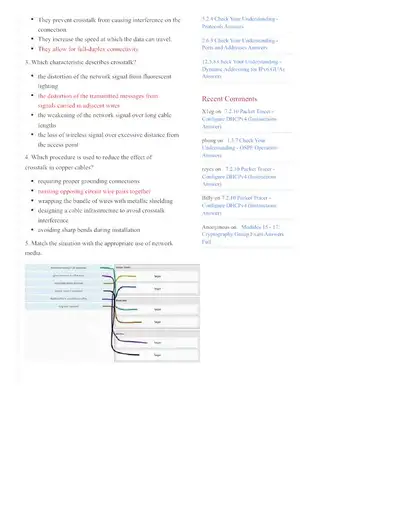 Past Exams
CCNA 1 v7 Modules 4 to 7 Ethernet Concepts Exam An
Cisco Certified Network Associate
33 pagesJun 2025 Past Exams
Type 2 Cisco CCNA Certifications
Cisco Certified Network Associate
3 pagesJun 2025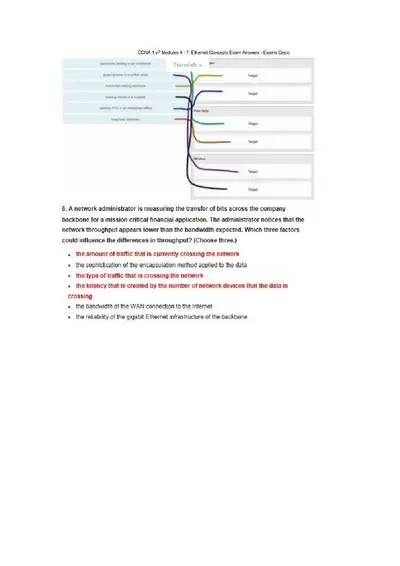 Past Exams
CCNA 1 v7 Modules 4 7 Ethernet Concepts Exam
Cisco Certified Network Associate
29 pagesJun 2025 Class Notes
CCNA 1 v7.0 Module 9: Address Resolution — MAC, IP and ARP
Cisco Certified Network Associate
21 pagesJun 2025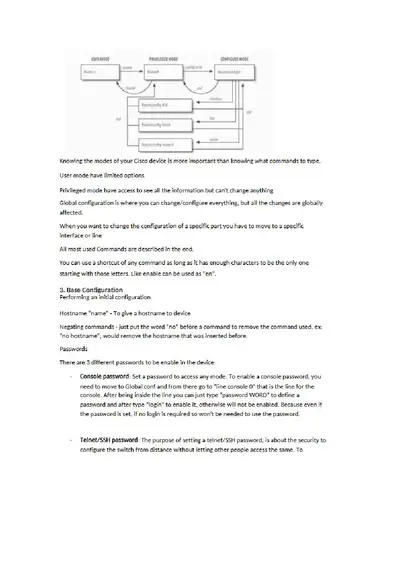 Class Notes
CCNA Week 1 Networks Basic Configuration
Cisco Certified Network Associate
33 pagesJun 2025 Past Exams
CCNA Exam Review Fundamentals12 Stamped
Cisco Certified Network Associate
70 pagesJun 2025 Class Presentation
Week 4 Security Concepts CCNA
Cisco Certified Network Associate
84 pagesJun 2025
Study this document with CramX
Once it is in your library, every tool can work from it.