

Mike Meyers' CompTIA Security+ SY0-601 Exam Certification Guide, 3rd Edition (2021)
- CompTIA Certifications
- 1258 pages
- Shared February 2025
- 55 downloads
Mike Meyers' CompTIA Security+ SY0-601 Exam Certification Guide, 3rd Edition (2021) is the ultimate study tool to help you pass your exam on the first try.
Preview 31 of 1258 pages
See the first 31 pages exactly as they appear in the document.
Page 1 Page 2 Page 3 Read page 3 as text
ABOUT THE AUTHORS Mike Meyers , CompTIA A+, CompTIA Network+, CompTIA Security+, is the industry’s leading authority on CompTIA certifications and the best- selling author of ten editions of CompTIA A+ Certification All-in-One Exam Guide (McGraw Hill). He is the president and founder of Total Seminars, LLC, a major provider of PC and network repair seminars for thousands of organizations throughout the world, and a member of CompTIA. Scott Jernigan , CompTIA ITF+, CompTIA A+, CompTIA Network+, CompTIA Security+, MCP, is the author or co-author (with Mike Meyers) of over two dozen IT certification books, including CompTIA IT Fundamentals (ITF+) Certification All-in-One Exam Guide (McGraw Hill). He has taught seminars on building, fixing, and securing computers and networks all over the United States, including stints at the FBI Academy in Quantico, Virginia, and the UN Headquarters in New York City, New York. About the Technical Editor Matt Walker is currently a member of the Cyber Security Infrastructure team at Kennedy Space Center with DB Consulting. An IT security and education professional for more than 20 years, he has served in multiple positions ranging from director of the Network Training Center and a curriculum lead/senior instructor for Cisco Networking Academy on Ramstein AB, Germany, to instructor supervisor and senior instructor at Dynetics, Inc., in Huntsville, Alabama, providing onsite certification- awarding classes for (ISC) 2 , Cisco, and CompTIA. Matt has written and contributed to numerous technical training books for NASA, Air Education and Training Command, and the US Air Force, as well as commercially ( CEH Certified Ethical Hacker All-in-One Exam Guide , now in its fourth
Page 4 Read page 4 as text
edition), and continues to train and write certification and college-level IT and IA security courses.
Page 5 Page 6 Read page 6 as text
Copyright © 2021 by McGraw Hill. All rights reserved. Except as permitted under the United States Copyright Act of 1976, no part of this publication may be reproduced or distributed in any form or by any means, or stored in a database or retrieval system, without the prior written permission of the publisher, with the exception that the program listings may be entered, stored, and executed in a computer system, but they may not be reproduced for publication. ISBN: 978-1-26-047370-4 MHID: 1-26-047370-8 The material in this eBook also appears in the print version of this title: ISBN: 978-1-26-047369-8, MHID: 1-26-047369-4. eBook conversion by codeMantra Version 1.0 All trademarks are trademarks of their respective owners. Rather than put a trademark symbol after every occurrence of a trademarked name, we use names in an editorial fashion only, and to the benefit of the trademark owner, with no intention of infringement of the trademark. Where such designations appear in this book, they have been printed with initial caps. McGraw-Hill Education eBooks are available at special quantity discounts to use as premiums and sales promotions or for use in corporate training programs. To contact a representative, please visit the Contact Us page at www.mhprofessional.com. Information has been obtained by McGraw Hill from sources believed to be reliable. However, because of the possibility of human or mechanical error by our sources, McGraw Hill, or others, McGraw Hill does not guarantee the accuracy, adequacy, or completeness of any information and is not responsible for any errors or omissions or the results obtained from the use of such information. TERMS OF USE
Page 7 Read page 7 as text
This is a copyrighted work and McGraw-Hill Education and its licensors reserve all rights in and to the work. Use of this work is subject to these terms. Except as permitted under the Copyright Act of 1976 and the right to store and retrieve one copy of the work, you may not decompile, disassemble, reverse engineer, reproduce, modify, create derivative works based upon, transmit, distribute, disseminate, sell, publish or sublicense the work or any part of it without McGraw-Hill Education’s prior consent. You may use the work for your own noncommercial and personal use; any other use of the work is strictly prohibited. Your right to use the work may be terminated if you fail to comply with these terms. THE WORK IS PROVIDED “AS IS.” McGRAW-HILL EDUCATION AND ITS LICENSORS MAKE NO GUARANTEES OR WARRANTIES AS TO THE ACCURACY, ADEQUACY OR COMPLETENESS OF OR RESULTS TO BE OBTAINED FROM USING THE WORK, INCLUDING ANY INFORMATION THAT CAN BE ACCESSED THROUGH THE WORK VIA HYPERLINK OR OTHERWISE, AND EXPRESSLY DISCLAIM ANY WARRANTY, EXPRESS OR IMPLIED, INCLUDING BUT NOT LIMITED TO IMPLIED WARRANTIES OF MERCHANTABILITY OR FITNESS FOR A PARTICULAR PURPOSE. McGraw-Hill Education and its licensors do not warrant or guarantee that the functions contained in the work will meet your requirements or that its operation will be uninterrupted or error free. Neither McGraw-Hill Education nor its licensors shall be liable to you or anyone else for any inaccuracy, error or omission, regardless of cause, in the work or for any damages resulting therefrom. McGraw-Hill Education has no responsibility for the content of any information accessed through the work. Under no circumstances shall McGraw-Hill Education and/or its licensors be liable for any indirect, incidental, special, punitive, consequential or similar damages that result from the use of or inability to use the work, even if any of them has been advised of the possibility of such damages. This limitation of liability shall apply to any claim or cause whatsoever whether such claim or cause arises in contract, tort or otherwise.
Page 8 Read page 8 as text
For the great friends from around the world who shared this crazy lockdown with us: Andre de Gooyert, Tullowit, Alice Pozzi, Zak Morrill, Patricia Grace, Jose Braden, and so many others. Cheers! —Mike and Scott
Page 9 Read page 9 as text
CONTENTS AT A GLANCE Chapter 1 Risk Management Chapter 2 Cryptography Chapter 3 Identity and Account Management Chapter 4 Tools of the Trade Chapter 5 Securing Individual Systems Chapter 6 The Basic LAN Chapter 7 Securing Wireless LANs Chapter 8 Securing Public Servers Chapter 9 Securing Dedicated Systems Chapter 10 Physical Security Chapter 11 Protocols and Applications Chapter 12 Testing Infrastructure Chapter 13 Dealing with Incidents Appendix A Exam Objective Map Appendix B About the Online Content Glossary Index
Page 10 Read page 10 as text
CONTENTS Acknowledgments Introduction Chapter 1 Risk Management Module 1-1: Defining Risk Asset Likelihood Threat Actor Vulnerability and Threat Circling Back to the Risk Definition Vectors Threat Intelligence Module 1-2: Risk Management Concepts Infrastructure Security Controls Risk Management Frameworks Module 1-3: Security Controls Control Categories Control Types Module 1-4: Risk Assessment Risk Assessment Processes and Concepts Quantitative Risk Assessment Qualitative Risk Assessment Putting It All Together: Risk Analysis Risk Response Module 1-5: Business Impact Analysis BIA Basics Types of Impact Locating Critical Resources
Page 11 Read page 11 as text
Calculating Impact Calculating Downtime Module 1-6: Data Security and Data Protection Organizing Data Legal and Compliance Data Destruction Privacy Breaches Module 1-7: Personnel Risk and Policies Hiring Onboarding Personnel Management Policies Training Policies User Habits Offboarding Module 1-8: Third-Party Risk and Policies Third-Party Risk Management Agreement Types Questions Answers Chapter 2 Cryptography Module 2-1: Cryptography Basics Essential Building Blocks Early Cryptography Cryptography Components Module 2-2: Cryptographic Methods Symmetric Cryptography Asymmetric Cryptography Hashing Limitations in Symmetric vs. Asymmetric Cryptography Hybrid Cryptography The Perfect Cryptosystem Module 2-3: Symmetric Cryptosystems DES
Page 12 Read page 12 as text
3DES AES Blowfish Twofish RC4 Summary of Symmetric Algorithm Characteristics Module 2-4: Asymmetric Cryptosystems RSA Diffie-Hellman PGP/GPG ECC ElGamal Module 2-5: Hashing Algorithms Hashing Process MD5 SHA RIPEMD HMAC Module 2-6: Digital Signatures and Certificates Digital Signatures Digital Certificates Module 2-7: Public Key Infrastructure Keys, Algorithms, and Standards PKI Services Digital Certificates and PKI Structure Key Safety Trust Models Module 2-8: Cryptographic Attacks Attack Strategies Attackable Data Attack Scenarios Defending Password Storage Other Attack Options Module 2-9: Other Cryptosystems Homomorphic Encryption
Page 13 Read page 13 as text
Blockchain Quantum Cryptography Questions Answers Chapter 3 Identity and Account Management Module 3-1: Understanding Authentication Identification and AAA Identification and Authentication Authorization Accounting Trust Module 3-2: Authentication Methods and Access Controls Authentication Methods Biometrics Authorization and Access Control Schemes/Models Module 3-3: Account Management User Accounts Account Policies Account Administration Module 3-4: Point-to-Point Authentication PAP CHAP/MS-CHAP Remote Access Connection and Authentication Services Module 3-5: Network Authentication The Challenge of LAN Access Management Microsoft Networking LDAP and Secure LDAP Module 3-6: Identity Management Systems Trust Shared Authentication Schemes Questions Answers Chapter 4 Tools of the Trade
Page 14 Read page 14 as text
Module 4-1: Operating System Utilities Network Reconnaissance and Discovery File Manipulation Shell and Script Environments Module 4-2: Network Scanners Scanning Methods Scanning Targets Scanner Types Module 4-3: Protocol Analyzers Why Protocol Analyze? Wireshark tcpdump Module 4-4: Monitoring Networks Exploring Log Files Centralizing Log Files Security Information and Event Management Log File Management Questions Answers Chapter 5 Securing Individual Systems Module 5-1: Types of System Attacks Attacking Applications Driver Manipulation Malicious Code or Script Execution Module 5-2: Malware Virus Cryptomalware/Ransomware Worm Trojan Horse Potentially Unwanted Programs Bots/Botnets Logic Bomb Keylogger RAT
Page 15 Read page 15 as text
Rootkit Backdoor Module 5-3: Cybersecurity Resilience Non-persistence Redundancy Diversity Module 5-4: Securing Hardware Physical Attacks Securing the Systems Securing Boot Integrity Module 5-5: Securing Endpoints Hardening Operating Systems Anti-malware Data Execution Prevention File Integrity Monitors Data Loss Prevention Module 5-6: System Recycling Clear Purge Destroy Questions Answers Chapter 6 The Basic LAN Module 6-1: Layer 2 LAN Attacks ARP Poisoning Man-in-the-Middle Attacks MAC Flooding MAC Cloning Module 6-2: Organizing LANs Configuration Management Network Segmentation Load Balancing Module 6-3: Implementing Secure Network Designs Securing the LAN
Page 16 Read page 16 as text
Internet Connection Firewalls Securing Servers Module 6-4: Virtual Private Networks How VPNs Work Early VPNs IPsec VPNs TLS VPNs Module 6-5: Network-Based Intrusion Detection/Prevention Detection vs. Prevention Detecting Attacks Configuring Network-Based IDS/IPS Monitoring NIDS/NIPS Endpoint Detection and Response Questions Answers Chapter 7 Securing Wireless LANs Module 7-1: Networking with 802.11 Wireless Cryptographic Protocols Wireless Authentication Protocols Module 7-2: Attacking 802.11 Wireless Survey/Stumbler Packet Capture Attack Tools Rogue Access Point Jamming Packet Sniffing Deauthentication Attack Near-Field Communication Replay Attacks WEP/WPA Attacks WPS Attacks Wireless Peripherals Module 7-3: Securing 802.11 Installation Considerations
Page 17 Read page 17 as text
Wireless Configuration Security Posture Assessment Questions Answers Chapter 8 Securing Public Servers Module 8-1: Attacking and Defending Public Servers Distributed Denial-of-Service Route Security Quality of Service Monitoring Services Module 8-2: Virtualization Security Virtualization Architecture Containers Virtualization Risks Using Virtualization for Security Module 8-3: Cloud Deployment Let’s Talk Amazon Cloud Deployment Models Cloud Architecture Models Cloud Growing Pains Module 8-4: Securing the Cloud Cloud Security Controls Unique Cloud Security Solutions Questions Answers Chapter 9 Securing Dedicated Systems Module 9-1: Embedded, Specialized, and Mobile Systems Embedded Systems SCADA/ICS Internet of Things Specialized Systems Mobile Systems Module 9-2: Connecting to Dedicated Systems
Page 18 Read page 18 as text
Common Communication Technologies IoT-Specific Communication Technologies Module 9-3: Security Constraints for Dedicated Systems Hardware Programming Connectivity Module 9-4: Implementing Secure Mobile Solutions Mobile Device Management Deployment Models Inventory Control and Asset Tracking Application Management and Security Encryption and Authentication Enforcement and Monitoring for Device Security Questions Answers Chapter 10 Physical Security Module 10-1: Physical Security Controls Passive Defensive Systems and Perimeter Controls Active Alert Systems Manned Defensive Systems Module 10-2: Environmental Controls EMI and RFI Shielding Fire Suppression HVAC Temperature and Humidity Controls Hot and Cold Aisles Environmental Monitoring Questions Answers Chapter 11 Secure Protocols and Applications Module 11-1: Secure Internet Protocols DNS Security SNMP
Page 19 Read page 19 as text
SSH FTP SRTP Module 11-2: Secure Web and E-mail HTTP HTTPS E-mail Module 11-3: Web Application Attacks Injection Attacks Hijacking and Related Attacks Other Web Application Attacks Module 11-4: Application Security Development Code Quality and Testing Staging Production Quality Assurance Getting Organized Module 11-5: Certificates in Security Certificate Concepts and Components PKI Concepts Online vs. Offline CA PKI TLS Scenario Types of Certificates Certificate Formats Key Escrow Questions Answers Chapter 12 Testing Infrastructure Module 12-1: Vulnerability Impact Device/Hardware Vulnerabilities Configuration Vulnerabilities Management/Design Vulnerabilities Module 12-2: Social Engineering
Page 20 Read page 20 as text
Social Engineering Goals Principles Types of Attacks Module 12-3: Artificial Intelligence Understanding Artificial Intelligence Machine Learning Essentials OSINT Adversarial Artificial Intelligence Module 12-4: Security Assessment Threat Hunting Vulnerability Scans Penetration Testing Module 12-5: Assessment Tools Protocol Analyzer Network Scanner Vulnerability Scanner Configuration Compliance Scanner Penetration Testing with Metasploit Specific Tools Mentioned by CompTIA Interpreting Security Assessment Tool Results Questions Answers Chapter 13 Dealing with Incidents Module 13-1: Incident Response Incident Response Concepts Incident Response Procedures Scenarios: Mitigation During and After an Incident Module 13-2: Digital Forensics Digital Forensics Concepts Data Volatility Critical Forensics Practices Data Acquisition Analyzing Evidence Module 13-3: Continuity of Operations and Disaster Recovery
Page 21 Read page 21 as text
Risk Management Best Practices Contingency Planning and Resilience Functional Recovery Plans Backup and Restore Plans and Policies Questions Answers Appendix A Exam Objective Map Exam SY0-601 Appendix B About the Online Content System Requirements Your Total Seminars Training Hub Account Privacy Notice Single User License Terms and Conditions TotalTester Online Other Book Resources Video Training from Mike Meyers TotalSim Simulations Mike’s Cool Tools Technical Support Glossary Index
Page 22 Read page 22 as text
ACKNOWLEDGMENTS In general, we’d like to thank our amazing teams at McGraw Hill and KnowledgeWorks Global Ltd. for such excellent support and brilliant work editing, laying out, and publishing this edition. Special shout out to our co- workers at Total Seminars—Michael Smyer, Dave Rush, and Travis Everett —for listening to us rant and providing excellent feedback. We’d like to acknowledge the many people who contributed their talents to make this book possible: To Tim Green, our acquisitions editor at McGraw Hill : Thank you for the steady encouragement during this crazy year. You’re the best! To Matt Walker, technical editor : Excellent working with you! Thanks for laughing at our geeky jokes and sharing great stories. To Bill McManus, copy editor : What an absolute delight to do this project with you! Your efforts made this a much better book. To Emily Walters, acquisitions coordinator at McGraw Hill : Thanks for the Friday meetings and slightly menacing cat-on-lap petting. Way to keep us on track! To Neelu Sahu, project manager at KnowledgeWorks Global Ltd. : Enjoyed working with you, Neelu. Hope the somewhat chaotic pacing wasn’t too stressful! To Lisa McCoy, proofreader : Fabulous job, thanks! To Ted Laux, indexer extraordinaire : Well done! To KnowledgeWorks Global Ltd. compositors : The layout was excellent, thanks! To Janet Walden, editorial supervisor at McGraw Hill : Great to work with you on this project! Next time we’ll make a few extra changes in page proofs just for you! To Tom Somers, production supervisor at McGraw Hill : Thanks for waving that magic wand of yours and making so much happen as smoothly as possible.
Page 23 Read page 23 as text
INTRODUCTION Most societies teem with a host of networked devices, from servers to smartphones, that provide the backbone for much of modern life. People and companies use these devices to produce and sell products and services, communicate around the globe, educate at every level, and manage the mechanisms of governments everywhere. Networked devices and the complex networks that interconnect them offer advances for humanity on par with, or perhaps beyond, the Agricultural and Industrial Revolutions. That’s the good news. The bad news is the fact that reliance on these devices creates a security risk to the resources placed on them. Networks can lose critical data and connections, both of which equate to loss of energy, confidence, time, and money. To paraphrase a few words from the American statesman, James Madison, if humans were angels, there’d be no need for security professionals. But humans are at best negligent and at worst petty, vindictive, and astoundingly creative in pursuit of your money and secrets. Networked devices and the networks that interconnect them need security professionals to stand guard. The need for security professionals in information technology (IT) far outstrips demand, and we assume that’s why you picked up this book. You see the trend and want to take the first step to becoming an IT security professional by attaining the acknowledged first security certification to get CompTIA Security+. This introduction starts with an overview of the goals of security, to put a framework around everything you’re going to learn. Second, we’ll discuss the CompTIA Security+ certification and look at exam details. Finally, this introduction details the overall structure of the book, providing a roadmap for studying for the exam. Goals of Security Traditional computer security theory balances among three critical elements:
Page 24 Read page 24 as text
functionality, security, and the resources available to ensure both. From a functionality standpoint, systems must function as people need them to function to process the data needed. Users and other systems need to interface with systems and data seamlessly to get work done. Don’t confuse functionality with free rein. Allowing users to do whatever they wish with systems and data may result in loss, theft, or destruction of systems and data. Therefore, functionality must balance with security. From the security standpoint, however, increasing the levels of protection for systems and data usually reduces functionality. Introducing security mechanisms and procedures into the mix doesn’t always allow users to see or interact with data and systems the way they would like. This usually means a reduction in functionality to some degree. To add another wrinkle, the resources expended toward functionality and security, and the balance between them, are finite. No one has all the money or resources they need or as much functionality or security as they want. Keep in mind, therefore, that the relationship between functionality and security is inversely proportional; that is to say, the more security in place, the less functionality, and vice versa. Also, the fewer resources a person or organization has, the less of either functionality or security they can afford. Figure 1 illustrates this careful balancing act among the three elements of functionality, security, and resources. Figure 1 Balancing functionality, security, and resources Security theory follows three goals, widely considered the foundations of the IT security trade: confidentiality, integrity, and availability. Security professionals work to achieve these goals in every security program and technology. These three goals inform all the data and the systems that process it. The three goals of security are called the CIA triad . Figure 2 illustrates the three goals of confidentiality, integrity, and availability.
Page 25 Read page 25 as text
Figure 2 The CIA triad NOTE The CIA triad is put into practice through various security mechanisms and controls. Every security technique, practice, and mechanism put into place to protect systems and data relates in some fashion to ensuring confidentiality, integrity, and availability. Confidentiality Confidentiality tries to keep unauthorized people from accessing, seeing, reading, or interacting with systems and data. Confidentiality is a characteristic met by keeping data secret from people who aren’t allowed to have it or interact with it in any way, while making sure that only those people who do have the right to access it can do so. Systems achieve confidentiality through various means, including the use of permissions to data, encryption, and so on.
Page 26 Read page 26 as text
Integrity Meeting the goal of integrity requires maintaining data and systems in a pristine, unaltered state when they are stored, transmitted, processed, and received, unless the alteration is intended due to normal processing. In other words, there should be no unauthorized modification, alteration, creation, or deletion of data. Any changes to data must be done only as part of authorized transformations in normal use and processing. Integrity can be maintained by the use of a variety of checks and other mechanisms, including data checksums and comparison with known or computed data values. Availability Maintaining availability means ensuring that systems and data are available for authorized users to perform authorized tasks, whenever they need them. Availability bridges security and functionality, because it ensures that users have a secure, functional system at their immediate disposal. An extremely secure system that’s not functional is not available in practice. Availability is ensured in various ways, including system redundancy, data backups, business continuity, and other means. During the course of your study, keep in mind the overall goals in IT security. First, balance three critical elements: functionality, security, and the resources available to ensure both. Second, focus on the goals of the CIA triad—confidentiality, integrity, and availability—when implementing, reviewing, managing, or troubleshooting network and system security. The book returns to these themes many times, tying new pieces of knowledge to this framework. CompTIA Security+ Certification The CompTIA Security+ certification has earned the reputation as the first step for anyone pursuing a career in the highly complex, highly convoluted, and still very much evolving world of IT security. Let’s start with a description of CompTIA, then look at the specifics of the certification.
Page 27 Read page 27 as text
CompTIA The Computing Technology Industry Association (CompTIA) is a nonprofit, industry-wide organization of just about everyone in the IT industry. The different aspects of CompTIA’s mission include certification, education, and public policy. As of this writing, CompTIA offers 13 vendor-neutral certifications covering a wide range of information technology areas. Examples of some of these areas and certifications include CompTIA Linux+ (focusing on the Linux operating system), CompTIA A+ (which focuses on computer technology support fundamentals), CompTIA Network+ (covering different network technologies), and, of course, CompTIA Security+. CompTIA certifications are considered the de facto standard in the industry in some areas. Because they are vendor neutral, almost all CompTIA certifications cover basic knowledge of fundamental concepts of a particular aspect of IT. CompTIA works hard to develop exams that accurately validate knowledge that professionals must have in that area. This enables employers and others to be confident that the individual’s knowledge meets a minimum level of skill, standardized across the industry. The CompTIA Security+ Exam Let’s state up front that CompTIA does not have any requirements for individuals who want to take the CompTIA Security+ exam. There are no prerequisites for certification or definitive requirements for years of experience. CompTIA does have several recommendations, on the other hand, including knowledge that might be validated by other CompTIA certifications such as the CompTIA Network+ certification. In other words, the level of networking knowledge you are expected to have before you take the CompTIA Security+ exam is the level that you would have after successfully completing the CompTIA Network+ certification. Here are CompTIA’s recommendations: • Network+ certification • Two years of experience in IT systems administration, with a focus on security
Page 28 Read page 28 as text
You should have experience in several areas, such as networking knowledge, basic information security concepts, hardware, software (both operating systems and applications), cryptography, physical security, and so on. The next few sections cover specific exam objectives that you need to know. The following table shows the six domains in the CompTIA Security+ Certification Exam Objectives document for exam SY0-601. Each of these domains has very detailed exam objectives. Threats, Attacks, and Vulnerabilities Domain 1.0 is all about the attacks, from malware to application attacks. It’s critical you know your keyloggers from your RATs and your buffer overflows from your cross-site scripting. In addition, you should recognize the threat actors, from script kiddies to evil governments to incompetent users. Along with the threats and attacks, you should understand different types of vulnerabilities that enable these attacks to thrive and the two main tools you use to minimize those vulnerabilities, security assessments, and penetration testing. Architecture and Design Domain 2.0 explores a lot of topics under its benign-sounding title. You’re expected to explain important security concepts, such as data protection, hashing, and site resiliency. The domain covers cloud models, such as infrastructure as a service (IaaS); you’ll need to summarize containers, infrastructure as code, and virtualization. In addition, this domain covers the design of secure applications and security for embedded systems. Domain 2.0 requires you to know how to use security devices, protocols, and tools. This domain covers the frameworks that enable secure IT, the
Page 29 Read page 29 as text
design concepts such as defense-in-depth, and benchmarks used to measure security. This domain covers technologies to defend networks, such as VLANs, screened subnets, and wireless designs. In addition, this domain covers the design of secure applications and security for embedded systems. Domain 2.0 also covers physical security controls, such as fencing and fire prevention. Finally, domain 2.0 expects knowledge of cryptographic concepts. You’ll get questions on symmetric versus asymmetric cryptography, for example. The objectives explore public key encryption, keys, salting, hashing, and more. Implementation The key with domain 3.0 is in the name, “Implementation.” Concepts discussed in other domains get scenario-level in this domain. Domain 3.0 goes into great detail about authentication, authorization, and accounting. It expects you to know and implement authentication and the many identity and access services such as LDAP and Kerberos. The domain addresses authorization via user groups and accounts and the tools and methods used to control them. You’ll need to know how to implement secure wireless and mobile solutions, plus apply cybersecurity solutions to cloud computing. Finally, the domain expects you to understand how to implement public key infrastructure. Operations and Incident Response Domain 4.0 explores organizational security, such as incident response policies and procedures. You’ll need to know mitigation techniques and controls, plus practical forensic practices, such as how to acquire and handle evidence. Governance, Risk, and Compliance Domain 5.0 defines critical concepts in risk management, such as events, exposures, incidents, and vulnerability. You’re expected to know risk-related tools, such as business impact analysis, assessments, incident response, and disaster recovery/business continuity. You’ll need to understand the regulations, standards, and frameworks that impact operational security and
Page 30 Read page 30 as text
explain policies that organizations use to implement security. Finally, the domain expects you to know how privacy and sensitive data use impacts security. Getting Certified This book covers everything you’ll need to know for CompTIA’s Security+ certification exam. The book is written in a modular fashion, with short, concise modules within each chapter devoted to specific topics and areas you’ll need to master for the exam. Each module covers specific objectives and details for the exam, as defined by CompTIA. We’ve arranged these objectives in a manner that makes fairly logical sense from a learning perspective, and we think you’ll find that arrangement will help you in learning the material. NOTE Throughout the book, you’ll see helpful Notes and Exam Tips. These elements offer insight on how the concepts you’ll study apply in the real world. Often, they may give you a bit more information on a topic than what is covered in the text or expected on the exam. And they may also be helpful in pointing out an area you need to focus on or important topics that you may see on the test. End of Chapter Questions At the end of each chapter you’ll find questions that will test your knowledge and understanding of the concepts discussed in the modules. The questions also include an answer key, with explanations of the correct answers. Using the Exam Objective Map The Exam Objective map included in Appendix A has been constructed to
Page 31 Read page 31 as text
help you cross-reference the official exam objectives from CompTIA with the relevant coverage in the book. References have been provided for the exam objectives exactly as CompTIA has presented them—the module that covers that objective, the chapter, and a page reference are included. Online Resources The online resources that accompany this book feature the TotalTester exam software that enables you to generate a complete practice exam or quizzes by chapter or by exam domain. See Appendix B for more information. Study Well and Live Better We enjoyed writing this book and hope you will enjoy reading it as well. Good luck in your studies and good luck on the CompTIA Security+ exam. If you have comments, questions, or suggestions, tag us: Mike: desweds@protonmail.com Scott: jernigan.scott@gmail.com
1227 more pages in the full document
Unlock it once and it stays in your library, ready to chat with or turn into flashcards.
Unlock the full documentMore CompTIA Certifications study materials
See all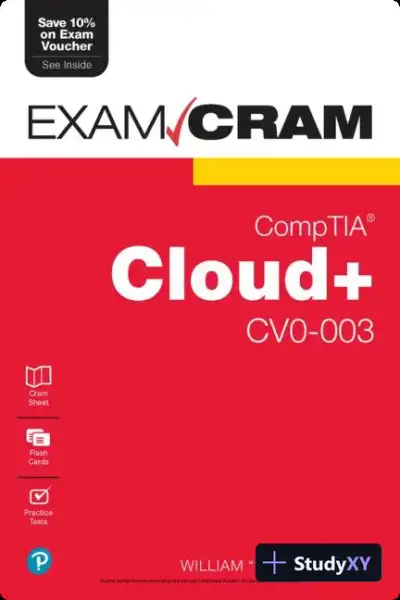 Certification Guides
CompTIA Cloud+ CV0-003 Exam Cram (2021)
CompTIA Certifications
434 pages156downloadsFeb 2025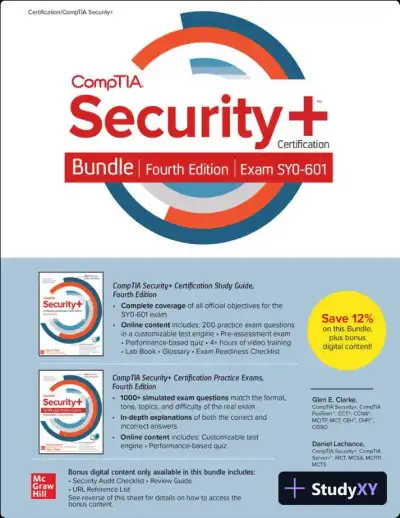 Certification Guides
CompTIA Security+ SY0-601 Exam Certification Bundle, 4th Edition (2021)
CompTIA Certifications
1897 pages152downloadsFeb 2025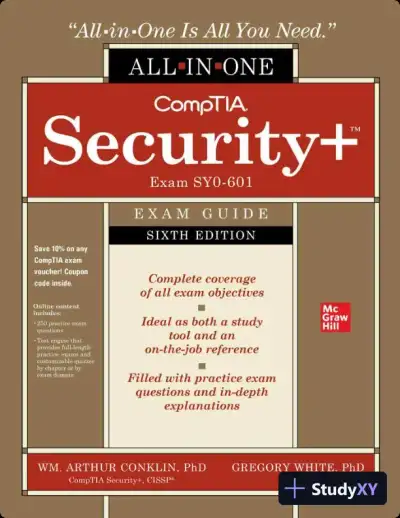 Certification Guides
CompTIA Security+ All-in-One SY0-601 Exam Guide, 6th Edition (2021)
CompTIA Certifications
1093 pages144downloadsFeb 2025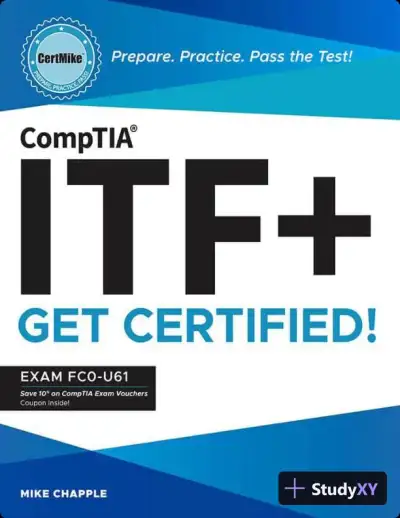 Certification Guides
CompTIA ITF+ CertMike: Exam FC0-U61 (2023)
CompTIA Certifications
464 pages144downloadsFeb 2025 Certification Guides
Comptia Security+ Practice Tests : exam sy0-601, 2nd Edition (2021)
CompTIA Certifications
339 pages144downloadsFeb 2025 Certification Guides
CompTIA Server+ SK0-005 Certification All-in-One Exam Guide, 2nd Edition (2021)
CompTIA Certifications
628 pages144downloadsFeb 2025 Certification Guides
CompTIA Network+ N10-008 Exam Cram (2021)
CompTIA Certifications
654 pages143downloadsFeb 2025 Certification Guides
CompTIA Security+ Certification Study Guide Exam SY0-601 (2022)
CompTIA Certifications
1024 pages134downloadsFeb 2025
Study this document with CramX
Once it is in your library, every tool can work from it.