

Mike Meyers CompTIA Security+ SY0-601 Exam Certification Passport, 6th Edition (2021)
- CompTIA Certifications
- 764 pages
- Shared February 2025
- 73 downloads
Mike Meyers CompTIA Security+ SY0-601 Exam Certification Passport, 6th Edition (2021) makes exam prep stress-free with structured learning.
Preview 31 of 764 pages
See the first 31 pages exactly as they appear in the document.
Page 1 Page 2 Page 3 Read page 3 as text
About the Author Dawn Dunkerley received a PhD in Information Systems from Nova Southeastern University in 2011 with a doctoral focus on measuring information security success within organizations. Her research interests include cyberwarfare, cybersecurity, and the success and measurement of organizational cybersecurity initiatives. Dr. Dunkerley holds numerous professional certifications, including the Certified Information Systems Security Professional (CISSP), Information Systems Security Architecture Professional (ISSAP), Information Systems Security Engineering Professional (ISSEP), Information Systems Security Management Professional (ISSMP), Certified Secure Software Lifecycle Professional (CSSLP), Certified in Risk and Information System Control (CRISC), and CompTIA Security+. She is an Area Editor for the Cyber Defense Review published by the United States Army Cyber Institute at West Point and a Fellow of the Americas Institute of Cybersecurity Leadership. About the Technical Editor Bobby E. Rogers is an information security engineer working as a contractor for U.S. Department of Defense agencies, helping to secure, certify, and accredit their information systems. His duties include information system security engineering, risk management, and certification and accreditation efforts. He retired after 21 years in the U.S. Air Force, serving as a network security engineer and instructor, and has secured networks all over the world. Bobby has a master’s degree in information assurance (IA) and is pursuing a doctoral degree in cybersecurity from Capitol Technology University in Maryland. His many certifications include CISSP-ISSEP, CEH, and MCSE: Security, as well as the CompTIA A+, Network+, Security+, and Mobility+
Page 4 Read page 4 as text
certifications.
Page 5 Page 6 Page 7 Read page 7 as text
Copyright © 2021 by McGraw Hill. All rights reserved. Except as permitted under the United States Copyright Act of 1976, no part of this publication may be reproduced or distributed in any form or by any means, or stored in a database or retrieval system, without the prior written permission of the publisher, with the exception that the program listings may be entered, stored, and executed in a computer system, but they may not be reproduced for publication. ISBN: 978-1-26-046796-3 MHID: 1-26-046796-1 The material in this eBook also appears in the print version of this title: ISBN: 978-1-26-046795-6, MHID: 1-26-046795-3. eBook conversion by codeMantra Version 1.0 All trademarks are trademarks of their respective owners. Rather than put a trademark symbol after every occurrence of a trademarked name, we use names in an editorial fashion only, and to the benefit of the trademark owner, with no intention of infringement of the trademark. Where such designations appear in this book, they have been printed with initial caps. McGraw-Hill Education eBooks are available at special quantity discounts to use as premiums and sales promotions or for use in corporate training programs. To contact a representative, please visit the Contact Us page at www.mhprofessional.com. Information has been obtained by McGraw-Hill Education from sources believed to be reliable. However, because of the possibility of human or mechanical error by our sources, McGraw-Hill Education, or others, McGraw-Hill Education does not guarantee the accuracy, adequacy, or completeness of any information and is not responsible for any errors or omissions or the results obtained from the use of such information. TERMS OF USE
Page 8 Read page 8 as text
This is a copyrighted work and McGraw-Hill Education and its licensors reserve all rights in and to the work. Use of this work is subject to these terms. Except as permitted under the Copyright Act of 1976 and the right to store and retrieve one copy of the work, you may not decompile, disassemble, reverse engineer, reproduce, modify, create derivative works based upon, transmit, distribute, disseminate, sell, publish or sublicense the work or any part of it without McGraw-Hill Education’s prior consent. You may use the work for your own noncommercial and personal use; any other use of the work is strictly prohibited. Your right to use the work may be terminated if you fail to comply with these terms. THE WORK IS PROVIDED “AS IS.” McGRAW-HILL EDUCATION AND ITS LICENSORS MAKE NO GUARANTEES OR WARRANTIES AS TO THE ACCURACY, ADEQUACY OR COMPLETENESS OF OR RESULTS TO BE OBTAINED FROM USING THE WORK, INCLUDING ANY INFORMATION THAT CAN BE ACCESSED THROUGH THE WORK VIA HYPERLINK OR OTHERWISE, AND EXPRESSLY DISCLAIM ANY WARRANTY, EXPRESS OR IMPLIED, INCLUDING BUT NOT LIMITED TO IMPLIED WARRANTIES OF MERCHANTABILITY OR FITNESS FOR A PARTICULAR PURPOSE. McGraw-Hill Education and its licensors do not warrant or guarantee that the functions contained in the work will meet your requirements or that its operation will be uninterrupted or error free. Neither McGraw-Hill Education nor its licensors shall be liable to you or anyone else for any inaccuracy, error or omission, regardless of cause, in the work or for any damages resulting therefrom. McGraw-Hill Education has no responsibility for the content of any information accessed through the work. Under no circumstances shall McGraw-Hill Education and/or its licensors be liable for any indirect, incidental, special, punitive, consequential or similar damages that result from the use of or inability to use the work, even if any of them has been advised of the possibility of such damages. This limitation of liability shall apply to any claim or cause whatsoever whether such claim or cause arises in contract, tort or otherwise.
Page 9 Read page 9 as text
I dedicate this book to my amazing family. Thomas, Lauren, and Max, you are the lights of my life. I couldn’t be happier or prouder to be your wife and mom. I love you. —Dawn Dunkerley
Page 10 Read page 10 as text
Contents at a Glance 1.0 Threats, Attacks, and Vulnerabilities 5.0 Governance, Risk, and Compliance 2.0 Architecture and Design 3.0 Implementation 4.0 Operations and Incident Response A About the Online Content Index
Page 11 Read page 11 as text
Contents Acknowledgments Introduction 1.0 Threats, Attacks, and Vulnerabilities Objective 1.1 Compare and bcontrast different types of social engineering techniques Understanding Social Engineering Social Engineering Techniques Phishing Whaling Shoulder Surfing Tailgating Pharming Spam SPIM Vishing Hoaxes Dumpster Diving Influence Campaigns REVIEW 1.1 QUESTIONS 1.1 ANSWERS
Page 12 Read page 12 as text
Objective 1.2 Given a scenario, analyze potential indicators to determine the type of attack Analyze and Differentiate Among Types of Malware Viruses Keyloggers Trojans Backdoor Logic Bombs Worms Adware and Spyware Ransomware Rootkits Botnets Malicious Code or Script Execution Analyze and Differentiate Among Types of Password Attacks Analyze and Differentiate Among Nonstandard and Emerging Attacks Supply-Chain Attacks Physical Attacks Adversarial Artificial Intelligence Cloud-Based vs. On-Premises Attacks REVIEW 1.2 QUESTIONS 1.2 ANSWERS Objective 1.3 Given a scenario, analyze potential indicators associated with application attacks Application Attacks Buffer Overflows Resource Exhaustion Privilege Escalation Hijacking HTML Attachments
Page 13 Read page 13 as text
Malicious Add-Ons Cross-Site Scripting Request Forgeries Application Programming Interface Attacks Driver Manipulation Header Manipulation Injections Directory Traversal Arbitrary Code Execution Zero-Day Attacks Race Conditions Replay REVIEW 1.3 QUESTIONS 1.3 ANSWERS Objective 1.4 Given a scenario, analyze potential indicators associated with network attacks Wireless Attacks Data Emanation Jamming Bluetooth Vulnerabilities Near-Field Communication War Driving Access Points (Evil Twin) Disassociation Packet Sniffing and Eavesdropping WPS Attacks WEP/WPA Attacks Network Attacks Denial-of-Service Layer 2 Attacks Smurf Attack
Page 14 Read page 14 as text
TCP/IP Hijacking On-Path Xmas Attack DNS Poisoning Domain Kiting Domain Reputation Typosquatting Client-side Attacks Watering Hole Attack REVIEW 1.4 QUESTIONS 1.4 ANSWERS Objective 1.5 Explain different threat actors, vectors, and intelligence sources Understanding and Analyzing Threats Actors, Attributes, and Vectors Threat Intelligence Sources Research Sources REVIEW 1.5 QUESTIONS 1.5 ANSWERS Objective 1.6 Explain the security concerns associated with various types of vulnerabilities Vulnerabilities Vulnerability Types REVIEW 1.6 QUESTIONS 1.6 ANSWERS Objective 1.7 Summarize the techniques used in security assessments Implement Assessment Techniques to Discover Security Threats and Vulnerabilities Vulnerability Assessment Tools and Techniques
Page 15 Read page 15 as text
REVIEW 1.7 QUESTIONS 1.7 ANSWERS Objective 1.8 Explain the techniques used in penetration testing Penetration Testing Techniques Known, Unknown, and Partially Known Environment Testing Exercise Types REVIEW 1.8 QUESTIONS 1.8 ANSWERS 5.0 Governance, Risk, and Compliance Objective 5.1 Compare and contrast various types of controls Control Categories Managerial Controls Technical Controls Operational Controls Control Types REVIEW 5.1 QUESTIONS 5.1 ANSWERS Objective 5.2 Explain the importance of applicable regulations, standards, or frameworks that impact organizational security posture Understanding Guidance Documents Regulations, Legislation, and Standards Key Frameworks Benchmarks and Secure Configuration Guides REVIEW 5.2 QUESTIONS 5.2 ANSWERS
Page 16 Read page 16 as text
Objective 5.3 Explain the importance of policies to organizational security Policies Supporting Organizational Security Using Organizational Policies to Reduce Risk Security Training and Awareness Policies Data and Documentation Policies User Behavior Policies Change Management Policies Incident Response Policy Third-Party Risk Management REVIEW 5.3 QUESTIONS 5.3 ANSWERS Objective 5.4 Summarize risk management processes and concepts Understanding and Managing Risk Risk Assessment Risk Register Types of Disasters Functional Recovery Plans High Availability and Redundancy Planning REVIEW 5.4 QUESTIONS 5.4 ANSWERS Objective 5.5 Explain privacy and sensitive data concepts in relation to security Privacy and Sensitive Data Organizational Consequences of Privacy and Data Breaches Notification of Breaches Data Types Privacy Enhancing Technologies Data Ownership Roles and Responsibilities
Page 17 Read page 17 as text
Terms of Agreement and Privacy Notices REVIEW 5.5 QUESTIONS 5.5 ANSWERS 2.0 Architecture and Design Objective 2.1 Explain the importance of security concepts in an enterprise environment Enterprise Security Change and Configuration Management Data Protection Data Encryption Cloud Storage Storage Area Networks Handling Big Data Data Sovereignty Response and Recovery Deception and Disruption REVIEW 2.1 QUESTIONS 2.1 ANSWERS Objective 2.2 Summarize virtualization and cloud computing concepts Cloud Computing Anything as a Service Cloud Deployment Virtualization REVIEW 2.2 QUESTIONS 2.2 ANSWERS Objective 2.3 Summarize secure application development, deployment, and automation concepts Secure Application Development, Deployment, and
Page 18 Read page 18 as text
Automation Development Life-Cycle Models Secure Coding Concepts REVIEW 2.3 QUESTIONS 2.3 ANSWERS Objective 2.4 Summarize authentication and authorization design concepts Authentication Concepts Multifactor Authentication Authentication Methods Biometrics Cloud vs. On-Premises Requirements REVIEW 2.4 QUESTIONS 2.4 ANSWERS Objective 2.5 Given a scenario, implement cybersecurity resilience Resiliency Concepts Service Levels Redundancy Backups Nonpersistence REVIEW 2.5 QUESTIONS 2.5 ANSWERS Objective 2.6 Explain the security implications of embedded and specialized systems Embedded and Specialized Systems Embedded Systems Industrial Control Systems and Supervisory Control and Data Acquisition Systems Internet of Things
Page 19 Read page 19 as text
Specialized Systems Voice over IP Heating, Ventilation, and Air Conditioning Systems Drones/UAVs Multifunction Printers Surveillance Systems REVIEW 2.6 QUESTIONS 2.6 ANSWERS Objective 2.7 Explain the importance of physical security controls Physical Security Physical Barriers Badges Lighting Alarms Signage Surveillance Locks Access Control Vestibule Personnel Faraday Cages Visitor Logs USB Data Blocker Secure Areas Fire Suppression Environmental Issues REVIEW 2.7 QUESTIONS 2.7 ANSWERS Objective 2.8 Summarize the basics of cryptographic concepts Cryptography
Page 20 Read page 20 as text
Common Use Cases Algorithms Quantum Cryptography Homomorphic Encryption Steganography Blockchain Hashing Digital Signatures RIPEMD HMAC REVIEW 2.8 QUESTIONS 2.8 ANSWERS 3.0 Implementation Objective 3.1 Given a scenario, implement secure protocols Protocols and Use Cases TCP/IP DNSSEC SSH S/MIME SRTP LDAPS File Transfer Protocols SNMPv3 HTTPS IPSec E-mail Protocols NTP DHCP Use Cases REVIEW
Page 21 Read page 21 as text
3.1 QUESTIONS 3.1 ANSWERS Objective 3.2 Given a scenario, implement host or application security solutions Host and Application Security Endpoint Protection Boot Integrity Databases Application Security Hardening REVIEW 3.2 QUESTIONS 3.2 ANSWERS Objective 3.3 Given a scenario, implement secure network designs Secure Network Design Load Balancing Network Segmentation Virtual Private Network DNS Network Access Control Out-of-Band Management Port Security Network Appliances Hardware Security Modules Sensors Collectors Aggregators Firewalls Access Control Lists Route Security Quality of Service Implications of IPv6
Page 22 Read page 22 as text
Port Spanning/Monitoring Monitoring Services File Integrity Monitors REVIEW 3.3 QUESTIONS 3.3 ANSWERS Objective 3.4 Given a scenario, install and configure wireless security settings Wireless Security Cryptographic Protocols Authentication Protocols Methods Installation Considerations REVIEW 3.4 QUESTIONS 3.4 ANSWERS Objective 3.5 Given a scenario, implement secure mobile solutions Mobile Security Solutions Connection Methods and Receivers Mobile Device Management Mobile Devices Enforcement and Monitoring Deployment Models REVIEW 3.5 QUESTIONS 3.5 ANSWERS Objective 3.6 Given a scenario, apply cybersecurity solutions to the cloud Cloud Security Cloud Security Controls Solutions
Page 23 Read page 23 as text
Cloud Native Controls vs. Third-Party Solutions REVIEW 3.6 QUESTIONS 3.6 ANSWERS Objective 3.7 Given a scenario, implement identity and account management controls Identity and Account Management Identity Account Types Account Policies REVIEW 3.7 QUESTIONS 3.7 ANSWERS Objective 3.8 Given a scenario, implement authentication and authorization solutions Authentication and Authorization Authentication Management Authentication Access Control Schemes REVIEW 3.8 QUESTIONS 3.8 ANSWERS Objective 3.9 Given a scenario, implement public key infrastructure Public Key Infrastructure PKI Fundamentals Types of Certificates Certificate Formats Other Important Concepts REVIEW 3.9 QUESTIONS 3.9 ANSWERS
Page 24 Read page 24 as text
4.0 Operations and Incident Response Objective 4.1 Given a scenario, use the appropriate tool to assess organizational security Assessing Organizational Security Network Reconnaissance and Discovery File Manipulation Shell and Script Environments Packet Capture and Replay Forensics Exploitation Frameworks Password Crackers Data Sanitization REVIEW 4.1 QUESTIONS 4.1 ANSWERS Objective 4.2 Summarize the importance of policies, processes, and procedures for incident response Incident Response Incident Response Plans Incident Response Process Exercises Attack Frameworks Communication Plan Business Continuity Plan Disaster Recovery Plan Continuity of Operations Planning Incident Response Team Stakeholder Management Retention Policies REVIEW 4.2 QUESTIONS
Page 25 Read page 25 as text
4.2 ANSWERS Objective 4.3 Given an incident, utilize appropriate data sources to support an investigation Data Sources Vulnerability Scan Output SIEM Dashboards Log Files syslog/rsyslog/syslog-ng journalctl NXLog Bandwidth Monitors Metadata NetFlow/sFlow Protocol Analyzer Output REVIEW 4.3 QUESTIONS 4.3 ANSWERS Objective 4.4 Given an incident, apply mitigation techniques or controls to secure an environment Incident Mitigation Reconfigure Endpoint Security Solutions Configuration Changes Isolation Containment Segmentation Security Orchestration, Automation, and Response REVIEW 4.4 QUESTIONS 4.4 ANSWERS Objective 4.5 Explain the key aspects of digital forensics Digital Forensics Documentation and Evidence
Page 26 Read page 26 as text
Acquisition and Preservation On-Premises vs. Cloud Integrity Data Recovery REVIEW 4.5 QUESTIONS 4.5 ANSWERS A About the Online Content System Requirements Your Total Seminars Training Hub Account Privacy Notice Single User License Terms and Conditions TotalTester Online Technical Support Index
Page 27 Read page 27 as text
Acknowledgments So many thanks go to McGraw Hill Professional, especially Tim Green, Emily Walters, and Janet Walden. You’ve been exceptionally helpful and patient through this process. Finally, I couldn’t have completed this project without my technical editor, Bobby Rogers. He continues to be the best partner and, more importantly, the best friend I could hope to work alongside. Thank you. —Dawn Dunkerley
Page 28 Read page 28 as text
Introduction This book is your guide to CompTIA’s Security+ certification, the vendor- neutral, industry-standard certification developed for foundation-level cybersecurity professionals. Based on a worldwide job task analysis, the exam structure focuses on cybersecurity core competencies, understanding governance, risk, and compliance; attacks, threats, and vulnerabilities; architecture and design; operations and incident response; and implementation. Whether the CompTIA Security+ certification is your first step toward a career focus in security or an additional skill credential, this book is your guide to success on the CompTIA Security+ certification exam. This book is organized similarly to the official CompTIA Security+ exam objectives, consisting of five domains, each of which is divided into objectives that align with the CompTIA Security+ exam objectives. I stick closely to the exam content that’s officially stated by CompTIA, and when I don’t, I provide you my expert take on the best way to approach the topics. For example, I’ve chosen to present Domain 5, with its coverage of risk, after Domain 1 and its discussion of threat and vulnerability. Each domain contains some useful items to call out points of interest: EXAM TIP Indicates critical topics you’re likely to see on the actual exam.
Page 29 Read page 29 as text
NOTE Points out ancillary but pertinent information, as well as areas for further study. KEY TERM Describes special terms, in detail, and in a way you can easily understand. CAUTION Warns you of common pitfalls, misconceptions, and potentially harmful or risky situations in working with the technology in the real world. Cross-Reference Directs you to other places in the book where concepts are covered, for your reference. ADDITIONAL RESOURCES Where you can find books, websites, and other media for further assistance. The end of each objective gives you two handy tools. The Review covers each objective with a synopsis—a great way to quickly review the critical information. Then the Questions and Answers enable you to test your newly acquired skills. For further study, this book includes access to online practice exams that will help to prepare you for taking the exam itself. All the information you need for accessing the exam questions is provided in the
Page 30 Read page 30 as text
appendix. I recommend that you take the practice exams to identify where you have knowledge gaps and then go back and review as needed. The IT industry changes and grows continuously, and so should you . Finishing one certification is just a step in an ongoing process of gaining more knowledge to match your constantly changing and developing skills. Remember, in the cybersecurity business, if you’re not moving forward, you’re way behind!
Page 31 Read page 31 as text
Threats, Attacks, and Vulnerabilities Domain Objectives • 1.1 Compare and contrast different types of social engineering techniques • 1.2 Given a scenario, analyze potential indicators to determine the type of attack • 1.3 Given a scenario, analyze potential indicators associated with application attacks • 1.4 Given a scenario, analyze potential indicators associated with network attacks • 1.5 Explain different threat actors, vectors, and intelligence sources • 1.6 Explain the security concerns associated with various types of vulnerabilities • 1.7 Summarize the techniques used in security assessments • 1.8 Explain the techniques used in penetration testing
733 more pages in the full document
Unlock it once and it stays in your library, ready to chat with or turn into flashcards.
Unlock the full documentMore CompTIA Certifications study materials
See all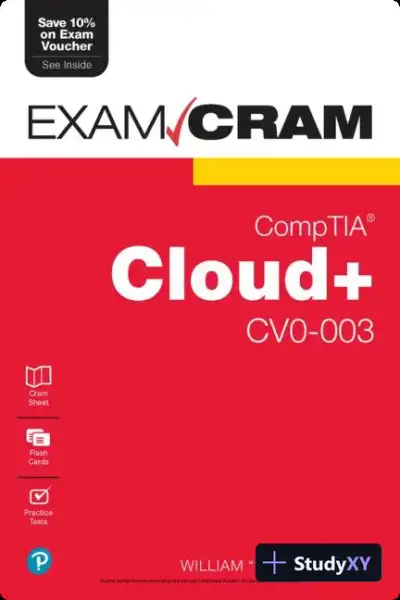 Certification Guides
CompTIA Cloud+ CV0-003 Exam Cram (2021)
CompTIA Certifications
434 pages156downloadsFeb 2025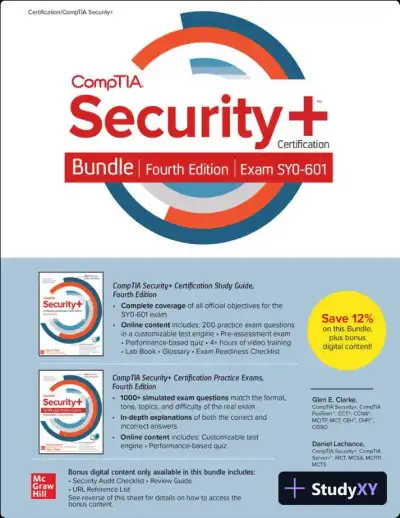 Certification Guides
CompTIA Security+ SY0-601 Exam Certification Bundle, 4th Edition (2021)
CompTIA Certifications
1897 pages152downloadsFeb 2025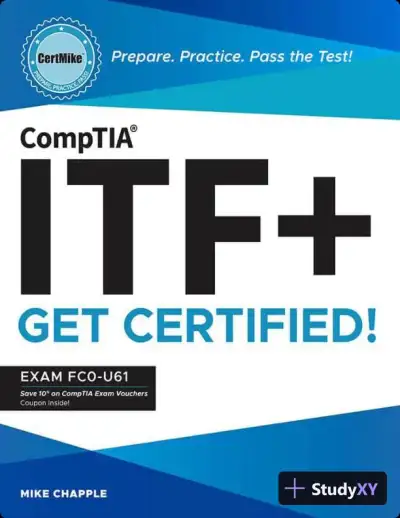 Certification Guides
CompTIA ITF+ CertMike: Exam FC0-U61 (2023)
CompTIA Certifications
464 pages144downloadsFeb 2025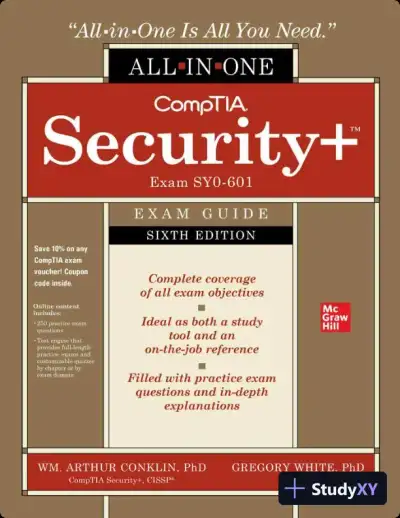 Certification Guides
CompTIA Security+ All-in-One SY0-601 Exam Guide, 6th Edition (2021)
CompTIA Certifications
1093 pages144downloadsFeb 2025 Certification Guides
Comptia Security+ Practice Tests : exam sy0-601, 2nd Edition (2021)
CompTIA Certifications
339 pages144downloadsFeb 2025 Certification Guides
CompTIA Server+ SK0-005 Certification All-in-One Exam Guide, 2nd Edition (2021)
CompTIA Certifications
628 pages144downloadsFeb 2025 Certification Guides
CompTIA Network+ N10-008 Exam Cram (2021)
CompTIA Certifications
654 pages143downloadsFeb 2025 Certification Guides
CompTIA Security+ Certification Study Guide Exam SY0-601 (2022)
CompTIA Certifications
1024 pages134downloadsFeb 2025
Study this document with CramX
Once it is in your library, every tool can work from it.