

Writing - How to Begin a Writing Assignment
- English
- Texas A&M University
- 30 pages
- Shared March 2026
Preview 9 of 30 pages
See the first 9 pages exactly as they appear in the document.
Page 1 Read page 1 as text
Study Guide Writing – How to Begin a Writing Assignment 1. Quiz: Steps in Writing Question 1 Which statement about writing is TRUE ? Answer Choices • Writing is a straight - line task; you should follow the same, neat steps each time. • Writing is a process that doesn't progress neatly from one step to the next. • Good writers don't need to revise or edit their final drafts. Correct Answer Writing is a process that doesn't progress neatly from one step to the next. Why This Is Correct • Writing is recursive, not linear. • Writers often move back and forth between planning, drafting, revising, and editing. Question 2 Which statement about writing is FALSE ? Answer Choices • A writer's first draft is always the best and final effort. • Most writers create many drafts before they are satisfied with their writing. • Even in the final - draft stage, a writer may reorganize and rewrite his or her paper.
Page 2 Read page 2 as text
Study Guide Correct Answer A writer's first draft is always the best and final effort. Why This Is Correct • First drafts are usually rough and incomplete. • Revision and rewriting are essential parts of effective writing. Question 3 Complete the following sentence: The first step in a writing project is to ________ Answer Choices • write a specific title that states the conclusion of your paper. • define the purpose of your writing and decide on a topic. • work on a detailed introductory paragraph until you are happy with it. Correct Answer define the purpose of your writing and decide on a topic. Why This Is Correct • Writers must understand their purpose and subject before drafting. • Titles and introductions come later in the process. Question 4 Complete the following: A thesis is ________
Page 3 Read page 3 as text
Study Guide Answer Choices • a single statement that makes an assertion about your topic. • what graduate students write after they receive a master's degree. • the statement that summarizes an opposing argument in a persuasive essay. Correct Answer a single statement that makes an assertion about your topic. Why This Is Correct • A thesis expresses the main idea or claim of a paper. • It guides the development and organization of the writing. Question 5 Which of the following is BAD advice about the writing process? Answer Choices • Before you write a first draft, formulate a clear thesis related to the purpose of your writing. • Before you write a first draft, research information that relates to your thesis statement and supporting points. • Choose a current topic you saw or read about online and connect the issue to stories your friends have told you. Correct Answer Choose a current topic you saw or read about online and connect the issue to stories your friends have told you. Why This Is Correct • Personal stories may not be reliable or relevant sources. • Effective writing depends on credible research and clear purpose, not casual anecdotes.
Page 4 Read page 4 as text
Study Guide 2. Types of Writing Throughout your life, you will be asked to write many different kinds of texts . These might include timed essays on exams, college application essays, school papers on different subjects, or workplace writing such as business letters, memos, reports, and proposals. Even though these assignments may look different, most writing tasks fall into a few main categories. 2.1 Common Purposes for Writing In most writing, you will do one or more of the following: • Describe a person, place, or thing • Narrate a story or retell an event • Inform by reporting facts or information • Explain a process or give instructions • Argue or persuade by taking a position and supporting it • Analyze or critique a text, idea, situation, or event 2.2 How Writing Types Overlap These types of writing often overlap . You rarely use just one technique. For example, if you are writing a descriptive essay about your Aunt Stephanie, you might also tell a short story that shows her personality. 2.3 Writing in College Many college assignments focus on argument and analysis . However, even when you are arguing a position, you may still use description or narration. For example, in an essay arguing for or against capital punishment, you might: • Describe the steps of an execution, or • Narrate a specific event involving lethal injection These techniques help support your main argument and make your writing clearer and more persuasive.
Page 5 Read page 5 as text
Study Guide 3. Quiz: Types of Writing Question 1 Which statement about writing is TRUE ? Answer Choices • You will use different and sometimes overlapping techniques for different types of writing. • You will use analysis and narrative techniques for college writing only, never for business writing. • Try to perfect one technique — narration, analysis, or description — and use it for all writing. Correct Answer You will use different and sometimes overlapping techniques for different types of writing. Why This Is Correct • Most writing combines multiple techniques. • Different purposes and audiences require flexibility in approach. Question 2 Complete the following sentence: If you don't understand a writing assignment from your instructor or your work supervisor, ________ Answer Choices • ask classmates or co - workers to find out what they are writing about. • pick your own topic and write a first draft, then ask your instructor or supervisor to review it. • talk to the instructor and make sure you clearly understand the purpose of the assignment.
Page 6 Read page 6 as text
Study Guide Correct Answer talk to the instructor and make sure you clearly understand the purpose of the assignment. Why This Is Correct • Clarifying expectations early prevents mistakes and wasted effort. • The instructor or supervisor is the best source of accurate guidance. Question 3 If you are writing a research paper that argues in favor of U.S. military intervention to control Korea's nuclear testing program, which writing techniques should you use? Answer Choices • descriptive and narrative techniques • analytical and persuasive techniques • You could use all the techniques mentioned in a and b. Correct Answer analytical and persuasive techniques Why This Is Correct • The topic requires analysis of evidence and reasoning. • Persuasion is necessary to argue for a specific position. Question 4 If you are writing a business proposal that analyzes the potential market for organic beef and cheese in Europe, which writing techniques should you use?
Page 7 Read page 7 as text
Study Guide Answer Choices • descriptive and narrative techniques • analytical and persuasive techniques • You could use all the techniques mentioned in a and b. Correct Answer analytical and persuasive techniques Why This Is Correct • Market analysis depends on data and evaluation. • Persuasive writing is needed to convince stakeholders of the proposal’s value. 4 . Understanding Your Assignment When you receive a writing assignment, your main goal is to do exactly what the assignment asks . Everything you write should help you meet that goal. If anything about the assignment is unclear, the best step is to ask your instructor for clarification before you begin. 4.1 Why Understanding the Assignment Matters Even strong writing can miss the mark if it doesn’t answer the right question. • If you’re asked to analyze how an author’s techniques support a theme , you must discuss both the techniques and the theme. Writing only about the theme — even in great detail — means you haven’t completed the task. • If a psychology assignment asks you to compare and contrast two theories , you need to give balanced attention to both . Writing five pages on one theory and only half a page on the other usually means the assignment hasn’t been fulfilled. In short, good writing isn’t just about quality — it’s about meeting the assignment’s requirements .
Page 8 Read page 8 as text
Study Guide 4.2 Assignments at Work Are Similar Writing in the workplace follows the same basic idea: understand the task, then write with a clear purpose. For example: • If you’re asked to write a testing protocol for a new product , you should include: o A detailed description of testing samples and control groups o Testing conditions o Materials and equipment o Step - by - step procedures o Relevant formulas or equations o Methods for evaluating results Later, if your manager asks for a summary of the results , your approach should change: • Be clear, honest, and concise • Include only a brief explanation of the tests • Avoid unnecessary technical details 5 . Understanding Your Audience Before you start writing, take a moment to think about who will read your work . Every piece of writing has a reader, and keeping that reader in mind will help you make better choices about what to say and how to say it. 5.1 Don’t Write Just to Sound Impressive Many students assume their audience is an instructor who wants big words and long, complicated sentences. In reality, most teachers value clear, thoughtful writing more than fancy language. They can easily tell the difference between: • Writing that sounds impressive but says very little, and • Writing that has strong ideas and explains them clearly — even if it includes a few small errors It’s always better to focus on meaning and clarity than on trying to sound overly sophisticated.
Page 9 Read page 9 as text
Study Guide 5.2 Purpose and Audience Go Together Your purpose for writing and your audience are closely connected. Different audiences expect different styles, tones, and levels of formality. For example: • A letter praising a new snowboard in a sports magazine would sound casual and enthusiastic. • A college research paper about the European Union’s move toward a single currency would be formal, detailed, and carefully supported. Both audiences want to understand your ideas, but they expect those ideas to be presented in very different ways. 5.3 Questions to Ask Before You Write Thinking about your audience ahead of time can make your writing much stronger. Ask yourself these questions: • Who is my audience? Are you writing for experts in a specific field, such as psychology or engineering, or for a general audience? Can you use technical terms freely, or do you need to explain them? • How much background information is needed? Will a brief summary be enough, or does your reader need more detailed context to understand the topic? • What does my audience expect? A group of marine biologists will expect a different kind of writing than readers with no science background. • Are there specific rules or preferences to follow? Some instructors have strict requirements, such as essay length, structure, or grammar rules. Be aware of these expectations before you begin. • What is the reading level of my audience? Writing for middle school students requires different language than writing for college students or professionals. • Will my audience agree or disagree with me? This is especially important for persuasive or argumentative writing. If your audience may disagree, you’ll need stronger evidence, careful reasoning, and a respectful tone.
21 more pages in the full document
Unlock it once and it stays in your library, ready to chat with or turn into flashcards.
Unlock the full documentMore English study materials
See all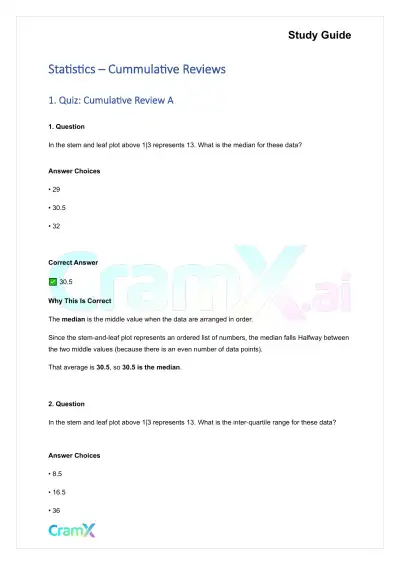 Quick Guides
Statistics - Cummulative Reviews
Statistics
58 pagesMar 2026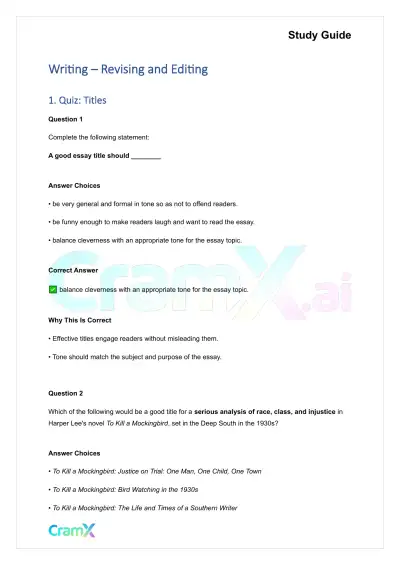 Quick Guides
Writing - Revising and Editing
English
16 pagesMar 2026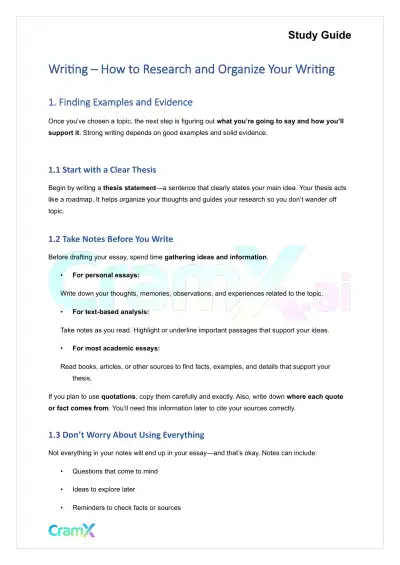 Quick Guides
Writing - How to Research and Organize Your Writing
English
21 pagesMar 2026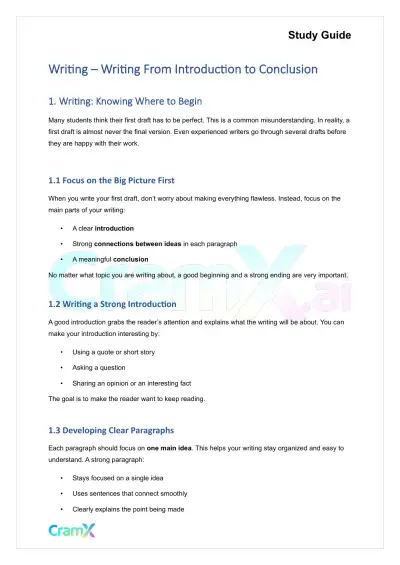 Quick Guides
Writing - Writing From Introduction to Conclusion
English
33 pagesMar 2026 Quick Guides
Statistics - Principles of Testing
Statistics
58 pagesMar 2026 Quick Guides
Statistics - Probability
Statistics
68 pagesMar 2026 Quick Guides
Statistics - Graphic Displays
Statistics
53 pagesMar 2026 Quick Guides
Statistics - Numerical Measures
Statistics
43 pagesMar 2026
Study this document with CramX
Once it is in your library, every tool can work from it.