

Statistics - Probability
- Statistics
- Texas A&M University
- 68 pages
- Shared March 2026
Preview 10 of 68 pages
See the first 10 pages exactly as they appear in the document.
Page 1 Read page 1 as text
Study Guide Statistics – Probability 1. Classic Theory of Probability The classic theory of probability is one of the most common ways we understand probability in statistics. It explains probability using a simple idea: Probability = the number of ways something can happen ÷ the total number of possible outcomes 1.1 The Basic Probability Formula • Favorable outcomes = the outcomes you want (also called “successes”) • Total outcomes = all possible outcomes Example: Drawing an Ace from a Deck of Cards Imagine you randomly pick one card from a well - shuffled deck. • Total cards in a deck = 52 • Number of aces in a deck = 4 So, the probability of drawing an ace is: That means: So, the probability of getting an ace in one draw is 0.077 .
Page 2 Read page 2 as text
Study Guide 1.2 Probability Values (Decimals) In statistics, probability is usually written as a decimal . It always falls between: • 0 = no chance at all • 1 = guaranteed (certainty) So probabilities range from 0 to 1 . 1.3 Important Assumption: All Outcomes Are Equally Likely The classic theory works only when every outcome has the same chance of happening . For example, in a fair deck of cards: • Every card has an equal chance of being chosen. • No card is more likely than another. That’s why this method works well for things like: • flipping fair coins • rolling fair dice • selecting from a well - shuffled deck of cards 1.4 Another Key Condition: Mutually Exclusive Outcomes The classic theory applies to outcomes that are mutually exclusive (disjoint) . Mutually exclusive means: Two outcomes cannot happen at the same time in one trial. Example 1: Flipping a Coin In one coin flip, you can get: • Head OR Tail
Page 3 Read page 3 as text
Study Guide But you cannot get: • Head AND Tail at the same time So, head and tail are mutually exclusive outcomes. Example 2: Drawing One Card If you draw one card, it can be: • an Ace OR a King But it cannot be: • an Ace AND a King in the same single draw So, “ace” and “king” are also mutually exclusive outcomes when drawing one card. Quick Summary Classic probability uses this idea: It works best when: • All outcomes are equally likely • Outcomes are mutually exclusive (cannot happen together) 2. Relative Frequency Theory of Probability The relative frequency theory of probability explains probability using real results from repeated trials . Instead of assuming outcomes are equally likely (like the classic theory), this approach says: If you repeat an experiment a very large number of times , the percentage of times an outcome happens becomes a good estimate of its probability .
Page 4 Read page 4 as text
Study Guide The Main Idea Think of probability like a pattern you notice after doing something again and again: • The more times you repeat the experiment, • the closer the observed percentage gets to the true probability . So basically: Probability ≈ (Number of times the outcome happens) ÷ (Total number of trials) Example: Faulty Widgets Suppose a machine makes 10,000 widgets (one at a time). • Total widgets produced = 10,000 • Faulty widgets = 1,000 So the probability that a widget is faulty is: That means the machine produces faulty widgets about 10% of the time . Quick Summary • Relative frequency probability is based on actual repeated results • When the number of trials is extremely large, the percentage of outcomes becomes close to the real probability 3. Probability of Simple Events A n easy probability example using three coins : A penny A nickel A dime
Page 5 Read page 5 as text
Study Guide Each coin can land either: • Head (H) or • Tail (T) Example 1: What is the probability that all three coins land on heads? To solve this, we use the classic theory of probability : Step 1: Count the total outcomes Since each coin has 2 possible results (H or T), the total number of outcomes is: 2 × 2 × 2 = 8 So there are 8 total possible outcomes . Step 2: Count the favorable outcomes “All three land heads” means: H H H This happens in only 1 outcome . Step 3: Find the probability Final Answer: The probability is 1/8 , or 0.125 .
Page 6 Read page 6 as text
Study Guide Example 2: What is the probability that exactly two of the three coins land heads? Step 1: Total outcomes stay the same There are still 8 total outcomes . Step 2: Count outcomes with exactly two heads Exactly two heads means two H’s and one T . These possible outcomes are: • H H T • H T H • T H H That gives us 3 favorable outcomes .
Page 7 Read page 7 as text
Study Guide Step 3: Find the probability Final Answer: The probability is 3/8 , or 0.375 . Quick Summary • All three heads: • Exactly two heads: 4. Quiz: Probability of Simple Events 1. Question What is the probability that the number is 3 ? Answer Choices • 1/10 • 3/10 • 1/3 Correct Answer 1/10 Why This Is Correct If there are 10 equally likely numbers (such as 1 to 10), only one of them is 3 .
Page 8 Read page 8 as text
Study Guide So the probability is: 1 out of 10 = 1/10 2. Question What is the probability that the number is greater than 6 ? Answer Choices • 1/10 • 3/10 • 2/5 Correct Answer 2/5 Why This Is Correct Numbers greater than 6 (from 1 to 10) are: 7, 8, 9, 10 → 4 numbers Total possible outcomes = 10 Probability = 4/10 = 2/5 3. Question What is the probability that the number is less than or equal to 3 ? Answer Choices • 1/10 • 3/10 • 2/5
Page 9 Read page 9 as text
Study Guide Correct Answer 3/10 Why This Is Correct Numbers less than or equal to 3 are: 1, 2, 3 → 3 numbers Total outcomes = 10 Probability = 3/10 4. Question What is the probability that the number is odd ? Answer Choices • 1/10 • 2/5 • 1/2 Correct Answer 1/2 Why This Is Correct Odd numbers from 1 to 10 are: 1, 3, 5, 7, 9 → 5 numbers Total outcomes = 10 Probability = 5/10 = 1/2 5. Question What is the probability that the number is not 8 ?
Page 10 Read page 10 as text
Study Guide Answer Choices • 1/10 • 1/2 • 9/10 Correct Answer 9/10 Why This Is Correct Only one outcome is 8. So outcomes that are not 8 = 9 outcomes out of 10 Probability = 9/10 6. Question What is the probability that the number is 4 or 7 ? Answer Choices • 1/10 • 1/5 • 2/5 Correct Answer 1/5 Why This Is Correct Favorable outcomes: 4 or 7 → 2 numbers Total outcomes = 10 Probability = 2/10 = 1/5
58 more pages in the full document
Unlock it once and it stays in your library, ready to chat with or turn into flashcards.
Unlock the full documentMore Statistics study materials
See all Quick Guides
Statistics - Cummulative Reviews
Statistics
58 pagesMar 2026 Quick Guides
Writing - Revising and Editing
English
16 pagesMar 2026 Quick Guides
Writing - How to Research and Organize Your Writing
English
21 pagesMar 2026 Quick Guides
Writing - How to Begin a Writing Assignment
English
30 pagesMar 2026 Quick Guides
Writing - Writing From Introduction to Conclusion
English
33 pagesMar 2026 Quick Guides
Statistics - Principles of Testing
Statistics
58 pagesMar 2026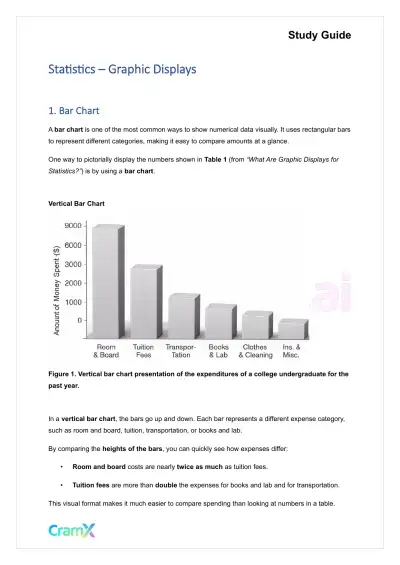 Quick Guides
Statistics - Graphic Displays
Statistics
53 pagesMar 2026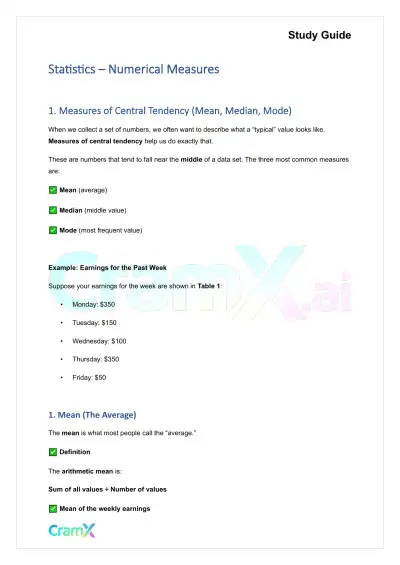 Quick Guides
Statistics - Numerical Measures
Statistics
43 pagesMar 2026
Study this document with CramX
Once it is in your library, every tool can work from it.