

Statistics - Cummulative Reviews
- Statistics
- Texas A&M University
- 58 pages
- Shared March 2026
Preview 10 of 58 pages
See the first 10 pages exactly as they appear in the document.
Page 1 Read page 1 as text
Study Guide Statistics – Cummulative Reviews 1. Quiz: Cumulative Review A 1. Question In the stem and leaf plot above 1|3 represents 13. What is the median for these data? Answer Choices • 29 • 30.5 • 32 Correct Answer 30.5 Why This Is Correct The median is the middle value when the data are arranged in order. Since the stem - and - leaf plot represents an ordered list of numbers, the median falls Halfway between the two middle values (because there is an even number of data points). That average is 30.5 , so 30.5 is the median . 2. Question In the stem and leaf plot above 1|3 represents 13. What is the inter ‐ quartile range for these data? Answer Choices • 8.5 • 16.5 • 36
Page 2 Read page 2 as text
Study Guide Correct Answer 16.5 Why This Is Correct The interquartile range (IQR) measures the spread of the middle 50% of the data. It is found using : When the first quartile ( Q1 ) and third quartile ( Q3 ) are identified from the stem - and - leaf plot, the difference comes out to 16.5 . 3. Question For the data set 2, 4, 5, 7, 8, 10, 12, 16, what is the mean? Answer Choices • 7.111 • 7.5 • 8 Correct Answer 8 Why This Is Correct The mean is the sum of all values divided by the number of values. Sum : There are 8 numbers , so :
Page 3 Read page 3 as text
Study Guide 4. Question For the data set 2, 4, 5, 7, 8, 10, 12, 16, what is the variance? Answer Choices • 4.567 • 6.5 • 20.857 Correct Answer 20.857 Why This Is Correct Variance measures how spread out the data are from the mean. 1. Mean = 8 2. Find squared differences from the mean 3. Add them and divide by n − 1 (sample variance) The calculation gives approximately : So the correct variance is 20.857 . 5. Question Each test in statistics class is worth 100 points. After four tests, a student Has an average of 85.0. She scores 95.0 on the fifth test. What is her average for the five tests?
Page 4 Read page 4 as text
Study Guide Answer Choices • 87.0 • 90.0 • 93.0 Correct Answer 87.0 Why This Is Correct Average after 4 tests is 85, so total points so far : Add the 5th test score : Now divide by 5 tests : 6. Question What is the mean? Answer Choices • 13.5 • 13.64 • 14
Page 5 Read page 5 as text
Study Guide Correct Answer 13.64 Why This Is Correct The mean is found by dividing the total of all values by the number of values. Using the data from the given frequency table/graph, the calculated mean comes out to 13.64 . 7. Question What is the relative frequency for time 15 seconds? Answer Choices • 0.08 • 0.167 • 0.24 Correct Answer 0.167 Why This Is Correct Relative frequency is : The frequency for 15 seconds compared to the total gives : So the correct relative frequency is 0.167 .
Page 6 Read page 6 as text
Study Guide 8. Question A lottery uses three machines and each machine Has 10 balls. In each machine, each ball is marked with a different single digit from 0 to 9. One ball is randomly selected from each machine and the three digit number is the winning number. What is the probability that the number is 123? Answer Choices • 1/1000 • 1/729 • 3/10 Correct Answer 1/1000 Why This Is Correct Each machine Has 10 digits (0 – 9) , so the probability of choosing a specific digit is : To get exactly 123 , you must get : • 1 from machine 1 • 2 from machine 2 • 3 from machine 3 Multiply : 9. Question What is the probability that the student prefers hockey?
Page 7 Read page 7 as text
Study Guide Answer Choices • 1/2 • 7/15 • 8/15 Correct Answer 8/15 Why This Is Correct Probability is : From the given data, 8 students prefer hockey out of 15 total , so : 10. Question What is the probability that the student is a female and prefers figure skating? Answer Choices • 1/4 • 2/5 • 2/3 Correct Answer 1/4 Why This Is Correct This is a joint probability (female and figure skating) : From the table, 1/4 of the students meet both conditions, so the probability is 1/4 .
Page 8 Read page 8 as text
Study Guide 1 1. Question What is the probability that the student is a male or prefers hockey? Answer Choices • 3/5 • 3/4 • 14/15 Correct Answer 14/15 Why This Is Correct This is an “OR” probability , so we use : Using the counts from the table, the union (male or hockey) includes 14 out of 15 students , so : 1 2. Question What is the probability that the student prefers figure skating given that the student is female? Answer Choices • 2/5 • 2/3 • 6/7
Page 9 Read page 9 as text
Study Guide Correct Answer 2/3 Why This Is Correct This is a conditional probability : From the data table, 2/3 of the females prefer figure skating, so the probability is : 1 3. Question A binomial experiment Has 12 trials with probability of success 0.40 on each trial. What is the mean of the distribution? Answer Choices • 4.8 • 5.0 • 6.0 Correct Answer 4.8 Why This Is Correct For a binomial distribution : Here, (n = 12) and (p = 0.40) :
Page 10 Read page 10 as text
Study Guide 1 4. Question A binomial experiment Has 12 trials with probability of success 0.40 on each trial. What is the probability of exactly 4 successes? Answer Choices • 0.0420 • 0.1208 • 0.2128 Correct Answer 0.2128 Why This Is Correct Use the binomial probability formula : Evaluating the expression gives approximately : 1 5. Question Which of the following is an example of a parameter? Answer Choices • a population mean • a sample mean • a sample proportion
48 more pages in the full document
Unlock it once and it stays in your library, ready to chat with or turn into flashcards.
Unlock the full documentMore Statistics study materials
See all Quick Guides
Writing - Revising and Editing
English
16 pagesMar 2026 Quick Guides
Writing - How to Research and Organize Your Writing
English
21 pagesMar 2026 Quick Guides
Writing - How to Begin a Writing Assignment
English
30 pagesMar 2026 Quick Guides
Writing - Writing From Introduction to Conclusion
English
33 pagesMar 2026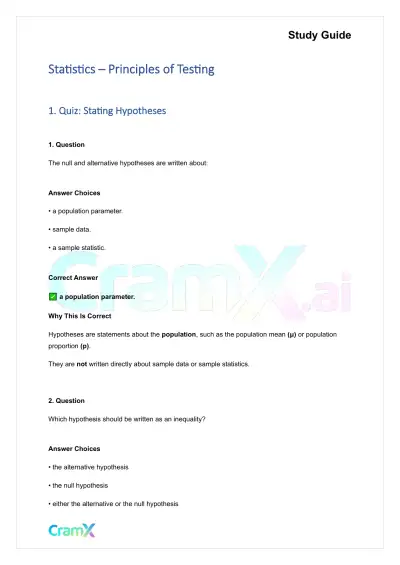 Quick Guides
Statistics - Principles of Testing
Statistics
58 pagesMar 2026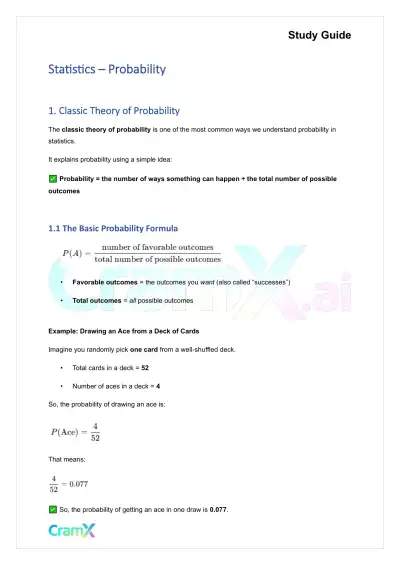 Quick Guides
Statistics - Probability
Statistics
68 pagesMar 2026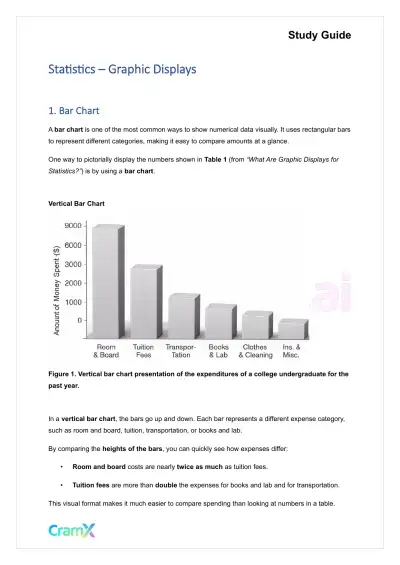 Quick Guides
Statistics - Graphic Displays
Statistics
53 pagesMar 2026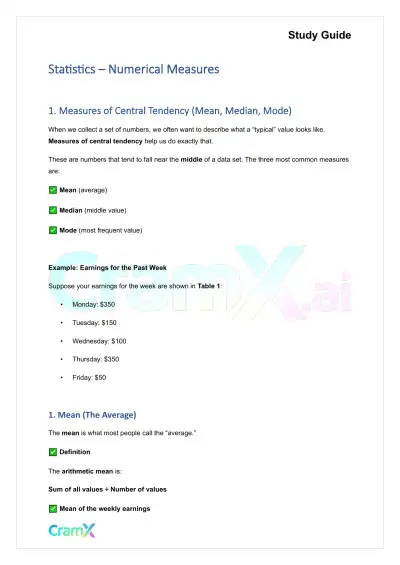 Quick Guides
Statistics - Numerical Measures
Statistics
43 pagesMar 2026
Study this document with CramX
Once it is in your library, every tool can work from it.