

APUSH DBQ Rubric
- History
- 2 pages
- Shared June 2025
This is a scoring rubric for an AP U.S. History Document-Based Question (DBQ). It outlines how points are awarded for thesis, contextualization, analysis. Designed to assess historical thinking and writing skills.
Preview 1 of 2 pages
See the first page exactly as it appears in the document.
Page 1 Read page 1 as text
N a m e : Per iod: AP U.S. HISTORY: Document-Based Question - Rubric Thesis / Claim [1 Point] Responds t o the prompt with a historically defensible thesis/claim that establishes a line of reasoning. To earn this point, the thesis must make a claim that responds t o the prompt rather than restating or rephrasing the prompt- The thesis must consist of one o r more sentences located i n one place, either i n the introduction or the conclusion. /I Contextualization [1 Point] Describes a broader historical context relevant t o the prompt. To earn this point, the response must relate the topic of the prompt t o broader historical everts, developments, or processes that occur before, during, or continue after the timeframe of the question. This point is not awarded for merely a phrase or reference. /I Evidence [3 Points] Evidence FROM t h e Documents /3 1 Point = Uses the content of at least THREE documents t o 2 Points = Supports an ARGUMENT in response t o the prompt using at least address the TOPIC of the prompt. To earn one point, the FOUR documents. To earn two points, the response must occuroteJ describe response must occurarei'y describe— rather t.ban simply OR —rather than simply quote — the content from at least FOUR documents. In quote—the contentfrom at least THREE oft.be documents. addition, the response must use the content of the o'ocuments to support on ARGUMENTin response to the prompt. Evidence BEYOND t h e Documents 1 Point = Uses at least ONEadditional piece of the specific historical evidence [beyord that found in the documents} relevant to ar ARGUMENT about the prompt. To earn this paint, rhe response must describe the evidence and.must use more than a phrase or reference. This additional piece o f evidence must be differentfrom the evidence used to eurn the pointfor contextualization. Analysis and Reasoning [2 Points] 1 Point = For at least TWO documents, explains how or why the document's point of view, purpose, historical situation, and/or audience is relevant to an ARGUMENT. To earn this point, the response must explain how or why (rather than simpiy identifying/ the document'spair-t of view, purpose, historical situation, ar audience is relevant to an ARGUMENT about the promptfor each of rhe TWO documents sourced. /2 1 Point = Demonstrates a complex understanding of the historical development that is the focus of the prompt through sophisticated argumentation and/or effective use of evidence.A response may demonstrate a complex undersranding in a variety o f ways, such as: ± Explaining mu'ripi'e themes or perspectives to explore complexity or nuance; OR i Explaining mu/ripie causes/effects, .mu.'t'p.'e simi/arities/digferences, o r muftipie continuiries/changes; OR ± Explaining BOTH cause and effect, BOTH similarity and difference, or BOTH continuity and change; OR ± Exp/aimrig relevant andinsightfijJ connectons within and across periods o r geographical areas. These connections should dearly relate to an argument that responds to the prompt A response may demonstrate a complex understanding through effective use o f evidence relevant to an argument that addresses the prompt. This may be done in a variety of v/ays, such as: ± Effective using SEVEN documents to support an argument that responds to the prompt; OR ± Explaining how the point of view, purpose, historical situation, and/or audience o f at least FOUR documents supports an argument that responds to the prompt; OR ± Using documents and evidence beyond the documents effectively to demonstrate a sophisticated understanding of different perspectives relevant to the prompt. This complex understanding must be part of the argument and may be demonstrated in any part of the response. While it is not necessa.fyfar this campiex understanding to be woven throughout the response, it must be more than merely a phrase or reference. 7.0 = 1 0 0 pts. 6.0 = 9 0 pts. 5.0 = 80 pts. 4.0 = 70 pts. 3.0 = 6 0 pts. 2.0 = 50 pts. 1.0 = 40 pts. 0.0 = 30 pts. 6.5 = 9 5 pts. 5.5 = 8 5 pts. . 4.5 = 75 pts. 3.5 = 65 pts. 2.5 = 5 5 pts. 1.5 = 45 pts. 0.5 = 35 pts. - - = Opts. Document 1 Document 2 Document 3 D o c u m e n t 4 Document S Document 6 Document 7 Supports thesis L J Supports thesis _ ■ Supports thesis ■ _- 1 Supports thesis L3 Supports thesis Supports thesis O Supports thesis C'ROV Q pov O POV Q POV C p o v O POV C 1 POV C 1 Purpose O Purpose Q Purpose U Purpose O Purpose Q Purpose O Purpose C 1 Audience O Audience O Audience O Audience O Audience O Audience Q Audience O Historical Situation Historical Situation Historical Situation Historical Situation ' ■ _! Historical Situation Historical Situation ■ _J Historical Situation
1 more page in the full document
Unlock it once and it stays in your library, ready to chat with or turn into flashcards.
Unlock the full documentMore History study materials
See all Exam Guides
Test Bank For Visions of America: A History of the United States, Combined Volume 2nd Edition Test Bank
History
1084 pages111downloadsFeb 2025 Exam Guides
Cengage Advantage Books: Making America, Volume 1 To 1877: A History Of The United States, 7th Edition Test Bank
History
170 pages60downloadsFeb 2025 Exam Guides
Test Bank for The American Journey: A History of the United States, Combined Volume, 8th Edition
History
447 pagesMay 2025 Exam Guides
Palmer, A History of Europe in the Modern World, 11th Edition Test Bank
History
766 pagesMay 2025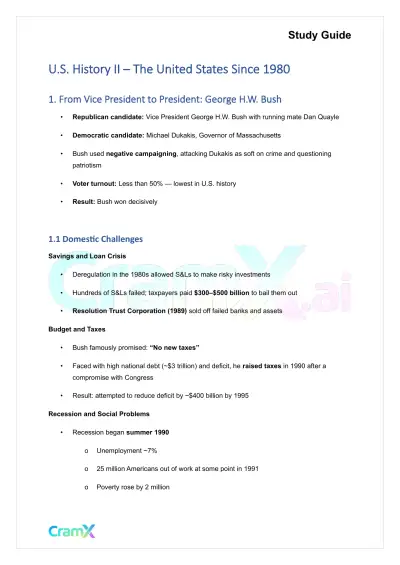 Quick Guides
U.S. History II - The United States Since 1980
History
16 pagesMar 2026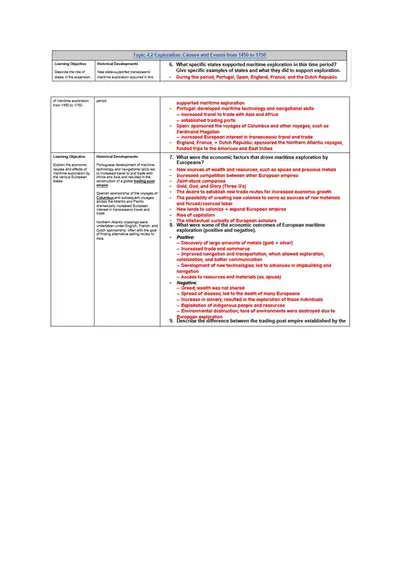 Solved Assignments
AP World History Unit 4 Study Guide (Transoceanic
History
14 pagesJun 2025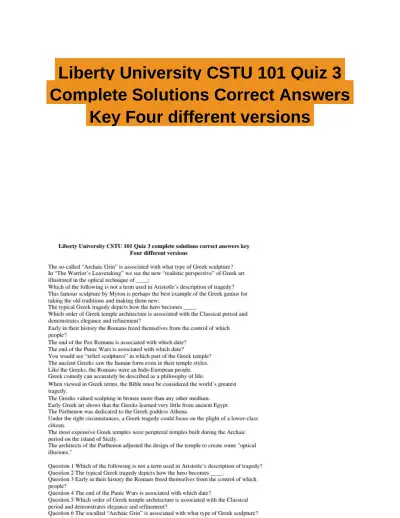 Solved Assignments
Liberty University CSTU 101 Quiz 3 Complete Solutions Correct Answers Key Four different versions
History
9 pagesMay 2025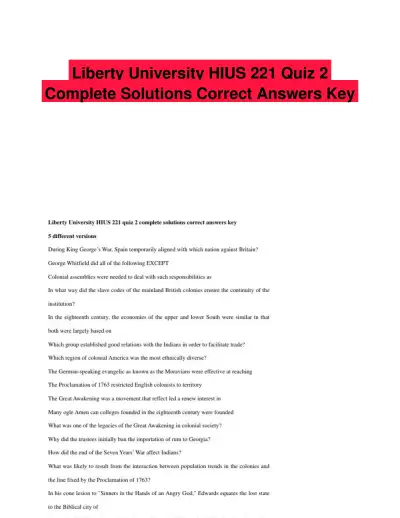 Solved Assignments
Liberty University HIUS 221 Quiz 2 Complete Solutions Correct Answers Key
History
31 pagesMay 2025
Study this document with CramX
Once it is in your library, every tool can work from it.