

U.S. History II - The United States Since 1980
- History
- Texas A&M University
- 16 pages
- Shared March 2026
Preview 5 of 16 pages
See the first 5 pages exactly as they appear in the document.
Page 1 Read page 1 as text
Study Guide U.S. History II – The United States Since 1980 1. From Vice President to President: George H.W. Bush • Republican candidate: Vice President George H.W. Bush with running mate Dan Quayle • Democratic candidate: Michael Dukakis, Governor of Massachusetts • Bush used negative campaigning , attacking Dukakis as soft on crime and questioning patriotism • Voter turnout: Less than 50% — lowest in U.S. history • Result: Bush won decisively 1.1 Domestic Challenges Savings and Loan Crisis • Deregulation in the 1980s allowed S&Ls to make risky investments • Hundreds of S&Ls failed; taxpayers paid $300 – $500 billion to bail them out • Resolution Trust Corporation (1989) sold off failed banks and assets Budget and Taxes • Bush famously promised: “No new taxes” • Faced with high national debt (~$3 trillion) and deficit, he raised taxes in 1990 after a compromise with Congress • Result: attempted to reduce deficit by ~$400 billion by 1995 Recession and Social Problems • Recession began summer 1990 o Unemployment ~7% o 25 million Americans out of work at some point in 1991 o Poverty rose by 2 million
Page 2 Read page 2 as text
Study Guide • Bush’s economic plans included middle - class tax cuts, help for first - time homebuyers, and lower capital gains taxes, but came too late • Social issues persisted: homelessness, teen pregnancy, drug addiction, and ineffective war on drugs • Health care problems worsened: 30+ million Americans uninsured; slow response to AIDS epidemic 1.2 Foreign Policy End of the Cold War • 1989 – 1991: Collapse of Communist regimes in Eastern Europe (Poland, Hungary, Czechoslovakia, Bulgaria, Romania) • Berlin Wall fell (1989); Germany reunited • Soviet Union dissolved (1991) ; Baltic states (Latvia, Estonia, Lithuania) gained independence • Led to nuclear weapons reduction agreements and reduced U.S. NATO commitments Other Global Issues • Tiananmen Square (1989): China’s violent crackdown on student protests worsened U.S. - China relations • Panama (1989): Bush ordered invasion to remove Manuel Noriega; Noriega captured and imprisoned Persian Gulf War (1990 – 1991) • Iraq invaded Kuwait (Aug 1990) • U.S. led international coalition (Operation Desert Shield → Desert Storm) • Air campaign began Jan 17, 1991 ; ground war Feb 23 – 28, 1991 • Iraq defeated, Kuwait freed; Saddam Hussein remained in power • Issues left unresolved: Iraq’s WMD programs, treatment of Kurds and Shiites
Page 3 Read page 3 as text
Study Guide 1.3 Big Picture • Bush’s presidency was defined by: o Foreign policy successes: End of the Cold War, victory in Persian Gulf War o Domestic struggles: Recession, S&L crisis, rising social problems, unpopular tax increase • His foreign policy experience contrasted with difficulties managing domestic economic issues 2. The Clinton Years 2.1 The Clinton Years (1993 – 2001) — Summary and Key Points Bill Clinton’s presidency was shaped by economic growth , domestic reforms , foreign policy involvement , and personal scandals . 2.2 Election of 1992 • Republican: Incumbent George H.W. Bush and VP Dan Quayle • Democrat: Governor Bill Clinton (Arkansas) and Senator Al Gore • Third - party: H. Ross Perot — focused on the economy, took 19% of the popular vote • Results: Clinton won 370 – 168 electoral votes • Platform: Job creation, environmental protection, and health care reform 2.3 Domestic Policy Health Care and “Don’t Ask, Don’t Tell” • Early attempts at health care reform failed; Hillary Clinton led the task force • Military policy compromise: “Don’t ask, don’t tell” regarding gay service members Trade Policy • NAFTA (1993): Free trade among U.S., Canada, and Mexico
Page 4 Read page 4 as text
Study Guide • Concerns from labor (jobs moving to Mexico) and environmentalists addressed in amendments • GATT (1994): Reduced global trade barriers Economic Policy • 1994 midterms: Republicans gained Congress; Newt Gingrich led the Contract with America • Clinton took moderate stances and emphasized deficit reduction • Welfare Reform Act (1996): Block grants to states, work/training requirements • Economy: Budget went from $290B deficit (1992) → $80B surplus (1999) ; unemployment fell to ~4% 2.4 Scandals and Impeachment • Whitewater investigation: Real estate dealings, later expanded to other allegations • Monica Lewinsky affair: Clinton impeached by House (perjury, obstruction of justice) • Senate trial: Acquitted; remained in office • Despite scandals, public approval remained high 2.5 Foreign Policy Global Role • U.S. as sole superpower after Cold War • Focused on trade, economic aid , and multilateral cooperation (UN, NATO) Haiti • Forced military regime to step down, restored elected president Jean - Bertrand Aristide Iraq • Enforced UN sanctions; limited military action against Saddam Hussein and Iraqi Kurds
Page 5 Read page 5 as text
Study Guide Balkans • Bosnia - Herzegovina: U.S. aircraft supported UN operations; peacekeepers sent post - Dayton Accords (1995) • Kosovo (1998): Led NATO air campaign against Serbian forces to stop ethnic cleansing Israel - Palestinian Conflict • Oslo Accords (1993): Mutual recognition, self - rule in Gaza and Jericho • 1995 – 2000: Attempted further peace negotiations, including Camp David 2000 summit — ultimately unsuccessful 2.6 Terrorism • Foreign: o 1993 World Trade Center bombing (NYC) o 1996 Khobar Towers bombing (Saudi Arabia) o 1998 U.S. embassy bombings (Kenya, Tanzania) o 2000 USS Cole bombing (Yemen) o Targets linked to Osama bin Laden/al Qaeda ; Clinton authorized strikes in Afghanistan and Sudan • Domestic: o 1995 Oklahoma City bombing by Timothy McVeigh , killing 168 and injuring hundreds Key Takeaways 1. Domestic success: Economic growth, deficit reduction, welfare reform, NAFTA/GATT trade policies 2. Foreign policy: Humanitarian intervention in Balkans and Haiti, global peacekeeping, and counter - terrorism 3. Challenges: Personal scandals, impeachment, terrorism threats, ongoing Middle East conflict 4. Legacy: First Democratic president reelected since FDR, maintained high approval ratings despite controversies, oversaw strong economy and expansion of U.S. global influence Clinton’s presidency is often seen as a balance of political skill, economic prosperity, and foreign policy engagement , yet marred by personal and political scandals .
11 more pages in the full document
Unlock it once and it stays in your library, ready to chat with or turn into flashcards.
Unlock the full documentMore History study materials
See all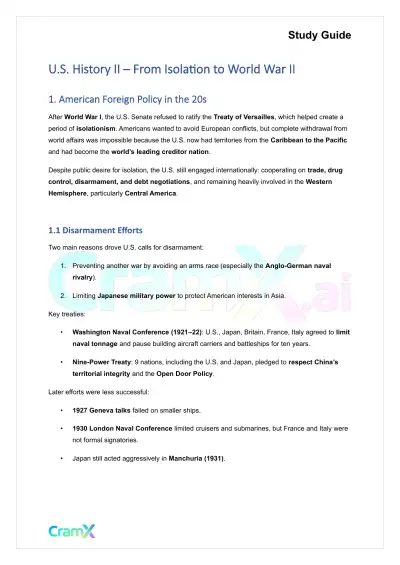 Quick Guides
U.S. History II - From Isolation to World War II
History
9 pagesMar 2026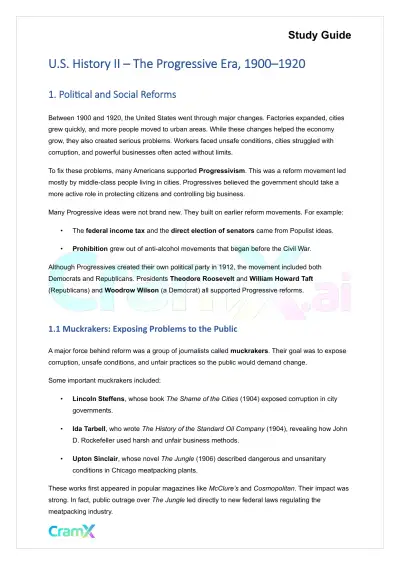 Quick Guides
U.S. History II - The Progressive Era, 1900–1920
History
10 pagesMar 2026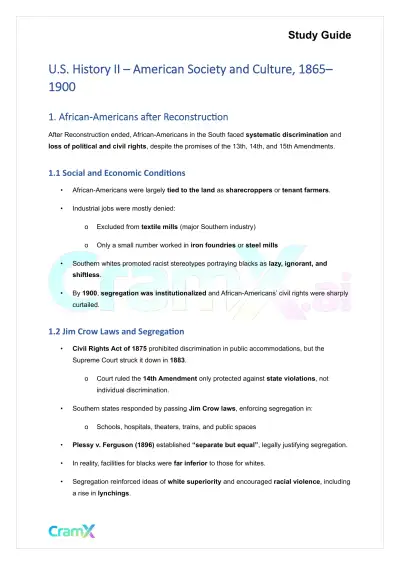 Quick Guides
U.S. History II - American Society and Culture, 1865–1900
History
7 pagesMar 2026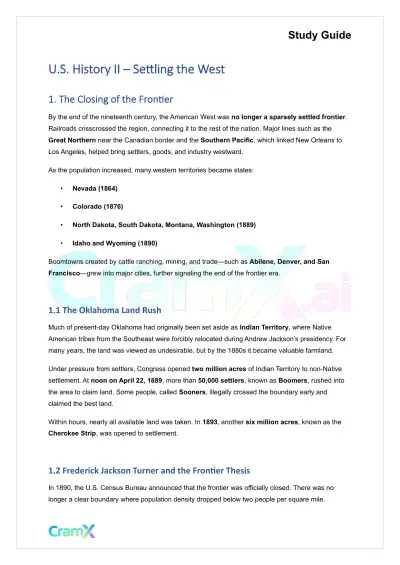 Quick Guides
U.S. History II - Settling the West
History
13 pagesMar 2026 Quick Guides
U.S. History II - Industrial America
History
12 pagesMar 2026 Quick Guides
U.S. History II - America in the Twenties
History
9 pagesMar 2026 Quick Guides
U.S. History II - America in the Fifties
History
12 pagesMar 2026 Quick Guides
U.S. History II - Depression and the New Deal
History
10 pagesMar 2026
Study this document with CramX
Once it is in your library, every tool can work from it.