

Human Resource Management, 10th Edition Solution Manual
- Human Resource Management
- 127 pages
- Shared May 2025
Human Resource Management, 10th Edition Solution Manual helps you connect textbook theory with real-world applications.
Preview 16 of 127 pages
See the first 16 pages exactly as they appear in the document.
Page 1 Read page 1 as text
Chapter 1 Manual – Human Resource Management: Gaining a Competitive Advantage Explanation of the Instructors Manual : This instructor’s manual was developed to assist the individual in using the material presented in the textbook within the context of a classroom. It is important to not e that in developing the manual, it was not assumed the instructor teaching this course is versed in Human Resource Management (HRM) as a practitioner , researcher, or faculty member. Thus, within this manual, a summary for each chapter is provided to help give context and structure for the instructor. Within each summary are also potential issues that, through awareness may assist in instruction and student understanding of the presented material. Following each chapter summary are suggested responses and guidance for the chapter materials , including potential answers for case studies, end of chapter questions , and other materials. New to the instruction manual is a reference guide to the two leading profess ional Human Resource Management B odies of Knowledge: the Society for Human Resource Management Body of Competency and Knowledge, and the Human Resource Certification Institutes’ A Guide to the HR Body of Knowledge. While not a complete study guide for examination, this may assist instructors to connect materials for those students who are interested, while also providing further instruction within the practice of HRM. The full reference guide is available and includes a breakdown o f each chapter . Reference to the Chapter PowerPoints and available CONNECT materials are also included in each chapter. Chapter 1 Summary for Instructors This chapter discusses the role of Human Resource Management (HRM) in gaining a competitive advantage . It provides a foundation for the rest of the chapters by describing the role HRM plays within organizations and the skills HRM practitioners need for any company to be competitive. Within this chapter are the competitive challenges tha t U.S. companies currently face which influence their ability to meet the needs of shareholders, customers, emp loyees, and other stakeholders and support as to how these competitive c hallenges are influencing HRM. A full summary is provided in the textbook on page 55. At the end of this chapter, instructors should ensure students understand HRM as a practice, HR as a department and be prepared to delineate between the two (LO 1 - 1 , LO1 - 6, LO1 - 7). Further, students should be able to discuss the differe nt HRM practices (LO1 - 7) , which are outlined towards the end of the chapter. Accomplishing both tasks will help support students in subsequent chapters, however , it can be a difficult task given the current perceptions of HRM and HR departments, as well as the potential for students who lack exposure to such ideas and practices. Another difficulty may be with having students seeing themselves as managers , and not employees. Often the exposure students have had with HRM is when they have been interviewed – not as them acting as the interviewer. Thus, the instructor may
Page 2 Page 3 Read page 3 as text
Chapter 1 Manual – Human Resource Management: Gaining a Competitive Advantage wish to ensure (and continue to revisit throughout the course) the student continually focuses on how they are the ones making the decisions (i.e. managers) . However, their own experiences such as being interviewed can lend to great course discussion and reflection. Ins tructors may also find students, especially those with little interes t in HRM or within other majors, experiencing difficulty in recognizing the importance of this topic and practice. Instructors may wish to emphasize that although HRM is a separate practice, much of what will be studied directly applies to the business acumen of managers and leaders in all facets of business management. Once the above is considered, instr uctors may then wish to discuss the remainder of the LOs. If students have had a previous Introduction to Business/ Management or similar course, then discussion of these LOs from the perspective of strategic management and internal/external analysis (i.e. SWOT analysis) may help students to connect the concepts. Specifically, if a general understanding of strategic management exists, then instructors may discuss how HRM practices can contribute to the strategic advantage of organizations, and how HR departments and professionals hold a specific role and may contribute to this process. It would be helpful to draw students ’ attention to Table 1.15 on page 54 , which shows the outline of the textbook. These can help further demonstrate the different areas with in HRM, and what students may expect from the remainder of the course. Society for Human Resource Management Body of Competency & Knowledge : This chapter contains content which may be identified within the following content areas: Talent Acquisition & Retention Learning & Development Total Rewards Structure of the HR Function Technology & Data Organizational Effectiveness & Design Workforce Management Risk Management Business & HR Strategy Human Resource Certification Institute’s A Guide to the HR Body of Knowledge : This chapter contains content which may be identif ied within the following areas : Business Management & Strategy Workforce Planning and Employment Human Resource Development Compensation and Benefits Employee and Labor Relations Risk Management Other Classroom Materials: CONNECT and PowerPoint Slides
Page 4 Read page 4 as text
Chapter 1 Manual – Human Resource Management: Gaining a Competitive Advantage Instructors sh ould review both the available PowerP oint slides and CONNECT mater ials. The available PowerP oint slides may assist instructors by providing additional insight into the chapter materials, while expediting any classroom preparation. They may also provide visual reinforcement for students during class room discussion. There are CONNECT exe rcises available through McGraw - Hill which can greatly assist student preparation for class and understanding of chapter concepts. Instructors may w ish to structure the class where students must complete the CONNECT exercises prior to class, thus, further reinforcing material and allowing instructors to expand and challenge student understanding during class time. CONNECT exercises may be set - up to be time - based, requiring students to prac tice chapter ma terials for a specific timefram e . It is the instructors ’ discretion how they desire to include this into the course grade, but a low - stakes grading system based on completion is suggested to help encourage student usage, while minimizing penalties for mistakes during completion. To assist in course review, instructors may also require students to periodically complete CONNECT chapters for previously read chapters. This may be beneficial to support students in preparation for exams, projects , or where new chapter material expands upon a previous chapter. Further support for instructors in setting - up the CONNECT materials may b e obtained by contacting McGraw - Hill. Suggested Additional Exercises What does HR do? Exercise #1 Faculty may lead a discussion asking students to consider their previous understanding and perceptions of HRM. Preparatory questions and ideas may include: - Ask a friend/family member, etc. what they think of when they hear HR? - Research articles on HR’s role in organizations, summarize , and bring summaries to class During class, ask students to discuss the responses and other information they have found. Faculty will notice that student discussion and responses may vary greatly, but will probably shift between HR as a department, and HRM as a practice. Faculty should be prepared to delineate how HRM as a practice is different from how HR departments sometimes function, or how they are perceived. This can he lp students better understand LO s 1, 2 , and 7. These exercises can also support End of Chapter Questions 1, 2, 4, 7 , and 8. Table 1.1 on page 6 has a list of HR functions and r esponsibilities , which can be integrated into this conversation. Exercise #2 Instructors may ask students to research careers in HR. This can be accomplished through the following:
Page 5 Read page 5 as text
Chapter 1 Manual – Human Resource Management: Gaining a Competitive Advantage - Requiring students write a reflection paper on different jobs they find by searching in online Job Boards, and whether those are jobs they wish to pursue. - Requiring students speak with someone who has a job or spent their career in HRM - Requiring students to complete the self - assessment exercise Do you have what it takes to work in HR? ( page 62 ). This may be required separately, or in conjunction with the suggested assignments above. - Figure 1.3 on page 14 regarding Competencies for HR Professionals may also be integrated by asking students to reflect on their own current competencies and if they match with Figure 1.3 . Chapter 1 – List of Cases Enter the World of Business Marriott : HR Practices Result in Engaged Employees and Satisfied Customers (p. 3) Suggested Discussion Question: Do you think Marriott is meeting its principal of “Take care of associates and they will take care of customers?” What about its core value of putting people first? What evidence can you provide? Student r esponses should demonstrate reflect ion on the evidence within the case spe cific to employee treatment. This evidence should be connected to the different outcomes identified within the vignette, such as management tenure. Students should also identify different HRM practices and tools (surveys, compensation) and explore the relationship these have on the success of Marriott’s business. Finally, instructors may wish to integrate these observations and the discussion into an overall discussion of the different HRM practices to be discussed within the textbook and thus what the students can expect to be studying and learning. Instructors should note that at the end of Chapter 1 on page 55 there is a “Look Back” section that revisits the Marriott case and asks 4 questions. Suggested guidance for each is as follows: 1) Student responses should demonstrate an understanding of the different HRM practices and how they may impact the competitive advantage of the organization. Integration of Marriott’s core values and principals should be apparent in student responses. For example, discussion of the corporate culture of “family” and retention may be connected to Marriott’s hiring and selection processes. Benefits may also be discussed as evidence of Marriott’s commitment to take care of its employees. 2) Studen t responses may simply be yes or no. The instructor may look to engage students in a devil’s advocate role, where regardless of response, students must justify their position. This is to avoid students from simply acquiescing to yes due to the conte nt of the book, or moving to a no reply due to a simple misunderstanding or dislike. Once past the simple yes or no, the instructor should look to emphasize how these HR practices have helped Marriott strategically through what was
Page 6 Read page 6 as text
Chapter 1 Manual – Human Resource Management: Gaining a Competitive Advantage discussed in question 1. Further, instructors may also wish to emphasize the importance of student ability to advocate for HRM practices as a strategic investment with a return on investment (ROI). 3) Students should be able to discuss how while practices may vary due to industry, HRM can contribute to the strategic advantage of the company regardless of sector, product/service, or industry. Students should be able to begin to recognize how different companies may need to emphasize different HRM imperatives. For example, employee retention within research and development is extremely important due to technological advancement and proprietary company knowledge, highlighting how retention needs for Marriott are different. 4) Responses can vary, and instructors may wish to (depending on demographics of the class) ask students to reflect on their own needs as employees and what they would like from an employer. Regardless of responses, instructor may wish to emphasize that practices must not only meet needs and desires of employees, but also align behind corporate strategy. Page 35 discussed Generational Differences, as well as Table 1.11 with the ages, years born , and names of each generation. Competing Through Sustainability: Socially Responsible Programs Help Improve the World (p. 29) Question Guidance: Students may focus on the alignment of employee preference and concern for such initiatives and organizations’ own initiatives and the culture within. This would lead to attraction, retention, as well as motivation of employees to contribute and develop to further support the organization. Integrity in Action: CEO Cuts Pay to R educe Income Inequality (p. 42) Question Guidance: Instructor should help facilitate a discussion investigating the difference between intrinsic and extrinsic motivation, and pay plans may speak specifically to extrinsic motivation, while the ability to work for a CEO with a “moral imperative” may be intrinsically motivating. Competing Through Globalization Effectiveness in Global Business Requires More than Just a First - Class Ticket (p. 45) Question Guidance: Topics would include cross - cultural skills including verbal and nonverbal; culture - specific training for the specific destination such as customs and business practices; time and stress management for expatriates. It is important for families to receive this training because family issues and problems are the number one reason why overseas assignments fail. Competing Through Technology Connectiveness and Mobility Enhance HR Practices (p. 48) Question Guidance
Page 7 Read page 7 as text
Chapter 1 Manual – Human Resource Management: Gaining a Competitive Advantage Some disadvantages may include lack of access due to socio - economic reasons; cyber security concerns; employee privacy and data ; rate of technological change and adoption. Answers and Guidance to End of Chapter Sections : Discussion Questions (page 56 ) , suggested guidance 1. Discussion will most likely focus on associated costs as companies outsource administrative functions normally housed within HR departments. Instructors may need to emphasize that as long as the strategically necessary functions are still emphasized and managed well then HR departments may not be necessary. The c aveat is that sometimes without the department they do not get the necessary emphasis. However, HR professionals may not necessarily reside with in HR departments, and can be within other departments (Training and Learning departments separate from the traditional HR department, for example) that focus on a specific function. It may also be important to emphasize that HR professionals can practice from multiple areas and backgrounds (Industrial/Organizational Psychology). Thus, HR practitioners and professionals become an important part of organizations, with or without departments. Further support may be found on pages 5 - 11, with particular focus on Tables 1.1 (Responsibilities of HR Departments) and 1.2 (Questions to Ask: Are Human Resources Playing a Strategic Role in the Business?). Page 10 also offers discussion of pros/cons of having an in house HR department. 2) Staffing: ensuring organizations predict the appropriate number of employees and competencies necessary to meet strategic objectives, do mestically and globally and then acquire them within the necessary timeframe. Example would be leadership identification and selection with global understanding and the ability to foresee issues within organizational operations/logistics to ensure sustainability. Training: ensuring employees of organizations have the support to obtain and improve upon the competencies as necessary to meet the strategy. This would also include leadership development . Example could be sales training, development of customer service competencies , and a fluency to use corporate technology and its continual adoption of new technology to service customers. Compensation: Identifying appropriate compensation and benefits strategies that align behind organizational strategy while meeting identified imperatives such as attraction and retention of key talent. Global challenge of compensation which meets regulation and demographic needs in multiple cultural and geographically dispersed areas. Technological challenge of risk and security management of employee data from theft, as well as meeting regulatory needs of multiple countries and economic zones. Performance Management: Ensuring employee performance is measured for improvement and other used for organizational decisions. Global challenge of developing leaders with global business acumen may also be discussed .
Page 8 Read page 8 as text
Chapter 1 Manual – Human Resource Management: Gaining a Competitive Advantage 3) Table 1.6 on page 21. Here, intangible assets would be employees and the skills/competencies/knowledge they bring to the organiza tion. HRM practices, as anything which impacts the attitudes, behaviors , and performance of employees within the organization (recalling the definition on page 4). 4) Page 11 for definition. HR may resist due to a) lack of understanding, knowledge skill sets necessary, b) a feeling of de - personalization of the HR function (i.e. data and cold decisions versus people and warm decisions) c) fear of data - driven decisions resulting in downsizing of work force and HR, especially connected to previous mentioned reasons. 5) Page 11 provides an example. Further responses may include employee surveys, competitor compensation surveys, performance evaluation results (maybe mention 360 degree assessments and potential perceptions of management) , length of tenure at specific positions, number of promotions by position/demographic, etc. 6) Page 46, Table 1.13 lists potential uses of Social Networking. Page 22 has example for customer service; page 44 for recruitment and employer branding. Page 48 discusses again collaboration tools within context of cloud computing and how data will be more accessible. One example would be employer of choice branding and c ampaigns on Social Media, which may help make employers look attractive. 7) No; as employee engagement can save costs and thus help take company from the red and into the black (page 6) 8) This question is meant to have each student explore the different areas of HRM and help ensure they understand the practice. Students should be guided towards the agreement that each area is important, but may becom e more of a strategic imperative depending on an organization’s internal and/or external environment and subsequent strategy at a point in time. 9) Page s 27 - 28; page 28 , Table 1.8 provides the responses. 10) Pages 5 - 11, with particular focus on Tables 1.1 (Responsibilities of HR Departments) and 1.2 (Questions to Ask: Are Human Resources Playing a Strategic Role in the Business?) as within Discussion Question #1. Discussion may also integrate the Competencies of HR Professionals (Figure 1.3, page 14) and how strategy requires professionals to have the requisite skill set. Overall discussion should reflect on the need for HRM practices to contribute to the strategy of the organization, and the different approaches outlined on pages 5 - 11 through which organizations attempt to accomplish this. Discussion may also reflect on the history of HR as the personnel department, and its difficulty with becoming more strategic. 11) Page 16 for definition of sustainability; page 28 for Social Responsi bility, which includes social, ethical and environmental responsibility discussions. HRM examples
Page 9 Read page 9 as text
Chapter 1 Manual – Human Resource Management: Gaining a Competitive Advantage might be development of a culture focused on sustainability, with identification, selection of individuals who wish to work for such a company. Training and development initiatives which help develop skill sets to recogniz e when and where a company can be socially and environmentally responsible. 12) Aging Workforce (page 34): loss of key employees and skill sets without enough of a workforce to replace the loss; employers may encourage delaying retirement or working part time as they age. May also face need to retrain and need to ensure age discrimination does not occur. Diverse Workforce (page s 34, 38): Diverse mind sets and perspectives could lead to more difficulties in management within organizations. Can lead to more creativity, problem solving and understanding of different cultures due to diverse perspectives. Page 38 outlines the skills set managers would need to manage a diverse workforce. Skill Deficiencies : the need for organizations to ensure selection processes identify employees either with the requisite skill sets, or with the ability to learn. Organizations will also need to ensure their talent management and internal training and development are adequate to ensure skills and competencies are met. Retention of skilled employees will also become more imperative. 13) Page 43; talent identification and retention within emerging markets; the need for cross - cultural training of employees who are relocated as well as those who conduct business across cultural barriers for the company are all challenges for HRM within global context. Thus, identifying workforce capability within a specific geographic area and the internal competency of the expanding organization become necessary for to assess prior to the decision to expand. 14) Page 49 for definition. Page 50, regarding how HRM practices which focus on the whole and their integration and n ot in isolation is how they may have commonality with HPWS and quality goals. 15) Page s 8 - 11 discussed outsourcing, where disadvantages may include an ability to control quality of product/service delivered to company regarding the HR function. Managers might also lack specific knowledge concerning employment laws, HR practices that having in - house departments can assist with. Page s 7 - 8 discuss self - service model, disadvantages may include resistance by managers to adopt such practices lik e their own reviewing of resumes , approving of bonuses, payroll , etc. These can also be disadvantages when line managers are more involved in designing and using HR practices. Other disadvantages may results from lack of understanding and/or skill regarding how to design and use such practices. 16) Page s 44 - 45. Reasons to reshore would include decreased shipping costs, mitigation of supply chain disruption, quality concerns and customer preferences
Page 10 Read page 10 as text
Chapter 1 Manual – Human Resource Management: Gaining a Competitive Advantage towards domestic production. Reasons not to would all be the contrary of any positives gained from the previously mentioned. Organizations should consider all of these reasons prior to a decision to reshore operations. Exercising Strategy: Zappos Faces Competitive Challenges (p. 57) Question Guidance 1) Students should be able to accurately identify the challenges listed in Chapter 1 and make rational arguments based on information in the textbook and case that link each together. One example might be the loss of 210 employees and the potential lack of skilled employees in the workforce leading to a weakened competitive position. Students should then be able to mitigate the issue they identify. Again, regarding the loss of 210 employees due to a change in the new management system, HRM can mitigate this through training employees on the new system, developing pathways for employees to solve problems from the new system, as well as redevelop the recruitment and selection practices to find employees who can work within such a system. 2) Responses should correctly identify the differe nt outcomes of engagement from C hapter 1, and then find those examples within the case. This would include being ranked 86 th Best Company to Work for 2014. 3) Each one of the 10 core values could potentially be influenced or impacted by HRM. Here, again, focus should be on the rationale students provide, which, demonstrate connecting the core value (a part of strategy) to how HRM can impact it as well as students ’ ability to identify different roles of HRM. For example, Be Adventurous, Creative, and Open - Minded could be argued that HR has the most impact on (Managing the HR Environment; Acquiring and Preparing Human Resources) if students identify culture of the organization, recruitment and selection of appropriate candidates as HRM practices. 4) Time in more meetings undermines values of Create Fun; Be Adventurous; Be Passionate. Employees who are worried about career advanceme nt undermine the value of Pursue Growth and L e arning. Both undermine Build a Positive Team and Family S pirit, especially with the loss of 210 employees. Employees who are struggling to understand the management system will be demotivated and less engaged, especially if they are not sure if what they are doing is correct, or if it will lead to promotion. Managing People: Mars Incorporated: HR Practices Help Create Sweet Success (p. 59) Question Guidance 1) Here, students should be able to identify the specific HR practices the case mentions. For example, the training and career development offered or the compensation and bonuses provided to employees. Upon identification, students should be able to link these to motivation, engagement and thus high performance of its employees.
Page 11 Read page 11 as text
Chapter 1 Manual – Human Resource Management: Gaining a Competitive Advantage 2) Students should be able to rationalize that HR practices contribute to the strategy of the organization, and thus probably not. Discussion should link HR practices to competitive advantages originating from the workforce. 3) Students should be able to identify HR practi ces and apply them to different industries. For example, research and deve lopment; much like with Mars Inc. would implement initiatives focused on career development and retention. 4) This is briefly discussed in the case, but publically owned companies have other pressures from shareholders and “Wall Street” to meet sho rt - term gains, which may impede long - term sustainability. Students may not be aware of these issues or differences, and further conversation may be necessary. HR in Small Business Managing HR at a Services Firm (p. 60) Question Guidance 1 ) Students should be engaged in a discussion that while employee well - being and happiness is important, there are other practices necessary for strategic success. Thus, other areas identified in Table 1.15 on page 54, and the Competencies of HR Professionals on page 14, Table 1.3 2 ) Students may identify Human Resource Specialist and Labor Relations Specialist http://www.bls.gov/ooh/business - and - financial/human - resources - specialists - and - labor - relations - specialists.htm ) as the job that best fits, as others, such as HR Directors, Compensation & Benefits Managers and Training & Development Managers (all found under Management) seem to encompass more responsibilities she does not manage. 3 ) Differences may include having larger responsibilities more akin to the HR Directors description found above. She would need to develop her business acumen to contribute to strategic conversation, while also developing her awareness of other HR practices.
Page 12 Read page 12 as text
Chapter 2 Manual - Strategic Human Resource Management Chapter 2 Summary for Instructors This chapter provides an introduction of the strategic management of HRM practices (i.e. strategic human resource management) and its role within a company’s competiveness and competitive advantage. The chapter also juxtaposes how human resources (i.e. employees) are the most important asset to competitive advantage, but also the most costly and controllable asset, lead ing to a disconnect between personnel decisions and strategy. Within this chapter then is a discussion of how HRM practices contribute to competitive advantage and how to make such decisions. A chapter summary may be found on page 94. This chapter provides instructor s opportunity to illustrate how HRM contributes to strategy, and how to make strategic decisions within HRM. First, however, it is important to ensure students are aware of strategic management (LO 2 - 1) and the general approaches to strategic management (LO 2 - 2). Here, instructors may be able to have students review previous material covered in a Principles of Management /Introduction to Business course and review different generic strategies such as low cost or differentiation. It may be helpful for instructors to emphasize internal and external analysis (p. 73, figure 2.2) as important steps to strategy formulation. As within Chapter 1, this can be integrated into a discussion of general business acumen for any manager or leader, not just those concerned with HRM. Instructors may emphasize that strategic decisions and components of the process are all people - related (LO 2 - 3; p. 74) and thus may require further integration of H RM and strategy formulation (LO 2 - 4). Discussion could include the difficulty HR has had over the years with being seen as secondary within strateg y. Reviewing F igure 2.5 on page 77 can help emphasize how input from HR within all aspects of the strategic management process is important and thus a strategic necessity. Page 77 also includes examples of HR - related concerns that would need to be considered in the internal and external analysis to ensure viable strategy. It is important here to not just simply state that employees are important to consider, but to illustrate how these decisions may be informed through HRM as well as improved and enhanced for better strategy. LO 2 - 5 and LO 2 - 6 provides examples of how HRM practices would be chosen to align behind different organizational strategies. Throughout the discussion, different HRM practices and processes are defined and how they may contribute is defined. Society for Human Resource Management Body of Competency & Knowledge : This chapter contains content , which may be identified within the following content areas: Structure of the HR Function Organizational Effectiveness & Design
Page 13 Read page 13 as text
Chapter 2 Manual - Strategic Human Resource Management Workforce Management Talent Acquisition & Retention Learning & Development Total Rewards Business & HR Strategy Employee Relations Human Resource Certification Institute’s A Guide to the HR Body of Knowledge: This chapter contains content which may be identified within the following content areas: Business Management & Strategy Workforce Planning and Employment Human Resource Development Compensation and Benefits Employee and Labor Relations Other Classroom Materials: CONNECT and PowerPoint Slides Instructors should review both the available PowerPoint slides and CONNECT materials. The available PowerPoint slides may assist instructors by providing additional insight into the chapter materials, while expediting any classroom preparation. They may also provide visual reinforcement for students during classroom discussion. There are CONNECT exe rcises available through McGraw - Hill, which can greatly assist student preparation for class and understanding of chapter concepts. Instructors may wish to structure the class, where students must complete the CONNECT exercises prior to class, thus, further reinforcing material and allowing instructors to expand and challenge student understanding during class time. CONNECT exercises may be set - up to be time - based, requiring students to practice chapter materials for a specific timeframe. It is the instructors’ discretion how they desire to include this into the course grade, but a low - stakes grading system based on completion is suggested to help encourage student usage, while minimizing penalties for mistakes during completion. To assist in course review, instructors may also require students to periodically complete CONNECT chapters for previously read chapters. This may be beneficial to support students in preparation for exams, projects , or where new chapter material expands upon a previous chapter. Further support for instructors in setting - up the CONNECT materials may b e obtained by contacting McGraw - Hill. Suggested Additional Exercise
Page 14 Read page 14 as text
Chapter 2 Manual - Strategic Human Resource Management How was HR where you worked ? Exercise #1 Faculty may lead a discussion asking students to consider previous work experience and how HR was managed there. This can help students in understanding the information for this chapter. Both the Self - Assessment exercise and Discuss Question # 3 can help assist in this assignment. - If students do not possess (or do not remember) the experience, the instructor may ask that they ask a friend/family member. Chapter 2 – List of Cases Enter the World of Business Southwest Airlines Hits Middle Age (p 67) Suggested Discussion Questions What do you think of when you hear, “strategic human resource management?” This could serve as an opening question to introduce students to the chapter. Responses should demonstrate a basic understanding of strategic management (internal/external analysis, SWOT analysis) and the need to allocate resources behind a chosen strategy. Students may then be engaged in conversat ion concerning how HRM practices, when aligned behind organizational goals, constitutes strategic human resource management. Within the example, the lower cost structure of labor coupled with strong labor relations (i.e. family culture) may be seen as aligning behind Southwest’s strategy offer lower costs to consumers. Instructors should note that at the end of Chapter 2 on page 94 there is a “Look Back” section, which revisits the Southwest Airlines case and asks 3 questions. Suggested guidance for each is as follows: 1) Student s may focus on how the lower wage structure and strong labor relations helped to keep Southwest’s prices for consumer tickets lower. In addition, students may also wish to discuss Southwest’s different business model, and how these HRM practices helped to support its success. 2) Some challenges would include changing relations with labor unions, increased competition and pricing pressure from other airlines, potential changes of the company culture. Student s may benefit from the instructor dividing this discussion into external challenges (threats) and internal challenges (weakness) and discussing this from a strategic management approach. 3) Answers may vary greatly, but students should be able to connect the general strategy of Southwest with the different approaches to HRM. Competing through Globalization: Facebook’s Euro pean Privacy Policy Problems (p. 71) Question Guidance Instructors may wish to guide the discussion towards the assessment that organizations need to determine whether standardization or localization is the best
Page 15 Read page 15 as text
Chapter 2 Manual - Strategic Human Resource Management approach to HR practices. This can be recognized within countries and locales, geographic regions as well as economic blocks (European Union). It may also be beneficial to reflect on how the legal environment is a component of external analysis, and this assessment may be an area HR could contribute to strategy formulation. Competing through Technology: The Rise of the Robot in China (p. 75) Question Guidance Instructors may wish to facilitate the conversation around labor and economic costs for both the country as well as the organization. Integrity in Action: 3M Named One of World’s Most Ethical Companies (p. 79) Question Guidance Student responses should focus on ethics as both a component of operations as well as a component of culture. Both ethical operations (i.e. actions/behaviors) and an ethical culture helps attract, re tain and motivate the workforce as the y work daily towards organizational goals. Competing through Sustainability: Starbucks Employees Go to School (p. 90) Question Guidance Traits may include attractive compensation and benefits packages, career development, training and skill development, education and certification attainment, reputation and brand recognition, work - life balance and company - specific perquisites such as recreational rooms. These all, however, must also be a component of larger strategy to have satisfied and engaged employees and cannot make - up for issues within those areas. Larger discussion can emphasize how an employer of choice initiative help s companies attract and retain employees , which are important to organizational strategy. Answers and Guidance to End of Chapter Sections: Discussion Questions (page 95), suggested guidance 1 ) Answers may vary widely, and so the instructor may wish to ensure rationale follows from strategy to human capital. For example, if a defensive strategy is identified, then human capital should be positioned to focus on defense. Instructors should also look to seek rationale behind strengths and weaknesses, and not the specific correct or incorrect identification. 2 ) Instructors may look to play devil’s advocate depending on the students ’ response. Larger organizations may have issues with bureaucracy, but have the resources to support large HR initiatives. Smaller organizations, on the other hand, may be flexible and more open to change, but not necessarily have the resources.
Page 16 Read page 16 as text
Chapter 2 Manual - Strategic Human Resource Management 3 ) Student s should be able to present rationale that aligns the consistent HR practices with the strategy, while identifying how the inconsistent practices didn’t align and may have hurt the organization. Some examples might be policy on importance of employees, but poor (or lack of) training and low wages. This may be integrated with the Self - Assessment Exercise. 4) Student’s may identify that a) strategic management within the HRM department leads to leadership recognition of such decisions and thus a role in company strategic management process, and b) strategic management within HRM department provides the foundation for the department to contribute 5) Students should be able to recall the Competencies of HR Professionals from Chapter 1 and identify some of these skill sets. Some areas would be college, certification programs, and experience within companies. 6) Any number of variables may be identified, some previously discussed in Chapter 1. Students should be able to rationalize those changes in their impact on HRM functions. For example, the aging workforce, changes healthcare and minimum wage laws may impact compensation and benefits practices. Focus should be on their ability to identify trends in the external environment and apply them to HRM practices. Exercising Strategy: Strategy and HRM at Delta Airlines (p. 95) Question Guidance 1 ) The CEO’s strategy, while focused on financial performance, did not consider the impact on employees, those who would be responsibility for operational performance. For instance, it is difficult to excel in operational performance (strategy implementation) when the employees who are working for the company have very low morale, and the other competencies important to performance are outsourced. Strict adherence to financial performance led to inadequate consideration of other issues that existed, or could arise due to the strategy. 2 ) Students may identify employee morale, but should also consider employee morale as an important driver of union activity. Thus, initiatives to manage employee morale, as well as other internal HRM activities to improve employee performance and morale could be considered. Managing People: Is Dell too Big for Michael Dell? (p p . 96 - 97) Question Guidance 1 ) The instructor may wish to draw attention to Dell’s strategy of a direct - sales model, which needed to emphasize bot h customer service and quality in both consumer and business sales. It would seem that Dell’s position has been eroded due to competitive pressure and weakness of customer service and computer quality. Further, leadership has been stumbling with no apparent leadership bench other than Dell now. Thus, lower price competition drove prices lower, causing
111 more pages in the full document
Unlock it once and it stays in your library, ready to chat with or turn into flashcards.
Unlock the full documentMore Human Resource Management study materials
See all Exam Guides
Compensation, Fifth Canadian Edition Test Bank
Human Resource Management
194 pages89downloadsFeb 2025 Solved Assignments
Travel Agency HR Plan
Human Resource Management
7 pagesMay 2025 Solved Assignments
Module 3 Assignment 2: LASA 1: Human Resource Planning Argosy University
Human Resource Management
7 pagesMay 2025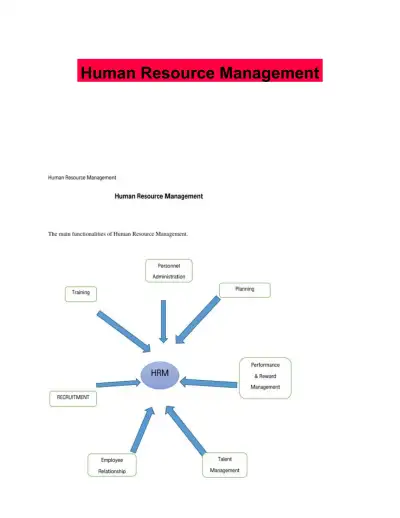 Solved Assignments
Human Resource Management
Human Resource Management
6 pagesMay 2025 Exam Guides
Human Resource Management -, Fourth Canadian Edition Test Bank
Human Resource Management
243 pagesMay 2025 Class Notes
Progressive Disciplinary Process Highlights - HRM 323
Human Resource Management
5 pagesMay 2025 Class Notes
Recruiting In Saudi Arabia
Human Resource Management
7 pagesMay 2025 Class Presentation
Talent Management: Tools And Software
Human Resource Management
11 pagesMay 2025
Study this document with CramX
Once it is in your library, every tool can work from it.