
Human Resource Management in Public Service: Paradoxes, Processes, and Problems Fifth Edition Test Bank

Human Resource Management in Public Service: Paradoxes, Processes, and Problems Fifth Edition Test Bank offers expert-reviewed explanations and practice questions to boost your exam performance.

Claire Mitchell
Contributor
5.0
57
11 months ago
Preview (16 of 59 Pages)
100%
Log in to unlock

Page 1

Human Resource Management in Public Service: Paradoxes, Processes, and Problems Fifth Edition Test Bank - Page 1 preview image

Loading page ...

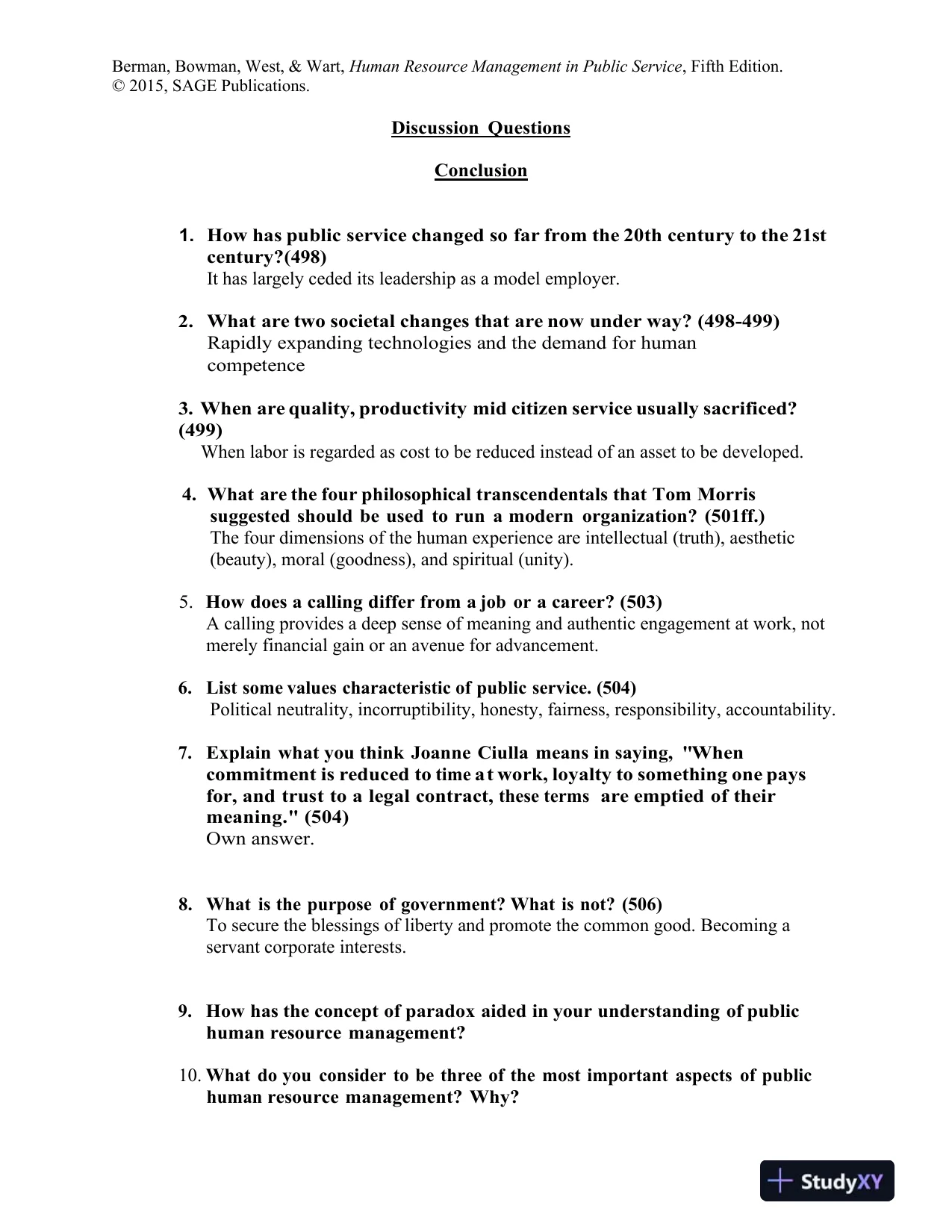
Berman, Bowman, West, & Wart,Human Resource Management in Public Service, Fifth Edition.© 2015, SAGE Publications.DiscussionQuestionsConclusion1.Howhaspublicservicechanged sofarfromthe20th centurytothe21stcentury?(498)It has largely ceded its leadership as a model employer.2.Whataretwosocietalchangesthat arenowunderway?(498-499)Rapidly expanding technologies and the demand for humancompetence3.Whenarequality,productivitymidcitizenserviceusuallysacrificed?(499)When labor is regarded as cost to be reduced instead of an asset to bedeveloped.4.WhatarethefourphilosophicaltranscendentalsthatTomMorrissuggestedshouldbeusedtorunamodernorganization?(501ff.)The four dimensions of the human experience are intellectual (truth), aesthetic(beauty), moral(goodness), and spiritual (unity).5.Howdoesacallingdifferfromajoboracareer?(503)A calling provides a deep sense of meaning and authentic engagement at work, notmerely financial gain or an avenue for advancement.6.Listsomevaluescharacteristicofpublicservice.(504)Political neutrality, incorruptibility, honesty, fairness, responsibility, accountability.7.Explainwhatyou thinkJoanneCiullameans in saying,"Whencommitmentisreducedtotimeatwork,loyaltytosomethingonepaysfor,andtrusttoalegalcontract,these termsareemptiedoftheirmeaning."(504)Own answer.8.Whatisthepurposeofgovernment? Whatisnot?(506)To secure the blessings of liberty and promote the common good.Becoming aservant corporate interests.9.Howhas theconceptofparadoxaidedinyourunderstandingofpublichumanresourcemanagement?10.Whatdoyouconsidertobethreeofthemostimportantaspectsofpublichumanresourcemanagement?Why?

Page 2

Human Resource Management in Public Service: Paradoxes, Processes, and Problems Fifth Edition Test Bank - Page 2 preview image

Loading page ...

Page 3

Human Resource Management in Public Service: Paradoxes, Processes, and Problems Fifth Edition Test Bank - Page 3 preview image

Loading page ...

Berman, Bowman, West, & Wart,Human Resource Management in Public Service, Fifth Edition. © 2015, SAGEPublication.Review/DiscussionQuestionsIntroduction1.What is a paradoxin management? (1)Seemingly incompatible ideas and practices that have to be made to work well together inorganizations.2.Definehuman resource management? (1-2, 4)Why is it important?The development of policies for effective utilization of human resources in an organization. Stateddifferently, all decisions affecting the relationship between the individual and the organization can beseen as dimensions of human resource management.It has a significant, even definitive, effect on careers. HRM makes it possible for democracy tosucceed.3.What is the most important job of an administrator? (2)To help his or her organization use its most valuable assetpeopleproductively.4.What are some decisions administrators needto make about employees? (2)How individualswill be recruited,selected, placed,compensated, trained, and evaluated.5.Explain the paradox of democracy? (3)Citizens have many civil rights in the conduct of public affairs, but employees experience preciousfew such rights in organizations. One part of American culture stresses individualism, diversity,equality, and participation, while the other emphasizes conformity, uniformity, inequality, andsubmission to authority.6.What is the paradox of needs? (4)Individuals and organizations need one another, but human happiness and organizational rationalityare as likely to conflict as they are to coincide. Many institutions today still use the machine model ofyesteryear. A top-down, command-and-control approach, revealed by the hierarchical organizationchart, imposes static predictability, demand efficiency, and expect self-sacrifice. Human beings, bydefinition, are not premised on a mechanical model, but rather on an organic one.7.Identify the cardinal question in HRM?(3-4)Do organizational procedures help or hinder the resolutions of the signature paradoxes above?8.List some ways to address paradoxes. (5)Inquire into the bases of clashing perspectives, identify and appreciate the best of differentviewpoints, strive to create new viewpoints that balance divergent opinions, and dialectic reasoning.9.Interpret Exhibit 0.2. (6)Student view.

Page 4

Human Resource Management in Public Service: Paradoxes, Processes, and Problems Fifth Edition Test Bank - Page 4 preview image

Loading page ...

Berman, Bowman, West, & Wart,Human Resource Management in Public Service, Fifth Edition.© 2015, SAGE Publications.Review/DiscussionQuestionsChapter 11.What are two major schools of thought about the breakdown of government (according toEhrenhalt)? (10)One argues that breakdown in government performance is an “incompetent people” problem, and theotherargues that it is an “evil system” problem.2.What are 3 insights from the Maria Hernandez example? Is she a good example of an HRdirector? Whatadvice would you give her? (11-13)HRM deals with many areas at once. HRM managers must weigh the pros and cons of eachdecision as well as their impact in other areas. Long-term and short-term decisions are required ofHRM managers on a daily basis.Maria Hernandez can be considered a good example of an HR director.She is involved in morethan simply “managing people”; rather she is involved in human capital development and greaterorganizational development.Stay organized, deal with problems as they come up on an individual basis, do not wait untilproblems become too large to handle.3.What are some trends that present challenges to government in getting the right people? (14-16)Trendsinclude a changing workforce, declining confidence in government, declining budgets leading toincreased use of alternative work arrangements, rightsizing and downsizing despite population growth,demands for productivity gains, emerging virtual workplaces and virtual government, anddecentralization and increased managerial flexibility.4.What are some of the reasons that young people choose public service?To make a difference in a wide variety of leadership positions in the nonprofit and for-profitsectors; different branches of local, state, regional, and federal governments; and the internationalarenaTo become engaged intellectually in the challenges facing their communitiesTo establish career and personal development skills that they can use throughout their livesTo build a better future for the world and to solve big problemsTo create communication links within and between different communitiesTo gain a sense of responsibility for others and the causes they care about5.What is the core-ring staffing model? What is its purpose? (15)It is an alternativework arrangement, noted by J.Thompson and Mastracciand Barr, in which the core iscomprised of full-time workers in permanent jobs and the ring is comprised of employees in contingentor alternative arrangements (e.g., contractors, temporary workers, and part-time employees).6.How does traditional personnel administration differ from HRM? (16, 18)Traditional personnel training was concerned primarily with traditional internal practices-recruitment,compensation, discipline-and the applications of the rules and procedures of the civil service system.Public HRM embraces a broader, more “people-focused” definition of the management of humanresources with an eye to the kind of workforce needs in government(i.e.,employee and organizationaldevelopment, organizational design, performance appraisal and management, reward systems andbenefits, productivity improvement, staffing, employee-employer relations, and health and safety).

Page 5

Human Resource Management in Public Service: Paradoxes, Processes, and Problems Fifth Edition Test Bank - Page 5 preview image

Loading page ...

Berman, Bowman, West, & Wart,Human Resource Management in Public Service, Fifth Edition.© 2015, SAGE Publications.7.When does the term strategic human resource management apply? (18)When human resource management is most global and long-term in its perspective and includes issuessuch as workforce planning and overall organizational design issues.8.What does the term civil service cover? (18)The termcivil servicerefers to the government employees in permanent public service,excludinglegislative, judicial, or uniformed military; positions typically are filled based on competitiveexaminations, and a professional career public service exists with protection against political influenceand patronage.9.Does your organization conform more closely to a traditional publicsector system or to "publicservice forthe 21stcentury"? In what ways? (19)Own Answer10.What five models of HR does the text discuss? (20)It discusses models emphasizing a/an: centralized HR department, devolved HR, decentralized HR,specialized HR departments, and outsourced HR.11.HR departments commonly share some functions with otherindividual and units. What aresome examples of sharing? (21)Employment law, recruiting, selection, creating apositive work environment, compensation, benefits,training and development, appraisal, and labor relations.12.What are the four reform tides mentioned by Paul Light? (22)Scientific management, war on waste, watchful eye, and liberation management.13.Whatis scientific management? (22)A reform tide with the goal of efficiency; characterized by the use of implementation strategies such asstructure, rules, and experts; and typified by laws such as the Reorganization Act of 1939.This reformsought to synthesize workflows.14.What are its(scientific management)implications for HRM? (23)Emphasizes conformity and predictability of employees’ contributions to the organization, and it seeshuman relationships as subject to control by management.15.What is the war on waste? What are its implications for HRM? (23)A reform tide with the goal of economy; characterized by use of implementation strategies such asgenerally accepted practices, audits, and investigations; and typified by laws such as the InspectorGeneral Act of 1978. Preoccupation with waste leads to increases in internal controls, oversight andregulations, managerial directives, tight supervision, and concerns about accountability. Can result inproliferation of detailed rules, processes, and procedures.16.What is the watchful eye? What areits implications for HRM? (24)A reform tide with the goal of fairness; characterized by use of implementation strategies such aswhistleblowers, interest groups, and media; and typified by laws such as the Administrative ProcedureAct of 1978.Implications include greater scrutiny in the hiring process to ensure integrity as well as job-related competence of new recruits. It minimizes the use of illegitimate hiring criteria, such as sex, race,age, and handicap status. Would also minimize arbitrary decisions to fire employees.17.What is liberation management? What areits implications for HRM? (24-25)

Page 6

Human Resource Management in Public Service: Paradoxes, Processes, and Problems Fifth Edition Test Bank - Page 6 preview image

Loading page ...

Berman, Bowman, West, & Wart,Human Resource Management in Public Service, Fifth Edition.© 2015, SAGE Publications.A reform tide with the goal of higher performance; characterized by implementation strategies such asstandards, evaluations, and outcomes.; and typified by laws such as the Government Performance andResults Act of 1993.Implications for HRM include employee empowerment reengineering, work teams,continuous improvement, customer service, flattened hierarchies, and self-directed employees.18.In what ways does CSRA reflect each of the tides of reform? (26-29)As stated in the CSRA, “ to strengthen the presidential claim of command (scientific management), a capon total federal employment to save money (war on waste), whistleblower protection to assure truthtelling from the inside (watchful eye), and pay for performance (liberation management).19.How did the PendletonAct alter public service? (26-20)It established the institutional framework for federal HRM. It created the Civil Service Commission(CSC) which was a protective buffer against the partisan pressures. Competitive practical exams wereintroduced, and a neutral (nonpartisan), competent, career civil service with legally mandated tenure wasexpected. Entry into the civil service was permitted at any level under this hierarchy.20.How did CSRA of 1978 alter public service? (26-29)Created the Office of Personnel Management (OPM) and the Merit System Protection Board. The OPM isthe “doing” side of public HRM. The OPM’s director is appointed/removed by the president andfunctions as his principal advisor on personnel matters. The MSB is responsible for adjudications, andemployee appeals. The CSRA also created the Federal Labor Relations Authority (FLRA) and establishedthe Senior Executive Service (SES). The FLRA functions as the federal sector counterpart to the privatesector’s National Labor Relations Board (NLRB). The SES comprises top-level administrators, mostlycareer civil servants and a lesser number of political appointees.21.What two writers are associated with reinventing government? What is the federal programimplementing it? (29)David Osborne and Ted Gaebler. The federal program implementing it is The National PerformanceReview (now called the National Partnership for Reinventing Government).22.What were the components of Clinton’s 3-part strategy for civil service reform? (31)The 3-prong strategy includes authorizing personnel demonstration projects, creating “performance basedorganizations, and constructing modified personnel systems for malfunctioning agencies.”23.What are the 5 key areas emphasized in George W. Bush’s plan for reform? (31)The 5 key areas emphasized are: human capital, competitive sourcing, financial performance, E-government, and budge-performance integration.24.The civil service has to try to please at least three major constituents. Who are they? (32-322)Political masters(elites),civil servantsthemselves and their sense of professionalism (professionalstandards, independence, neutrality), and taxpayers & customers.25.Compare Germany before and after the Civil Service Reform Law of 1997. How did the civilservants react? Why? (Exhibit 1.11) (33-34)The German civil service is based on the concept of the “rule-of-law state” that transcendsdivisive political divisions and acts in the name of all citizens on the basis of administrative law.After WWII, the system was decentralized to put the focus on the regional and local civil service.The German federal bureaucracy is thus relatively small, with the bulk of civil service in the 16states and local governments. The foundations of German service are designed to make publicservice the most highly respected profession. After theCivil Service Reform Law (key tenetsin

Page 7

Human Resource Management in Public Service: Paradoxes, Processes, and Problems Fifth Edition Test Bank - Page 7 preview image

Loading page ...

Berman, Bowman, West, & Wart,Human Resource Management in Public Service, Fifth Edition.© 2015, SAGE Publications.Exhibit 1.14), there was a huge resistance to these reforms by civil servants. Civil servants usedto generous salaries and benefits, as well as clear guidelines about promotion and pay, rebelledagainst performance-based outcomes and probationary periods, and the elimination of theirtraditional “thirteenth month” paycheck and reduction in pensions. Basically, these civil servantswere used to a codified administrative law that did not easily adapt to reforms that emphasizeautonomy and creativity. They were already receiving very generous benefits and salaries in thecurrent system. Many felt these reforms were not advantageous to them.26.The recommendations of the Winter Commission (National Commission on the State and LocalPublic Service) are remarkably relevant today and continue to be promoted. What are themajor recommendations? (35)Greater decentralization of the merit systemReduced reliance on written testsRejection of the rule of three and other requirements that severely restrict managerialdiscretion in selecting from a pool of eligible applicantsReduction of the weight given to seniority and veterans’ preferenceReduction in the number of job classificationsImplementation of less cumbersome procedures for removing employees from positionsGreater portability of pensions, enabling government-to-government mobilityGreater flexibility to provide financial incentives for exemplary performance by work teams27.What are the key criticisms of reinvention applied to HRM? (36)Criticism includes the undermining of the role of public servants, too few people with the necessary skillsare attracted to the public service, performance rewards are underfunded, reduced oversight of the publicservice, can invite corruption, and in-service training for continuous learning and planning is frequentlyinadequate. Pursuit of quick successes via downsizing too often takes precedence over improvingperformance, ideas borrowed from elsewhere, and accepted blindly often create more problems thansolutions, and empowerment initiative frequently are uneven.28.How does your organization stack up against the values of HRM? (37)Own Answer29.What are the four overarching principles that administrators need to be mindful of? (37-39)Understand the values inherent in the career public service.Understand and integrate noncivil service systems as appropriate.Understand that the public has rights beyond merit principles.Provide leadership for the workforce.30.How do Level 1,2, and 3 of value consciousness differ? What arethe HRM implications of eachlevel? (40)Administrators at Level 1 value unconsciousness, lack understanding or basic awareness of agencyvalues, missions, or standard operating procedures (SOPs), and they may knowingly or unconsciouslytake inappropriate or illegal actions. At Level 2, elementary values consciousness, managers have a basicgrasp of the mission, laws, and rules, and they focus on conforming in order to avoid legal violations orinappropriate actions. Managers at level 3, advanced values consciousness, have a thoroughunderstanding of their unit’s mission, values, and mandate, and they can take actions that reflect the idealsassociated with good government, such as efficiency, economy, ethics, fairness, and the public good. Atlevel 1, lack of awareness requires education. Ignorance can be very costly . At level 2, mere conformity

Page 8

Human Resource Management in Public Service: Paradoxes, Processes, and Problems Fifth Edition Test Bank - Page 8 preview image

Loading page ...

Berman, Bowman, West, & Wart,Human Resource Management in Public Service, Fifth Edition.© 2015, SAGE Publications.to the laws, rules, and SOPs put managers in the role of compliance officers. At level 3, managers have amore expansive perspective with agency values, missions, and requirements and view human resources asa precious resource for improving governmental performance.31.How are value conflicts resolved? (41)Balance of competing pressures by comparing issues of legality, ethics, and fairness.32.Have you encountered any of these dilemmas? How were they resolved? (41-42)Own Answer33.What is the paradox between ethics principles, codes, and strategies? (42)Must be able to balance the law with ethics as well as fairness to others34.How do levels of valueconsciousness relate to the first and second HRM value subsystems? (41)In level 1 culture, responses are nonexistent, selective or reactive. When workers lack basic consciousnessabout valuesand appropriate ethical conduct, then ethics and integrity are often managed using fearthreats, and punishment. In level 2,policies are to reward, appraise, and develop employees. There is aneffort to have employees conform to work processes and comply with externally mandated standards.35.Why are the quotes from FDR and Thomas Jefferson profound? (43))The need to build a firm foundation of public trust, which harks back to the basic principles of reform.Shows the need to exhibit professionalism, promote merit, ensure accountability to political leaders, andavoid partisan bias. Defining core values and being guided by bedrock principals helps administratorsmake the critical ethicaljudgmentsoften requiredin resolving nettlesome human resource issues. .Managers must decide when to “swim” with prevailing tides and when to “stand.”

Page 9

Human Resource Management in Public Service: Paradoxes, Processes, and Problems Fifth Edition Test Bank - Page 9 preview image

Loading page ...

Berman, Bowman, West, & Wart,Human Resource Management in Public Service, Fifth Edition.© 2015, SAGE Publications.1Summary/Review/DiscussionQuestions andAnswersChapter 21A. Explain the following paradox: “Managers must embrace the law to avoid the law.” (51)Managers must learn the intricacies of the law to ensure they do not spend their careers entangled in it.2A. What are the reasons a manager should be familiarwith basic legal principles? (51)a.To avoid liability.b.To anticipate and prevent problems from developing into lawsuits.c.To gain the confidence to make tough decision, such as when to discipline an employee.d.To capably assist in implementing worthy societal objectives such as equality, fairness, dignity,economic well-being, strong familiar relationship.2.What are three competing interests thatneed to be kept in balance?(52)a.The need of employers to mange their workforce and operations in efficient ways.b.Rights the employees have in their jobs, privacy, and other matters.c.The interest of governments to pursue social objectives through public policy.3A. Describe the overarching paradox in the legal arena and listsome of the reasons for it. (51/52)Those in charge are expected to uphold the law, but the complexities and uncertainties of constitutional,statutory, administrative and common law make complying frustratingly difficult.Reasons:a.Legal requirements and interpretations of them are voluminous and dynamic, so managerssometimes have the experience that “the more you know, the less you know.b.Supervisors may contact legal counsel for assistance, but formal options may take considerabletime to obtain and legal staff may be unwilling to stand behind initial, informal opinions.c.Applying a statute is rarely straightforward.d.Using case law is tricky because cases are decided on specific facts, but managers seldomconfront identical facts, so they must determine whether minor factual distinctions should alterthe outcome.e.Legal requirements may be crosscutting so that compliance with one directive conflicts withanother.3.How can managers stay upto date with legal changes?(53)Managers can await policy directives from theirorganizations, use networking, major newspapers, lawfirm seminars,theInternet.4.What is a common law system?(53)Most “rules in a common law system are not written down in statutes or codes, but are in the form ofjudicial opinions. The “law” is built up case by case by judges,to find the law, in addition to reading anypertinent statutes, one must read judges’ opinions on the matter at hand.5.What is a civil law system? (56)Civil law systems place their primary emphasis on legislation. There are comprehensive statutes or codesenacted by a legislative body on every subject.7A. Define the principle of “stare decisis”. (56)Courts generally should abide by precedents established by a superior court.

Page 10

Human Resource Management in Public Service: Paradoxes, Processes, and Problems Fifth Edition Test Bank - Page 10 preview image

Loading page ...

Berman, Bowman, West, & Wart,Human Resource Management in Public Service, Fifth Edition.© 2015, SAGE Publications.26.Explainthe difference between a binding precedent and a persuasive precedent?(56)Binding precedents must be followed by other courts. For a court’s opinion to be controlling precedentor binding precedent, it must have been written by a court directly up the pyramid from the lower court.Apersuasive precedent refers to a court decision that does not control but that may be followed voluntarilyby another court because the facts are comparable and the reasoning strong.8A.Which institutions are responsible for most federal employment laws? (56)The Equal Employment Opportunity Commission (EEOC) and the U.S. Department of Labor.9A. List some of thefederal employment laws. (54-55)a.Exhibit 2.27.Define at-will employment? (58)Unless the parties have agreed to a specific duration of employment, either party may terminateemployment at any time, without notice, for any lawful reason.8.What two trends have increased individual rights anderoded the at-will doctrine?(59)First, the Supreme Court ruled that when a public employer takes adverse personnel action againstemployees it is “state action,” so federal and state constitutional protections apply. Second, the SupremeCourt ruled that when a law, rule, or understanding creates an expectation of continued employment in agovernment job, then employees possess a property interest that cannot be taken away without dueprocess of law.9A.What is the implication of having property interests in a job? (60)The person has procedural due process rights. The employee may not be disciplined seriously unlessprocedures designed to guarantee fairness are followed.9.What did the Supreme Court seek to do inBoard of Regents v. Roth(1972)? (61)The Supreme Court explained the conditions that raise government employment to the level of propertyinterest. The employee must havea legitimate claim of entitlement to continued employment based oncodified rules or explicitly agreed-upon contract terms.10.What are Loudermill rights? (61)The right to pre-termination hearing..Before it makes a decision, the employer must give the employeenotice of the charges, an explanation of the evidence, and an opportunity for the employee to present hisside of the story.11A. Define “adverse action” and explain who is affected by it.(60)Formal discipline of an employee involving suspension, salary reductions, demotions and terminations.It affects civil servants in classified positions.11.What did the court seek to do in thePickeringcase? (62)Sought to weigh the need for workplace efficiency against employees’ free speech rights to speak out ascitizens in matters of public debate.12.Whom does the Whistleblower Protection Act of 1989 protect? (63)Requires federal employees to seek protection against an agency’s adverse action in response to whistle-blowing through the Office of Special Counsel. If this course is unsatisfactory, plaintiffs may appeal tothe Merit Systems Protection Board.

Page 11

Human Resource Management in Public Service: Paradoxes, Processes, and Problems Fifth Edition Test Bank - Page 11 preview image

Loading page ...

Berman, Bowman, West, & Wart,Human Resource Management in Public Service, Fifth Edition.© 2015, SAGE Publications.313.What is the Hatch Act? (63)Government workers are limited in the political activity in which they may engage by the federal HatchAct of 1939 as amended, and state and local little Hatch Acts. These acts restrict the First Amendmentright to political expression, but they pass muster with courts because they reduce political coercion of thebureaucracy and promote non-partisan, efficient government workforce.14A. The U.S. Office of Special Counsel that publishes guides to the Hatch Act, has divided federalemployees in two groups. List themand explain how they differ. (64)a.Further restricted employees work in intelligence and enforcement-type agencies. They have littleability to participate in partisan politics.b.Less restricted employees face fewer restrictions.14.Identifythe key finding inBranti v. Finkel(1980)?(64-65)The court clarified that, regardless of whether the “policy maker” or “confidential” label fits,partyaffiliation must be necessary for effective performance of the job.15.What is the overtime pay requirement under the FLSA of 1938?(65)A minimum wageshouldbe paid and the overtime be paid, at time-and-a-half of the regular ratefor hoursmore than 40 per week.16.What isthe white-collar exemption?(65)Employees who are engaged in an executive, administrative, or professional capacity, whichincludes many government workers, are exempt from both minimum wage and overtimerequirements.17.What does the1963 Equal Pay Act requires?(65)It requires employers to pay men and women equal wages for equal work, unless the employercan justify the differential by seniority, merit, piecework, or any other factor other than sex.19A.What coverage is provided under theworkers’ compensation acts? (67)All injured workers in federal agencies should receive health care and lost wages.Employeesrelinquish the right to sue employers in civil courts for on-the-job injurieswhile employersforfeit the right to deny benefits to employees whose own negligence caused or contributed tothe injury.18.Are public employers legally obligated to provide health insurance to employees?(67)Yes. Private sector employment-based health insurance benefits are voluntary, but public-sectorplans are created by laws.19.How are retirees and same-sex domestic partners treated in terms of healthinsurance?(67-68)

Page 12

Human Resource Management in Public Service: Paradoxes, Processes, and Problems Fifth Edition Test Bank - Page 12 preview image

Loading page ...

Berman, Bowman, West, & Wart,Human Resource Management in Public Service, Fifth Edition.© 2015, SAGE Publications.4Most public employers offer health insurance coverage to retirees, and many subsidize thepremium. Far less offer health insurance to same-sex domestic partners. Though financing thesebenefits is a growing challenge.21A. What does the Affordable Care Act require? (67)Employers with at least 50 employees to offer coverage to people who workan average of 30hours a week. It requires all citizens to have health insurance, so that hose unable to accessemployer plans must turn to private insurers or health exchanges; governmental subsidies areavailable to assist these individuals..20.What is required under the FMLA of 1993? (68)Under the Family and Medical Leave Act, employers are required to give employees up to 12 weeks ofunpaid leave for childbirth, adoption, or care of ill children, spouses, or parents.22A.Define officialimmunity. (68)It is a common-law doctrine that shields government employees from individual liability. It is based onthe belief that government actors should not be made hesitant in carryingout their responsibilities bythreats of lawsuits.21.What is qualified immunityand absolute immunity?To whom do they apply?(68-69)Absolute Immunity: it applies to few officials such as judges and legislators for actions performed infurtherance of judicial or legislative functions.Qualified Immunity: most officialsare immune from liability for discretionary acts in the scope of theirduties if they act in good faith (without malice) and reasonably.22.How does the “balance doctrine” apply to matters of privacy? (69-70)In the workplace, a reasonable search must balance the work-related purposes of the government againstsocially accepted expectations of privacy.23.How can employers remove expectations of privacy? (70)Eliminating personal work places and adopting pertinent workplace policies authorizing search.24.What is Executive Order 12564? (70)It requires executive agencies to test federal employees in sensitive positions for illegal drug use. Theorder authorizes drug testing in four circumstances:a.Where there is a reasonable suspicion of illegal drug useb.In apost-accident investigationc.As part of counseling or rehabilitation for drug use through an employee assistance programd.To screen any job applicant.26A.What approach should be adopted by agencies in matters of grooming and dress? (74)One-size-fits-all standard of dress and grooming is not recommended. A contingency approach seemswarranted.25.What questions should not be asked in pre-employment checks? (74)May not inquire about such personal matters as sexual orientation, marital status, or eventhe willingnessof a working spouse to relocate. Cardinal Rule is job relatedness.

Page 13

Human Resource Management in Public Service: Paradoxes, Processes, and Problems Fifth Edition Test Bank - Page 13 preview image

Loading page ...

Berman, Bowman, West, & Wart,Human Resource Management in Public Service, Fifth Edition.© 2015, SAGE Publications.526.Whenis it OK to use medical tests? (74-75)May be used as a condition to hiring after an offer has been made.Medical testing of current employeesmust be job related. The results of tests should be kept confidential and used in a nondiscriminatory way.27.When it is OK to administer AIDS tests? (75)Only where transmission of the HIV virus is a demonstrable risk.29A.Whendoes defamation occur in post-employment references? (77)A job reference is defamatory if it contains a false statement that injures an individual’s work reputation.28.Who is protected under the Civil Rights Act of 1964? ..the Age Discrimination inEmployment Act? …the ADA of1990?(76)The Civil Rights Act of 1964 protects employees in hiring, promotion, and termination decisions basedon their race, color, religion, national origin, or gender. The Age Discrimination in Employment Actextends protection to all workers over 40 years of age. The Americans With Disabilities Act protectspersons with disabilities and requires employers to make reasonable accommodation.30A.Inwhich ways can intentional discrimination be proved? (78-79)a.Direct evidence: statements that demonstrate bias by the decision maker.b.Indirect evidence: the employee relies on actions by the employer to support an inference ofunlawful motive.29.DefineBFOQ? (78-79)Bona Fide Occupational Qualifications, could allow employees to make gender or race a relevant jobqualification-if it is job related. Today, BFOQs are all but dead.31A.What is the reason for the harassment? (83)Gender, for example not conforming to the male stereotype.32A.What is the paradox contained in affirmative action programs? (84)They use race-based decision making to remedy harm caused by race-based decision making.30.What did the U.S. Supreme Court say about theUniversity of Michigan’s law schooladmissions policy? Why?(84)The University of Michigan Law School could constitutionally use a race-conscious admissions policybecause the law school had a compelling interest in attaining a diverse student body.31.What is reverse discrimination? (84)When organizations have adopted a affirmative action plan to address underrepresentation, they may hirequalified minority or female candidates over better-qualified majority or male candidates.32.What is the 80% rule? (85)Discrimination is any selection process that results in qualification rates of protected groups that are lessthan 80% of those of the highest group.33.What is race normingand what purpose did it serve? (85)

Page 14

Human Resource Management in Public Service: Paradoxes, Processes, and Problems Fifth Edition Test Bank - Page 14 preview image

Loading page ...

Berman, Bowman, West, & Wart,Human Resource Management in Public Service, Fifth Edition.© 2015, SAGE Publications.6The practice of adjusting test scores of minority groups to ensure that a sufficient number of candidatescan be hired, a practice disallowed by the Civil Rights Act of 1991.It has been used to avoid a disparateimpact on a protected group.35A. Would an employee with cancer be covered under the Americans with Disability Act? Whichfunctions are expected to be carried on by the employee?(87)Yes. The employee covered by ADA must be able to perform essential job functions previouslyidentified by the manager.34.What constitutes “reasonable accommodation” regarding employer actions and religiousfreedom?(86-87)That which is minimally necessary for the employee to fulfill his or her religious obligation orconscience.

Page 15

Human Resource Management in Public Service: Paradoxes, Processes, and Problems Fifth Edition Test Bank - Page 15 preview image

Loading page ...

Berman, Bowman, West, & Wart,Human Resource Management in Public Service, Fifth Edition.© 2015, SAGE Publications.Review/DiscussionQuestionsChapter 31.What are key paradoxes of recruiting? (97)(a)Procurement strategies may be relatively insignificant compared to the environment withinwhich recruitment takes place(b)The seeming abundance of employment opportunities but the scarcity of desirable positions(c)Management applicants should prepare themselves as both specialists and as generalists2.Which decades were the high water mark for prestige of the public service? (97)1930s and 1940s.3.What five factors affect finding talented workers? (99)At least five major elements influence the effectiveness of recruitment: (1) the breadth andquality of the process, (2) the size of the labor pool and the location of jobs, (3) pay and benefits,(4) job quality, and (5) organizational image.4.Which is often the first factor that potential applicants review and consider? How dothe private, public, and nonprofit sectors compare in this respect?(100)Pay and benefits are often the first factor that potential applicants review and consider. Publicsector pay generally varies from being uncompetitive to moderately competitive, depending onthe agency, location, and position. Public sector benefits are generally perceived as on par withto substantially better than the private sector on average and thus a recruiting strength. Thenonprofit sector often suffers from a substantially lower pay scale and more limited benefits thaneither the private or public sectors, and thus must make up for these weaknesses in the intrinsicjob quality elements.5.What is your experience with recruitment from an applicant’s perspective? (101)Own Answer.6.What are the three steps inrecruitment or staffing? (102)(a)Planning and approval for staffing(b)Preparation of the position announcement; ensuring announcement fits regulations/laws(c)Selection and use of recruitment strategies7.What is proceduralism? (103)Connotes processes that have become excessively detailed, complicated, protracted, and/orimpersonal.8.What are three ways government reform initiatives have changed staffing? 103)(a)Strong drive to decentralize staffing activities(b)Sincere effort to simplify and invigorate intake functions(c)Personnel offices are demonstrating a willingness to experiment with new staffing strategies.9.What is a labor-market survey? 104)Overview of the labor market as it affects agency job clusters.10.Why do a needs assessment? (104)

Page 16

Human Resource Management in Public Service: Paradoxes, Processes, and Problems Fifth Edition Test Bank - Page 16 preview image

Loading page ...

Berman, Bowman, West, & Wart,Human Resource Management in Public Service, Fifth Edition.© 2015, SAGE Publications.To assess requirements for new positions, restructured positions, and eliminated positions.Toensure that previous needs assessment are still accurate.11.What are examples of important issues that can be found by a needs assessment?(104)The issue of succession planningand understanding the differences among different generationsand their varying needs and the preferences of the newer generations; If an agency is required tostrengthen its educative or facilitative role and decrease its regulative role, then it will need newskills and even different types of staff;. The problem with the housing boom and bust has led todramatic shifts in staffing code enforcement, building services, and the types of economicdevelopment initiatives undertaken.12.What are someforms planning can take? (105)Some forms are staff intake function is properly funded, working on the institutional image,providing flexible schedules, and providing family support policies like child care, comparablepay, and technology upgrades. A final aspect of planning is to make sure that the process istimely and user-friendly.13.What aresome red flags for managers? 105)(a)Applicants for recent positions have been poorly qualified.(b)Supervisors complain that new workers do not fit well into the department.(c)The best potential candidates do not apply.(d)The most desirable applicants have already found jobs by the time the position is offered.14.What is the point about hiring under-qualified, but high-potential candidates? (106)Ensures higher quality training by focusing resources on the trainer, thus the demands on thepersonnel of the unit are reduced and training is less of a distraction.15.What is “pool hiring”? What are its advantages? (107)Broad, entry-level classifications in moderately large organizations. Generically advertise fornumerous entry-level secretaries, computer programmers, and accountants to be placed on astanding certified list. Advantages are increased efficiency, low cost, and multipleconsiderations of qualified applications. Main disadvantage is difficulty keeping list up to date.16.What are three options concerning the breadth of involvement in recruiting? (107)(a)supervisor is sole decision maker(b)a search committee that selects the finalists for an interview and recommends a bestcandidate to the hiring supervisor.(c)Input is solicited from the affected subordinates and colleagues, but the final decision is stillprimarily the domain of the supervisor.17.What are some advantages of generalists? (107)Broader perspective, “see the forest for the trees,” superior people skills, cheaperto hire, easierto cross-train, often more willing to accept multiple roles/assignments18.What are some advantagesof specialists? (107)More efficient due to technical background, easier to justify in the budget in front-line positions,requirerelativelylittle training for the production work that many supervisors today continue todo; specialized to the job.19.What are three key considerations in drafting job announcements? (108-109)
Preview Mode

This document has 59 pages. Sign in to access the full document!