
Lecture Notes for Industrial Relations in Canada, 4th Edition

Stay prepared with Lecture Notes for Industrial Relations in Canada, 4th Edition, a well-structured collection of lecture notes designed to enhance your learning.

Ava Martinez
Contributor
4.8
55
11 months ago
Preview (16 of 426 Pages)
100%
Log in to unlock

Page 1

Lecture Notes for Industrial Relations in Canada, 4th Edition - Page 1 preview image

Loading page ...

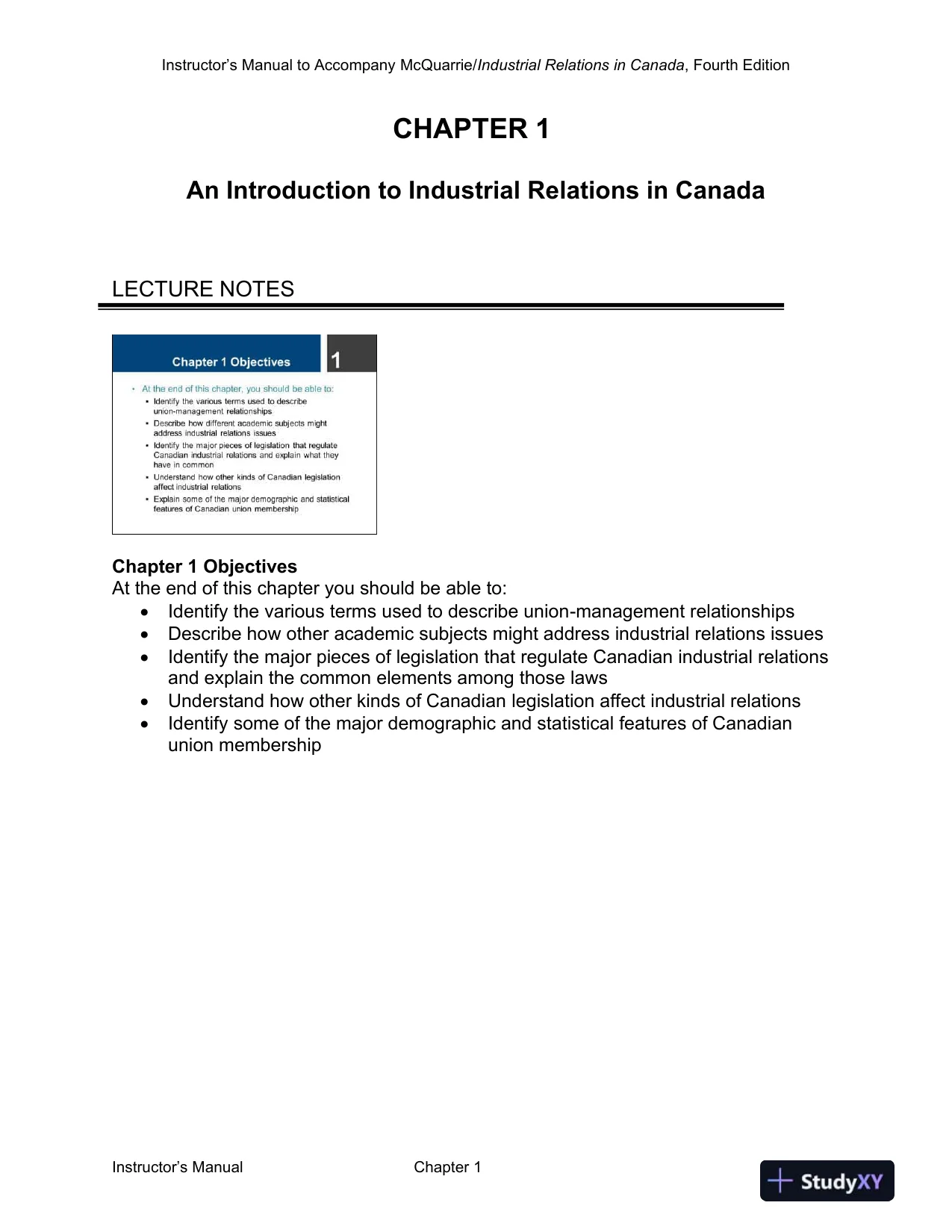
Instructor’s Manual to AccompanyMcQuarrie/Industrial Relations in Canada,FourthEditionInstructor’s ManualChapter 11-1CHAPTER 1An Introduction to Industrial Relations in CanadaLECTURE NOTESChapter 1 ObjectivesAt the end of this chapter you should be able to:Identify the various terms used to describe union-management relationshipsDescribe howother academic subjects might address industrial relations issuesIdentify the major pieces of legislation that regulate Canadian industrial relationsand explain the common elements among those lawsUnderstand how other kinds of Canadianlegislation affect industrial relationsIdentifysome of the major demographic and statistical features of Canadianunion membership

Page 2

Lecture Notes for Industrial Relations in Canada, 4th Edition - Page 2 preview image

Loading page ...

Page 3

Lecture Notes for Industrial Relations in Canada, 4th Edition - Page 3 preview image

Loading page ...

Instructor’s Manual to AccompanyMcQuarrie/Industrial Relations in Canada,FourthEditionInstructor’s ManualChapter 11-2What Is Industrial Relations?Refers to the relationship between aunionand anemployerUnion:organization run for and by workersEmployer: organization that workers in union work forEmployer can also be called “management”, “the company”, or “theorganization”, but “employer” is most common term because it reflectsemployer-employee relationship that is the basis of union’s connection toworkplaceUnion’s primary role is to represent workers in interactions with the employerUnion is given this power throughCanadianprovincial and federal lawThe expressionindustrial relations(IR):Is the preferred Canadian term for union-employer interactions-Used by federal government since 1919 Royal Commission to Enquire intoIndustrial Relations in CanadaIs a more appropriate description thanlabour relations(LR)-“Labour relations” comes from “organized labour”, a term used to describeunionsEmphasizes that there are two parties-“Labour relations” only focuses on labour side of union-employer relationship-“Industrial relations” also indicates that union-employer relationship is withinthe context of an industry or workplaceOne widely used definition of“industrial relations”contends that it is abroadandinterdisciplinary field ofstudyandpractice that encompasses all aspects of theemployment relationshipMore appropriately as a descriptor of union-employer relationship-In common usage “industrial relations” refers to employer-employeerelationships in unionized workplaces-Study of non-unionized workplaces is usually called “employmentrelations” or “human resource management” (although human resourcemanagement(HRM)can and does deal with issues in unionizedworkplaces)

Page 4

Lecture Notes for Industrial Relations in Canada, 4th Edition - Page 4 preview image

Loading page ...

Instructor’s Manual to AccompanyMcQuarrie/Industrial Relations in Canada,FourthEditionInstructor’s ManualChapter 11-3-Much I.R. research on non-unionized workplaces investigates how non-union workplaces replicate or adopt structures of unionized workplacesI.R. differs from H.R.M. primarily in that I.R. deals mostly with unionizedworkplaces, while H.R.M. deals with both unionized and non-unionizedworkplacesNo Single, Unifying Theory of Industrial RelationsI.R. issues may interest historians, psychologists, economists, and others-E.g., historian: events leading to formation of a union or study of an industrialrelations conflict-E.g., psychologist: development or changes of individual attitudes towardunion or employer-E.g. economist: effect of unionized wage rates on industry wage rates or costof livingEach would approach the topic differently-Thus there is no single theory that completely explains all events in I.R.-Sometheories may even contradict or be in conflict with each otherNo single theory could explain every possible situation-I.R. contains perspectives from multiple disciplines-Union-employer relationships involve complex work and work arrangements,and take place within complex organizationsand thereforedifficult to have asingle theory-Should instead recognize that different perspectiveshelp tomake a richercontribution tohow weunderstand union-employer relationshipWhy Study IndustrialRelations?Common student attitudes:Unions no longer needed because workers are treated fairlyOnly part of Canadian workforce is unionized, so no need to study unions if youmight never join onePersonally opposed to unions and would never join one

Page 5

Lecture Notes for Industrial Relations in Canada, 4th Edition - Page 5 preview image

Loading page ...

Instructor’s Manual to AccompanyMcQuarrie/Industrial Relations in Canada,FourthEditionInstructor’s ManualChapter 11-4All valid statements, but there are several reasons to study I.R. even if you hold some orall of these beliefs:1.In many workplaces and occupations, union membership is a prerequisite toemploymentAttaining a certain job or pursuing a certain career may require joining a unionregardless of one’spersonal views on unions2.Non-union members are often affected by the actions of unions and unionizedemployersE.g.,during Air Canada’s 2012 labour disputes between unionized workersand the employer (Air Canada), the impact of the conflict extended to otherparties: travellers whose trips were disrupted; businesses whose productsand supplies were not delivered on time, etc.Thus important to understand unions and their activitieseven if you are notpart of a union3.Canadian law makes unionization an option for nearly every kind of workerNot every workplace is perfect and unions may have a role to play in affectingworker satisfaction and working conditions4.Knowing the history of unionization helps explain the modern Canadianworkplace and the laws that govern itUnions have been influential in obtaining e.g. minimum wage laws,occupational health and safety standards5.Knowledge of I.R.is a benefit for anyone seeking employment inhumanresource managementor related fields-Ability to workwithinand understandboth unionized and non-unionizedenvironments is amuch sought after skill for employers6.It is easier tocontestunions if you know about them-If you want to oppose a union, it’s useful to know howthey operate, whatlaws govern their operations, and what employers can and can’t do tocounteract unionizationin the workplace

Page 6

Lecture Notes for Industrial Relations in Canada, 4th Edition - Page 6 preview image

Loading page ...

Instructor’s Manual to AccompanyMcQuarrie/Industrial Relations in Canada,FourthEditionInstructor’s ManualChapter 11-5The Legal FrameworkJurisdictionTerm means which government or law-making body has responsibility forlegislation regulating a particular issueDepending on the situation, union-employer relations may be governed byfederal or provincial legislationUntil the mid-1920s, all I.R. issues were covered by federal laws-1867British North American Actconcentrated most Canadian legislativepower at the federal level-Deliberate choice by founders of Canada because they wished to avoidAmerican experience of Civil War caused by decentralization of legislativepowerIn 1925, case ofSnider vs. Toronto Electrical Commissionestablished thatindustrial relations were mostly a provincial responsibility-The outcome of this case required each province to develop its own labourrelations legislation-There is now a federal labour relations act AND a separate labourrelationsact in each province

Page 7

Lecture Notes for Industrial Relations in Canada, 4th Edition - Page 7 preview image

Loading page ...

Instructor’s Manual to AccompanyMcQuarrie/Industrial Relations in Canada,FourthEditionInstructor’s ManualChapter 11-6Federal JurisdictionHow to determine if a specific union-employer relationship is governed by federal orprovincial labour law?If an employer’s business has aninterprovincial componenti.e., it regularlycrosses provincial linesit is covered by federal labour lawsExamples are banking, telecommunications, broadcasting and interprovincialtransportationEmployees of the federal government and some Crown corporations are alsocoveredProvincial JurisdictionProvincial labour law covers businesses that operate within the boundaries of thatprovince(intraprovincially)Covers 90 per cent of union-employer relationships in Canada

Page 8

Lecture Notes for Industrial Relations in Canada, 4th Edition - Page 8 preview image

Loading page ...

Instructor’s Manual to AccompanyMcQuarrie/Industrial Relations in Canada,FourthEditionInstructor’s ManualChapter 11-7Types of Laws Covering LabourRelationsLabour Relations LawsFederal and provincial labour relations acts share common characteristics. They:Establish certification procedures covering the recognition of a union in aworkplace-Discussed in more detail in Chapter 5Set a minimum term for collective agreements between employer and union;usually one yearEstablish procedures for legal strikes and lockouts-Procedures usually include regulations for strike or lockout-related activitiese.g., picketing, replacement workers-Discussed ingreaterdetail in Chapter 9Establish ways of resolving disputes duringthe term of thecollective agreement-These are usually called grievance resolution procedures-Discussed in more detail in Chapter 11Define unfair labour practices-Unfair labour practices are behaviours by union or management during e.g.,certification campaigns-Discussed in more detail in Chapter 6Createlabour relations board, which hasquasi-judicialstatus-Specific name varies by jurisdiction Its purpose is toadminister and enforcelabour relations legislation-Resolves disputes related to the application oflabour relationslegislation andprovides services such as assistance in grievance resolution-Rules on cases brought before it and issues interpretations of the law-Board hasQuasi-judicialstatus because, like civil or criminal court, it ruleson cases and the government funds its operations, butthe government doesnot control its operations. Unlike civil or criminal court, labour relations boardcan suggest remedies as well as impose solutions. It also has broader

Page 9

Lecture Notes for Industrial Relations in Canada, 4th Edition - Page 9 preview image

Loading page ...

Instructor’s Manual to AccompanyMcQuarrie/Industrial Relations in Canada,FourthEditionInstructor’s ManualChapter 11-8guidelines than other courts on what evidence can be submitted when a caseis heard-Board members are union and management representatives, allappointed bygovernment-Board members are appointed to panels to hear cases; usually one unionrepresentative and one management representative, who then pickathirdmember. (There can also be single-member panels)-Boards also have chairs and vice-chairs appointed by government, and staffmembers whoassist board members in their work and provide services topublic

Page 10

Lecture Notes for Industrial Relations in Canada, 4th Edition - Page 10 preview image

Loading page ...

Instructor’s Manual to AccompanyMcQuarrie/Industrial Relations in Canada,FourthEditionInstructor’s ManualChapter 11-9Public Sector Labour Relations LegislationIn most Canadian jurisdictions, separate labour relations acts governpublicsectoremployees-Public sector employees = employees who work for government or foraffiliated organizations e.g. Crown corporationsSome jurisdictions have separate acts forpara-publicorquasi-public sectoremployees (employees who work for government-funded organizations, but don’tdirectly work for the government.)-Examples of para-public/quasi-public sector employees: court workers,health-care workers, university/college employeesReasons for separatelabourlegislationUnique employment relationshipemployer sets rules, holds more power-Government is the employer but government is also responsible for creatingand administering labour relations legislation.Other employers do not havethis regulatory power.-Separate public sector labour legislation recognizes the unique status ofgovernment as employerPublic and para-public employees often provide vital services: fire protection,social services, health care-These services are needed for communities to function effectively-Separate legislation allows government to establish rules specific to thesetypes of employees, e.g. restrictions on ability to strikeIn some jurisdictions, public sector disputes are heard by the same labour relationsboard as private sector disputesOther jurisdictions provide for separate public sector boardWhere this exists, public sector labour relations board has same structure andfunction as “regular” labour relations board, but public sector board’s mandate islimited to interpretation/administration of public sector labour law only

Page 11

Lecture Notes for Industrial Relations in Canada, 4th Edition - Page 11 preview image

Loading page ...

Instructor’s Manual to AccompanyMcQuarrie/Industrial Relations in Canada,FourthEditionInstructor’s ManualChapter 11-10Occupation-Specific Labour Relations LegislationSome jurisdictions have additional labour relationslegislation that applies to particularoccupations or industriesUsually addresses specific conditions in occupations or industries that would notbe adequately covered under regularlabour relationslegislation-examples e.g. police, fire, constructionOther Relevant LegislationEmployment Standards LegislationExists in every jurisdictionEstablishes minimum standards for working conditions in both union and non-union workplacesthrough and Act or CodeUsually covers e.g. working hours, minimum wages, holiday time, and timerequired for notification of termination or layoffUnion collective agreements must not contain terms inferior to employmentstandards legislation-E.g., even if both parties agree to a minimum wage lower than thatestablished by employment standards act, this would not be a legalagreement-Parties can negotiate better conditions than those specified in employmentstandards act (and usually do) but employment standards act ensures basicstandards for all workplaces

Page 12

Lecture Notes for Industrial Relations in Canada, 4th Edition - Page 12 preview image

Loading page ...

Instructor’s Manual to AccompanyMcQuarrie/Industrial Relations in Canada,FourthEditionInstructor’s ManualChapter 11-11HumanRights LegislationExists in every jurisdictionForbids discrimination against individuals on the basis of gender, ethnic origin,sexual orientation, etc.Discriminationdefined as:Refusal to grant access to accommodation, contracts, goods and services, oremployment because of an identified personal attribute (e.g., ethnic origin),known asprotected groundsorprohibited grounds-E.g., cannot refuse to rent an apartment to someone because they areAboriginalMembers of particular groups may be legally excluded from employment in some cases.(e.g.,A women’s prison may determine thatmalecorrectional officers are not suitableforawomen’sfacility)This can only be done if there is an essential part of the job that can only beperformed by members of certain groups e.g., it would be inappropriate formale prison guards to do body searches on female prisonersTwo kinds of discrimination:Intentional discriminationSystemicdiscriminationIntentional discrimination:Direct and deliberate refusal based on prohibited groundsE.g., previous example of refusing to rent an apartment to a Black personSystemic discrimination-Also called unintentional, constructive, or adverse impact discriminationOccurs when an organization or individual uses policies or practices that havetheeffectof discriminating against groups or individuals

Page 13

Lecture Notes for Industrial Relations in Canada, 4th Edition - Page 13 preview image

Loading page ...

Instructor’s Manual to AccompanyMcQuarrie/Industrial Relations in Canada,FourthEditionInstructor’s ManualChapter 11-12-E.g., a policy requiring job applicants to be a certain height might eliminatemany women and members of certain ethnic groups from consideration,even if they were otherwise qualifiedCan occur even if there is no intent to discriminate-E.g., in example above, there might not be an explicit intent to removesome women and members of certain ethnic groups from consideration,but the policy would have the effect of discriminating against them-If a job requirement has such restrictions, employer needs to be able toshow that restriction is related to some essential part of the job (e.g.,heightspecificationmight benecessary for aworkerto be able toeffectively perform a certain job requirement)Human Rights LegislationImplications for unions andemployers:Collective agreements must not intentionally or systemically discriminate-Language in collective agreement must not discriminate on protectedgrounds, e.g., cannot say men will be given priority in promotions, even ifboth parties agree to this languageUnions and employers must not act in a discriminatory fashion-Unions must represent all of their members fairly, e.g., a union could notrefuse to pursue an employee’s complaintsimplybecause employee wasAsianHuman Rights CommissionStructure and function similar to labour relations board-Also has quasi-judicial statusAdministers and enforces only human rights legislation-Hears and resolves complaints about discrimination, and also offersservices to public e.g., educationComplaintsIndividuals may file complaint with relevant human rights commission

Page 14

Lecture Notes for Industrial Relations in Canada, 4th Edition - Page 14 preview image

Loading page ...

Instructor’s Manual to AccompanyMcQuarrie/Industrial Relations in Canada,FourthEditionInstructor’s ManualChapter 11-13If it is substantiated, the Commission will investigate the complaint and suggest aremedyUnion members who feel their union has discriminated against them may file complaintwith labour relations boardUnions have “duty of fair representation” and union members who feel union isdiscriminating against them can file a complaint with labour relations boardalleging this duty has been breachedDuty of fair representation discussed in Chapter 11

Page 15

Lecture Notes for Industrial Relations in Canada, 4th Edition - Page 15 preview image

Loading page ...

Instructor’s Manual to AccompanyMcQuarrie/Industrial Relations in Canada,FourthEditionInstructor’s ManualChapter 11-14The Charter of Rights and FreedomsGuarantees certain basic rights and freedoms to all Canadianscontained in thefederalConstitution Act (1982)Takes precedence over all other laws, with two exceptions:-Laws that can be justified asimposing reasonable limits ina “free anddemocratic society”-Laws passedby provincial legislatures thatinvokethe “notwithstanding”provisionThe Charter of Rights and FreedomsThe Charter broadly defines anumber of fundamental rights-Broaddefinitions do not include specific guidance on practical application-Applicabilityhas mostly been determined through outcomes of “Charter cases”Major cases involving industrial relations issues have focused on these rights:Freedom of association-E.g., freedom to join groups or to be associated with individuals of one’schoiceFreedom of peaceful assembly-E.g., freedom to participate in demonstrations and public gatherings

Page 16

Lecture Notes for Industrial Relations in Canada, 4th Edition - Page 16 preview image

Loading page ...

Instructor’s Manual to AccompanyMcQuarrie/Industrial Relations in Canada,FourthEditionInstructor’s ManualChapter 11-15Freedom of thought, belief, opinion, and expression-E.g., freedom to express views through print or other means ofcommunicationThe Charter of Rights and FreedomsKey Charter cases:Dolphin Delivery, 1982. Supreme Court of Canada (SCC) ruled Charterprovisions do not apply to courtorders resolving common-law-based disputesbetween private parties-Employees involved in dispute with employer wanted to picket at a businessnot on strike but doing business with their employer-Lower court granted the business an injunction to stop picketing; employeesargued this restricted their freedom of expression, association and assembly-Supreme Court ruled that this situation would not be covered by Charterprovisions because it involved a dispute based on common law and notCharter lawThe “labour trilogy,” 1990. SCC ruled that the right to belong to a union isprotected by the Charter but the rights to strike and bargain collectively are not-Supreme Court ruled that the right to belong to a union is part of right tobelong to, establish, maintain, and participate in an association-Supreme Court ruled that rights to strike and to bargain collectively are rightscreated by law and not fundamental freedoms protected by CharterLavigne, 1991. The Supreme Court ruled that mandatory union dues do notviolate the Charter-College instructor objected to portion of his mandatory union dues being usedto support organizations he objected to-Instructor alleged that this violated his freedom of association, so question incase was whether “freedom to associate” also implies “freedom tonotassociate”-Supreme Court ruled that all individuals in workplace received benefits fromunion dues (e.g. representation in bargaining), so mandatory dues paymentdid not violate Charter provisions
Preview Mode

This document has 426 pages. Sign in to access the full document!