

Managing Human Behavior in Public and Nonprofit Organizations Fourth Edition Test Bank
- Human Resource Management
- 118 pages
- Shared May 2025
Master key topics with Managing Human Behavior in Public and Nonprofit Organizations Fourth Edition Test Bank, a detailed guide that ensures a well-rounded understanding of exam concepts.
Preview 16 of 118 pages
See the first 16 pages exactly as they appear in the document.
Page 1 Read page 1 as text
Denhardt – Managing Human Behavior in Nonprofit Organizations Chapter 1 : Organizational Behavior as a Way of Thinking and Acting Multiple Choice 1. Which of the following questions should you ask when analyzing individual employee behavior in public organizations ? A) Do employees feel like part of a team? B) Do workers understand the underlying values of the mission of the unit ? C) Are the appropriate equipment, technology, and supplies available? D) Is the unit is receiving adequate funding and central agency support ? Ans: B 2. Which of the following is the field of organizational behavior NOT concerned with : A) Using power and politics constructively and ethically B) Using diversity to enhance organizational performance C) Securing profits for shareholders D) Creating and securing commitment to shared values Ans: C 3. The ________ conducted a study addressing what public organizations need to know in order to act effectively and responsibly. A) U.S. Office of Personnel Management B) U.S. Office of Management & Budget C) U.S. Office of Special Counsel D) U.S. Department of Education Ans: A
Page 2 Page 3 Read page 3 as text
4. Which of the following is a “What” of management function? A) Strategic view B) Broad perspective C) Leadership D) Monitoring Ans: D 5. Which of the following is an effective characteristic of the “How” of management ? A) Planning B) Managing materials C) Results focus D) Coordination Ans: C 6 . Which of the following management functions involves p resenting, explaining, selling, and defending the work unit’s activities to the supervisor in the agency and to persons and groups outside of the agency ? A) Coordination B) Representation C) Leadership D) Monitoring Ans: B 7 . Which of the following management functions involves s elf - knowledge and awareness of impact on others ? A) Interpersonal sensitivity B) Communication C) Representation D) Monitoring Ans: A
Page 4 Read page 4 as text
8 . Frederick Taylor’s overall purpose was to make workers more: A) Satisfied B) Empowered C) Productive D) Committed Ans: C 9 . The finding that people change their behavior when they know they are being observed is known as the: A) Hawthorne Finding B) Hawthorne Effect C) Hawthorne Works D) Hawthorne Results Ans: B 1 0 . Theory Y characterizes assumes people are: A) Motivated solely by money. B) Lazy and uninvolved. C) Inherently worthwhile. D) Complex and difficult to understand. Ans: C 1 1 . Rensis Likert refers to managers as the __________. : A) Focal point B) Trend setter C) Leader D) Linking pin Ans: D
Page 5 Read page 5 as text
1 2 . Which of the following is NOT an assumption that underlie s the study of organizational behavior ? A) Human behavior is purposeful. B) Human behavior is random. C) Human behavior can be changed. D) Human behavior can be influenced by others. Ans: B 1 3 . The understanding that people are more likely to carry out decisions they helped to make is based on the research of ____________. A) Kurt Lewin B) Douglas McGregor C) Frederick Taylor D) Chester Barnard Ans: A 1 4 . Evaluating whether resources are tracked and allocated to areas of high need is analysis on the ________ level. A) Individual B) Group C) Organizational D) Systems Ans: C 1 5 . Sarah is trying to evaluate whether her supervisors are managing their units in a manner that supports employee development and performance . Which of the following levels of analysis is she engaging in? ? A) Individual B) Group C) Organizational D) Systems Ans: A
Page 6 Read page 6 as text
1 6 . Joe is researching any external issues or trends that seem likely to affect the work unit . Which management function is he engaging in? A) Supervision B) Budgeting C) Representation D) External awareness Ans: D 1 7 . Martha has s pecialized expertise in agency programs and operations . Which of the following effective management characteristics was she most likely hired for? A) Interpersonal sensitivity B) Technical competence C) Action orientation D) Strategic view Ans: B 1 8 . Organizational behavior provides the ________ for managing human behavior in organizations. A) Strategies B) Rationale C) Goals D) Purpose Ans: A 19 . Helen feels that it is possible for a trained monkey to do the jobs of her workers. Which researcher’s viewpoint is she espousing ? A) Max Hawthorne B) Chester Barnard C) Frederick Taylor D) Abraham Maslow E) Ans: C
Page 7 Read page 7 as text
2 0 . Jason believes he should focus on the strength, resilience and vitality of his workers. He is most likely influenced by which researcher? A) Frederick Taylor B) Martin Seligman C) Sigmund Freud D) Robert Waterman E Ans: B True/False 21 . True or False. To be effective, public administrators and nonprofit managers must lead and motivate others only within their organizations. Ans: False 22 . True or False. O rganizational behavior can tell a manager what type of computer system will be most effective. Ans: False 23 . True or False. Organizational behavior is concerned with how people act, their motivations, and how they interact with others. Ans: True
Page 8 Read page 8 as text
24 . True or False. T he management of organizational behavior in the public sector does not concern governance in the public interest. Ans: False 25 . True or False. In order for executives at t he top levels of government to be successful , they must have the ability to work with and through people . Ans: True 26 . True or False. Frederick Taylor was greatly concerned with employee motivation. Ans: False 27 . True or False. The importance of human cooperation in organizations was emphasized in the Hawthorn study ’s definition of a formal organization . Ans: False 28 . True or False. The psychological theories of Sigmund Freud are useful when looking at adults in organizational settings. Ans: False 29 . True or False. Positive organizational scholarship focuses on what i s wrong with people and their deficiencies, Ans: False
Page 9 Read page 9 as text
30 . True or False. One assumption that guides the exploration of organizational behavior in the public sector is that public service is about serving others. Ans: True Essay 31 . D efine the different levels of analysis in organizational behavior. What questions should be asked for each level? How should the analysis be conducted? Ans: varies 32 . Discuss how organizational behavior is defined in the public sector. Does this differ from organizational behavior outside of the public sector? Why or why not? Ans: varies 33 . I dentify the skills that are critical to managerial success in government . Pick five skills to discuss in detail. Why did you choose these skills? What makes them important? Ans: varies 34 . Discuss the evolution of research and understanding about human behavior in an organizational context. Be sure to identify the factors that led to changes in understanding organizational behavior. Ans: varies 35 . Briefly describe the assumptions underlying organizational behavior. How might these assumptions influence our understanding of organizational behavior in the public sector ? Ans: varies
Page 10 Read page 10 as text
Denhardt – Managing Human Behavior in Nonprofit Organizations Chapter 2 : Knowing and Managing Yourself Multiple Choice 1. Which level of the self is motivated by the welfare of the group ? A) Individual B) Group C) Collective D) Interpersonal Ans: C 2. The first level of skill development in any discipline involves ________. A) emotional challenge B) cognitive knowledge C) behavioral skills D) training Ans: B 3. Brenda exhibits self - control, is trustworthy, adaptable, open to change and has a strong desire to achieve. Which component of emotional intelligence is she exhibiting ? A) Self - management B) Self - awareness C) Social awareness D) Social management Ans: A
Page 11 Read page 11 as text
4. Bill has been described by his employees as an empathetic boss who values diversity and is cross - culturally sensitive. Which component of emotional intelligence are his employees recognizing? A) Self - management B) Self - awareness C) Social awareness D) Social management Ans: C 5. Which of the following is NOT a competency associated with the social management component of emotional intelligence ? A) Self - control B) Leadership C) Conflict management D) Expertise in building teams Ans: A 6 . Which of the following is NOT a self - imposed barrier to rising to leadership positions ? A) Overemphasis of personal goals B) Turning competitors into enemies C) Gaps in training D) Needing to lead alone Ans: C 7 . ________ are the foundation upon which attitudes and personal preferences are formed and the basis for crucial decisions, life directions, and personal choice. A) Personal values B) Self - disclosure C) Locus of control D) Personality style Ans : A
Page 12 Read page 12 as text
8 . According to Kohlberg’s model of moral development , in which of the following stages of development would cheating on an exam be considered acceptable? A) Unconventional B) Preconventional C) Conventional D) Postconventional Ans: B 9 . Bill knows that it is against company policy to report incorrect hours on his timesheet and therefore always reports the correct number of hours he has worked. Based on this, Bill is in the ________ stage of moral development. A) Unconventional B) Preconventional C) Conventional D) Postconventional Ans: C 1 0 . John l ikes to work and sees work as an end in itself . Which of following value orientations does he have ? A) Industry B) Financial C) Power D) Achievement Ans: A 1 1 . Which psychologist described several aspects of the human psyche based on the way in which we take in and process information ? A) Ivan Pavlov B) Abraham Maslow C) Carl Jung D) Sigmund Freud
Page 13 Read page 13 as text
Ans: C 1 2 . Guardians tend to be ________ while Artisans tend to be _________. A) Adaptable, Sociable B) Sociable, Adaptable C) Responsible, Analytical D) Analytical, Responsible Ans: B 1 3 . Which of the following is NOT a characteristic of idealists? A) Intense B) Intuitive C) Inspiring D) Impulsive Ans: D 1 4 . Raj tends to be optimistic and adaptable. Which of t he following temperaments does he exhibit ? A) Artisan B) Guardian C) Rational D) Idealistic Ans: B 1 5 . Which of the following is NOT a characteristic of those with an internal locus of control ? A) E ngage in actio ns to improve their environment B) A sk more questions C) R emember more information D) Believe that what happens is caused by others Ans: D
Page 14 Read page 14 as text
1 6 . Jillian desires to climb to a leadership level in an organization so as to enable integration and coordination of the efforts of others. Which of the following is most likely her career anchor? A) General M anager competence B) Security/stability C) Service/dedication to a cause D) Autonomy/independence Ans: A 1 7 . Who was one of the first behavioral scientists to comment on the close connection between an individual’s self - concept and his or her views of others ? A) Carl Rogers B) Erich Fromm C) Carl Jung D) Abraham Maslow Ans: B 1 8 . ________ tend to be symbolic and enthusiastic. A) Artisan s B) Guardian s C) Rational ists D) Idealist s Ans: D 19 . Which of the following is NOT related to having an internal locus of control ? A) Ability to cope with stress B) Promotability C) Low satisfaction D) Job involvement Ans: C
Page 15 Read page 15 as text
2 0 . For an employee with the ________ career anchor, flexibility is of primary importance. A) Lifestyle B) Autonomy C) Entrepreneurial creativity D) Pure challenge Ans: B True/False 21 . True or False. The interpersonal level of self is motivated by self - interest. Ans: False 22 . True or False. The term emotional challenge refers to any real or perceived threat to our security, self - image, or sense of self - worth that stimulates our instinctive self - protective tendencies to either withdraw or become aggressive. Ans: True 23 . True or False. Social awareness is the ability to understand what one is feeling and how to direct those feelings . Ans: False 24 . True or False. People who do not trust others often are viewed by others as untrustworthy
Page 16 Read page 16 as text
themselves. Ans: True 25 . True or False. The human value orientation views people and relationships in a nega tive manner . Ans: False 26 . True or False. Personality style refers to the manner in which individuals gather and process information. Ans: True 27 . True or False. People who rely on “sensing” are more likely to focus on the future, to see the potential in a situation, and to be highly creative. Ans: False 28 . True or False. The feeler needs a thinki ng type to persuade and conciliate feelings, to arouse enthusiasm and to sell or advertise, and to teach and forecast. Ans: False 29 . True or False. Interpersonal orientation identifies the underlying tendencies that the individual has to behave in certain ways regardless of circumstances or presence of others. Ans: True
102 more pages in the full document
Unlock it once and it stays in your library, ready to chat with or turn into flashcards.
Unlock the full documentMore Human Resource Management study materials
See all Exam Guides
Compensation, Fifth Canadian Edition Test Bank
Human Resource Management
194 pages89downloadsFeb 2025 Solved Assignments
Travel Agency HR Plan
Human Resource Management
7 pagesMay 2025 Solved Assignments
Module 3 Assignment 2: LASA 1: Human Resource Planning Argosy University
Human Resource Management
7 pagesMay 2025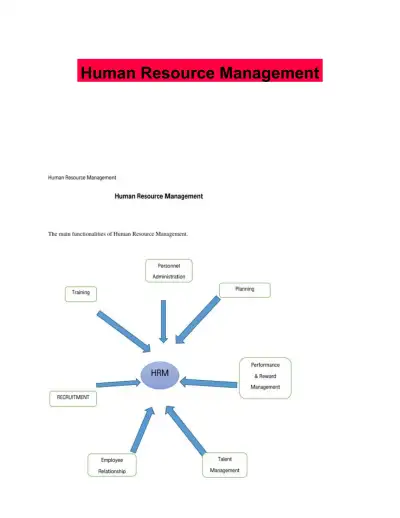 Solved Assignments
Human Resource Management
Human Resource Management
6 pagesMay 2025 Exam Guides
Human Resource Management -, Fourth Canadian Edition Test Bank
Human Resource Management
243 pagesMay 2025 Class Notes
Progressive Disciplinary Process Highlights - HRM 323
Human Resource Management
5 pagesMay 2025 Class Notes
Recruiting In Saudi Arabia
Human Resource Management
7 pagesMay 2025 Class Presentation
Talent Management: Tools And Software
Human Resource Management
11 pagesMay 2025
Study this document with CramX
Once it is in your library, every tool can work from it.