
Strategic Human Resource Management: Gaining a Competitive Advantage 2nd Canadian Edition Test Bank

Achieve top scores with Strategic Human Resource Management: Gaining a Competitive Advantage 2nd Canadian Edition Test Bank, a well-crafted guide filled with must-know information, examples, and revision techniques.

Daniel Mitchell
Contributor
4.9
31
10 months ago
Preview (16 of 204 Pages)
100%
Log in to unlock

Page 1

Strategic Human Resource Management: Gaining a Competitive Advantage 2nd Canadian Edition Test Bank - Page 1 preview image

Loading page ...

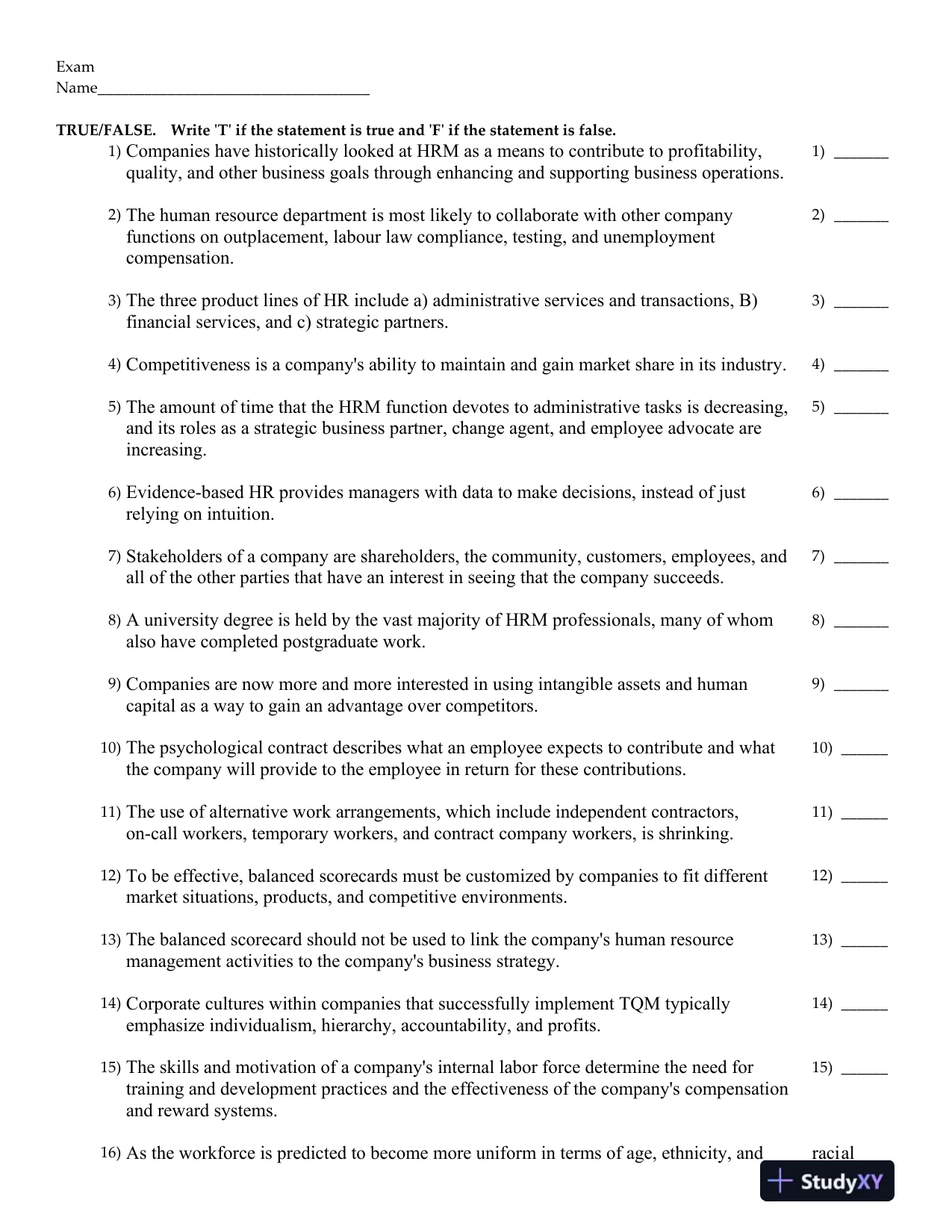
ExamName___________________________________TRUE/FALSE.Write 'T' if the statement is true and 'F' if the statement is false.1)Companies have historically looked at HRM as a means to contribute to profitability,quality, and other business goals through enhancing and supporting business operations.1)_______2)The human resource department is most likely to collaborate with other companyfunctions on outplacement, labour law compliance, testing, and unemploymentcompensation.2)_______3)The three product lines of HR include a) administrative services and transactions, B)financial services, and c) strategic partners.3)_______4)Competitiveness is a company's ability to maintain and gain market share in its industry.4)_______5)The amount of time that the HRM function devotes to administrative tasks is decreasing,and its roles as a strategic business partner, change agent, and employee advocate areincreasing.5)_______6)Evidence-based HR provides managers with data to make decisions, instead of justrelying on intuition.6)_______7)Stakeholders of a company are shareholders, the community, customers, employees, andall of the other parties that have an interest in seeing that the company succeeds.7)_______8)A university degree is held by the vast majority of HRM professionals, many of whomalso have completed postgraduate work.8)_______9)Companies are now more and more interested in using intangible assets and humancapital as a way to gain an advantage over competitors.9)_______10)The psychological contract describes what an employee expects to contribute and whatthe company will provide to the employee in return for these contributions.10)______11)The use of alternative work arrangements, which include independent contractors,on-call workers, temporary workers, and contract company workers, is shrinking.11)______12)To be effective, balanced scorecards must be customized by companies to fit differentmarket situations, products, and competitive environments.12)______13)The balanced scorecard should not be used to link the company's human resourcemanagement activities to the company's business strategy.13)______14)Corporate cultures within companies that successfully implement TQM typicallyemphasize individualism, hierarchy, accountability, and profits.14)______15)The skills and motivation of a company's internal labor force determine the need fortraining and development practices and the effectiveness of the company's compensationand reward systems.15)______16)As the workforce is predicted to become more uniform in terms of age, ethnicity, andracial

Page 2

Strategic Human Resource Management: Gaining a Competitive Advantage 2nd Canadian Edition Test Bank - Page 2 preview image

Loading page ...

Page 3

Strategic Human Resource Management: Gaining a Competitive Advantage 2nd Canadian Edition Test Bank - Page 3 preview image

Loading page ...

background, it islikelythat oneset ofvalueswillcharacterize allemployees.16)______17)Cultural diversity can provide a company competitive advantage regardingproblem-solving.17)______18)Every business must be prepared to deal with the global economy.18)______19)Initially, offshoring involved complex manufacturing jobs with little direction in how thework was to be completed.19)______20)Smaller entrepreneurial companies are finding that offshoring helps them expand theirbusiness.20)______21)One of the disadvantages of technology is that it does not allow older workers topostpone retirement.21)______22)Many companies are taking steps to reduce the amount of flexible work schedules.22)______23)E-HRM is more applicable to practices associated with recruiting and training than thoseassociated with analysis and design work, selection, and compensation and benefits.23)______24)Most HR Executives have recognized the need to make the function's major role into onethat is much more strategic.24)______25)As the role of HRM in administration has increased, other roles such as practicedevelopment and strategic business partnering have decreased.25)______MULTIPLE CHOICE.Choose the one alternative that best completes the statement or answers the question.26)As far back as 2004, a Management Issues Survey conducted by the CME revealed that42 percent of respondents believed limited availability of skilled and experiencedpersonnel would be a strategic issue changing fundamental business practices over thenext five years. All survey respondents agreed that the core competencies required of themanufacturing workforce would change substantially, and by the year 2020 wouldinclude all the following key skills except:26)______A)Multilingual and multicultural skills, as business operations expand on a moreglobal basis.B)A mix of creative problem-solving capabilities, technical know-how, and businessskills, as well as an ability to interact with colleagues and customers.C)A high degree of skilled workers that can be applied to all areas of business as theywill have a more well-rounded business education.D)A higher degree of technical and technological expertise as production systems

Page 4

Strategic Human Resource Management: Gaining a Competitive Advantage 2nd Canadian Edition Test Bank - Page 4 preview image

Loading page ...

become moreautomatedand interconnected, and as workplaces incorporate advanced technologies such asnanotechnology, biotechnology, microelectronics, and robotics.27)Which of the following best describes the HR Professional's competency ofconsultation?27)______A)Ability to apply the principles of HRM to contribute to the success of the business.B)Ability to provide guidance to stakeholders on a variety of circumstances andsituations.C)Ability to effectively exchange and create a free flow of information amongstakeholders.D)Ability to direct initiatives and processes within the organization and gain buy-infrom stakeholders.28)Transformational activities28)______A)include knowledge management, cultural change, and strategic renewal.B)are the nuts and bolts of HRM.C)are low in their strategic value.D)often form the practices and systems to ensure strategy execution.29)Adaptive organizational structures emphasize:29)______A)internal linking, external linking, diversification, and a core set of values.B)efficiency, decision making by managers, and the flow of information from top tobottom of the organization.C)a core set of values, and elimination of boundaries between managers, employees,and organizational functions.D)clear boundaries between managers, employees, customers, vendors, and thefunctional areas, and a constant state of learning.30)Which of the following is NOT a responsibility of HR departments?30)______A)BenefitsB)Community relationsC)Production and operationsD)Recruiting31)An example of a transformational activity is31)______A)benefits administration.B)management development.C)training.D)compensation.32)_________ is a competency for HR professionals that includes the ability to managerinteractions with and between others with the specific goal of providing service andorganizational success.32)______A)Critical EvaluationB)ConsultationC)Relationship ManagementD)Organizational Leadership and Navigation33)Which of the following fall under the traditional activities of HRM?33)______A)Benefits administrationB)Employee ServicesC)Performance managementD)Cultural change34)HRM practices that support high-performance work systems include all of the followingEXCEPT:34)______A)DisciplineB)Training

Page 5

Strategic Human Resource Management: Gaining a Competitive Advantage 2nd Canadian Edition Test Bank - Page 5 preview image

Loading page ...

C)CompensationD)Work design35)Technology has also made equipment __________ to operate, helping companies copewith skill shortages and allowing older workers to ___________ retirement.35)______A)harder; postponeB)harder; move upC)easier; move upD)easier; postpone36)___________ is a systematic planned strategic effort by a company to attract, retain,develop, and motivate highly skilled employees and managers.36)______A)Employee managementB)Labour managementC)Talent managementD)Recruitment management37)All of the following HR practices support high-performance work systems EXCEPT:37)______A)employee rewards are related to company performance.B)jobs are designed to use a variety of skills.C)employees participate in selection process.D)individuals tend to work separately.38)HRM practices include all of the following EXCEPT38)______A)Employee relationsB)Employee work-life balanceC)RecruitingD)HR planning39)Litigation involving job security will have a major influence on human resourcemanagement practices because:39)______A)employees now bear the burden of proof in discrimination cases.B)work rules, recruitment practices, and performance evaluation systems might falselycommunicate lifetime employment agreements that the company does not intend tohonor during layoffs.C)adjustments of test scores to meet affirmative action requirements are now illegal.D)compensation awards for discrimination claims have increased.40)Traditionally, the HRM department was primarily a(n):40)______A)employer advocate.B)administrative expert.C)proactive agency.D)finance expert.41)Which of the following is NOT a standard that human resource managers must satisfyfor practices to be ethical?41)______A)Managers must treat employees and customers equitably and fairly.B)Human resource practices must result in the greatest good for the largest number ofpeople.C)Employment practices must respect basic human rights of privacy, due process, andfree speech.D)Managers must treat employees as family.42)Sustainability includes all of the following EXCEPT:42)______A)the ability to deal with economic and social changes.B)engaging in responsible and ethical business practices.C)expanding into foreign markets.D)providing high-quality products and services.43)Many companies are entering international markets by all of the following meansEXCEPT

Page 6

Strategic Human Resource Management: Gaining a Competitive Advantage 2nd Canadian Edition Test Bank - Page 6 preview image

Loading page ...

43)______A)Entering into alliances with foreign companiesB)Exporting their products overseasC)Entering into alliances with foreign governmentsD)Building manufacturing facilities or service centers in other countries44)Managing cultural diversity involves:44)______A)creating separate career tracks for employees with families.B)creating a workplace that makes it comfortable for employees of all backgrounds tobe creative and innovative.C)establishing a strong affirmative action policy.D)enforcing EEO rules.45)From the manager's perspective, an HRIS can be used to perform primarily all but one ofthe following. Name the exception.45)______A)Avoid litigationB)Evaluate programs and policiesC)Support strategic decision makingD)Motivate employees46)The skills and motivation of a company's _____ labour force determine the need fortraining and development practices and the effectiveness of the company's compensationand reward systems.46)______A)internalB)projectedC)secondaryD)external47)__________ has the potential to increase employee productivity, encouragefamily-friendly work arrangements, and help reduce traffic and air pollution.47)______A)Flexible work schedulesB)Virtual teamsC)TelecommutingD)Teleconferencing48)__________ are work systems that maximize the fit between the company's socialsystem and technical system.48)______A)High-performance work systemsB)Virtual teamsC)Functional work systemsD)High-efficiency work systems49)Some companies are offering ___________ to better prepare their managers and theirfamilies for overseas assignments.49)______A)travel arrangementsB)cross-cultural trainingC)cultural assimilation preparationD)guided tours50)Tacit knowledge is an example of _____ capital.50)______A)intellectualB)customerC)socialD)human51)The processing and transmission of digitized information used in HRM is known as51)______A)Human Resource Information System (HRIS)B)Electronic Human Resource Management (e-HRM)C)Human Resource Interactive System (HRIS)D)Electronic Human Resource Information Management (e-HRIM)52)__________ is a system used to acquire, store, manipulate, analyze, retrieve, anddistribute information related to a company's human resources.52)______A)Electronic Human Resource Information Management (e-HRIM)B)Electronic Human Resource Management (e-HRM)

Page 7

Strategic Human Resource Management: Gaining a Competitive Advantage 2nd Canadian Edition Test Bank - Page 7 preview image

Loading page ...

C)Human Resource Interactive System (HRIS)D)Human Resource Information System (HRIS)53)_____ refers to the policies, practices, and systems that influence employees' behavior,attitudes, and performance.53)______A)Total quality managementB)Human resource managementC)Production and operations managementD)Financial management54)Exporting jobs from developed to less developed countries is known as:54)______A)offshoring.B)importing.C)onshoring.D)insourcing.55)As the role of HRM in administration has __________, other roles such as practicedevelopment and strategic business partnering have __________.55)______A)increased; increasedB)increased; decreasedC)decreased; decreasedD)decreased; increased56)The balanced scorecard:56)______A)is similar to most measures of company performance.B)should not be applied to HR practices.C)uses indicators important to the company's strategy.D)is a standardized instrument of company performance.57)Which of the following statements about evidence-based HR is FALSE?57)______A)It emphasizes that HR is being transformed from a broad corporate competency to aspecialized, stand-alone function in which human resources and line managers buildpartnerships to gain competitive advantage.B)It helps show that the money invested in HR programs is justified and that HR iscontributing to the company's goals and objectives.C)It refers to demonstrating that human resources practices have a positive influenceon the company's bottom line or key stakeholders.D)It requires collecting data on such metrics as productivity, turnover, accidents,employee attitudes and medical costs and showing their relationship with HRpractices.58)All of the following statements about cross training are true EXCEPT:58)______A)employees can fill any of the roles needed to be performed on the team.B)it helps in measuring employees' performance.C)it provides teams' maximum flexibility.D)it trains employees in a wide range of skills.59)The balanced scorecard presents a view of company performance from the perspectiveof:59)______A)its employees and customers only.B)its employees only.C)its customers only.D)its employees, customers, and shareholders.60)The main reason jobs are offshored is60)______A)material costsB)overhead costs

Page 8

Strategic Human Resource Management: Gaining a Competitive Advantage 2nd Canadian Edition Test Bank - Page 8 preview image

Loading page ...

C)labour costsD)production costs61)The following are reasons that the demand for employees will exceed supply EXCEPT:61)______A)Creation of jobsB)Slow population growthC)Slow retirement of the aging populationD)Lack of employees with the required skills62)Company Xanado has offices around the globe. Its teams are separated by time,geographic distance, culture and or organizational boundaries, and almost relyexclusively on technology for interaction between team members. Its teams are:62)______A)virtual teams.B)teleworker teams.C)geographically-concentrated teams.D)lean teams.63)Which of the following is FALSE about high-involvement, adaptive organizationalstructures?63)______A)Employees are in a constant state of learning and performance improvement.B)Previously established boundaries between managers, employees, customers, andvendors are abandoned.C)Employees are free to move wherever they are needed in a company.D)Line employees are trained to specialize in one job in order to maximize efficiency.64)Initially, offshoring involved ___________ manufacturing jobs with ___________ tasksand ___________ guidelines for how the work was to be completed.64)______A)high-skilled; repeatable; generalB)low-skilled; repeatable; specificC)low-skilled; repeatable; generalD)high-skilled; complex; specific65)While there has been considerable debate across North America about whetheroffshoring results in loss of jobs or creates new jobs, a 2008 study by Baldwin and Guconcluded that material and services offshoring has ________________.65)______A)no effect on employment in North AmericaB)no effect on employment in CanadaC)a major effect on employment in CanadaD)a major effect on employment in North America66)All of the following are examples of alternative work arrangements EXCEPT:66)______A)on-call workers.B)temporary workers.C)independent contractors.D)current labour force.67)TQM focuses on:67)______A)reducing variability in the product or service.B)preventing errors rather than correcting errors.C)designing processes to meet the needs of external customers only.D)tying pay to employees' total output less production rejects.68)What areas of the legal environment have influenced HRM practices over the past 25years?68)______A)Equal employment opportunity, patent infringement, workers' compensation, safetyand health, and job security.B)Product liability, workers' compensation, equal employment opportunity, safety andhealth, and labour relations.

Page 9

Strategic Human Resource Management: Gaining a Competitive Advantage 2nd Canadian Edition Test Bank - Page 9 preview image

Loading page ...

C)Equal employment opportunity, safety and health, pay and benefits, privacy, andjob security.D)Executive compensation, pay and benefits, workers' compensation, safety andhealth, and job security.69)Which one of the following statements about the HR profession is FALSE?69)______A)The primary professional organization for HRM is the Society for Human ResourceManagement.B)Professional certification in HRM is less common than membership in professionalassociations.C)A college degree is required of HR specialists, but not of generalists.D)Generalists usually perform the full range of HRM activities, including recruiting,training, compensation, and employee relations.70)A(n) _____ contract describes what an employee expects to contribute and what thecompany will provide to the employee for these contributions.70)______A)employeeB)psychologicalC)employerD)job71)Businesses around the world are attempting to increase their competitiveness and valueby71)______A)recruiting and hiring internationallyB)increasing their global presenceC)advertisingD)outsourcing current production72)How diversity issues are managed in companies has implications for all the followingEXCEPT:72)______A)creativity.B)retaining good employees.C)knowing how to learn.D)problem solving.73)_____ refers to a company's ability to maintain and gain market share in its industry.73)______A)Self-serviceB)EmpowermentC)CompetitivenessD)Outsourcing74)One estimate is that developing economies and emerging markets such as those found inthe BRIC nations (Brazil, Russia, India, and China) will be responsible for ________percent of the growth of the world's economy.74)______A)sixty eightB)seventy fiveC)forty twoD)fifty four75)Although the labour force in Canada grew at an average annual rate of about 1.4 percentbetween 2006 and 2010, it is projected to ______ percent by 2016.75)______A)increase to 1.8B)slow to 1C)slow to 0.5D)increase to 276)You are the Senior HR Specialist for the national light bulb factory, Daylite, that isfocused on providing environmentally friendly and energy efficient alternatives tolighting. Unfortunately due to the recession, sales are not as high as anticipated due tothe higher cost of your products. Which of the following creative cost controls wouldyou NOT be able to implement in order to prevent layoffs?76)______A)restructuring benefit plansB)paid leavesC)suspending pension plan contributionsD)cutting training budgets

Page 10

Strategic Human Resource Management: Gaining a Competitive Advantage 2nd Canadian Edition Test Bank - Page 10 preview image

Loading page ...

77)_____ refers to the ability of a company to survive and succeed in a dynamic competitiveenvironment.77)______A)EmpowermentB)SustainabilityC)OutsourcingD)Resource management78)Global business expansion has been made easier by78)______A)technologyB)NAFTAC)enhanced communicationD)improved government relations79)Which of the following statements about technology is FALSE?79)______A)Technology does not allow older workers to postpone retirement.B)The Internet gives employees instant access to experts whom they can communicatewith.C)Technology has made equipment easier to operate, helping companies cope withskill shortages.D)The Internet allows employees to locate and gather resources, including software,reports, photos, and videos.80)All of the following competitive challenges faced by companies will increase theimportance of human resource management EXCEPT:80)______A)the global challenge.B)the technology challenge.C)the political challenge.D)the challenge of sustainability.81)Which of the following statements about intangible assets is FALSE?81)______A)They include human capital.B)They are less valuable than physical assets.C)They are difficult to duplicate or imitate.D)They are equally or even more valuable than financial assets.82)Which of the following is NOT typically true of work teams?82)______A)They assume all of the activities reserved for managers such as controlling,planning, and coordinating activities.B)They use cross-training to give employees knowledge on a wide range of skills.C)They frequently select new team members and plan work schedules.D)They are used to increase employee responsibility and control.83)Increasingly, companies are trying to meet shareholder and general public demands thatthey be more socially, ethically, and environmentally responsible. Thus, companies arerecognizing the importance of:83)______A)total quality management.B)diversity.C)a balanced scorecard approach to business.D)social responsibility.84)The nuts and bolts of HRM are84)______A)training activities.B)traditional activities.C)transactional activities.D)transformational activities.85)Traditional HRM functions were structured around all of the following basic subfunctions of HRM EXCEPT85)______

Page 11

Strategic Human Resource Management: Gaining a Competitive Advantage 2nd Canadian Edition Test Bank - Page 11 preview image

Loading page ...

A)training.B)management development.C)compensation.D)staffing.86)Knowledge management, management development, cultural change, and strategicredirection and renewal represent which type of HR activity?86)______A)TransnationalB)TransformationalC)TransactionalD)Traditional87)Benefits administration, record keeping and employee services represent which type ofHR activity?87)______A)TransactionalB)TraditionalC)TransformationalD)Transnational88)Recruitment and selection, training, performance management, compensation andemployee relations represent which type of HR activity?88)______A)TransactionalB)TraditionalC)TransformationalD)Transnational89)Teams that are separated by time, geographic distance, culture, and or organizationalboundaries and rely almost exclusively on technology for interaction between teammembers are89)______A)virtual teams.B)transformational teams.C)cyber teams.D)transnational teams.90)Which of the following is NOT one of the questions used to determine if HumanResources are playing a strategic role in the Business?90)______A)What can HR do to increase the recruitment of highly skilled employees?B)What makes an employee want to stay at our company?C)What's the best change we can make to prepare for the future?D)How can we reinvest in employees?SHORT ANSWER.Write the word or phrase that best completes each statement or answers the question.91)Name and describe the competencies that HR professionals need.91)_____________92)What are the three competitive challenges that companies now face, which willincrease the importance of human resources management practices? List some ofthe activities functions within these competitive challenges that companies willhave to complete.92)_____________93)Describe some of the trends in employment, occupation growth, and skillrequirements.93)_____________94)What is the psychological contract? How has the psychological contract changedwith the new type of economy?94)_____________95)Discuss the balanced scorecard approach of measuring stakeholder performance.95)_____________96)Indicate five main areas of the legal environment that have influenced humanresource management over the past 25 years.96)_____________97)Bob Russell, CEO of Party Pizzaz and Co., has realized that many companieshave been

Page 12

Strategic Human Resource Management: Gaining a Competitive Advantage 2nd Canadian Edition Test Bank - Page 12 preview image

Loading page ...

attractedtooffshoringbecauseof thelabourbenefits.However, he hascome toyou foradviceas hewants toknowwhatimplications itwillhave fortheHRMfunctions. Whatadvicewill yougivehim?97)_____________98)How has technology changed the way people work and where they work?98)_____________99)There are nine key questions used to determine if Human Resources are playing astrategic role in the business. List five of these nine key questions.99)_____________100)In order for individuals to understand the transformation going on in HRM, theymust understand the HRM activities in terms of their strategic value. List thethree categories of HRM activities in descending order of amount of time spenton each activity. What are some of the activities that take place within each ofthese categories?100)____________

Page 13

Strategic Human Resource Management: Gaining a Competitive Advantage 2nd Canadian Edition Test Bank - Page 13 preview image

Loading page ...

1)FALSE2)FALSE3)FALSE4)TRUE5)TRUE6)TRUE7)TRUE8)TRUE9)TRUE10)TRUE11)FALSE12)TRUE13)FALSE14)FALSE15)TRUE16)FALSE17)TRUE18)TRUE19)FALSE20)TRUE21)FALSE22)FALSE23)FALSE24)TRUE25)FALSE26)C27)B28)A29)C30)C31)B32)C33)C34)A35)D36)C37)D38)B39)B40)B41)D42)C43)C44)B45)D46)A47)C48)A49)B50)D51)B

Page 14

Strategic Human Resource Management: Gaining a Competitive Advantage 2nd Canadian Edition Test Bank - Page 14 preview image

Loading page ...

52)D53)B54)A55)D56)C57)A58)B59)D60)C61)C62)A63)D64)B65)B66)D67)B68)C69)C70)B71)B72)C73)C74)A75)B76)B77)B78)A79)A80)C81)B82)A83)D84)B85)B86)B87)A88)B89)A90)A91)Answers may varyCompetencies and Example Behaviours for HR Professionals:Human Resource Technical Expertise and Practice: The ability to apply the principles of human resourcemanagement to contribute to the success of the business.Relationship Management: The ability to manage interactions with and between others with thespecific goal of providing service and organizational successConsultation:Provide guidance to stakeholders such as employees and leaders seekingexpert advice on a variety of circumstances and situationsOrganizational Leadership and Navigation: The ability to direct initiatives and processes within theorganization and gain buy-in from stakeholdersCommunications: The ability to effectively exchange and create a free flow of information with and

Page 15

Strategic Human Resource Management: Gaining a Competitive Advantage 2nd Canadian Edition Test Bank - Page 15 preview image

Loading page ...

amongvariousstakeholdersat alllevels of the organization to produce meaningful outcomesGlobal and Cultural Effectiveness: Managing human resources both within and across boundariesEthical Practice: Integration of core values, integrity, and accountability throughout all organizational andbusiness practicesCritical Evaluation: Skill in interpreting information to determine return on investment and organizationalimpact in making recommendations and business decisionsBusiness Acumen: Ability to understand business functions and metrics within the organization andindustry92)Answers may vary(1) Competing through technology: Change employees' and managers' work roles; Createhigh-performance work systems through integrating technology and social systems; and develope-commerce and e-HRM. (2) Competing through sustainability: Provide a return to shareholders; Providehigh-quality products, services and work experiences for employees; Increase value placed on intangibleassets and human capital; Social and environmental responsibility; Adapt to changing characteristics andexpectations of the labour force; Address legal and ethical issues; and Effectively use new workarrangements. (3) Competing through globalization: Expand into foreign markets and prepare employeesto work in foreign locations.93)Answers may varyThe competition for labour is affected by the growth and decline of industries, jobs, and occupations.Competition for labour is also influenced by the number and skills of persons available for full-time work.While the labour force in Canada is projected to grow in the next two decades, reaching around 20.5-22.5million by 2031, the period up to 2026 reveals some concerns. For example, although the labour force inCanada grew at an average annual rate of about 1.4 percent between 2006 and 2010, it is projected to slowto 1 percent by 2016 and less than 1 percent annually thereafter until 2026, at which point most of thebaby boomers will have retired. The current national labour force participation rate is expected to fall toonly 62.6 percent by 2031, from its current levels of around 67 percent. The future Canadian labourmarket will be both a knowledge economy and a service economy. Projections indicate that by 2022 theservice sector will account for 79 percent of total employment, although job growth in this area will slowto a marginal pace. Job growth in the construction sector, which was substantial in the early part of the2000s, will weaken due to slower anticipated growth in the construction industry, and is expected tocomprise 7.6 percent of all jobs. Finally, all other Canadian jobs will be derived from the manufacturingsector (9.5 percent) and the primary sector (3.7 percent) by 2022.29 There will be many high educationprofessional and managerial jobs and low-education service jobs. Boundaries between knowledge andservice work are blurring, creating "technoservice" occupations that combine service technology andsoftware application. Software application engineers, technical support, engineering, and people inscientific consulting jobs work directly with customers, and customers influence the product designprocess.94)Answers may varyThe psychological contract describes what an employee expects to contribute and what the company willprovide to the employee for these contributions. Unlike a sales contract, a psychological contract is notwritten. Traditionally, companies expected employees to contribute time, effort, skills, abilities, andloyalty. In return, companies would provide job security and opportunities for promotion. However, in thenew economy a new type of psychological contract is emerging. The competitive business environmentdemands frequent changes in the quality, innovation, creativeness, and timeliness of employeecontributions and the skills needed to provide them. This has led to restructuring, mergers and acquisitionsand often layoffs and longer hours for many employees. Companies demand excellent customer serviceand high productivity levels. Employees are expected to take more responsibility for their own careers,from seeking training to balancing work and family. In exchange for top performance and working longer

Page 16

Strategic Human Resource Management: Gaining a Competitive Advantage 2nd Canadian Edition Test Bank - Page 16 preview image

Loading page ...

hourswithoutjobsecurity,employees want companies to provide flexible work schedules, comfortable working conditions, moreautonomy in accomplishing work, training and development opportunities, and financial incentives basedon how the company performs. Employees realize that companies cannot provide employment security, sothey want employability-that is, they want their company to provide training and job experiences to helpensure that employees can find other employment opportunities. These changing expectations and anunderlying cynicism felt by employees have been aggravated by the recession.95)Answers may varyThe balanced scorecard is a means of performance measurement that gives managers a chance to look attheir company from the perspectives of internal and external customers, employees, and shareholders. Thebalanced scorecard:1. Is based on the degree to which stakeholder needs are satisfied.2. Brings together most measures needed to be competitive.3. Gives employees a framework to link their goals to organizational goals.4. Is used to link HR activities to business strategy.5. Evaluates how much HR is helping to meet strategic objectives.96)Answers may varyThe five main areas of the legal environment that have influenced HRM over the past 25 years are equalemployment opportunity legislation, employee safety and health, employee pay and benefits, employeeprivacy, and job security.97)Answers may varyPoints to consider are (1) Can employees in the offshored locations provide a level of customer service thesame as or higher than customers receive from Canadian operations? (2) Would offshoring demoralizeCanadian employees such that the gains from offshoring would be negated by lower motivation, lowersatisfaction, and higher turnover? (3) Are local managers adequately trained to motivate and retainoffshore employees? (4) What is the potential effect, if any, of political unrest in the countries in whichoperations are offshored? Will employees be safe there? And, (5) What effect would offshoring have onthe public image of the company? Would customers or potential customers avoid purchasing products orservices because they believe offshoring costs Canadian employees their jobs? Would offshoring have anadverse effect on recruiting new employees?98)Answers may varyAdvances in sophisticated technology along with reduced costs for the technology are changing manyaspects of human resource management. Technological advances in electronics and communicationssoftware have made possible mobile technology such as smartphones and iPods as well as improving theInternet. Companies are able to keep things moving around the clock using highly integrated computertechnology, cellphones and skype to hold meetings and exchange information. Many have gone as far ascreating a virtual watercooler on a secure site so that staff can socialize across the miles. The Internet andthe Web allow employees to send and receive information as well as to locate and gather resources,including software, reports, photos, and videos. The Internet gives employees instant access to expertswhom they can communicate with and to newsgroups, which are bulletin boards dedicated to specificareas of interest, where employees can read, post, and respond to messages and articles.Companies are able to establish High-Performance Work Systems and Virtual Teams and build HumanResources Information Systems. These advances have the potential for freeing workers from going to aspecific location to work and from traditional work schedules. Telecommuting has the potential toincrease employee productivity, encourage family-friendly work arrangements, and help reduce traffic andair pollution. But at the same time, technologies may result in employees being on call hours a day, seven
Preview Mode

This document has 204 pages. Sign in to access the full document!