

Solution Manual for Global Marketing, 8th Edition
- Marketing
- 393 pages
- Shared February 2025
- 105 downloads
Solution Manual for Global Marketing, 8th Edition is the ultimate guide for understanding and solving textbook problems.
Preview 31 of 393 pages
See the first 31 pages exactly as they appear in the document.
Page 1 Read page 1 as text
1 CHAPTER 1 INTRODUCTION TO GLOBAL MARKETING SUMMARY A. Marketing is an organizational function and a set of processes for creating, communicating, and delivering value to customers and for managing customer relationships in ways that benefit the organization and its stakeholders. A company that engages in global marketing focuses resources on global market opportunities and threats. Successful global marketers such as Nestl é , Coca - Cola, and Honda use familiar marketing mix elements – the four Ps – to create global marketing programs. B. Marketing, R&D, manufacturing, and other activities comprise a firm’s value chain t he value equation (V =B/P) expresses the relationship between values and the marketing mix. C. Global companies also maintain strategic focus while pursuing competitive advantage. The marketing mix, value chain, competitive advantage, and focus are universal in their applicability, irrespective of whether a company does business only in the home country or has a presence in many markets around the world. However, in a global industry, companies that fail to pursue global opportunities risk being pushed aside by stronger global competitors. D. A firm’s global marketing strategy (GMS) can enhance its worldwide performance. The GMS addresses several issues. First is the nature of the marketing program in terms of the balance between a standardization (extension) approach to the marketing mix and a localization (adaptation) approach that is responsive to country or regional differences. Second is the concentration of marketing activities in a few countries or the dispersal of such activities across many countries. Companies that engage in global marketing can also engage in coordination of marketing activities . Finally, a firm’s GMS will address the issue of global market participation . E. The importance of global marketing today can be seen in the company rankings compiled by the Wall Street Journal, Fortune , Financial Times, and other publications. Whether ranked by revenues, market capitalization, or some other measure, most of the world’s major corporations are active regionally or globally. The size of global markets for individual industries or product categories helps explain why companies “go global”. Global markets for some product categories represent hundreds of billions of dollars in annual sales; other markets are much smaller. Whatever the size of the opportunity, successful industry competitors find that increasing revenues and profits means seeking markets outside the home country.
Page 2 Page 3 Read page 3 as text
2 F. Company management can be classified in terms of its orientation toward the world: ethnocentric, polycentric, regiocentric, or geocentric. The terms reflect progressive levels of development or evolution. An ethnocentric orientation characterizes domestic and international companies ; international companies pursue marketing opportunities outside the home market by extending various elements of the marketing mix. A polycentric worldview predominates at a multinational company, where the marketing mix is adapted by country managers operating autonomously. Managers at global and transnational companies are regiocentric or geocentric in their orientation and pursue both extension and adaptation strategies in global markets. G. The dynamic interplay of several driving and restraining forces shapes the importance of global marketing. Driving forces include market needs and wants, technology, transportation and communication improvements, product costs, quality, world economic trends, and recognition of opportunities to develop leverage by operating globally. Restraining forces include market differences, management myopia, organizational culture, and national controls such as nontariff barriers (NTBs). OUTLINE OF THE BOOK The book is divided into five parts. Part 1: An overview of global marketing and the basic theory of global marketing. Part 2: The environments of global marketing. Part 3: Approaching global markets (global strategy) Part 4: The marketing mix in global marketing. Part 5: Corporate strategy, leadership, and the impact of the digital revolution on global marketing. LEARNING OBJECTIVES 1 Use the product/market growth matrix to explain the various ways a company can expand globally 2 Describe how companies in global industries pursue competitive advantage 3 Compare and contrast single - country marketing strategy with global marketing strategy (GMS) 4 Identify the companies at the top of the Global 500 rankings
Page 4 Read page 4 as text
3 5 Explain the stages a company goes through as its management orientation evolves from domestic and ethnocentric to global and geocentric. 6 Discuss the driving and restraining forces affecting global integration today. DISCUSSION QUESTIONS 1 - 4 . What are the basic goals of marketing? Are these goals relevant to global marketing? Marketing activities represent an organization’s efforts to satisfy customer wants and needs by offering products and services that create value. These goals are relevant in virtually every part of the world; however, when an organization pursues market opportunities outside of its home country (domestic) market, managers need an understanding of additional conceptual tools and guidelines in order to do business in these other countries – in other words, to create value and satisfy consumer needs and wants. 1 - 5 . What is meant by “global localization?” Is Coca - Cola a global product? Explain. The phrase “global localization” represents an attempt to capture the spirit of the rallying cry for organizations in the 21 st century, namely, “think globally, act locally, and manage regionally.” Most students will agree that Coca - Cola is a global product by virtue of the fact that it is available in more than 195 countries in red cans bearing the distinctive signature style. It must be noted, however, that customer service efforts are adapted to the needs of particular markets (for example, vending machines in Japan). Thus, Coca - Cola is both global and local. 1 - 6 . A company’s global marketing strategy (GMS) is a crucial , competitive tool. Describe some of the global marketing strategies available to companies. Give examples of companies that use the different strategies. This question invites reference to Table 1 - 2. Strategies include global branding (Coca - Cola, Marlboro), product design (McDonald’s restaurants and menu items), positioning (Harley - Davidson), packaging (Gillette Sensor), distribution (Benetton), customer service (Caterpillar), and sourcing (Toyota, Gap). 1 - 7 . UK - based Burberry is a luxury fashion brand that appeals to both genders and all ages. To improve Burberry’s competitiveness in the luxury goods market, CEO Angela Ahrendts recently unveiled a new strategy that includes all the elements of the marketing mix. Their strategy also addresses key markets that Burberry will participate in, as well as the integration and coordination of marketing activities. Search for recent articles about Burberry and write a brief summary that outlines Burberry’s GMS. Student answers will vary, but all should contain the facts that the new CEO intends to broaden the brand’s appeal and introduce two new logos.
Page 5 Read page 5 as text
4 1 - 8. Discuss the differences between the global marketing strategies of H arley - Davidson and Toyota ? Harley - Davidson motorcycles are known the world over as “the” all - American motorcycle. Harley’s mystique and heritage are associated with America. The company backs up this positioning with exports from two U.S. manufacturing locations. By contrast, Toyota builds some models (e.g. Camry) for the U.S. market in the U.S., a fact that Toyota stresses in its American advertising. Thus, Harley - Davidson serves global markets while sourcing locally, while Toyota’s strategy calls for serving world markets and using the world as a source of supply. 1 - 9 . Describe the difference between ethnocentric, polycentric, regiocentric, and geocentric management orientations. The premise of an ethnocentric orientation is that home country products and management processes are superior. An ethnocentric company that neither sources inputs from, nor seeks market opportunities in the world outside the home country may be classified as an international company. A company that does business abroad while still presuming the superiority of the home country may be classified as an international company. Such a company would rely on an extension strategy whereby it would export, without adaptation, products designed for the domestic market. The polycentric orientation that predominates at a multinational company leads to a view of the world in which each country market is different from the others. Local country managers operating with a high degree of autonomy adapt the marketing mix in a polycentric, multinational company. Managers who are regiocentric or geocentric in their orientations recognize both similarities and differences in world markets. Market opportunities are pursued using both extension and adaptation strategies. The regiocentric and geocentric orientations are characteristic of global transnational companies. 1 - 10 . Identify and briefly describe some of the forces that have resulted in increased global integration and the growing importance of global marketing. The dynamic involving driving and restraining forces is shown diagrammatically in Figure 1 - 2. Driving forces include regional economic agreements such as NAFTA, converging market needs and wants, technology advances such as the Internet and global TV networks, transportation improvements, the need to recoup high product development costs in global markets, the need to improve quality through R&D investment, world economic trends such as privatization and finally, opportunities to use leverage, corporate culture, and the continuing presence of national controls that create trade barriers. 1 - 11 . Define leverage and explain the different types of leverage utilized by companies with global operations.
Page 6 Read page 6 as text
5 Webster’s New World Dictionary defines “leverage” as an “increased means of accomplishing some purpose.” A global company can take advantage of several types of leverage in pursuit of corporate goals such as profit or revenue growth. These include experience transfers, scale economies, enhanced resource utilization, and global strategy. 1 - 12 . Each July, Fortune publishes its Global 500 listing of the world’s largest companies. You can find the current rankings online at: http://money.cnn.com/magazines/fortune/ global500/20 12 /full list. Alternatively, you can consult the print edition of Fortune . Browse through the list and choose any company that interests you. Compare its 2012 ranking with the most recent ranking. Has the company’s ranking changed? Consult additional sources (e.g., magazine articles, annual reports, the company’s Web site) to get a better understanding of the factors and forces that contributed to the company’s move up or down in the rankings. Write a brief summary of your findin gs. Each student’s answer will vary based upon the company they chose. 1 - 13 . There’s a saying in the business world that “nothing fails like success” . Take Gap, for example . How can a fashion retailer that was once the source for wardrobe staples such as chinos and white T - shirts suddenly lose its marketing edge? Motorola has also fallen victim to its own success. The company’s Razr cell phone was a huge hit, but Motorola struggled to leverage that success. Now, Google owns Motorola Mobility. Also, Starbucks CEO Howard Shultz recently warned that his company and brand risk becoming commoditized. And, as noted in Case 1 - 3, some industry observers are saying that Apple has “lost its cool”. If you were to make separate recommendations to management at each of these companies, what would you say? Each student’s answer will vary but their answers should incorporate such terms as global marketing, marketing mix strategy, value chain, V = B/P, strategic focus, global marketing strategy, extension, adaption, ethnocentric, polycentric, regiocentric, or geocentric orientations in their responses. Perhaps, a phrase that could be said to each of these chief executives is “think globally, act locally”. OVERVIEW The growing importance of global marketing is one aspect of a sweeping transformation that has profoundly affected the people and industries of many nations during the past 160 years. Fou r decades ago, the phrase global marketing did not even exist. Today businesspeople utilize global marketing to realize their companies’ full commercial potential. However, there is another, even more critical reason why companies need to take global marketing seriously: survival. A management team that fails to understand the importance of global marketing risks losing its domestic business to competitors with lower costs, more experience, and better products.
Page 7 Read page 7 as text
6 But what is global marketing? How does it differ from “regular” marketing? Marketing can be defined as the activity, set of institutions, and processes for creating, communicating, and delivering value for customers, clients, partners, and society at large. Marketing activities center on an organization’s efforts to satisfy customer wants and needs with products and services that offer competitive value and for managing customer relationships in ways that benefit the organization and its stakeholders. The marketing mix (product, price, place, and promotion) comprises a contemporary marketer’s primary tools. Marketing is a universal discipline – as applicable in Argentina as it is in Zimbabwe. ✓ (Learning Objective #1) This book is about global marketing. An organization that engages in global marketing focuses its resources and competencies on global market opportunities and threats. A fundamental difference between regular marketing and global marketing is the scope of activities. A company that engages in global marketing conducts important business activities outside the home - country market. The scope issue can be conceptualized in terms of the familiar product/market matrix of growth strategies (see Table 1 - 1). Some companies pursue a market development strategy ; this involves seeking new customers by introducing existing products or services to a new market segment or to a new geographical market. Global marketing can also take the form of a diversification strategy in which a company creates new product or service offerings targeting a new segment, a new country, or a new region. F our of the growth strategies shown in Table 1 - 1: (Chapter 1, Page 5) Four Stages - Starbucks Market penetration : Starbucks is building on its loyalty card and rewards program in the United States with a smartphone app that enables customers to pay for purchases electronically. The app displays a bar code that the barista can scan. Market development : Starbucks is entering India via an alliance with the Tata Group. Phase one calls for sourcing coffee beans in India and marketing them at Starbucks stores throughout the world. The next phase will likely involve opening Starbucks outlets in Tata’s upscale Taj hotels in India. Product development : Starbucks created a brand of instant coffee, Via, to enable its customer s to enjoy coffee at the office and other locations where brewed coffee is not available. After a successful launch in the United States, Starbucks rolled out Via in Great Britain, Japan, South Korea, and several other Asian countries. Diversification : Starbucks has launched several new ventures, including music CDs and movie production. Next up: Revamping stores so they can serve as wine bars and attract new customers in the evening.
Page 8 Read page 8 as text
7 Companies that engage in global marketing frequently encounter unique or unfamiliar features in specific countries or regions of the world. In some regions of the world, bribery and corruption are deeply entrenched. A successful global marketer understands specific concepts and has a broad and deep understanding of the world’s varied business environments. He or she also must understand the strategies that, when skillfully implemented in conjunction with universal marketing fundamentals, increase the likelihood of market success. ANNOTATED LECTURE/OUTLINE Principles of Marketing: A Review Marketing is one of the functional areas of business – distinct from finance and operations. Marketing is the set of activities and processes that (along with product design, manufacturing, and transportation) comprises a firm’s value chain. Decisions at every stage of the process – from idea conceptualization to customer support after the sale – should be assessed in terms of their ability to create value for customers. The core of marketing is to surpass the competition in creating perceived value for customers. The value equation is the guide to this task: Value = Benefits / Price (money, time, effort, etc.) The marketing mix is central to this equation because benefits are a combination of the product, promotion, and distribution components of the mix. Value to the customer can be increased in two ways – 1 ) an improved bundle of benefits or 2 ) a lower price (or both) : 1) Marketers may improve the product, design new channels of distribution, communicate better – or a combination of all three. 2) Marketers may seek ways to cut costs or lower the price. Nonmonetary costs may be lowered by decreasing the time and effort customers must expend to learn about or acquire a product. If a company is able to offer a combination of superior product, distribution, and promotion of the benefits AND offer lower prices than its competition, it should enjoy an extremely advantageous position. Recall the definition of a market: people or organizations that are both able and willing to buy. In order to achieve market success, a product or brand must measure up to a threshold of acceptable quality and be consistent with buyer behavior, expectations, and preferences Competitive Advantage, Globalization, and Global Industries
Page 9 Read page 9 as text
8 ✓ (Learning Objective #2) When a company succeeds in creating more value for customers than its competitors, that company is said to enjoy competitive advantage in an industry. Competitive advantage is measured relative to rivals with whom you compete in the industry – whether that is on a local, national, or global level. Global marketing is essential if a company competes in a global industry or one that is globalizing. The process of globalization is the transformation of formerly local or national industries into global ones . From a marketing point of view, globalization presents companies with tantalizing opportunities — and challenges — as executives decide whether to offer their products and services everywhere. As defined by management guru Michael Porter, a global industry is one in which competitive advantage can be achieved by integrating and leveraging operations on a worldwide scale. Put another way, an industry is global to the extent that a company’s industry position in one country is interdependent with its industry position in other countries. Indicators of globalization include the ratio of cross - border trade to total worldwide production, the ratio of cross - border investment to total capital investment, and the proportion of industry revenue generated by companies that compete in all key world regions. One way to determine the degree of globalization in an industry sector is to calculate the ratio of the annual value of global trade in the sector — including components shipped to various countries during the production process — to the annual value of industry sales. Achieving competitive advantage in a global industry requires executives and managers to maintain a well - defined strategic focus. Focus is simply the concentration of attention on a core business or competence. Companies that understand and engage in global marketing can offer more overall value to customers than companies that do not have that understanding. Global Marketing: What It Is and What It Isn’t The discipline of marketing is universal. It is natural, however, that marketing practices will vary from country to country, for the simple reason that the countries and peoples of the world are different. A successful marketing approach in one country may not necessarily succeed in another. Customer preferences, competitors, channels of distribution, and communication media may differ. An important managerial task in global marketing is learning to recognize the extent to which it is possible to extend marketing plans and programs worldwide, as well as the extent to which adaptation is required. ✓ (Learning Objective #3)
Page 10 Read page 10 as text
9 The way a company addresses this task is a reflection of its global marketing strategy (GMS). In single - country marketing, strategy development addresses two fundamental issues: choosing a target market and developing a marketing mix. The same two issues are at the heart of a firm’s GMS, although they are viewed from a somewhat different perspective (see Table 1 - 2). The Cultural Commentary from Great Britain Tells the story about how the rock band the Kinks were a hit in the US and other western countries in the 60’s due to their globalization of their music and the story of Ford’s plant in England now accounting for 25% of the company’s engine manufacturing. a) Global market participation – is the extent to which a company has operations in major world markets. b) Standardization versus adaptation – is the extent to which each marketing mix element can be standardized (used the same way) or must be adapted (used in different ways) in different country markets. c) Concentration of marketing activities – is the extent to which activities related to the marketing mix (such as pricing decisions) are performed in one or only a few country locations. d) Coordination of marketing activities – is the extent to which marketing activities related to the mix are planned and executed interdependently around the globe. e) Integration of competitive moves – the extent to which a firm’s competitive marketing tactics in different parts of the world are interdependent. The decision to enter one or more particular markets outside the home country depends on a company’s resources, its managerial mind - set, and the nature of opportunities and threats. Global marketing does mean widening business horizons to encompass the world in scanning for opportunities and threats. The four emerging markets of Brazil, Russia, India, and China represent significant growth opportunities. They are known as BRIC. Mexico, Indonesia, Nigeria, and Turkey — the so - called MINTs — also hold great potential. We can use Burberry as a case study in global marketing strategy. The U.K. - based luxury brand is available in scores of countries, and Burberry’s current expansion plans emphasize several geographical areas . Burberry’s marketing mix strategy includes the following: Product: Boost sales of handbags, belts, and accessories — products whose sales are less cyclical than clothing. Price: More expensive than Coach, less expensive than Prada. “Affordable luxury” is central to the value proposition. Place: Burberry intends to open more independent stores in the United States.
Page 11 Read page 11 as text
10 Promotion: Roll out new logo to reduce “plaid overexposure.” Use social media such as Twitter and www.artofthetrench.com. The issue of standardization versus adaption has been at the center of a long - standing controversy among both academicians and business practitioners. Much of the controversy dates back to the days of Theodore Levitt’s (1983) “homogenized global market.” Levitt envisioned a global community where standardized, high - quality world products would be marketed in a standardized manner. The “homogenized global market” view didn’t work. Even those companies that have become global successes have not done so through total standardization of the product. Global marketing made Coke a worldwide success. However, that success was not based on a total standardization of marketing mix elements. Coca - Cola succeeded through the application of global localization. What does the term “global localization” really mean? Global localization: Think globally, act locally (refer to Table 1 - 3). a) For example, Cinnabon’s customers in Central and South America prefer dulce de leche. Products developed in those regions being introduced in the U.S., where the Hispanic population is a key segment. b) Starbucks opened an experimental store in Amsterdam that serves as a testing ground for new design concepts such as locally sourced and recycled building materials. c) Kraft’s Tang powder became a $ 1 billion brand as regional managers in Latin American and the Middle East moved beyond orange (the top - seller) into popular local flavors such as mango and pineapple. Kraft plans to use these lessons learned on the U.S. market. Global marketing may include a combination of standard and nonstandard approaches. Global marketing requires marketers to think and act in a way that is both global and local by responding to similarities and differences in world markets (refer to Exhibit 1 - 4). The particular approach to global marketing that a company employs will depend on industry conditions and its sources of competitive advantage. For example, McDonald’s global marketing strategy is based on a combination of global and local marketing mix elements (refer to Table 1 - 4). a) For example, Harley - Davidson’s competitive advantage is based in part on “Made in the USA.” Moving production to a low - wage country would tarnish its image. b) Toyota’s and Honda’s success in the US has come through its ability to transfer world - class manufacturing skills to America and advertising that the Camry is “Made in the USA” by Americans.
Page 12 Read page 12 as text
11 c) Uniqlo, a division of Japan’s Fast Retail operates about 850 stores in Japan and 300 stores in 12 overseas countries. Uniqlo currently has 6 stores in the U.S. but plans call for a total of 200 stores by 2020. The Importance of Global Marketing The largest single market in the world in terms of national income is The United States, representing roughly 25 percent of the total world market for all products and services. U.S. companies that wish to achieve maximum growth potential must “go global” because 75 percent of the world market potential is outside of their home country. Non - US companies have an even greater incentive to “go global;” their potential markets include the 300 million people in the US. Management Orientations ✓ (Learning Objective #5) The form and substance of a company’s response to global market opportunities will depend greatly on its management’s assumptions and beliefs – both conscious and unconscious - about the nature of the world. The world view of a company’s personnel can be described as ethnocentric, polycentric, regiocentric, and geocentric. The orientations are collectively known as the EPRG framework. Ethnocentric Orientation: a) A person who assumes that his/her home country is superior to the rest of the world. b) Associated with national arrogance or feelings of national superiority. c) At some companies, the ethnocentric orientation means that opportunities outside of the home country are routinely ignored ( domestic companies). d) Ethnocentric companies that conduct business outside their home country are known as international companies – they believe products that succeed in the home country are superior. e) Leads to a standardized or extension approach – the belief that products can be sold everywhere without adaptation. f) Foreign operations or markets are viewed as inferior or subordinate to the home market. g) Headquarters knowledge is applied everywhere; local knowledge is viewed as unnecessary. Polycentric Orientation: a) The opposite view of ethnocentrism. b) The belief that each country in which you do business is unique. c) This assumption allows each subsidiary to develop its own unique marketing strategies in order to succeed. d) The term multinational company is often used to describe such a structure.
Page 13 Read page 13 as text
12 e) Leads to a localized or adaptation view that assumes products MUST be adapted to succeed. Regiocentric Orientation: a) The region becomes the relevant geographic unit. b) Management’s goal is to develop a regional ly integrated strategy (e.g. NAFTA or the EU). c) May be viewed as a variant of the multinational view (polycentric). Geocentric Orientation: a) Views the entire world as a potential market and strives to develop integrated global strategies. b) These companies are known as global or transnational companies. c) Serves world markets from a single country or sources globally for the purposes of focusing on select country markets. d) Tend to maintain their association with a particular headquarters country. (Harley - Davidson and Waterford serve world markets from the US and Ireland, respectively.) e) Transnational companies serve global markets and utilize global supply chains. f) Transnational companies both serve global markets and utilize global supply chains and often have a blurring of national identity. A true transnational would be stateless . (Toyota and Honda are examples of companies that exhibit key characteristics of transnationality (see Exhibit 1 - 7) g) A key factor that distinguishes global and transnational companies from international or multinational companies is mind - set: At global and transnational companies, decisions regarding extension and adaptation are not based on assumptions but rather on made on the basis of ongoing research into market needs and wants. h) It is a synthesis of ethnocentrism and polycentrism – it is a “world view.” i) Seeks to build a global strategy that is responsive to local needs and wants. It is a positive sign that, at many companies, management realizes the need to adopt a geocentric orientation. However, the transition to new structures and organizational forms can take time to bear fruit. A global company can be further described as one that pursues either a strategy of serving world markets from a single country or one that sources globally for the purposes of focusing on select country markets. In addition, global companies tend to retain their association with a particular headquarters country. At global and transnational companies, management uses a combination of standardized (extension) and localized (adaptation) elements in the marketing program. One way to assess a company’s “degree of transnationality” is to compute an average of three figures: (1) sales outside the home country to total sales, (2) assets outside the home country to total assets, and ( 3 ) employees outside the home country to total employees. Viewed in terms of these metrics, Nestlé, Unilever, Royal Philips Electronics, GlaxoSmithKline, and the News Corporation can also be categorized as transnational companies.
Page 14 Read page 14 as text
13 Each is headquartered in a relatively small home country market, a fact of life that has compelled management to adopt regiocentric or geocentric orientations to achieve revenue and profit growth. The geocentric orientation represents a synthesis of ethnocentrism and polycentrism; it is a “worldview” that sees similarities and differences in markets and countries and seeks to create a global strategy that is fully responsive to local needs and wants. A regiocentric manager might be said to have a worldview on a regional scale; the world outside the region of interest will be viewed with an ethnocentric or a polycentric orientation, or a combination of the two. H o wever, recent research suggests that many companies are seeking to strengthen their regional c ompetitiveness rather than moving directly to develop global responses to changes in the competitive environment The ethnocentric company is centralized in its marketing management; the polycentric company is decentralized; and the regiocentric and geocentric companies are integrated on a regional and global scale, respectively. A crucial difference between the orientations is the underlying assumption for each. The ethnocentric orientation is based on a belief in home - country superiority. The underlying assumption of the polycentric approach is that there are so many differences in cultural, economic, and marketing conditions in the world that it is futile to attempt to transfer experience across national boundaries. A key challenge facing organizational leaders today is managing a company’s evolution beyond an ethnocentric, polycentric, or regiocentric orientation to a geocentric one. As noted in one highly regarded book on global business, “The multinational solution encounters problems by ignoring a number of organizational impediments to the implementation of a global strategy and underestimating the impact of global competition.” Innovation, Entrepreneurship, and the Global Startup Kevin Plank, Under Armour In less than 20 years Under Armour is on track to reach $ 1.5 billion in sales. Under Armour is intent on building their brand into “the biggest brand in the land”. In 2012, only 6 percent of Under Armour’s revenues were generated outside of North America. Some industry observers think Under Armour is planning significant global product introductions times to coincide with the 2016 Summer Olympic Games in Brazil. Forces Affecting Global Integration and Global Marketing ✓ (Learning Objective #6)
Page 15 Read page 15 as text
14 The remarkable growth of the global economy over the past 65 years has been shaped by the dynamic interplay of various driving and restraining forces. Regional economic agreements, converging market needs and wants, technology advances, and pressures to cut costs, pressures to improve quality, improvements in communications and transportation technology, global economic growth, and opportunities for leverage all represent important driving forces. Converging Market Needs and Wants and the Information Revolution A person studying markets around the world will discover cultural universals as well as differences. The common elements in human nature provide an underlying basis for the opportunity to create and serve global markets. Most global markets d o not exist in nature – marketing efforts must create them. (For example, no one needs soft drinks.) Evidence is mounting that consumer needs and wants around the world are converging today as never before. This creates an opportunity for global marketing. Multinational companies pursuing a strategy of product adaptation run the risk of falling victim to global competitors that have recognized opportunities to serve global customers. The information revolution — what some refer to as the “democratization of information” — is one reason for the trend toward convergence. Thanks to satellite dishes and globe - spanning TV networks (CNN and MTV), it seems as though almost everyone has the opportunity to compare their lives against everyone else’s. The Internet is an even stronger driving force. When a company establishes a presence on the Internet, it is automatically a global company. Transportation and Communication Improvements Time and cost barriers associated with distance have fallen tremendously over the past 100 years. The jet airplane revolutionized communication by making it possible for people to travel around the world in less than 48 hours. In 1970, 75 million passengers traveled internationally. By 2011 , that figure rose to almost 980 million. The newest communication technologies, such as e - mail, video teleconferencing, and Wi - Fi, mean that managers, executives, and customers can link up electronically from virtually any part of the globe without traveling at all. A similar revolution is occurring in transportation technology. The costs associated with physical distribution – in both money and time – have been greatly reduced. Product Development Costs
Page 16 Read page 16 as text
15 The pressure for globalization is intense when new products require major investment and long period s of development time. The pharmaceutical industry provides a good example of this driving force. Today, the process of developing a new drug and bringing it to market can span 14 years and exceed $400 million. Such cost must be recovered globally because no single national market is likely to be large enough to support investments of this size. (Refer to Table 1 - 15). Quality Global companies “raise the bar” for all competitors in an industry. When a global company establishes a benchmark for quality, competitors must quickly make their own improvement and come up to par. Global marketing strategies can generate greater revenue and greater operating margins, which, in turn, support design and manufacturing quality. World Economic Trends Prior to the global economic crisis that began in 2008, economic growth had been a driving force in the expansion of the international economy and the growth of global marketing for three reasons : a) Economic growth in key developing countries has created market opportunities that provide a major incentive for companies to expand globally. b) Economic growth has reduced resistance that might otherwise have developed in response to the entry of foreign firms into domestic economies. (When a country such as China experiences rapid economic growth, policy makers are more likely to look favorably on outsiders.) c) The worldwide movement toward free markets, deregulation, and privatization is the third driving force. (Telephone company privatization is an example.) Leverage A global company possesses the unique opportunity to develop leverage. In the context of global marketing, leverage means some type of advantage that a company enjoys by virtue of the fact that it has experience in more than one country. Leverage allows a company to conserve resources when pursuing opportunities in new geographical markets. Four important types of leverage exist: 1) Experience Transfers – A global company can leverage its experience in any market in the world by drawing on management practices, strategies, products,
Page 17 Read page 17 as text
16 advertising appeals, or sales or promotional ideas that have been market - tested in one country and applied to another. 2) Scale Economies – The global company can take advantage of its greater manufacturing volume to obtain traditional scale advantages. Finished products can be manufactured by combining components manufactured in scale - efficient plants in different countries. 3) Resource Utilization – A global company has the ability to scan the entire world to identify people, money, and raw materials that will enable it to compete most effectively in world markets. 4) Global Strategy – The global company’s greatest advantage is its global strategy. A global strategy is built on an information system that scans the world business environment to identify opportunities, trends, threats, and resources. A global strategy is a design to create a winning strategy on a global scale. Note: A global strategy is NO guarantee of ongoing organizational success. (Consider InBev’s acquisition of Anheuser - Bush, Daimler - Chrysler, and Deutsche Post’s DHL unit.) Restraining Factors Despite the impact of the driving forces previously discussed, several restraining forces may slow a company’s efforts to engage in global marketing. Luckily, in today’s world the driving forces predominate over the restraining forces. That is why the importance of global marketing is steadily growing. Important restraining forces include: a) Management Myopia and Organizational Culture – Management may simply ignore opportunities to pursue global marketing. A company that is ethnocentric (or “nearsighted”) will not expand geographically. Myopia is a recipe for market disaster if headquarters attempts to dictate when it should listen. Successful global marketing requires a strong local team “on the ground” to provide information about local markets. b) National Controls – Every country protects the commercial interests of local businesses by maintaining control over market access and entry in both low - and high - tech industries. Today, tariff barriers have been largely removed in high - income countries. Still, nontariff barriers (NTBs), such as “Buy American” campaigns, make it difficult for companies to gain access to local markets. c) Opposition to Globalization – To many people, globalization represents a threat. Globaphobia is used to describe an attitude of hostility toward trade agreements or global brands. Opponents of globalization include labor unions, university students and nongovernmental organizations (NGOs). CASES C ase 1 - 1: The Global Marketplace: The Assignment
Page 18 Read page 18 as text
17 Answers given in the text book. Case 1 - 1 Discussion Questions 1 - 14 . Anheuser - Busch, which has been described as “an American icon,” is now under the ownership of a company based in Belgium. Responding to reports that some consumers planned to boycott Bud products to protest the deal, one industry observer said, “Brand nationality is all about where it was born, and also the ingredients of that beer and how they make the beer: Basically, it doesn’t matter who owns it. We are in a global world right now”. Do you agree? Students answers will vary based on their agreement or disagreement with this statement. Good students will introduce key words like ethnocentric, polycentric, regiocentric, and geocentric in their answers to describe their view of the manufacturer of beer and how they “feel” about the national origin(s) of and about the beer they drink. 1 - 15 . Anheuser - Busch, (A - B) has long enjoyed a reputation as a very desirable place to work. Executives were awarded well - appointed corporate suites and traveled on corporate jets; many had secretaries as well as executive assistants. When manager s took commercial flights, they flew first class. Most employees received beer for free and could count on donations of beer and merchandise for community events. Tickets to Cardinal home games were also used as a marketing tool. A - B spent heavily on advertising and promotion; various advertising agencies produced about 100 new ads for A - B each year. Given these facts, what changes, if any, would you expect A - B’s new owners to make? Why? Student answers should explain the differences in / among / between the different management orientations and compare and contrast the ethnocentric orientation of A - B beverage company versus their new Belgium owners. One could argue that A - B InBev, the new owners of A - B practice a polycentric orientation towards selling beer around the world. In that case, the marketing sales and promotional practices previously enjoyed by A - B most likely will continue. However, the executive “perks” will most likely decrease.
Page 19 Read page 19 as text
18 1 - 16 . In 2009, Italy’s Fiat acquired a 20 percent stake in Chrysler, another iconic American company. Are you familiar with Fiat? What do you think CEO Sergio Marchionne hope to accomplish with this deal? How might Chrysler benefit from the alliance? CEO Sergio Marchionne hopes to turn Fiat into a transnational company serving global markets and utilizing global supply chains. His strategy might be to turn Fiat into a geocentric company. Chrysler might benefit from the alliance by becoming a “global” brand instead of just an “American icon.” 1 - 17 . Ben & Jerry’s Homemade is a quirky ice cream marketer based in Burlington, Vermont. Founders Ben Cohen and Jerry Greenfield are legendary for enlightened business practices that include a three - part mission statement: product mission, financial mission, and social mission. When the company was acquired by consumer products gia n t Unilever, some of the brand’s loyal customers were alarmed. What do you think was the source of their concern? The form and substance of a company’s response to global market opportunities depends greatly on the management’s assumption or beliefs. In this case, Ben & Jerry consumers were afraid that Unilever’s management orientation would be different from the original owners views — either ethnocentric, polycentric, or regiocentric. C ase 1 - 2: McDonald’s Expands Globally While Adjusting Its Local Recipe Overview : Today, McDonald’s golden arches are one of the most recognized symbols in the world, just behind the Olympic rings. While growth within the U.S. has slowed, the picture outside the U.S. has appeared brighter, until recently. However, globally, taste profiles and consumer desires are changing. McDonald’s has responded to these changes by altering their basic products (when necessary) to fit the requirements of the local markets. While not always successful, it has proven to be a winning strategy. 1 - 18 . Identify the key elements in McDonald’s global marketing strategy (GMS). In particular, how does McDonald’s approach the issue of standardization? Does McDonald’s think global and act local? Does it also think local and act global? The popularity of American - style hamburgers, fries, and soft drinks is growing around the world, supporting Levitt’s view of the global village. Also, the restaurants themselves offer the consumers a chance to experience for themselves a fast food legend. However, students should point out that, in many locations, menu items are adapted according to the customs and tastes of individual countries. McDonald’s offers an ideal example of “global localization.” With McDonald’s offering of local tastes and a combination of American fare, McDonald’s thinks globally (product adaption) and acts globally (standardization). 1 - 19 . Do you think government officials in developing countries such as Russia, China, and India welcome McDonald’s? Do consumers in these countries welcome McDonald’s? Why or why not?
Page 20 Read page 20 as text
19 Despite concerns by governments and citizens in some countries about “cultural imperialism,” McDonald’s and other franchises with well - known brand names are generally welcome. Such businesses provide both much - needed jobs and employee training. McDonald’s does a good job of earning the support of local authorities and the local population by working with agricultural producers to develop local supply sources for beef, potatoes, and dairy products. Finally, thanks to changing lifestyles around the globe, more people are embracing the whole concept of fast food. 1 - 20 . The “Plan to Win” initiative is built around five factors that drive McDonald’s business: people, products, place, price, and promotion. As a student of marketing what can you say about these factors? These five factors closely mirror the four P’s of marketing: product, price, promotion, and place. For a service marketer: people and physical evidence are also added to the mix. For McDonald’s people and physical evidence are also important P’s of marketing. 1 - 21 . Is it realistic to expect that McDonald’s – or any well - known company – can expand globally without occasionally making mistakes or generating controversy? Why do anti - globalization protesters around the world frequently target McDonald’s? McDonald’s has a reputation for being sensitive to local issues and mentalities. According to the staff director for international human resources in Central Europe, “One of our guiding principles is that our restaurants should always be a reflection of the communities they serve.” Mistakes such as the one in France represent exceptions that can serve as learning experiences. Still, each new nation has the potential to present unique problems. In Israel, for example, McDonald’s must deal diplomatically and appropriately with dietary laws pertaining to kosher foods and operating restaurants on the Sabbath (Friday and Saturday). Another issue is to maintain the service attitude that was a cornerstone of McDonald’s U.S. reputation. A German student noted that in Germany, good service is not associated with McDonald’s because counter - help consists of immigrants who do not exhibit the cheerful demeanor of their U.S. counterparts. CASE 1 - 3: Apple versus Samsung: The Battle for Smartphone Supremacy Heats Up Overview: Apple’s reputation was based on its proven ability to disrupt existing markets and create new markets with technical and design innovations. In some circles the launch of the iPhone 5 was viewed as an evolution, rather than a revolution. Samsung makes several versions of their Galaxy S 4 to suit the needs of different markets, Apple does not. In India, the number three smart - phone market, Apple lags far behind Samsung, offering an Android phone for about $ 100. Indian consumers pay $ 500 for an iPhone 4 and about $ 850 for the iPhone 5.
Page 21 Read page 21 as text
20 1 - 22 . Do you own a smartphone? If so, which brand did you buy, and why? Student answers will vary based on which phone they own. 1 - 2 3 . Should Apple introduce a lower - cost iPhone to attract consumers who are not willing or able to pay a premium for an Apple device? If Apple wants to stay in the smart - phone market, they will need to introduce a lower - cost option. Samsung’s success has proved that in the emerging country markets, this is necessary to compete. 1 - 24 . Do you think Apple can continue to grow by developing break - through products that create new markets, as it did with the iPod, iPhone, and iPad? Apple needs to embrace the concept of formal market research. Steve Jobs downplayed the importance of this concept saying that consumers don’t know what they want. Samsung Electronics on the other hand, relies heavily on market research. 60,000 staff members work in dozens of research centers in China, Great Britain, India, Japan, the United States, and elsewhere. Samsung designers have backgrounds in such diverse disciplines as psychology, sociology, and engineering. 1 - 25 . How has Samsung’s global marketing strategy enabled it to compete so effectively against Apple? In many developing countries, there is a strong demand for inexpensive mobile phones. Some Android - based models from Android models from Samsung sell for much less than the iPhone 5. Apple does not offer a lower - cost version of the iPhone. Samsung has done their research and found the unsatisfied needs of the consumers. TEACHING TOOLS AND EXERCISES Additional Cases: "GENICON: A Surgical Strike into Emerging Markets" by Allen H. Kupetz; Adam P. Tindall; Gary Haberland. June 2010, HBS : 910M41 - PDF - ENG. "Market Stretch" by Gavin Price and Margaret Sutherland. June 2009. HBS : 909M46 - PDF - ENG. “Global Brand Face - Off”, HBR Case Study and Commentary RO 306A. Anand P. Raman, Peter M. Thompson, Jennifer L. Aaker; Harish Manwani; Simon Clift; Masaaki Mike Kotabe.
Page 22 Read page 22 as text
21 “Mary Kay Inc: Asian Market Entry (B)”, John A. Quelch. HBS 509067. Video: This article is from Management International Review, March 2011. It is titled “ Effective Global Strategy Implementation: Structural and Process Choices Facilitating Global Integration and Coordination.” The abstract states that this article o ffers “a contingency framework of global strategy implementation effectiveness on firm performance. The research question we seek to address is what the structural and process requirements are for MNEs to successfully implement global strategy through increased efficiency and effectiveness of integration and coordination across world markets. Our central premise is that MNEs' capabilities in establishing supporting structural and process mechanisms will enhance the effectiveness and efficiency of implementing their global strategies which would, in turn, lead to better firm performance.” Link: http://www.freepatentsonline.com/article/Management - International - Review/256930786.html and here is a different link to the PDF of this document: http://www.springerlink.com/content/12181r4440117312/ This next video is just a quick two - minute video showing Pepsi’s marketing throughout the world, and how they differentiate packaging and advertising to adapt to the region in which they are marketing. It provides a good example to show how companies cater their products to different regions. Link: http://www.youtube.com/watch?v=9q6onCYu0DA Film : Assign “The Gods Must Be Crazy.” This classic, humor - filled movie examines the life of a bushman unaware of white culture who finds a Coca - Cola bottle in the Kalahari (dropped by a passing pilot) and promptly has his life turned around by this mystical object. It shows how our simplest acts can have far - reaching impacts. This is a great introduction to global awareness. Out - of - Class Reading : Zou, Shaoming and S. Tamer Cavusgil, “The GMS: A Broad Conceptualization of Global Marketing Strategy and Its Effect on Performance.” Journal of Marketing 66 (October 2002) pp. 40 - 56. Internet Exercise: Fortune magazine profiled the world’s richest man ( http://money.cnn.com/2007/08/03/news/international/carlosslim.fortune/ ). Have students read and summarize this piece and use this as the basis for an in - class discussion on the changing face of world business. Full Semester Research Assignment and Activity This is a full semester cultural and marketing plan project designed for individuals or groups. Students should choose a country and a product / service that is not currently found in the targeted country and devise a cultural analysis and marketing plan for the chosen country.
Page 23 Read page 23 as text
22 For example, students can choose to market an automobile from the United States into a foreign country or can choose to market an automobile into the United States that is not currently available here. At the Instructors discretion, this project can be spread over the entire semester or used as a “take home” final exam, collected in sections as the material is covered in class or any combination deemed. Foreign students are especially encouraged to find products / services that they’ve been accustomed to or enjoyed (a favorite type of food product) here in the United States and wish to “export” to their home country. Cultural Analysis: The data suggested in the cultural analysis includes information that helps the marketer make market - planning decisions. However, its application extends beyond product and market analysis to being an important source of information for someone interested in understanding business customs and other important cultural features of the country. This cultural analysis is composed of two parts: information on the cultural makeup of the country and the economic analysis of the country. The information in this analysis must be more than a collection of facts. In preparing this material, you should attempt to interpret the meaning of cultural information. With that said, your country analysis should contain at least one paragraph on each of the following areas: Per the instructor’s discretion, this section could be collected either before or after Part 2 of the text has been discussed in class (Part 2 is chapters 2 , 3, 4 , and 5). PART I: Introduction to the Culture of the Country I. Include short profiles of the company, the product to be exported and the country with which you wish to trade. II. Brief discussion of the country’s relevant history III. Geographical setting a) location b) climate c) topography IV. Social institutions a) Family i) The nuclear family ii) The extended family iii) Dynamics of the family (1) Parental roles (2) Marriage and courtship
Page 24 Read page 24 as text
23 b) Education i) The role of education in society (1) Primary education (quality, levels of development, etc) (2) Secondary education (quality, levels of development, etc.) (3) Higher education (quality, levels of development, etc.) ii) Literacy rates c) Political System i) Political structure ii) Political Parties iii) Stability of government iv) Special taxes v) Role of local government d) Legal System i) Organization of the judiciary system ii) Code, common, socialist, or Islamic - law country? iii) Participation in patents, trademarks and other conventions e) Organizations i) Group behavior ii) Social classes iii) Clubs, other organizations iv) Race, ethnicity and subcultures f) Business customs and practices V. Religion and aesthetics a) Religion and other belief systems i) Orthodox doctrines and structures ii) Relationship with the people iii) Which religions are prominent? iv) Membership of each religion v) Any powerful or influential cults? b) Aesthetics i) Visual arts (fine arts, plastics, graphics, public arts, colors etc.) ii) Music iii) Drama, ballet, and other performing arts iv) Folklore and relevant symbols VI. Living conditions a) Diet and nutrition i) Meat and vegetable consumption rates ii) Typical meals
Page 25 Read page 25 as text
24 iii) Malnutrition rates iv) Foods available b) Housing i) Types of housing available ii) Do most people own or rent? iii) Do most people live in one - family dwellings or with other families? c) Clothing i) National dress ii) Types of clothing worn at work d) Recreation, sports, and other leisure activities i) Types available and in demand ii) Percentage of income spent on such activities e) Social security f) Health Care VII. Language a) Official language(s) b) Spoken versus written language(s) c) Dialects VIII. Executive Summary After completing all of the other sections, prepare a two - page (maximum length) summary of the major points and place it at the front of the report. The purpose of an executive summary is to give the reader a brief glance at the critical points of your report. Those aspects of the culture a reader should know to do business in the country but would not be expected to know or would find different based on his or her home country should be included in this summary. IX. Sources of information X. Appendixes Per the discretion of the instructor, this part could be collected after Part 3 of the textbook has been covered in the class. (Part 3 of the text includes chapter 6, 7, 8, and 9). PART II: The Economic Analysis of the Country The reader may find the data collected for the economics analysis guideline are more straightforward than for the cultural analysis guideline. There are two broad categories of information in this guideline: general economic data that serve as a basis for an evaluation of the economic soundness of a country and information on channels of distribution and media availability. As mentioned earlier, the guideline focuses only on broad categories of data and
Page 26 Read page 26 as text
25 must be adapted to the particular company and its product needs. With that said, write at least one (1) paragraph for each of these sections. Guideline I. Introduction II. Population a) Total i) Growth rates ii) Number of live births iii) Birth rates b) Distribution of population i) Age ii) Sex iii) Geographic areas (urban suburban, and rural density and concentration) iv) Migration rates and patterns v) Ethnic groups III. Economic statistics and activity c) Gross national product (GNP or GDP) 1. Total 2. Rate of growth (Real GNP or GDP) a. Personal income per capita b. Average family income d) Distribution of wealth i) Income classes ii) Proportion of the population in each class iii) Is the distribution distorted? e) Minerals and resources f) Surface transportation i) Mode ii) Availability iii) Usage rates iv) Ports. g) Communication systems i) Types ii) Availability iii) Usage rates h) Working conditions i) Employer - Employee relations ii) Employee participation iii) Salaries and benefits i) Principal industries i) What proportion of the GNP does each industry contribute? ii) Ratio of private to publicly owned industries
Page 27 Read page 27 as text
26 j) Foreign Investment i) Opportunities? ii) Which industries? k) International trade statistics i) Major exports (1) Dollar value (2) Trends ii) Major imports (1) Dollar value (2) Trends iii) Balance - of - payments situation (1) Surplus or deficit? (2) Recent trends iv) Exchange rates (1) Single or multiple exchange rates? (2) Current rate of exchange (3) Trends l) Trade restrictions i) Embargoes ii) Quotas iii) Import taxes iv) Tariffs v) Licensing vi) Customs duties m) Extent of economic activity not included in cash income activities i) Counter trades (1) Products generally offered for counter trading (2) Types of counter trades requested (i.e. barter, counter purchase, etc.) (3) Foreign aid received n) Labor force i) Size ii) Unemployment rates o) Inflation rates IV. Developments in science and technology a) Current technology available (computers, machinery, tools etc.) b) Percentage of GNP invested in research and development c) Technological skills of the labor force and general population V. Channels of distribution (macro analysis) This section reports data on all channel middlemen available within the market. Select a specific channel as part of your distribution strategy for your marketing plan a) Retailers i) Number of retailers
Page 28 Read page 28 as text
27 ii) Typical size of retail outlets iii) Customary markup for various classes of goods iv) Methods of operation (cash/credit) v) Scale of operation (large/small) vi) Role of chain stores, department stores specialty shops b) Wholesale middlemen i) number and size ii) Customary markup for various classes of goods iii) Method of operation (cash/credit) c) Import/Export agents d) Warehousing e) Penetration of urban and rural markets VI. Media This section reports data on all media available within the country or market. Select specific media as part of the promotional mix and strategy for your marketing plan. a) Availability of media b) Costs i) Television ii) Radio iii) Print iv) Other media (cinema, outdoor etc.) c) Agency assistance d) Coverage of various media e) Percentage of population reached by each of the media VII. Executive summary After completing the research for this report, prepare a two - page (maximum) summary of the major economic points and place it at the front of the report VIII. Sources of information IX. Appendixes Per the instructor’s discretion, this section can be used as a final exam, a take home writing assignment or group work. It can / could be used in conjunction with Part 4 of the textbook, which are chapters 10, 11, 12, 13, 14, and 15). THE MARKETING PLAN Market - oriented firms build strategic market plans around company objectives, markets and the competitive environment. Planning for marketing can be complicated even for one country, but when a company is doing business internationally, the problems are multiplied. Company objectives may vary from market to market and from time to time; the structure of international markets also changes periodically and from country to country; and the competitive,
Page 29 Read page 29 as text
28 governmental, and economic parameters affecting market planning are in a constant state of flux. These variations require international marketing executives to be specially flexible and creative in their approach to strategic marketing planning. PART III: Market Audit and Competitive Market Analysis Of the guidelines presented, this is the most product or brand specific. Information in the other guidelines is general in nature, focusing on product categories, whereas data in this guideline are brand specific and are used to determine competitive market conditions and market potential. Two different components of the planning process are reflected in this guideline. Information in Parts I and II, Cultural Analysis and Economic Analysis, serve as the basis for an evaluation of the product or brand in a specific country market. Information in this guideline provides an estimate of market potential and an evaluation of the strengths and weaknesses of competitive marketing efforts. The data generated in this step are used to determine the extent of adaptation of the company’s marketing mix necessary for successful market entry and to develop the final step, the action plan. The detailed information needed to complete this guideline is not necessarily available without conducting a thorough marketing research investigation. Thus another purpose of this part of the country notebook is to identify the correct questions to ask in a formal market study. Write at least one (1) paragraph on each in each of these areas. I. Introduction II. The Product A. Evaluate the product as an innovation as it is perceive by the intended market. 1. Relative advantage 2. Compatibility 3. Complexity 4. Trialability 5. Observability B Major problems and resistance to product acceptance based on the preceding evaluation III. The Market A. Describe the market(s) in which the product is to be sold 1. Geographical region(s) 2. Forms of transportation and communication available in that (those) region(s) 3. Consumer buying habits a. Product - use patterns b. Product feature preferences
Page 30 Read page 30 as text
29 c. Shopping habits 4. Distribution of the product a. typical retail outlets b. Product sales by other middlemen 5. Advertising and promotion a. Advertising media usually used to reach your target market(s) b. Sales promotions customarily used (sampling, coupons, etc.) 6. Pricing strategy a. Customary markup b. Types of discounts available B. Compare and contrast your product and the competition’s product(s). 1. Competitor’s product(s) a. Brand name b. Features c. Package 2. Competitor’s prices 3. Competitor’s promotion and advertising methods 4. Competitor’s distribution channels C. Market size 1. Estimated industry sales for the planning year 2. Estimated sales for your company for the planning Year D. Government participation in the marketplace 1. Agencies that can help you. 2. Regulations you must follow IV. Executive Summary Based on your analysis of the market, briefly summarize (two - page maximum) the major problems and opportunities requiring attention in your marketing mix, and place the summary at the front of the report V. Sources of information VI. Appendixes SUGGESTED READINGS Books Arnold, David. The Mirage of Global Markets . Upper Saddle River, NJ: Pearson Education, 2004. Barnet, Richard J., and John Cavanaugh. Global Dreams: Imperial Corporations and the New World Order. New York: Simon & Schuster, 1994.
Page 31 Read page 31 as text
30 Bartlett, Christopher A., Sumantra Ghoshal, and Paul W. Beamish. Transnational Management, 5 th edition. New York: McGraw - Hill/Irwin, 2006. Bryan, Lowell. Race for the World: Strategies to Build a Great Global Firm. Boston: Harvard Business School Press, 1999. Doremus, Paul. The Myth of the Global Corporation . Princeton, NJ: Princeton University Press, 1998. Friedman, Thomas L. The World Is Flat 3.0: A Brief History of the Twenty - First Century , New York, Picador 2005. Friedman, Thomas L. The Lexus and the Olive Tree. New York: Anchor Books, 2000. Garten, Jeffrey. World View: Global Strategies for the New Economy . Cambridge, MA: Harvard University Press, 2000. Greider, William. One World, Ready or Not: The Manic Logic of Global Capitalism. New York: Simon & Schuster, 1997. Johnson, Chalmers. Japan, Who Governs? The Rise of the Developmental State. New York: W. W. Norton, 1995. Kets de Vries, Manfred F.R., and Elizabeth Florent - Treacy. The New Global Leaders: Richard Branson, Percy Barnevik, David Simon and the Remaking of International Business. San Francisco: Jossey - Bass, 1999. Kynge, James. China Shakes the World. New York: Houghton Mifflin, 2006. McGregor, James. One Billion Customers: Lessons from the Front Lines of Doing Business with China. New York: Free Press, 2005. Micklethwait, John, and Adrian Wooldridge. A Future Perfect: The Challenge and Hidden Promise of Globalization. New York: Crown Publishers, 2000. Ohmae, Kenichi. The End of the Nation State: The Rise of Regional Economies. New York: Free Press, 1995. Watson, James L., ed. Golden Arches East: McDonald's in East Asia . Stanford, CA: Stanford University Press, 1997. Wendt, Henry. Global Embrace: Corporate Challenges in a Transnational World. New York: HarperBusiness, 1993.
362 more pages in the full document
Unlock it once and it stays in your library, ready to chat with or turn into flashcards.
Unlock the full documentMore Marketing study materials
See all Textbook Guides
Retail Management, Global Edition 13th Edition Solution Manual
Marketing
150 pages173downloadsFeb 2025 Textbook Guides
Solution Manual for Market-Based Management, 6th Edition
Marketing
180 pages171downloadsFeb 2025 Class Notes
SELL, Canadian Edition Lecture Notes
Marketing
66 pages160downloadsFeb 2025 Class Notes
Class Notes For A Preface to Marketing Management, 14th Edition
Marketing
138 pages159downloadsFeb 2025 Textbook Guides
SELL, Canadian Edition Solution Manual
Marketing
65 pages154downloadsFeb 2025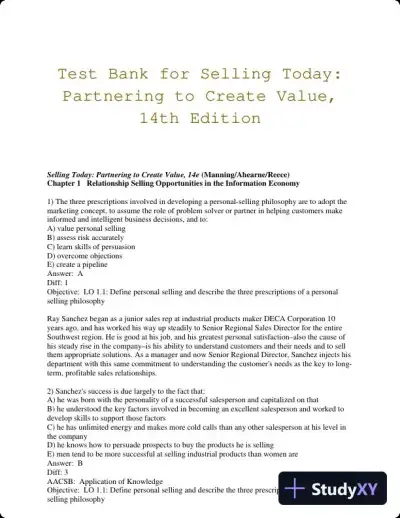 Exam Guides
Test Bank for Selling Today: Partnering to Create Value, 14th Edition
Marketing
337 pages103downloadsFeb 2025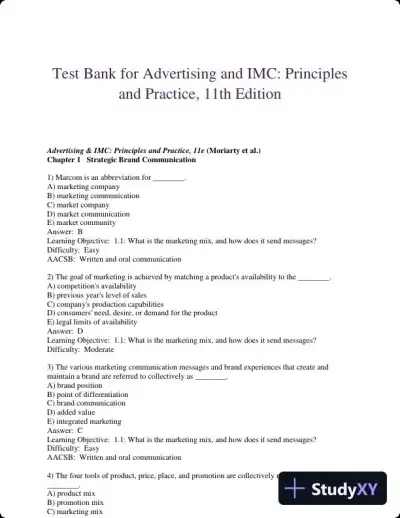 Exam Guides
Test Bank for Advertising and IMC: Principles and Practice, 11th Edition
Marketing
687 pages99downloadsFeb 2025 Textbook Guides
Consumer Behavior, 12th Edition Solution Manual
Marketing
295 pages71downloadsFeb 2025
Study this document with CramX
Once it is in your library, every tool can work from it.