

Basic Math and Pre-Algebra - Decimals
- Mathematics
- Texas A&M University
- 41 pages
- Shared March 2026
Preview 10 of 41 pages
See the first 10 pages exactly as they appear in the document.
Page 1 Read page 1 as text
Study Guide Basic Math and Pre - Algebra – Decimals 1. Using the Place Value Grid The place value grid helps you understand how decimals work. Just like whole numbers, each digit in a decimal has a specific place and value. The only difference? Decimal places go to the right of the decimal point and represent parts of a whole (tenths, hundredths, thousandths, and so on). 1.1 Expanded Nota Ɵ on with Decimals Decimals can be written in expanded notation , just like whole numbers. You simply multiply each digit by its place value. Example 1: Write 0.365 in expanded notation. First, identify each place value: • 3 is in the tenths place → 0.3 • 6 is in the hundredths place → 0.06 • 5 is in the thousandths place → 0.005 So: 0.365 = 0.3 + 0.06 + 0.005 Now show it with multiplication: = (3 × 0.1) + (6 × 0.01) + (5 × 0.001) Or using powers of ten: = (3 × 10 ⁻ ¹) + (6 × 10 ⁻ ²) + (5 × 10 ⁻ ³) Notice that decimal places use negative exponents because they represent parts of 1.
Page 2 Read page 2 as text
Study Guide Example 2: Write 5.26 in expanded notation. Break it into place values: • 5 is in the ones place • 2 is in the tenths place • 6 is in the hundredths place So: 5.26 = 5 + 0.2 + 0.06 With multiplication: = (5 × 1) + (2 × 0.1) + (6 × 0.01) Or with exponents: = (5 × 10 ⁰ ) + (2 × 10 ⁻ ¹) + (6 × 10 ⁻ ²) Expanded notation helps you clearly see the value of every digit. 1.2 Wri Ɵ ng Decimals in Words To read or write a decimal in words: 1. Start reading from the left. 2. Say the whole number part. 3. Say “and” to show the decimal point. 4. Read the digits to the right as a whole number. 5. End with the place value of the last digit. Example 3: Read 0.75 0.75 = seventy - five hundredths
Page 3 Read page 3 as text
Study Guide Example 4: Read 45.321 45.321 = forty - five and three hundred twenty - one thousandths Example 5: Write “two hundred and three tenths.” Two hundred = 200 Three tenths = 0.3 So the number is: 200.3 1.3 Comparing Decimals To compare decimals, make sure they go to the same number of places to the right. You can do this by adding zeros at the end. Adding zeros does not change the value of a decimal. Example 6: Which is greater, 0.37 or 0.365? Rewrite 0.37 as 0.370 so both numbers have three decimal places. 0.370 0.365 Now compare digit by digit. Since 370 thousandths is greater than 365 thousandths, 0.37 is greater than 0.365. Example 7: Order 0.66, 0.6587, and 0.661 from largest to smallest. First, write them to the same place value (ten - thousandths): 0.6600 0.6587 0.6610
Page 4 Read page 4 as text
Study Guide Now compare: Largest → 0.661 Next → 0.66 Smallest → 0.6587 So the order is: 0.661, 0.66, 0.6587 Remember: The number of digits after the decimal point does not determine size. For example, 0.5 is greater than 0.33, even though it has fewer digits. 1.4 Rounding Decimals Rounding decimals is almost the same as rounding whole numbers. Follow these steps: 1. Underline the place value you are rounding to. 2. Look at the digit immediately to the right. 3. If that digit is 5 or more , round up. 4. If that digit is 4 or less , keep the number the same. 5. Drop (remove) all digits to the right of your rounding place. 6. (You do not need to replace dropped digits with zeros.) Example 8: Round 0.478 to the nearest hundredth. Underline the hundredths place (7). Look at the thousandths digit (8). Since 8 is 5 or more, round up. 0.478 becomes 0.48
Page 5 Read page 5 as text
Study Guide Example 9: Round 5.3743 to the nearest thousandth. Underline the thousandths place (4). Look at the next digit (3). Since 3 is less than 5, round down. 5.3743 becomes 5.374 Why This Ma Ʃ ers Understanding decimals helps you: • Work with money • Measure length and weight • Compare data • Estimate answers • Solve real - world problems Summary • The place value grid helps you understand decimals by showing that each digit has a specific value based on its position (tenths, hundredths, thousandths, etc.). • Decimals can be written in expanded notation by breaking the number into the value of each digit, using multiplication or powers of ten with negative exponents. • When reading decimals in words, say the whole number part, use “and” for the decimal point, then name the decimal part using the place value of the last digit. • To compare decimals, line up the decimal points and add zeros if needed so the numbers have the same number of decimal places before comparing digits from left to right. • The number of digits after the decimal point does not determine which number is larger (for example, 0.5 is greater than 0.33). • Rounding decimals follows the same rules as whole numbers: look at the digit to the right of the rounding place, round up if it is 5 or more, and round down if it is 4 or less.
Page 6 Read page 6 as text
Study Guide 2. Quiz: Using the Place Value Grid 1. Question How is the value one - tenth expressed as a power of 10? Answer Choices • 10 ⁻ ¹ • 10 ⁰ • 10¹ Correct Answer 10 ⁻ ¹ Why This Is Correct One - tenth equals 0.1 . 10 ⁻ ¹ = 1 ÷ 10 = 0.1 2. Question How is the value hundred - thousandths expressed as a power of 10? Answer Choices • 10 ⁻ ⁶ • 10 ⁻ ⁵ • 10 ⁵ Correct Answer 10 ⁻ ⁵
Page 7 Read page 7 as text
Study Guide Why This Is Correct Hundred - thousandths means 1 divided by 100,000 . That equals 0.00001, which is 10 ⁻ ⁵ . 3. Question Which of the following is NOT an accepted expanded form for 0.0234? Answer Choices • (2 × 0.01) + (3 × 0.001) + (4 × 0.0001) • (2 × 10 ⁻ ¹) + (3 × 10 ⁻ ²) + (4 × 10 ⁻ ³) • (2 × 10 ⁻ ²) + (3 × 10 ⁻ ³) + (4 × 10 ⁻ ⁴ ) Correct Answer (2 × 10 ⁻ ¹) + (3 × 10 ⁻ ²) + (4 × 10 ⁻ ³) Why This Is Correct 0.0234 means: 2 hundredths → 2 × 10 ⁻ ² 3 thousandths → 3 × 10 ⁻ ³ 4 ten - thousandths → 4 × 10 ⁻ ⁴ But 2 × 10 ⁻ ¹ equals 0.2, which is too large. 4. Question Which of the following is an accepted expanded form for 10.405? Answer Choices • (10 × 10 ⁰ ) + (4 × 10 ⁻ ¹) + (5 × 10 ⁻ ³) • (1 × 10¹) + (4 × 10 ⁻ ¹) + (5 × 10 ⁻ ²) • (1 × 10¹) + (4 × 10 ⁻ ¹) + (5 × 10 ⁻ ³)
Page 8 Read page 8 as text
Study Guide Correct Answer (1 × 10¹) + (4 × 10 ⁻ ¹) + (5 × 10 ⁻ ³) Why This Is Correct 10.405 = 1 in the tens place → 1 × 10¹ 4 in the tenths place → 4 × 10 ⁻ ¹ 5 in the thousandths place → 5 × 10 ⁻ ³ That matches the third choice. 5. Question Which of the following represents (3 × 10²) + (4 × 10 ⁰ ) + (5 × 10 ⁻ ²) + (6 × 10 ⁻ ⁴ )? Answer Choices • 304.506 • 304.056 • 304.0506 Correct Answer 304.0506 Why This Is Correct 3 × 10² = 300 4 × 10 ⁰ = 4 5 × 10 ⁻ ² = 0.05 6 × 10 ⁻ ⁴ = 0.0006 Add them: 300 + 4 + 0.05 + 0.0006 = 304.0506
Page 9 Read page 9 as text
Study Guide 6. Question How do you read 0.023? Answer Choices • twenty - three thousandths • twenty - three hundredths • twenty - three tenths Correct Answer twenty - three thousandths Why This Is Correct 0.023 has three digits after the decimal point. That makes it thousandths. 7. Question How is the number three hundred and three hundredths written? Answer Choices • 0.303 • 300.03 • 300.003 Correct Answer 300.03 Why This Is Correct Three hundred = 300 Three hundredths = 0.03 Together: 300.03
Page 10 Read page 10 as text
Study Guide 8. Question Which list is correctly ordered from least to greatest? Answer Choices • 0.45; 0.5; 0.396 • 0.375; 0.4; 0.51 • 0.8; 0.73; 0.652 Correct Answer 0.375; 0.4; 0.51 Why This Is Correct 0.375 < 0.4 < 0.51 The other lists are not in increasing order. 9. Question Which has the least value? Answer Choices thirteen hundredths four tenths fifty - three thousandths Correct Answer fifty - three thousandths
31 more pages in the full document
Unlock it once and it stays in your library, ready to chat with or turn into flashcards.
Unlock the full documentMore Mathematics study materials
See all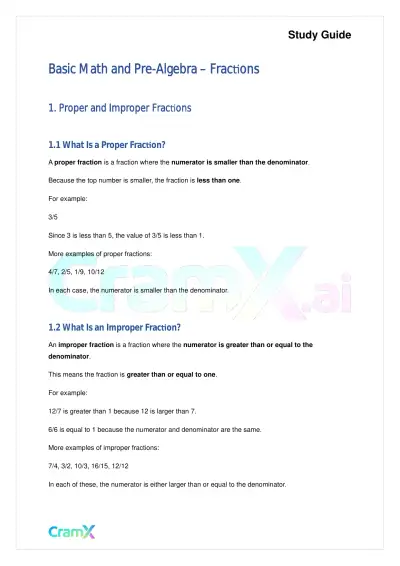 Quick Guides
Basic Math and Pre-Algebra – Fractions
Mathematics
82 pagesMar 2026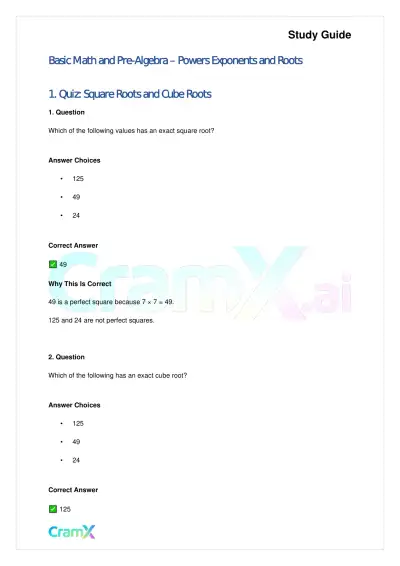 Quick Guides
Basic Math and Pre-Algebra - Powers Exponents and Roots
Mathematics
35 pagesMar 2026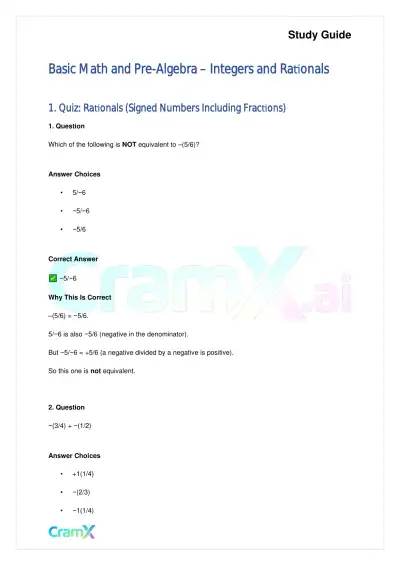 Quick Guides
Basic Math and Pre-Algebra - Integers and Rationals
Mathematics
46 pagesMar 2026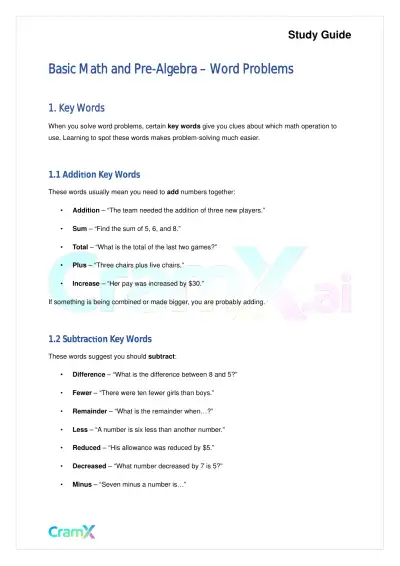 Quick Guides
Basic Math and Pre-Algebra - Word Problems
Mathematics
53 pagesMar 2026 Quick Guides
Basic Math and Pre-Algebra - Variables Algebraic Expressions and Simple Equations
Mathematics
40 pagesMar 2026 Quick Guides
Basic Math and Pre-Algebra - Whole Numbers
Mathematics
41 pagesMar 2026 Quick Guides
Basic Math and Pre-Algebra - Preliminaries
Mathematics
49 pagesMar 2026 Quick Guides
Basic Math and Pre-Algebra - Percents
Mathematics
42 pagesMar 2026
Study this document with CramX
Once it is in your library, every tool can work from it.