

Lecture Notes for Developing Management Skills, 10th Edition
- Medicine
- 446 pages
- Shared February 2025
- 55 downloads
Master key topics with Lecture Notes for Developing Management Skills, 10th Edition, your perfect class companion.
Preview 31 of 446 pages
See the first 31 pages exactly as they appear in the document.
Page 1 Read page 1 as text
Developing Management Skills T en th Edition David A. Whetten Kim S. Cameron Developing Management Skills , Instructor's Resource Manual with Solutions (Download only) , 1 0 e By
Page 2 Page 3 Read page 3 as text
1 1 CONTENTS PREFACE SECTION 1: DESIGNING THE COURSE Getting Started Course Philosophy Course Design Course Requirements Course Administration Tools A Note o n Using Skill Assessments TA Training Program for Large Courses Further Reading on Teaching Management Skills * Principles of Effective Course Design: What I Wish I Had Known About Learning - Centered Teaching 30 Years Ago by Dav id Whetten * Integrated Model for Teaching Management Skills by Dav id Whetten and Sue Campbell Clark SECTION 2: TEACHING THE COURSE Introduction Personal Assessment of Management Skills (PAMS) (Associates Version) Icebreaker Exercises Chapter 1: Developing Self - Awareness Skill Assessment Skill Learning Skill Analysis (Cases) Skill Practice (Exercises) Skill Application For Further Reading Chapter 2: Managing Stress and Well - Being Skill Assessment Skill Learning Skill Analysis (Cases) Skill Practice (Exercises) Skill Application For Further Reading Chapter 3: Solving Problems Analytically and Creatively Skill Assessment Skill Learning Skill Analysis (Cases) Skill Practice (Exercises) Skill Application For Further Reading Chapter 4: Building Relationships by Communicating Supportively
Page 4 Read page 4 as text
1 2 Skill Assessment Skill Learning Skill Analysis (Cases) Skill Practice (Exercises) Skill Application For Further Reading Resource Guide Chapter 5: Gaining Power and Influence Skill Assessment Skill Learning Skill Analysis (Cases) Skill Practice (Exercises) Skill Application For Further Reading Chapter 6: Motivating Performance Skill Assessment Skill Learning Skill Analysis (Cases) Skill Practice (Exercises) Skill Application For Further Reading Chapter 7: Negotiat ing and Resolving Conflict Skill Assessment Skill Learning Skill Analysis (Cases) Skill Practice (Exercises) Skill Application For Further Reading Chapter 8: Empowering and Engag ing Others Skill Assessment Skill Learning Skill Analysis (Cases) Skill Practice (Exercises) Skill Application For Further Reading Chapter 9: Building Effective Teams and Teamwork Skill Assessment Skill Learning Skill Analysis (Cases) Skill Practice (Exercises) Skill Application For Further Reading Chapter 10: Lead ing Positive Change Skill Assessment Skill Learning
Page 5 Read page 5 as text
1 3 Skill Analysis (Cases) Skill Practice (Exercises) Skill Application For Further Reading SECTION 3: SUPPLEMENTARY TEACHING AND LEARNING MATERIALS I. Teaching Enhancement Tools Role Playing as a Learning Tool for Skill Development Guidelines for Conducting Effective Demonstration Role Plays by Karen Fletcher, as Revised by Debra Comer Variations on the Structured Role Play Model Suggestions for Effective Classroom Discussions II. Learning - Centered Approaches to Testing A Team Learning Approach to Content Mastery Exams Action Skills Exams by John Bigelow Integrative, Application - Oriented Exams by Larry Michaels e n Integration Exam Cases
Page 6 Read page 6 as text
1 4 PREFACE This Instructor’s Manual contains three sections. Section One focuses on the fundamental principles and design of a management skill - building course. It contains many specific ideas and suggestions for course requirements, along with a comparison of this approach with traditional course design. Two skill - building alternative formats are examined: a high - involvement class option that assumes a relatively small class size (fewer than 40 students) and a low - involvement option for use in large lecture hall settings. The material, gleaned from the authors’ many years of teaching the subject, demonstrates the wide range of settings in which management skills can be taught effectively. Section Two focuses on teaching the course. The chapters in this section correspond with those in the text — beginning with the Introduction. Subsequent chapters follow the basic format of each book chapter, with supporting teaching tips and guidelines for the Skill Assessment, Skill Learning, Skill Analysis, Skill Practice, and Skill Application sections. Section Three contains supplemental teaching aids that support the learning - centered approach to skill - development characteristic of the text and text supplements. (For more information on how the learning - centered focus is reflected in the design of the text see the Preface and Introduction in the text.) In this final section are guidelines for conducting effective role plays, enhancing classroom discussions, as well as suggestions for assessing students’ abilities to integrate and apply core concepts and behavioral guidelines. Some of the impo rtant features of this revised Instructor’s Manual include: Guidelines for designing a skill - building course, including tips on how to use teaching assistants effectively for larger courses. An extensive introduction to teaching a skill - building course, including comparisons with traditional pedagogical approaches. Suggestions for conducting role plays and managing effective class discussion. Tips for helping students to use and interpret skill assessments. Suggestions for testing higher order learning, including integration and application. Extensive teaching hints and discussion questions for each chapter. High - involvement classroom exercises for introducing each chapter, including new video clips from popular movies to illustrate course principles. In addition to the Instructor’s Manual, the teaching support package for this edition of DMS includes the following (available at www.pearsonhighered.com/irc). DMS Test Item File (with the accompanying TestGen® Computerized Test Bank). The revised test bank includes new test questions that focus on application. Updated PowerPoint slides of key text materials, including tables, figures, and behavioral guidelines. Please send your suggestions for how we can use our web site to better support you as a teacher to dms@byu.edu .
Page 7 Read page 7 as text
1 5 ACKNOWLEDGEMENTS We would like to thank those who have contributed to developing this instructor’s manual over the years — David Whetten, Brigham Young University ; Carol F. Moore, California State University, Hayward ; Marian Burk Wood, M.B.A; Debra R. Comer, Hofstra University; John E. Tropman, University of Michigan; Sue Campbell Clark, University of Idaho; Patricia Seybolt, University of Utah; Arthur Shr iberg, Xavier University; Carol A. Lloyd, Lloyd Communications ; and Forrest Aven and David Niño , University of Houston - Downtown . In this edition, we have added new content, retained or revised some of the previous contributions, and deleted content that we felt no longer fit with the tenth edition of the textbook. Finally, we would also like to acknowledge Pooja Aggarwal and Darathie Renganatha n at Pearson for their excellent assistance in coordinating and developing this updated version of the instructor’s manual.
Page 8 Read page 8 as text
1 - 1 CHAPTER 1 DEVELOPING SELF - AWARENESS Learning Objectives Increase p ersonal a wareness of y our : 1. Sensitive Line 2. Emotional Intelligence 3. Personal Values and Moral Maturity 4. Character Strengths 5. Cognitive Style 6. Orientation Toward Change 7. Core Self - Evaluation QUICK RESOURCE LOCATOR: 1 One way to help your students master the general skill of “developing self - awareness” is to focus their attention on one or more specific skills. These basic skills are identified in the chapter’s title page, and below as learning objectives. If you elect to organize this portion of your course around specific learning objectives/ management skills, you can use the following table as a roadmap — guiding each of your “trips” through the five - step learning model and corresponding support material in this chapter of the Instructor’s Manual (hereafter referred to as “IM”). Learning Objective #1: Increase personal awareness of your sensitive line Skill Assessment 2 ✓ Take “Self - Awareness As sessment” items 1 - 3 (text, p. 74 ) ✓ Take “Big 5 Personality Test” ( IM, p. 1 - 25 ) Skill Learning ✓ Read “Sensitive Line” (text, p. 45 - 46) ✓ Read Behavioral Guidelines A & G (text, p. 64 ) ✓ View clip from “The Lion King” ( IM, p. 1 - 25 ) 4 ✓ View clip from “Pleasantville” ( IM, p. 1 - 25 ) 4 ✓ View PowerPoint slides 3 Skill Analysis ✓ Analyze “The Case of Heinz” (text, p. 65; IM, p. 1 - 25 ) Skill Practice 5,6 ✓ Do “Through the Looking Glass” exercise (text, p. 69 - 71; IM, p. 1 - 25 ) ✓ Do “A Learning Plan and Autobiography” exercise (text, p. 73 - 75) Skill Application ✓ Complete Assignment 1.20 (text, p. 75) ✓ Complete an Application Plan and Evaluation (text, p. 76) For Further Reading ✓ Buckingham, Marcus & Clifton, Donald O. (2001) Now, Find Your Strengths. ✓ Drucker, Peter. (1999) Managing oneself. Harvard Business Review, March - April, pp. 65 - 74. ✓ Fletcher, Clive, & Baldry, Caroline. (2000). A study of individual differences and self - awareness in the context of multi - source feedback. Journal of Occupational and Organizational Behavior , 73, 303 – 319. ✓ McCallum, John S. (2000, May/June). Tennyson on management. Ivey Business Journal , 64 (5), 70 – 72. Learning Objective #2:
Page 9 Read page 9 as text
1 - 2 Increase personal awareness of your emotional intelligence Skill Assessment 2 ✓ Take “Self - Awareness Assessment” items 4 - 8, 10 (text, p. 74 ) ✓ Take “Emotional Intelligence Assessment” (text, p. 74 - 76) ✓ Take “Big 5 Personality Test” ( IM, p. 1 - 25 ) Skill Learning ✓ Read “Emotional Intelligence” (text, p. 48 - 50 ) ✓ Read Behavioral Guidelines E & H (text, p. 64 ) ✓ View clip from “Pleasantville” ( IM, p. 1 - 25 ) 4 ✓ View PowerPoint slides 3 Skill Analysis ✓ Analyze “The Case of Heinz” (text, p. 65; IM, p. 1 - 25 ) ✓ Analyze “Decision Dilemmas” (text, p. 67; IM, p. 1 - 25 ) ✓ Skill Practice 5,6 ✓ Do “Through the Looking Glass” exercise (text, p. 69 - 71; IM, p. 1 - 25 ) ✓ Do “Diagnosing Managerial Characteristics” exercise (text, p. 71 - 72; IM, p. 1 - 25 ) ✓ Do “A Learning Plan and Autobiography” exercise (text, p. 73 - 75) Skill Application ✓ Complete Assignments 1.19, 1.20, 1.23, 1.24 (text, p. 75) ✓ Complete an Application Plan and Evaluation (text, p. 76) For Further Reading ✓ Buckingham, Marcus & Clifton, Donald O. (2001) Now, Find Your Strengths. ✓ Drucker, Peter. (1999) Managing oneself. Harvard Business Review, March - April, pp. 65 - 74. ✓ Fletcher, Clive, & Baldry, Caroline. (2000). A study of individual differences and self - awareness in the context of multi - source feedback. Journal of Occupational and Organizational Behavior , 73, 303 – 319. ✓ McCallum, John S. (2000, May/June). Tennyson on management. Ivey Business Journal , 64 (5), 70 – 72. Learning Objective #3: Increas e personal awareness of your personal values and moral maturity Skill Assessment 2 ✓ Take “Self - Awareness Assessment” item 7 (text, p. 74 ) ✓ Take “Defining Issues Test” (text, p. 38 - 39) Skill Learning ✓ Read “Ethical Decision - Making” (text, p. 55 - 57 ) ✓ Read Behavioral Guidelines 2 - 3 (text, p. 64) ✓ View clip from “Lion King” ( IM, p. 1 - 25 ) 4 ✓ View PowerPoint slides 3 Skill Analysis ✓ Analyze “The Case of Heinz” (text, p. 65; IM, p. 1 - 25 ) ✓ Analyze “Computerized Exam” (text, p. 66; IM, p. 1 - 25 ) ✓ Analyze “Decision Dilemmas” (text, p. 67; IM, p. 1 - 25 ) ✓ Skill Practice 5,6 ✓ Do “Through the Looking Glass” exercise (text, p. 69 - 71; IM, p. 1 - 25 ) ✓ Do “Diagnosing Managerial Characteristics” exercise (text, p. 71 - 72; IM, p. 1 - 25 ) ✓ Do “A Learning Plan and Autobiography” exercise (text, p. 73 - 75) ✓ Do “Self - Introduction Role Play” ( IM, p. 1 - 25 ) ✓ Do “Cultural Values” exercise ( IM, p. 1 - 25 ) Skill Application ✓ Complete Assignments 1.19, 1.20, 1.22, 1,23, 1.24 (text, p. 75) ✓ Complete an Application Plan and Evaluation (text, p. 76) For Further Reading ✓ Buckingham, Marcus & Clifton, Donald O. (2001) Now, Find Your Strengths. ✓ Drucker, Peter. (1999) Managing oneself. Harvard Business Review,
Page 10 Read page 10 as text
1 - 3 March - April, pp. 65 - 74. ✓ Fletcher, Clive, & Baldry, Caroline. (2000). A study of individual differences and self - awareness in the context of multi - source feedback. Journal of Occupational and Organizational Behavior , 73, 303 – 319. ✓ McCallum, John S. (2000, May/June). Tennyson on management. Ivey Business Journal , 64 (5), 70 – 72. Learning Objective #4: Increase personal awareness of your cognitive style Skill Assessment 2 ✓ Take “Self - Awareness Assessment” item 4 (text, p. 74 ) ✓ Take “Cognitive Style Indicator” (text, p. 41 - 42) Skill Learning ✓ Read “Cognitive Style” (text, p. 57 - 59 ) ✓ Read Behavioral Guideline 4 (text, p. 64 ) ✓ View PowerPoint slides 3 Skill Analysis ✓ Analyze “The Case of Heinz” (text, p. 65; IM, p. 1 - 25 ) ✓ Analyze “Decision Dilemmas” (text, p. 67; IM, p. 1 - 25 ) Skill Practice 5,6 ✓ Do “Through the Looking Glass” exercise (text, p. 89; IM, p. 1 - 25 ) ✓ Do “Diagnosing Managerial Characteristics” exercise (text, p. 71 - 72; IM, p. 1 - 25 ) ✓ Do “A Learning Plan and Autobiography” exercise (text, p. 73 - 75) ✓ Do “Self - Introduction Role Play” ( IM, p. 1 - 25 ) Skill Application ✓ Complete Assignments 1.19, 1.20, 1.23, 1.24 (text, p. 75) ✓ Complete an Application Plan and Evaluation (text, p. 76) For Further Reading ✓ Buckingham, Marcus & Clifton, Donald O. (2001) Now, Find Your Strengths. ✓ Drucker, Peter. (1999) Managing oneself. Harvard Business Review, March - April, pp. 65 - 74. ✓ Fletcher, Clive, & Baldry, Caroline. (2000). A study of individual differences and self - awareness in the context of multi - source feedback. Journal of Occupational and Organizational Behavior , 73, 303 – 319. ✓ McCallum, John S. (2000, May/June). Tennyson on management. Ivey Business Journal , 64 (5), 70 – 72. Learning Objective #5 : Increase personal awareness of your orientation toward change Skill Assessment 2 ✓ Take “Self - Awareness Assessment” items 6, 8 (text, p. 74 ) ✓ Take “Locus of Control Scale” (text, p. 74) ✓ Take “Tolerance of Ambiguity Scale” (text p. 74) ✓ Take “Big 5 Personality Test” ( IM, p. 1 - 25 ) Skill Learning ✓ Read “Attitudes Toward Change” (text, p. 59) ✓ Read Behavioral Guideline 4 (text, p. 64) ✓ View clip from “Pleasantville” ( IM, p. 1 - 25 ) 4 ✓ View PowerPoint slides 3 Skill Analysis ✓ Analyze “The Case of Heinz” (text, p. 65; IM, p. 1 - 25 ) ✓ Analyze “Decision Dilemmas” (text, p. 67; IM, p. 1 - 25 ) ✓ Do “Entrepreneurial Locus of Control” exercise ( IM, p. 1 - 25 ) Skill Practice 5,6 ✓ Do “Through the Looking Glass” exercise (text, p. 69 - 71; IM, p. 1 - 25 ) ✓ Do “Diagnosing Managerial Characteristics” exercise (text, p. 71 - 72; IM, p. 1 - 25 ) ✓ Do “A Learning Plan and Autobiography” exercise (text, p. 73 - 75) ✓ Do “Self - Introduction Role Play” ( IM, p. 1 - 25 ) Skill Application ✓ Complete Assignments 1.19, 1.20, 1.23, 1.24 (text, p. 75)
Page 11 Read page 11 as text
1 - 4 ✓ Complete an Application Plan and Evaluation (text, p. 76) For Further Reading ✓ Buckingham, Marcus & Clifton, Donald O. (2001) Now, Find Your Strengths. ✓ Drucker, Peter. (1999) Managing oneself. Harvard Business Review, March - April, pp. 65 - 74. ✓ Fletcher, Clive, & Baldry, Caroline. (2000). A study of individual differences and self - awareness in the context of multi - source feedback. Journal of Occupational and Organizational Behavior , 73, 303 – 319. ✓ McCallum, John S. (2000, May/June). Tennyson on management. Ivey Business Journal , 64 (5), 70 – 72. Learning Objective #6: Increase personal awareness of your core self - evaluation Skill Assessment 2 ✓ Take “Self - Awareness Assessment” items 4 - 8, 10 (text, p. 74 ) ✓ Take “Core Self - Evaluation Scale” (text, p. 73) ✓ Take “Big 5 Personality Test” ( IM, p. 1 - 25 ) Skill Learning ✓ Read “Core Self - Evaluation” (text, p. 7 3 - 75 ) ✓ Read Behavioral Guidelines 6, 8 (text, p. 64) ✓ View clip from “The Lion King” ( IM, p. 1 - 25 ) 4 ✓ View PowerPoint slides 3 Skill Analysis ✓ Analyze “The Case of Heinz” (text, p. 65; IM, p. 1 - 25 ) ✓ Analyze “Decision Dilemmas” (text, p. 67; IM, p. 1 - 25 ) Skill Practice 5,6 ✓ Do “Through the Looking Glass” exercise (text, p. 69 - 71; IM, p. 1 - 25 ) ✓ Do “Diagnosing Managerial Characteristics” exercise (text, p. 71 - 72; IM, p. 1 - 25 ) ✓ Do “A Learning Plan and Autobiography” exercise (text, p. 73 - 75) ✓ Do “Self - Introduction Role Play” ( IM, p. 1 - 25 ) Skill Application ✓ Complete Assignments 1.19, 1.20, 1.23, 1.24 (text, p. 75) ✓ Complete an Application Plan and Evaluation (text, p. 76) For Further Reading ✓ Buckingham, Marcus & Clifton, Donald O. (2001) Now, Find Your Strengths. ✓ Drucker, Peter. (1999) Managing oneself. Harvard Business Review, March - April, pp. 65 - 74. ✓ Fletcher, Clive, & Baldry, Caroline. (2000). A study of individual differences and self - awareness in the context of multi - source feedback. Journal of Occupational and Organizational Behavior , 73, 303 – 319. ✓ McCallum, John S. (2000, May/June). Tennyson on management. Ivey Business Journal , 64 (5), 70 – 72. Footnotes: 1. A web site to support DMS teachers has been developed t o post questions, share resource materials, seek feedback on new ideas, a nd so forth. T o participate in this DMS teaching network, please send an enrollment request to dms@byu.edu . 2. Tips for helping students learn the most from skill assessment surveys are included in Section 1, “Designing the Cours e” of the Instructor’s Manual. A computerized version of all Skill Assessment surveys is available through the MyLab Management course online at www.pearson.com/mylab/management . 3. The PowerPoint slides for the text can be ordered through Prentice Hall representative, or they can be downloaded from the Prentice Hall website.
Page 12 Read page 12 as text
1 - 5 4. Short video clips from popular movies can be used as a Skill Learning exercise to introduce a chapter, or as video cases — setting up Skill Analysis discussions or Skill Practice role playing exercises. Several suggestions are included in each IM chapter . 5. There are several benefits to using classroom exercises to introduce key concepts in a chapter. These activities generate a high level of interaction and stimulate student interest in learning the related subject matter. 6. In Section 3 of the IM, under the title “Action Skill Exams,” John Bigelow has developed a set of role play exercises for use as application or performance exams. These would be excellent demonstration role plays for introducing a particular learning objective, or simultaneous role plays for practicing specific behavioral guidelines. The first part of Section 3 contains numerous teaching tips for the effective use of demonstration and simultaneous role plays in a skill development course. Resources for Teaching the Chapter Becoming an effective manager or leader begins with a process of self - awareness, and this chapter provides valid content and assessment tools for achieving this self - knowledge. Managers that fail to know and understand themselves would very likely experience problems unde rstanding and managing others. The same could be said for people in general; knowing oneself is an essential prerequisite to personal growth and to the development of good interpersonal relationships. The following sections provide resources to help instructors guide their students through the five - step Model for Developing Management Skills ( s ee Table 2 in the Introduction of the textbook). SKILL ASSESSMENT Before reading the chapter, have students complete the Personal Inventory A ssessment instruments i n MyLab Management TM . Scores indicate the extent to which individuals have developed competency in the relevant skills and the extent to which they need to improve. Because this chapter focuses on students becoming more aware of their own styles and inclinations, the assessment instruments constitute the core learning material in the chapter. Most of the text material explains the relevance of these instruments and provides research - based information about their association with management success. Self - Awareness Assessment Instrument . This instrument assess es the core aspects of skill learning covered in the chapter. Five items (1, 2, 3, 9, and 11) focus on the extent to which students are open to new information and to feedback from others and the extent to which they self - disclose to others. The other part of the Self - Awareness Assessment instrument (items 4, 5, 6, 7, 8, and 10) focuses on the four dimensions of self - awareness covered in the chapter; values, emotional intelligence (EI), change orientation, and core self - evaluation. These single items help introduce students to the concepts, each of which is assessed in detail in other assessment instruments. Emotional Intelligence Assessment : This instrument evaluate s competencies in four general areas of emotional intelligence; emotional awareness (items 1, 5, and 9), emotional control or
Page 13 Read page 13 as text
1 - 6 balance (2, 6, and 10), emotional diagnosis or empathy (3, 7, and 11) , and emotional response (4, 8, and 12). Note that this is a short and relatively incomplete assessment of emotional intelligence. Students interested in gaining a more fully validated measure of emotional intelligence should use those in the sources cited in the text. Instructions are provided in the text on how to score this assessment. The Defining Issue s Test : This instrument is the most reliable and valid paper - and - pencil instrument available for assessing moral or values maturity. However, author James R. Rest has asked that we not provide the precise scoring key used in research because of possible misinterpretation of the scores. The purpose here is to use the instrument to become aware of the stage of moral development that one uses most when facing moral dilemmas. The instrument does not assess moral worth or the goodness or badness of a person. Rather, it assesses the extent to which people rely on certain instrumental values when making choices in value - laden circumstances. The scoring instructions give students an idea of which level they rely on most. Suggested Procedure: 1. Have students consider only the four statements they ranked as most important, ignoring ratings of the other statements. 2. Identify the stage that each statement represents. For example, in the Escaped Prisoner story, statement #1 represents a Stage 3 response. 3. Reverse the points associated with the rankings. That is, the item ranked #1 gets four points, #2 gets three points, #3 gets two points, and #4 gets one point. 4. Draw the following figure. Record the number of points associated with each stage in the appropriate box. For example, if sentence #1 in the Escaped Prisoner story was ranked #1, put a 4 (4 points) in the cell entitled Stage 3. STORY 1 2 3 4 5 6 Prisoner Doctor Newspaper Total Points 5. Multiply the total points for each stage by 2.3 and compare the scores to norm data shown BELOW. Level Percent Scoring in this Stage 2 6.98 3 18.08 4 31.00 5 28.40 6 6.37
Page 14 Read page 14 as text
1 - 7 (The scores in this table are based on seven stories, so multiplying by 2.3 makes scores comparable.) This table of comparison values shows that most adults select most frequently responses representing stages 4 and 5 in values maturity. Stages 2 and 6 are selected least frequently. Another way to compare themselves to a norm group is to use the table in Chapter 1, which shows how stages of development change over time. This table plots the emphasis individuals give to different stages as they get older. Note that college - age students tend to use mostly stages 3 and 4 according to these data. (These data are derived from Kohlberg’s interview technique, however, not from the paper - and - pencil instrument used here.) Questions to Trigger Reflection and Discussion : In what way have your own responses changed over the last 5 or 10 years? What events or experiences have helped change your level of values maturity? In what ways do you think you can develop an even more mature level of values maturity? Discussion O bjective: Use this discussion to guide students to a deeper understanding of Kohlberg’s model. Help them understand that people tend to move through the three stages over time. Help them identify the differences between the stages using examples from their own lives. Teaching Hints : Before reviewing and using this instrument in class, it may be especially helpful for instructors to complete the assessment and scor e themselves. The scoring and interpretation of the results is a complicated procedure and completing the assessment in advance may help instructors better explain this procedure. Values Maturity : The discussion about values maturity is derived from many references on moral maturity. Some students may be familiar with that literature and may question what moral maturity has to do with values maturity. In brief, moral maturity is much the same as instrumental values development, in that both focus on behavioral processes or means to reach an end. Neither prescribes an end state, but both focus on the best way to reach an end state. Moral maturity literature suggests that the bases on which moral judgments are made change as individuals mature, so that what is correct behavior at one time may not be judged correct later. The same is true for the rankings of instrumental values. As individuals mature, values change, so methods that were once deemed highly important may not be later. Thus, another way of helping individuals become aware of their instrumental values is to assess their current level of values maturity, or the values they tend to emphasize at this stage in their development. Maturity can be enhanced, according to researchers, by providing opportunities for students to confront value - laden issues and work through them, and particularly by encouraging students to develop a consistent, comprehensive set of principles that they can internalize. Kohlberg’s research suggests that it is not necessarily the choice made that is most important, but the motive behind the choice. Therefore, asking, “Why did you make the choice that you did?” is probably the most enlightening aspect of this exercise. The reasons will be more informative, and more helpful to the student, than the actual choice made. Personal Values : A list of instrumental and terminal values used by Rokeach in his research is included below . Rokeach asked respondents to order these values according to their importance. We have found it enlightening to ask students to complete the same task,
Page 15 Read page 15 as text
1 - 8 and then compare their rankings with one another . N umerous comparison tables are available in Milton Rokeach’s The Nature of Human Values (New York: Free Press, 1973) for those who are interested. R okeach’s T erminal V alues : 1. True Friendship 2. Mature Love 3. Self - Respect 4. Happiness 5. Inner Harmony 6. Equality 7. Freedom 8. Pleasure 9. Social Recognition 10. Wisdom 11. Salvation 12. Family Security 13. National Security 14. A Sense of Accomplishment 15. A World of Beauty 16. A World at Peace 17. A Comfortable Life 18. An Exciting Life Rokeach’s I nstrumental V alues : 1. Cheerfulness 2. Ambition 3. Love 4. Cleanliness 5. Self - Control 6. Capability 7. Courage 8. Politeness 9. Honesty 10. Imagination 11. Independence 12. Intellect 13. Broad - Mindedness 14. Logic 15. Obedience 16. Helpfulness 17. Responsibility 18. Forgiveness The Cognitive Style Indicator: This instrument assess es critical dimensions of cognitive style — knowing, planning, and creating — and provide s insights into the students ’ preferred way of collecting and processing information. Scores reflect the relative strength of students’ tendencies to use each of the three styles in day - to - day situations. However, the instrument is not intended to signify a fixed trait. People can alter their comfort level with the various cognitive styles through training and experience. The instrument provides insight about one’s current level of comfort with the styles, but does not imply limits to their further development, nor is it indicative of intelligence or professional capacity. Questions to Trigger Reflection and Discussion: What accounts for differences in these scores? Is there anything consistently unique about people who are characterized by one cognitive style more than others? What implications do you think cognitive style ha s for college majors, future occupations, study habits, social relationships, test - taking abilities, and so on? How do you think a person can further develop a cognitive style? What implications might cognitive style have for the way you study? The way you collaborate with teammates? Discussion O bjective: Help students explore how the three cognitive styles apply to their own experiences. Encourage them to find evidence for their preferred style. Help them see that we can develop other styles through practice and application. Allow them to speculate about how the styles prepare them for different roles or learning strategies.
Page 16 Read page 16 as text
1 - 9 Applying cognitive style to studying : Hold a classroom discussion about the best ways to study for exams or for case discussions. First, ask students about their preferred methods of studying. Depending on their cognitive styles, students usually prefer very different modes of preparing for final exams. The following table summarizes recommendations for each different cognitive style. Style Best Study Methods Knowing Reading, integrating, thinking things through, analyzing Planning Memorizing, outlining, identifying facts, focusing on few things Creating Creative thinking, trial and error, personal feedback, a study partner Although this table is oversimplified, it can help students identify the practical applications of knowing their individual cognitive style. Developing a well - rounded set of styles : Students’ scores indicate how much they rely on each of the three main cognitive styles. Although individuals may concentrate on just one style at times, a completely engaged learner will use all three styles for most effective learning. This is why it is important for students to strengthen their less - developed cognitive style skills. Ask students to examine their scores and rank their cognitive styles from their strongest to their less developed. Then have them list at least two ways they can strengthen their less - developed cognitive styles. The goal is to avoid overreliance on a single strong cognitive style for all situations. The following table shows suggestions for strengthening each of the four cognitive styles. Style How to Strengthen Knowing Practice collecting and carefully analyzing complex data Planning Practice setting goals and developing concrete and detailed plans of action Creating Practice identifying new opportunities and becoming personally involved with people who challenge your thinking Strategies for developing cognitive style skills : With a long - term plan, students can identify safe situations in which to test and develop their cognitive style skills. Remind them to reward themselves for seeking out and actively participating in such learning experiences. Three strategies for developing cognitive style skills are: Strategy Rationale Develop learning and work relationships with individuals who are strong in learning styles where you are not. Watching and participating with people who use different cognitive styles can help you value different styles. Better fit your cognitive style strengths to the learning experiences you encounter. You will learn better and feel more satisfied if you focus on tasks that fit with your cognitive style strengths. Apply and strengthen cognitive style skills that are the opposite of your strongest style skills. Become more flexible in your cognitive style so you can deal more effectively with a broader range of challenges and situations.
Page 17 Read page 17 as text
1 - 10 Locus of Control Scale : Locus of control’s importance has been established in relation to many types of behaviors and attitudes. Because of overwhelming evidence that an internal locus of control is associated with successful management, students may feel that they are destined to failure if they score high as externals. Emphasize that locus of control can shift over time, and that this book helps students take control of their own skill competency development and become internally focused. The instrument should provide insight and motivation, not discouragement. Procedure: Scoring, as explained in the text, consists of simply identifying how many of the keyed alternatives were chosen. The higher the score, the more the external locus of control. The lower the score, the more the internal locus of control. If you have students share their scores with the entire class as well as their own small group, do it before students have read the text material. After reading it, they are less likely to feel comfortable when they know that one type of score seems to have a higher potential of success. Questions to Trigger Reflection and Discussion: What accounts for the differences in the scores of individuals in the class? Is there anything consistently unique about the people who scored especially high or especially low on internal or external locus of control? What implications does locus of control have for college majors, future occupations, study habits, social relationships, test - taking abilities, and so on? How can a person change his or her locus of control? Discussion O bjective: Help students explore applications of locus of control in their own experiences. Encourage the sharing of anecdotes that reveal the difference between internal and external locus of control. Allow the students to speculate about how internal locus of control could benefit their study habits and relationships. Emphasize that locus of control can shift toward the internal as people strive to take more responsibility for their own outcomes. Tolerance of Ambiguity Scale : T his instrument assess es individuals’ comfort with ambiguous situations in which only partial information is available or new experiences are encountered. Asking students to share their scores and record them on a chalkboard or flip chart provides the range of scores for the class and helps students interpret where they are compared to their classmates. It also stimulates discussion of the meaning of the scale and its implications. Because there is an implied positive bias in the scoring — that is, tolerance is better than intolerance — help students avoid discouragement if they have high scores by explaining that this orientation is changeable and that exposure to new information, new situations, and complex problems (typical of the university environment) will help them develop more tolerance of ambiguity. Most important, improving their competency in several of the skills in this book (such as knowing how to solve problems, handle difficult interpersonal situations , and influence others) will boost tolerance as well. Discuss the differences that might exist in the three subscales: Novelty, Complexity, and Insolubility. Encourage students to share their scores in their small group and compare subscales as well as total scores. Questions to Trigger Reflection and Discussion: What are the major sources of ambiguity for students? For managers?
Page 18 Read page 18 as text
1 - 11 To what extent do you think tolerance of ambiguity is situation - dependent? Are some people more tolerant in some situations than in others? (Research suggests that this orientation toward change is generalizable, not situation - specific.) What accounts for differences in the scores of individuals in the class? Is anything consistently unique about the people who scored especially high or especially low on intolerance of ambiguity? What implications does intolerance of ambiguity have for college majors, future occupations, study habits, social relationships, test - taking abilities, and so on? How can a person change his or her tolerance scores? Discussion O bjective: Help students explore how tolerance for ambiguity applies to their own experiences. Encourage the sharing of personal anecdotes and insights. Allow them to speculate about how tolerance (or intolerance) for ambiguity aligns with different jobs or majors. Core Self - Evaluation Scale : T his instrument assess es the four components of core self - evaluation: self - esteem, generalized self - efficacy, neuroticism, and locus of control. These four areas of personality provide a measure of a powerful factor that lies at the core of one’s personality and its various behavioral and attitudinal manifestations. This survey measures the extent of one’s positive self - regard and feelings of being valuable, capable, stable, and in control. As noted in the text, when scoring the instrument, be sure that students reverse - score relevant measures (2, 4, 6, 8, 10, and 12). Following is an online survey instrument that doesn’t appear in the text, but which students can access without cost : The “Big Five” Personality Test Direct students to take the “Big Five” personality test at: www.outofservice.com and click on the link titled “The Big Five Personality Test” (Website developed and copyrighted by Atof Inc. <Jeff Potter>, portions of “Big Five” test copyrighted by U. C. Berkeley psychologist Oliver D. John, Ph.D.). This test gives information about five fundamental personality characteristics: 1) Neuroticism (or Negative Emotionality), 2) Extraversion, 3) Openness (or Originality), 4) Agreeableness (or Accommodation), and 5) Conscientiousness (or Consolidation.) For a complete description of each of these characteristics, go to the website www.centacs.com and click on “Learn about the Big Five Model.” Once the students have received their test results, ask them to compare these results with the results of the other tests that appear in the text, particularly the test for Tolerance of Ambiguity (results should correspond to results on Openness) and the Core Self - Evaluation assessments. See the preface of this instructor’s manual for additional information on helping students to interpret tests. If time permits, students might find a mini - lecture about personality and work outcomes interesting. Two articles by Timothy Judge and his associates summarize the research on personality and job satisfaction (Judge, T. A., Heller, D., & Mount, M.K. (2002). Five - Factor Model of Personality and Job Satisfaction: A Meta - Analysis. Journal of Applied Psychology , 87, 530 – 541) and personality and leadership characteristics (Judge, T. A., Bono, J. E., Ilies, R., &
Page 19 Read page 19 as text
1 - 12 Gerhardt, M. W. (2002). Personality and leadership: A qualitative and quantitative review. Journal of Applied Psychology , 87, 765 – 780.) Judge finds that people who are more neurotic tend to have lower job satisfaction (ρ = - .29) and that people who are more extraverted tend to have higher job satisfaction (ρ = .25.) They also found high true score correlations between job satisfaction and conscientiousness (ρ = .26) and agreeableness (ρ = .17), but determined that the relationship between those two traits and job satisfaction did not generalize across all studies. As for leadership, Judge, et al. found that Extraversion was the trait most cons istently related to leadership, although it was more strongly related to leader emergence (who is likely to become a leader) than leader effectiveness (how well that person leads.) Conscientiousness and Openness to Experience also showed positive correlations with leadership, although more research is needed to fully explore the relationship of Openness to Experience and leadership. SKILL LEARNING Following is an outline of key concepts developed in the Skill Learning section of Chapter 1: Ke y Dimensions of Self - awareness • Self - awareness involves developing an understanding of many dimensions of the self , and provides an essential foundation for general personal mastery as well as other personal management skills. The Enigma of Self - Awareness • The sensitive line refers to the point at which individuals become defensive or protective when encountering information about themselves that is inconsistent with their self - concept. • The threat - rigidity response refers to the way in which people respond to threatening situations or information. When encountering such information, people tend to become tight, rigid, protective, and defensive, making it hard for people to listen to and understand feedback about themselves. • People can overcome the threat - rigidity response by 1) receiving information about oneself that is verifiable, predictable, and controllable , 2) interacting with others and engaging in self - disclosure . Understanding and A ppreciating I ndividual D ifferences • Self - awareness assists people in learning to diagnose, value, and utilize differences ( rather than distinctions) among others. Since people are naturally inclined to interact with people like themselves, understanding and appreciating individual differences can be a tool for creating trusting relationships . Important A reas of S elf - A wareness. • The text focus es on five important areas of self - awareness that are directly relevant to effective management. They include emotional intelligence, personal values, cognitive style, orientation toward change, and core self - evaluation. • Cognitive style describes the manner in which people acquire and evaluate information. • Orientation toward change refers to the methods that people use to cope with changing circumstances. It pertains to one’s tolerance of ambiguity, and how one accepts responsibility for one’s actions under changing conditions.
Page 20 Read page 20 as text
1 - 13 • Core self - evaluation refers to the most fundamental aspects of personality, and incorporates self - esteem, self - efficacy, emotional stability, and self - control. Emotional Intelligence (Area #1) • Emotional intelligence is the ability to manage one’s own emotions as well as relationships with others. • The specific components include: (1) the ability to diagnose and recognize your own emotions, (2) the ability to control your own emotions, (3) the ability to recognize and diagnose emotions displayed by others, and (4) the ability to respond appropriately to those emotional cues. • Research suggests that emotional intelligence is four times more important than IQ in determining job performance and life success. Values (Area #2) • V alues are a person’s stable and taken - for - granted standards that define what is good/bad, worthwhile/worthless, desirable/undesirable, true/untrue, moral/immoral. • Cultural values explain patterns of shared values among people in various countries , as well as difference between them . T hese patterns can be explained using the following seven dimensions. 1. Universalism (societal rules govern behavior) versus particularism , (rules in particular relationships govern behavior). 2. Individualism (the individual is emphasized) versus collectivism (the group is emphasized). 3. Affective (emotions are openly displayed) versus neutral (rationality is expected rather than emotional displays). 4. Specific (careful separation of roles in life) versus diffuse (integration of roles in life). 5. Achievement (status is derived from accomplishments) versus ascription (status is derived from birthright). 6. Emphasis on past and present versus emphasis on the future . 7. Internal locus of control (individuals’ control their own destiny) versus external locus of control (external forces control one’s destiny). • Personal values explain what an individual tends to value in his or her decisions. These are relatively small sets of two types of values. 1. Instrumental values prescribe standards of conduct or methods for accomplishing some end . 2. Terminal values prescribe desired ends or goals. • Values maturity suggests that a person’s values develop and mature over time. Kohlberg’s model consists of three major levels, each of which has two sequential s tages of development. Table 1.2 summarizes this model. • Ethical decision - making . Managers often have to weigh competing values, such as those associated with maximizing what is best for the company versus what is best for other groups (customers, employees, suppliers, society, etc…). Managers best deal with these tradeoffs when they that have a clear sense of their own values and universal principles. Cognitive style (Area #3) • Cognitive styles refer to how an individual tends to perceive, interpret, and respond to information. The three styles include: 1. Knowing Style e mphasizes facts, details, and data. It gives p reference for data that confirms one’s argument. Knowers are well suited to evidence - based argumentation.
Page 21 Read page 21 as text
1 - 14 2. Planning Style e mphasizes structure, preparation, and planning. It s eek s clear agendas and well - defined processes . Planners tend to be well - prepared and follow - up meticulously. 3. Creating Style e mphasize s ex perimentation and creativity. It s eek s novelty and embrace s ambiguity. Creators t end to respond to information quickly and impulsively. Orientation toward change (Area #4) • Tolerance of ambiguity is the extent to which individuals are threatened by, or have difficulty coping with, situations that are ambiguous, incomplete, unstructured, and changing. • Locus of control refers to the attitude people develop regarding the extent to which they are in control of their own destinies. o People with an internal locus of control tend to interpret such information as “I was the caus e of this success or failure.” They are more inclined to believe that changes in their environments are the result of their own actions. o People with an external locus of control tend to interpret such information as “Something or someone else caused this success or failure .” They are more inclined to believe that changes in their environments are the result of outside forces — not their own actions. Core Self - Evaluation (Area #5) • Core self - evaluation refers to one’s fundamental evaluation of oneself . It is comprised of four components: 1. Self - esteem is the extent to which people see themselves as capable, successful, and worthy. 2. Generalized self - efficacy is a generalized sense of one’s ability to perform capably across a variety of circumstances. 3. Neuroticism is the tendency to have a negative outlook or pessimistic approach to life. 4. Locus of control is a person’s belief about the extent to which they can control their own experiences. SKILL ANALYSIS (CASES) Following are resources to help instructors teach the three cases that appear in the text: The Case of Heinz This case illustrates the different levels of values maturity using Kohlberg (1969)’s well known story to help better understand levels of values maturity. In discussing this case, you might break the class into smaller groups to discuss the how a person classified as the following levels of maturity might respond to the dilemma presented in The Case of Heinz: • Self - centered level of maturity • Conformity level of maturity • Principle - level of maturity
Page 22 Read page 22 as text
1 - 15 Computerized Exam This exercise allows students to examine the ethical decision rules and rationale that they might use in making value - based decisions. The situation in the case is one that students should closely relate to, since it involves the process of taking an exam on a computer. The case enables students to evaluate the situation from the standpoint of both a student and an instructor. In teaching the case, emphasize that “right and wrong” answers are less important than values maturity, ethics, and one’s rationale for making these choices . Other suggestions for teaching the case: • As a class, have students vote on alternatives first and then discuss t hem. This should force them first to “take a public stand” on decisions and subsequently explain their rationale and decision rules. • Another way of teaching the case is to ask students to vote, then move t hem in to groups according to their choices , and then have them develop rationales in small groups. Decision Dilemmas These five brief scenarios illustrate bases of ethical decision - making — for example, which criterion did the students use: universalism, reversibility, dignity and liberty, utilitarianism, distributive justice, or personal moral code? They can also help stimulate a discussion about all four aspects of self - awareness. That is, some students will interpret the scenarios differently, some will have difficulty making a decision without more information, some will make assumptions that others will not make, some will want to discuss their point of view with others, some will be very confident of their answers whereas others are less confident, and so on. In each case, encourage the students to identify individual differences that are reflected in their approaches to the answers as well as the answers themselves. For each scenario, ask the questions following the exercise. Then encourage different points of view by different students. The discussion will be more interesting and enlightening if students with different viewpoints are asked to elaborate and defend their positions. Following are descriptions of clips from feature films that instructors might use as further in - class skill analysis activities: The Lion King Simba, the lion cub heir to the throne of Pride Rock, is lured by his evil Uncle Scar into a plot resulting in the death of Simba’s father. Scar then tells Simba that he is responsible for his father’s demise. Stricken with grief and guilt, Simba banishes himself from Pride Rock, leaving Scar as king. The exiled Simba’s new friends encourage him to forget his tragic past. Meanwhile, Scar eventually runs the kingdom to ruins, prompting Simba’s childhood friend, Nala the lioness, to forage for food beyond the borders of the Pridelands. Clip (1:00:30 – 1:08:20). Nala (Moira Kelly), overjoyed to find Simba (Matthew Broderick) alive, implores him to reclaim the throne that is rightfully his and save Pride Rock. Simba fears how Nala will react if she learns that he is at fault for the death of his father (James Earl Jones). He
Page 23 Read page 23 as text
1 - 16 also doubts his ability to rule. When Nala asks him why he stayed away from home, he becomes defensive and refuses to give her an explanation. Nala angrily accuses him of shirking his responsibilities. Although she cannot persuade Simba to return to Pride Rock, she does succeed in shaking him out of his comfortable cocoon of self - delusion. When Simba encounters the shaman baboon Rafiki (Robert Guillaume) soon thereafter, he admits that he is uncertain about who he is. Primed by Nala, Simba heeds his father’s spirit, who urges him to engage in introspection and remember who he is. Simba, who had adopted a new persona to cover his past, can no longer hide from himself. He gives up his carefree existence to face his past and battle Scar. Questions to Trigger Reflection and Discussion: Whenever an individual is in a situation in which he or she encounters information that defies or threatens his or her self - image, the individual is likely to become defensive. How is this situation compounded when the individual is confronted with information that he or she already knows, but has been suppressing? Distinguish between a lack of self - awareness due to insufficient introspection and self - delusion due to a deliberate avoidance of introspection. Simba’s introspection was initiated by Nala and advanced by Rafiki. What are the implications for designing interventions to raise someone’s self - awareness? Why can it be more difficult to disclose one’s deepest fears and self - doubts to a friend than to a stranger? Simba constructed for himself an entirely novel life and identity. To a lesser extent, many people adopt new personae. How and why do they do so? What are the benefits of self - delusion? What are the dangers of self - delusion? Although it may be natural to respond to someone’s defensiveness with anger, anger will likely exacerbate the other person’s defensiveness. What can one do to control one’s own emotions when trying to diffuse defensiveness? Discussion O bjective: Help students explore how this film clip depicts the process by which people become more self - aware. Allow them to speculate about how the processes depicted in this clip might apply to their own lives. Pleasantville David, a modern - day teenager, is transported with his twin sister into the world of a 50s sit - com, where the characters’ seemingly perfect lives mask their empty existence. The twins’ interactions with the townspeople of Pleasantville make these people aware of their monotone lives, which, in turn, spark their curiosity and their desire to replace their ignorance with knowledge and personal growth. Such enlightenment is manifested by their transformation from black - and - white to colorized characters. Clip (1:42:00 – 1:47:40). The changes in Pleasantville frighten many of the citizens, including the mayor (J. T. Walsh), who tries to halt them. He arrests David (Tobey Maguire) and a merchant (Jeff Daniels), who has lately taken to painting vivid R - rated murals on his store windows. During their trial, David purposely baits the mayor to the point where he becomes angry. As his less - than - pleasant emotions emerge for the first time in his life, the mayor gains self - awareness — and color. Questions to Trigger Reflection and Discussion:
Page 24 Read page 24 as text
1 - 17 What positive outcomes does self - awareness confer on an individual and those with whom the individual interacts? What challenges does an individual encounter as his or her self - awareness develops? Under what circumstances might members of a group collude to limit one another’s self - awareness? Why? The mayor was made to confront his more - complex self quite suddenly. How effective is an abrupt epiphany for raising a person’s self - awareness? What are some possible disadvantages of sudden self - awareness? When may it be more advisable to increase an individual’s self - awareness more gradually? Discussion O bjective: Help students explore how this film clip depicts the barriers to self - awareness. Encourage them to r eflect on their own experiences, and situations or events that have inhibited their self - awareness. Allow them to speculate about how sudden self - awareness can bring challenges, but that often these challenges lead to growth . S KILL PRACTICE (EXERCISES) Following are resources to help instructors teach the three practice activities that appear in the text: Through the Looking Glass Purpose : To help students practice self - disclosure and receive feedback on a non - superficial level. Time required: 30 – 90 minutes, depending on how well the partners know each other and whether there are partnerships of two or three. We often assign this exercise to be done outside of class and recorded in a journal. Procedure: 1. Assign each student to do this exercise with a partner or two. 2. Ask each person to share his or her scores on each of the assessment instruments with the others . 3. Each person then answers the 10 questions listed in the exercise. Encourage students to answer seriously and carefully. 4. After each person has answered the 10 questions, the other partner(s) should provide reactions and feedback. They should address the following statements: a. What I have learned about you is... b. I think your greatest strengths are... c. Areas I think you may want to work on are... 5. Feedback from the partner(s) is important because self - disclosure with no feedback is uncomfortable and one - sided. The exercise should end up being an interchange, not a one - way presentation. Unlike other exercises in this book, this discussion exercise does not lend itself to behavioral analysis or observation. Instead, it is intended to motivate simple self - disclosure and the receipt of feedback. However, experiencing self - disclosure, on a relatively personal level, generally produces improved sensitivity to aspects of the self that were previously masked or hidden. The public self, often couched in superficial roles and managed impressions, can be put aside in this
Page 25 Read page 25 as text
1 - 18 exercise, and focus placed on real feelings and perspectives. In our experience, this positive outcome almost always occurs when they are told of its significance in improving self - awareness. At the end of the exercise, discuss the following questions in the class as a whole: What did you learn about yourselves by participating in this exercise? What became clarified that was less clear before? What was uncomfortable to talk about? What does that suggest about you? How difficult was it to provide feedback to others after they answered the 10 questions? Because self - disclosure is such an important ingredient in acquiring self - awareness, what else would have been helpful for you (or others) to share to further improve self - awareness? Diagnosing Managerial Characteristics Purpose: To help students diagnose and manage different styles, weaknesses, and strengths among other people. By analyzing four real managers and their emotional intelli gence, values maturity, orientations toward change, cognitive styles, and core self - evaluation, students will get a sense of the alternative approaches that must be used in managing different kinds of people. Of course, too little information is provided to do an accurate and complete diagnosis, but we have found that students can do a reasonable job using just the information provided here. Procedure: Have students form small groups and do the diagnoses of these four individuals in teams. Each team can diagnose all four individuals — focusing on contrasts and differences — or each team can diagnose one person and then present their diagnosis and rationale to the rest of the class. If the latter option is chosen, make sure that you leave time for questions and challenges by other class members. Encourage students to challenge and question one another’s assumptions and perceptions. The intent is to make certain that students understand clearly what the manifestations might be for each of these different kinds of styles or orientations. The following table summarizes examples of two of the self - awareness dimensions that differentiate these four individuals. Manager Cognitive Style, Orientation Toward Change Michael Dell Knowing style — problem solver focused on technical tasks High tolerance for ambiguity Patrick M. Byrne Planning style — focus on theory based on sound logic Medium tolerance for ambiguity Maurice Blanks Planning and Knowing styles — systematic control of information to solve technical problems Moderate to low tolerance for ambiguity Gordon Bethune Creating style — focus on spontaneity, novelty, and social relations High tolerance for ambiguity Questions to Trigger Reflection and Discussion: How would you manage a team full of people like each of these managers? What would be your challenges?
Page 26 Read page 26 as text
1 - 19 What are the main weaknesses of these managers? What will cause them to fail? Which one of these managers do you think would be best as president of this university, or dean of this school? Which manager would you most like to work for? Which would you least like to work for? Why? Discussion O bjective: Challenge the students to use concepts from this chapter (e.g., the personality traits and measures) to describe the managers in the case. Allow them to speculate about which traits predispose people to leadership. Encourage them to draw upon their own experiences in their responses. An Exercise for Identifying Aspects of Personal Culture: A Learning Plan and Autobiography Purpose: To help students identify and clarify their own goals, plans, aspirations, strengths, and core attributes. This assignment will be one of the most important activities students will complete during the course. It helps them come to grips, in a positive and optimistic way, with the improvements that they need to make, the strengths they have to work with, and the support they have available as they work toward being an effective leader and manager. Procedure: Have students engage in all four steps in this activity: Write a future autobiography showing what they will have achieved. Analyze their scores on the pre - assessment instruments and identify their strengths. Conduct an interview with a family member or close friend. Create a plan for development and improvement. This assignment will require that students do work outside of class, so you may want to make this assignment before you cover this chapter. It can also be completed as one of the students’ semester - long projects. First, ask students to write a future - oriented newspaper article identifying what they will have accomplished in the future. Ask them to use future - perfect tense. How will they have fulfilled their dreams? Encourage students to take this assignment seriously — that is, avoid fantastic, unrealistic, or ridiculous scenarios — while at the same time being optimistic and stretching their aspirations. Second, ask students to analyze and interpret their scores on the instruments. They should draw conclusions about their own strengths and inclinations. They should identify the implications of those scores for their own future. Third, they should interview someone who will give them unmitigated and unqualified positive feedback. This is not a time for someone to point out weaknesses or areas of immaturity. It is an interview where someone close to them identifies special strengths and attributes of the “best self.” Questions are provided in the text to help students conduct this interview. Finally, students should use all this information to create a personal development or improvement plan. Five questions can help guide the development activities. If done well, this will be a document that students will cherish and will want to read and reread as the years go by. We recommend that students turn this paper in for class credit. In a few cases the document is so personal students have been uncomfortable having an instructor read it. In such cases, they still
Page 27 Read page 27 as text
1 - 20 turn it in, but they staple it closed or in some other way tell us they would rather not have it read. We usually trust that the student completed the assignment seriously, and we honor their request. In discussing this assignment , it is useful to have students share some peak experiences. Try to capture themes or categories in the stories being shared; e.g., some might be related to obtaining popularity or acclaim, some to achieving inner confidence, some to observing a role model’s behavior, and so on. Having students share, and hear others share, incidents that were life - changing often creates positive energy in the class and stimulates a willingness to improve themselves. Questions to Trigger Reflection and Discussion: What did you learn about yourselves by participating in this exercise? What became clarified that was less clear before? What did you uncover that you had not known regarding your strengths and inclinations? What kinds of peak experiences were most significant to you? Is there a theme in the experiences that seemed to have the biggest impact on you? What level of dissatisfaction exists with scores on the assessment instruments? What does this tell you about yourselves? Discussion O bjective: Challenge the students to use the experience to reflect on their own traits and strengths. Consider having small groups discuss them to foster more self - disclosure. Allow the students to explore how the exercise provides insights into their real - life experiences. Following are supplemental activities that do not appear in the textbook, but serve as a resource that instructors can use in class. Entrepreneurial Locus of Control Purpose: To help students understand how locus of control relates to entrepreneurial initiative. By predicting and then testing assumptions about the internal locus of control of a small business owner, students will gain a deeper appreciation for the way this attitude toward change can affect an entrepreneur’s outlook and accomplishments. Procedure: Ask each student to select a small business owner they know (such as the owner of a small store, restaurant, repair service, or other business). Based on what they know of that entrepreneur, have students complete the locus of control questionnaire (in the assessment section of Chapter 1) before they meet with him or her. Next, students should arrange to meet with the entrepreneur they have chosen and ask whether his or her business success has come about largely as a result of his/her own initiative or as a result of outside forces (such as being in the right place at the right time). Have students record the entrepreneur’s response. Then students should ask the owners to complete the locus of control questionnaire (or respond as the students pose each question). Before leaving the owner’s office or place of business, students should look around and consider what the furnishings and personal items say about the occupant.
Page 28 Read page 28 as text
1 - 21 In preparation for class discussion, ask students to score both the predicted and the actual answers and compare the results. For which questions did students correctly predict the entrepreneur’s answers? How did these predictions compare with the message conveyed by the furnishings and mementos in the owner’s office? Now have students compare the predicted and actual results with the scores for corporate business executives shown in Appendix 1. What differences do students observe? Students should also compare the actual answers with the entrepreneur’s statement about the source of his or her business success. During the class discussion, have students consider the entrepreneurs’ self - awareness by determining how many of the entrepreneurs’ statements match the results of their responses to the questionnaire and match the message conveyed by their office. Also ask them to collect the scores and calculate the average of all the entrepreneurs interviewed by the class. How does this average compare with the scores for corporate business executives and with other scores? What conclusions about locus of control and entrepreneurial activity do students draw from this exercise? Self - Introduction Role Play Purpose: To help students practice conveying their strengths and achievements so they will be more comfortable in job application situations. This is an opportunity for students to play the role of interviewer as well as the role of applicant so they can develop a deeper understanding of the influence of self - awareness on both roles. Procedure: Ask students to pair up (ideally, with someone who is not a close friend), with one student assuming the role of a job applicant and the other assuming the role of a manager interviewing to fill an open position. Each pair should role - play the initial meeting between the applicant and the interviewer, in which the interviewer asks the applicant to take no more than two minutes to “tell me about yourself.” As the applicant speaks — without notes — the interviewer should take notes about what the self - introduction covers. After two minutes, the interviewer reads over the notes and offers feedback about what strengths, accomplishments, and values were conveyed by the applicant’s self - introduction. Did the interviewer get a favorable or unfavorable impression of the applicant? Now ask the students to switch roles, with the interviewer becoming the job applicant. After both role plays, students can discuss the results in their pairs and then prepare a one - page summary of what they have learned about self - awareness and self - introductions in employment situations. Cultural Values Purpose: To help students identify the influence of cultural values dimensions in management situations. By analyzing publicly - reported statements and actions, students will see the effect of key value dimensions on executive behavior and company performance. Procedure: Ask students to gather two in - depth news articles, one about a senior executive from a company based in the United States and one about a senior executive of a firm based in another country, such as Japan. Have them scan the stories for information and quotes related to one of the following: Each executive’s comparison of the company’s past with its future Each executive’s comments on the value of individual vs. team contributions
Page 29 Read page 29 as text
1 - 22 Each executive’s behavior regarding displaying emotions Each executive’s behavior regarding segregation or integration of life roles Now ask students to prepare an oral or written report contrasting the U.S. and non - U.S. executive’s attitudes and behavior on the value dimension they have selected. What are the similarities and differences between the two executives? Based on the discussion of cultural values in Chapter 1, how well do these executives exemplify their countries’ dominance on the selected value dimension? According to the news reports, how is each company performing? Hold a class discussion to discuss the influence of each leader’s cultural values on his or her own management behavior and on company performance. SKILL APPLICATION Suggested Activities These exercises provide opportunities for students to extend the learning experience outside the classroom. Assignment 1 .19 is especially important. In fact, much of the rest of the textbook assumes that your students will keep a journal. Not only does a journal provide a good mechanism for evaluating and grading students’ work, but it also frequently proves invaluable to students as they progress through this course. A journal is not a diary. It need not be written in every day, or even every week. Instead, it is a place where students can record insights and experiences that contribute to their skill competency. We usually require students to record at least one skill application exercise in the journal, and then we evaluate the report as part of the grading process for the course. We expect students to make entries regularly, not just at the end of a chapter or (at worst) at the end of the course. Therefore, we ask to see the journal periodically throughout the course to monitor progress and learning. You may find good feedback to help improve the class or your teaching methods. A good reference for the value of keeping a journal as an aid to self - awareness and insight is Ira Progoff’s, At a Workshop (Dialogue House, 1975) . Assignments 1.20 - 1.2 2 provide alternative opportunities for students to further explore the core aspects of self - awareness discussed in the chapter. Assignments 1.23 and 1.24 encourage students to teach what they have learned to someone else. Teaching others is a reliable method for increasing students’ understanding of the material. Application Plan and Evaluation One of the best ways to generate application exercises that help students transfer their skill learning to a real - life setting is to have them create their own assignments. This application exercise is designed to help students identify the specific skills associated with the chapter that they want to improve. Students should identify specific behaviors, a specific time frame, and specific reporting mechanisms that can help them actually implement a change in their skill behaviors outside the classroom environment.
Page 30 Read page 30 as text
1 - 23 Step 1 asks students to identify the specific skill(s) that they want to improve. Writing this down helps clarify it in ways that would not occur otherwise. Ask them to write the skill(s) behaviorally, using the behavioral guidelines as a model — as well as a source of ideas. Step 2 asks students to identify the circumstances in which the improvement efforts will occur. This focuses their attention on a particular problem or issue, a particular work situation, or a specific set of individuals. Students should indicate when they will begin this application activity; otherwise it is easy for them to procrastinate. Step 3 asks the student to identify specific behaviors in which they will engage to improve their skill performance. Completing this step will take some analysis and time; it should not be done hurriedly or perfunctorily. This step essentially operationalizes the improvement activity into observable actions. Step 4 asks the student to identify specific outcomes that will signal success. This is not easy for skills without a quantifiable outcome, but that is why this step is so important. Identifying the ways , they know they have improved helps students see more clearly what improvement requires. Appropriate outcomes might include increased satisfaction with a relationship or improved understanding, but do not let students use changes in another person’s behavior serve as the criteria for success. Instead, they should focus on outcomes that they can control. Steps 5 through 7 ask students to analyze, evaluate, and record their improvement in a journal. These steps not only foster learning and self - understanding, they can also lead to continued improvement as students discover new ways to enhance their performance. We usually have students hand in at least some of these skill application analyses as part of their grade for the course. By doing so, you reinforce immediate application and also get a chance for giving students written feedback and encouragement. FOR FURTHER READING • Buckingham, Marcus & Clifton, Donald O. (2001) Now, Find Your Strengths. This book argues that most people devote too much focus on their weaknesses while neglecting their strengths. The book develops a program for identifying and enhancing one’s strengths, including the introduction of an online instrument called the StrengthsFinder Profile. Access to this instrument is provided by a code packaged with a purchased book. • Drucker, Peter. (1999) Managing oneself. Harvard Business Review , March – April, pp. 65 – 74 . In this article, Drucker distills a lifetime of accumulated wisdom about how effective managers can know and manage themselves. It explicitly poses many questions that relate to those in this chapter – including how one performs, how they learn and communicate, what one’s contribution (in life) should be, and how one takes responsibility for relationships. The article describes a method for obtaining feedback about oneself that may be particularly useful. • Fletcher, Clive, & Baldry, Caroline. (2000). A study of individual differences and self - awareness in the context of multi - source feedback. Journal of Occupational and Organizational Behavior, 73 , 303 – 319.
Page 31 Read page 31 as text
1 - 24 • McCallum, John S. (2000, May/June). Tennyson on management. Ivey Business Journal, 64 (5), 70 – 72. The author draws from Tennyson’s “Oenone” to assert that self - knowledge i s a key prerequisite for successful organizational leaders. He argues that managers must (1) admit to themselves those areas in which they need to develop proficiency and acquire knowledge, (2) gauge the effectiveness of their characteristic modes of responding to typically encountered organizational situations, and (3) be willing to solicit and use honest feedback from their subordinates.
415 more pages in the full document
Unlock it once and it stays in your library, ready to chat with or turn into flashcards.
Unlock the full documentMore Medicine study materials
See all Exam Guides
Test Bank for Applied Pathophysiology: A Conceptual Approach to the Mechanisms of Disease, 3rd Edition (Chapters 1-18)
Medicine
103 pages116downloadsFeb 2025 Exam Guides
Test Bank for Applied Pathophysiology: A Conceptual Approach, 4th North American Edition (Chapters 1-18)
Medicine
104 pages89downloadsFeb 2025 Exam Guides
Test Bank for The Human Body in Health and Illness, 7th Edition (Chapters 1-27)
Medicine
370 pages162downloadsFeb 2025 Textbook Guides
Solution Manual for Pearson's Comprehensive Medical Coding, 2nd Edition
Medicine
462 pages153downloadsFeb 2025 Certification Guides
Mosbys Exam Review for Computed Tomography 3rd Edition (2019)
Medicine
624 pages150downloadsFeb 2025 Exam Guides
Test Bank for CURRENT Medical Diagnosis and Treatment 2020, 59th Edition
Medicine
461 pages149downloadsFeb 2025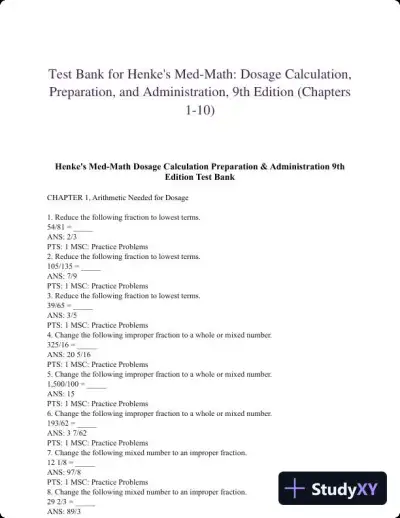 Exam Guides
Test Bank for Henke's Med-Math: Dosage Calculation, Preparation, and Administration, 9th Edition (Chapters 1-10)
Medicine
58 pages139downloadsFeb 2025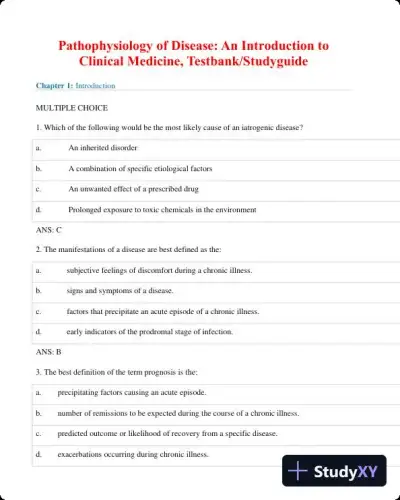 Exam Guides
Pathophysiology of Disease: An Introduction to Clinical Medicine 8th Edition Test Bank
Medicine
284 pages138downloadsFeb 2025
Study this document with CramX
Once it is in your library, every tool can work from it.