
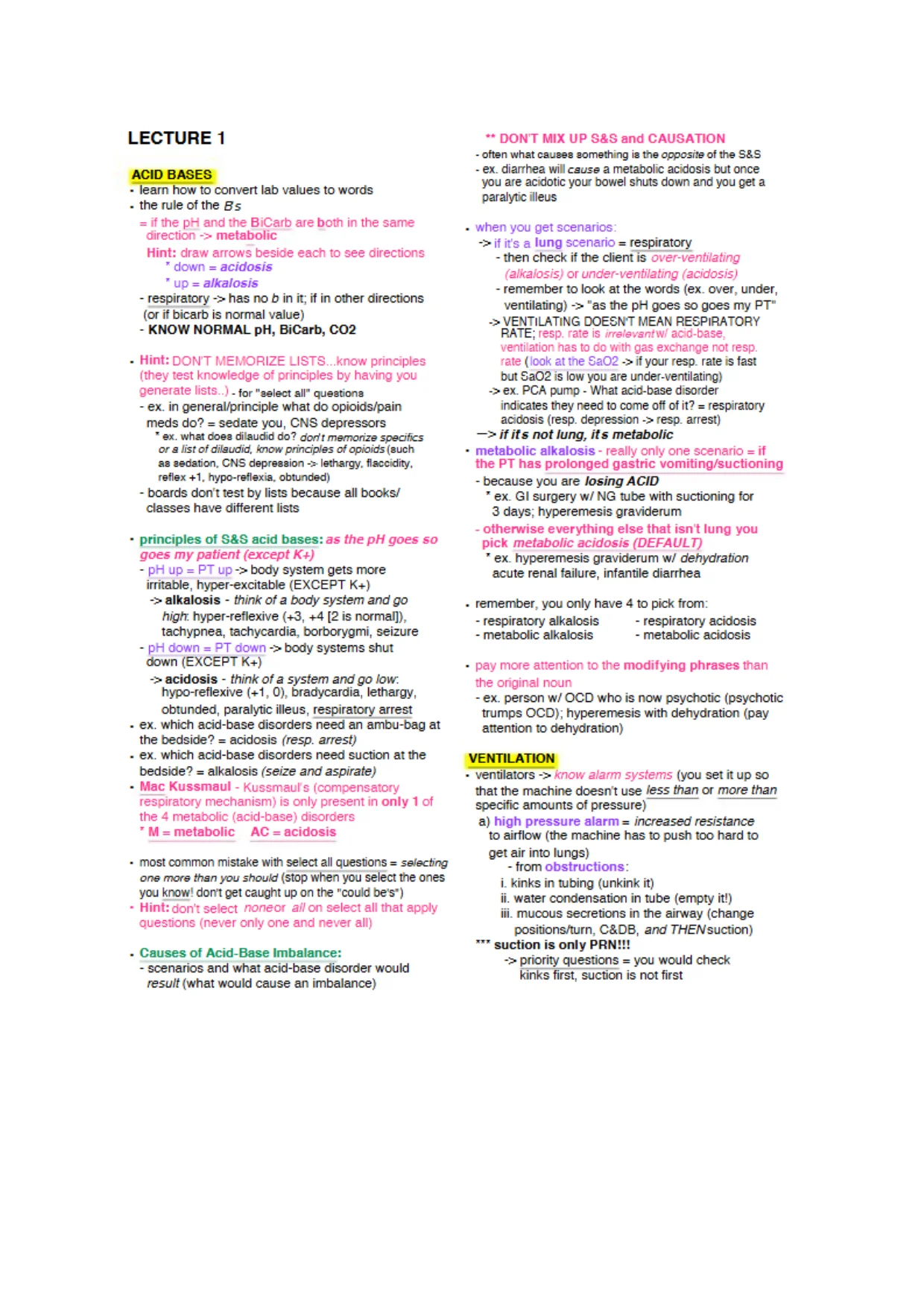
Lecture Notes NCLEX

Comprehensive NCLEX acid-base balance study guide covering principles over memorization, identifying respiratory vs. metabolic imbalances, interpreting patient symptoms, and ventilator alarms.

Alice Edwards
Contributor
4.1
39
10 months ago
Preview (12 of 38 Pages)
100%
Log in to unlock

Page 1

Lecture Notes NCLEX - Page 1 preview image

Loading page ...

LECTURE 1ACIDBASES- learn how to convert lab values to words- the rule of theB s= if the p H a n d the BiCarb are bothinthe samedirection - > m e t a b o l i cH i n t : draw arrows beside each to see directions* down =acidosis* up = afka/osis- respiratory - > has nobinit; ifin other directions(orifbicarb is normal value)- K N O W N O R M A L p H ,B i C a r b , C O 2. Hint:DON'T MEMORIZE LISTS...knowprinciples(they test knowledge of principles b y having yougenerate lists..) _fo r"select all" queBtiona- ex. in general/prindple what d o opioids/painmeds do? = sedate you, C N S depressors" ex. what coea dilaudid do? dorff memorize specificsor a list of dilaudid, know principles of opioids(suchas sedation, CNS depression -> lethargy, flacc dity,reflex +1, hypo-reflexia, obtundedj- boards dorit test b y lists because all books/classes have different lists* principles of S & Sa c i d b a s e s : a s thep H goes s ogoes m y patient (except K+)- p H u p = P T up - > body system gets moreirritable, hyper-excitable (EXCEPT K + )- > alkalosis -thrnk o fa body system and g ohigh:hyper-reflexive (+3, + 4 [2 i s normal]),tachypnea, tachycardia, borborygmi, seizure- p H down = P T down - > body systemsshutdown (EXCEPT K+)- > acidosis -ffi/nAcof a system and g o iow.hypo-reflexive (+1, 0). bradycardia, lethargy,obtunded, paralytic illeus, respiratory arrest. ex. which acid-base disorders need an ambu-bag atthe bedside? = acidosis(resp. arrest)- ex.which acid-base disorders need suction at thebedside? = alkalosis(seize and aspirate)- M a c Kussmaul -Kussmaul's (compensatoryrespiratory mechanism) is only present inonly 1ofthe 4 metabolic (add-base) disordersFM = metabolicA C = acidosismost common mistake with se ect all questions =selectingone more than you should(stop when you select tne onesyou know! don't get caught up on the "could be's')Hint:don't select rroneorail onselect all that applyquestions (never only one a n d never all).C a u s e s o f Acid-Base I m b a l a n c e :- scenarios and what acid-base disorder wouldrestrif {what would cause a n imbalance)** DON'T MIX U P S 4 S and CAUSATION- often what cajses aemelh ng is the opposite of the S&S- ex. diarrhea willcausea metabol c ac idosis but onceyou are ac dotic yourbowel shuts down and you get aparalytic illeus- when you get scenarios:- > if it's a l u n g scenario = respiratory- thencheck if the clientisover-venWatrng(atfcafosrs) o runder-ventilating (acidosis)- remember to look at the words (ex. over, under,ventilating) - > "as the p H goes s o gees m y PT"-> VENTILATING DOESNT MEAN RESPIRATORYRATE; resp. rate isirrelevsnfwlacid-base,ventilation has to co with gas excharge not resp.rate ( oak at t i e SaO2 -> il your resp. rate is fastbut SaO2 is low you are under-ventilating)-> ex. PCA pump - What acid-base disorderindicates they r e e d to come off of it? = respiratoryacidosis (resp. depression ->resp. arrest)—> if itsnot iung, i t s metabolicmetabolic alkalosis -really only one scenario = ifthe P T h a s prolonged gastric vomiting/suctio nin g- because you arelosing ACID1ex. G l surgery w f N G tube with suctioning for3 days; hyperemesis graviderum- o t h e r w i s eeverythinge l s ethat isn't lung youp i c kmetabolic acidosis (DEFAULT)* ex. hyperemesis graviderum w fdehydrationacute renal failure, infantile diarrhea- remember, you only have 4 to pick from:- respiratory alkalosis- respiratory acidosis- metabolic alkalosis- metabolic acidosis- pay more attention to the m o d i f y i n g p h r a s e s thanthe original noun- e x . person w / O C D who is now psychotic (psychotictrumps O C D ) ; hyperemesis with dehydration (payattention to dehydration)VENTILATION- ventilators - > ki'idvsysfe.ms(you set it up sothat the machine doesn t use /ess than ormore thanspecific amounts of pressure)a) h i g h p r e s s u r e a l a r m =increased resistanceto airflow (the machine has to push too hard toget air into lungs)- fromobstructions:i.kinksi n tubing (unkink it)ii.water condensation in tube (empty it!)iii. mucous secretions i n the airway (changepositions/turn C&DB,and THENsuction)suction is only PRNJI1- > priority questions = you would checkkinks first, suction is not first

Page 2

Lecture Notes NCLEX - Page 2 preview image

Loading page ...

b) low pressure alarm =decreased resistanceto airflow (the machine had to work too littleto push air into lungs)- fromdisconnections:i. main tubing (reconnect it duh!)ii. 0 2 sensor tubing (which senses FiO2 atthe airway/trach area; black coated wirecoming from machine right along thetubing - reconnect!)- ventilators-> know blood gases- resp. alkalosis = ventilation settings might beset too high (OVER-VENTILATING)- resp. acidosis = ventilation settings might b e settoo low {UNDER-VENTILATING)ex. weaning a PT off ventilator -> should not beunder-ventilated, they need the ventilator; if they areover-ventilating then they can be weaned- never pick an answer where you dent de somethingand someone else has to do something

Page 3

Lecture Notes NCLEX - Page 3 preview image

Loading page ...

LECTURE 2ABUSE(Psych and Med- Surge)Psychological Aspect/Psycho-Dynamics# 1psychological problem isthesame in any/allabusive situations= DENI AL- abusers have an infinite capacity for denial so thatthey can continue the behavior w/o answering for it- can use the alcoholism rules for any abuse- ex. # 1 psych problem i n child abuse, gambl ng'cocaine abuse a de™aJ- whyis denial the problem? HOW CAN YOU TREATSOMEONE WHO DEN1ES/DOESN T RECOGNIZETHE Y HAVE A PROBLEM- denial = refusal to accept the reality of a problemtreat denialbyCONFRONTINGtheproblem(itsnotthe same as agression which attacks the person, notthe problem) =they DENY you CONFRONT- pointing out to the person the difference betweenwhat they say and what they do- Hintnever pick answers that attack the person-> ex. bad answers have bad pronouns - "you"-> ex. good answers have good pronouns - ' I " , "we"-> ex. "you wrote the order wrong" vs. "I’m havingdifficulty interpreting what you want'- loss and grief - > for this denial you mustSUPPORTit- DABDA = den al, anger, ba'gaining, depreasion, acceptance- Hint:for questions about denial you must look to seeif itis LOSS or ABUSE- loss/grief = support- abuse = confront- #2 psychological problem in abuse =DEPENDENCY,CO-DEPENDENCY- dependency=when the abuser gets significant otherto do things for them or make decisions lor them-> thedependent = abuser- co-dependency =when the significant otherderivespositive self-esteem from making decisions for ordoingthings for the abuser-> the abuser gets a life w/o responsibilities-> the sig. other gets positive self-esteem (which iswhy they can't get out of the relationship)- how do you treat it?- set limits and enforce them-> start teaching sig. other to say N O (and theyhave to keep doing it)- must also work on the self-esteem of the co-dependent(ex. I'm a good person becauseI’msaying"no’)- manipulation= when the abuser gets the sig. otherto do things for them that are not in the best interest ofthe sig. other- the nature of the act isdangerous/harmful- how is manipulation like dependency?-> in both the abuser is getting the other person todo something for them-how do you tell the difference between manipulation& dependency?- > NEJ-RAL vs\ E3 ATI7 E (look at what they'rebeing asked to do)- > if the sig. other is being asked to do somethingneutral (no harm} its dependency/co-dependency- > if the sig. other is being asked to do somethingthat will harm them or is dangerous to them theyare manipulated- how do you treat manipulation?- set limits and enforce them-> 'NO"- easier to treat than dependency/co-dependencybecause n o one likes to be manipulated (no positiveself-esteem issue going on)ex. how many P Ts do you have w / denial? =1ex. how many P Ts do you have w / dependency/co-dependency = 2ex. how many P Ts do you have w / manipulation = 1AlcoholismWernicke s & Korsakoff's- typically separate BUT boards lumps them together- wemicke s = encephalopathy- korsakoffs = psychosis (lose touch with reality)-> tend to go together,findthem in the same PT• WernickeKorsakoff s syndrome:a} psychosis induced by Wf. B7 [Th/am/nej deficiency- lose touch w / reality, go insane because of no B1b) primary symptom ->amnesia w f confabulation- significant memory loss w / making up stories- they believe their stories• How do you deal w / these PT's?- bad way = confrontation (because they believe whatthey are saying and can't see reality)- good way= redirection(take what the PT can't doand channel it into something they can do)Characteristics ofWenicke Korsakoff's:a}its preventable =take Vit. B i (co-enzyme neededfor the metabolism of alcohol which keeps alcoholfrom accumulating and destroying brain cells)FPT doesn't have to stop drinkingb)it s arrestable=can stop it from getting worse bytaking Vit. B1ralso not necessary to stop drinkingc)its irreversible(70% of cases) - > Hint: On boardsanswer w / the majority (ex. if something is majorityof the time fatal, you say it’s fatal even if 5 % of thetime its not)Drugs for Alcoholism:DISULFIRAM (Antabuse)= aversion therapy-> want P Ts to develop aguthatred for alcohol-> interacts w/ alcohol in the blood to make you very ill- > worksin theory better than in reality- > onset &duration:2weeks(soifyou want todrink again, wait 2 weeks)

Page 4

Lecture Notes NCLEX - Page 4 preview image

Loading page ...

- P T teaching= avoid A L L forms of alcohol to avoidnausea, vomiting & possibly death-> including mouthwash, aftershaves'cologne&''perfumes(topical stuff will make them nauseous), insectrepellanls. any OTC that ends with "-elixer, alcohol-based hard sanitizers, uncooked (no-bakei icingswhich have vsmWsextract,red wine vinaig-ette- Overdoses & Withdrawals:- every abusetf drug is either an UPPER orDOWNER- > the other drugs don't d o anything- > #1 abused class of drug that is not a n upper ordowner = laxativesinthe elderlya) first establishif thedrug is anupperor downer- uppers (5) =caffeine, cocaine, PCP/LSD (psychedelichallucinogens], metharr pfiafarranes, adderol {ADD drug)" S&S -> make you go up; euphoria, tachycardia.restlessness, irritability, diarrhea, oorbo-ygmi.hyoer-refexia. spastic, seize (need suction)- d o w n e r s = don't memorize names - > anything thatis not an upper is a downer! if you don't know whatthe med is, you have a high chance that i t s adowner if i t s not part of the uppers listTS&S - > make you go cown; lethargy, resp ratorydepression (fi. arrest)ex. The PT is high on cocaine. What is critical to assess?- > N O T resps below1 2because they will b e high- > maybe check reflexesb) are they talking aboutoverdoseo rwithdrawsI- overdose/into xication =too much- withdrawal =not enough- ex. the P T has overdosed on an upper -> pick theS&S of too much upper- ex. the P T has overdosed on a downer -> pick theS&S of too much dowrer- ex. the P T is withdrawing from an uppep-> notenough uppe- makes everything go down- ex. the P T is withdrawing from a cowner -> notenough downer makes eveyth ng go up- upper overdose looks tike = downer withdrawaldowner overdose looks like = upper withdrawal- I n what 2 situations would resp. depression & arrestbe your highest priority:- downer overdose- upper withdrawal- I n what 2 situations would seizure be the biggest risk:- upper overdose- downer withdrawalAlcohol Withdrawal Syndrome vs. Delirium Tremens- they are both different! not the samea)everyalcoholic goes through withdrawal 24hrs.after they stop drinking- only a m/norifyget delirium tremens- timeframe - > 72 hrs. (alcohol withdrawal comes 1st)- alcohol withdrawal syndrome ALWAYS precedesdelirium tremens, B U T delirium tremens does notalways follow alcohol withdrawal syndromeb) A W S is not life-threatening: D T s can kill youc) PT's w.' A W S are not a danger to self/others; PT'sw / D T s are dangerous to self/others- they are withdrawing from a downer s o they willbe exhibiting upper S & S- D T s are dangerousDifferencesAWSDTinCareDietRegular c etNPO/clear lieuica(because oi risk for seizures whichcan cauae risk c i asp ration)RoomSe"- -prvatePrivate nea- nurses staticinanywhere on (dangerous A unstab e i1he unitAmbulation Up ad libRestricted bed rest - > no ba1hroc<nprivileges (use bedpans- urinals)RestraintsNo restra nts Rest-aims (because dange-ous)(because not - not aofl wrist or 4 point softdangeroua)because tnev'll gel c ut- need to be id vSat or Z-pt. lockedleathers (opposite 1 arm i. leg,rotate {J2nra,lock the f-eelinribs 1st before releasing 1helocked ones)They both get ANTI-HYPERTENSIVES &TRANOUIDZERS- because everything ia up (downer withdrawal)They both get MULTIVITAMIN w/ B lRN's can accent but RPN's can't (because PT is unstable)- on med-surge, the RN who takes them must decreasetheir workload (i.e. reduceP Tload if they take a D TPT)- > Hint:on boards, the setting is always perfect(i.e.enough staff/time/resourcesonthe unit etc.)• Drug Abuse i n the Newborn:- always assume intoxication N O T withdrawal at birth- after 24hrs- > withdrawal- ex. caring for infant of a Quaalude addicted m o m 2 4hrs. after birth, select all that apply:-> dowrer withdrawal so everything is up = exaggeratedstartle, seizing, high ptched'shrill cry

Page 5

Lecture Notes NCLEX - Page 5 preview image

Loading page ...

DRUGSAMINOGLYCOCIDESpowerful class ofantibiotics(when nothing elseworks pull these outs, the bigguns)- don't use unless anything else worksboards iove to test these drugs because they redangerous and are a test of safetythiik: A MEAN OLD MYCIN- > a mean oid =they treat serious, life-threatening,resistant, Gram-neg bacteria infections (i.e.a meanoi'dandbiotic for amean oidinfectionJ- > mycin =what they end with(allendw/-mycin)"notall-rnycin'sare aminoglycosides BUT mostare (the 3 that are not are erythromycin.azthromydn, clarithro mycin = throw rfoff the list!)• 2 toxic effects:i) when you see '-mycin , thinkmice- mice ->ears -> otto toxic-monitor hearing, tinnitus, vertgo/dizzinessii) the human ear i s shaped like akidney sonexteffect is nephrotoxicity- monitorcreatinine(notBUN, output, daily weight)'creatinine =the best indicator of kidney/renalfunction (pick 24 hrcreatinine clearance overserum creatinine if both available)- #8 (fits nicely in the kidney) reminds you about 2things about these drugs- toxic to cranial ner.'e 8 = ear nerveadminister Q8- route:- IM or IV. do not give PO -> they are not absorbedif you give an oral -mycin' it will go into gut. dissolve,go through and come out as expensive stool {won'thave any systemic effect)- EXCEPTin2 cases =bowel sterilizers:rhepatic encephaicpathy (hepatic coma) =to getammonia down, oral '-rnycin's' will sterilize thebowel by killing Gram-neg bacteria (E. coli) to helpbringdownammonia andwont harm thedamaged liver because it doesn't go through theliver (also gives diarrhea, more poopout isgood)’ pre-op bowei surgery =it sterilizes the gut bykilling the E. coli bacteria- if oral, no otto or nephro toxicity because not absorbed- these areneomycin & kanamycin* Who can sterilize my bowels? NEO KANTrough and Peak levels:- trough = drug atlowestpeak = drug athighest*' TAP Jevefc- troughadminister peak-> draw trough levels first- > administer your drug- > draw peak levels after drug administration- Why draw levels? =narrow therapeutic window- small difference between what works and what kills- if the drug has a wide range then you wouldn'tneed to draw TAP levels' ex. Lasix doses range from 5-80mg thus a widerange so you won t need TAP levelsTex. Dig doses range from 0.125 - 0.25 so thisnarrow range needs TAPS levels- A MEAN OLD MYCINS = major class that needsTAPs drawn because of narrow window- When do you draw TAPS?-> depends on the route (don't focus o n the med)a)TroughLevelsdoesn't matter which route or med. always 30 mins.- sublingual = 3 0 mins, before next dose- IV = 3 0 mins, before next dose- IM = 3 0 mins, before next dose- Sub-Q = 30 mins, before next dose- PO = 3 0 mins, before next doseb)Peak Levels"" different but depends on theroute(not the med)- Sublingual = 5-10 mins after drug is dissolved- IV = 15-30 mins after drugs isfinished infusingrHint:if you get two values that are correct (i.e. a15 min. answer and a 30 min. one)pick the highestwithout going overso 3 0 mins.- IM = 30-60 mins, after administration- Sub-Q = SEE (see diabetes lecture -> because theonly Sub-Q peaks are Insulins)- PO = forget about it, too variable so not testedThe BIG 1 0 Drugs to Know:1. psych drugs2. insulins3. anti-coagulants4. digitalis5 aminoglycosides6. steroids7. calcium-channel blockers8. beta-blockers9. pain meds10.OB drugs

Page 6

Lecture Notes NCLEX - Page 6 preview image

Loading page ...

LECTURE 3C A R DI AC- AR R Y T HM l A S- Interpreting R h y t h m Strips( 4 that need t o b e k n o w nb y sight):a) N o r m a l Sinus Rhythm= P wave before every Q R S & followed b y a Twave for every single c o m p l e x- > all P wave peaks are equally distant from e a c hother, Q R S evenly spacedb )-Fib = chaotic squiggly line, n o patternc) V-Tach = sharp peaks, h a s a patternd) A-Systole = flat-line* Terminology:- i f Q R S d e p o l a r i z a t i o n ,itstalking aboutventricular(so r u l e o u t anything atrial)- ifitsays P-wavethenits talking aboutatrial-6 Rhythms m o s t tested o n N - C L E X :1 - ' a lack of Q R S s" = A-systole- flat-line, n o Q R S2. " P - w a v e " = Atrial- if i t s a 5.vrooth wave, alwayspickatrial flutter3 . "chaotic' - A-fib if w / P-wave4. "chaotic" - V - f i b if w / Q R S- H i n t : the word chaos' i s u s e d forfibrillation5 . 'bizarre" = atrial tachycardia if w / P-wave6 . 'bizarre" = ventricular tachycardia if w / Q R S- Hint:the work 'bizarre' i s used fortachycardias- P V C s(premature ventricular contractions)= a.k.a. periodic w i d e bizarre Q R S- ventricular because Q R S- bizarre - > tachycardia-you c a n call a group o f P V C s a short run o f V-tach- d oPhysician's care about P T ' s having P V C s ?- > N O , n o t a h i g h priority = l o w priority- > 3 circumstances when you could elevate theseP T stomoderatepriority (never reach high)i.ifthere are more than 6 P V C s i n a minuteii. if there are more than 6 PVC's i n a rowiii. if the P V C fall o n the T-wave of t h e previousbeat ( R o n T phenomenon)- > most common order if you call the N D about aP T w / P V C s = D/C monitor (because then youcan t see t h e P V C s a n d then you won t call them)• Lethal A r r h y t h m i a s :- H I G H P R I O R I T Y , 2 main o n e s (will kill you i n 8 m i n so r less) - > t h e s e P T s will probably b e top prioritiesa )A-Systoleb )V-Fibboth have i n common =n oc a r d i a co u t p u t- > n o brain perfusion ( a n d yourll b e d e a d i n8 mins)-V-tach =potentiallylife-threatening (but not actuallylife-threatening), b u t still m a k e s it a fairly high priority- difference i s that these P T ' s have cardiac output- i n c o d e s , even if the rhythm changes, if there i s n ocardiac output it's just a s b a d a s the previous rhythmCardiacD R U G SC A L C I U M - C H A N N E L B L O C K E R SCalcium-Channel Blockers are like Vaiium for your headValium - > c a l m ' s you down; s o C C B s c a l m your heartdown(ex.iftachycardic, g i v e C C B sbutnotinshock)- t o R E S T Y O U RH E A R T- not stimulantscalcium-channel blockers a r enegative i n o t r o p i cchronotropic, S. d r o m o t r o p i c drugs- fancy w a y of saying that t h e y c a l m t h e heart downPOSITIVENEGATIVEInotr o p e sChronotropesDromotopesCardiac StimjlartsCardiac Depressants- stimu ate. speed- earn the heart down,up the heartweaken & slow cowh- W h e n d o youwant to' d e p r e s s " theheart? W h a t d oCCB's treat?A: anti- hypertensives- relax heart & blood vessels t o bring down B PA A : anti-angina s- relax heart t o u s e less 0 2 t o m a k e a n g i n a g o away- treats a n g i n a by addressing oxygen d e m a n dAAA: anti-atrial a r r h y t h m i a- e x . atrial flutter, A-fib, premature atrial contractions- never ventricularmwhat aboutsupra-ventricular tachycardia??- > because it m e a n s ' a b o v e the ventricles' (whichare the atria)- Side-Effects:H & H = h e a d a c h e & h y p o t e n s i o n- > hypoTN - from relaxed heart Si vessels- > headache - vasodilation t o brainH i n t : h e a d a c h e i s a g o o d thing t c s e ect for'select all that apply' questions (ex.low N a & highNa = headache, high fi. law glucose = headache, hign &low BP = headache).N a m e s o f C a l c i u m - C h a n n e l Blockers:- anything endingTiT - d ip i n e '- e x . amlodipine, nifedipine- N O T just '-pind- a l s o includes:V E R A P A M I L &C A R D I Z E M- which can b e g i v e n a s c o n t i n u o u s I V drip??= Cardizeml/Vhaf V Sneeds to b e assessed before giving a C C B ?- B P = because of risk ofhypoTN- > parameters/guidelines - hold C C B ifsystoiici su n d e r 1 0 0- > s o you n e e d t o monitor B PifP T i s o n a C a r d i z e mcontinuous drip (if its u n d e r 1 0 0 then you m a yhave t o stop or c h a n g e the drip rate)

Page 7

Lecture Notes NCLEX - Page 7 preview image

Loading page ...

- Treatment (more drugs):alPVCsb)V-tach= forventricularuse LIDOCAINE/AMIODARONE* i n rural areas mare Lidocaine use (cheaper &anger ahelf-lrte)c) Supra-Ventricular Arrhythmia s= atrial arrhythmia's use ABCDsA->ADENOCARD (Adenosine)- have to push in less than 8 seconds (FAST IVpush}-> slam this drug, followed by a flush; use ab g vein: BUT the problem w/ slamming it last isthe risk of PT going nto A-Systole (for 30 secordsbut they wiff come out of it so don't worry [unlesslonger than 30 sec...])for IV pushes: wften you oon't know you go slowB-> BETA-BLOCKERS- afl end /n'-lot- every-lol’is a BB & every BBisa-lol'- are negative inotropes, chronotropes, &dromotropes like calciumchannel blockers (a_k.a.valium for your heart so they treat A, AA, AAA &have same side-effects)" g e n e r a ly spea<irg don’: Take a big differencebetween Beta- & Calcium channel blockers;except that CCB are better for P T s w/ asthmaor COPD -> Beta-B's bronchoconstrictC ->CALCIUM-CHANNEL BLOCKERS- see Beta-Blockers & CCB's earlierD -> DIGITALIS (DIGOXIN, LANOXIN)d) V-Fib= for V-fib you D-fib(shock them!)e)A-Systole= use EPINEPHRINE &ATROPINE (inthis order!)-> if epinephrine doesn't work then use atropineCHEST TUBES- purpose is tore-establish negative pressure inthepleuralspace(so that the lung expands when thechest wall moves)- pleural space ->negative is good(negative pressuremakes things stick together)- ex. gun shot to the lung add positive pressureHint:when you get a chest tube question, look at thereason for which it was placed(will tell you what toexpect & what not to expect)- ex. pneumothorax = to remove air (because aircreated the positive pressure!- ex. hemothorax = to remove blood- ex. pneumohemothorax = to remove blcod & air* Hint:Alsc, pay attention to the tocaf/onof the tubes:alApical =the chest tube is way u p high, thus itisremoving axr(because air rises)- ex. its bad if you re apical tube is draining 200 m L oritis not bubblingb)BasiIar =at the bottom of the Iungs. thus it isremoving b loodAiquid (because of gravity)- ex. i t s bad if your basilar tube is bubbling or notdraining any m L-ax. Hoivmany chest tubes3where would you place themfor a unilateral pneumohemothorax?- 2 chest tubes (apical for pneumo, basilar for nemo)- ax. H o w manychest tubes & where would you place themfor a bi-lateral pneumothorax?- 2 tubes (apical oneft.apical on right)ax. H o w manychest tubes & where would place them farpost-op chest surgery?- 2 tubes (apical & basilar on the side of the surgery)"you are to assume that chest surgery/trauma isunilateral untess otherwise specified (theywillsay bilateral)* Trick Question:How many chest tubes would youneed and where would you place them for a post-opright pneumonectomy?- NONE! because you are removing the lung so youdon't need to re-establish any pressure (there is notpleural space)!Troubleshooting Chest Tubes:- What do you do if you knock over the plasticcontainers that certain tubes are attached to?- > set it back up & have PT take some deep breaths-> NOT a medical emergency!(don t callND)What do you do if the water seal breaks (theactual device breaks?)-> first =CLAMPit!!!because now positive pressurecan get in! don't le: anything get in-> 2nd = cut the tube away from the broken device-> 3rd = stick that open end into sterile water-> then unclamp it because you've re-established thewater seal (doesn't need clamo if its under waterbetter for the tube to be under water thanclamped! -> air can t go in and stuff can still keepcoming out (if clamped, nothing can come outwhich is what the tube is for)Ex.Ifthey ask what thefirstthing is to do if the sealbreaks -> Clamp! BUT, if they ask what's thebestthing to do -> put end of tube under water! (because itactually solves the problem, clamping is a temp, fix)- Hint:'BEST vs. FIRST questions- first questions =are about what order- best questions = what's the one thing you would doifyou couldonly do 1of the options-> ex.You notice the PT has V-fib on the monitor. Yourunto the room and they are non-responsive withno oulse. What is thefirstthing you do?A) place a backboard?B) begin chest compressions?- "first1is about order so = pick A (because youwouldn't start chest compressions first)- BUT,ifthe questionask"What s thebestthing todo?" -> you only get to do1thing not the other soyou would pick B

Page 8

Lecture Notes NCLEX - Page 8 preview image

Loading page ...

- What do you do if the chest tube gets pulled out?- first= take a gloved hand and cover the hole- test= cover the hole with vaseline gauze- Bubbling chest tubes:(ask yourself 2 questions)a) Where i s it bubbling?b) When is it bubbling?= the answer will depend on these 2 questions(sometimes bubbling is good, sometimes bad butdepends o n where & when)ex.intermittent bubbling in the water sea! -> GOOD(document it,never bad!\ex.Continuous bubbling in the water seal -> BAD(you don't want this. means a leak in the system thatyou need to find and tapeituntil it stops leaking)"in RPN scope- ex. Infermiftenf insuction control chamber -> BAD(means suction is not high enough, turnitu p on thewall until bubbling is continuous)- ex. Continuousin suction control chamber -> GOOD(document it)- Hint: bothlocations are opposites of each other(memorize one & deduce the others)> if there is a seal it should not b e continuous(ex. a sealed bottle of pop continuouslybubbling means its leaking!)- A straight catheter is to a foley catheter as athoracentesis is to a chest tube.- in-i-outvs. continuous secured- thoracentesis -> also helps re-establish neg.pressure (in-&-out chest tube)- higher risk for infections are continuousRules for Clamping Tubes:- al Never clamp a tube for more than15 secondswithout a doctors order.- so if you break the water seal -> you have 15seconds to get that tube under water- b) Userubber-tippeddoubled clamps.- the teeth of thedampneedtobe coveredw/rubber so that you don't puncture the tubeCONGENITAL HEART DEFECTS- every congenital heart defect is either TROUBLE orNO TROUBLE (ALL BAD or NO BAD)- either causes a lot of problems or its no nig deal (noin-between defect)- memorize one word:TRouBLeHeart DelectsTRouBLe (S5% o fall heart def seta)N o Tro ubleSurgeryNEED surgery nowto live- don'1 need su-ge-vnght away; pose Divneed it years later ir itcauses'a T'mubj'e(butwe don't expect it to)Growth & Dev.alow, delayednormalLife Expectancy shortnormalEarent'sExperiencinggrief, stress,tfnanc al issues, lotsregular average personissuesof caregiving issuesGoing Homeapnea monitornc apnea monitort pafjil a i Stay at weeks24-48 hoursWho FollowsYour CarePaediat-icCare olcgistPaediaticiaiLpaediat-ic NPShuntingR to L(TRouBLe)L t o RCyanosisCyanotic <= Blue(THou BLe)Acyanotic- ex. You are teaching the parents about a heart defect:- pick all the options that causetroubie• Hint:Boards will not give pictures of defects and askyou what they are.- not our job, we don't diagnose-our role is teaching parents the implications-> so f its trouble = teach them things that its goingto be a lot of trouble-> il it's not rouble = Dick the things say ng it's notgoing to be troube• There are 40+ congenital heart defects so just rememberTRouBLe (don't memorze all of them!):- Hint:all congenital heart defects thatstart w/theletter TareTroubie Defects- we don'tcare about the detect, we care about whatwere teaching the parentsAll congenital heart defect kids (trouble orno trouble)will have 2 things:a)Murmur- why? = because of the shunting of the blood(regardless of direction of shunt)bj all have anEchocardiogramdone (to find outwhat the defect is or why there's a murmur)• 4 Defects of Tetralogy of Fallout:-VarieD Pictures Of ARancH (or Valentines Day=lc<Someone Out A Red Heart)1. VD= ventricular defect2. PS = pulmonany stenosis3.OA =overriding aorta4.RH =right hypertrophy• don't have torecailthese. RECOGNIZE them- recall > remember from nothing- RECOGNIZE -> spot it when you see it (use theinitials to recognize them in questions)- ONLY DEFECT where they ask you what it is

Page 9

Lecture Notes NCLEX - Page 9 preview image

Loading page ...

INFECTIOUS DISEASE a n d TRANSMISSION B A S E DPRECAUTIONS(Isolations)- Standard- Universal- Contact- for anything e n t e r i c = can be caught from /nfesiwTe- > fecal, oral- C-Diff. Hep. A, Cholera, Dysenteryrthings with b u g s in diarrheaTHint for Hep A & B : Hep A - > think anus. Hep B - >think blood (anything from the bowsf starts w/ a vowel!- Staph infections- RSV =respiratory syncytia! virus(what babies, 1-2yr. old's get that is not dangeroustoadultsbutcanbe fatal for them)Ttransmitted b y dropletB U T stilt put them oncontact precautions because iittie kids catch itfrom touching thingsthat other sick kids touched- Herpes infections(includes Shingles - >HerpesZoster virus even though caused b y varicella)What's involved in contact precautions?- > private room ispreferred(but not required)Tor 2 R S V kids in the same roomTkeep R S V kid &suspectedR S V separatebecause you need ocsit v e cultures (not basedon symptoms}- > N O :mask, eye/face shield (unless for universal},special filter mask, P T mask, neg. airflow->YES: gloves, gown, hand-washing, specialsupplies & dedicated equipment (includes toys)"disposable supply vs. dedicated equipment:- thermometer cover- BP cuff that stays in room• Droplet- forb u g s that travel 3 feetonlarge particles duetosneezing/coughing- allmeningitis" cultured through lumbar puncture- H Flu (haemophilus influenzaB ) - > commonlycausesepigiotitis’ never stick something down throat becauseit willcause obstructionWhat's involved in droplet precautions?- > private room ispreferred(but not required)Ton boards select privateTcan also cohort based onpositive cultures- > N O :gown, eye/face shield, special filter mask.neg. air flow- > Y E S : mask, gloves, hand-washing, P T wornmask (when leaving room), disposable supplies& dedicated equipment- Airborne- M-M-R; T B : varicella (chicken pox)- W h a t s involved in airborne precautions?- > private room isrequiredrunless co-horting- > N O :gown (mostly for contact}, eye/face shields- > YES: mask, gloves, hand-washing, special-filtermask ONLY for TB, P T mask for leaving room(but really shouldn't be leaving), neg. air flowdisposable supplies & dedicated equipment i s agood thing but not really a s essential a s i n theother 2 (can let this one slide)- > TB: technically transmitted via dropletB U Tputo n airborne- P P E = Personal Protective Equipment- boards like to test how you put o n or take off-always t a k e i t off in alphabetical order- > ex. gloves, goggles, gown, mask- p u t t i n g o n is reverse alphabetically for the 'g s' &mask comes 2nd- > gown., mask, goggles, gloves

Page 10

Lecture Notes NCLEX - Page 10 preview image

Loading page ...

LECTURE 4CRUTCHES. CANES, WALKERSmajor area of human function islocomotions o they testthese even though not a major emshasis i n school- area to test P T teaching & risk reductionCrutches:- Howd o youmeasure crutches?need to know for risk reduction - > so you don'tcause nerve damagea)lengtho fcrutch =2-3 finger-w dths belowanterioraxillary fold to a point lateral to & si ghtly in front of the foot-> many questions ask where you measure fromfto (so forcrutches, if they ask anything measuring Tarn ax Ila tofoot -> rule out. they're wrong instructions for length)b)hand grip =can be adjusted up & down; when properlyplaced,shouldoeapx. 3 0 degrees elbow hexion• How to teachcrutchg a i t s (4 kinds}T" names are pretty obvious w / a few exceptionsa) 2-point- move acrutch and opposite foottogether followedby other crutch & opposite foot- moving 2 things togetherb) 3-point- moving2 crutches &fhebad legtogether- moving 3 things togetherc) 4-point- movingeverything separately- move any crutch, then opposite foot, followed b ynext crutch then other foot- very slow but very stabled) Swing-through- fornon-weight bearinginjuries (ex. amputations)- plant crutches and swing the injured limb through(never touches down)- W h e n d o they use them?ask yourself "how m a n y legs are affected?- even for even, odd for oddTeven point gaits when a weakness is evenlydistributed (i.e. even # of legs messed up)- 2-point =mildproblems (bilateral)- 4-point = severe problems (severe, bilateralweaknesses)- 3-point = onjy odd one, when only 1 leg i s affected.Ex.Eady stages of rheumatoid arthritis =2-pointEx. Left, atovB the fcnea amjMJtatrcvj = swing-throughEx. Frrafday post-op right knee replacement, partial weight-bearing allowed=3-pointEx. Adyancsd stages of ALS = 4-pointEx. Left L.'p replacement,2nd day post-op, non weight-hearing= swing-throughEx. BWsieraf totai' fcnae repfac&mefft,1st day post-op. weight-bearing allowed=4-poinlEx. ®/aHera/ totai' knee replacement, 3 weeks post-op = 2 point• Going up & down stairs:- up with the good, down with bad- crutches move with the bad legCains:* hold the cain o n thestrong side- a lot of people use it the wrong wayWalkers:- pick it up, set it down, walk to it• if they must tie their belongings to the walker, tie it atthe sides, not the front- boards doesn't li<e things on the front (even tno mostpeop e do that anyways: they dont like wheels or tennisball on the bottom either)

Page 11

Lecture Notes NCLEX - Page 11 preview image

Loading page ...

ex- person storingstawall &says:see abomtf ->hallucination0 X- personlooksstfire extinguisher on the wall and says:" Isee sbornff -> illusion (referent)Hint:O n the test, they will tell you that there issomething there thus, you can differentiate between ahallucination & an illusion.How do you deal with these Psychotic Symptoms?- first thing you ask after determining if PT is psychotic:What is their problem?—> what kind of psychosis do they have?- 3 Types of Psychosis:1. Functional Psychosis- c a n .ricf/c,'! i/t everyday v e (i e. have obs amarriage, etc.}- 4 diseases:SchizoSchizoMajor Manicsi.Schizophreniaii.Schizoaffective Disorderiii. Major Depression (if i t s major, test will say)iv. Manic (Acute)-> so bi-polar is functional, only psychoticduring manic phase-these PTs have the potential to learn reality(because no damage)-> may need medsorset boundariesforstructure- > nurse role = teach reality {4 steps}a)acknowledge feeling-> -|s e eyou're angry;'You seem upset', "Tell me how you are feeling',often uses the wcrd feeling or shows a feelingb)PRESENT REALITY ->"I know that those voicesare real to youbut Idon't hear them" or tellingthem what is real ("I'm a nurse & this is a hospital")c)seta limit-> "That topic/behaviorisoff-limits’,"Weare not going to talk about that right now",' Stop talking about that"d)enforce the limit-> "I see you're too ill to stayreality based s o our convo is over"(endingtheconversationNOTtaking away a privilege [Te.punishment]; continuing to talk may enforce thenon-reality)" " on the test, they won't ask these specific steps butinstead, will ask "how should the nurse respond...”" "try to pick the morepositive statements (i.e.whatthey can have,'do, not what they cant); if between2 statements go w/ the positive one- 2. Psychosisof Dementia-psychosis because of acfua/ damage to f/?e bra.'inTin Functional Dementia, there is no brain damage:its just messed up chemicals- include P Ts w / Alzeimer's, psychosis after a stroke,organic brain syndrome; anything w / " senile" or"dementia"-cannot learn reality-> major difference from functional (which is whyyou have to determine type of psychosis)DELUSIONS, HALLUCINATIONS, & ILLUSIONS (Psych)Neurosis Non-Psychotic vs. Psychosis* Hint:thefirst thingyou have to do to get a psychquestions correct is decide: 'Is m y PT non-psychoticor psychotic?"= this will determine treatment, goals, prognosis,medication, length of stay, legalities., everythingNON-PSYCHOTICPSYCHOTICDefinitionHas n o insight & isnotrealit y-basea- qon't think.'know their aick- th nk everyone e ae naathe problem bjt not them(bla™"e anyone eee)- even if they Bay they re,sick but tnen trrey aay themartiana made them sickthey oont nave insightood therapeuticHimun caton coea notwork beca jee they are- RMRfifle,specificstrategies- good therapeutic- qCommunication Hikecany P T that displaysocod comm, skilieithere s n d h ngspec al tnat youTieecto do,'know,compareato any med-su'de.paetfe, or OB PTDELUSIONS,HALLUCINATION,ILLUS ONS- cnlv in Dsvchotc PTs- as scon sra they get anyof these they’ve crossed,the line to Be ng peycnoticHasinsight1. isneality-bpeed- eventt!emotonaldistreas/illness,mentabbenavio'aldisorder- reaogn ze what theproblem a and howit afiecls their lifeTreatment/TechniquesSymptomsdon't have delusions,hallucinations, o-illusionsPsychotic Symptoms:. a} Delusions= false, fixed, idea or belief; n osensory component(all in the brain,, thinking it)i.Paranoid Delusions-> people are outtoharm m e- ex. the mafia are our to get meii.Grandiose Delusions - >you are superior or youare the world s smartest jreatest person- ex. thinking you are Christ, Genghis Khaniii.Somatic Delusions-> about a body part- ex. x-ray vision; there are worms in my bodyb)Hallucinations= a false, ’ xeo, sensory experience (pure y sensory):5 senses so 5 for (1 for each sense}i. Auditory _>heaping things that aren’t thepe (primarilyvoices telling you to hurt yourself); most commonii. Visual -> seeing; 2nd most commoniii. Tactile -> feeling things; 3rd most commoniv.Gustatory ->tasting things that are not thepev. Olfactory -> smelling things that are not thereTast 2 are relatively rape- c) Illusions= misinterpretation of reality,sensory experience- difference from hallucination ->with an illusion thereis areferent in reality-> referent= something in reality towhicha personrefers when they say something (theyjustmisinterpretit)ex.FT says:*! heardemon i/rwcss -> halluc nationex. P T ovrerfiearera/rses£MUs laughing & talking st the nursd sstation & says:*1Listen,i hear oemor. voices' ->ill- s o r (thereta a referent)

Page 12

Lecture Notes NCLEX - Page 12 preview image

Loading page ...

-> nurse role:al ac/mowJ'ecfgefeelingblREDIRECT them-> from something they can tdo to something they can doyou dont set-limits because i t s meanNOT APPROPRIATE to present reality to thesePT's when they are experiencing psychoticsymptoms (BUT don't confuse this w/ realityorientation)-> important to remember that forgetting things (likewhere they are or what room they're i n - P T s w /dementia/Alzheimers) is NOT psychosiswhen they start having delusions, halucirations orillusions, then they are psychotic-> reality orientation = telling them person, place,and time (ALWAYS APPROPRIATE w/DEMENTIA) - this deals w / memory3. Psychotic Delirium= atemporary,sudden, oramatic, episodic,secondary loss of reality; usually due to somechem/cai' irnbaiance in the bodyFdifferent because it's temporary and very acute- > include PT's that are short-term psychotic becauseof something else causing the psychosis- ex. a crug reaction, high on uppers or withdmwingfrom cowners (delirium tremens), cocaine overdose,post-oppsychosis (withdrawing from a dowrer). ICUpsychosis (sensory deprivation), UTl (or any occultinfection), tnyro d storm, adrenal crisis- good thing is it's temporary s o focus is removingthe underlying cause & keeping t h e m safe-> nurse role:al acknowledgefeelingbl REASSUREthem:it s temp. & they'll be safe"" don't present reality -> they won t get it"don't redirect -> not going to work* Personality Disorders are differentA = artsocialB = bopcerlineN = narcissisticvery sick personality disorders" may be gooc to use Functional Psychosistechniques because you set limits- Narrowed Self Concept=when a psycnofc refuses >:leave the i roari orchange their clothes-functional psychotic- #1 reason is because their definition of self isnarrowed - > defined self based o n 2 things:i. Where they areii. What they are wearingso they dbrf fknow who they are unless they arewearing those exact clothes in that exact room- as the nurse, don't make them change or leave theroom (will cause escalating panic because they willlose their concept of self)Tuse the Functional Psychosis techniques- Ideas of Reference= think everyone is ta k ng abcut you- ex. see someone on the news and get upsetbecause you think they are talking about you- can have both paranoia & ideas of reference(paranoia if also think they are going to harm you)Other Psychotic Symptoms:- Loosening of Association= your thoughts aren't wrapped too tight, all over the mapal Flight of Ideas- coherent phrases but the phrases are notconnected (not coherent together)b) Word Salad- sicker, can t even make a coherent phrase-> babble random wordsc) Neologism- making up imaginary words
Preview Mode

This document has 38 pages. Sign in to access the full document!