

Matching Supply with Demand: An Introduction to Operations Management 3rd Edition Class Notes
- Operations Management
- 13 pages
- Shared May 2025
Use Matching Supply with Demand: An Introduction to Operations Management 3rd Edition Class Notes for quick access to lecture summaries and ensure you have all the essential information for exams.
Preview 4 of 13 pages
See the first 4 pages exactly as they appear in the document.
Page 1 Read page 1 as text
1 Matching Supply with Demand: An Introduction to Operations Management 3 rd Edition by Gerard Cachon and Christian Terwiesch This document describes our pedagogical strategy, summarizes the materials provided along with the text to aid instructors (i.e., instructor materials), details our copyright policy regarding the instructor materials, and provides a brief description of how we use the text in our own teaching (e.g., cases, preparation questions, etc.) Pedagogical strategy: Our guiding philosophy with the design of this text is “real operations – real solutions ” : we provide real company cases and real solutions to their operational challenges while presenting the material in a manner that non - engineering student can understand. In fact, we also like the expression “rigor with relevance” : we do not shy away from rigorous mathematical analysis but our analysis is always focused on relevant operational problems. Our primary target audience is students in MBA degree programs (daytime, weekend or executive). Even though the models we present are quite rich (e.g., they allow for different objective functions and different performance measure evaluations) we find that MBA students are capable of mastering this material and they appreciate that the course has not been “dumbed down”. In fact, we find that both “quant jocks” and “poets” enjoy the course. Because the text emphasizes models and the qualitative insights from those models, we find that junior professors are successful in the MBA classroom even with their limited experience. Finally, we suspect that the text will work quite well with business or engineer undergraduate students. The following is a list of our design features that make this text a useful teaching tool: 1. Multiple levels of detail . Each chapter walks students through a case analysis i n great detail. But we find that students sometimes want a quick “how do I do X” solution, so we provide exhibits within the chapter that explain to students the steps need to do a particular calculation. Furthermore, at the end of each chapter and at the end of the text there are lists of key equations for when students remember the process to do the calculation but can’t remember the particular equation details. 2. Little mathematical notation . S tudents do not have the time or the desire to remember the meaning of many different mathematical symbols or variables. So in many cases we write out variable names so that there is no confusion, e.g., it is clear what “Expected Sales” means. 3. Plenty of practice problems . S tudents learn by repetition. So we provide enough practice problems to satisfy even the most eager student.
Page 2 Page 3 Read page 3 as text
2 4. Presentation slides linked to the text . We find that the less quantitatively oriented students appreciate our in class lectures that cover examples from the text, because then they can read the text latter for additional explanations and reinforcement. Some of the quantitatively strong students would prefer less redundancy, but when we consider the needs of all students, the redundancy is a net winner. 5. Excel spreadsheets . We give students spreadsheets that perform the analysis of many of the models. Students that are able to absorb this material quickly and need to minimize their time on the course appreciate these tools. 6. Statistics Tutorial. Students do not always receive the statistics they need from their statistics course. (For example, at our school the Poisson distribution is never mentioned in the statistics core class.) So we provide a statistics tutorial in the appendix that gives the students exactly the statistics they need for this text. 7. Advanced materials . Some students, the “quant jocks”, often want to know how equations are derived. To satisfy their curiosity, we provide that supplemental information in the Appendix. Summary of Instructor Materials: 1. Lecture slides . (Power Point files). These are slides that we use in our course. Many contain references to cases and problems in the text, but there is additional content as well. 2. Solutions to all end - of - chapter problems in the text . ( Word files ). 3. Text figures . (Power Point). These files contain the figures that are used in the text (and may not be contained in the lecture slides). 4. Case materials . We use a number of cases along with the text in our course and have prepared materials associated with the cases, e.g., data students can use to answer preparation questions, case analysis slides, etc. 5. Model solvers . We have developed several Excel spreadsheets that help students solve several of the model discussed in the text. 6. Supplementary questions . We provide questions beyond those at the end of each chapter, including both quantitative and qualitative questions. We have used these questions in final exams and homework assignments . All of our homework and final exams are multiple choice with no partial credit. We have had a very positive experience using this testing format: students find the format to be fair, grading errors are minimized (in particular, there is no need to train graders on how to offer partial credit), grading ambiguities are minimized (students with short answer questions can be strategic in how they answer even if they do not know the answer), grading time is very quick and question development does not require much more time than typical qualitative or quantitative questions. 7. Sample syllabi . These syllabi are from our courses that use the text and include course policy, timetables, case preparation questions, etc.
Page 4 Read page 4 as text
3 Copyright policy: All instructor materials that are not included in the actual text are copyrighted by the authors, Gerard Cachon and Christian Terwiesch. Instructors that adopt the text as a requirement for their course are free to use these materials and to modify them as they see fit. All others are required to obtain explicit written permission from the authors. Suggested course outline: In our own teaching we u se the text in 24 sessions (divided between two courses, each with 12 sessions) and each session is 80 minutes of class time. The following are the cases we use and the chapters that contain materials associated with those cases: Chapter Case Topic 2 - 4 Toshiba : OME works (HBS 9 - 696 - 059) Process analysis 2 - 4 National Cranberry (HBS 9 - 688 - 122) Process analysis 7 Executive Shirt (HBS 9 - 696 - 071) Process analysis (with batching) 8 - 9 Beau Ties (UVA - om - 0836) Queuing 8 - 9 Manzana Insurance (HBS 9 - 692 - 015) Queuing, process design 1 2 Le Club Francais (Wharton case) or LL Bean (HBS 983 - 003) Newsvendor m odel 1 3 Timbuk2 (Wharton case) or National Bicycle (Wharton case) Newsvendor model , reactive capacity 1 3 Sport Obermeyer (HBS 9 - 695 - 022) Reactive capacity 1 4 Hewlett - Packard (Stanford) Order - up - to model, delayed differentiation 1 5 Barnes and Noble vs Amazon.com (HBS 9 - 798 - 063) Risk pooling 1 6 We do not use a case. Revenue management 1 7 Barilla (HBS 9 - 694 - 046) Supply chain coordination, bullwhip effect 1 7 Video Vault (HBS 9 - 102 - 070) Supply chain contracting The following outlines the sequence in which we present the material. The first set of 12 sessions covers process analysis, quality , and lean manufacturing. The second set covers inventory and supply chain management .
9 more pages in the full document
Unlock it once and it stays in your library, ready to chat with or turn into flashcards.
Unlock the full documentMore Operations Management study materials
See all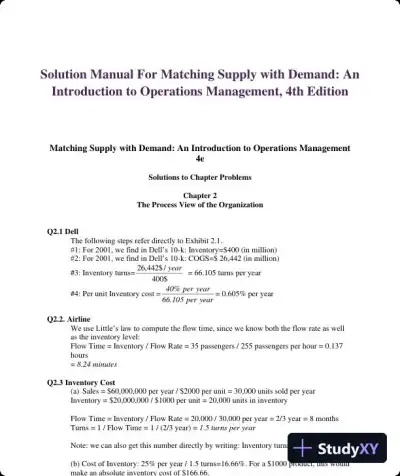 Textbook Guides
Solution Manual For Matching Supply with Demand: An Introduction to Operations Management, 4th Edition
Operations Management
76 pages36downloadsFeb 2025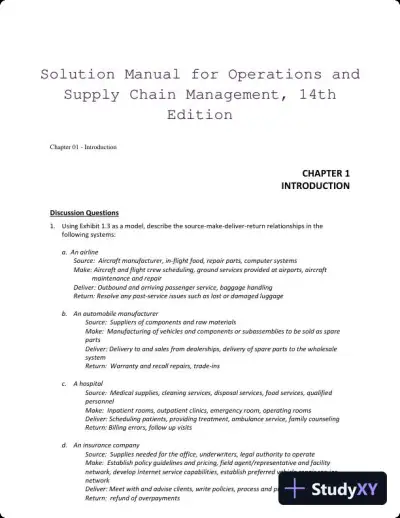 Textbook Guides
Solution Manual for Operations and Supply Chain Management, 14th Edition
Operations Management
342 pages133downloadsFeb 2025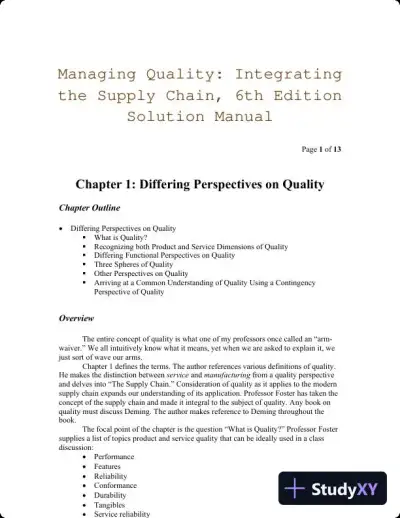 Textbook Guides
Managing Quality: Integrating the Supply Chain, 6th Edition Solution Manual
Operations Management
262 pages115downloadsFeb 2025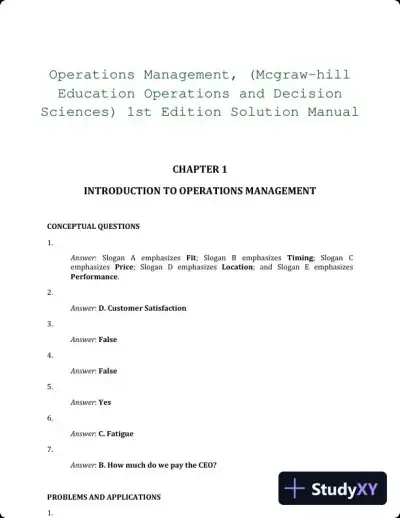 Textbook Guides
Operations Management, (Mcgraw-hill Education Operations and Decision Sciences) 1st Edition Solution Manual
Operations Management
153 pages91downloadsFeb 2025 Exam Guides
Operations Management, 5th Canadian Edition Test Bank
Operations Management
1208 pagesMay 2025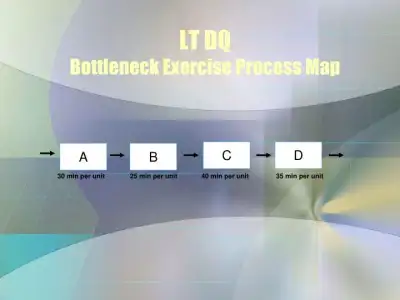 Class Notes
LT DQ Bottleneck Exercise Process Map
Operations Management
1 pageMay 2025 Textbook Guides
Solution Manual for Introduction to Materials Management, 8th Edition
Operations Management
44 pagesMay 2025 Solved Assignments
Analysis of Economic Order Quantity (EOQ) and Production Order Quantity (POQ) Models for Inventory Management
Operations Management
4 pagesMay 2025
Study this document with CramX
Once it is in your library, every tool can work from it.