

NR565 Pharmacology Midterm Exam With Answers (150 Solved Questions)
- Pharmacology
- Chamberlain College of Nursing
- 15 pages
- Shared May 2025
NR565 Pharmacology Midterm Exam With Answers helps you understand complex topics using past exam questions.
Preview 5 of 15 pages
See the first 5 pages exactly as they appear in the document.
Page 1 Read page 1 as text
1 / 15 Advance Pharmacy NR565 MIDTERM 1. ·· Which schedule drugs can APRNs prescribe?: Schedule II - V 2. · Who determines and regulates prescriptive authority?: Nurse practitioner scope of practice is determined by state practice and licensure laws. 3. · How does limited prescriptive authority impact patients within the healthcare system?: limited authority creates problems for the patient. The patient is not able to get the care they need 4. · What are the key responsibilities of prescr ibing?: 1. Be prudent and deliberate in your decision - making process 2. Have a documented provider - patient relationship with the person for whom you are prescribing 3. Do not prescribe medications for family or friends or for yourself 4. Document a thorough history and physical examination in your records 5.Include any discussions you have with the patient regarding risk factors, side effects, or therapy options 6. Have a documented plan regarding drug monitoring or titration, if applicable 5. · What should be used to make prescribing decisions?: 6. Pharmakinetiscs and Pharmodynamics of older adults: drug accumulation secondary to reduced renal function polypharmacy (the use of five or more medications daily) greater severity of illness presence of comorbidities use of drugs that have a low therapeutic index (e.g., digoxin) increased individual variation secondary to altered pharmacokinetics inadequate supervision of long - term therapy poor patient adherence 7. : 8. · Beer's Criteria: • potentially Inappropriate Medication (PIM ) use in older adults • PIM use in older adults due to medication - disease or medication - syndrome interactions that may exacerbate the disease or syndrome • medications to be used cautiously in older adults • clinically significant drug interactions that shoul d be avoided in older adults • medications to be avoided or dosage decreased in the presence of impaired kidney function in older adults (American Geriatric Society Beers Criteria Update Expert Panel, 2019)
Page 2 Page 3 Read page 3 as text
2 / 15 9. CYP450: Many medications are metabolized through t he liver enzyme system called cytochrome P450 (CYP450). Metabolization can be inhibited or induced by drugs and once this happens drug - drug interactions can occur. 10. VISA credit card dept Inhibits Spending on CK and GQ: Valproate I - soniazid S - ulfamids A - mio darone C - hloramphenical Ketoconazole G - rapefruit Juice Q - uinidine 11. CYP450 Inhibitors: - Decreases the CYP450 which keeps the medication in your body longer which can cause toxicity 12. CYP450 INDUCERS: Increase CYP450 to work faster causes Drugs to leave your body faster. 13. Inducers for PY450 Chronic Alcholics Steal Phen Phen and Never Refuse Greasy Carbs: Chronic Alcoholics St. Johns Wort Phenytoin Phenobarbital Nevirapine Refiampin Griseofalvin Carbamazepine 14. · What happens when someone has a poor metabolism phenotype?: Metabolizes to slow or to fast. 15. How is absorption of intramuscular medication different in neonates?: -
Page 4 Read page 4 as text
3 / 15 • Slow and erratic due to low blood flow in muscles first few days of life 16. • Why is absorpti on of medication in the stomach increased in infancy?: - Delayed gastric emptying (adult values reached by 6 - 8 months) 17. What are some medications that should be avoided in the pediatric patient?: glucocorticoids, discoloration of developing teeth with tetracyclines, and kernicterus with sulfonamides 18. • What should be included in medication administration patient education?: 1. dosage size and timing 2. route and technique of administration 3. duration of treatment 4.drug storage 5.nature and time course of desired responses 6. nature and time course of adverse responses 19. • What are some of the Physiologic changes that occur in the body when a woman is pregnant that can change the pharmacodynamic and pharmacokinetic properties of many drugs?: - Increased GFR= Increased drug excretion - Increased hepatic metabolism for some drugs. - Decreased tone and mobility of bowel - Increased drug absorption. 20. • During what trimester is a pregnant woman most at risk for adverse drug reactions with potential long - term conseque nces?: 1 trimester 21. • What are some medications that we know to be teratogenic?: • Antiepileptic drugs, antimicrobials such as tetracyclines and fluoroquinolones, vitamin A in large doses, some anticoagulants, and hormonal medications such as diethylstilbestr ol (DES). 22. • How can we as healthcare providers decrease the likelihood of a elderly patient experiencing an adverse drug reaction?: • - obtaining a thorough drug history that includes over - the - counter medications • considering pharmacokinetic and pharmacodyna mic changes due to age • monitoring the patient's clinical response and plasma drug levels • using the simplest regimen possible • monitoring for drug - drug interactions and iatrogenic illness • periodically reviewing the need for continued drug therapy • encouraging the patient to dispose of old medications • taking steps to promote adherence and to avoid drugs on the Beers list
Page 5 Read page 5 as text
4 / 15 23. Why do Nitrates need to be taken no later than 4 pm?: Need nitrate free interval so tolerance doesn't develop 24. • What are the nine factors that impact the outcome of medication according to Rosenthal & Burcham?: • Gender and race • Genetics and pharmacogenomics • Variability in absorption • placebo effect • Tolerance • patho • age • bodyweight 25. • What is the difference between NP practice autho rity and prescriptive authority?: Practice authority refers to the nurse practitioner's ability to practice without physician oversight, whereas prescriptive authority refers to the nurse practitioner's authority to prescribe medications independently and without limitations. 26. • Who regulates prescription authority?: The regulation of prescriptive authority is under the jurisdiction of a health professional board. This may be the State Board of Nursing, the State Board of Medicine, or the State Board of Pharm acy, as determined by each state. Although the federal government controls drug regulation, it has no control over prescriptive authority. 27. • What is scope of practice determined by?: Nurse practitioner scope of practice is determined by state practice and l icensure laws. 28. • What is full - practice authority?: Nurse practitioners have the autonomy to evaluate patients, diagnose, order and interpret tests, initiate and manage treatments and prescribe medications, including controlled substances without physician o versight. 29. • What is reduced practice authority?: Nurse practitioners are limited in at least one element of practice. The state requires a formal collaborative agreement with an outside health discipline for the nurse practitioner to provide patient care. 30. W hat is restricted practice authority?: Nurse practitioners are limited in at least one element of practice by requiring supervision, delegation, or team management by an outside health discipline for the nurse practitioner to provide patient care.
10 more pages in the full document
Unlock it once and it stays in your library, ready to chat with or turn into flashcards.
Unlock the full documentMore Pharmacology study materials
See all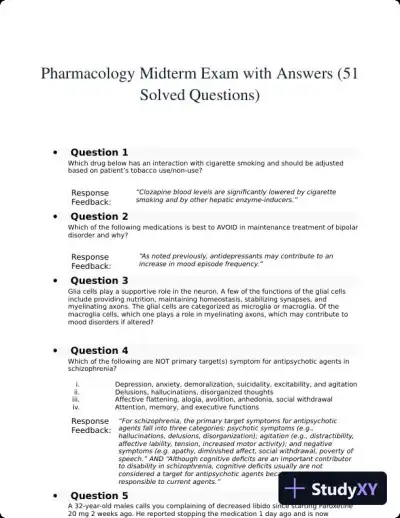 Past Exams
Pharmacology Midterm Exam with Answers (51 Solved Questions)
Pharmacology
10 pages140downloadsFeb 2025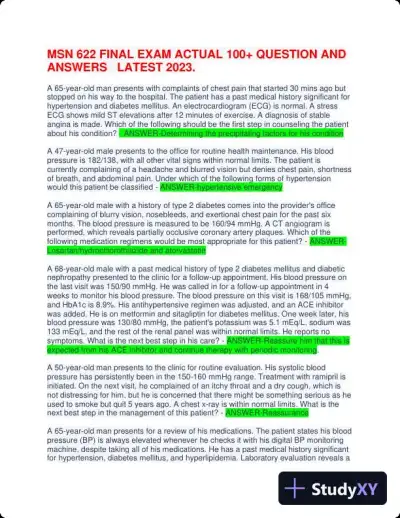 Past Exams
2023 MSN622 Final Exam with Answers (117 Solved Questions)
Pharmacology
21 pages139downloadsFeb 2025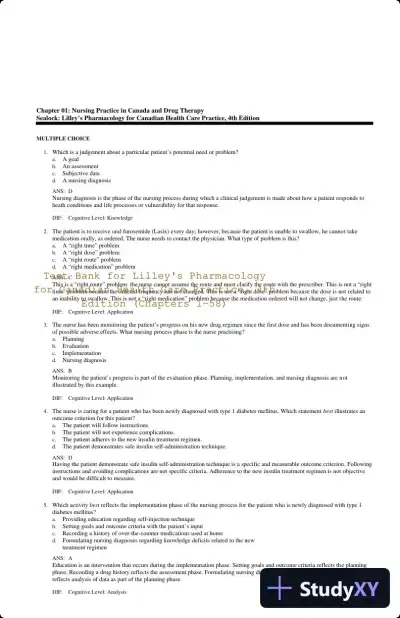 Exam Guides
Test Bank for Lilley's Pharmacology for Canadian Health Care Practice, 4th Edition (Chapters 1-58)
Pharmacology
133 pages131downloadsFeb 2025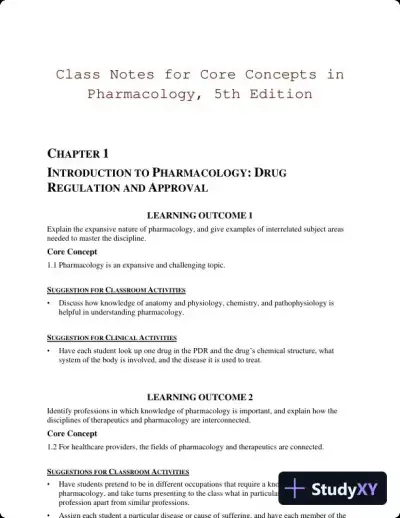 Class Notes
Class Notes for Core Concepts in Pharmacology, 5th Edition
Pharmacology
163 pages128downloadsFeb 2025 Exam Guides
Stahl's Essential Psychopharmacology: Neuroscientific Basis and Practical Applications 4th Edition Test Bank
Pharmacology
121 pages123downloadsFeb 2025 Past Exams
2024-2025 MN553 Advanced Pharmacology Final Exam with Answers (94 Solved Questions)
Pharmacology
28 pages104downloadsFeb 2025 Exam Guides
Pharmacology For Nurses: A Pathophysiologic Approach , 4th Edition Test Bank
Pharmacology
1193 pages102downloadsFeb 2025 Past Exams
MN553 Final Exam Quiz with Answers (97 Solved Questions)
Pharmacology
28 pages102downloadsFeb 2025
Study this document with CramX
Once it is in your library, every tool can work from it.