

Barron's Physics Practice Plus: 400+ Online Questions and Quick Study Review (2022)
- Physics
- 322 pages
- Shared May 2025
Prepare confidently with Barron's Physics Practice Plus: 400+ Online Questions and Quick Study Review (2022), offering structured revision tests to reinforce key concepts.
Preview 16 of 322 pages
See the first 16 pages exactly as they appear in the document.
Page 1 Read page 1 as text
BARRON'S Phvsics YySI Practice Plus WITH QUICK REVIEW GUIDE ROBERT JANSEN, M.A. anp GREG YOUNG, MSS. + studyxy
Page 2 Read page 2 as text
Downloaded from StudyXY.com ® + StudyXY Sd Ye. o> \ | iF ’ pr E \ 3 S Stu dy Anything This ContentHas been Posted On StudyXY.com as supplementary learning material. StudyXY does not endrose any university, college or publisher. Allmaterials posted are under the liability of the contributors. wv 8) www.studyxy.com
Page 3 Read page 3 as text
Scan now : i red to access practice included with this book, or go to online.barronsbooks.com BARRON'S
Page 4 Read page 4 as text
Physics Practice Plus
Page 5 Read page 5 as text
About the Authors Robert Jansen Robert Jansen has taught Advanced Placement Physics at Aliso Niguel High School in Aliso Viejo, California, since 1998. He holds a bachelor’s degree in psychobiology from the University of California, Los Angeles, and a master’s degree in education from Pepperdine University. He gravitated toward teaching physics because of the challenging material and a sustained belief that physics does not need to be mysterious and difficult but rather can be comprehensible and achievable. The result has been a large and competitive physics program where each year more than 220 students participate in the AP Physics 1 and AP Physics C courses. The overarching goal is preparedness and confidence for students who will be studying science during their undergraduate years. Greg Young Greg Young has been teaching high school science for more than twenty years. He currently teaches Honors Physics, AP Chemistry, and Chemistry at San Clemente High School in San Clemente, California. He holds a bachelor’s degree in biochemistry from the University of California, San Diego, and a master’s degree in science education from USC. Having always been interested in science and how to make it relevant to others, Greg’s interest in teaching lies in being able to create interactive lessons that engage students in their learning and form a relevant context for difficult concepts in physics and chemistry. Science made interesting is science worth learning.
Page 6 Read page 6 as text
© Copyright 2022 by Kaplan North America, LLC, dba Barron’s Educational Series. Content in this book was previously published in a different format under the title SAT Subject Test in Physics. Published by Kaplan North America, LLC, dba Barron’s Educational Series 1515 West Cypress Creek Road Fort Lauderdale, FL 33309 www.barronseduc.com All rights reserved under International and Pan-American Copyright Conventions. By payment of the required fees, you have been granted the non-exclusive, non-transferable right to access and read the text of this eBook on screen. No part of this text may be reproduced, transmitted, downloaded, decompiled, reverse engineered, or stored in or introduced into any information storage and retrieval system, in any form or by any means, whether electronic or mechanical, now known or hereinafter invented, without the express written permission of the publisher. 10987654321 ISBN: 978-1-5062-8153-7
Page 7 Read page 7 as text
How to Use This Book CHAPTER 1: CONVENTIONS AND GRAPHING Fundamental and Derived Units Graphing Variables Slope and Area Interpreting Graphs CHAPTER 2: VECTORS Coordinate System Scalars Vectors Vector Mathematics CHAPTER 3: KINEMATICS IN ONE DIMENSION Kinematic Quantities Kinematic Equations Kinematic Graphs CHAPTER 4: KINEMATICS IN TWO DIMENSIONS
Page 8 Read page 8 as text
Independence of Motion True Velocity and Displacement Relative Velocity Projectile Motion Projectiles Launched at an Angle CHAPTER 5: DYNAMICS Inertia Force Common Forces Force Diagrams Newton’s Laws of Motion Solving Force Problems CHAPTER 6: CIRCULAR MOTION Uniform Circular Motion Dynamics in Circular Motion Angular Velocity CHAPTER 7: ENERGY, WORK, AND POWER Mechanical Energy Work Power Conservation of Energy CHAPTER 8: MOMENTUM AND IMPULSE
Page 9 Read page 9 as text
Momentum Impulse Conservation of Momentum Energy in Collisions CHAPTER 9: GRAVITY Universal Gravity Gravitational Field Circular Orbits Kepler’s Laws CHAPTER 10: ELECTRIC FIELDS Charge Electric Fields Uniform Electric Fields Electric Fields of Point Charges CHAPTER 11: ELECTRIC POTENTIAL Potential of Uniform Fields Potential of Point Charges Electric Potential Energy Motion of Charges and Potential Capacitors CHAPTER 12: CIRCUIT ELEMENTS AND DC CIRCUITS Principal Components of a DC Circuit
Page 10 Read page 10 as text
DC Circuits Heat and Power Dissipation CHAPTER 13: MAGNETISM Permanent or Fixed Magnets Current-Carrying Wires Solenoids and Electromagnets Force on Moving Charges Force on Current-Carrying Wires Electromagnetic Induction CHAPTER 14: SIMPLE HARMONIC MOTION Terms Related to SHM Oscillations of Springs Oscillations of Pendulums Graphical Representations of SHM CHAPTER 15: WAVES Traveling Waves Mechanical Waves Electromagnetic Waves Doppler Effect Superposition and Standing Waves CHAPTER 16: GEOMETRIC OPTICS
Page 11 Read page 11 as text
Ray Model of Light Reflection Refraction Thin Lenses Spherical Mirrors CHAPTER 17: PHYSICAL OPTICS Diffraction Interference of Light Polarization of Light Color CHAPTER 18: THERMAL PROPERTIES Thermal Systems Thermal Energy Temperature Thermal Expansion Ideal Gases Heat and Heat Transfer Heating and Cooling CHAPTER 19: THERMODYNAMICS Internal Energy Energy Transfer in Thermodynamics Energy Model Summarized
Page 12 Read page 12 as text
First Law of Thermodynamics Entropy Second Law of Thermodynamics CHAPTER 20: ATOMIC AND QUANTUM PHENOMENA Development of the Atomic Theory Energy-Level Transitions Ionization Energy/Work Function Photoelectric Effect CHAPTER 21: NUCLEAR REACTIONS Nucleons Subatomic Particles Isotopes The Strong Force Mass-Energy Equivalence Radioactive Decay Fission and Fusion CHAPTER 22: RELATIVITY Special Theory of Relativity Time, Length, and Mass INDEX
Page 13 Read page 13 as text
How to Use This Book Barron’s Physics Practice Plus is designed to offer essential review of key topics and loads of online practice to help you excel in physics. Online Practice Access more than 400 questions in online quizzes arranged by topic for customized practice! All questions include answer explanations. What Will You Learn in the Book? Key review and topics are covered so you can study the essentials needed to succeed. Learning objectives are listed at the start of each chapter. This list of key ideas will help guide your learning and study plan and allow you to easily return to topics that you want to review again. Tips are given throughout the book to offer helpful notes, reminders, and strategies to improve your learning.
Page 14 Read page 14 as text
CHAPTER 1 Conventions and Graphing Learning Objectives In this chapter, you will learn how to: © Review the fundamental metric units (SI units) and some of the derived metric units (SI units) used in physics ° Determine the dependent and independent variables of a graph > Explain the importance of slope and area to a graph Fundamental and Derived Units The fundamental metric units (SI units) in physics cover the basic quantities measured, such as length, mass, and time. The units measure a quantity and are given a unit name and symbol. Table 1.1 lists the fundamental quantities along with the unit names and symbols. TABLE 1.1 Fundamental Quantities and Units Quantity (Symbol) Unit Name Symbol Length (I) Meter m Mass (m) Kilogram kg Time (£) Second s
Page 15 Read page 15 as text
Derived units are combinations of one or more of the fundamental units. Table 1.2 lists common derived units used in physics. TABLE 1.2 Derived Units Unit Unit Quantity (Symbol) Name Symbol Fundamental Units Density (p) Density kg/m? kg/m? Frequency (f) Hertz Hz VUs=s71 | Force (F) Newton N kg + m/s? | Energy (E) Joule J Nm = kg + m%/s? Power (P) w J/s = kg + m?/s? Pressure (P) Pascal Pa N/m? = kg/m « s2 Electric charge (q) Coulomb [¢} Ass Electric potential (V) Volt \% J/C=J/A*s=kg*m¥A-sd It is important to know which units correctly belong to a specific quantity. An easy way to do this is to write out the principal formula for the quantity and then replace each variable on the right side of the equation with its unit symbol. There may be more than one correct answer including the unit symbol, other derived units, and fundamental units. For example, all of the following are correct ways to express units of energy: J, N « m, and kg * m?/s? EXAMPLE 1.1 Study
Page 16 Read page 16 as text
Derived Units The unit of force is the newton. What are the fundamental units that make up the newton? WHAT’S THE TRICK? Write down the foundational formula for force. 2 F=ma Replace the variable symbols with their matching units. Force is measured in newtons, N. Mass is measured in kilograms, kg. Acceleration is measured in meters per second squared, m/s2. N=kg- m/s? . . Graphing Variables The graphing techniques of mathematics are used in science to compare dependent and independent variables. In mathematics, you are familiar with the traditional x- and y-coordinate axes. In science, the x-axis represents the independent variable and the y-axis represents the dependent variable. The value of the dependent variable depends upon the independent variable. Graphs are always titled so that the dependent variable is listed first, and the independent variable is listed second. As an example, a position versus time graph would have position (dependent variable) plotted on the y-axis and time (independent variable) plotted on the x-axis. Slope and Area Slope Slopes are very important in physics. Slope is determined by dividing the rise (y-axis value) by the run (x-axis value). The trick is to look at the units written on the axes of the graph. If you divide these units, you can easily + StudyXY
306 more pages in the full document
Unlock it once and it stays in your library, ready to chat with or turn into flashcards.
Unlock the full documentMore Physics study materials
See all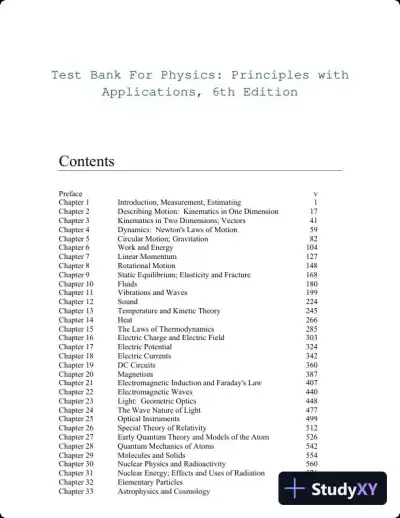 Exam Guides
Test Bank For Physics: Principles with Applications, 6th Edition
Physics
606 pages160downloadsFeb 2025 Textbook Guides
Solution Manual for Modern Physics, 2nd Edition
Physics
187 pages141downloadsFeb 2025 Class Notes
Class Notes for Financial Accounting, 10th Edition
Physics
208 pages139downloadsFeb 2025 Textbook Guides
Solution Manual for Physics: for Scientists and Engineers with Modern Physics, 3rd Edition
Physics
1291 pages136downloadsFeb 2025 Textbook Guides
Solution Manual for E and M TIPERs Electricity And Magnetism: Electricity And Magnetism Tasks: Inspried By Physics Education Research, 1st Edition
Physics
257 pages118downloadsFeb 2025 Textbook Guides
Solution Manual for Financial Accounting, 10th Edition
Physics
1061 pages107downloadsFeb 2025 Exam Guides
Test Bank for Conceptual Physics, 12th Edition
Physics
581 pages71downloadsFeb 2025 Textbook Guides
Solution Manual For College Physics With Masteringphysics, 7th Edition
Physics
536 pages37downloadsFeb 2025
Study this document with CramX
Once it is in your library, every tool can work from it.