

Solution Manual for Modern Physics, 2nd Edition
- Physics
- 187 pages
- Shared February 2025
- 141 downloads
Get immediate access to clear and precise solutions with Solution Manual for Modern Physics, 2nd Edition.
Preview 31 of 187 pages
See the first 31 pages exactly as they appear in the document.
Page 1 Read page 1 as text
INSTRUCTOR SOLUTIONS MANUAL MODERN PHYSICS S E C O N D E D I T I O N RANDY HARRIS University of California, Davis
Page 2 Page 3 Read page 3 as text
iii Contents 2. Special Relativity 1 3. Waves and Particles I: Electromagnetic Radiation Behaving as Particles 31 4. Waves and Particles II: Matter Behaving as Waves 41 5. Bound States: Simple Cases 55 6. Unbound States: Obstacles, Tunneling and Particle - Wave Propagation 76 7. Quantum Mechanics in Three Dimensions and the Hydrogen Atom 92 8. Spin and Atomic Physics 115 9. Statistical Mechanics 132 10. Bonding: Molecules and Solids 151 11. Nuclear Physics 166 12. Fundamental Particles and Interactions 178
Page 4 Read page 4 as text
1 CHAPTER 2 Special Relativity 2.1 According to Anna, if clocks at the train’s ends sent light signals when they read noon, the signals would reach Anna together somewhat after noon. According to Bob outside, the signals must start at different times, so that both reach the moving Anna together. The clocks read noon at different times according to Bob. 2.2 She decides to turn on the lights simultaneously. According to her, light signals leave her brain together and reach her hands simultaneously, so her hands act simultaneously. According to Bob outside, the light signal heading toward her trailing hand will reach that hand first, for the hand moves toward the signal. This hand acts first. The signal heading toward her front hand has to catch up with that hand, taking more time and causing that hand to act later. 2.3 By symmetry, if an observer in S sees the origin of frame S´ moving at speed v , an observer in S´ must see the origin of S moving at the same speed. 2.4 (a) Slower. (b) Later. (c) Ground observers must see my clock running slowly, so their clock at Y must be ahead. I don’t see clocks X and Y as synchronized, so when I pass by X, the clock at Y certainly does not read zero, so even though it does run slowly according to me, it might (must) nevertheless be ahead of mine when I pass it. 2.5 If it passes through in one frame, it must do so in all others. Moving parallel to the ground is an issue of simultaneity. If you are “on the disk,” the plate has both x - and y - components of velocity and it will not be equal distances from the ground at the same time — it will be slanted. If slanted, the disk can pass through it without collision. 2.6 Physical laws are not the same if you are not in an inertial frame. If you are in an accelerating frame, you know it, no matter what others may be doing. Objects in your frame would appear to change velocity without cause. The physical laws are always obeyed for the observer in the inertial frame, but not for the twin who turns around. There is an asymmetry. 2.7 No, clocks run at different rates no matter how low the relative velocity, though considerable total travel time might be required before a significant effect is noticed. 2.8 I am inertial, so I must see this moving clock running slowly. Each time the space alien passes in front of me I will see his clock getting further and further behind. Passing observers always agree on the readings of local clocks, so he will agree that his clock is getting further and further behind — that my clock is running faster than his. He is in a frame constantly accelerating toward me, so according to him, my clock is continuously “jumping ahead,” as in the Twin Paradox. 2.9 Sound involves a medium, and three speeds — wave, source, and observer — relative to that. Light has no medium. The only speeds are the relative velocity of the source and observer, and of course the speed of light.
Page 5 Read page 5 as text
Chapter 2 Special Relativity 2 2.10 First, for a massive object, E = mc 2 is incomplete. If something is moving, it is E = u mc 2 , which would invalidate the argument. Second, some things have energy and no mass, so if any of these are generated, the energy and mass of what remains could change. 2.11 No, for if we consider a frame in which the initial object is at rest, kinetic energy clearly increases, so mass would have to decrease. 2.12 No, for if we consider a frame in which the final object is at rest, kinetic energy clearly decreases, so mass would have to increase. 2.13 Yes, of course. We could consider a frame in which it is either at rest or moving, giving different values for KE. No, for mass/internal energy is the same in any frame of reference, so the change in mass is the same, and so the corresponding opposite change in kinetic energy must be the same. 2.14 Yes, if it loses internal energy — in whatever form it may be taken away — it loses mass. 2.15 No, the light was emitted in a frame that, relative to me, is moving away, so I see a longer wavelength (a very slight change). The observer at the front waits longer to see the light, so a greater relative velocity is involved, and thus a larger red shift. Simply turn the bus up on end and let gravity accomplish the same thing. 2.16 No electron travels from one side of the screen to the other. Nothing that can have any information about the left - hand - side of the screen moves to the right - hand - side. The events (electrons hitting phosphors) are all planned ahead of time, and have no effect upon one another. 2.17 v ≥ 1. Classical mechanics applies when v << c , and v = 1. At what speed will v be 1.01? 2 2 1 1 − v c = 1.01 0.14 c 2.18 Inserting x´ = – vt´ and x = 0 into (2 - 4) yields – vt´ = 0 + Bt and t´ = 0 + Dt . Dividing these equations gives – v = B / D . I nserting x´ = ct´ and x = ct into (2 - 4) yields ct´ = Act + Bt = At ( c – v ) or t´ = At (1 – v / c ) and t´ = Cct + Dt = t ( Cc + A ). Setting these two equations equal gives A (1 – v / c ) = Cc + A or C = – v / c 2 A . 2.19 If I am in frame S and say that the post in S´ is shorter, then my saw will not slice off any of the post in frame S´, but the saw in frame S´ will slice off some of the post in my frame S. An observer in frame S´, where the relative speed (if not direction) is the same, would also have to say that the post in the “other frame,” frame S, is shorter. Therefore, the saw in frame S will slice off some of the post in frame S´. This is a contradiction. Thus, the posts cannot be contracted in either frame. The same argument would work if we supposed that the post in the “other frame” were elongated rather than contracted. 2.20 Your time is longer. t you = v t Carl → 60s = 2 1 1 (0.5) − t Carl t Carl = 52s 2.21 L = L 0 2 2 1 − v c → 35m = L 0 2 1 (0.6) − L 0 = 43.75m 2.22 Let Anna be S , Bob S. It is simplest to let t = t = 0 be the time when Anna passes Earth. According to Bob, the explosion event occurs at x = 5ly, t = 2yr.
Page 6 Read page 6 as text
Instructor Solutions Manual for Harris, Modern Physics , Second Edition 3 According to Anna, x = v ( x − v t ) = ( ) 2 1 (5ly) (0.8 )(2yr) 1 (0.8) − − c = 5.67ly , and t = v 2 − + v x t c = 2 2 1 0.8 (5ly) 2yr 1 (0.8 ) − + − c c c = − 3.33yr . Negative!? How can this be? To gain some appreciation of the Lorentz transformation, let’s see how involved it is to solve the problem without it. According to Bob : The planet explodes at t = 2yr. At this time, Anna will have moved (0.8 c ) (2yr) = 1.6ly. Bob sees a distance between Anna and Planet Y of 3.4ly and a relative velocity between Anna and the light from the explosion of 1.8 c . So the light from the explosion will reach Anna in another t = 3.4ly/1.8 c = 1.89yr — at the time, according to Bob, of 2 + 1.89 = 3.889yr. The distance he no w sees between Anna and Planet Y (or the center of the debris) is 5ly − (0.8 c ) (3.889yr) = 1.889ly. Meanwhile he will have seen less time go by on Anna’s clock: 2 1 (0.8) − 3.889yr = 2.33yr. According to Anna : The distance Planet Y is from h erself when she receives the bad news will be shorter: 2 1 (0.8) − 1.889ly = 1.133ly. The big question: If Planet Y moves toward Anna at 0.8 c , and the light from the explosion moves toward Anna at c , how long will it take for the light to get 1.133ly in front of the planet? The relative velocity between Planet Y and the light from the explosion is 0.2 c , and 0.2 c t = 1.133ly t = 5.667yr. If Anna’s clock reads 2.33yr when she gets the bad news, and it took 5.667yr for the news to reach her, the explosion must have occurred at t = − 3.33yr. The problem is a good example of two events that occur in a different o rder in two frames of reference. The explosion (one event) occurs before Anna and Bob cross (another event) according to Anna, but after according to Bob. 2.23 Let Anna be S , Bob S. The flash of the flashbulb is the event in question here. We seek Bob’s time. We know that it is 100ns 27ns, i.e., either 127ns or 73ns. 2 v v t x t c = + = 2 2 1 0.6 100ns 1 (0.6 ) c x c c + − = 0.75 c x + 125ns. If x is positive (Anna’s arm is stretched out in the positive direction), then it must be 127ns. La ter. We might be tempted to use time dilation to answer this, but care is necessary. There is no doubt that the wristwatch on Anna’s hand reads 100ns when the flash goes off. But Bob will not agree that it reads zero when Anna passed him. It is set back a bit according to Bob (like the front clocks in Example 2.4). Thus, Bob sees slightly more than 100ns go by on the wristwatch. Time dilation would then give the time Bob sees go by on his own: slightly more than 0.6 (100ns) = 125ns. (b) Now knowing that t must be 127ns, we can solve for x , the location in Anna’s frame where the flash occurs (i.e., her hand). 127 10 − 9 s = 8 0.75 3 10 m/s x + 125 10 − 9 s x = 0.8m . (A reasonable arm length.) 2.24 Bob, stan ding in the barn/S, sees a length L = 2 2 1 / − v c L . 10ft = 2 2 1 / (16ft) − v c v = 0.78 c . (b) The observer stationary in the barn. Pole − vaulter Anna, S , will never agree that the pole fits in all at once; the barn is shorter than 10ft! (c) We seek t , knowing that, according to a barn observer, the ends of the pole are at the doors simultaneously, i.e., t = 0, and that the distance between these events is 10ft = 3.048m. 2 1 2 1 2 1 2 ( ) ( ) − = − − + − v v t t x x t t c = 2 2 1 0.78 (3.08m) 0 1 (0.78 ) − + − c c c = − 1.27 10 − 8 s .
Page 7 Read page 7 as text
Chapter 2 Special Relativity 4 Why negative? Since we chose x 2 − x 1 as positive, it must be that the front of the pole reaching its door is Event 2, the back reaching its door Event 1. The answer shows that the front time is a smaller time; it occurs earlier, as it must. Ac cording to the pole − vaulter/S , front leaves before back enters . 2.25 0.8c = 2 1 1 (0.8) − = 5 . 3 Bob sees Anna’s ship contracted to 100m/ v = 100m/ 5 3 = 60m, so Bob Jr. will have to be at x = 60m . (b) We seek t , knowing x , x , and t . 2 = − + v v t x t c = 8 5 0.8 (60m) 0 3 3 10 m/s − + = − 2.67 10 − 7 s . 2.26 Calling the front light Event 2, Anna frame S , ( ) ( ) 2 1 2 1 2 1 2 − = − + − v v t t x x t t c = 2 (60m) 0 + v v c . Since this is positive, the front time i s the larger (later), so back light must go on first. (b) 40 10 − 9 s = 2 2 2 1 (60m) 1 / − v c v c → ( ) 2 2 9 1 / (40 10 s) − − v c 2 c 2 = ( v 2 / c 2 ) (60m) 2 → (40 10 − 9 s) 2 (3 10 8 m/s) 2 = ( ) 2 2 9 2 8 (60m) (40 10 s) (3 10 m/s − + v 2 / c 2 v / c = 0.196 2.27 Bob and Bob Jr. see a 25m − l ong plane. L = L 0 / v → 25m = 40m 2 2 1 / − v c v c = 0.781 (b) If zero on Anna’s clock is the front of her spaceplane (where Bob is), then the time at the back occurs at x = − 40m, as well as at x = − 25m and t = 0. 2 = − + v v t x t c = 8 2 1 0.781 ( 25m) 0 3 10 m/s 1 (0.781) − − + − = 1.04 10 − 7 s. A positive number. Sensible. Back enters after front leaves. (c) We know that t = 104ns (“at this time”) and x = 0 (Bob’s location), and seek x . x = v ( x + v t ) → ( ) 8 7 2 1 0 (0.781 3 10 m/s)(1.04 10 s) 1 (0.781) − = + − x x = − 24.375m. The front of her ship is the origin, so 24.375m sticks out. Note: “at this time”, observers at the back ( x = − 40m) and at x = − 24.375m, i.e., 15.625m apart in Anna’s frame, see the ends of Bob’s hangar. This is correct: An na should see a hangar length of L = 25m/ v = 25m 2 1 (0.781) − = 15.625m.
Page 8 Read page 8 as text
Instructor Solutions Manual for Harris, Modern Physics , Second Edition 5 2.28 Since Bob moves to the right, let’s make his frame S . Thus, we seek times in frame S. v = 2 → 2 2 1 1 / − v c = 2 3 2 = v c . The clock at the back of Anna’s ship is presently at x = 1 2 L 0 . (It is also at x = L 0 .) Bob looks at this clock at t = 0 on his own clock. Call this Event a. With x a = 1 2 L 0 , t a = 0, we may find t a , the time in An na’s frame. 2 = + a v a a v t x t c 0 3 2 1 2 0 2 = + L c = 3 2 c L 0 . The clock at the center of Anna’s ship is at x = 1 4 L 0 (rather than 1 2 L 0 ) in Bob’s frame. The time on this clock, t b , will therefore simply be half the previous result. t b = 3 4 c L 0 . 2.29 If it takes light 40ns to travel half the length of Bob’s ship, then: 1 2 L 0 = (3 10 8 m/s)(40 10 − 9 s) L 0 = 24m . (b) The origins are at the center. We know that the event at x = 12m (i.e., the front of Anna’s ship) and t = − 24ns occurs at t = 0. 2 = + v v t x t c → 9 2 0 (12m) ( 24 10 s) − = + − v v c v c = 0.6c . (c) 0.8c = 2 1 5 4 1 (0.8) = − . Logicall y, at the initial instant, if the front clock says − 24ns, the back has to say +24ns. Now consider Anna’s origin at t = 20ns. 2 = + v v t x t c → 20 10 − 9 s = 8 5 0.6 0 4 3 10 / − + t m s t = 16 10 − 9 s. Agrees. Another route: If 20ns passes for Bob, h e must see less time pass on the clock’s in Anna’s frame. Since v = 5 1 4 0.8 = , he must see 80% as much time pass, and 80% of 20ns is 16ns. Similarly, Bob must see 16ns pass on all of Anna’s clocks as diagram shows. At t = 40ns, Bob must see that 80% of 40ns, 32ns, has passed on Anna’s clocks as shown. Finally, 80ns for Bob must show 80% of 80ns, or 64ns, pass on Anna’s clocks. 2.30 It is tricky to use time dilation to relate readings on two different clocks moving relative to you. You wou ld never agree that the gas station clocks were synchronized. However, gas station observers (S) watch a single clock (yours, S ) and must observe time dilation. When you get to the second station, observers there must see your clock as having registered l ess time than in their frame: the gas station clock must be ahead .
Page 9 Read page 9 as text
Chapter 2 Special Relativity 6 (b) In the frame of the gas stations, t = 900m/20m/s = 45s. t = v t → 45s = 8 2 1 (20 / 3 10 ) − t t = ( ) 1 8 2 2 1 (20 / 3 10 ) (45s) − 8 2 1 1 (20 / 3 10 ) (45s) 2 − = 45s − 10 − 13 s. Yours is behind by 10 − 13 s . Another route: Time zero is you (S ) passing first station. What would an observer in your frame and abreast the second station at t = 0 (it’s a long bus) see on the second station’s clock? x = 900m, t = 0 t = ? 2 0 = − + v v x t c → 8 2 20m/s 0 (900m) (3 10 m/s) = − + v t t = 2 10 − 13 s. According to you, then, the second station’s clock is ahead of the first’s by 2 10 − 13 s. Now, you do see less time pass on those clocks than on your own — 10 − 13 s less — but this will still leave the s econd station’s clock ahead of yours by 10 − 13 s when you get there. Yet another route: What t will your clock read when you pass the second station, at x = 900m, t = 45s? 2 = − + v v t x t c = 8 2 8 2 1 20m/s (900m) 45s (3 10 m/s) 1 (20 / 3 10 ) − + − ( ) 8 2 13 1 1 (20 / 3 10 ) 2 10 s 45s 2 − + − + = 45s − 2 10 − 13 s + 1 10 − 13 s − 2 10 − 26 s 45s − 1 10 − 13 s, i.e., 10 − 13 s behind. 2.31 According to those on the ground, this is simple classical mechanics: a speed and distance according to a ground observer are used to find a time according to a groun d observer. Let’s call the ground frame S. t = 6 8 4 10 m 0.8 3 10 m/s = 1.67 10 − 2 s. There are two ways to find the time on the spaceplane — time dilation, or length contraction. Time dilation : The ground observer will see more time pass on his clock th an on the plane. His is t , the plane’s t . (Note: 0.8c = 1.67) t = v t → 1.67 10 − 2 s = (1.67) t t = 0.0100s. Length contraction : The plane observer sees a different coast − to − coast distance. He sees L = 2 6 1 (0.8) (4 10 m) − = 2.4 10 6 m. Ho w much time will it take a 2,400m object to pass at 0.8c? Classical mechanics: t = 6 8 2.4 10 m 0.8 3 10 m/s = 0.0100s. The clock seen on the plane from the ground will be 0.0167s − 0.0100s = 0.0067s behind . But how can it be behind if the people on th e plane must see time on ground clocks passing more slowly? Should they not see the ground clocks behind? Assuming the plane and ground clocks read zero as the plane started across the country, the plane clock will indeed be behind the ground clock on the other coast, just as we calculated. The people on the plane will by no means agree that the clock on the far coast was synchronized, that it read zero when the plane started across country (relative simultaneity). In fact, they will say that it was signifi cantly ahead, so that, even though they “see” less time pass on this far − off clock, they will agree that it is ahead when they pass it. 2.32 Passengers see a 5km - long object shrunk to L = L Rest / v = 2 5km 1 (0.8) − = 3km. If the ends of this object ar e at the train’s ends simultaneously (according to observers on the train), the train must be 3km long. (b) Look at it from the ground’s point of view, the train is not 5km long; it’s not even 3km long, but L = L Rest / v = 2 3km 1 (0.8) − = 1.8km. Surely the back end will pass its station before the front end passes its, so the front station is the more current information. No reason to slow down.
Page 10 Read page 10 as text
Instructor Solutions Manual for Harris, Modern Physics , Second Edition 7 (c) From the ground point of view, the train travels 5km – 1.8km = 3.2km from the time the employee at the back sees his sign to the time the conductor sees his: t = dist/speed = 3.2 10 3 m / (0.8 3 10 8 m/s) = 13.3μs . 2.33 According to the muons, the distance from the mountaintop to sea level is 2 1910m 1 (0.9952) 187m. − = According to a muon, this distance would pass in 7 8 187m 6.26 10 s 0.626 s 0.9952 3 10 m/s − = = . 0.626 / 2.2 0 0.75. − = = N e N And 395 0.75. 527 = 2.34 We may “work in either frame”. Muon’s frame : = 2.2 s. Distance to Earth is shorter: 4km 2 1 (0.93) − = 1.47km. t = 8 dist 1, 470m speed 0.93 3 10 m/s = = 5.27 10 − 6 s. 0 N N = e − (5.27/2.2) = e − 2.4 or 9.1% . Earth frame : Distance to Earth is 4km. Lifetime is longer. 2 2.2 1 (0.93) − s = 5.99 s. t = 8 dist 4, 000m speed 0.93 3 10 m/s = = 1.43 10 − 5 s. 0 N N = e − (14.3/5.99) = e − 2.4 or 9.1% (b) = 2.2 s. t = 8 dist 4, 000m speed 0.93 3 10 m/s = = 1.43 10 − 5 s. 0 N N = e − (14.3/2.2) = e − 6.5 or 0.14% 2.35 According to observers on the plane, these two events occur at the same location. Their times differ by t 0 . 0 2 2 1 / = → − t t v c ( ) 1 2 8 2 0 1 (420 / 3 10 ) (10s) = − t ( ) 8 2 1 2 1 (420 / 3 10 ) (10s) − = 10s − 9.8 10 − 12 s. The plane’s clock will read 9.8ps earlier . May also solve in plane frame, where 4.2 km is contracted. 2.36 L = 2 2 1 / − v c L → 50m − 0.1 10 − 9 m = 2 2 1 / (50m) − v c . Must use the approximation, since v / c is apparently small. ( ) ( ) 1 2 2 2 1 + − v c 1 − 2 2 1 2 v c . 50m − 0.1 10 − 9 m = 2 2 1 1 (50m) 2 − v c 0.1 10 − 9 m = 2 2 1 2 v c (50m) v = 2 10 − 6 c = 600m/s . 2.37 There are two equivalent routes. First : Anna doesn’t see a distance of 20ly, but rather a length − contracted one of 20ly/ , and it p asses in twenty years of her life, so its speed is v = 20ly / 20yr v = v c . Solving, v c = 2 2 1 − v c or 2 2 v c = 1 − 2 2 v c or v = 1 2 c .
Page 11 Read page 11 as text
Chapter 2 Special Relativity 8 Second : From Bob’s perspective, Planet Y is 20ly away. But Bob, seeing Anna age twenty years, must, owing to time − dilation, see more time go by on his own clock: v 20yr. Anna’s speed is thus v = 20ly 20yr v = v c . Same equation. 2.38 The plank has moved to a different frame, frame S . The length along the x − axis is L x = L o cos 0 , and along the y − axis it is L y = L o sin o . An observer in S will see the x − leg contracted, but not the y . L x = L x / v = L o cos o 2 2 1 / , − v c and L y = L y = L o sin o . L = 2 2 + x y L L = ( ) 2 2 2 2 2 2 0 0 cos 1 sin . − + o o L v c L But sin 2 o = 1 − cos 2 o . L = L o ( ) ( ) 2 2 2 2 cos 1 1 cos − + − o o v c = L o 2 2 2 1 ( )cos . − o v c As the angle o goes from zero t o 90º, the length of the plank to an observer in S goes from L o 2 2 1 − v c (simple length contraction) to merely L o (no contraction perpendicular to axes of relative motion). Now, tan = y x L L = 2 2 sin cos 1 − o o o o L L v c = tan o 2 2 1 1 − v c = tan o . As the speed increases, the angle seen by an observer in S increases. This makes sense in view of the fact that the faster the relative motion, the shorter the x − component of the plank will be. The y − co mponent doesn’t change, so the angle is larger. 2.39 If it can pass through according to one observer it must be able to pass through according to the other! There cannot be a collision in one frame and not in the other! It’s just a matter of when . One argument is that its dimensions perpendicular to the direction of relative motion don’t change — its height is the same in either frame, so it cannot hit. Another argument is that while Bob sees a plank and doorway at the same angle , Anna, at rest with respect to the plank, sees a plank at a smaller angle, 0 . She also sees a wall moving toward her, contracted along the direction of relative motion and therefore at a larger angle than the seen by Bob. The top will pass through fir st! Let’s say that the bottom passes through at time zero on both clocks. According to Bob, the top will also (simultaneously) pass through at time zero: t = 0. It can’t according to Anna! The top passing through (an event) occurs at t = 0 and at x = L 0 co s 0 . Find t . 2 = + v t x t c → 0 0 2 0 cos = + v v L t c t = − 2 v c L 0 cos 0 . According to Anna, in frame S , the top passes through 2 v c L 0 cos 0 earlier . This adds up! We know that Anna sees a sma ller angle than Bob. If it passes through at once according to Bob, the top must pass through first according to Anna. If it does not go through all at once according to Anna, it can indeed be larger than the “hole”.
Page 12 Read page 12 as text
Instructor Solutions Manual for Harris, Modern Physics , Second Edition 9 2.40 We have a speed and time according to the lab and wish to know a distance according to that frame. distance = (0.94 3 10 8 m/s)(0.032 10 − 6 s) = 9.02m . (b) If the experimenter sees 0.032 s pass on his own clock, he will see less pass on the clock glued to the particle. t = 2 1 (0.94) − t → 0.032 s = 2 1 (0.94) − t t = 0.011 s . (c) Length con traction. According to the particle, the lab is 2 1 (0.94) (9.02m) − = 3.08m long. Let’s see, if 3.08m of lab passes by in 0.011 s, how fast is the lab moving? 6 3.08m 0.011 10 s − = .94 c . It all fits! 2.41 According to Earth observer, muon “lives ” longer. t = 0 2 2 1 / − t v c = 2 1 1 (0.92) − 2.2 s = 2.55(2.2 s) = 5.61 s. Dist = speed time = (0.92 3 10 8 m/s)(5.61 10 − 6 s) = 1,549m . 2.42 According to an observer in the lab, the pion survives t = 2 2 26ns . 1 − v c But moving a distance of 13m at speed v , this time must also be t = 13m v . Thus: 2 2 26ns 1 / − v c = 13m v → v 8 2.6 10 s 13m − = 2 2 1 / − v c → 8 5 10 m/s v = 2 2 1 / − v c → 2 8 2 (5 10 ) v = 1 − 2 8 2 (3 10 ) v v = 2.57 10 8 m/s . 2.43 Calling to the right positive and Anna frame S , we know that this tick of the clock/event occurs at t = 0 and x = 1 2 accordi ng to Bob. We seek t . t = 2 − + v v x t c . v = 2 1 1 1 2 − = 2 . Thus t = 1 2 2 (30m) 0 − + c = − 8 30m 3 10 m/s = − 10 − 7 s = − 100ns . (b) We have a distance traveled according to B ob, 30m, and a speed, and so find a time according to Bob via classical mechanics. t = 30m 2 c = 8 30m 2 3 10 m/s = 1.41 10 − 7 s = 141ns . (c) If Anna’s back clock has moved to the middle of Bob’s ship, Anna’s front clock, forme rly at Bob’s middle, will now be at Bob’s front, x = 60m. Thus the locations, according to Bob, are x = 30 and x = 60m. The times are both 141ns. For Anna’s back clock: t = 9 1 2 2 (30m) 141 10 s − − + c = − 8 30m 3 10 m/s + 2 141 10 − 9 s = 100ns . For Anna’s front: t = 9 1/ 2 2 (60m) 141 10 s c − − + = − 8 60 m 3 10 m / s + 2 141 10 − 9 s = 0 .
Page 13 Read page 13 as text
Chapter 2 Special Relativity 10 (d) In the diagrams, Event 1 shows an observer in Anna’s ship, at t = − 100ns by her wristwatch, looki ng at a clock at the middle of Bob’s, which reads zero. Event 2 shows another observer in Anna’s ship, at t = + 100ns by her wristwatch, looking at the same clock in Bob’s, which reads 141ns. The time elapsing between these events in Anna’s frame is +100 − ( − 100) = 200ns, but they see this single clock at a fixed location in Bob’s ship mark off only 141ns, which is less than 200ns by the usual factor: v . That is, 200ns = 2 141ns. Events 3 and 4 show observers in Anna’s frame, who are less than 60m apart (not both being at the very ends of their own ship) viewing at the same time ( t = 0) the very ends of Bob’s ship. It is less than 60m long according to them. How much less? According to Bob, the two clocks on Anna’s ship are 30m ap art, but this is a length − contracted observation, so they must be more than 30m apart in their own frame: 2 30m = 42.4m. As noted, this is how long Bob’s ship appears from Anna’s frame. This fits! Anna should see the length of Bo b’s ship as 60m v = 60m 2 = 2 30m = 42.4m. 2.44 When v c , v approaches 1, so equations (2 - 12) become x ´ = x − vt and t ´ = t − 2 v c x , while equations (2 - 13) become x = x ´ + vt ´ and t = t ´ + 2 v c x ´. So long as neither x nor x ´ is large, the two time equations become equivalent, t ´ = t , and then the two position equations are also equivalent, x ´ = x – vt . These are equations (2 - 1). If, however, we are talking about events at such large x that 2 v c x is not negligible, then the correspondence fails. 2.45 Bob will wait t = 12ly 0.6 c = 20yr for Anna to get there and 20yr for her to return. Bob ages 40yr. Bob, always in an inertial frame, will observe Anna’s aging slowly the whole way. v 40yr = 2 40yr 1/ 1 (0.6) − = 32yr. Anna “sees” Bob age slower than herself on the way out and on the way back, but “sees” Bob age horribly during the interval in which she accelerates. We need not calculate from Anna’s perspective. Both must agree on their respective ages when they reunite. Bob is 20 + 40 = 60yr . Anna is 20 + 32 = 52yr . 2.46 A distance of 30ly is traveled at 0.9c. Time in Bob’s frame = distance in Bob's frame speed = 30ly 0.9 c = 33.3yr . (b) Anna will see Bob age less than herself, but how much does Anna age? She sees a distance of 2 1 (0.9) − 30ly = 13.08ly pass by her window at 0.9c. Time in Anna’s frame = distance in Anna's frame speed = 13.08ly 0.9 c = 14.5yr. This is Anna’s age according to herself, reckoned via length contraction. It is also Anna’s age according to Bob, for Bob ages 33.3yr, but will determine that Anna ages less (events transpire less rapidly): 2 1 (0.9) − 33.3yr = 14.5yr.
Page 14 Read page 14 as text
Instructor Solutions Manual for Harris, Modern Physics , Second Edition 11 Anna, aging 14.5yr, will determine that Bob ages less than herself, by the same factor. 2 1 (0.9) − 14.5yr = 6.33yr . (c) and (d) already answered: 14.5yr . Yes, each says, correctly , that the other is younger. 2.47 For Anna in S´, where the planets are 24ly apart, (2 - 12b) evaluated for two events is 2 1 2 1 2 2 1 2 ( ) ( ) − = + − + − v v t t x x t t c = 5 0.8 (24ly) (0) 3 + + = c 32yr . (b) Relative to Earth, Carl simply has a v that is the opposite of Anna’s, so in this case the time interval is – 32yr . (c) Bob waits 50yr, so the Planet X clock (synchronized in his frame at least) reads 50yr. All observers agree that the clock on Planet X reads 50yr when they pass. According to Anna, the clock on Planet X (event 2) is 32 yr ahead of that on Earth, so she says that the Earth clock is chiming 18yr now. Carl says that the Planet X clock is 32yr behind , so the Earth clock is right now chiming 82yr. 2.48 Calling to the right positive and Anna frame S , we know that this tick of the clock/event occurs at t = 0 and x = − 24m according to this observer in Bob’s frame. We seek t . t = 2 − + v v x t c and v = 2 1 1 (0.6) − = 1.25. Thus, t = 0.6 1.25 ( 24m) 0 − − + c = 8 18m 3 10 m/s = 6 10 − 8 s = 60ns . (b) Before your friend steps on, Anna, at the center of her ship, is seen from Bob’s frame to be age zero. Afterward, your friend is in Anna’s frame, where the clock reads 60ns. But once in Anna’s frame, all clocks are synchronized in that frame . Specifically, the clock right at Anna’s location now also must read 60ns. Anna’s age jumps forward by 60ns . (c) x would be +24m rather than − 24m, so the new time would be − 60ns and Anna’s age, starting at zero, jumps backward b y 60ns . (d) In part (b) your friend is accelerating toward Anna, and Anna’s age jumps forward . In part (c) your friend accelerates away from Anna (before the ship - changing, Anna was approaching your friend, but afterward is no longer doing so), and Anna’s age jumps backward. If you think about this with relative simultaneity in mind, it makes sense. If your two friends jump off your ship at the same time ( t 1 = t 2 = 0), they cannot possibly arrive on Anna’s ship at the same time ( t 1 ≠ t 2 ). They must necessarily arrive there at two different times (ages) of Anna. 2.49 The whole idea here is that you are jumping into a new frame, and the clocks in the now moving Earth − Centaurus A frame are unsynchronized. How out of synch is the one on Ce ntaurus A? Let us call the Earth − Centaurus A system frame S, with their separation given the symbol W. You are initially in frame S, but at the passing of the origins you instantly jump into frame S , moving at 5m/s toward Centaurus A. We know that your ti me is t = 0, and we seek t, the time on a clock in Centaurus A at x = + W in frame S. t = 2 − v v t x c → 0 = 2 W − v v t c , or t = 2 v c W. This being positive, the clocks in front of you will all be ahea d. 2 v c = 16 2 2 5m/s 9 10 m /s = 5.56 10 − 17 s/m. Thus, t = W 5.56 10 − 17 s/m
Page 15 Read page 15 as text
Chapter 2 Special Relativity 12 (a) If W = 2 10 23 m then clock jumps ahead by t = 1.11 10 7 s = 128days . (b) If W = 4.5 10 9 m then t = 250ns . (c) Need only reverse the sign of x . Clocks w ill be behind by same amounts . (d) If the traveler is moving away from Earth, then decelerates to a stop ( stopping being the reverse of starting to jog away from a planet), he moves to a frame in which clocks back on Earth are immediately advanced. If he furthermore turns around and jumps to a frame moving back toward Earth, he moves to a frame in which clocks back on Earth are again immediately advanced. Acceleration toward Earth causes clocks there to advance. The effect depends not only on the speed involved, but also on the distance away; as we see, by merely jogging this way and that at ordinary speeds, we move through frames in which clocks on heavenly bodies very far away change by a great deal. Readings on local clocks, those around the solar system, don’t vary much. 2.50 I am S´. At t ´ = 0, I seek t on a clock at the 100cm mark, i.e., x = 50cm (with origin at meterstick center). t = 2 − + v v x t c → = 2 50cm − + v v t c or t = v c 2 50cm . The clock at 0cm, or x = – 50cm, would read v c 2 – 50cm . (b) Changing direction would simply change the sign on each value calculated. (c) When I turn around, the clock at the 0cm mark jumps forward by v c 2 1m , as I accelerate toward it, just as Bob’s clock on Earth jumps forward as Anna accelerates toward it. 2.51 Toward is = 180º, cos = − 1. f obs = f source 2 2 1 / 1 / − − v c v c = f source (1 / )(1 / ) (1 / )(1 / ) − + − − v c v c v c v c = f source 1 / 1 / + − v c v c 2.52 f obs = f source 1 / 1 / − + v c v c → obs c = source 1 / 1 / − + c v c v c obs = 1 / 1 / + − v c v c source = 1 0.9 1 0.9 + − source = 4.36 source 2.53 If we see a shorter wavelength, a higher frequency, it must be moving toward . obs source f f = 1 / 1 / + − v c v c → obs source / / c c = 1 / 1 / + − v c v c → 532 412 = 1 / 1 / + − v c v c → 1.667 = 1 / 1 / + − v c v c v c = 0.25 . (b) Away: obs c = source 1 / 1 / − + c v c v c → obs 1 = 1 1 0.25 532 1 0.25 − + obs = 687nm. (c) If = 90º, f obs = f source 2 2 1 / − v c → obs c = 2 1 (0.25) 532nm − c obs = 549nm . A period in the observer’s frame is longer than for 532nm light, due solely to time dilation.
Page 16 Read page 16 as text
Instructor Solutions Manual for Harris, Modern Physics , Second Edition 13 2.54 Since the observed frequency is larger (wavelength smaller) than the source, the galaxy must be moving toward Earth. f obs = f source 1 / 1 / + − v c v c → obs source f f = 1 / 1 / + − v c v c → obs source / / c c = 1 / 1 / + − v c v c → 396.85 396.58 = 1 / 1 / + − v c v c → 1.00136 = 1 / 1 / + − v c v c v c = 0.000681 . The wavelength shift is about one part in a thousand, and the speed is roughly one − thousandth that of light. 2.55 Yes — movement partially to ward must be compensating for time dilation effect. f obs = f source 2 2 1 / 1 ( / ) cos − + v c v c but f obs = f source 1 + ( v / c ) cos = 2 2 1 / − v c → 1+ 0.8 cos = 2 1 (0.8) − = 120º . This fits, for the movement is partially toward. 2.56 Toward: obs c = source 1 / 1 / + − c v c v c → 540nm c = source 1 / 1 / + − c v c v c Away: obs c = source 1 / 1 / − + c v c v c → 650nm c = source 1 / 1 / − + c v c v c Divide firs t equation by second: 650 540 = 1 1 + − v c v c v c = 0.0924 Plug back in: 540nm c = source 1 0.0924 1 0.0924 + − c source = 592nm (Yellow.) 2.57 When moving away, f obs = f source 1 / 1 / − + v c v c or obs c = source c 1 / 1 / − + v c v c or obs = source (1 + v / c ) 1/2 (1 − v / c ) − 1/2 source (1 + 1 2 v / c )(1 + 1 2 v / c ) source + source ( v / c ). Moving toward would just change the sign. The total range is thus 2 source v / c = / B 3k T m c 2 . (b) v rms = 23 4 27 3(1.38 10 J/K)(5 10 K) /1.67 10 kg − − = 3.5 10 4 m/s. Thus, = 4 8 3.5 10 2 656 nm 3 10 = 0.15nm . 2.58 The car moving away would detect a frequ ency f obs = f source 1 / 1 / − + v c v c = f source (1 − v / c ) 1/2 (1 + v / c ) − 1/2 f source (1 − 1 2 v / c ) (1 − 1 2 v / c ) f source (1 − v / c ). It then becomes a source of this frequency, moving away from the final observer (i.e., the radar gun). The final observed frequency would be f ' obs = f ' source 1 / 1 / − + v c v c = 1 / (1 / ) 1 / − − + source v c f v c v c (1 / ) (1 / ) − − source f v c v c f source (1 − 2 v / c ) = 900MHz ( 1 − 2 8 30 3 10 ) = 900MHz − 180Hz. The beat frequency (the difference) is 180Hz.
Page 17 Read page 17 as text
Chapter 2 Special Relativity 14 2.59 The “object” here is the projectile. Let’s choose away from Earth as positive. Therefore Bob, on Earth, is frame S, while Anna (moving in the positive direction) is frame S . We are given that the velocity is v = 0.6 c between the frames, and that the object moves in the positive (away from Earth) direction at u = 0.8c relative to frame S/Bob. u = 2 1 − − u v uv c = 0.8 0.6 1 (0.8)(0.6) − − c c = 0.385c . (b) The relativistic velocity transformation wo rks for light just as for a massive object. Thus, u = c , and u = 2 1 − − u v uv c = 0.6 1 (1)(0.6) − − c c = c . This had better be the case! Light traveling at c in both frames is built in to the Lorentz Transformation equations, from whic h the velocity transformation is derived. 2.60 The “object” here is Carl. Let’s choose Anna, on Earth, as frame S and Bob as frame S . (Since the S frame by definition moves in the positive direction relative to S, we’ve chosen toward Earth as positive.) We ar e given that the velocity is v = 0.8 c between the frames, and that the object Carl moves in the positive (toward Earth) direction at u = 0.9 c relative to frame S/Anna. We seek the velocity u of the object/Carl relative to frame S /Bob. u = 2 1 − − u v uv c = 0.9 0.8 1 (0.8)(0.9) − − c c = 0.357c . Positive means toward Earth . (b) Bob sees Carl moving at 0.357 c in one direction and Earth moving at 0.8 c in the other (i.e., toward Bob). These are both velocities according to Bob . They may be added using the classical expression to find a relative velocity according to Bob . 1.157c . Note: This is a velocity of Carl relative to Earth according to Bob . It is not said that an observer sees something else moving at greater than c relative to him or herself . 2.61 ( c − u )( c − v ) > 0 c 2 − ( u + v ) c + u v > 0 → c 2 + u v > ( u + v ) c → c > 2 1 + + u v u v c = u 2.62 The lab is S; Particle 2 is S , moving at v = + 0.99 c relative to the lab; and Particle 1 is the object, which moves at u = − 0.99 c through the lab. u = 2 1 − − u v uv c = 0.99 0.99 1 ( 0.99)(0.99) − − − − c c = − 0.9995c 2.63 u y = . 2 2 x c u − (b) x u = 2 1 − − x x u v u v c = 2 2 1 − − x x x u u u c = 0 and y u = 2 1 − y x v u u v c = 2 2 2 2 1 − − x x v c u u c = 2 2 2 2 2 2 1 1 1 − − − x x x c u u c u c = c . The light beam has no x - component, and its speed overall must be c . 2.64 In frame S, the velocity components of the light beam are u x = c cos and u y = c sin . Equations (2 - 20) apply. x u = 2 1 − − x x u v u v c and y u = 2 1 − y x v u u v c .
Page 18 Read page 18 as text
Instructor Solutions Manual for Harris, Modern Physics , Second Edition 15 Plugging in: x u = − − cos cos 1 c v v c , y u = − v sin cos 1 c v c 2 2 + x y u u = 2 2 ( cos ) cos 1 − − c v v c + 2 2 2 2 ( sin ) 1 cos 1 − − v c c v c = ( ) 2 2 2 2 2 ( cos ) 1 / ( sin ) cos 1 − + − − c v v c c v c . Multiplying out the numerator, c 2 cos 2 − 2 c v cos + v 2 + c 2 sin 2 − v 2 sin 2 = c 2 cos 2 − 2 c v cos + v 2 + c 2 (1 − cos 2 ) − v 2 (1 − cos 2 ) = − 2 c v cos + c 2 + v 2 cos 2 . Multiplying out the denominator, 1 − 2 ( v / c ) cos + ( v 2 / c 2 ) cos 2 . The numerator is c 2 times the denominator. Co nclusion: Though the components may be different, the light beam moves at c in both frames of reference. 2.65 u x = – c cos 60° = – c /2. u y = c sin 60° = 3 2. c x u = 1 1 2 2 1 1 2 2 2 1 4 5 − − = − − − c c c c c c and y u = 2 1 − y x v u u v c = 1 1 2 2 2 2 1 2 3 2 1 1 1 ( ) − − − c c c c c = . c 3 5 ´ = tan - 1 ( – 3/4) = 36.9° north of west. u ´ = 2 2 (0.8 ) (0.6 ) + c c = c , as it must be. (b) Would change only the sign of v . Thus, x u = 1 1 2 2 1 1 2 2 2 ( ) 1 − + − − − c c c c c = 0 , and y u = 1 1 2 2 2 2 1 2 3 2 ( ) 1 1 1 ( ) − − − − c c c c c = c . Again, speed is c , but direction is along y ´. 2.66 When x u = 2 1 − − x x u v u v c is zero, it divides positive x ´ − component s from negative ones according to an observer in S´. This occurs when u x = v or u cos = v . But the “object” moving in frame S here is light, for which u = c . Thus c cos = v or = cos − 1 ( v / c ). (b) At v = 0, this is 90°, which makes sense. The beacon and Anna are in the same frame, and light emitted on the + x side would be on the + x side according to both. At v = c , the angle is 0°. Only the light emitted by the beacon directly along the horizontal axis would appear to Anna to be moving in the positive direction. All the rest would appear to have a negative component according to Anna. (c) According to Anna, the beacon shines essentially all of its light in front of it, in the direction it is moving relative to Anna. 2.67 u 2 2 1 1 − u c = 2 2 2 2 1 1 + + − x y z u u u c = ( ) ( ) ( ) 2 2 2 2 2 2 2 1 1 1 1 1 1 − − + + − − − y x z x v x v x u u v u c u v c u v c u v c
Page 19 Read page 19 as text
Chapter 2 Special Relativity 16 = ( ) 2 2 2 2 2 2 2 2 2 2 2 1 1 1 1 1 − − − − + − + − x x x y z u v c u v v v u v u u c c c c = 2 2 2 2 2 2 2 2 2 2 4 2 2 2 2 2 2 1 1 1 2 2 1 1 − − + − + − − − + − x x x x x y z u v c u v u v u u v v v v u u c c c c c c c c = 2 2 2 2 2 2 2 2 2 2 2 2 2 2 1 1 1 1 1 1 1 − − − − − − + − x x y z u v c v v v v u u u c c c c c c = 2 2 2 2 2 2 2 1 1 1 1 − + + − − x x y z u v c v u u u c c = 2 1 − x u v c v u 2.68 We suppress the index i for clarity. 2 1 = − x u u v mu c v u m 2 1 − − x x u v u v c = v u mu x – v v u m . Summing this over all particles of the system would reproduce equation (2 - 23). 2.69 u mu mu = u . This becomes significant when u nears c . 2.70 p = u mu = 27 8 2 1 (1.67 10 kg)(0.8 3 10 m/s) 1 (0.8) − − = 6.68 10 − 19 kg m/s . (b) E = u mc 2 = 27 8 2 2 1 (1.67 10 kg)(3 10 m/s) 1 (0.8) − − = 2.51 10 − 10 J . (c) KE = ( ) 1 − u mc 2 = 27 8 2 2 1 1 (1.67 10 kg)(3 10 m/s) 1 (0.8) − − − = 1.00 10 − 10 J . 2.71 E internal = mc 2 = (1kg) (3 108m/s) 2 = 9 10 16 J (Huge!); KE = ( u − 1) mc 2 = ( 5 3 − 1)(1kg) (3 10 8 m/s) 2 = 6 10 16 J ; E total = u mc 2 = E internal +KE = 1.5 10 17 J . 2.72 To melt ice, energy (heat) must be added. This increases the internal thermal energy, hence the mass. It takes 3.33 10 5 J/kg to change ice at 0ºC to water at 0ºC. Water is 18g/mol, so, with one mole, we have 18g. 3.33 10 5 J kg 0.018kg = 6 10 3 J. E = m c 2 m = 2 E c = 3 16 2 2 6 10 J 9 10 m /s = 6.7 10 − 14 kg. The mass of the ice is less, by 67pg . Not much! 2.73 1 2 k x 2 = 1 2 (18N/m) (0.5m) 2 = 2.25J. If it gains this much internal energy, its mass increases correspondingly: E internal = m c 2 m = (2.25J)/9 10 16 m 2 /s 2 = 2.5 10 − 17 kg .
Page 20 Read page 20 as text
Instructor Solutions Manual for Harris, Modern Physics , Second Edition 17 2.74 500 10 3 W 3,600s = 1.8 10 9 J. E = mc 2 → m = 9 16 2 2 1.8 10 J 9 10 m /s = 2 10 − 8 kg or 20 g. 2.75 p = u mu = 31 4 2 4 8 1 (9.11 10 kg)(2.4 10 m/s) 2.4 10 m/s 1 3 10 m/s − − = (1.000000003) (9.11 10 − 31 kg) (2.4 10 4 m/s) = 2.19 10 − 26 kg m/s . (b) p = u mu = 31 6 2 8 8 1 (9.11 10 kg)(2.4 10 m/s) 2.4 10 m/s 1 3 10 m/s − − = (1.667) (9.11 10 − 31 kg)(2.4 10 8 m/s) = 3.64 10 − 22 kg m/s . (c) % error = − classical correct correct p p p 100% = − u u mu mu mu 100% = 1 1 − u 100%. In the first case, 1 1 1.000000003 − 100% = (0.999999997 − 1) 100% = − 3 10 − 7 % or 3 10 − 7 % low . In the second case, 1 1 1.667 − 100% = (0.6 − 1) 100% = − 40% or 40% low . Simply put, the classical expression is good so long as u is not significantly different from 1. 2.76 Before: p total = 0.6 (16)(0.6 c ) + 0.8 (9)( − 0.8 c ) = 5 4 (16)(0.6 c ) + 5 3 (9)(0.8 c ) = 0 (b) v = 0.6 c and we seek u , given various u . u = 2 1 − − u v uv c . Given u = +0.6 c : u = 0.6 0.6 1 (0.6)(0.6) − − c c = 0 . Given u = − 0.8 c : u = 0.8 0.6 1 ( 0.8)(0.6) − − − − c c = − 0.946c . Given u = − 0.6 c : u = 0.6 0.6 1 ( 0.6)(0.6) − − − − c c = − 0.882c . Given u = +0.8 c : u = 0.8 0.6 1 (0.8)(0.6) − − c c = 0.385c . (c) Before: p total = 1 (16)(0) 1 0 − + 2 1 (9)( .946 ) 1 (0.946) − − c = − 26.25 c . After: p total = 2 1 (16)( 0.882 ) 1 (0.882) − − c + 2 1 (9)(0.385) 1 (0.385) − = − 26.25 c . 2.77 Momentum can be arbitrarily large. p = u mu = m c u u = c u = c 2 2 1 / − u c u = c / 2 2.78 ( u − 1) mc 2 = ( ) 1 2 2 2 (1 / ) 1 − − − u c mc 2 ( ) 2 2 1 2 [1 ( ) / ] 1 − − − u c mc 2 = 1 2 mu 2
Page 21 Read page 21 as text
Chapter 2 Special Relativity 18 2.79 The area that Earth presents to (and that absorbs) the incoming sunlight is simply a circle whose radius is that of Earth. area = R E 2 = (6.37 10 6 m) 2 = 1.27 10 14 m 2 . The power absorbed is thus power = power area area = (1.5 3 W/m 2 )(1.27 10 14 m 2 ) = 1.91 10 17 W. m t = int 2 / E t c = 17 16 2 2 1.91 10 W 9 10 m / s = 2.1kg/s or 1.83 5 kg/day . 2.80 In orbit: F = ma → earth 2 GM m r = m 2 v r or v 2 = earth GM r . If r = R earth (i.e., 6.37 10 6 m) then v = 11 2 2 24 6 (6.67 10 N m /kg )(5.98 10 kg) 6.37 10 m − = 7913m/s. The Empire State Building is of mass 365 10 3 ton 8890 N ton 2 1 9.8m/s = 3.31 10 8 kg. Thus its KE needs to be 1 2 (3.31 10 8 kg) (7913) 2 = 1 10 16 J. But 1kg converts to (1kg)(3 10 8 m/s) 2 = 9 10 16 J. More than enough. 2.81 Intensity Power Area = 2 Power 4 R Power = Intensity 4 R 2 = (1.5 3 W/m 2 ) 11 2 4 (1.5 10 m) = 4.24 10 26 W. So every second, 4.24 10 26 J of energy is put out by the sun. m = int 2 E c = 26 16 2 2 4.24 10 J/s 9 10 m /s = 4.71 10 9 kg per second . 2.82 If one kilogram explodes, 10 6 J is released. But how much mass must actually be converted to produce such energy? m = int 2 E c = 6 16 2 2 10 J 9 10 m /s = 1.11 10 − 11 kg. 11 1.11 10 kg 1kg − = 1.11 10 − 11 (b) Suppose we have one kilogram. If one part in ten − thousand is converted, 1kg 10,000 = 0.0001kg is converted. How much energy is released? E int = m c 2 = (0.0001kg) (9 10 16 m 2 /s 2 ) = 9 10 12 J. Explosive yield: 9 10 12 J/kg . A much greater percent is converted, so it is much more powerful. 2.83 ( u − 1) mc 2 = mc 2 u = 2 → 2 1 1 ( / ) − u c = 2 u = c 3 /2 . Fast! Internal energy is large. 2.84 KE = ( ) 1 − f u m e c 2 − ( ) 1 − i u m e c 2 = ( ) − f i u u m e c 2 = 31 16 2 2 2 2 1 1 (9.11 10 kg)(9 10 m /s ) 1 (0.6) 1 (0.3) − − − − = 1.65 10 − 14 J (b) 31 16 2 2 2 2 1 1 (9.11 10 kg)(9 10 m /s ) 1 (0.9) 1 (0.6) − − − − = 8.56 10 − 14 J If 1 2 mu 2 were correct, the second one would require only 67% more energy. Here we see it is more than five times as much. This is due to the steep rise in KE near c .
Page 22 Read page 22 as text
Instructor Solutions Manual for Harris, Modern Physics , Second Edition 19 2.85 KE = KE f = 31 16 2 2 2 1 1 (9.11 10 kg)(9 10 m /s ) 1 (0.9998) − − − = 4.02 10 − 12 J = 25.1MeV, requiring an accelerating potential of 25.1MV . 2.86 First find the kinetic energy from qV = KE ; then either (1) solve for u , then find p , or (2) calculate E from KE, then use (2 − 28). Let’s do (1). qV = KE → qV = ( u − 1) m p c 2 → (1.6 10 − 19 C)(10 9 V) = 27 16 2 2 2 1 1 (1.67 10 kg)(9 10 m /s ) 1 ( / ) − − − u c u = 0.875 c . p = u mu = 27 8 2 1 (1.67 10 kg)(0.875 3 10 m/s) 1 (0.875) − − = 9.05 10 − 19 kg m/s . 2.87 It acquires a KE of 500MeV = 8 10 − 11 J. KE = ( u − 1) mc 2 → 8 10 − 11 J = 27 16 2 2 2 2 1 1 (1.66 10 kg)(9 10 m /s ) 1 / − − − u c u = 0.759c (b) 4 8 10 − 11 J = 27 2 1 (1.66 10 kg) 2 − u u = 6.21 10 8 m/s = 2.07c (c) 4 ( ) 11 8 10 J − = 27 16 2 2 2 2 1 1 (1.66 10 kg)(9 10 m /s ) 1 / − − − u c u = 0.948c 2.88 Momentum conserved: 0.6 m 0 (0.6 c ) = 0.8 (0.66 m 0 )(0.8 c ) + u m u Energy conserved: 0.6 m 0 c 2 = 0.8 (0.66 m 0 ) c 2 + u m c 2 . The physics is done; the rest is math. We wish to solve for u . Divide energy equation by c 2 , and rearrange the equations: (1) 0.6 m 0 (0.6 c ) − 0.8 (0.66 m 0 )(0.8 c ) = u m u (2) 0.6 m 0 − 0.8 (0.66 m 0 ) = u m Divide (1) by (2): u = 0.6 0 0.8 0 0.6 0 0.8 0 (0.6 ) (0.66 )(0.8 ) (0.66 ) − − m c m c m m = (5 / 4)(0.6 ) (5 / 3)(0.66)(0.8 ) (5 / 4) (5 / 3)(0.66) − − c c = − 0.867 c . It moves at 0.867c in the opposite direction . Plug back into either (1) or (2) to find m . Using (2): 0.6 m 0 − 0.8 (0.66 m 0 ) = u m → (5/4) m 0 − (5/3)(0.66 m 0 ) = 2 1 1 (0.867) − m m = 0.0748 m 0 . Much mass is lost, because there is a significant increase in kinetic energy. 2.89 Since carbon − 14 is “slow”, 1. P f = P i → m C u C + e m e u e = 0. E f = E i → m C c 2 + e m e c 2 = m B c 2 → (13.99995) + 2 2 e 1 (0.00055) 1 − u c = (14.02266) u e = 0.99971c . Plug back in to momentum equation: (13.99995) u C + 2 1 (0.00055)(0.99971 ) 1 (0.99971) − c = 0 u C = − 1.62 10 − 3 c (~ 1 600 the electron’s speed).
Page 23 Read page 23 as text
Chapter 2 Special Relativity 20 KE e = ( − 1) mc 2 = 31 16 2 2 2 1 1 (9.11 10 kg)(9 10 m /c ) 1 (0.99971) − − − = 3.3 10 − 12 J = 20.6MeV . KE C = 1 2 mu 2 = 1 2 (13.99995u 1.66 10 − 27 kg/u) (1.62 10 − 3 3 10 8 m/s) 2 = 2.75 10 − 15 J = 17.1keV (about 1 1, 000 of KE e ). 2.90 Let’s use m 0 for an “atomic mass unit”, rather than u (for obvious reasons). Momentum: 0.8 (3 m 0 ) (+0.8 c ) + 0.6 (4 m 0 )( − 0.6 c ) = 0 (6 m 0 )(0) + u m u → 1 m 0 c = u m u Energy: 0.8 (3 m 0 ) c 2 + 0.6 (4 m 0 ) c 2 = +10 m 0 c 2 = 0 (6 m 0 ) c 2 + u mc 2 → +4m 0 = u m Divide the two: u = c/4 . Plug back in: 4 m 0 = 0.25 m m = 3.87u (b) Since mass/internal energy increases, KE must decrease. The long way: KE final = ( 0.25 − 1) (3.87 m 0 ) c 2 = 0.127 m 0 c 2 . KE initial = ( 0.8 − 1) (3 m 0 ) c 2 + ( 0.6 − 1) (4 m 0 ) c 2 = 3 m 0 c 2 KE = − 2.87 m 0 c 2 . The short way: KE = − m c 2 = − ((3.87+6) − (3+4)) m 0 c 2 = − 2.87 m 0 c 2 = − 2.87u 1.66 10 − 27 kg/u (3 10 8 m/s) 2 = − 4.29 10 − 10 J 2.91 Momentum: 0.6 (10kg)(0.6 c ) = 0.6 m 1 ( − 0.6 c ) + 0.8 m 2 (0.8 c ) → 7.5kg = − 0.75 m 1 +1.33 m 2 Energy: 0.6 (10kg) c 2 = 0.6 m 1 c 2 + 0.8 m 2 c 2 → 12.5kg = 1.25 m 1 + 1.67 m 2 Solve: Multiply E − equation by 0.6, then add: 15kg = 2.33 m 2 m 2 = 6.43kg . Reinsert: m 1 = 1.43kg (b) KE = − mc 2 = − (6.43kg + 1.43kg − 10kg) (9 10 16 m 2 / c 2 ) = 1.93 10 17 J 2.92 Momentum: 0.8 m 1 (0.8 c ) + 0.6 m 2 ( − 0.6 c ) = 0 1.33 m 1 = 0.75 m 2 m 2 = 1.78 m 1 (b) Energy: 0.8 m 1 c 2 + 0.6 m 2 c 2 = 0 m f c 2 → 1.67 m 1 + 1.25 m 2 = m f → 1.67 m 1 + 1.25(1.78 m 1 ) = m f m f = 3.89 m 1 . (c) KE = − mc 2 = − (3.89 m 1 − m 1 − 1.78 m 1 ) c 2 = − 1.11 m 1 c 2 2.93 ( 0.9 − 1) m 0 c 2 = 2 1 1 1 (0.9) − − m 0 c 2 = 1.29 m 0 c 2 (b) 2 ( u − 1) m 0 c 2 = 1.29 m 0 c 2 u = 1.29 2 + 1 = 1.647. 2 1 1 ( / ) − u c = 1.647 u = 0.795c . (c) Experiment A: Momentum: 0.9 m 0 (0.9 c ) = f u m u f . Energy: 0.9 m 0 c 2 + m 0 c 2 = f u m c 2 Divide equations: u f = 0.9 0 0.9 0 0 (0.9 ) + m c m m = 2 2 1 (0.9 ) 1 (0.9) 1 1 1 (0.9) − + − c = 0.627 c . Plug back in to momentum equation: 2 1 1 (0.9) − m 0 (0.9 c ) = 2 1 1 (0.627) − m (0.627 c ) m = 2.57 m 0
Page 24 Read page 24 as text
Instructor Solutions Manual for Harris, Modern Physics , Second Edition 21 Experiment B: Momentum: 0.795 m 0 ( − 0.795 c ) + 0.795 m 0 (+0.795 c ) = f u m u f . Energy: 2 0.795 m 0 c 2 = f u mc 2 . From p - equation, u f = 0. E - equation becomes: 2 0.795 m 0 = 1 m m = 2 2 1 1 (0.795) − m 0 = 3.29 m 0 . Though mass increases in the both completely inelastic collisions, Experiment B , the collider, with the same initial kinetic energy input, yields more mass, simply because u f = 0. There is no final kinetic energy. 2.94 Energy: u (8.87 10 − 28 kg) c 2 = 0.9 (2.49 10 − 28 kg) c 2 + 0.8 (2.49 10 − 28 kg) c 2 2 1 1 ( / ) − u c = (2.294)(2.49) (1.67)(2.49) 8.87 + u = 0.437c . Momentum x : 0.437 (8.87)(0.437 c ) = 0.9 (2.49)(0.9 c cos 1 ) + 0.8 (2.49)(0.8 c cos 2 ) Momentum y : 0 = 0.9 (2.49)(0.9 c sin 1 ) − 0.8 (2.49)(0.8 c sin 2 ) Or: 4.312 − 5.141 cos 1 = 3.32 cos 2 and 5.141 sin 1 = 3.32 sin 2 . Square both: 18.591 − 44.335 cos 1 + 26.432 cos 2 1 = 11.022 cos 2 2 and 26.432 sin 2 1 = 11.022 sin 2 2 . Add: 18.591 − 44.335 cos 1 + 26.432 = 11.022 1 = 39.9º (the 0.9 c + ) Plug back in: 5.141 sin 39.9º = 3.32 sin 2 2 = 83.6º (the 0.8 c − ) Mass decreases, so KE must increase. As is often the case, this can be seen another way: There is a frame of reference moving with the kaon in which the process is simply a stationary object (i.e., the kaon) exploding into two parts. KE i = 0, KE f > 0. 2.95 In the new frame, the initial particle moves left at 0.6 c and the right - hand fragment is stationary. The left - hand fragment moves at u = 2 1 − − u v uv c = 2 0.6 0.6 ( 0.6 )(0.6 ) 1 − − − − c c c c c = − 0.882 c . In the new frame, P initial = 0.6 m 0 ( – 0.6 c ) = – 1.25 m 0 0.6 c = – 0.75 m 0 c P final = 0.882 m ( – 0.882 c ) = – 2.125 m 0.882 c . Can relate m 0 and m via energy conservation, and using original frame is easiest: m 0 c 2 = 2(1.25) mc 2 m = 0.4 m 0 . Plug back in: P final = – 2.125 (0.4 m 0 ) 0.882 c = – 0.75 m 0 c 2.96 ( ) 2 2 2 1 = − + i i u i u i i m c m c m c . E = 0 → ( ) 2 2 1 0 − + = i u i i m c m c or ( ) 2 2 1 − = − i u i i m c m c 2.97 E = u m c 2 and p = u mu . Squaring both: E 2 = 2 1 1 ( / ) − u c m 2 c 4 and p 2 = 2 1 1 ( / ) − u c m 2 u 2 . E 2 − p 2 c 2 = 2 1 1 ( / ) − u c m 2 c 4 − 2 1 1 ( / ) − u c m 2 u 2 c 2 = m 2 c 2 2 2 2 ( ) 1 ( / ) − − c u u c = m 2 c 4 2.98 In the product 2 2 1 1 2 2 1 1 ( ) ( ) ( 2 ) ( ) . . . ( ) ( 2 ) ( ) ( ) − + + − − + f r f r dr f r dr f r dr f r dr f r dr f r dr f r , all terms but 2 1 ( ) ( ) f r f r cancel.
Page 25 Read page 25 as text
Chapter 2 Special Relativity 22 (b) In multiplying out the product 1 1 1 2 2 2 2 2 ( ) ( ) ( 2 ) ( ) 1 1 1 . . . 1 + + − − − − − g r dr g r dr dr g r dr dr g r dr dr c c c c , any term with a fraction squared or higher order will be negligible. Thus, only the leading 1 and terms with a fraction to the first power survive. 1 1 1 2 2 2 2 2 ( ) ( ) ( 2 ) ( ) 1 . . . + + − − − − − − g r dr g r dr dr g r dr dr g r dr dr c c c c . The terms beyond the 1 define the integral of g ( r ) from r 1 to r 2 . (c) mg ( r ) = 2 GMm r g ( r ) = 2 GM r . So, 2 1 2 2 2 2 1 1 2 ( ) 1 1 1 1 1 1 ( ) = − = − − r r f r GM dr GM f r r r c r c or 2 1 2 1 2 1 1 1 ( ) ( ) 1 = − − f r f r GM r r c . This is analogous to equation (2 - 29), where the satellite is the higher point r 2 and Earth is the lower point r 1 . Thus, analogous to (2 - 30), we have 1 2 2 1 2 1 1 1 ( ) ( ) 1 = − − t r t r GM r r c or Earth satellite 2 Earth satellite 1 1 1 1 = − − t t GM r r c 2.99 Although the satellite appears not to move in the sky, it is moving, and the point on Earth’s equator is also moving. For geosynchronous orbit, 2 2 = → = v GMm GM m v r r r and T = 2 86, 400s. = r v 11 2 2 24 (6.67 10 N m /kg )(5.98 10 kg) 86, 400s / 2 − = v v . Solving this for v gives v = 3.07 10 3 m/s. Subtracting the tangential speed of 460m/s at Earth’s surface gives a relative speed of 2.61 10 3 m/s. The orbit radius is given by 3 2 86, 400s 3.07 10 m/s = r , or r = 4.23 10 7 m/s. Now, as in the GPS example, for the speed - dependent part, ( ) 1/ 2 11 Satellite Earth Satellite 2 3 8 1 7.6 10 2.61 10 1 3 10 − − = = − − t t t ( ) 11 Satellite 1 3.8 10 − + t and for the gravitational part, 14 3 2 Earth Satellite 8 2 6 7 4.0 10 m /s 1 1 1 (3 10 m/s) 6.4 10 m 4.23 10 m − − t t ( ) 10 Satellite 1 5.89 10 − = − t . Accounting for both (5.89 – 0.38 5.5), ( ) 10 Earth Satellite 1 5.5 10 − − t t . The difference in a day is (86,400s) (5.5 10 − 10 ) = 4.8 10 − 5 s = 48μs . 2.100 Radius is of dimensions [L], mass [M], c [L] [T] , and G (N m 2 /kg 2 ) 3 2 [L] [T] [M] r = M a G b c d → [L] = [M] a 3b d 2b b d [L] [L] [T] [M] [T] . Considering mass gives 0 = a − b, or a = b Considering time gives 0 = − 2b − d, or d = − 2b. Considering length gives 1 = 3b + d. But since d = − 2b this becomes 1 = 3b − 2b, b = 1. This in turns gives d = − 2 and a = 1. Thus r = MG / c 2 2.101 KE + PE = E + 2 ( / ) − GM E c r = 0. The pulse’s energy cancels, leaving r = 2 GM c .
Page 26 Read page 26 as text
Instructor Solutions Manual for Harris, Modern Physics , Second Edition 23 2.102 Those of velocity +1m/s will be at 1m, of velocity +2m/s at 2m, of velocity − 1m/s at − 1m, etc. (b) If the observer jumps to v meters from the origin, on a particle moving at v meters per second, he will find particles moving at v +1 meters per second one meter further away, and particles moving at v − 1 meters per second one meter closer to the origin. But if moving at v meters per second himself, he will see relative velocities, respectively, of +1m/s and − 1m/s, just as does the person at the origin. 2.103 0 0 0 3 2 0 0 0 0 2 1 0 1 0 1 2 2 2 2 2 2 = − + − + + v u u u v c v c v c t x u c c u c c u c c u or ( ) 0 2 2 0 0 0 1 2 1 2 2 = + + u v c c u u c c c u . (b) If u 0 < c , then ( ) 2 2 0 2 1 + u c > 1. Thus, for 3 t to be negative means that 0 u v c c , but, as noted, v is not allowed to exceed u 0 . (c) 2 2 2 0 0 0 0 0 2 2 1 0 2 1 0 1 2 − → − + → + u u u u u c c c c c or 0 2 2 0 2 1 1 + u c u c 2.104 2 = − + v v t x t c . Divide both sides by t : 2 1 = − + v t v x t t c . If the time intervals are of opposite sign, then 2 1 0 − + v x t c or 2 . x c c t v The speed needed to travel the x in time t is greater than c . Using the complementary Lorentz transformation equation gives 2 1 0 + + v x t c or 2 − x c t v . This too implies a speed greater than c . 2.105 As v c → 0, v → 1, so the matrix in (1 − 15) becomes: − − 1 0 0 0 1 0 0 0 0 1 0 0 0 1 v c v c (b) 0 0 x ct = 1 0 0 0 1 0 0 0 0 0 1 0 0 0 0 1 − − v c v c x ct = − − x vt 0 0 ct xv c . In the limit v c → 0, the term xv / c can be ignored, leaving x = x − vt and t = t .
Page 27 Read page 27 as text
Chapter 2 Special Relativity 24 2.106 The matrix to find ( x , t ) values from ( x , t ) is of the form: x y x ct = 0 0 0 1 0 0 0 0 1 0 0 0 − − v c v c v v v v x y x ct 0.8c = 5 3 and 5 3 0.8 = 4 3 , so this matrix is − − 0 0 0 1 0 0 0 0 1 0 0 0 5 4 3 3 5 4 3 3 . The space − time point is 5ly 0 0 2yr c in Bob’s frame S. Thus, in Anna’s frame S : 5 4 3 3 5 4 3 3 0 0 5ly 0 1 0 0 0 0 0 1 0 0 0 0 2yr − − c = (17 / 3)ly 0 0 (10 / 3)yr − c . The position is 5.67ly and the time − 3.33yr, in agreement with Exercise 22. 2.107 = − x v x t v A A A c = y y A A = z z A A = − t v t x v A A A c Squaring, 2 2 2 2 2 2 2 + = − x v x x t t v v A A A A A c c and 2 2 2 2 2 2 2 + = − t v t x t x v v A A A A A c c Subtracting, the middle terms cancel: 2 2 2 2 2 2 2 2 2 1 1 − = − − − t x v t x v v A A A A c c . But v 2 = 2 2 1 1 − v c , so this becomes 2 2 − t x A A , and since = y y A A and = z z A A , equation (2 - 36) follows. 2.108 p = 0.8 m (0.8 c ) = 5 3 (1kg)(0.8 c ) = 4 3 (1kg) c = 4 10 8 kg m/s . E = 5 3 (1kg) c 2 = 1.5 10 17 J The matrix to find ( , ) x p E from ( , ) x p E is of the form x y z p p p E c = 0 0 0 1 0 0 0 0 1 0 0 0 − − v c v c v v x y z v v p p p E c Since 0.8c = 5 3 and 5 3 0.8 = 4 3 , the matrix is − − 0 0 0 1 0 0 0 0 1 0 0 0 5 4 3 3 5 4 3 3 . Momentum − energy in S is 4 3 2 5 3 (1kg) 0 0 (1kg) c c c and matrix multiplication gives 5 5 4 4 3 3 3 3 5 5 4 4 3 3 3 3 (1kg) (1kg) 0 0 0 0 0 (1kg) (1kg) (1kg) − = − + c c c c c for momentum − energy in S . In its rest frame, its momentum is zero ; and E / c = (1kg) c E = (1kg)c 2 . Its energy is internal only; no KE.
Page 28 Read page 28 as text
Instructor Solutions Manual for Harris, Modern Physics , Second Edition 25 2.109 y p = 2 1 − x v u u v c m 2 1 − y x v u u v c = u m u y = p y . The z − component follows similarly. 2.110 = − x v x v E p p c c . If 1, v c then v 1 and E mc 2 . Thus, x p becomes p x – mv , essentially equation (2 - 21). = − v x E E v p c c c . In the same limit, this becomes m ´ c = mc , simply confirming that the mass is the same in both frames. 2.111 p = 0.8 3 m 0 (0.8 c ) = 5 3 3 m 0 (0.8 c ) = 4 m 0 c . E = 5 3 3 m 0 c 2 = 5 m 0 c 2 . (b) x u = 2 1 − − x x u v u v c = 2 0.8 0.5 0.5 . (0.8 )(0.5 ) 1 − = − c c c c c c p ´ = 0.5 3 m 0 (0.5 c ) = 2 3 3 m 0 (0.5 c ) = 3 m 0 c . E ´ = 2 3 3 m 0 c 2 = 2 3 m 0 c 2 . = − x v x v E p p c c = 0 0 0 2 4 (0.5)5 3 . 3 − = m c m c m c = − v x E E v p c c c 0 0 0 2 = 5 (0.5) 4 2 3 . 3 m c m c m c − = 2.112 The frame in which the final single object is at rest is simplest, in which case the invariant is just ( Mc 2 / c ) 2 = M 2 c 2 . (b) In the lab frame there are two terms in the total energy. Inserting both and using the relationship suggested to eliminate P total , gives 2 2 2 2 2 2 2 total total ( / ) ( / ) ( / ) i i E c P E c mc E c m c − = + − − = 2 2 2 2 2 2 2 2 / 2 / i i i E c E m m c E c m c + + − + = 2( mE i + m 2 c 2 ). The invariant is the same no matter which frame is considered, so M 2 c 2 = 2( mE i + m 2 c 2 ) M = 2 2 2 2 i mE c m + . (c) Momentum and energy conservation are i f u i u f mu Mu = and 2 2 2 i f u u mc mc Mc + = . If we square both sides of both we have 2 2 2 2 2 2 i f u i u f m u M u = and 2 2 4 2 4 2 4 2 2 4 2 i i f u u u m c m c m c M c + + = . If we now subtract c 2 times the former from the latter we have 2 2 4 2 2 2 2 2 4 2 4 2 2 4 2 2 2 2 2 i i i f f u u i u u u f m c m u c m c m c M c M u c − + + = − . The identify can now be used on each side, yielding 2 4 2 4 2 4 2 4 2 i u m c m c m c M c + + = , or 2 2 2 2 2 2 2 2 i u m c m c M c + = . Noting that 2 i u mc is E i , this is the same result as before.
Page 29 Read page 29 as text
Chapter 2 Special Relativity 26 2.113 = x x du a dt = 2 2 ( ) 1 − − − + x x v u v d u v c v dx dt c = 2 2 2 2 2 ( ) 1 1 − + − − − + x x x x x v v u v du du c u v u v c c v dx dt c = 2 2 2 2 2 2 2 1 ( ) 1 1 − − + − − − + x x x x x v u v v u v c c du u v u v c c v dx dt c = 2 2 2 2 2 1 1 ( ) − − − + x x v u v v du c c v dx dt c . Dividing top and bottom by dt yields 2 2 2 2 2 1 1 1 − − = − + x x x v du u v v dt c c a v dx dt c But = x x du a dt , and 1 − 2 2 v c = 2 1 v and − 2 v dx dt c +1 = 1 − 2 x v u c , so 3 3 2 1 = − x x x v a a u v c = y y du a dt = 2 2 1 − − + x y v v u v d u c v dx dt c = 2 2 2 2 2 2 1 1 + − − − + y x y x x v v u du du c u v u v c c v dx dt c . Dividing top and bottom by dt , 2 2 2 2 2 2 1 1 1 + − − = − + x y y x x y v du v du u dt c dt u v u v c c a v dx dt c But = x x du a dt , = y y du a dt and − 2 v dx dt c +1 = 1 − 2 x v u c , so 2 2 3 2 2 2 2 1 1 = + − − y x y y x x v v u v a a c a u v u v c c . 2.114 0.5c = 2 1 1 (0.5) − = 2 3 and v c v is therefore 1 3 . Thus, the matrix is − − 0 0 0 1 0 0 0 0 1 0 0 0 2 1 3 3 1 2 3 3 .
Page 30 Read page 30 as text
Instructor Solutions Manual for Harris, Modern Physics , Second Edition 27 Now multiplying, 2 1 2 1 3 3 3 3 1 2 1 2 3 3 3 3 0 0 0 0 0 1 0 0 0 1 0 0 0 0 1 0 0 0 1 0 0 0 0 0 − − − − = − − 0 0 0 1 0 0 0 0 1 0 0 0 5 4 3 3 5 4 3 3 . The upper − left element is v , which in this case is 5 3 . 2 2 1 1 / − v c = 5 3 v = 0.8c . This is as it should be: If S moves at 0.5c relative to S , which moves at 0.5 c relative to S, the velocity addition formula gives a velocity of 2 0.5 0.5 (0.5 )(0.5 ) 1 + + c c c c c = 0.8 c for S relative to S. 2.115 In the new frame, the right - moving stream is stationary, so the distance between the charges is larger by v and the charge density thus smaller by v . right = / v = 2 1 (1 3) − = 8 3 . This is the charge density in the rest frame of the charges in the stream. The charges in the left - moving stream move at c /3 relative to the “lab,” and the lab moves at c /3 relative to the stationary stream, so the speed of the left - moving stream relative to the stationary stream, by the relativistic velocity transformation, is 2 3 3 ( 3)( 3) 1 + + c c c c c = 0.6 c . Relative to the stationary stream, the left - moving charges are close together, so the density is higher by 0.6 . Thus, left = 0.6 right = 5 4 8 3 = 5 8 12 . (b) The streams push in opposite directions on the point charge and are the same distance away, so the net electric force will depend only on the difference between the charge densities. ( ) 0 5 8 12 8 3 2 = = − E F qE q r . 0 8 24 = q r For the magnetic force, only the left - moving stream is indeed moving, thus producing a magnetic field. The current is the charge per distance times the distance per unit time. ( ) 5 8 12 0.6 8 4. = = I c c In the new frame, the point charge is moving at speed c /3, so it experiences a magnetic force ( ) 2 point charge 0 0 ( 3) 8 4 2 ( ) 8 24 . = = = B F qv B q c c r c q r Noting that 2 0 0 1 , = c we see that this is the same as the electric force. Because the point charge would not experience a net force in the “lab” frame, it must not experience one in the new frame. The electric and magnetic forces must be equal and opposite. 2.116 W = 0 f u u dp = 0 2 2 1 1 / − f u u d mu u c = 2 2 2 3/ 2 2 2 1/ 2 0 ( / ) 1 (1 / ) (1 / ) + − − f u u c du u m u du u c u c 2 2 2 2 2 3/ 2 2 2 3/ 2 0 / 1 / (1 / ) (1 / ) − + − − f u u c u c u m u du u c u c = 2 2 3 / 2 0 1 (1 / ) − f u u m du u c = 2 2 2 0 1 / − f u mc u c = 2 0 f u u mc = 2 ( 1) − f u mc 2.117 F = dp dt = 2 2 1/ 2 1 (1 / ) − d mu dt u c = 2 2 2 3 / 2 2 2 1/ 2 / 1 (1 / ) (1 / ) + − − u c du du m u dt dt u c u c = 2 2 2 2 2 3/ 2 2 2 3/ 2 ( / ) 1 / (1 / ) (1 / ) − + − − u c u u c du m dt u c u c = 2 2 3 / 2 1 (1 / ) − du m dt u c = 3 u du m dt .
Page 31 Read page 31 as text
Chapter 2 Special Relativity 28 (b) F = du m dt only when u is essentially unity, at speeds much less than c . (c) F = 2 2 3 / 2 1 (1 / ) − du m dt u c → ( F / m ) dt = 2 2 3/ 2 (1 / ) − du u c → ( F / m ) 2 2 3 / 2 (1 / ) = − du dt u c → ( F / m ) t = 2 2 1/ 2 (1 / ) − u u c → 2 2 1/ 2 ( ) (1 / ) − = F m t u c u → 2 2 2 2 ( ) (1 / ) − = Ft m u c u ( ) 2 2 2 ( ) 1 ( ) = + Ft m Ft mc u u = 2 1 1 ( ) + F t m Ft mc . (d) u → c . 2.118 t = 8 2 0.99 3 10 m/s 9.8m/s = 3.03 10 7 s = 0.96yr . (b) u = 2 1 1 ( / ) + F m Ft mc t → 0.99 3 10 8 m/s = 2 2 2 8 1 9.8 / 9.8m/s 1 + 3 10 m/s m s t m t m → (0.99 3 10 8 m/s) 2 2 2 8 9.8m/s 1 3 10 m/s + t = (9.8m/s 2 ) 2 t 2 t = 8 2 2 0.99 3 10 m/s 9.8m/s 1 (0.99) − = 2.15 10 8 s = 6.8yr . Because when u approaches c the momentum begins to grow much more rapidly with speed than classically, force must be applied for a much greater time. 2.119 x = 0 2 1 1 ( / ) = + f t F u dt t dt m Ft mc = 2 2 0 2 ( / ) 1 ( / ) + f t mc F mc t dt F Ft mc = 2 2 0 1 ( / ) + f t mc Ft mc F = ( ) 2 2 1 ( / ) 1 + − mc Ft mc F 2.120 dt = 2 2 1 / − u c dt = 2 2 2 1 1 1 1 ( / ) − + gt c gt c dt = 2 2 2 1 ( / ) ( / ) 1 ( / ) + − + gt c gt c gt c dt = 2 1 ( / ) + dt gt c . Integrating both sides, t = 2 0 1 ( / ) + t dt gt c = 1 sinh − c gt g c or t = sinh c gt g c
156 more pages in the full document
Unlock it once and it stays in your library, ready to chat with or turn into flashcards.
Unlock the full documentMore Physics study materials
See all Exam Guides
Test Bank For Physics: Principles with Applications, 6th Edition
Physics
606 pages160downloadsFeb 2025 Class Notes
Class Notes for Financial Accounting, 10th Edition
Physics
208 pages139downloadsFeb 2025 Textbook Guides
Solution Manual for Physics: for Scientists and Engineers with Modern Physics, 3rd Edition
Physics
1291 pages136downloadsFeb 2025 Textbook Guides
Solution Manual for E and M TIPERs Electricity And Magnetism: Electricity And Magnetism Tasks: Inspried By Physics Education Research, 1st Edition
Physics
257 pages118downloadsFeb 2025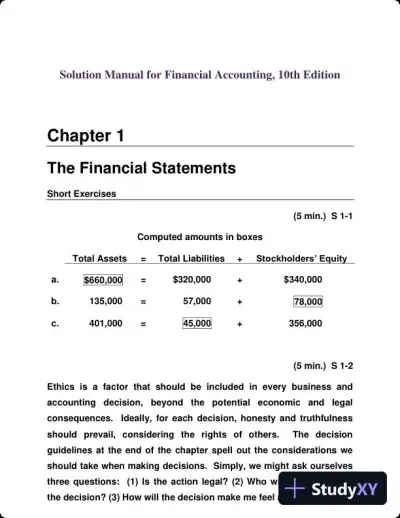 Textbook Guides
Solution Manual for Financial Accounting, 10th Edition
Physics
1061 pages107downloadsFeb 2025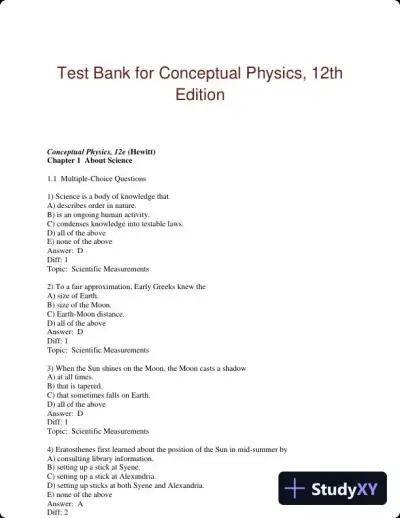 Exam Guides
Test Bank for Conceptual Physics, 12th Edition
Physics
581 pages71downloadsFeb 2025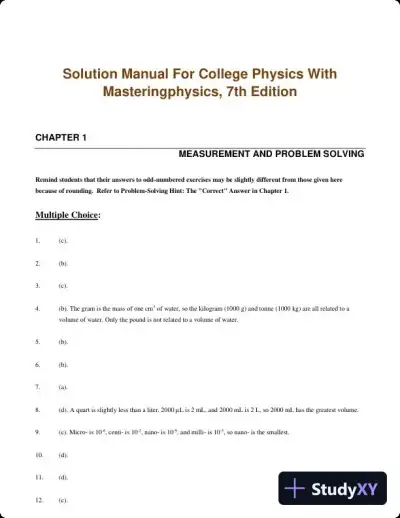 Textbook Guides
Solution Manual For College Physics With Masteringphysics, 7th Edition
Physics
536 pages37downloadsFeb 2025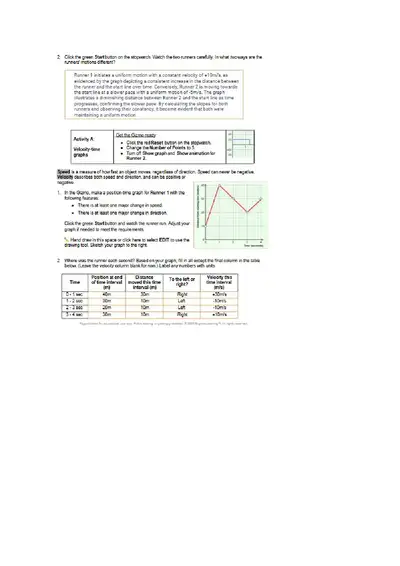 Solved Assignments
Distance Time Velocity Gizmo Handout-2
Physics
7 pagesJun 2025
Study this document with CramX
Once it is in your library, every tool can work from it.